
Video is the new glamour item of the consumer electronics industry, and this
was very positively demonstrated at the 1981 Summer Consumer Electronics Show
in Chicago, May 31 through June 3, at McCormick Place. Video products were
everywhere, in myriad manifestations, but in spite of the spotlight on video,
there were plenty of new audio products on view at McCormick Place and in satellite
hotels.
The only audio product which might be termed a "technological breakthrough" was the Sony/Philips Compact Digital Audio Disc. Sony, Philips and licensee Marantz were actually demonstrating prototype models which, needless to say, was a foretaste of the future and caused considerable excitement. The Compact Disc is 4.7 inches in diameter, is made of metallized plastic encapsulated with a plastic transparent protective scuff coating, and is thus impervious to dust, dirt, fingerprints, and scratches.
The disc rotates in a counter-clockwise direction, with the speed varying from 500 rpm on the inside of the disc (the disc is played inside out) to 200 rpm on the outside to maintain a constant linear velocity. The CD system uses pulse code modulation, with 16-bit linear en coding and a sampling rate of 44.33 kHz. A solid-state laser scans the information pits and flats at a rate of 4.3 mil lion bits per second. Theoretically, the disc can be recorded on both sides, but at present there is only 60 minutes stereo program on one side. An interesting point is that 30 minutes of four-channel playback is possible, and, with a stated channel separation of 90 dB, the signals would be very discrete indeed! The actual information density on a side of the CD is far greater than is needed for 60 minutes of music. Therefore, special purpose encoding can be employed to provide playback of individual selections in any sequence, to repeat selections, or even to display selection titles, playing time and lyrics of songs via a luminescent or LED device . or TV monitor screen. The usual digital specifications . . . 90-dB S/N and dynamic range, 20 Hz to 20 kHz frequency response, un measurable wow and flutter, etc. . . . apply to this Sony/Philips CD audio disc.
While the Digital Audio Disc committee of the EIAJ did not specifically name the Sony/Philips CD system as their unequivocal choice for a "standard." it certainly is the front-runner and has already been adopted by such companies as Bang and Olufsen, CBS/Sony, Crown, Dual, Matsushita, Nakamichi, Nippon Columbia, Onkyo, Polygram, Sony, Studer/Revox, and Kenwood. Polygram, the huge record conglomerate, is said to be setting up a plant to manufacture the Compact Discs, and CBS/ Sony is expecting to have ready a catalog of 100 CD recordings to coincide with the introduction of the CD system in Japan in the fall of 1982, with the U.S. introduction shortly thereafter. Projected price of the Sony/Philips CD player is expected to be between $400.00 and $600.00, with the discs between $9.00 and $12.00. From all this, one must conclude that by January 1983 the digital audio disc will be a reality, which, needless to say, will have a profound effect on many aspects of our industry. As I am sure you are aware. there have been numerous manufacturing problems with the laser-read videodiscs which have resulted in very high return rates.
Since the Sony/Philips system has virtually identical playback procedures, the quality control on the CD discs will have to be very stringent to keep the reject rate below one percent and ensure a viable system.
Another peek into the future of consumer electronics was provided at this SCES by the giant Matsushita Co. of Japan. Every few years. Matsushita holds a technology fair in Japan. This year they decided to schedule it in conjunction with the 1981 SCES in Chicago The massive Matsushita exhibit entitled "Matsushita Technology Today" occupied all 12,000 sq. ft of the huge Chicago Room at McCormick Place. This was in addition to the usual Panasonic. Technics, and Quasar exhibits on the main floor of McCormick Place. The special exhibit was divided into sections. each representing a particular manufacturing activity of the company. There were sections on health care electronics. featuring such advances as a bone-conduction hearing aid, and a Braille duplication system. Some absolutely fascinating new video technologies will be covered in my "VideoScenes" column. The business electronics section had such items as mobile facsimile systems and a Pana-copy automatic color-slide processor In the appliance electronics area, how about a microwave oven that "talks'. to you, acknowledging instructions! Component electronics featured microcomputer and memory devices, ICs and LSIs, sensors and opto-electronic devices. There were sections on sensory control, test instruments and production electronics, including an arc-welding robot. The audio item that attracted a great deal of attention was the SV-P100 digital-audio cassette recorder which was described in April and June 1981 issues of Audio. While it might be said that some of the exotic products in the Matsushita exhibit are some years away, there were none that should be de scribed as pure blue sky. The exhibit was certainly a revelatory experience and a tribute to Matsushita's dedication to high technology.
As you might expect, with laser digital-audio discs being demonstrated at the SCES, the doomsayers were out in full cry, proclaiming that the days of the LP record and all analog record-playing equipment were numbered. This is, of course, sheer nonsense. Even if the digital audio disc does not encounter any technical or production difficulties whatsoever, it will be years before any reasonably comprehensive catalog of soft ware exists, The analog LP record will be around for a long time, and there was plenty of new phonograph equipment offered at the SCES to underscore this point. Among audiophiles, the Linn-Sondek turntable has built up an enviable reputation for its "neutrality" and for not imparting any colorations to recordings during playback. Over the years, there have been a number of turntables, whose designer's goal was to knock the Linn from its expensive perch.
One particularly interesting design project with this goal is a joint effort between Sumiko, the importer of Grace and Supex cartridges, and SOTA Indus tries. both of Berkeley, California. Dave Fletcher, the canny head of Sumiko, is a physicist, and he teamed up with engineer Rodney Herman of SOTA, to de sign a turntable which they claim is based on Newtonian principles. Although there is one basic design on the turntable, there are two different models.
The Gem will be sold through Sumiko and it differs from SOTA's Sapphire in being equipped with either the Grace 707 Mk II tonearm or the Grace 747 Tonearm. The SOTA turntable is sold without a tonearm. Both turntables em ploy an 18-pound subassembly made of a special zinc alloy, with added lead and synthetic damping. A special four-point suspension is used with a resonance frequency of 2.55 Hz. This is combined with a 12.5-pound cast-zinc alloy base with compound damping. Some 40 percent of the weight is concentrated near the rim of the platter to provide a flywheel effect. Under the platter spindle is an inverted sapphire disc bearing, said to be accurate to one wavelength of light. The bearing is at the table's center of gravity. The sapphire disc rides on a hardened chrome-steel ball, claimed to be accurate to 1/10,000,000 of an inch. Most turntables have shafts which extend from the platter. In the SOTA design the thrust shaft remains fixed and immobile. Rotation occurs only at the center of gravity and any unbalanced forces are effectively nulled. In the Gem model, the built-in arms are factory balanced and mass-loaded to compensate for the weight of the sub-assembly and platter. In the Sapphire model, there are variable mass-loading options to adjust for the specific weight of the tonearm selected. In both models, with this approach, total mass of the entire turntable system remains constant, and this offers a combination of static balance and dynamic stability. In the SOTA model, a special belt drives the outer rim of the platter from a brushless d.c. servo motor with 33 1/3-rpm and 45-rpm speeds electronically switchable. In the Gem model, the belt drive is the same but employs a different motor with push-button selection of the two playback speeds. Rumble for these turntables is claimed to be-60 db unweighted at a reference of 10 cm/ S at 1000 Hz. The price of the Gem is $725 with the Grace 707 Mk II arm and $800.00 with the Grace 747 arm. The SOTA version of the table is $650.00.
A new Denon turntable offers an entirely different "brute force" approach to its design. The platter weighs 35 pounds, there is a 150-pound turntable chassis and base, mounted on massive springs, and the drive is direct via a huge cogless quartz-lock motor. A special arm is provided with the system. Price of this backbreaker is $5000.00.
Lux created quite a stir with its vacuum hold-down turntable at the 1980 SCES. Now they have introduced the Model PD-375 turntable, which, in contrast to the previous model, is a direct-drive unit with a built-in arm. The all-important vacuum hold-down feature is there, but this time the vacuum is established with a manual pump instead of the automatic electric system on the earlier turntable. The good news is that you can now enjoy the disc-flattening and vinyl resonance damping of the vacuum hold--down for $599.95 instead of the whop ping $2995.00 of the original model.
For many years the highly regarded British-made SME tonearms were distributed in this country by Shure Bros. I ran across Alastair Robertson-Aikman, the ever-debonair director of SME at the Show, and he informed me that after a very successful collaboration with Ortofon on a cartridge/arm interface, he had appointed Ortofon U.S.A. as sole distributor of SME products in this country.
Those who are interested in 16-inch tonearms will be glad to know that SME has introduced an updated version of its classic arm design in that length.
Speaking of tonearms, no SCES would be complete without the introduction of some really exotic design. This year's winner is probably the Souther Equamass linear-tracking tonearm. The designer, Lou Souther, has produced a unique arm which is molded from epoxy resin and incorporates millions of tiny 0.0002-inch diameter hollow-glass spheres (with a specific gravity of 0.8) and a special aluminum tube 3/32-inch diameter. The total weight of the arm is 1.25 grams! Obviously, this is less than the tracking force of many cartridges.
Then, on the back of the arm, Souther positions a counterweight, equal to the weight of the cartridge, at a distance from the horizontal pivot bearings slightly less than the arm's effective length. This enables him to set the exact tracking force for a particular cartridge. The arm is driven laterally across the record by the record groove itself, and ultra-low friction bearings are used. When this arm encounters a record warp and the stylus assembly starts its upward motion, it is met with a total mass just over twice that of the cartridge: for example, this could be 4 grams cartridge, 4 grams counterweight, and arm mass 1.25 grams for a total mass of 9.25 grams.
Souther claims there is never enough up force generated to compress the cantilever assembly, and on the down side of the warp, the arm mass is so low that little or no inertia effect is produced. The stylus tracks the grooves perfectly, with no significant changes in tracking force, Souther claims. If you strike the turntable laterally from the side, the shock can cause the counterweight to oscillate left and right as much as a quarter of an inch, yet the stylus will not leave the groove! This super tracking ability is said to provide a much cleaner, more open and highly detailed sound than can be heard from conventional arms. This intriguing arm will be priced at $500.00.
Dennesen was showing an unusual head amplifier for moving-coil cartridges called the Cetus, which is said to operate as a true differential–input transconductance amplifier, treating the moving-coil cartridge as a current source rather than a voltage source. It is said to be derived from a sensing amplifier in a computer's analog-memory system. The Cetus uses a matched pair of high-current thermally coupled transistors in its circuit. The unit is a.c. powered from a remote supply. There is a variable 2- to 120-ohms impedance-matching control, which also varies gain from 26 to 35 dB depending on the impedance. Frequency response is said to be 7 Hz to 250 kHz ±-0.01 dB. Input overload is rated at one volt and output is 10 volts. S/N ratio is listed as 85 dB and rise time is a very fast 500 nanoseconds at 2 volts output.
No price available.
Moving over to records to really give all this fancy phono gear a tough work out and a super sound source, Mobile Fidelity has introduced their UHQR (Ultra High Quality Record) series, which was developed in conjunction with JVC. It is a "spin-off" from JVC's work in video disc technology. The UHQR records weigh in at approximately 200 grams, which is a helluva thick record. Points of superiority include channel separation 10 dB better than standard Mobile Fidelity records which use JVC CD-4 super vinyl. Intermodulation distortion is reduced to the theoretical limits of vinyl.
Vinyl resonance has been removed from the audible range. S/N ratio is 10 dB better than standard Mobile Fidelity re cords. Groove depth on the UHQR can be 3 mils or more. Pressing cycle on UHQR is 2 1/2 to 3 minutes compared to 50 seconds for standard Mobile Fidelity pressings. Only one press in the world is set up for UHQR product and Mobile Fidelity has exclusive rights to its use. The first three releases in the UHQR series will be Pink Floyd's Dark Side of the Moon, Supertramp's Crime of the Century and Earl Klugh's Finger Paintings.
Only 5,000 pressings will be issued of each limited-edition title. If you really dig this music and you want these super pressings, they will set you back a rather breathtaking $40.00 each! Mobile Fidelity has stated they will not be sending out any review copies of these records. I can't tell you what these particular numbers will sound like, but I already have two UHQR discs with other program material, one a Mozart piano sonata simply stunning in its realism. There just isn't any surface noise, the frequency response goes way out, distortion is the lowest I have ever heard from a record, and volume level and dynamic range are overwhelming. An outstanding achievement, and if the oncoming digital discs mean the end of the analog LP, to paraphrase old Winnie . . . "this is their finest hour." Many more audio products from the 1981 SCES next month.
-----------
Vintage magazine ADs:
Time-Life
Great Men of Music
He created some of the world's most passionate music.

Yet he died whispering the name of a woman he had never met.
She was his patroness...his confessor...his "Beloved Friend" in an intimate 14 -year correspondence. She was the inspiration for his most romantic works. And yet he shrank from meeting her even when she invited it.
Finally, she withdrew her support from him. Yet years later, on his deathbed, he whispered her name. In gratitude? In love? In anger? The secret died with Tchaikovsky. But the passion that Nadezhda von Meck inspired lives on in some of the most soaringly romantic melody ever penned, as you will discover in TIME-LIFE RECORDS' magnificent four-stereo-record album, Tchaikovsky-your introduction to the outstanding series GREAT MEN OF MUSIC.
Here is a connoisseur's choice of Tchaikovsky's creations, recorded in finest stereo sound by artists who have no peer. You'll hear Van Cliburn's rendition of the Piano Concerto No. 1 in B Flat Minor... Jascha Heifetz and the Chicago Symphony Orchestra (conducted by Reiner) playing the Violin Concerto in D Major...the Symphony No. 6 in B Minor (Pathetique), performed by the Boston Symphony Orchestra, conducted by Monteux.
The boxed set on Tchaikovsky is only the beginning of GREAT MEN OF Music--an unparalleled collection of the world's greatest music, performed by leading artists of our time. In future albums, you will thrill to the genius of Bach, Beethoven, Mozart, Brahms, Mahler...over 20 composers. And you'll listen with new understanding because each album is enriched with a color -filled booklet on the composer, plus illuminating notes about the music.
Start by auditioning Tchaikovsky for 10 days free.
You'll receive four 12-inch LP stereo records (the kind that usually retail for $8.95 each) in an elegant slipcase, the background booklet complete with Listener's Guide, AND the $19.95 deluxe edition of The Golden Encyclopedia of Music--yours free just for purchasing Tchaikovsky and agreeing to audition future albums.
If after ten days you decide you'd like to own this $55.75 value, it's yours for only $24.95, plus shipping and handling. If, however, you are not completely delighted, return the album and encyclopedia and owe nothing. Send no money.
Just mail the attached card. Or write TIME-LIFE RECORDS, Time & Life Bldg., Chicago, IL 60611.
All orders subject to credit approval. FREE BOOK! (with purchase of Tchaikovsky album) THE GOLDEN ENCYCLOPEDIA OF MUSIC. $19.95 retail value, 720 pages, 8 1/2" x 11". More than 800 illustrations, 24 pages in full color. More than 1,000 musical examples including a separate glossary of 1,000 famous names in music.
-----------
IT DOESN'T COST ANY MORE TO OWN A BANG & OLUFSEN CARTRIDGE.
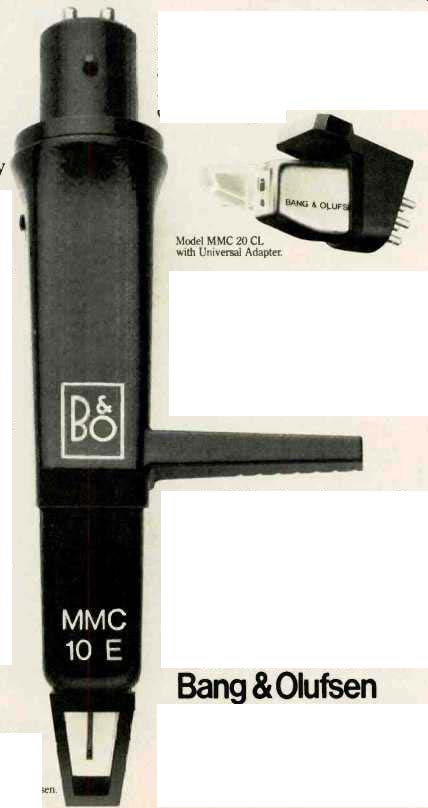
One of the most prestigious names in audio offers a remarkably affordable way to improve your stereo system.
Bang & Olufsen MMC cartridges.
Their audibly superior innovations will now fit virtually all of today's better tonearms.
MMC, Separation and Imaging.
What is MMC? It's the patented Moving Micro Cross' armature found in all five Bang & Olufsen cartridges.
This MMC keeps each channel on its own axis so you'll hear exceptionally accurate stereo separation, depth and realistic stereo imaging.
The manner in which these cartridges pinpoint the placement of individual instruments is uncanny. One audition will convince you.
Longer record life.
It's a result of our extremely low Effective Tip Mass (ETM).
How we achieve it is an engineering story in itself. But the low ETM of our stylus assemblies means much longer record life and better tracking even on "hopelessly" warped records.
A cantilever made of a solid, single crystal of sapphire.
You'll find it on the remarkable MMC-20CL. Why sapphire?
Because it has very low mass yet is 21% more rigid than beryllium and 500% more rigid than aluminum commonly used in other cartridges.
----------Model MMC 20 CL with Universal Adapter.
This rigidity virtually eliminates any distortion-causing vibration within the cantilever.
Every subtle movement of the stylus tip is translated into transparent, uncolored sound and musical detail.
Audition them for yourself.
Hear for yourself why the critics respect our MMC cartridges. Bring in your favorite records to a select audio dealer and learn how for the price of a fine cartridge ... you can own a Bang & Olufsen.
For more information, write to: Bang & Olufsen Bang & Olufsen of America, Inc. 515 Busse Road Elk Grove Village, Illinois 60007. 1. Moving Micro Cross is a registered trademark of Bang & Olufsen.
--------------------
INTRODUCING THE MOST ADVANCED AND REVOLUTIONARY AUDIO CASSETTE IN THE WORLD.
NEITHER THE HEAT OF THE DESERT, NOR THE COLD OF ALASKA, NOR THE OVEN TEMPERATURES OF A CLOSED CAR IN THE SUN, NOR FALLING ON THE FLOOR, OR GETTING SAT ON,OR BEING BAKED IN A BEACHBAG...
CAN STOP LORAN FROM DELIVERING INCREDIBLY CLEAR, ACCURATE AND BEAUTIFUL SOUN
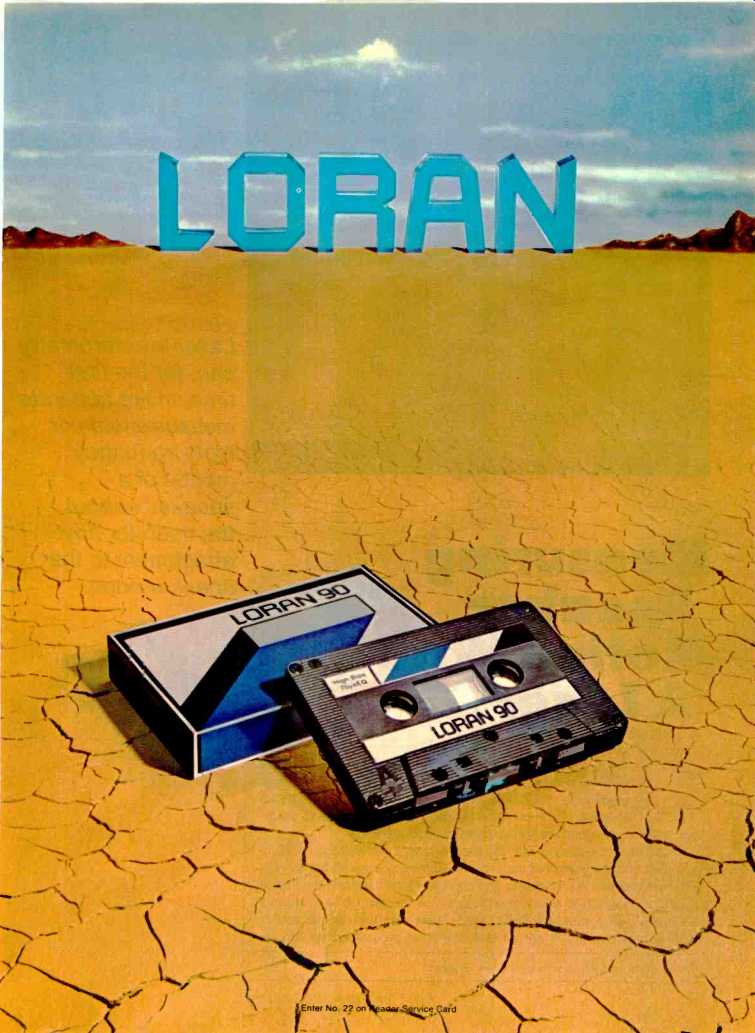
Loran' proudly introduces an extraordinary breakthrough in audio cassette technology: a cassette shell that is virtually indestructible, with tape of such superior performance that the combination redefines the limits of cassette sound reproduction.
Loran has the only cassette shell in the world made from LEXAN resin, the incredibly tough space-age material used for bulletproof vests and bank teller windows. Unlike other cassette shells, Loran stands up to extremes of heat and cold. It will not warp at 250 degrees Fahrenheit or shatter at 60 degrees below zero, and its dimensions won't change significantly even when exposed to these extremes repeatedly. You can leave Loran on an exposed car dashboard all day and still be sure of trouble free performance. Molded parts of LEXAN resin also display astonishing resistance to impact-it has 16 times the impact strength of typical cassette materials, and 4 times the strength of cast aluminum or zinc. For the many tape enthusiasts who have "lost" prized recordings because of temperature extremes in parked cars, or because of accidental falls, this feature alone makes Loran uniquely valuable.
But there is more to Loran cassette technology. Unique Safety Tabs (patent pending) provide the only wholly integrated reversible erasure prevention system available today. A 1/2 turn of the Safety Tab makes it virtually impossible to erase a recording. However, unlike all other cassettes, you can restore its erase and record capability by simply turning the Safety Tab back to its original position.
Another unique feature is the hub lock (patent pending). It offers the highest resistance to leader-tape pull-out in the tape field.
And tape-path friction is reduced by Loran's conductive polymer slip sheets and natural fur pressure pad.
Loran's unique formulations offer performance that matches the advanced technology of the Loran shell and tape guide systems. Our Chrome equivalent high bias tape is coated with separate layers of two different oxides. It offers extremely low residual noise levels (-56 dB, A weighted, relative 0 VU) and an MOL of +6 dB relative to 0 VU for 3 percent distortion.
This tape provides magnificent low-end response, in addition to the high-end response normally found in other Chrome equivalent formulations.
Loran's Metal, Ferric Oxide and Ferrichrome tapes also deliver improved and out-
standing performance levels over the entire spectrum of characteristics associated with these formulations.
Loran...the most advanced cassette in the world with unique innovations in shell construction, tape guidance mechanisms and state-of-the-art tape formulations.
Destined to become a leader. We invite you to share in the excitement.
Listen to Loran
Loran Audio Cassettes have been selected by the Consumer Electronics Show Design and Engineering Exhibition as "one of the most innovative consumer electronics products of 1981."
-------------------
SME
MODEL 3012-R
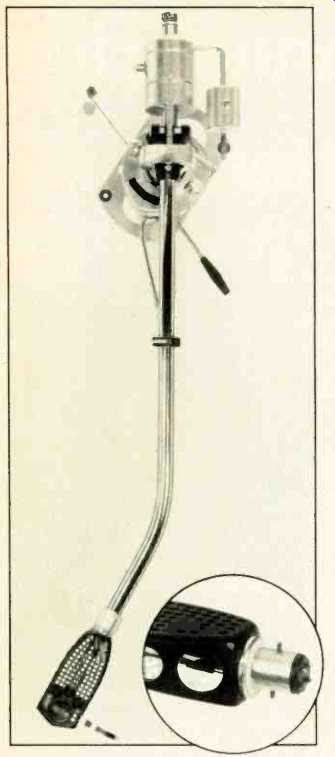
Manufacture of the Model 3012 Series 11 12"(16" US nomenclature) precision pick up arm ended in 1972. In response to many requests to re-introduce it for professional and hi-fi applications we have produced the Model 3012-R. It is basically similar to its classic predecessor but with important refinements including:
Thin walled stainless steel tone-arm.
New design lateral balance system.
Extra rigid low mass shell with double draw-in pins.
Fine adjustment longitudinal and lateral balance for cartridges weighing from 1½-26 grams or plug-in heads up to 33 1/2 grams.
Geometry optimized for 12" records.
Distortion caused by lateral tracking error is at least 25% less than is possible with a 9" arm and its effective mass of 14 grams makes is particularly suitable for the many medium and low compliance cartridges now on the market.
The S2-R shell supplied with it is another SME 'first' in heavy gauge aluminum with pin-up and pin-down bayonet for positive locking. The sockets of all SME arms employing detachable shells are double slotted and therefore compatible with this design.
Full details will be sent on request.
Write to Dept 1464 SME Limited, Steyning, Sussex, BN4 3GY, England
------------------
Pickering
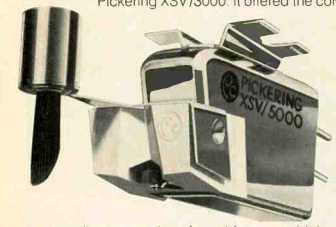
The best for both worlds.
The culmination of 30 years of Audio Engineering leadership-the new Stereohedron
XSV/5000
One of the most dramatic developments of cartridge performance was the introduction of the Pickering XSV/3000. It offered the consumer a first 'generation of cartridges, combining both high tracking ability and superb frequency response. It utilized a new concept in stylus design
---Stereohedron, coupled with an exotic samarium cobalt moving magnet.
Now Pickering offers a top-of-the-line Stereohedron cartridge, the XSV /5000.
combining features of both the XSV /3000 and the XSV /4000.
It allows a frequency response out to 50,000 Hz.
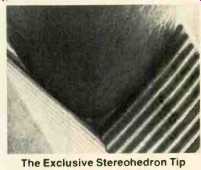
---------The Exclusive Stereohedron Tip
The new XSV samarium cobalt magnet accounts for an extremely high output with the smallest effective tip mass. The Stereohedron tip design is the result of long research in extended frequency response for tracing of high frequency modulations. The patented Dustamatic brush and stylus work hand in hand with the rest of the cartridge assembly to reproduce with superb fidelity all frequencies contained in today's recordings.
Pickering is proud to offer the XSV /5000 as the best effort yet in over 30 years of cartridge development.
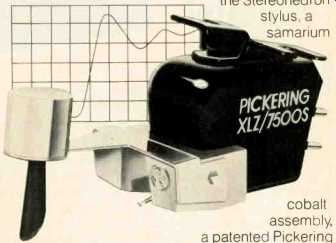
A fresh new breakthrough in cartridge development designed specifically as an answer for the low impedance moving coil cartridge-XLZ/7500S
The advantages of the XLZ/7500S are that it offers characteristics exceeding even the best of moving coil cartridges. Features such as an openness of sound and extremely fast risetime, less than 10µ seconds, to provide a new crispness in sound reproduction. At the same time, the XLZ/7500S provides these features without any of the disadvantages of ringing, undesirable spurious harmonics which are often characterizations of moving coil pickups.
The above advantages provide a new sound experience while utilizing the proven advantages of the Stereohedron stylus, a samarium
cobalt assembly, a patented Pickering Dustamatic brush, with replaceable stylus, along with low dynamic tip mass with very high compliance for superb tracking.
So, for those who prefer the sound characteristics attributed to moving coil cartridges, but insist on the reliability, stability and convenience of moving magnet design, Pickering presents its XLZ/7500S.
THE SOURCE OF PERFECTION ... from Pickering
-----------
(Adapted from: Audio magazine, Sept. 1981; Bert Whyte )
= = = =