By BERT WHYTE
The 1981 Summer Consumer Electronics Show, in common with its predecessors, displayed such a vast, all-encompassing array of audio components that complete coverage of them is simply impossible. Even if such a heroic undertaking could be accomplished, space limitations would preclude a truly comprehensive survey.
Thus, as usual, it is necessary to be ruthlessly selective in choosing the components to be covered. Without further preamble, herewith Part Two of my 1981 SCES report.

The new Dolby C-type noise-reduction system was introduced at the WCES in Las Vegas. Evidently, the C-type, which affords 20 dB of noise reduction, has aroused great interest among cassette deck manufacturers, since in a scant six months time, more than 30 cassette decks featuring Dolby C-type noise reduction were shown at the SCES. Such models were introduced by Aiwa, Dual, Hitachi, JVC, Marantz, Mitsubishi, NAD, Nakamichi, Onkyo, Pioneer, H.H. Scott, Sony, and Vector Research. Several companies are developing dedicated integrated-circuit chips for Dolby C-type noise reduction, so that by the WCES in January, there should be many more cassette decks equipped with this new system. Most of the cassette decks incorporating Dolby C-type were in the mid- to upper-price ranges.
Nakamichi, Rotel, and Sony also showed add-on outboard Dolby C-type noise-reduction units. Of considerable interest to prospective owners of Dolby C cassette decks is the fact that prerecorded Dolby C cassettes appear to be in the offing. In collaboration with Capitol Records, cassettes were duplicated on Gauss machines at ratios up to 64 to 1.
Both pop and classical selections of wide dynamic range and containing high-level, high-frequency energy were used, with excellent results reported.
With the C-type encoding, the noise level of the cassettes was said to be close to that of the original Dolby A masters. Another development that could further improve prerecorded Dolby C--type cassettes was the introduction by Bang and Olufsen of what they call the B&O/Dolby HX Professional Bias System. HX Professional offers a significant improvement in high-level, high-frequency headroom, as much as 7 dB at 10 kHz. Essentially this means that regular ferric tapes recorded with the HX Professional system will afford the same performance as normally recorded metal tapes. HX Professional utilizes dynamic biasing but, unlike the Dolby HX, does not vary record equalization. Further, HX Professional operates independently of any noise reduction system, and another plus is that stereo channels are treated separately. This system would be invaluable to commercial cassette duplicators, where combined with Dolby C noise reduction should give us superlative cassettes of truly high fidelity. In a unique "switch," Dolby Labs has licensed the B&O HX Professional system for professional applications, while B&O has incorporated the system into its new Beocord 8002 cassette deck, but for the present will keep the system for its exclusive use in the consumer field. More about the HX Professional system and the new Beocord 8002 at a later time.
The dbx noise-reduction system found a formidable ally in Technics, who introduced their Model RS-M240X and Model RS-M270X cassette decks, both of which incorporate dbx encode/decode circuitry (including facilities to ,decode dbx discs) and are said to afford a dynamic range of 110 dB with CrO2 tape. The first dbx prerecorded cassettes are on the market and have created quite a stir with their total lack of tape hiss and ultra-wide dynamic range. My recordings of Virgil Fox's organ and Arthur Fiedler and the Boston Pops have been very well received in this format.
As a result of a co-operative research effort by Akai, Teac, Maxell, and TDK, we have that rarity ... a new development in open-reel tape-deck technology.
TDK and Maxell have in essence taken cobalt-modified ferric oxide, high-density cassette tape formulations and adapted it to open-reel use. Akai calls the new tape "EE" for "extra efficiency." This new EE tape has nearly double the coercivity of conventional tape as well as higher MOL. When compared to present high-performance tapes, magnetic flux density is 1 1/2 times greater. Recording bias is 30 percent greater than conventional tapes. The nature of this EE tape is such that lower time constants can be used in the equalizer, and signal-to-noise ratio is considerably improved. I have not seen the Teac decks, but Akai developed two new decks to take advantage of this new tape, and each has an EE position on its tape selector switch for proper bias and EQ. The Akai GX-77 accepts up to 7-inch reels and features six magnetic heads, permitting reverse record and playback. The Akai GX-747 has the same features, can accept up to 10 1/2-inch reels, and has other operational features and refinements. The rationale behind these new decks and the new EE tape is that performance at 3 3/4 ips is equal to what is usually available at the higher 7 1/2-ips speed, while the 7 ½ ips speed enables performance that was heretofore possible only at 15 ips. For example, frequency response at 3 3/4 ips is 25 to 25,000 Hz ± 3 dB, while 7 1/2 ips affords 25 to 33,000 Hz ± 3 dB. Thus, while the new EE tape will cost a bit more than present premium open-reel tapes of equal length, the performance values will actually result in a saving, since slower speeds can be used.
Every SCES brings forth new designs in exotic preamps and amplifiers. This time around there were a number of units that would quicken the pulse of even the most jaded audiophile. For example, Bedini is a company that specializes in Class-A amplifiers. They have models ranging from 25 watts per channel to a 200-watt-per-channel behemoth. John Bedini demonstrated his newest amplifier, The Phase Three, nicknamed the "One Meg" since this wide-band design extends from 5 Hz to 1 megahertz. Power output was 25 watts per channel into 8 ohms. The amplifier can drive speaker loads down to 1 1/2 ohms and is claimed to be completely stable with inductive, reactive or resistive loads.
The "One Meg" is also said to have very high current-output capability. John had it hooked up to a pair of the new Acoustat Monitor Four electrostatic speakers and he was playing Sheffield's Amanda McBroom "Growing Up in Hollywood Town" recording. The sound quality was quite outstanding and, in fact, was the best I have ever heard from these speakers--pristine, clean, open, transparent, with razor-sharp transient response, and solid, well defined bass. Although the room was on the small side, the sound level was surprisingly high and, with the projection of bass, appeared to verify the claim of high current output. Price is $1995.
To Denon must go plaudits for one of the most strikingly beautiful power amplifiers I have ever seen. In fact the Denon POA-8000 did win an award from the CES Design Committee. A mono amplifier rated at 200 watts per channel, it employs a circuit with no negative feedback and is said to operate as a true Class-A amplifier. Price is $2300. Still another 200-watt-per-channel, Class-A amplifier was shown by the Krell Company. Each channel is actually a separate mono amplifier. Each has a 1.8-k VA power transformer, with 250,000 microfarads of capacitors.
Each amplifier is fan cooled in addition to having massive heat sinks. Price is $5500, the pair.
David Hafler's DH-500 power amplifier may not come under the "exotic" heading, but come to think of it, there are very few power MOS-FET amplifiers around rated at 255 watts per channel into 8 ohms. In any case, the DH-500 is now in full production. Considering its very clean sound, gobs of reserve power and high current output, plus a 2.5-microsecond rise time and 45 volt per microsecond slew rate which translate into excellent transient response, it gets a "best buy" rating at its assembled price of $799.
If you have lusted for Levinson amplifiers and preamps, but have not had the wherewithal to satisfy those urges, take heart, because Mark Levinson was showing his new ML-9 stereo power amplifier and ML-10 preamplifier. The ML-9 is essentially about half the size, power, and price of the Levinson 200 watt per channel ML-3. The ML-9 is rated at 100 watts per channel into 8 ohms from 20 Hz to 20 kHz with less than 0.2 percent THD. The power supply is in keeping with the design embodied in the ML-3. A toroidal transformer of 1 .2kVA is used, along with a pair of 36,000 microfarad capacitors, which affords a huge energy storage in excess of 230 Joules. The audio circuitry of the ML-9 and ML-3 are similar, with push-pull operation maintained from input to output. The ML-3 is noted for its high current output, and the ML-9 has this characteristic as well, being on the order of 20 amperes per channel. Each channel of the ML-9 has a three-position toggle switch to vary the damping factor in accordance with loudspeaker requirements. The ML-9 is available now, and the price is $2350. The ML-10 preamplifier has many of the same characteristics as the Levinson ML-7 preamplifier, but is a simpler, somewhat less flexible design. For example, the power supply is integrated into the preamplifier chassis, rather than the separate power supply used in the ML-7. Where as the ML-7 is modular in construction, the ML-10 is a hard-wired unit. Instead of interchangeable phono modules for moving-magnet and moving-coil cartridges, the ML-10 uses switchable gain stages. Proper loading of virtually any phono cartridge is accomplished via internal switches. Balance switches are provided, along with full monitoring for one tape recorder, and there are inputs for tuner and auxiliary. The ML-10 will be on the market by early September and will also be priced at $2350. The ML-9 and ML-10 might be considered "junior" versions of the current ML-3 and ML-7 units as there is less power and less flexibility, but this is not at the expense of quality. From what I could see, these new models were constructed of the same quality materials and with the same meticulous fabrication that have been the hallmark of this company's products.
By way of a specialized product is Janis Audio's new Interface Amplifier and Crossover Network IA Mark Two, for use with Janis and other sub-woofers.
Output power has been increased to 90 watts per channel, and there are switchable 18(Sr 36-dB-per-octave crossover slopes. An invaluable refinement is a switch which interchanges speaker connections to determine whether playback is in relative or absolute phase. The system will be available in early fall; price is not yet finalized.
At a time when it appears that FM tuner design had reached a pretty high level of sophistication, along comes Bob Carver with his new TX-11 AM/FM tuner. With newly developed circuitry that affords a substantial improvement in signal-to-noise ratio and virtually eliminates multipath distortion, his tuner created quite a stir during demonstrations at the Americana Congress Hotel. Carver calls his new circuit "Asymmetrical Charge-Coupled FM Detector" and says that the improvements it effects in S/N ratio and multipath distortion are not at the expense of stereo separation or frequency bandwidth. In addition to this circuit, he has developed another circuit which is said to prevent FM front-end overload. The TX-11 can accept 9 volts at the antenna terminals. Carver isn't at present divulging how his new circuitry works but it did indeed work. Using both closed-circuit transmission and an antenna system, Bob conclusively demonstrated that when he activated his circuit, stations which a moment before had been full of hiss and distortion were cleaned up to an amazing degree. Hiss, noise, and distortion were either greatly attenuated or completely eliminated.
Some eyebrow-raising specs on this TX-11 tuner are a 50-dB quieting sensitivity in stereo of 3.5 microvolts, a signal-to-noise ratio (at 65 dBF) in stereo of 100 dB, and separation of 60 dB at 400 Hz and 52 dB from 50 Hz to 10 kHz. Now if we could only get some nice live broadcasts of a symphony orchestra, a tuner like this would be a joy to use! The Carver TX-11 tuner is scheduled for delivery in early fall with a price somewhere between $500 to $600. For almost 25 years, the Quad electrostatic loudspeaker has been a favorite of many music lovers. They liked it for its smooth, transparent sound, and most especially for its unparalleled transient response. The design has remained virtually unchanged over all these years, even though many people would have.
liked amelioration of some of the problems with this speaker. It could be easily overdriven with resultant arcing of the diaphragm. Because of this, dynamic range was fairly limited. Bass response was marginal, with fast roll-off below 50 Hz, and the speaker was subject to severe beaming with good stereo listening localized to one sweet spot. In spite of this, it had many quite seductive qualities, so many that the speaker developed into something of a cult object.
Now, there is a new Quad electrostatic loudspeaker, the Quad ESL-63 which was introduced at the SCES. Ensconced in a large suite in the Drake Hotel, it played to throngs of eager devotees.
The old Quad was wider than it was high. The new ESL-63 is higher than it is wide, at 92.5 cm by 66 cm, with a depth of 27 cm at the base. Quad describes their speaker thusly, "it consists of a diaphragm suspended between two sets of concentric annular electrodes. Signal is fed to the electrodes via sequential delay lines and the diaphragm motion produces a sound pressure pattern which is an exact replica of that from an ideal source placed some 30 cm behind the plane of the diaphragm. The ESL-63 is a totally homogeneous sound source, phase true and very aperiodic." The speaker has one protection circuit to limit maximum input voltage and another which detects fault conditions and instantaneously shorts the signal being fed to the loudspeaker. Quad claims it is impossible to damage the loudspeaker elements. Unlike the older Quad, the ESL-63 presents a largely resistive 8-ohm load to the amplifier. Amplifiers up to 190 watts can be used with this speaker. What did the new Quad ESL-63 sound like? I'll have to reserve judgment on this point. Certainly the potential is there ... response was very clean, smooth, and as expected superb transient response. However, I was only able to hear three short selections, which were not particularly demanding, and playback was at a low level, which didn't tell me much about its bass response or dynamic range capabilities. The Quad ESL-63 appears to have considerably more bass extension and higher output than its predecessor so that when I get a chance to audition the speakers in my own listening environment, I expect I'll hear some very good sound. In the meanwhile, I'm sure Quad can sell all they can make, even at $3300 the pair. Deliveries are slated to begin in August. As usual, many more items to report on than space permits, especially on speakers. Perhaps I can slip a few mentions in here and there in upcoming columns.
-----------
(Adapted from: Audio magazine, oct. 1981; Bert Whyte )
+++++++++++++
ADs:
------------
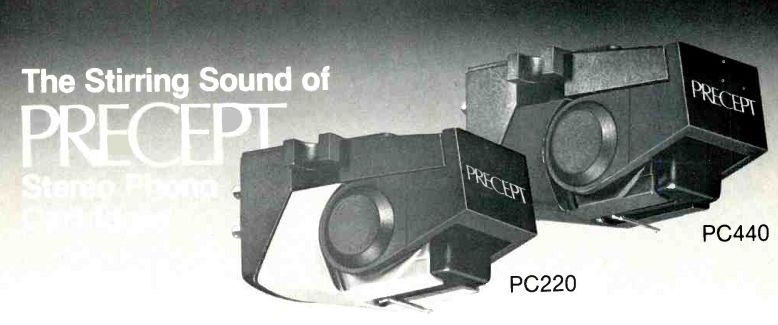
You've heard it so often ... just as the music reaches its peak, the phono cartridge simply gives up. But not Precept. Bring on your thundering climax...whether it's the heaviest rock music or the full majesty of a symphony orchestra. Precept cartridges reproduce it all with clarity, definition, and full dynamic range.
Or challenge Precept with the softest, most subtle solo. The sound will delight you with its honesty and accuracy.
Behind this soul-satisfying performance lies a tradition of engineering leadership and excellence.
You may not be aware of our dual magnets, square-shank nude styli, exceptionally low moving mass, or even our uniform 360° radial damping.
But each of these features contributes to music which is heard undistorted and unchanged from the intent of the artist.
Yet stirring sound is but one of the important benefits of a Precept cartridge. In addition, every record is treated safely and gently for longest record and stylus life.
There's a Precept model to fit every popular turntable and record player
of today. Without fuss or bother, because
we believe it should be easy to get the most from your record collection.
Precept makes good sense and great music. Precept cartridges may be
found at the most progressive audio store in your city. Precept Division,
A.T.U.S., Inc., 1221 Commerce Drive, Stow, Ohio 44224. Dept. 101A.
PRECEPT
------------
Denon
1939...FIRST DIRECT-DRIVE TURNTABLE SYSTEM. 1951...FIRST MOVING-COIL CARTRIDGE. 1972 ... FIRST DIGITAL (PCM) RECORDING.
----------Denon was founded 71 years ago, making it among the oldest extant companies in the audio industry. Thirty years ago, Denon first entered the professional recording field, and today it is the prime supplier to organizations like the NHK, Japan's equivalent to the British BBC. Devon's professional products range from blank tape to 24-track recording consoles to fully automated radio stations; their accomplishments include the development of PCM (digital recording), one of the most significant advancements in the history of recorded sound.
In the U.S. Denon is known primarily by those in the know. In Japan, the land where electronics is king, Denon is king of the land.
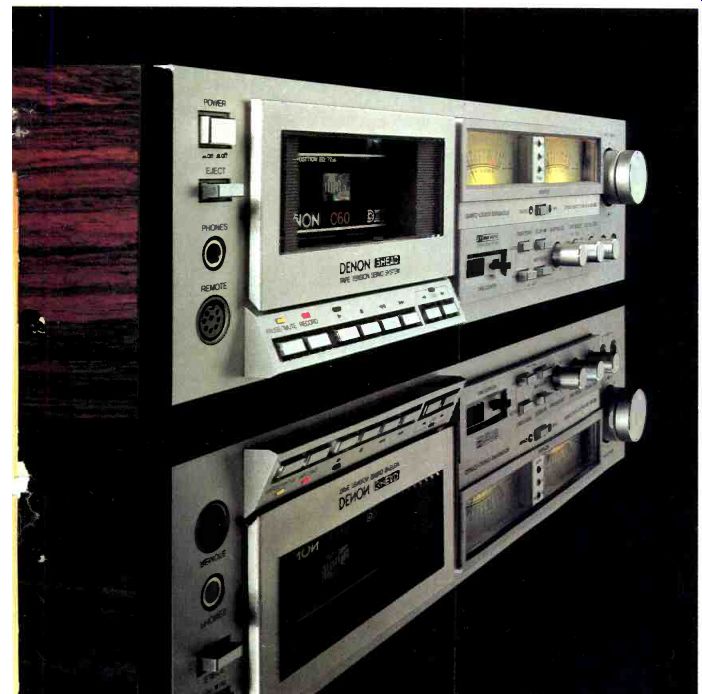
1981...THE DENON DR-330 AND DR-320 SERVO-TENSIONER THREE-HEAD CASSETTE DECKS.
Many manufacturers would lead you to believe that three heads alone can transform a cassette deck. Denon's experience with professional studio tape-recorders proved that lack of uniform tape-to-head contact and proper transport stability, can create serious phase problems-especially in the high frequencies whether the recorder has three heads or two To solve this problem, Denon developed a unique Tape Tension Servo Sensor, a system that maintains uniform tape-to-head contact during record and playback. In addition, Denon originated the Non-Slip Reel Drive mechanism (without clutches) which provides the extremely stable tape movement and prolongs the deck's life.
With the development of the Tape Tension Serve Sensor and Non-Slip Reel Drive, Denon has realized the full potential of the three-head configuration.
The Denon DR-320 and DR-330. Two important contributions to better sound reproduction, from the company where innovation is a tradition.
DENON Imagine what we'll do next.

Denon America. Inc 27 Law Drive. Fairfield. N.J. 07006
-------------------
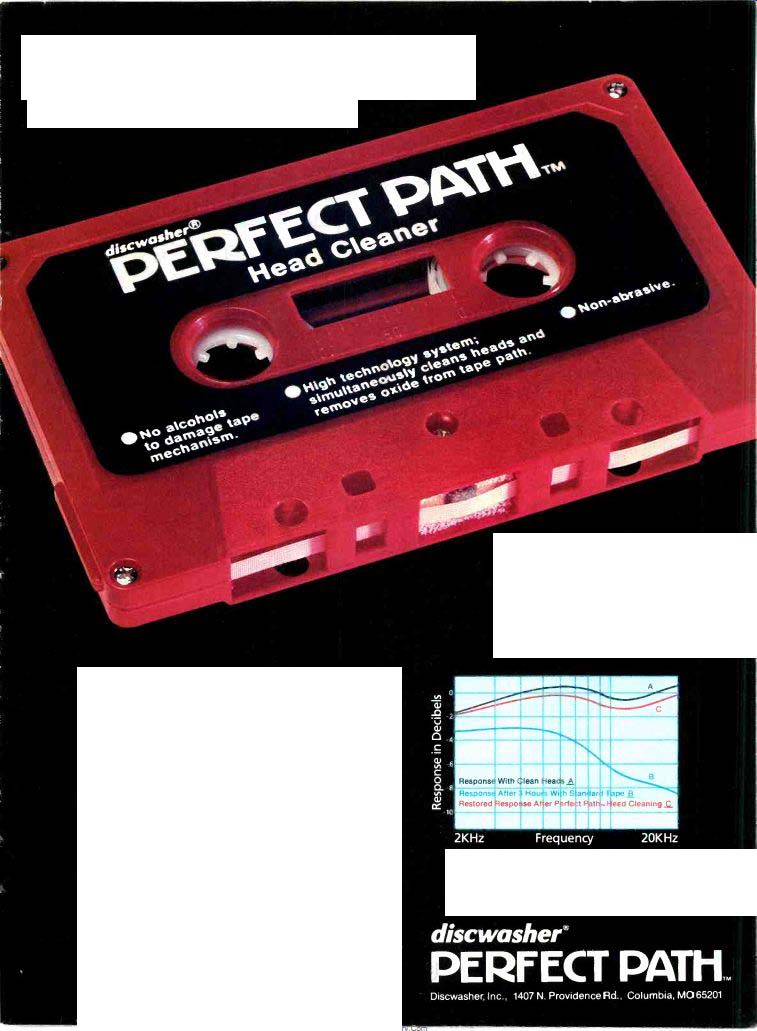
The First Discwasher Tape Accessory
---------Special non-abrasive clearing fibers are backed with an exclusive "capture surface" designed to trap tiny particles of tape residue, preventing them from contaminating tape mechinisms.
The Perfect Path Difference:
"Cleaning contact" is made along the total tape path including guides and heads, normally untouched by wiper cleaners.
Perfect Path cleans without alcohol or freon. It will not extract and age pinch rollers.
Perfect Path simultaneously cleans tape heads while removing debris from along the tape path.
Perfect Path's cleaning fiber grid is non-abrasive. Even after hundreds of passes, it will not scratch heads.
Perfect Path restores high frequency "air" and transient response of cassette recordings.
Playback accuracy of a calibrated tape. Note that after only three hours' play, high frequency response is reduced by as much as 10 dB. One cleaning with the Perfect Path Head Cleaner restores the highs to within 1 dB of the original response.
PERFECT PATHT. Discwasher, Inc., 1407 N. Providence Rd., Columbia, MO 65201
= = = =