by Martin Clifford
We all like to go to concerts and sit in the fifth row center, but it's too bad there are only a few seats which meet that requirement. Whether it's an opera, a classical concert, or a rock or jazz performance, some places in the house just plain sound better than others. Oddly, however, one of the best places for sound is your own living room.
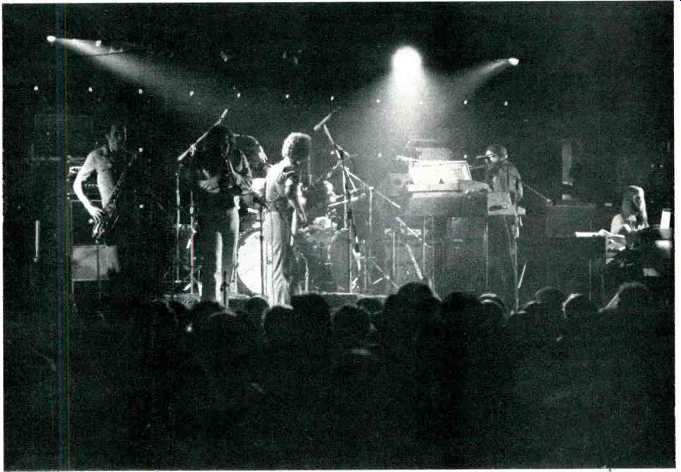
Bringing live performances into your living room has been the desire of radio stations since their inception.
AM radio began with one carbon microphone placed in front of a singer or an orchestra, and sound was carried back to the radio station and on to the transmitter by a single telephone line, which had a frequency response to about 5 kHz. In the 1920s and 30s this was an enormous step forward. With the proliferation of FM broadcast in the 60s, this one microphone and one telephone line system was dramatically improved, and the FM transmission medium with a 15-kHz bandwidth was a giant step ahead of AM in quality. Next came FM stereo with two or more microphones, two telephone lines, and a stereophonic transmission system which works magnificently. And now in the 70s we are going back to live radio, but now with quadraphonic sound.
Experiments in listening have shown that in order to create a truly lifelike sound field, more than two speakers are required in the playback area. What the optimum number is has yet to be agreed upon, but four seems to do a very meaningful job of reproducing the original sound. How then do today's live concerts get into your home? The ultimate experience, of course, is to receive these live programs in your living room at exactly the same time they are being performed on stage. The first step towards achieving this is to get a network of FM stations across the United States. A major step forward came when the Lincoln Center for the Performing Arts set up a network of FM and TV stations to simulcast live performances from the Center. The audio channels in this case were carried, in part, by two wideband satellite FM stations, yielding a signal-to-noise ratio in the transmission from New York to Los Angeles of almost 70 dB. Certainly this was the right direction for getting live, real-time, high-quality high fidelity into the living room.
With this two-channel transmission facility established, matrix four-channel experiments to yield real-time, four-channel programming were established. The British Broadcasting Corporation, for example, has a stereo distribution system for their VHF service throughout the United Kingdom. This uses an analog-to-digital technique and is carried along the BBC video network lines and dropped off at each FM station. It is therefore possible, and in fact happens, that when BBC broadcasts a live stereo and quadraphonic transmission from Royal Albert Hall in London, it is received in real-time in living rooms throughout Eng and, Scotland, Ireland and Wales.
Syndication
The United States, in general, has been somewhat behind Europe in network stereo transmission development, although many experiments are currently going on over existing television coaxial lines. Certainly such a system is possible, and if enough audience pressure is put upon the networks for live programming in real time, it will become a reality. Again, once you have established a network for the two-channel transmission system, you can also have four-channel broadcasts.
With AM stereo on the horizon, the increase in pressure for stereophonic and quadraphonic programming will not only come from the FM stations, but also from AM broadcasters. This may be the catalyst to bring these live quadraphonic shows to living room reality within the next few years.
A couple of good examples of live tape syndication are the Boston Symphony Orchestra recorded at Tanglewood, Mass., and the Agora Jazz Show recorded at the Agora Ballroom in Cleveland, Ohio. The contrast in production and miking techniques for the two programs bring out a lot of the "how to" in four-channel recording.
The Boston Symphony production is handled by Richard Kaye of WCRB in Boston, who is Manager of the Boston Symphony Transcription Trust.
The Orchestra, which has been syndicated for over six years, is carried by 130 radio stations both here and abroad, including Canada, Mexico, Britain, and Australia. The control room at the shed in Tanglewood contains mixing, encoding, and recording equipment specifically designed for four-channel production. The console takes up to 12 microphones and mixes down to four master buses.
The outputs of these buses are passed through the four-channel encoder and are then recorded on an Ampex AG-440 two-track machine. Since the productions are QS quadraphonically encoded, only a two-channel recording medium is required. In addition, a four-track, half-inch Tascam recorder is used to make the master four-channel tape. Revox and Otari two-track machines record back-up copies.
Recording Methods
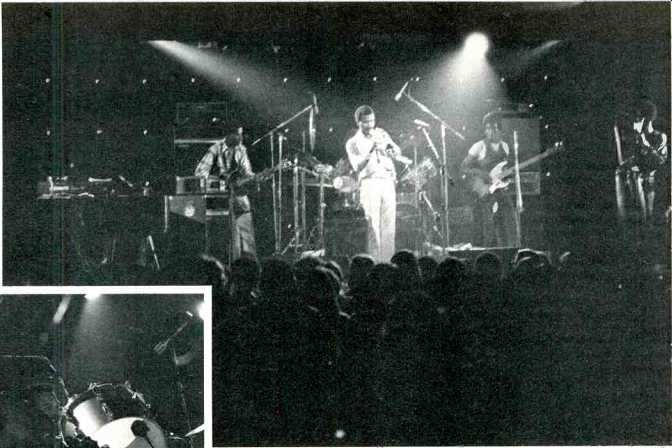
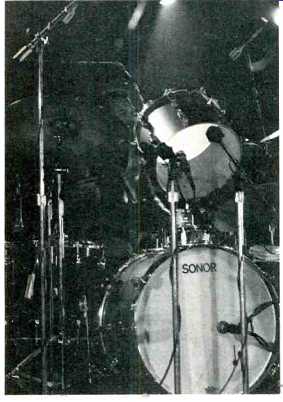
When recording classical music, a minimum of gimmickry in four-channel technique is desirable. According to Mr. Kaye, "We really record the orchestra using basically four microphones. The four are all non-directional Neuman KM-73s. The front mikes are placed on either side of the stage, and the two rear mikes, which pick up the ambience, are placed higher than the front mikes, basically in a trapezoid arrangement. Occasionally, we use a fifth mike for the woodwind section or for a solo, but we never use any solo mikes on the pianos. We don't use any artificial re verb or time delay, but rely on the natural sounds to give us life-like production. In other words, we deliver the natural hall sound exactly as you would hear it if you were sitting in the fifth row, center." When recording and encoding a jazz show such as "Live at the Agora," which runs on over 40 stations in the United States, producer Denny Martin feels that more latitude can be taken in a four-channel mix. The Agora Club is located beneath Agency Recording Studios, which is a 16-track studio facility. A full compliment of 20 or more mikes, both directional and non-directional, appear on the stage, and their output is mixed down for the 16-track Ampex which produces the master tape. The recording tracks not only include close miked instrumentals and vocals, but there are also ambience mikes hung about the room to get crowd noise for the live sound.
In the mixing process, a lot of quadraphonic panning and placement takes place. Says Martin, "With musicians such as Mike Urbaniak, we can take a lot of liberties in placing parts of the band on the side walls and even behind. We use four quadraphonic pan pots in the mix, and sometimes make things move all around the audience, while at other times we even have various sounds moving in different directions at the same time to create very interesting effects." Quadraphonic Mix "We mix the 16-tracks down through the QS encoder and make a two-channel running master. From there, we carefully duplicate on Scotch 207 and send it out to stations carrying the show. The comments we have gotten," says Denny Martin, "are coming from stations all over the country. Many of them comment that this is one of the most live sounding concerts they have ever heard and the living room experience seems to be even better than the live experience." Radio stations and listeners both appear anxious to get more quadraphonic programming on the air.
Shows in QS and SQ such as: "King Biscuit Flower Hour," "Live from the BBC," "The Chicago Symphony," "The Boston Pops," "Rock Around the World," in addition to local four channel productions by individual stations, continue to give the four channel listener lots of live listening for his living room.
(Source: Audio magazine.)
Also see: Three Car Components TESTED (July 1977)
= = = =