by Edward Tatnall Canby
My audio life history seems to get slower; I meant to be back sooner but, at least, later is better than less, if you follow my dangling comparatives. You'll find Chapters I and II of the saga in our January and May issues. Herewith Chapter III.
I left you, I trust happily, on the middle of a moonlit lake listening (by proxy, courtesy of this magazine) from a motionless canoe to an early Canby phonograph concert as the sound of 78-rpm mono shellac discs spread out magically from a boathouse balcony. I looked again at that balcony a few weeks ago. It is basically unchanged, as is the lake, but now the sounds of thumping disco come forth loudly via the teen age swimming crowd. Volume may be up 70 dB or so but the effect is no better than mine was, emanating out of an early electric radio-phono console with one small speaker and a five-ounce horseshoe magnet in the pick up to keep the needle from jumping grooves. (So we thought, anyhow.) Hi-fi, mind you, is great. I've been for it all my life. But the fi is not all. Which is my life message, if you wish.
Yes, there is the reproducing fi, slightly improved since that day, and which now serves as the raison d'etre for this magazine. And there is the fi of the recording process, about which we have heard a great deal lately as we have progressed from direct-to-disc to digital-audiophile, and as we await the all-digital sound of our future. But there are other equally vital matters.
Recording technique (or broadcast pickup--related, needless to say, but always different). And, still more important from my point of view, playback technique. So we are back to that moonlit lake.
Had you ever thought that a sheet of still water, a few smooth ripples here and there (sine waves?), over topped by a warm body of very still air, makes for excellent playback? Quite free of standing waves and spurious resonances of all sorts, the sound gently diffused, perhaps even with an ultra-smooth sonic delay due to thou sands of trees and millions of leaves around the nearby shore? Now that's the kind of environment we need to make the most of our audio sound, though to be sure, there are other ways of getting results. I hear that Chicago's been trying an outdoor sonic listening space via batteries of delayed-sound speakers set up around the perimeter, no doubt at consider able expense. Well, I had you beat, Chicago, almost a half century ago.
Trees are cheap and leaves are cheaper, at least in summer. Though I do like the idea of the Chicago experiment.
An outdoor phantom concert hall! But then, put yourself in that canoe....
Of course if Chicago had a lake navigable via canoe (and no wind in the Windy City), there wouldn't be enough canoes to go around, though the water be covered solid from shore to shore. So they have to resort to less favorable and more costly expedients.
You know, I did get involved in the fi of things, even so. Don't imagine that I remained satisfied with a mere radio-phono console. An important step came when, still in console days, I was in my fifth year of college, getting an M.A. in music which, miraculously, I still have. It was 1934. That fall, a gaudy mail-order catalogue reached my college mailbox and neatly trapped me. "Buy this super-incredible 16-tube ultra-radio by mail at a fraction of retail cost!"
Wow--SIXTEEN tubes! That was like a 16-cylinder Cadillac, also by odd co incidence an actuality of that vintage, if I remember correctly.
I forewent the Cadillac but I fell for the radio. It had 29 shortwave bands and at least eight sets of colored lights, just like to day, only not LED or whatever. It was terrific, in fact. Some of you ancient warriors will remember the breed: A Midwest Radio. I got Europe every night and listened, fascinated. Sixteen tubes! Well, I can tell you now that four of them were joint power-output tubes in parallel--this was just before the potent beam-power tubes appeared, the 6L6 in glass, for instance, together with the push-pull circuitry in which those later tubes were usually used. At least I had a lot of output, for that day, and I used it fully, just as soon as I had hooked up my separate-unit record player, the RCA with the horseshoe magnet and the two speeds--78 and 33 for "LP," the RCA Program Transcription discs.
(Playback-equipment specs: Wow, some; flutter, appalling. Pianos sounded like guitars.) You see, I was already edging into separate components, ahead of most Wright Decoster model, dynamic with electromagnet, of course. PM (permanent magnet) speakers, though on the market by that time, were weak things without much power handling capacity; the idea was good but the magnets were still feeble With the huge electromagnet, out of a transformer that fed some 400 filtered volts, the thing was so amazingly better than anything I had ever before heard that I went around for days in a delirium of joy and practically never turned the ma chine off.-hat speaker served me for six years and more before the competition began to catch up and, as we shall people I knew. The idea of a big con sole radio with a separately attached player for my records was terrific and with the Midwest put me far ahead of the local competition in terms of sound--both quality and volume. My Midwest, as a phonograph, was the sensation of my college area. As al ready noted, I played whole evenings of music for my college friends, who flocked to hear the splendid machine with its special extra-cost speaker.
I fell further, you see, for that superb option. It cost me $15 more (read $75 today) but it was worth every mega-dollar. It was a heavy-duty 12-inch see, it survived the demise of the famed 16-tube radio to become the speaker department of my first genuine hi-fi system with separate amp.
Better Bass for Better Living...
Through Physics But there was an intermediate stage.
After about two years, when I had moved on to my first job in another college, I got the bright idea of taking that speaker out of the Midwest con sole cabinet and mounting it separately on its own. What a sensational improvement! No--it wasn't really my idea. As usual, I fell for something that seemed to be in the air at the time, via friends who kept telling me what I ought to do. The thing was to get your speaker into its own baffle. Out of the outdated open-back console cabinet. Better bass, they told me. And were they right.
I lived and ate my meals at the graduate dormitory in my new college.
Everybody there sat at departmental tables and talked shop like crazy.
There was no graduate music department, only the undergraduates that I was teaching ("music appreciation"), so perforce I had to try another field.
First I sat at the English table--a disaster. Then I tried History and that was even worse. Not that I have anything against English or History. It was just the shop talk I couldn't take. Finally, by a fluke I ended up, of all places, at the Math and Physics table--considering that I knew no physics I hadn't picked up for myself and had flunked every sort of math course with dismal regularity.
To my astonishment, the conversation at this table was a delight, and in no time I was making new friends.
These people liked music. Most physicists and mathematicians do. Einstein lived right around the corner from us, and one day I almost knocked him flat with my bicycle as I was coming around a corner in a hurry. He was the type too--he played the fiddle. My new friends also liked records a lot, and I was in charge of the college record library. Also, hardly a one of these wasn't an amateur or professional electronics man; hardly anyone there didn't occasionally walk off with some fancy lab equipment to make himself a nice li'l amplifier for musical purposes. They liked any sort of gadget, these brainy guys in the graduate school, and I sopped up a mine of delightfully useless information about everything in the Lord's scientific heaven, and all for a modest return outlay of musical info and the loan of a few records. It was fun.
It was at this science-minded table hat I heard one day of new experiments with something called U-235.
Not a bomb, mind you, merely a chain reaction. This was in the late '30s and I never heard another word on that subject until August of 1945. These men were in the middle of things, whether fission power or amplifiers for music.
How could I help it? I learned.
In no time at all a stout and genial genius called The Tuke, now extremely well known as Dr. John Tukey of Bell Labs, decided that my "system" should be improved--first via a baffle. A baffle, of course, he explained, kept the n-curving bass sound waves apart so hey didn't cancel out, and the larger he baffle the more effective it would be, i.e., the lower the true bass. So out came the Wright Decoster speaker, dangling its impressive and slightly scary 400-volt complex of cables (four leads, two for signal and two for mag net power) to go into the middle of a perfectly enormous square of plywood. You never saw anything sillier. It took three of us to get it side wise through my door, and this super-baffle took up most of a diagonal corner of my room. But bass! I was astounded. A full-throated roar, a floor-shaking thump--something none of us had imagined. That old speaker had more virtues than I had known.
Have Baffle, Will Travel
Well, practicalities. Month by month, I was forced to saw off more and more of that plywood monstrosity to make room for non-sonic things in general. It ended up as a serviceable four-foot midget with hinges in the middle so I could fold it into my car when I moved around. I still had a lot more bass, and much less boomy (re sonant) than I ever knew via any open-back console including the Mid west itself. For some years thereafter I made a practice of moving friends' radio speakers into flat baffles, to their delight. I was now the "expert"--I fell into being an expert, and no two ways about it. My accidental reputation was beginning to grow.
Best of all, somebody showed me the trick of standing the baffle board up against an unused fireplace with chimney. What a bass that gives! Though hardly exponential, the chimney is a sort of big horn, or if not a horn, then a tuned tube of enormous configuration. Some startling sounds came out of my surprised speaker the first time I tried that trick. Before the stereo age mandated two speakers with the proper separation, this sort of sonic manipulation could make the difference between so-so sound and really superb music, even with all the limitations of our old equipment.
It was Dr. John Tukey, The Tuke, who persuaded me to try to build my own separate amplifier, of course under his tutelage. By now, the 16-tube radio-and-amplifier was considered a bit passe by the folks I had come to know. What I needed was beam power and push-pull. So I got the necessary parts and started to build, with The Tuke practically hovering over my shoulder.
I was no better then at construction than I am today. It just isn't my clumsy 10 thumbs. I had a terrible time, trying to bore holes in metal and ending up with bends and gashes and smashed fingers, soldering dozens of nonelectrical joints, hopelessly mismatching bolts and their nuts, wiring things backwards. I felt like a total fool among all those physical geniuses, but I guess I absorbed a bit of their radiation. In the end, my new amplifier with 6L6G tubes in push-pull actually worked, though it did look like a tin can opened with a blunt axe.
And thus, at last, I achieved a true component hi-fi system. Record player, radio tuner (the old Midwest), amplifier, and separately mounted speaker. Around 1937--not bad, eh? It was not for years that I made any basic improvements on that system, when, after the War, I finally ran into the then-sensational Electronic Work shop amplifier (Howard Sterling) and a big 15-inch Altec speaker, still mounted in a flat baffle, placed in front of a nice old New York fireplace in Greenwich Village. But meanwhile I had encountered something of hi-fi al together in another and higher sphere, the enormous phonograph system, super-state of the art, that was provided to our college along with the gift of the Carnegie Collection of phonograph records.
This was in late 1936, soon after I arrived. That machine was incredible.
Out of something called Federal Telegraph, whatever that might be, it had a huge 18-inch speaker and two tweeters--my very first--mounted in a massive enclosed and vented baffle box the size of a small elephant.
I've written about this extraordinary monster before and so will leave it for a brief rerun in my next installment.
The system was another crucial influence in my hi-fi life, though, and the consequences of its mere presence in our midst varied from tragic to ludicrous. Ahead of its time by many a year, it was an inspiration for me, who became its sole boss.
=========
TDK
The continuing story of TDK sound achievement. Parts Five and Six.
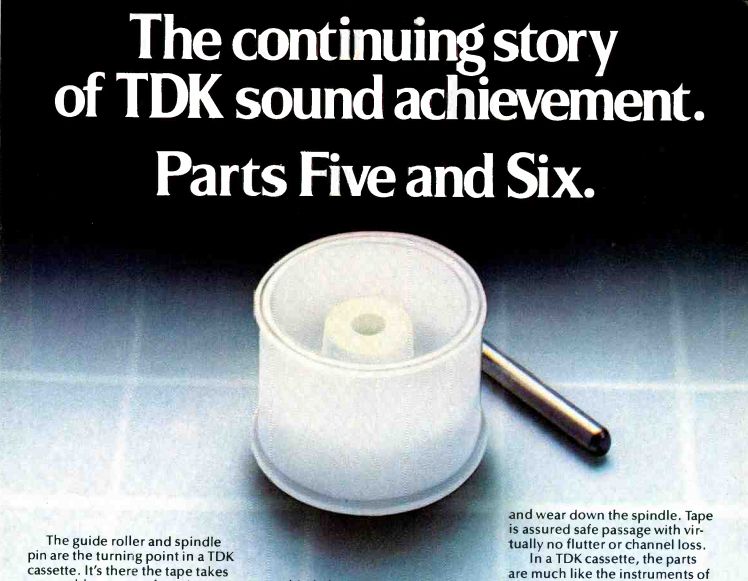
------ TDK guide roller and spindle pin in cassette.
The guide roller and spindle pin are the turning point in a TDK cassette. It's there the tape takes on a sudden surge of tension.
The winding angle changes sharply to 75°, causing great stress.
The slightest imperfection, even a microscopic speck, will cause serious output fluctuations in sound.
TDK engineers began by analyzing existing molding techniques.
They knew many manufacturers used a low split-die process. This turned out rollers with seams, which disturb tape travel. Spindle pins were no better. Merely convenient mold extensions with pullout tapers which allowed rollers to slip up, wear out and wrench the tape off the track.
Part Five, the TDK guide roller, is flared and absolutely seamless.
Made from a low-friction precision molded plastic, it's created r one piece Through an expensive forced-injection mold technique.
Its flared edges provide perfect tape guidance while its six spokes maintain rigidity and perfect circularity. The tape flows through the mechanism and past the head gap in true vertical alignment. There's virtually no tracking variation or loss of high frequencies. Sixty checkpoints during the manufacturing pro cess guarantee it.
For Part Six, the TDK spindle pin, our engineers chose stainless steel.
Machined to size and aligned to a perfect 90°, it's designed without a taper.
Micro-polishing and a silicone coating cut down friction. The TDK spindle pin is far more resistant to heat and cold than plastic.
It won't bend out of shape and wear down the spindle. Tape is assured safe passage with virtually no flutter or channel loss.
In a TDK cassette, the parts are much like the instruments of an Orchestra. All equally important. Music is an outcome of the perfect interplay between them.
In the end, that's what's so distinctive about TDK.
Music is the sum of its parts.
TDK. The Amazing Music Machine.
---------------
The Ultimate Amp.

0 Hz to 600,000 Hz (+0,-3dB).
For the past several years, a special team of top Kenwood engineers have been re-inventing the amplifier using their most sophisticated innovations in circuit design.
This is the result: The LO7MII Hi-Speed DC direct-drive amplifier system.
Our research determined that long speaker cables seriously degrade sound quality:
Total harmonic distortion doubles, damping reduces by 40%, and there is discernible "ringing:' In locating the amplifier close to the speaker by using a special 1-meter cable, THD and damping are not affected and "ringing" is eliminated.
In fact, everything in this amplifier has been engineered to reproduce an input signal audibly free from distortion and coloration. And to achieve a frequency response previously unobtainable. Our DC amplifier improves ultra-low frequency phase shift and transient response. Even the pin plugs of the input cables and locking connectors are gold-plated to insure no signal loss.
HI-SPEED--Even more remarkable is the inclusion of Kenwood's exclusive high speed circuitry.
By allowing the amplifier to react faster to dynamic changes in the musical input, Hi-Speed produces a more accurate sound. This is especially critical in the mid-to-high frequency transients where conventional amplifiers lose their imaging and detail. The LO7M11 separates individual singers in a vocal group or individual string players in a symphony orchestra with equal ease.
Of course, to appreciate the many design innovations requires much more space than is available here. Please write for full technical data at the address below. Or better yet, audition this remarkable amplifier system at a Kenwood Audio Purist Group dealer. If you have the ears to appreciate what the Kenwood engineers have accomplished, the LO7MII system will take your breath away.
Significant specifications: 150 watts one channel minimum power RMS at 8 ohms from 20 Hz to 20,000 Hz with no more than 0.007% total harmonic distortion.
S/N 120dB.
Rise time 0.55 µSec.
Slew rate ± 170 V/µSec.
AUDIO PURIST GROUP
KENWOOD--Not ail Kenwood dealers carry these products.
For the Audio Purist Group Dealer nearest you, write Kenwood, PO. Box 6213, Carson, CA 90749.
In Canada: Magnasonic Canada. Ltd.
--------------------
It's Technics SL-10 and it represents the most radical departure in turntable design since Technics first introduced the modern direct-drive turntable in 1969.
Not much bigger than a record jacket, the SL-10 com bines a quartz-locked direct-drive motor, a servo-controlled linear-tracking tonearm and a moving-coil cartridge, complete with a built-in pre-preamp.

To play a record, simply place it on the platter, close the cover and push the start button. The SL-10's micro computer automatically senses the record size and speed.
In addition to providing zero tracking error, the gimbal-suspended linear tonearm is dynamically balanced allowing you to play the SL-10 on its side or even upside down with no loss in accuracy or tracking ability.
Another reason for theSL-10's outstanding accuracy is its moving-coil cartridge. With its built-in pre-preamp, coreless twin-ring coils and pure boron pipe cantilever, the cartridge provides an extremely linear and flat frequency response as well as superb dynamic range.
Technics SL-10. The world's most unique turntable.
Technics The science of sound
========
(adapted from Audio magazine, 1980)
All That Data: FM Tuner Quieting and Distortion (Dec. 1980)
= = = =