by Bert Whyte
In the early days of audio, when a bright fellow with good ears decided to build a loudspeaker, the usual recipe called for a teaspoon of knowledge and theory, a pinch of intuition, a dash of black magic (cone doping and the like), and a fervent hope that the results would be well-seasoned with good luck. There were some very respectable loudspeakers which resulted from such empirical design methods as these.
Nowadays, there is an ever-increasing use of such exotic instrumentation as digital computers, laser interferometers, and holographic analysis in the de sign of loudspeakers. B&W and KEF are two highly re search-oriented British manufacturers which have always pioneered the use of these new design techniques. Some months ago, when B&W and Anglo American Audio (B&W's agent in North America) invited the audio press corps to visit the B&W plant and re search laboratories, I eagerly grasped this opportunity to see firsthand these interesting developments in loudspeaker technology.
The B&W plant is located in the village of Worthing in West Sussex, not far from the famous seaside resort town of Brighton. The facility is actually a complex of buildings, and our gracious host, Managing Director John Bowers, guided us through the various fabrication and laboratory areas. B&W is a relatively small company, with about 80 employees. However, they have twice won the Queen's Award for Export and now make eight different models of loudspeakers, including the new DM 11, DM 12, and 802.
These three speakers have been de signed with the benefit of the experience gained from computer-assisted research that resulted in the development of B&W's premier loudspeaker, the Model 801, which subsequently was designated as the "official monitor speaker" for EMI and Decca classical music recording.
The pride of B&W's research department is their laser interferometer installation; a separate room is devoted to this equipment. A massive cement pier or test bed about eight feet long and 28 inches high is used as the mount for the laser projector. This pier must weigh several tons, and its great mass is used to minimize--if not eliminate--any structure-borne vibrations which might cause a deflection of the laser beam from the target object. A specimen holding device is at one end of the pier, opposite the laser projector. A speaker driver can be mounted on this device, and an electric motor drive can rotate the speaker on its axis as well as move the speaker so the scan is across the driver's diameter. In this manner, the fixed-frequency laser beam with a 0.3-mm spot diameter can be focused on any area of the speaker cone, dust cap, the cone surround, or even the metal rim of the speaker basket. The laser interferometer is interfaced with B&W's in house Digital Equipment Corp. PDP 11/35 computer, which has a 96k byte core store and 20M byte disc store.
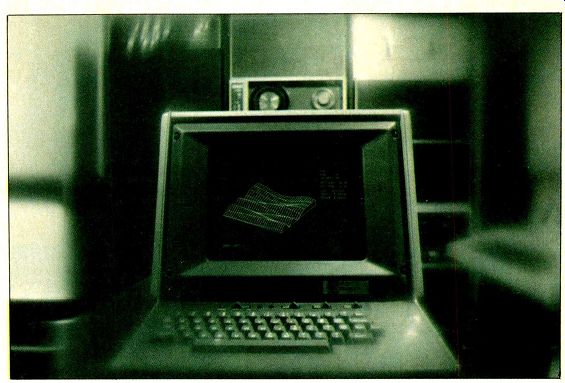
Long-term storage is on 9-track digital magnetic tape. Hard-copy printouts and graphs are available, and a visual display unit is incorporated in a Tektronix T 4010 interactive graphics terminal.
By feeding appropriate voltages into the voice-coil of the speaker under test, the velocity at a selected frequency at selected points on the diaphragm surface can be investigated. In B&W's own description, "The computer has been provided with facilities for converting analog signals into digital form for storage and processing. By exciting the speaker driver with a narrow rectangular voltage pulse, the velocity impulse at each point on the diaphragm surface can be stored in the computer and subsequently converted to frequency response data using the Fast Fourier Transform." The measurement of these impulse responses can be used to determine the amplitude and phase of the velocities generated at the selected points on the diaphragm surface. With this data stored in the computer, it can then calculate what effect the motion of any part or the whole surface of the diaphragm has on sound pressure output.
Driver Design
The bass, midrange, and tweeter drivers of the Model 801 were de signed with the aid of the laser interferometer/computer combination.
Without this instrumentation coping with the vast number of variables involved in the selection of the speaker diaphragms would be well-nigh impossible. Consider that there are three speaker drivers in the Model 801, and ideally each must operate in the most linear fashion within its prescribed frequency range. Should the speaker cone be made of paper, felted paper, Bextrene, or one of the new polypropylenes? What should the mass of the cone be? What about its density? Should the cone be thick near the dust cap and taper to a thinner cross-section at the surround, or vice versa? What material should be used for the surround suspension and what should its compliance be? In a series of tests relating to the low-frequency section of the Model 801, B&W decided to use a closed-box enclosure rather than the vented-box type, since the former has a shorter effective reverberation time. Other tests revealed that the low-frequency driver should be able to maintain linear response with voice-coil displacements up to 6 mm. The BW300 woofer de signed for the Model 801 uses long-throw suspensions and a voice-coil overhang of 6 mm on both sides of the magnet pole piece. To compensate for fault conditions in amplifiers which might cause voice-coil excursions greater than 6 mm, a special magnetic assembly is used and the restraining action of the inner suspension pre vents "bottoming" of the voice-coil against the magnet back plate. The BW300 woofer has an effective diaphragm diameter of 270 mm, the cone has the near-ubiquitous Bextrene coating with PVA damping compound, and the long-throw outer suspension is formed from plasticized PVC. The BW300 additionally has a two-inch voice-coil wound on Nomex formers to permit higher working temperatures. (It is interesting to note that the coveralls worn by race-car drivers are also made of Nomex, to reduce the danger from fire in crashes.) The midrange driver required more research and tests than did the woofer and tweeter, since most of the music signal spectrum--from 400 to 3500 Hz--lies in its operating range. Many materials were tried for the midrange cone and, though Bextrene appeared promising, an exotic new material, Kevlar, a woven matrix of aromatic polyamide fibers, was selected.
----------B&W's premier loudspeaker, the Model 80 .
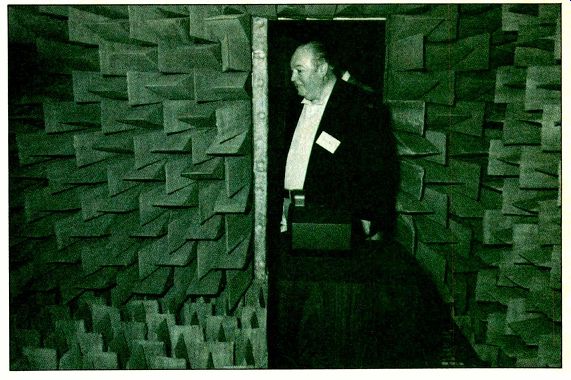
----------Bert Whyte "behind the scenes" in B&W's anechoic testing chamber.
While all the drivers used in B&W loudspeakers are made in the factory, the cones and speaker baskets are sup plied by vendors to B&W specifications. In the case of the MK100 mid range, the speaker cone is made in the B&W plant on a purpose-built die press. The Kevlar diaphragm is resin-
bonded and simultaneously heat treated and formed to the desired configuration under great pressure. The result is a cone with low mass and high strength, and it is said to have "low energy storage" characteristics affording superior transient response. The laser interferometer revealed good vibrational modes for cones made with the Kevlar material, and the final de--sign was a 100-mm cone with a one-inch voice-coil phenolic-bonded on an aluminum former and a PVC cone surround suspension.
The design of the B&W TS26S tweeter is also derived from laser interferometer and computer-aided re search. A 25-mm dome, made of woven polyester filaments, is driven from its outer edge by a 26-mm high-temperature epoxy-impregnated voice-coil. A high-energy nickel cobalt center-pole magnet is used to keep the dimensions to a minimum for good directional characteristics.
The crossovers of this speaker are fourth-order networks with frequency points at 400 Hz for low/mid and 3500 Hz for mid/high. B&W has a proprietary method of "numerical optimization" using computer synthesis to derive the network parameters. The networks are built in the B&W plant with vendor-supplied p.c. boards, to which the appropriate values of close-tolerance components are added.
Cabinet Colorations
The bass enclosure for the Model 801 is, as previously noted, of the closed-box acoustic-suspension type, with internal volume of 100 liters. Be cause cabinet panel resonances super imposed on reproduced sound cause unpleasant colorations and diminish overall clarity, many schemes have been devised to damp these resonances--including highly impractical cast-concrete or brick enclosures! During the investigation of cabinet resonances, B&W found that high levels of vibration were occurring near the woofer, which was mounted on the front speaker panel, and were probably due to mechanical transmission of the driver vibration. The use of a thick rubber gasket between the woofer and the front panel, plus mounting screws isolated from the woofer chassis with damping material, afforded a significant 12 to 14 dB reduction of vibration. The midrange driver and the tweeter are mounted in separate enclosures, with the tweeter atop the midrange unit. This mid/high assembly is affixed to the top of the bass enclosure with a circular rubber vibration isolator between them. To reduce high-frequency reflections from the top of the bass enclosure, it was covered with an acoustic absorbent foam.
-----------The Tektronix T 4010 interactive graphics terminal used by B&W
in its research department.
The tweeter, midrange and bass drivers are in a staggered vertical alignment for minimum time delay. The Model 801 is to be driven by an amplifier of 50 watts minimum, with no up per limit on power input. Its unusual overload-protection circuit senses the voltages supplied to the voice-coils of the three speaker drivers, and com pares each voltage with a pre-set threshold voltage assigned to each speaker. If the threshold voltage is exceeded, a relay cuts off the input. A red signal light on the top of the bass enclosure illuminates when there is no voltage input, and a button resets the relay and restores the input. A battery powers the circuit, and current drain is said to be so low that the circuit can be permanently connected.
All the speaker components produced in the B&W plant are individually tested for various parameters and then digitally compared to a reference standard driver. A computer matches response of pairs of drivers within t1/, dB! Each speaker system is tested in B&W's anechoic chamber and furnished with its own calibration certificate. In the anechoic chamber, the transient performance of a loudspeaker is measured via the energy versus time response method pioneered by Audio's own Richard Heyser. A Bruel and Kjaer 2031 spectrum analyzer is interfaced with a Hewlett-Packard 9825A desk-top computer for this procedure.
The specialized instrumentation-laser interferometers, digital computers, spectrum analyzers, etc.--are unquestionably of great value in developing B&W speaker systems. But however good the instruments tell us these speakers are, it is still the human ear and the reproduction of music that are the final arbiters of loudspeaker quality. Happily, John Bowers and his associates are in complete agreement with this philosophy. Mr. Bowers has a sensitive ear and an abiding love of music, so his purpose-built listening room at B&W is often where the ultimate assessment of speaker quality is decided.
At Home with the Range I have listened to the Model 801 for many months now with every conceivable type of music. It certainly has a smooth, clean response throughout the frequency spectrum, though there is a little coloration, apparent only at very high levels, above 108 to 110 dB.
Transient response is especially good, with little evidence of overhang. With its -3 dB point of 37 Hz, bass response is clean and solid, although this is not sufficient to reproduce the lowest fundamentals of the pipe organ. But then, very few speakers can handle this range. On the subject of bass response, some people have remarked that the Model 801 sounds "tubby" and a bit "over-resonant." This could be a function of several things: The listening room may be "peaky" and have standing waves; perhaps the 801 is placed too close to rear or side walls or, worse, in a corner. With the speakers about 3 feet from the rear wall and 2 1/2 to 3 feet from the side walls, I have not encountered any tubbiness. The amplifier used to drive the speakers can often have a significant effect on bass quality. One with a high damping factor, and output in the 150 to 200 watt range, helps considerably. By all odds, the most seductive quality of the 801s is their accuracy in producing a stable stereo image and depth perspective. At its best, the speakers simply "disappear"--you cannot isolate individual sound from each speaker.
The illusion of a panoramic stage image is startling, and even the most severe critics of the 801s admit that in this respect they are without peer.
There is a problem with the 801s when played at very high levels, say from 105 to 110 dB. There is no sign of stress or distortion per se, yet the superb imaging qualities of the speaker are considerably diminished, the sound field is compressed, and instrumental positioning is not as accurate.
Outside of this, the 801 can handle the dynamic range of most digital/hybrid recordings without distress. In general, it is one of the least fatiguing speakers I have ever encountered, thus encouraging extended listening.
----------
Vintage magazine AD:
Cambridge Physics.
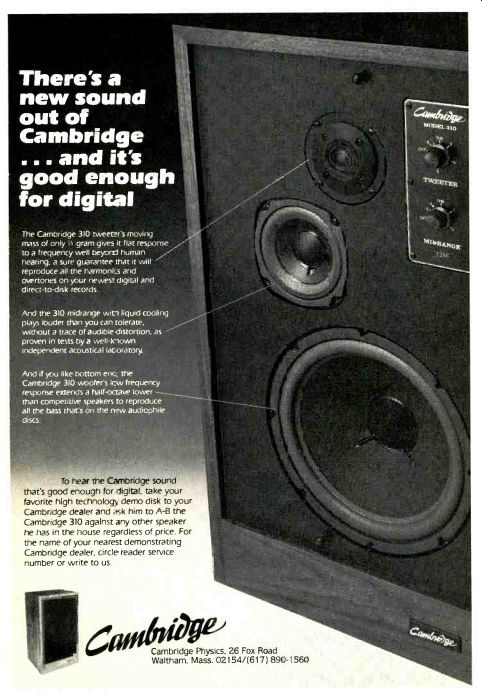
There's a new sound out of Cambridge ... and it's good enough for digital.
--The Cambridge 310 tweeter's moving mass of only 0.25 gram gives it flat response to a frequency well beyond human hearing, a sure guarantee that it will reproduce all the harmonics and overtones on your newest digital and direct-to-disk records.
-- And the 310 midrange with liquid cooling plays louder than you can tolerate, without a trace of audible distortion, as proven in tests by a well-known independent acoustical laboratory.
--And if you like bottom end, the Cambridge 310 woofer's low frequency response extends a half-octave lower than competitive speakers to reproduce all the bass that's on discs.
To hear the Cambridge sound that's good enough for digital, take your favorite high technology demo disk to your Cambridge dealer and ask him to A -B the Cambridge 310 against any other speaker he has in the house regardless of price. For the name of your nearest demonstrating Cambridge dealer write to us.
Cambridge Physics. 26 Fox Road Waltham. Mass. 02154 /(617) 890-1560
----------
(Source: Audio magazine, 1980; Bert Whyte)
Also see:
Mark Levinson JC-2 Straight-Line Preamplifier (Apr. 1976)
= = = =