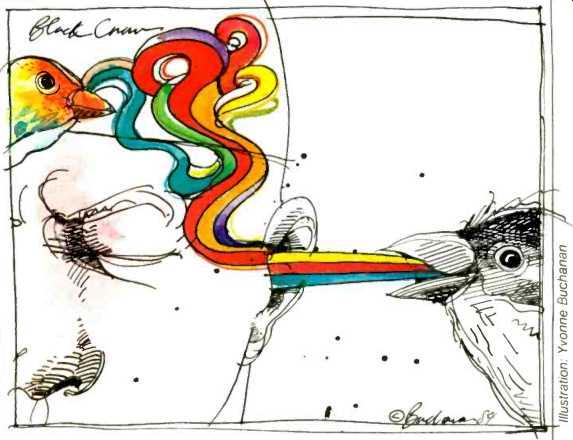
If beauty is in the eye of the beholder, as one old geezer of an aesthetician
said, then how about the ear? To be sure, he was right in a way:
Beauty is, in effect, what you think is beautiful. Or what somebody tells you is beautiful. But, how about the ear of the listener? That seems rather important to us in audio.
Prejudice in favor of the eyes, that's what we find. It's an eye world, and here we are plugging away with the ears alone, and nothing at all to look at.
Except, of course, all that pretty equipment. I'm tempted to say we're up to our ears in it.
Another pundit chose a different sense. Not the ears, of course. He announced that one man's meat is another man's poison. Right! Good man. My prime rib is your emetic. But still-no ears. He's talking about taste buds.
It has been an eye world for a long time. Sound has always been with us, as have the sonic arts of various kinds, but the eyes have had the play as the most important sense-from sheer sales figures to learned definitions of art. Just take a gander at any college course in aesthetics. It's all eye stuff.
Beauty for the ear? See cross-reference: Music. Different department. The musicians are left to take care of their own beauty.
Now, I have been worried about this for a long time, because I am, first of all, an ear man, even with perfectly good 20-20 vision in stereo. I hear and see, but it's the sound that I notice first.
In surprisingly small ways. Since we are all into audio of some sort, you will sympathize with me. Most people are eye people, just as most people are right-handed. (I'm left-handed.) We all have the two senses, except, of course, the deaf and blind; we all share an admirable coordination between them, as we do between our two hands; nevertheless, there are eye people and ear people and it's not only the musicians who are ear -orientated.
Take little things. Bird songs, for in stance. I've known many an ardent birdologist (as I call them), and there is no more persistent enthusiast than a bird chaser. If a bird is a bird is a bird, to you, the birdologist will drive you nuts.
Shades of Roger Tory P!
Well, a bird is color, sometimes, and I like color. So, I like cardinals and goldfinches and bluebirds. But all those nasty little warblers that migrate in the spring! Bird people go nuts with their field glasses trying to identify the brand name, feather by feather. This is a typical eye world. I find most birds very dull to look at, especially robins, catbirds and mockingbirds. Gray, mud color or speckled, that sums it up.
Even a crow or raven is just a jet-black silhouette.
But the sounds! Such incredible variety, out of such tiny equipment! I can never tire of bird sounds. I even get to know individual birds-by song, not sight. Mostly I never see them at all, nor wish to. I have long conversations with cardinals, who will come right up to you if you challenge them in their own parlance. Also with catbirds, charming conversationalists, or so it seems as you listen. And a mocking bird, that gray thing with the long tail, is an absolute sonic miracle in a miniature package. I have never even seen that serene, distant songster who sings chords, transposing the pitch up and down and supersonic, the herm t thrush. I guarantee you, he's nothing to look at, even through field glasses.
Just try your birdologist friends on a bird song-and watch them reach for their glasses. And Roger Tory P.
Let s move on to bigger and more important things-people. To be sure, I am always happiest when I can reconcile my two primary senses, sight and hearing. Just as when my left hand works smoothly with my right. People are to see and also to hear. In the flesh these are inseparable. But when people depart, or grow up, we have to remember them as they were. How? Eye stuff again. Billions and billions of pictures-what else? There were portraits, painted and drawn, long be fore daguerreotypes, and now we have instant. Again, we are sight-orientated.
It is by their pictures that we remember our kids as kids, and recall our parents, some long since gone. But can you hear their voices? As for me, though my eyes go along, my ear again comes first and often to the astonishment of others. I can actually hear my favorite uncle, an early childhood role model as they now would say, to the very timbre and pitch of his voice. He died suddenly, of a heart attack, in 1934. I think I hear him more accurately than I can see him in my mind. My father and mother, long since dead, are entirely familiar to me when I imagine their voices, or listen to a few odd recordings I still have around. I can make either of them talkin my head, precisely as if it were the live sound. Photos-of course! I take them for granted, as do most people.
You can understand, then, why I waxed so enthusiastic a year ago (Audio, January 1984) concerning my very recent editing of a wedding recording, made on an un-editable 78-rpm disc in 1940. Everybody has wedding pictures, but how many of us have sound pictures of our wedding guests? Especially from a half-century ago. Those recorded voices are so startlingly familiar to me now that I can hardly believe it has been so long.
Have you noticed that though people's figures and faces (and hairdos and clothes) change radically over the years until they are often unrecognizable, their voices remain remarkably constant, from late teenage right through the years of maturity? This confirms my own rare feeling that the sound of people is far more characteristic of them than the sight. The sound describes them best, not the photo graphs, not the painted portraits nor the (silent) home movies.
And so we in audio and hi-fi live in an eye world. People are eye-trained, not ear-trained. Sounds in the large tend to be background-unfortunate for musicians and for music listeners who hear their music in the foreground, like me.
Music itself is changing. More and more, the sound goes along with the sight, with something to look at. Concerts of Baroque dance music-with dancers. Michael Jackson, the sound and the sight. The two go together wherever you look-and listen. In all formats, right and left, but particularly in those which are reproduced. That is the key.
It's not hard to see [sic] the why and the wherefore of this, as Gilbert and Sullivan would have put it. The key is indeed reproduction in our current, nonsexual sense.
In the purely live state. sound and sight went together inseparably as nature intended and as man very well understood. It has always been extremely difficult to separate them, and it still is in the live original. Our ears and eyes, too, have worked together for so many millennia that we are full of subtle, built-in connections and inter actions in our system of perception.
These belonged to the most ancient of civilizations and to pre -civilized tribes exactly as they do to us today within our living, internal circuitry. It probably served first for human survival, but by a very close second it served for every sort of human entertainment.
But civilization is basically, as they say, a matter of record. We'd call it recording. Accurate duplication-re production-of all sorts of things, shapes, documents, artifacts, a sort of visible f 1. It was slow in coming, and there was no sound hi-fi at all. Visible hi-fi began when molds turned out identical castings, ring seals made multiple impressions, when movable type brought printing, while etching and lithography reproduced eye stuff with genuine, repeatable accuracy.
Is it any wonder, then, that products designed for the eyes to perceive still have a magisterial eminence in our world, including the sanction of law? Our brief instant of sonic reproduced glory is still much too short to have overtaken what has long endured. The eyes still have it.
The rest is simple. We are increasingly, as I say, in the age of reproduction, to the point where many of us aren't really sure what the word "live" means, as in "live on tape." And thus nature is reversed.
Where in the natural, live state, sound and sight are inseparable, re produced sound and sight are the opposite. The technologies are much easier if kept apart. Suddenly, it was extremely difficult to put these elements together-in the new reproduced form. So we developed them separately. Eye stuff. Ear stuff. And we found we could do wonders, first with visuals, then, later, with the sonic. Typically, we invented whole new kinds of softgear, as I like to call it, appropriate to each medium. Did we! The silent film. Radio. Records. These things made a new kind of sense, single-sense. and plenty of money too.
But all that is now about over. We are into the Great Merger, sound and sight reproduced together in all formats. It is, as you can see. no more than a return to mother nature, the natural state of things, after a brief interlude.
To me. this makes the whole business that much more exciting. We have a lot to look forward to, even including those dollars, if we do it right.
(adapted from Audio magazine, 1984; EDWARD TATNALL CANBY)
Also see: Audio Etc. (may 1985)
= = = =