Boulez' fresh view of Pelleas; Shostakovich's 14th-a new
protest? Julius Caesar and Handelian splendor.
========
Pierre Boulez' flesh-and-blood interpretation of Debussy's somber operatic drama.
A Fresh View of Pelleas
by David Hamilton
THE HISTORY of Debussy's Pelleas et Melisande in performance has been always closely bound up wish the Parisian tradition that stems from the very first production, and this tradition has in turn been quite closely documented on records. There is, first of all, the celebrated disc of Milisande's "Meslongs cheveux" sung by Mary Garden, the first exponent of the role, with the composer himself playing the accompaniment. The original Golaud, Hector Dufranne, took part in an extensive set of excerpts recorded in 1928 (once available on Entre RL 3092). And the al most incestuous continuation of that tradition can be traced through still later recordings: for example, the Arkel of that 1928 set in turn sang the role of the physician in the first complete recording of the opera, led by Roger Desormiere in 1942 (recently reissued in France on Pathe FALP 35001/3)-and the Physician of Andre Cluytens' 1957 recording was the nephew of the original Arkel of 1902! All of the pre-stereo versions of the opera draw directly upon the Parisian tradition for their casts (with the exception of Victoria de los Angeles, Cluytens' Melisande); although the Desormiere version remains perhaps the classic statement of the major roles (especially the un forgettable Golaud of Etcheverry), the versions of Fournet, Cluytens, and Ansermet (the latter's earlier set, now on Richmond RS 63013) each contain individual readings of great style and authority. (Well-founded rumors reach me of an RTF tape conducted by Inghel brecht, Debussy's friend and one of his greatest interpreters; perhaps this too will one day be available on records.) Ansermet's 1964 remake, however, drew extensively upon non-French singers, and now the second stereo version of the opera, based upon Pierre Boulez' much discussed Covent Garden performances of 1969, brings us a cast quite without any connection to the Parisian tradition-in fact, except for Soederstroem, every singer here is taking his role for the very first time. And lest we think that Boulez himself constitutes a link with the way Pelleas has been performed in Paris (and he surely must have heard some of those celebrated performances in the 1940s with the cast of the Desormiere recording), the conductor has written an essay for the libretto book let in which he launches an attack on what can only be the Pelleas tradition of which I have spoken.
Boulez argues that a gloss of "elegance" and "clarity" has been forced on the opera, in the name of avoiding vulgarity and theatricality; that a somber and oppressive drama has been turned into a "pre-Raphaelite fairy tale," with the effect of suppressing Debussy's subtle alternation and balance between realism and symbolism, and of restricting the rather wide-if still sub-Wagnerian-range of dynamic and coloristic contrast that is explicit in the music. Similarly, the characters are robbed of their ambivalent features, their realistic existence overlooked in favor of their symbolic qualities: Melisande sinless, pure as a dove; Pelleas a sort of refined page boy; Golaud a bully who obstinately refuses to grasp the "poetic" qualities of the relationship between his wife and half-brother; Arkel, a veritable Delphic oracle, spouting profundities at every turn of events.
In fact, argues the conductor, Milisande is a strange mixture of candor and duplicity, who eventually comes to hate Golaud; the latter, for all his surface energy, is fundamentally neurotic and unsure of himself; Pelleas is a naive adolescent who suddenly finds himself face to face with erotic reality; and Arkel, far from wise, is old, afraid, and also naive-a "Pelleas with white hair." There is more than a little textual and musical evidence in favor of these interpretations of the characters, and those who have seen Frank Corsaro's staging of the work at the New York City Opera will not find them entirely novel. There have been, in the past, others who have seen as much in the opera as Boulez; the Golauds of Etcheverry and Heinz Rehfuss (in the first Ansermet version) are rather more complex figures than suggested by Boulez' oversimplified straw men, and I find a touch of irony in Guus Hoekman's portrayal of Arkel (in Ansermet II). Nor would I agree that Desormiere is insensitive to the subtle interweaving of conversational realism and lyrical reflection in the music's continuity, although the boxy sound of his recording and its limited dynamic range prevent a full realization of the contrasts.
This is, then, very much a recording that makes a point-and, for the most part, it makes that point very effectively. There is throughout a strong sense of direction, resulting from a firm hand on the tempos (never stiff, but their freedom disposed over carefully chosen basic movements) and great precision of rhythm and intonation. If all the singers are not completely secure in detail, that is perhaps a necessary consequence of choosing a cast on the tabula rasa principles, so that they can be fitted into the conductor's conception. All have moments of insecurity in the French language; although the average is quite high, it can hardly match that in the French-based versions. And there are occasions of musical insecurity as well, with notes here and there not firmly pitched (Ward is the least good in this respect) or not accurately placed in time with respect to the orchestra; again, the French versions, with singers long versed in their roles, average out somewhat more highly.
Two rather special points must be mentioned. The choice of a tenor for the role of Pelleas, although clearly sanctioned by the score, goes against long tradition; all the other recordings use a high baritone, and that has been the practice in New York as well (until recently, when Gedda sang a few performances at the Met, and the City Opera's recent production also used a tenor).
Shirley has no difficulty with the lower-lying portions of the role and makes so much better an effect at the climaxes that the decision is easily justified. In the matter of Yniold, Boulez argues vigorously against the use of a small soprano, both for dramatic reasons and for the quality of the voice; I agree with the first reason (al though it is obviously not relevant in a recording), but am less certain about the issue of vocal quality; some sopranos on record have brought the part off very convincingly and offer more musical security. In the present case, at least, Master Britten does not let the side down.
Boulez makes rather a point in his essay about the matter of balance, saying that in the past the problem of overwhelming the voices has been overemphasized; more important, he feels, is to realize fully the contrasts--and the scoring is such that there shouldn't be a problem anyway. Unfortunately, the balance of this recording prevents that argument from being completely convincing, for the voices are kept very forward and often seem to be in a different acoustical space from the orchestra.
The resonance of the sound, especially with respect to the bass register, undoes some of the clarity that Boulez has brought into the score, and this is regrettable-if only he had received the kind of recorded sound that was given to Ansermet's stereo version! In addition to Boulez' essay, the booklet includes shorter articles by Felix Aprahamian and Andre Schaeffner, plus a synopsis and libretto. This booklet is laid out with excessive artfulness and acres of blank space, and the printed material is set throughout in a small and hard-to-read format, while the numerous pictures strewn about-most of them so small as to be undecipherable--are not captioned or otherwise identified. A very annoying example of thoughtless pretension.
Even if the actual realization of Boulez' ideas about Pelleas is not always convincing, there can be no doubt that this is a fresh view of the opera and one supported by strong musical and textual evidence. No Debussyan should fail to hear it, and anyone who in the past has found Pellet's to be "precious" should certainly take the time to re-examine the opera as filtered through the precise and penetrating eyes and ears of Pierre Boulez.
DEBUSSY: Pelleas et Melisande. Elisabeth Soederstroem (s), Melisande; Yvonne Minton (a), Genevieve; Anthony Britten (treble), Yniold; George Shirley (t), Pelleas; Donald McIntyre (b), Golaud; Dennis Wicks (b) Physician and Shepherd; David Ward (bs), Arkel; Covent Garden Royal Opera House Chorus and Orchestra, Pierre Boulez, cond. Columbia M3 30119, $17.96 (three discs).
---------------
Shostakovich's Fourteenth A New Protest?
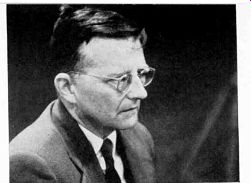
Barshai leads a superb performance of the Soviet Composer's new symphony.
by Royal S. Brown PERHAPS NO other work by Shostakovich has come as such a total surprise as the stark and bitter Fourteenth Symphony, first performed in Shostakovich's native Leningrad and then in Moscow in October of 1969. To be sure, a marked pessimism (which has brought about several contretemps between Shostakovich and the Soviet government in the past) pervades much of the composer's best work. But the Fourteenth Symphony goes beyond pessimism-it is a disquietingly obsessive, quasi-auto biographical testament whose tortured emotionalism, in stead of being contained in the highly climactic musical architecture typical of most of Shostakovich's symphonies, seems to form an elusive spiral communicating a despair more cosmic than human.
Even the choice of texts is startling. Who would have thought that Shostakovich (or any Russian composer, for that matter) would form the core of a symphonic work around poems by the French writer Guillaume Apollinaire, whose cubistic, personal style and art-for-art's-sake aesthetic are infinitely more foreign to the officially sanctioned Soviet sensibilities than anything to be found in the poetry of, say, Yevtushenko. According to Shostakovich, his Fourteenth Symphony can be com pared, in intent, to Mussorgsky's Songs and Dances of Death. On the surface, this seems to explain the entire symphony, which is seemingly a series of eleven unrelated arias, dialogues, and recitatives (including a ballade, a malaguena, a march, and a duet), all based on poems which at first appear to lack an over-all sense of coherent structure. However, by the time one arrives at movements seven through nine, which are not based directly on the theme of death, one begins to discern the composer's specific intentions. Those movements, for instance, all seem to allude indirectly to Shostakovich's clashes with the Soviet government: the seventh is based on a poem Apollinaire wrote after he had been falsely accused in a plot to steal the Mona Lisa, and it is a brooding portrait of a man who feels the full force of injustice (there is, in the Russian translation, a specific allusion to the persecution of Christ as well, an analogy not found in the original French). On the other hand, the eighth movement, also based on an Apollinaire poem, is a sardonic and vulgar cry of defiance that seems to be an answer to the injustice expressed in the seventh. And the ninth movement, which uses a work (the only purely Russian text in the symphony) by an obscure contemporary of Pushkin, Wilhelm Kuchelbecker, accuses the "powerful tyrants" of persecuting the authors of "bold, inspired deeds and sweet songs." Going back, then, to the other movements, there seems to be a definite progression. Following the introduction, the poetic themes are, successively, youth (movement No. 2); love (No. 3);
suicide, despair, and solitude (all in the fourth movement, which is based on an Apollinaire poem, one of the poet's most beautiful creations); World War II (Nos. 5 and 6), which played an important role in Shostakovich's career; persecution and defiance in No. 7 (one of Shostakovich's biggest run-ins with the government was right after the war in 1948); and the Death of the Poet (No. 8) in which Shostakovich, who has been quite sick of late, seems to be seeing his own death through the dark glass of Rilke's extraordinarily affecting poem. Closing the symphony is another Rilke poem which, like the Garcia Lorca Dc Profundis that opens the symphony, deals with death in a general manner (although much more fatalistically than in the Lorca poem), thus providing the entire cycle with a kind of frame of black crepe, as it were.
If Shostakovich's choice of texts for the Fourteenth Symphony seems both gloomy and-considering the composer's past experiences-radical, the music represents perhaps some of his most disturbing pages. One could mention the basic lack of thematic unity (except for the opening, Dies-Irae-type melody, which acts as a leitmotiv of sorts in Shostakovich's work) and the extraordinary instrumental effects, but these characterize other works by the Russian composer as well. Less typical is Shostakovich's orchestral forces, which are limited to the decidedly ascetic combination of strings and a bizarre assortment of percussion, including castanets, whip, woodblock, xylophone, vibraphone, and various side-drums (but no timpani). But it is the harmonic language that really creates the unsettled and rootless atmosphere that virtually pervades the entire symphony.
It is precisely because Shostakovich flirts with establishing tonal centers at various points in the symphony that his truly violent departures from tonality are all the more shattering. In addition to some occasional tone clusters and a frequent use of frenetic, wide-interval lines that are even more consistently non-melodic than is usual for Shostakovich, there are frequent, self-negating clashes between quasi-recitative vocal passages and the orchestral accompaniment. There is also the hollow and wispy interlude that interrupts the seventh movement (In Prison) with a kind of "ghost waltz," which later forms the foundation of the last movement. The final shocker comes at the end of the symphony when, after what appears to be a relatively conventional coda, the composer suddenly adds an almost totally unrelated and quite dissonant chord that is repeated in the low strings in an accelerating crescendo that suddenly just stops, thus creating a completely inconclusive musical and emotional state.
The instrumental forces that perform the symphony here--the Moscow Chamber Orchestra conducted by Rudolf Barshai--are the same that gave the work's premiere, and they do a superb and extremely accurate job of playing the difficult orchestral part. The all-important rhythmic complexities are perfectly delineated, while the tone quality of the string ensemble, as well as its component parts, is something of a marvel. I find the interpretation somewhat clipped and cold in spots, but that is almost impossible to avoid in this symphony. It was Galina Vishnevskaya and Mark Reshetin who originally sang the vocal parts. They are performed here, however, by two singers who are unknown to me, Margarita Miroshnikova and Yevgeny Vladimirov; although they do not seem to identify with the music to the same degree as their predecessors, they are gifted performers whose voices are admirably suited to this work. A splendid balance is, in fact, the strong point of the entire re cording, a quality reinforced by the sound which, al though a bit shrill, can be easily corrected by adjusting the treble control on your amplifier. The stereophony on this release is particularly effective in accentuating the many dimensions, both vocal and instrumental, of the symphony.
The very release of the Shostakovich Fourteenth so soon after its composition must be considered a blessing, since this is hardly the type of music to endear itself to the adherents of socialist realism. It is an invaluable recording, revealing a side of Shostakovich one has never seen before-although one suspects it has been lurking in the shadows for quite some time.
SHOSTAKOVICH: Symphony No. 14, Op. 135. Margarita Miroshnikova, soprano; Yevgeny Vladimirov bass-baritone; Moscow Chamber Orchestra, Rudolf Barshai, cond. Melodiya/Angel SR 40174, $5.98. Tape: 4XS 40174, $6.98.
---------------------
A Magnificent Baroque Opera
Fischer-Dieskau and Troyanos as Handel's Caesar and Cleopatra.
by Paul Henry Lang
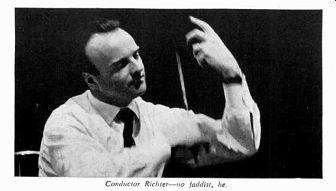
--- Conductor Richter--no faddist, he.
THIS RECORDING of Handel's Giulio Cesare, as well as RCA's earlier one, testifies to the remarkable broadening of musical literacy. It is a cause for wonder, though, that the greatness of baroque opera should be such a discovery. After all, the much admired religious music of that age-cantata, oratorio, Passion, and Mass-uses forms and idioms taken from opera: recitative, arioso, aria. Yet for a long time baroque opera was not considered viable, its da capo arias were denounced as dramatically impossible, its recitatives dismissed as mechanical and boring. Curiously enough, the same da capo arias and recitatives are listened to with deep satisfaction and approval in the Passions and oratorios. Beginning with the seventeenth century, orchestrally accompanied church music had been a member of the large family of dramatic music, a first cousin to opera. In a baroque oratorio the "operatic element" is not considered objection able by modern audiences for the simple reason that neither the public nor the musicians are familiar with baroque opera; but in a Mozart Mass, everyone familiar with Mozart's operas is instantly aware of the similarity.
Until recently this recognition has resulted in the absurd proscription of the great church music of Haydn and Mozart on the basis of its being "theatrical"-whatever that means. When Handel turned from opera to oratorio he did not stop writing opera, he merely used biblical texts and gave the chorus an important role. To mention an example, "He shall feed His flock" from Messiah is a superb specimen of the purest Neapolitan opera seria aria. Most of Handel's so-called sacred oratorios are music dramas that can and should be staged.
This little introduction is written because the stylistic similarity of sacred and secular music in the first half of the eighteenth century and our ignorance of the era's musical theater has led to a deplorable situation. Conductors and singers, accustomed to the unctuous roman tic church style, have sung and played baroque opera as if it were "sacred" music; the recitatives especially.
with their slow, even pace, and agonizing sanctimonious cadences, have suffered from this. Conductor Karl Richter, an enlightened and cultivated musician, rejects these false notions; under his direction the recitatives are freely declaimed, with plenty of elisions and tempo changes to propel them, and the cadences are crisp and businesslike-opera businesslike.
To be sure, there are certain aspects of baroque opera which for a long time prevented a popular revival. In the first place there was the chief protagonist, the castrato (at times there are two of them in the cast), singing soprano or alto, while men's voices were reserved for the minor figures in the drama. This is not the place to discuss the reasons for this preference for artificial high voices; suffice it to say that it is no longer accept able-or even understandable-to us. Speaking from the library, not the theater, some scholars argue that if the Julius Caesars and Alexander the Greats are deprived of their high tessitura in favor of a masculine range and tone, "something essential is lost." But where does one run across castratos these days, and what public would accept them, provided that we manage to get around the statutes? The French have never tolerated the castrato, and Gluck knew better than to go to Paris with an alto Orpheus-he rewrote the part for a tenor. The Germans were equally leery of the "Italian capons," while the vast majority of Englishmen looked upon the artificial soprano as a prime example of the immorality of foreign popery. In the aristocratic circles of London they were accepted as interesting freaks imported for the amusement of a small select audience; still, Burney repeatedly had to defend them as being great artists and decent persons. What the advocates of "original tessi tura" seem to ignore is that the remedy they suggest female singers in the castrato parts-destroys the nature of these roles far more thoroughly than the obvious and theatrically sound remedy: the transposition of these roles for men's voices, simply singing an octave lower.
The necessary changes in the score are minimal, the gains in theatrical values enormous. The castrato, though singing in regions natural for women, was still a man of sorts, singing with a flexible and powerful but white voice; we might call him a countertenor outré. But a good female soprano or alto is the quintessence of femininity, even when we disregard her (usually) buxom figure. The DGG recording bravely allots all men's roles to men, and the results are felicitous.
The next obstacle in the way of the popular appeal of baroque opera is the static nature of the seria and its often extreme length. The only remedy here is abbreviation, a procedure equally justified for oratorios and Passions. Moreover, such cutting is in accord with contemporaneous practices, for whenever an opera was shifted to a different theater it was rearranged by the resident maestro to suit the local situation. Handel him self performed these duties when he was one of the musical directors of the Royal Academy of Music. I am not praising this procedure, which more often than not disfigured the opera; I am only citing the fact that no composer expected all his recitatives and arias to be performed on every occasion. But cutting must be done with the greatest care, because the structure of Handel's operas is based on tonal concordances. The shortening should be carried out at the expense of the secco recitatives and the arias of the secondary personages, not, as it is unfortunately done, by clipping the da capo from the arias. The revival of baroque opera depends on these adjustments, which can be done and done well.
This recording is a "documentary": i.e., Richter plays the entire Handel geselischaft score, with all the repeats, not one note left out, not one added. We must be grateful for both the completeness and the avoidance of extraneous matter. In a live performance in the theater this version (eight sides) would be much too long, but sitting at home, playing an act or two, it offers a most satisfactory musical experience. Richter refrains from indulging in a fad which, now that everyone dabbles in musicology, is considered a must: the vocal embellishments. It is a known historical fact that in the repetition the A section of a da capo aria was embellished by the singer. In the seventeenth and eighteenth centuries singers, especially the castratos, were superbly trained in all facets of music, including composition, and were able to improvise ornaments on the spot. This was a generally accepted practice even though objections to it were widespread by the 1720s, and Handel kept a tight rein on his singers. Today's singer cannot do such
improvising; this music is no longer in his bones and his training is quite different from the one given in the great Neapolitan and Venetian conservatories of the baroque era. This being the case, someone must provide the embellishments for them in writing. The results, like the cadenzas composed in the nineteenth and twentieth centuries for eighteenth-century concertos, are almost al ways unfortunate. Few real composers are willing to engage in such archaic exercises, leaving it to the conductors and pedagogues to supply the ornaments, but surely such ad hoc composers are bound to be unsatisfactory. Richard Bonynge offers an appalling example of these anachronistic platitudes. One of the great merits of this recording is that it demonstrates the carrying power of Handel's great melodies; they easily bear literal repetition.
Giulio Cesare is a magnificent work that administered the coup de grace to the formidable competition led by Giovanni Bononcini, one of the most popular and talented opera composers of the age. The richness of its music is exceptional even for Handel; there is no parallel to it-except in some of Handel's other operas. Perhaps the most amazing aspect of this music, in turn dramatic, then again beguilingly amorous and caressing, is its Italianism. This German musician, trained in the severe and exacting contrapuntal art of the Lutheran cantor, penetrated to the core of Mediterranean art, Latin and Catholic, to a degree that outdoes even Scarlatti and Pergolesi. Listening to the duet at the end of the first act, to the gently undulating 12/8 rhythm of the siciliana, and to the beautifully flowing melody that smiles through its tears, one can fairly see Vesuvius in the distance.
Handel's powers of characterization are astounding; Caesar, Cornelia, and Cleopatra are before us in the flesh. Handel, like Racine, was always partial to his heroines, and Cleopatra particularly attracted him. The Egyptian enchantress, aspiring to the throne held by her brother, Ptolemy, decides to use the Roman general for her purposes. Sure of her charms, she puts on a show that sweeps Caesar off his feet. But gradually she begins to reciprocate his ardor, falling in love with her intended victim; on hearing of his supposed death, she sings a profoundly moving plaint. This metamorphosis from schemer to lover is conveyed by Handel on a broad and psychologically penetrating scale, in music of unflagging beauty and invention.
Richter goes about his work with artistic integrity and good taste. The orchestra is fine, the strings spirited, the basses light and nicely merged with the bassoons; only the solo flute and oboe are weak. The tempos are excellent throughout. At times the orchestra is a bit too subdued, but I ascribe this to the annoying recording "code" that seems to be followed by nearly all companies: "keep the accompaniment low." While the orchestra in effect does play accompaniments, such a score does not consist of solo parts (usually miked well for ward) and a secondary orchestral part (held in the background); the orchestral parts are integral to the texture, and the many melodic and rhythmic imitations, as well as the brisk concertante figurations, must be fully in evidence at all times. This mistaken concept (also applied to concertos) encourages the wrong kind of listening. The same goes for the handling of the harpsichord, a complaint I am forced to make almost every time a baroque work is reviewed. The harpsichord continuo is the backbone of baroque opera. It is well executed here but, except in the recitatives and in a few other spots, it is pale and often inaudible. If it can be heard in some places, why can it not be in others? Obviously, this is done deliberately, as part of the "code." It is disconcerting to hear long stretches of fine music without the latent harmony being realized. But where the harpsichord is heard, its contribution is commendable.
For once we hear cadences in the recitatives that disregard strict tempo and crisply dispose of the necessary final chords without making a production of it.
The casting of Fischer-Dieskau in the role of Caesar is a mixed blessing. He is not really an operatic performer but a Lieder singer who also sings dramatic roles, a combination that seldom works either way.
Moreover, his voice does not have the weight of a heroic baritone that Norman Treigle brings to the role in the (abbreviated) RCA recording of this opera.
Whenever Fischer-Dieskau has the time to form his sounds he is excellent, but in rapid passages he is un comfortable, and the coloraturas he cannot handle at all.
The recitatives are generally very good, and his diction, as one would expect, is elegant. He sings the great ac companied recitative, "Alma del gran Pompeo," magnificently; every shade is brought out and the phrases are beautifully shaped. There are several such well-executed numbers. But in the heroic pieces, such as "Al lampo," he has to labor hard and the voice loses its resonance; and in the bravura aria. "Quel torrent e," he is in real trouble. It is his fine musicianship that rescues him in the tight spots.
Tatiana Troyanos is really a mezzo who can sing high. She gives a creditable performance, but the difference in nature of the two extremes of her vocal range is too much in evidence: within an arching melody this can be a little awkward. She is always on pitch, but on high tones can be somewhat edgy, and aside from the two basic colors there is little else. But she is a brave artist and has some fine moments. In her ravishing aria, "V'adoro, pupille," in which Handel turns on all he has in sensuous, beguiling, and seductive love music, accompanied by muted strings, solo gamba, lute, oboe, bassoon, harpsichord, and them!) she nicely catches the magic of the situation.
Julia Hamari (Cornelia) is the real bel canto singer, with Franz Crass (Tolomeo) the only one in the cast who brings a quasi-Mediterranean quality to the singing.
She has a beautiful alto yet without the fruity quality that so many altos have-and exploit. On the contrary, Hamari, who has fine control over her voice, consistently avoids that corno di bassetto tone and displays many subtle shades of color. Franz Crass, a fine artist, has an ample, round, and sonorous bass voice, and is as secure in slow legato as in fast coloratura. He is made for the part of the villain who is also amorous. The remaining roles are all passably executed, though the vocal quality is not first class. Peter Schreier (Sesto) comes through everywhere, but his tenor has little sensuous attraction and his low tones are weak. Gerold Schramm (Achilla) does not seem much involved in his role, and his bass is hollow; Wolfgang Schone and Michael Schopper are adequate. Hermann Baumann deserves a citation for his splendid horn solo, and the little chorus is excellent.
What distinguishes this performance-a remarkable achievement-is the intelligence, musicality, and dedication of conductor and cast, all of which makes us for get the occasional shortcomings.
HANDEL: Giulio Cesare. Tatiana Troyanos (ms), Cleopatra; Julia Hamari (ms), Cornelia; Peter Schreier (t), Sesto; Dietrich Fischer-Dieskau (b), Giulio Cesare; Gerold Schramm (b), Achille; Franz Crass (bs), Tolomeo; Wolfgang Schone (bs), Curio; Michael Schopper (bs), Nireno; Munich Bach Chorus and Orchestra, Karl Richter, cond. Deutsche Grammophon 2711 009, $23.92 (four discs). Tape: 111) 1009, 7 1/2 ips, $29.95.
-------------
(High Fidelity)
Also see:
CLASSICAL Music Record REVIEWS
EQUIPMENT IN THE NEWS--The latest in audio gear.
Understanding Tonearms (Audio, June 1980)--part 1
Understanding Tonearms (Audio, June 1980)--part 2
Tone Arm Damping--The Overlooked Feature (High Fidelity, Jul. 1975)