reviewed by: R. D. DARRELL PETER G. DAVIS SHIRLEY FLEMING
ALFRED FRANKENSTEIN CLIFFORD F. GILMORE HARRIS GOLDSMITH DAVID HAMILTON PHILIP
HART PAUL HENRY LANG ROBERT C. MARSH ROBERT P. MORGAN GEORGE MOVSHON H. C.
ROBBINS LANDON SUSAN THIEMANN SOMMER JOHN S. WILSON
BACH: Motets (7), S. 225-231. The Barmen-Gemarke Schola Cantorum; Col legium Aureum, Helmut Kahlhbfer, cond. RCA Victrola VICS 6037, $5.96 (two discs).
Unlike all his other vocal works, Bach's motets have never been out of fashion: from the time of their composition right down to today they have remained consistently popular with singers and audiences-in church, at least, if not in the concert hall. It is curious, therefore, that until now these magnificent creations have not been available here in a single fully satisfying recorded version. Victrola's new release (taken from Harmonia Mundi originals) provides just that and even includes a bonus: the first recording ever available here of a seventh motet, Sei Lob and Preis mit Ehr'. S. 231. The motet can be found, with a different text, as the central choral movement of Cantata No. 28, Gottlob! nun geht das Jahr zu Ende, where it is ac companied by strings, three oboes, cornetto, and three trombones, all doubling the voice parts (available in this form in a fairly good performance by Fritz Werner from the Musical Heritage Society). It also appears, rather inexplicably, in a motet ascribed to Telemann, Jauchzet dem Herrn alle Welt.
The motet, as here recorded, is a short, four-voice polyphonic work in the Pachelbel style, based on the chorale Nun lob, mein See!, den Herren. and is ac companied only by the two continuo instruments.
In all seven motets Helmut Kahlhofer directs a mixed choir of about fifty mem bers. Though most of them are amateurs, they have been extremely well rehearsed and sing with a really beautiful sound.
While about half the number of singers would be more appropriate (and with boy trebles instead of women), the performances here are, nevertheless, first rate and far ahead of all the recorded competition.
Furthermore, Kahlhofer has enlisted the aid of players from the Collegium Aureum, which doubles the voices beautifully in two of the motets, Der Geist huff unsrer Schwachheit auf and Famine dich nicht. In all the others except Jesu, meine Freude, which is sung a cappella, the voices are accompanied by the continuo (organ and bass). It is now generally agreed that Bach probably in tended all of these works to be performed with accompanying instruments, -or at the very least, certainly with the continuo.
So, until a group like the Vienna Boys' Choir and the Concentus Musicus record the motets, this is the only recommended recording. The sound quality of these pressings seems to be identical to the Harmonia Mundi originals, but with even less surface noise. The Victrola discs, by the way, are about half the thickness of any record I've seen; they are so flexible they can almost be folded in two, like a large black tortilla. I don't know if this makes them more or less likely to warp, but my copies were perfect.
-C.F.G.
BEETHOVEN: Concerto for Piano and Orchestra, No. 1, in C, Op. 15; Leonore Overture No. 3, Op. 72a. Ania Dorf mann, piano; NBC Symphony Orchestra, Arturo Toscanini, cond. RCA Victrola VIC 1521, $2.98 (mono only).
Despite its obvious flaws, the reissue of this Dorfmann 'Toscanini collaboration (together with the Kapell/Golschmann reviewed below) evokes a strong sense of nostalgia for this reviewer.
Nowadays, of course, there are quite a few distinguished versions to choose from. My current favorites are the Fleisher/Szell (Odyssey) and the Serkin/ Ormandy (the latter. though on a full-priced Columbia. throws in an indispensable version of the Bagatelles, Op. 119). Those who prefer the lighter, less intense. Un-athletic Gieseking manner are directed to the fine versions by Solomon and Arrau/Haitink. Dorfmann's work cannot compete on so high a level.
She sounds uncomfortable with Toscanini's fast, opera buffo tempos, which really call for the technique of a Serkin, a Gould, or a Fleisher. Downbeats are lunged at, phrases are clipped, and in the outer movements there is an aura of rushed insensitivity. In the largo, where technical strain is not a drawback, Dorfmann disappoints with pallid, harmonically undifferentiated playing. It's all competent and lively, but not very interestingly or meaningfully phrased. This version. then, is of value chiefly as a curio. Toscanini buffs, though, are advised that the transfer of the 1945 Car negie Hall originals is remarkably full and clean (the first note of the cadenza, however, is elided from the dub).
There is, nonetheless, an overriding reason to acquire this disc: the bonus Leonore Overture No. 3--but not the one record collectors know so well from previous LPs or from the complete Fidelio set (which derived from a studio session held on June 1, 1945). The present account is the first domestic release of the unbelievably potent 1939 version taken from a live Beethoven cycle (Toscanini's first with the NBC Orchestra).
Here is one of the rare commercially available glimpses of the Maestro at his greatest. The opening adagio has searing intensity and breadth, the allegro de livers tremendous impact and momen tum, and the coda is absolutely shattering in its power. By comparison, the 1945 account (an excellent one by ordinary critical standards) sounds pale, smoothed out, and utterly mechanical.
The sonics are a bit frayed and un pleasant. yet they convey the electricity TAPE FORMAT KEY The following symbols indicate the format of new releases available on prerecorded tape.
OPEN REEL 4-TRACK CARTRIDGE 8-TRACK CARTRIDGE CASSETTE
of the performance remarkably well. It's good to have this reading available after all these years, and one fervently hopes that the Egmont and Leonore No. 2 from the same series will also appear one day, as well as the 1938 version of Coriolanus (which was broadcast on FM stations in New York, Boston, and Washington a few years ago). All of these superbly controlled, rhetorical, and expressive performances represent an aspect of Toscanini's greatness which is all but forgotten today. H.G.
BEETHOVEN: Concerto for Piano and Orchestra, No. 2, in B flat, Op. 19.
PROKOFIEV: Concerto for Piano and Orchestra, No. 3, in C, Op. 26. William Kapell, piano; NBC Symphony Orchestra, Vladimir Golschmann, cond. (in the Beethoven); Dallas Symphony Orchestra, Antal Dorati, cond. (in the Prokofiev). RCA Victrola VIC 1520, $2.98 (mono only).
At the risk of being considered heretical, I dare venture the opinion that the late William Kapell's recorded version of the Beethoven B flat Concerto was more successful than that of the Prokofiev Third. One usually reads that this lamented young virtuoso could do no wrong in pyrotechnical warhorses but banged away unsympathetically at the classics and (to quote one critic) "abused" the likes of Beethoven. A reviewer must call it as he sees it, and I have always had a soft spot for Kapell's healthy, vigorous, straightforward way with the Beethoven Op. 19. Furthermore, to my mind Kapell's treatment is not that dissimilar to Schnabel's. He lacks the older pianist's rhythmic and tonal subtlety per haps, but both artists are scrupulously faithful to the oft disregarded Beethoven pedal markings, and both go out of their way to avoid the tinkling, mincingly superficial approach that so many of today's pianists deem right for "early" Beethoven. Golschmann leads a very impressive accompaniment, and one is reminded that the NBC orchestra almost always sounded as if they were playing under Toscanini, no matter who was on the podium. The 1946 sonics are a bit constricted but really quite excellent and well transferred.
The Prokofiev is astonishingly deft and brilliant, and it too is well supported by the orchestra. But both the pianist and maestro Dorati tend to overemphasize the bleak, brittle, biting characteristics of the composer's style at the expense of his warmer, more romantic values. This in no way lessens my respect for the interpretation or tempers my welcome for this 1949 recording: it merely indicates that there are other effective ways to play this work and that this time around I was more taken by the closer, weightier piano tone of the Beethoven. RCA has also done remark ably well with these transfers, but they had exceptionally good material to begin with. Now how about a reissue of Kapell's Rachmaninoff Paganini Rhapsody with Reiner and the Robin Hood Dell Orchestra, coupled perhaps with the same composer's second concerto under Steinberg?
H.G.
BEETHOVEN: Egmont, Op. 84: Incidental Music (complete). Pilar Lorengar, soprano; Klaus Orgen Wussow, speaker; Vienna Philharmonic Orchestra, George Szell, cond. London CS 6675, $5.98.
The difficulty with concert performances of Beethoven's Egmont music, as I suggested in my Beethoven discography [July 1970], lies with Beethoven's masterful integration of the music into the play: the various entr'actes are superb examples of the art of transition--and when taken out of context they do not stand easily by themselves, for they proceed from one unspecified starting point to another equally unspecified destination.
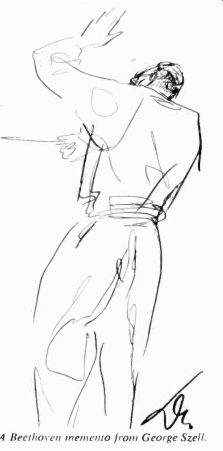
Now London has come up with a solution for this difficulty, with the use of a linking narration in German, based upon one devised by the poet Grillparzer for use in concert performances of the music. Most of the spoken passages are not long, but they do provide articulation between the musical numbers, some thing for them to mediate from and toward. I could wish that the spoken text had been omitted in those places where it overlaps the music, for we do not need this on records; for example, Grillparzer's description of Egmont's vision in prison could easily have been left to the liner notes, where it would not interfere with Beethoven's eloquent music. In this final scene, Wussow is not only narrator (in the left speaker) but ...
A Beethoven memento from George Szell.
...also Egmont himself (in between the speakers), and for once we get the full text of the final monologue, which is absolutely necessary to prepare the triumphant outburst of the Victory Symphony. Wussow unfortunately overdoes his delivery of this scene, lapsing into a variety of hysterical ranting that ill accords with the character's dignity and reserve; the threatening drum rolls, laid out across the listening space in typically spectacular London stereo, are also over produced-but this is still the only modern recording that shows what Beethoven intended with the Victory Symphony. Miss Lorengar is adequate, al though the tone is not well focused.
There is one further--and far from negligible--point: after a stiff, under-articulated reading of the overture, Szell gives what is far and away the best reading of the music on records. The Vienna Philharmonic has rarely sounded so fine: listen to the wind chordings throughout, or the hollow quality of the horn staccatos that open Clara's Death.
By comparison, the Karajan/Berlin version (not yet issued independently of the "Theatre Music" volume of the Beethoven, edition, DG 2720 011, a three-disc set also including the overtures) is flat and dull, and the various other versions are simply inadequate.
In short, one of the most valuable records to come out of the Beethoven year, and a splendid memento of the kind of craftsmanship and enthusiasm that marked Szell's music-making at its best.
D.H.
BEETHOVEN: Mass in C, Op. 86. Hanne-Lore Kuhse, soprano; Annelies Burmeister, contralto; Peter Schreier, tenor; Theo Adam, bass; Leipzig Radio Chorus; Gewandhaus Orchestra of Leipzig, Herbert Kegel, cond. Telefunken SAT 22512, $5.95.
There are three other versions of Beethoven's Mass in C, an old one with Beecham (a great performance, recently deleted); a good but not great one by Frederic Waldman on Decca; and a controversial one by Karl Richter on DGG which this reviewer found unsatisfactory.
There is, in this Mass, something slightly shrouded, oblique, and difficult to assess; it is a complicated and multi-leveled piece, part of it brilliant and al most Haydnish, part of it withdrawn and opaque. Telefunken's recording, for this reviewer, captures these qualities. Obviously Herbert Kegel is in sympathy with the work from the very beginning, and he finds the right approach, whether in the brilliant trumpet-dominated Gloria or the mystical Kyrie-the actual beginning of the work, in Kegel's hands, is breathtakingly beautiful. He has excellent soloists, and, of course, one of the oldest orchestras in Europe. I have never had the opportunity of hearing the famous Gewandhaus Orchestra live; obviously it is a great ensemble with a real sense of tradition. Every time I replay this beautiful record I find new beauties: it is an interpretation to live with, and its deliberate understatement grows on you. If you don't have the Mass in C and you like Beethoven, this is a great performance which will probably not be equaled for many years. H.C.R.L.
BEETHOVEN: Missa Solemnis, Op. 123. Martina Arroyo, soprano; Maureen Forrester, contralto; Richard Lewis, tenor; Cesare Siepi, bass; Singing City Choirs; Philadelphia Orchestra, Eugene Ormandy, cond. Columbia M2 30083, $11.96 (two discs).
Ormandy's performance of the Missa Solemnis is a well-paced reading with excellent soloists, and the recording is up to Columbia's highest standards. What is particularly noticeable, as you might expect, is the enormous sophistication in the orchestral playing, which is smooth as satin and well reproduced by the engineers. This is particularly the case in the Kyrie and the Sanctus, with that un believably poignant orchestral transition to the Benedictus--Beethoven treats these two movements, usually composed as two separate entities, as one section-which Ormandy plays with a beautiful instrumental color that rivals the old Toscanini set. The fine solo violin playing of Nor man Carol in the Benedictus ought to be singled out.
If this set had appeared twenty years ago, it would have been a sensation; if it had appeared even ten years ago it would have dominated the market, with only the Toscanini and the first Karajan set (Angel) as serious competitors. What has happened, then? There is, in fact, only one serious trouble with this beautiful set of records and that is the number and quality of the competition. Quite frankly, I do not think even his most fervent admirers would place Ormandy on the level of Otto Klemperer, nor does Ormandy approach Karajan's feline sophistication or brilliance of sound. If these two rivals (Klemperer, Karajan's two versions) were not formidable enough, there is also Leonard Bernstein, whose sheer physical explosiveness and drama would be hard to match, let alone excel. Also, Ormandy has less great soloists than Karajan;
Arroyo is not quite in Schwarzkopf's league on the old Angel set, nor even in Janowitz' on the DGG recording. All in all, I am afraid that in the Missa Solemnis Ormandy has too much competition.
H.C.R.L.
BEETHOVEN: Trios for Violin, Cello, and Piano: No. 1, in E flat, Op. 1, No. 1; No. 2, in G, Op. 1, No. 2; No. 3, in C minor, Op. 1, No. 3; No. 4, in B flat, Op. 11;
No. 5, in D, Op. 70, No. 1 ("Geister"); No. 6, in E flat, Op. 70, No. 2; No. 7, in B flat, Op. 97 ("Archduke"); No. 8, in B flat, WoO. 39; No. 9, in E flat, WoO. 38; Fourteen Variations on an Original Theme, Op. 44; Ten Variations on "Ich bin der Schneider Kakadu," Op. 121a; in E flat (1784) (in Angel set only); Quartets for Piano and Strings: in E flat, WoO. 36, No. 1; in D, WoO. 36, No. 2; in C, WoO. 36, No. 3 (in DGG set only).
Isaac Stern, violin; Leonard Rose, cello; Eugene lstomin, piano. Columbia M5 30065, $29.98 (five discs).
Pinchas Zukerman, violin; Jacqueline du Pre, cello; Daniel Barenboim, piano; Gervase de Peyer, clarinet (in Op. 11). Angel SE 3771, $29.90 (five discs).
Henryk Szeryng, violin; Pierre Fournier, cello; Wilhelm Kempff, piano (in the trios); Karl Leister, clarinet (in Op. 11); Christoph Eschenbach, piano; Amadeus Quartet (in the quartets).
Deutsche Grammophon, Beethoven Edition 2720 016, $35.88 (six discs).
Beethoven experimented with piano quartets in his earliest years as a composer and the results can be found, handsomely set forth, in the album listed above from the Deutsche Grammophon Beethoven Edition. But one suspects that before he was twenty he had decided that the piano trio was his preferred grouping of key board and strings for chamber music, and his later work concentrated on this form.
When I prepared my discography of the composer's chamber music for this magazine [May 1970], I complained of three things: that you could not acquire all the trios without buying one of the complete editions, that neither of the complete editions really was complete (since about a half dozen arrangements, as well as early and dubious works, are not represented on records), and that neither of the two editions then avail able was really as outstanding as it should be.
With the arrival of three new complete editions the situation changes, but not as much as you might expect. Two of the albums limit themselves to the nine canonical trios and the two sets of variations. Barenboim/Zukerman/Du Pre offer twelve trios with the last one numbered 14, proof enough that all the numbering of these works is capricious since Op. 1, No. 1 isn't even the first of the series. The Op. 11 trio exists in the conventional form and an alternative version in which a clarinet replaces the violin.
Stern will not yield to a clarinetist, so in that set we get an interesting contrast to the others which employ a wind instrument. However, since I believe the clarinet version is most representative of the composer's intentions, purchasers of the Stern album might consider a companion recording of this work: the admirable performance by Kell on Decca (using a modern instrument) or Honingh's version (with an instrument from 1800 and a 1825 Broadwood piano) on Telefunken.
Of the older albums, that of the Beaux Arts Trio (World Series) remains a legitimate bargain if one willingly al lows for its uneven qualities, and for the dollar conscious, the appeal of the Columbia set may be dimmed if one al ready owns two of these performances on single records. One hopes that a re packaging in terms of individual discs will be offered in addition to the present album format.
The decisive factor in considering these new albums is that of style. This music comes from the period 1784-1817; indeed seven of the twelve works belong in the eighteenth century. Clearly this is chamber music of the classical period and these works should be represented in that light.
---------------72 Isaac Stern, Eugene Istomin, and Leonard Rose-a trio for the classical Beethoven.
Discussing the Beethoven symphonies in the December 1970 issue, Paul Henry Lang pointed out that they were free of the element of Romantic improvisation and consistently revealed "the logical and consequent manipulation of the thematic material" that, as he sees it (and I fully agree) "was the classic symphonist's main creed." The development of this idea produces performance standards in fairly precise terms. It makes clear that performances which tend to conceal the "logical and consequent manipulation of the thematic material" and convey instead a romantic, improvisatory character may be presumed to be at variance with the composer's intentions.
The Romantics, of course, have always tried to claim Beethoven as one of their own. E. T. A. Hoffman, one of the first prophets of Romanticism, wrote in 1810 (the year of the Archduke trio), "Beethoven is a pure Romantic and because of this a truly musical composer." There is no question that many performers and listeners have shared these sentiments and have concluded that in a Beethoven performance the quality of feeling surpasses all other considerations. I have been beguiled myself by Romantic performances which, to quote my discography of 1960, offered "a persuasive and consistent development of a point of view reconcilable with the score Beethoven left us." But it is one thing to find Romanticism in a score and another to say that Beethoven regarded it in that light. Lang's arguments are thus the ones that must prevail in any discussion that separates musical scholarship from mat-
leis of personal taste. So much for preliminaries.
The Istomin/Stern/Rose Trio gives us an edition occasionally touched by Ro mantic nuances but more classical than anything else, hence the closest to what I take to be the style Beethoven himself intended for this music. 1 he Kempff / Szeryng/Fournier set is basically Roman tic, but the work of mature, disciplined artists who make a good case for their interpretive ideas. The Barenboim/Zukerman/Du Pre edition is not so much Romantic as sentimental, the sort of sticky-sweet music one imagines best presented to an audience of dear old English ladies wearing Queen Mary hats who are certain to applaud the performers for their youth, talent, and the feeling with which they play. Its appeal, in short, is strictly limited to those who like treacly chamber music.
The reader can gauge the three sets (and be his own critic) very quickly by simply playing the scherzo of the Arch duke. In the Istomin/Stern/Rose performance he will first note that the tempo is a good one, that the force and vitality as well as the humor of the music is projected well, and that the players establish at once a firm rhythmic foundation that is sustained throughout the movement. The playing is brilliant:
the three instruments well scaled to one another dynamically, and the textures are open and clear. The phrasing is strong, stylistically appropriate, and uni form throughout the group. The contrasting central portion of the movement with its lower dramatic intensity and broader thematic material becomes a logical continuation of what had preceded it, phrase outlines remain firm, and there is no loss of thrust or interpretive focus. The movement is brought to a splendid conclusion.
In the Kempff/Szeryng/Fournier set the playing also has brilliance, but at tacks are softer and, indeed, the entire performance exhibits rounder, more polished edges with a gentleness and warmth in place of bravura. There is more room for expressive nuance in the themes be cause the rhythm is less propulsive and the sense of forward motion consequently less intense. The performance is more obviously filled with feeling, but it is less exciting; I come to suspect that this manner of performance does not actually grow from Beethoven's music but has been thrust upon it, that "the logical and consequent manipulation of the thematic material" is best represented in the Columbia album.
The Barenboim/Zukerman/Du Pre set begins with a burst of energy, but it turns out to be short-winded. No strongly sustained rhythmic line is developed.
The middle section brings interpretive problems. In this group the string players both appear to turn to the piano for leadership (which is not the case in the other groups), and in the broader phrases the group seems without an interpretive commitment-except to play prettily. The cello flounders with flabby, melting phrases that lack any strong sense of meter or thrust, and the group seems simply to wallow in sentiment until the piano restores some sense of movement and direction.
It would be a deceptive oversimplification to suggest that the same process is repeated in each movement of these works, but this is the general idea.
Here are some off-the-cuff notes on the twelve works following a convention al (but not truly chronological) sequence:
Trio in E flat, Op. 1, No. 1. Obviously an eighteenth-century piece. I/S/R offer a bright, lyric performance that moves forcefully with a firm sense of pulse and sings out joyfully. The K/S/F performance does not move nearly as well and tends to get bogged down in big expansive phrases unsuited to the style.
B/Z/D do not offer an especially well balanced or attractive sound; the role of the strings is too passive; and the melodic flow lacks sparkle.
Trio in G, Op. 1, No. 2. I/S/R offer once more lightly flowing phrases graced with laughter. There are no comparable drolleries in the B/Z/D performance which comes to you with a tear-stained face and starts to melt. K/S/F offer a performance too broad and ripe in manner to suit the period.
Trio in C minor, Op. 1, No. 3. The I/S/R set was released previously and has been the standard edition for some time. Neither the B/Z/D nor the K/S/F set is a serious rival since both lack the youthful panache the work requires.
Trio in B flat, Op. 11. K/S/F offer the clarinet version in a strongly phrased performance that is effective in terms of its Romantic outlook. B/Z/D in contrast seem rather droopy. I/S/R offer the most persuasive account I can imagine for the variant violin version. Stern's playing has true elegance.
Trio in D, Op. 70, No. 1 ("Geister").
This is middle-period Beethoven and hence can take the somewhat ripe, expansive treatment K/S/F provide, but I/S/R still offer the most powerfully shaped and fully controlled phrasing and thematic flow--its sustained intensity produces more dramatic results. The B/Z/D performance drips on the floor.
Trio in E flat, Op. 70, No. 2. The work demands the strong control of lively accepted phrases, the sort of thing I/S/R seem to do as second nature.
K/S/F provide a nice sense of motion and another convincing romantic performance. B/Z/D give the impression that all the life of the performance is concentrated in the piano part.
Trio in B flat, Op. 97 ("Archduke").
The I/S/R set has been the dominant stereo edition for some time, and I see no reason to change.
Trio in B flat, WoO. 39. The B/Z/D version again sounds an awful lot like a piano solo. K/S/F offer a performance that misjudges the style for this period; I/S/R get it deliciously right.
Trio in E flat, WoO. 38. An early work, demanding a crisp eighteenth-century manner. K/S/F are unconscionably slow and rather affected, while B/Z/D opt for a rather brisk pace that is at least momentarily interesting. But they phrase like a music box. I/S/R are energetic, well-accented, brisk-right on target.
Trio in E flat (1784). Scarcely more than three minutes of music, this sounds like a teenage Beethoven with good ideas effectively set forth and developed-al though none too daringly. The piano dominates the performance.
Fourteen Variations, Op. 44. As I/S/R play this music, it is Beethoven touched by the grace and wit of his days as a young man in Vienna. The B/Z/D performance seems heavy in contrast; the K/S/F version somewhat pedestrian.
Ten Variations ("Kakadu") Op. 121a.
This is really Beethoven in what he called his unbuttoned humor, and the I/S/R performance projects it with a joyous lack of inhibition, even to a few rude noises. K/S/F, in contrast, confine their humor to drawing-room standards, and B/Z/D, very proper young people, tone everything down to genteel manners.
One final word. The DGG album also contains the piano quartets on one record. Hope for its release as a single. The performances are excellent. R.C.M.
BEDFORD: Music for Albion Moonlight --See Lutyens: And Suddenly It's Evening.
BERLIOZ: Songs with Orchestra: Les Nuits d'ete, Op. 7; La belle voyageuse; Le Chasseur danois; La Captive; Le jeune patre breton; Zaide. Sheila Arm strong, soprano; Josephine Veasey, alto; Frank Patterson, tenor; John Shirley-Quirk, baritone; London Symphony Orchestra, Colin Davis, cond.
Philips 6500 009, $5.98.
The bibliography of Berlioz' songs is extremely confusing because of the composer's practice of gathering together assorted works of different vintage for publication in collections and his habit of orchestrating the odd song now and then, usually for use in one of his concerts. Aside from Les Nuits d'ete, no group of Berlioz songs demonstrates any sort of cyclic or poetic unity, nor did Berlioz orchestrate any other group in its entirety. Suffice it to say that the present disc contains all of the songs arranged for solo voice and orchestra by the com poser and for the first time on records presents the Gauthier cycle sung by different voices rather than by a single soprano.
Aside from obviating the need for transpositions such as marred the Steber version, this adherence to the composer's instructions certainly casts the characters of the individual songs into great relief.
Unfortunately, not all the singing in the present version is completely successful.
John Shirley-Quirk does not sound at his best in Sur les tagunes--the tone is pushed and out of focus, especially in the lower registers-while Sheila Armstrong suffers from some insecurity of pitch. On the other hand, Josephine Veasey is extremely eloquent in Le Spectre de la rose, and Frank Patterson brings a pleasant "Irish" tenor (1 am speaking of vocal type, not nationality) to Villanelle and Au cimetiere. Davis asks, generally, for very slow tempos, and these may have some thing to do with the vocal problems; al though the orchestral detail is superbly realized, 1 am not certain that, as a whole, these performances "come off." Overside, there is one song from the Irlande cycle (cf. the piano version, sung by Helen Watts on Oiseau-Lyre S 305), a spirited hunting song with a sad finale (Shirley-Quirk sounds much more comfortable here), the elaborate setting of Hugo's La Captive (Veasey again demonstrating her fine feeling for the Berlioz line), the quiet melancholy of La jeune pchre breton with its luscious horn obbligato, and the cheery bolero Zaide. The last three of these were once recorded by Eleanor Steber (the original coupling for her Nuits d'ete), but the present versions seem preferable; I do not know of any previous commercial recordings of La belle voyageuse or Le Chasseur danois in their orchestral guise.
Texts and translations are included, and David Cairns provides illuminating liner notes.
D.H.
BLOCH: Schelomo; Voice in the Wilder ness. Janos Starker, cello; Israel Phil harmonic Orchestra, ' Zubin Mehta, cond. London CS 6661, $5.98.
This record appropriately couples Ernest Bloch's popular Schelomo rhapsody with the only currently available recording of his other major symphonic work for cello and orchestra, Voice in the Wilderness. Whereas Schelomo pursues its rhapsodic course with a single-mindedness of musical impulse, the sectional construction of Voice in the Wilderness produces greater expressive variety. In both works Bloch's extrevertedly expressionistic language calls for rich and colorful orchestral playing, an expansive solo style, and emotionally motivated direction by the conductor.
Janos Starker has always been one of the most patrician of our concert instrumentalists; he never allows his firm, warm tone to betray any hint of harsh ness or inaccurate intonation, and his phrasing and musical intelligence are counterparts of his sonic sense. Some may prefer a more expansive solo performance with richer and more varied tone, even at the risk of perfect intonation and refinement of timbre. The rather unbridled style of Rostropovich and Du Pre seems to enjoy greater vogue today, but Starker's more disciplined approach may, in the long run, produce greater musical returns.
Certainly Starker's performance here is a perfect foil for Mehta's exuberant direction of the orchestra. Though never directly at odds, the interplay of solo and orchestra creates a tension that con tributes much to the impact of both works. Time and again Mehta takes off from one of Starker's intensely contained statements in colorful and fanciful flight, only to subside and allow the spotlight to return to the solo.
If there is a flaw in this record, the fault lies with the Israel Philharmonic itself, which on more than one occasion makes sloppy attacks and reveals imprecise ensemble. Nor is the full sonic detail of Bloch's mighty climaxes as sharply defined as the scoring calls for.
In such matters it is not always possible to ascertain whether the blame lips with the conductor or orchestra, but such shortcomings from Mehta's best records with other orchestras, notably his own Los Angeles Philharmonic and the Vienna Philharmonic. P.H.
CARTER: Quartets for Strings: No. 1; No. 2. The Composers Quartet. None such H 71249, $2.98.
Elliott Carter's two string quartets, writ ten in 1951 and 1959, form a frame for the composer's musical development during the 1950s. And viewed from the vantage point of 1971, it seems clear that they represent not only milestones in Carter's own compositional career but key works taken in the context of the period as a whole. The first Quartet was the earliest major work by Carter to incorporate, in fully developed form, ideas that brought about a radical change in his music; the Second Quartet shows the integration of these ideas into what amounts to a completely new musical language.
What is involved, I think, is nothing less than the development of a new kind of musical continuity. This was brought about, at least initially, by experiments in rhythmic and metrical relationships which began to make themselves felt in Carter's music as early as the late 1940s. And it is in the rhythmic realm that one is most clearly aware of the innovative characteristics of the First Quartet. For here, although the rhythmic flow suggests a new sense of musical order, there is a sufficient residue from Carter's earlier neoclassicism--particularly in regard to the melodic and motivic structure--to make the piece seem a kind of Zwischending, with one foot in the past and one in the future. One might say that the technique looks for ward but that the "rhetoric" is still essentially traditional. The Second Quartet shows the completion of the process of transformation: all aspects of the music have come into the service of a radically new musical conception.
------------- The Composers Quartet--a remarkable performance of Carter's quartets for Nonesuch.
What is particularly striking, however, is that although Carter managed to "keep abreast" with the revolutionary musical developments characteristic of the 1950s he did so strictly on his own terms. One of the most significant developments in the music of the younger composers of that time was the destruction of the traditional metric system, which they viewed as an obsolete holdover from the functional tonal system of the eighteenth and nineteenth centuries. They accomplished this for the most part simply by giving up the idea of the strict measurement of musical time; complex, non-metrical temporal relationships were achieved by permitting the performers to move within a free, "unstructured" time-field. Complexity, in other words, was gained at the cost of precision. What Carter did. on the other hand, was to bring about an analogous rhythmic revolution from "within": that is. he too went beyond the metrical principle--not, however, by destroying it, but by extending and transforming it to a point where it became something essentially new and different. His principle of "metrical modulation" opened up a means of rhythmic development which made possible a kind of flexibility in some ways analogous to the developments among the younger composers. but it was achieved within a precisely conceived structural principle ultimately derivable from traditional compositional procedures.
It is this sense of the new as an extension of the old that impresses itself most upon the listener of Carter's quartets. And I would argue that the solid structural foundation on which this music rests lends it a durability far beyond that of most of the music of this period.
T[here is, of course, a price to be paid: both quartets, and particularly the second, are extremely difficult to perform.
I was once told by a friend-the first violinist in a quartet that has played both of these pieces, and played them well-that he didn't think the results justified the enormous effort required.
As he put it, "one can get similar effects through less complicated means." That was ten years ago, and even then I was skeptical. Now I am more convinced than ever that it is only from a quite superficial viewpoint that the effects of Carter's music seem comparable to those of many of his contemporaries; in substance the music is totally different. And the most telling difference is: Carter's is a music that increases in interest as the listener increases his knowledge of it; the effects do not "wear out" in the course of increasing familiarity.
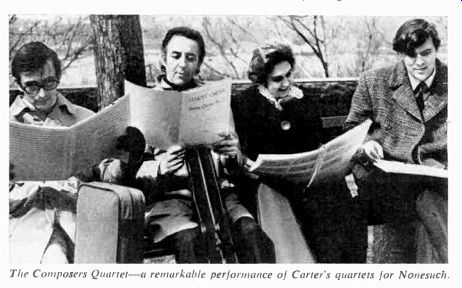
This brings me to Nonesuch's new re cording of both quartets performed by the Composers Quartet. It is a remarkable disc. 'The players have done much more than simply overcome the technical difficulties of these pieces, a prodigious accomplishment in itself; they have gotten to the very heart of the music, presenting it in what I can only describe, at least for the moment, as "ideal" performances. The balance between the four parts--the difficult but critical matter of proportionate weight-is delicately maintained throughout; and the sense of over-all shape is convincingly achieved without sacrificing the sheer beauty of tile transitory moment. Both these quartets have been previously recorded, the first by the Walden Quartet and the second by the Juilliard. The Walden's First Quartet (on Columbia) is still listed in Schwann, but 1 suspect that it will short ly be deleted. And in any case, although certainly a serviceable rendition, it is clearly superseded by the present disc.
The Juilliard Second Quartet (on RCA) is no longer available. It was a remark ably precise performance and also a very exciting one. Yet it lacked the sense of complete assurance-a sense of the performers having lived with and absorbed this music over a long period of time-which this new version so impressively communicates. The Composers Quartet reading consequently seems less strained and. as a result. I find that it is able to project the underlying logic of the music more successfully. But doubtlessly the listener who was interested enough to buy either or both of the earlier versions will certainly want these new ones. They rank with the best performances of new music I've had the pleasure of hearing, on record or otherwise. R.P.M.
DEBUSSY: Pelleas et Melisande. Elisabeth Soederstroem (s), Yvonne Minton (a), George Shirley (t), Donald Mac Intyre (b), David Ward (bs); Chorus and Orchestra of the Royal Opera House, Covent Garden, Pierre Boulez, cond. For a feature review of this re cording, see page 63.
DODGE: Earth's Magnetic Field. Computed electronic sound. Nonesuch H 71250, $2.98.
----- Charles Dodge-music of the spheres?
To oversimplify somewhat the notes that come with this record (and which themselves doubtless oversimplify an extremely complex phenomenon), the earth's magnetic field varies in response to the emanation of cosmic energy known as the solar wind. It is measured every three hours at a series of stations throughout the world, and the readings of these stations are recorded on a special graph which looks vaguely like a lute tablature. Hence this work, wherein the pattern of the graph for the year 1961 has been turned into music. Bruce R. Boller, Carl Frederick, and Stephen Ungar did the scientific work that was necessary and the composer Charles Dodge presided over the musical end.
The result sounds like a mild. Meditative, amiable but somewhat desultory improvisation on a mouth organ about four miles long. There is very little variety of tone; the metallic reed-organ sound is frequently topped off with something like the shriek produced by feedback in a public address system, but even this is good-natured. There is little layering of textures in either the harmonic or contrapuntal sense, and when there is. the piece tends to get a bit out of hand. The whole thing is interesting, by no means intellectually difficult or problematical for the listener, but the composition of music is always most successful when its form is dictated by musical considerations; when its form is conditioned by purely adventitious considerations. as is the case here, the results are bound to be less successful, even though this work brings one as close as one is ever likely to get to the proverbial music of the spheres. A.F.
HANDEL: Giulio Cesare. Tatiana Troyanos (ms), Julia Hamari (ms), Peter Schreier (t), Dietrich Fischer-Dieskau (b) Franz Crass (bs), et al.; Munich Bach Choir and Orchestra, Karl Richter, cond. For a feature review of this recording, see page 65.
HAYDN: Missa in tempore belli ("Paukenmesse").
HAYDN, M.: Ave Regina. April Cantelo, soprano; Helen Watts, contralto; Robert Tear, tenor; Barry McDaniel, bass; Stephen Cleobury, organ; St. John's College Choir, Cambridge; Academy of St. Martin-in-the-Fields, George Guest, cond. Argo ZRG 634, $5.95.
Argo has now completed its series of late Haydn Masses and, on the whole, it was a courageous undertaking, seeing that Haydn is. all things considered.
a box-office failure. The case of Haydn, altogether, is a very curious one in the history of music. From being the set teeento's most popular composer, adored and revered in London or Vienna, Paris or St. Petersburg. he was soon to be come. in Robert Schumann's callous words, a composer whose "music means nothing to us any more." The reasons for this spectacular decline and fall are too involved to be discussed in a review of this kind; but suffice it to say. Haydn has never recovered from his fall from grace. To a very tiny few his music speaks with the same freshness, urgency, and sense of "commitment" (as they say nowadays) that it did 200 years ago: to the large majority, his music is second-rate Mozart and third-rate Beethoven.
For the tiny few, then, this review is written. Probably anyone who has read this far already owns a recording, for there have been several since the historic one by Gillesberger twenty years ago (that long!) for the Haydn Society.
Gillesberger has made a second version, not so good as the 1950 recording; Woldike's recording for Vanguard is also rather old; and Kubelik's for DGG was badly recorded and not a very distin guished performance. By far the best was the Angel record of 1967 conducted by David Willcocks, and with the King's College Choir of Cambridge.
The new record does not measure up to its rival from the other college at Cambridge. King's has better soloists in the important parts (Heather Harper, Alexander Young, and John Shirley-Quirk), a better recording, and what is most important a far better performance.
George Guest is good, solid, and re liable but without any spark of genius.
And to clinch the matter, the filler on the Angel is a fabulous chorus from Haydn's oratorio, il Ritorno di Tobia, not otherwise available (this piece would be world-famous if it had Mozart's name attached to it) whereas the Michael Haydn Ave Regina on Argo is an Interesting Historical Work, in the stilo vecchio, a deliberate imitation of the old a cappella Palestrina style.
For the even tinier part of those read ers who may be interested to know which version of the two authentic scores were employed in the various recordings, the Urfassung (without the solo clarinet at the beginning of the Gloria, for example) has been used by Woldike, Gil lesberger I and II, and Kubelik; the revised version is used by Angel and the new Argo record. H.C.R.L.
HINDEMITH: Kleine Kammermusik, Op. 24, No. 2-See Schubert: Trio for Vio lin, Cello, and Piano, No. 1, in B flat, C. 898.
HODEIR: Anna Livia Plurabelle. Monique Aldebert and Nicole Croisille, voices; Hubert Rostaing, clarinet; Raymond Guiot, flute; Jean-Luc Ponty, violin; Roger Guerin, flugelhorn; Michel Portal, alto saxophone; Bernard Lubat, vibra phone; Pierre Cullaz, guitar; Pierre Michelot and Guy Pedersen, bass;
Christian Garros, Daniel Humair, Franco Manzecchi, and Roger Fugen, drums; Andre Hodeir, cond. Philips 900255, $5.98.
There is a surface logic in setting Joyce to music in jazz terms. His improvisations with words have more than a passing kinship to the exploratory improvisations of a jazz musicians. And in this setting by Andre Hodeir, Joyce's words and Hodeir's music prove warmly complementary.
Hodeir has divided the Anna Livia Plurabelle passage from Finnegans Wake between two female voices, alternating them in lines that are sometimes spoken rhythmically or sometimes sung, and occasionally bringing them together or using them as individual musical lines with the clarinet, the flute, or the violin as these instruments emerge from the ensemble to take a solo. The basic style is a mixture of the vocalese of the Swingle Singers and the technique developed by Jon Hendricks for filling out lines that had originated as instrumental solos with words.
The two singers. Monique Aldebert and Nicole Croisille, become, in effect jazz soloists as they phrase and inflect Joyce's words. Miss Aldebert is called on for prime displays of virtuosity as she takes off on high, rapidly articulated sections that often approach scat singing (although only one brief section by the two singers is actually done in scat: otherwise Hodeir has adhered to Joyce's text). Miss Croisille's dark, throaty voice provides a balance for Miss Aldebert's high flights even though their voices are quite similar in the spoken sections.
The record sleeve includes the text used by both singers as well as Joyce's original. But the over-all effect is much more interesting if one ignores the text and just lets the structure take precedence.
the Joycean sounds supported by Hodeir's music which is sometimes extended by Roger Guerin's singing, trombone-like flugelhorn passages: by Jean-Luc Ponty's violin and Hubert Rostaing's clarinet as they become entwined over a slinky, sinuous beat: or when one of the four drummers (presumably Daniel Humair) bursts out with some breaks that launch the ensemble on a singing surge of sound.
It is to Hodeir's credit that Joyce remains the focal point throughout.
Hodeir's music, viewed as jazz, is the polished, capable, impersonal work that one would expect of good studio musiclans, spiced with an occasional solo. It rarely becomes more than a supportive setting, deepening the colors of Joyce's text but never dominating it. J.S.W.
KAGEL: Ludwig Van. William Pearson, baritone; Carlos Feller, bass; Saschka Gawriloff and Egbert Ojstersek, violins; Gerard Ruymen, viola; Siegfried Palm, cello; Bruno Canino and Frederic Rzewski, piano. Deutsche Grammophon 2530 014, $5.98.
Ludwig Van is a spin-off from a film of the same name created by Kagel to com memorate the 200th anniversary of Beethoven's birth. This film has received much publicity and no small amount of notoriety, and a brief description of its content and tone should serve as a help ful introduction to my remarks on the recording itself. Briefly, the film presents a sort of "sentimental journey" made by Beethoven to his birthplace, Bonn. What he sees, however, is not his Bonn, but the Bonn of today: and what Kagel has tried to present to us in his film is our present-day view of Beethoven, as seen through Beethoven's own incredulous eyes. What emerges is not the "true" Beethoven, but a shiny, plastic reflection of him seen in the distorted, fun-house mirror provided by the contemporary commercialization of art.
The film was premiered in Vienna during the 1970 Festwochen, which were devoted primarily to Beethoven. Tit: Viennese audiences were incensed, for they viewed the film as an attack on Beethoven himself. Clearly what was in tended, however, was not an attack on Beethoven but on our "use" of Beethoven. The film has been made, in fact, by a musician who has the highest regard for the composer and an intimate knowledge of his music. And I would suggest that this recording, which presents one possible realization of the musical idea behind the over-all conception of the film, bears out this contention. In this version of Ludwig Van, Beethoven's chamber music (including the solo piano music and the songs) is subjected to a kind of decomposition-or rather a re-composition in terms of the contemporary musical experience. But here Kagel, rather than taking the essentially negative stance of the film, is trying to show the relevance of Beethoven as a living musical force in the light of present-day compositional procedures. All the notes in the piece-the total "sound source" are derived from the master: and in deed, with the negligible exceptions, no new notes whatever have been added.
But the original music has been fragmented, recorded, and in general placed out of context so that it is heard in radically new terms. The listener is apt to take one of two positions: either he will find the results an unforgivable per version of the original Beethoven, or he will be fascinated by the new view of Beethoven offered to him by Kagel.
Since I fall into the second camp, I wish to state straight off (and at the risk of seeming defensive) that I consider my fascination as being in direct correlation with my love and admiration for the original. Indeed. I am inclined to say that it is only due to my respect for Beethoven that I am moved by what Kagel has done to him. He has made explicit an aspect of Beethoven's music which I have always suspected: that there are relationships hidden within it that are as much a part of my world as they were of his.
The "violence" which Kagel does to the original takes various shapes. First of all, no pieces are presented in complete form (although some are heard unaltered for considerable stretches of time). Also. in dependent fragments are played simultaneously, and such things as tempo relationships. accelerandos. and dynamic variations arc exaggerated to the point of total distortion. There is also some mild electronic manipulation: passages are allowed to fade in and out and in general there is an intensification of the kinds of distortion that always occur in recording. The musical fragments chosen are for the most part well known, so that one is constantly aware of viewing the familiar in unfamiliar perspectives. The piece, in other words, is a collage, but one of a very special species. While in most recent collage compositions one is given brief glimpses of the familiar in what is essentially a foreign landscape, here the entire "region" is Beethoven, but a Beethoven seen through the focus of present-day vision.
A couple of examples may help to clarify just what Kagel is up to. A particularly cogent one is a segment lasting some four minutes based entirely on the slow movement of the Piano Trio, Op. 70, No. 1--the so-called Geister (Ghost) Trio. Kagal considers this an early in stance of "expressionism," and he has attempted here to emphasize the expressionistic characteristics in the music. All three instrumentalists play passages de rived from this one movement, but what they play is not "synchronized," nor is the order of occurrences the same as that of the original. What emerges is an even "ghostlier" trio-one which quite literal ly has become "disembodied." Then to cite one humorous example: near the end of the recording the music suddenly breaks off and we hear the musicians (in this case the four members of a string quartet) discussing the performance problems of the passage about to be played. They then tune, decide on a tem po. and after a false start, take off on a hilarious rendering of the opening of the presto movement of Op. 131. Here every thing is in sequence and all players start at the beginning of the movement; but things keep getting slightly out of phas.:.
There are also various perversities in re gard to tempo, articulations, expressive nuances. etc.
But I'm afraid that description isn't really the answer. Put simply, you must hear it to believe it. I don't doubt that many will be infuriated by what they hear. Still. I would urge you to approach Ludwig Van with open ears. You might not only come away with a fresh and challenging musical experience but you might gain an enhanced appreciation of Beethoven himself. I think I did.
-R.P.M.
LUTYENS: And Suddenly It's Evening. BEDFORD: Music for Albion Moonlight. Jane Manning, soprano (in the 8c-L ford); Herbert Handt, tenor (in the Lutyens); members of the BBC symphony Orchestra, Herbert Handt, cond. (in the Lutyens); John Carewe, cond. (in the Bedford). Argo ZRG 638, $5.95.
Exactly why England should have emerged as a bastion of contemporary musical creativity is a mystery to me certainly America has nothing comparable to match the accomplishments of Goehr, Bennett. Davies, Birtwistle, Maw, Bedford, Cardew, just to name a few of the younger composers. While neither of the two "night pieces" on this disc may be imperishable masterpieces, each is an absorbing work by two major British composers and should be acquired by anyone interested in today's music.
Elisabeth Lutyens belongs to the older generation (she was born in 1906); but unlike Britten, Tippett, or Walton, she has chiseled a terse twelve-note style partly out of the Schoenberg/Webern experience and partly out of sheer will power. Her most recent works have the security and purposefulness of a com poser who has found her own voice: And Suddenly It's Evening (1967) is a serene, economic score of great beauty and potent imagery. The four Salvatore Quasimodo settings are framed by instrumental pieces that create a Bartokian nocturnal atmosphere of tapping wood-blocks and swashes of harp and celesta, with comments from a second choir consisting of violin, horn, and cello. A third instrumental group, brass quintet and double bass, supply the solid chordal underpinning for the vocal line, a rhapsodic declamation of fluid, conjunct expressivity. Herbert Handt, as both singer and conductor, leads a most sensitive performance.
David Bedford (born in 1937) conjures up an altogether blacker musical night of eruptive violence based on four poems by Kenneth Patchen. The pre dominant mood is bitter and apocalyptic ("beautiful flesh blown to hell... our killdom's crime man's will be done; as he was in the beginning so shall he end, in slime"), but with a soothing Hofmannsthalesque ending of physical union. This is a relatively static "sound" piece, but the colorful textures, partially dictated by aleatory procedures, are ingenious (the instruments involved are flute, clarinet, violin, cello, alto melodica, and piano). Jane Manning is called upon to provide an intensely dramatic half-spoken, half-sung recitation and she turns in a virtuoso piece of work. Perhaps the appeal of this music lies somewhat on the surface, but it provides twenty minutes of gripping listening nonetheless.
The sound on Argo's pressing is crystal line and texts are supplied for both works.
-P.G.D.
MENOTTI: The Old Maid and the Thief. Judith Blegen (s), Laetitia; Margaret Baker (s), Miss Pinkerton; Anna Reyn olds (c), Miss Todd; John Reardon (b), Bob; Orchestra of the Teatro Verdi di Trieste, Jorge Mester, cond. Mercury SR 90521, $5.98.
Menotti's second opera, The Old Maid and the Thief, was first heard over the NBC network Aprill 22, 1939. Although specifically devised for radio, the work does not really use the medium in an especially outré fashion, any more than Lorenzo Jones or Ma Perkins did. The fourteen short scenes work out very nicely on stage and The Old Maid has since become an extremely popular one-act curtain-raiser for amateur or semi professional groups.
Unlike Menotti's serious operas, which still strike me as essentially shoddy and pretentious stuff, the composer's comedies seem to succeed in accomplishing precisely what they set out to do. In this case Menotti has taken a number of familiar opera buffa types-a foolish love-struck old maid, a saucy young maid, a snoopy neighbor, and a romantic harlequinesque hobo-places them in a "typical American town" setting, and puts them through the same routines that have worked for centuries. Of course the youngsters get together and make a fool out of the old maid who is left blustering at the final curtain. The Peyton Place atmosphere of frustrated sex may seem a bit dated and the underlying current of cruelty is not altogether pleasant, but these too were essential ingredients of commedia arte. No matter-the music is consistently clever, tuneful, and cheerful, and any objections are already taken care of by Menotti himself in the disarming program note he has supplied for this sprightly recording.
The performance is a fine one. Anna Reynolds' slight English accent seems wholly appropriate for the duped, up tight Miss Todd and she invests the part with flavorsome character while never neglecting to give the notes full musical value. Margaret Baker may never make a Gilda but her acid soprano and lip-curling delivery are perfect as the gossipy Miss Pinkerton. Judith Blegen and John Reardon each have good lyrical oppor tunities and they make fine capital from them. The production is modest but lively and Mester keeps things moving briskly. In addition to Menotti's bit of nostalgia, Mercury's handsome album contains a historical note by James Lyons and a complete libretto. Altogether a delightful piece of work from everyone concerned. P.G.D.
MILHAUD: Pastorale for Oboe, Clarinet, and Bassoon-See Schubert: Trio for Violin, Cello, and Piano, No. 1, in B flat, D. 898. MOZART: Concert Arias: Ch'io mi scordi di te, K. 505; Vado, ma dove?, K. 583; Alma grande e nobil core, K. 578; Nehmt meinen Dank, K. 383. STRAUSS, R.: Lieder: Ruhe, meine Seele; Meinem Kinde; Wiegenlied; Morgen; Das Bach lein; Das Rosenband; Winterweihe. Elis abeth Schwarzkopf, soprano; Alfred Brendel, piano (in K. 505); Edith Peine mann, violin (in Morgen); London Symphony Orchestra, George Szell, cond. Angel S 36643, $5.98.
Mozart's concert arias remain one of the least explored yet most rewarding corners of the repertory. Many of them, espe cially the later ones, are every bit as fine as the great numbers in his operas, and the reluctance of singers to program them (especially in solo dates with orchestras) is deplorable. Mme. Schwarz kopf brings us two of the better-known examples (K. 383 and K. 505) and two that are rather less familiar-and I'm sorry to have to say that for the most part this record is about ten years too late. Much of the singing here has more to do with the current state of the Schwarzkopf voice than with the music or the text: the crooned, covered tone, distorted vowels, and cautious fioritura all stand in the way of convincing projection of these arias despite the evident intelligence and care that has gone into the performances. Easily the best is Nehmt meinen Dank, in which the vocal demands (alleviated by a downward transposition) are not so strenuous as to impede communication. Szell's accompaniments are, of course, a model, and the piano obbligato in K. 505 has cer tainly never been played as stylishly as by Alfred Brendel.
The reverse side, devoted to seven Strauss songs in orchestral settings by the composer (I cannot locate Ruhe, meine Seele in the Strauss catalogue, but the liberties taken in this orchestration would seem to preclude the hand of anyone else), is more successful. Mme. Schwarz kopf is not as severely tried by some of these, although a comparison of Wiegen lied with her version of fifteen years ago (Angel 35383, with piano) is not very flattering; she usually avoids competing with her younger self in this way. But the real value of this side, to my mind, is the superb playing of these very fancy orchestrations by the London Symphony, under Szell's knowing hand; Strauss hardly ever does a purely mechanical orchestration for standard ensemble, and it is apparent that in each of these songs he set himself some particular task.
Meinem Kinde uses two flutes, two bassoons, and a quintet of solo strings, while the Wiegenlied becomes a study in staccato, with two harps and seven solo string parts as well as double winds and a normal string section. At least in the orchestral version some of these are first recordings and are recommended to all students of instrumentation for study.
The recording is not as clear as it might be, perhaps because of the special problems presented by the singer. Texts and translations are provided.
D.H.
SCHUBERT: Sonatas for Piano: in A, D. 664; in A minor, D. 845. Lili Kraus, piano. Cardinal VCS 10074, $3.98.
Artists who put stress on improvisatory freedom often fare less well on record than in the concert hall. Mme. Kraus is a case in point: few of her recorded performances capture the miraculous balance between classical poise and expressive fire that characterizes her best live work. This one-or at least part of it-does.
She turns in a triumphantly successful account of the long, difficult A minor Sonata (the one which used to be known as "Op. 42"). This music is notoriously difficult to hold together convincingly.
The first movement uses its motivic con tent in a way that can seem loose, epi sodic, and even repetitive in performance.
The following theme and variations, if not superbly balanced between stringent discipline and luxuriant, rhapsodic fancy, will sound like an impromptu gone to seed. Then, as so often happens in large-scaled Schubertiana, the third and fourth movements can sound anticlimactic, dif fuse, and sometimes downright unsettling.
Kraus approaches the music in the manner of an expressionist painter. She works boldly and freely with large dabs of color, stressing the asymmetrical pat terns and bar lines, shifting emphasis from one voice to another, and highlighting the strange harmonic turmoil. Her grasp of the over-all structure is so acute that it enables her to change tempo and bend the rhythm without forsaking for ward continuity. Her brusque energy, I hasten to add. is counterbalanced here by an almost bejeweled grace and elegance.
She observes the long repeat in the first movement omitted by Kempff on his most recent Deutsche Grammophon version of the work.
A comparison of the new Kraus record with Kempff's and Richter's elderly Monitor edition is instructive. There is no question of stylistic superiority, for all three players are specialists in this literature. Richter, of the three, is the most literal. He adheres to basically strict metrical configurations but is so luxuriant technically and so attentive to miniscule detail that the effect he produces is one of supreme balance, order, and authority-he permits the music to speak for itself. Kempff is slightly terser, though still essentially rigorous and clas sical in his outlook. His bright, sec tone gleams with prismatic brilliance, and one sees the music through Beethovenian eyes. Kraus, as I have indicated, is the most rhapsodic and dramatic-with her you are right into the world of Winter reise and the other great Schubert songs.
Any one of these discs would be an asset, but I believe my affections are divided between Kempff and Mme. Kraus: Richter is just a bit too straight and objective for my taste.
Mme. Kraus plays the "little" A major as well as anyone, but this essentially lightweight, lyrical sonata is not really music to evoke her best impulses. (How I wish that she would re-record the post humous A major Sonata, D. 959, one of her greatest interpretive achievements.) In the work under review she points up the structure, but in so doing, she some times manages to sound a trifle coy and exaggerated. For this reason, and also because he gets a fuller richer sonority from the piano. Richter's Angel record involves me more deeply than Kraus.
Kempff., Ashkenazy, Fleisher (Epic, deleted), and Solomon (HMV/Odeon). Cardinal's conics, however, are excellent--clean and airy. In sum, a major addition to the Schubert piano catalogue. Now, Mme. Kraus. the posthumous A major Sonata. please, H.G.
SCHUBERT: Trio for Violin, Cello, and Piano, No. 1, in B flat, D. 898.
MILHAUD: Pastorale for Oboe, Clarinet, and Bassoon.
HINDEMITH: Kleine Kammermusik, Op. 24, No. 2. Boston symphony Chamber Players. RCA Red Sea: LSC 3166, $5.98.
The balance of heart and head in this Boston Schubert is hard to fault, and you will have to go far to find a more civilized and legitimate reading. The spirit on the whole is self-contained; the cello, which in any performance does so much to set the emotional tone of this work, does not soar and reach and dare those fleeting moments of rubaito--no more than a breath--as one hears in the Stern/Rose/Istomin recording, nor is the rhythmic articulation here so pronounced: everything is in order. but there is care not to exaggerate the potentially electric character of the scherzo or the elasticity of the finale. If my own great fondness for the Stern version is beginning to show at this point, I am almost sorry, for the Boston performance ought not to be neglected; it is a beautiful one. Perhaps the slight feeling of carefulness that it conveys is one of the hazards faced by a "sometime" ensemble, whose members perforce spend more time playing apart than together as a chamber group.
If politics make strange bedfellows, so do recording necessities: the Milhaud and Hindemith woodwind pieces call for a broad leap in orientation coming on the heels of Schubert. They pair beautifully with each other, if that makes any difference: Milhaud's happy romp through some not-too-serious polyphony brings him home safely to a cozy major triad.
which is exactly where Hindemith's more sardonic, bluesy, Poulenc-ish exercises bring him in the end. The Milhaud was written in 1935, the Hindemith in 1922, and both are fun and stylishly performed.
S.F.
SHOSTAKOVICH: Symphony No. 14, Op. 135. Margarita Miroshnikova, soprano; Yevgeny Vladimirov, bass-baritone; Mos cow Chamber Orchestra, Rudolf Barshai, cond. For a feature review of this recording, see page 64.
STRAUSS, R.: Don Quixote, Op. 35. William Lincer, viola; Lorne Munroe, cello; New York Philharmonic, Leonard Bernstein, cond. Columbia M 30067, $5.98.
My benchmarks for evaluating new recordings of this music are first the in valuable (and. alas. long deleted) version by the composer himself and secondly (in mole modern sonics) the discs of Reiner and Szell. By these lights the Bernstein holds up exceedingly well under close scrutiny. Strauss projects un surpassed authority; Reiner gets the last bit of luster and drama from the great lyric pages such as the third variation provides: and Szell offers a precision and elegance that no other version can rival.
But Bernstein's claims on this work are not lightly to be dismissed. It was, after all, the major score in that concert of November 14, 1943 when as a last minute replacement for Bruno Walter he made himself an instant celebrity.
Nowadays young conductors who often find themselves in such circumstances often end up conducting not one pro gram but half a season-witness Michael Tilson Thomas of Boston-but in 1943 this was triumph enough to establish a career: it is only just that in the years
of his maturity Bernstein should return to this music and record it in such a forceful and effective manner.
If the Bernstein version is to be characterized in a phrase, I suggest that it is the more evocatively pictorial of those under discussion. Strauss in this work freely combines the musically abstract with realistic sounds (sheep, wind effects. etc.). and Bernstein has the art of establishing and maintaining a consistent perspective in which the pure music and the pictures flow together vividly in a harmonious development of the composer's ideas.
Bernstein and his soloists (actually the whole orchestra here sounds like a virtuoso solo group) are assisted by engineering of a high standard. but the merit in the result is not engineering for its own sake but the skill with which a fine performance has been captured in the full dimensions of its musicality.
Don Quixote may well be the finest of Strauss's tone poems. Certainly it wears well. One can hear it with joy long after some of its predecessors have begun to pall. And if you like the idea of reading the notes, following the store.
and having it all brought to life before you in wonderfully effective sound. Bern stein does it all exceedingly well.
R.C.M.
STRAUSS, R.: Ein Heldenleben, Op. 40. London Symphony Orchestra, Sir John Barbirolli, cond. Angel S 36734, $5.93. Tape: onli 4XS 36734, $6.98.
How strange that both Sir Thomas Beecham and Sir John Barbirolli should record this work at the close of their careers and that it should become their official memorial album. Those who want a funereal memento of Sir John will find this a unique item, but those whose primary concern is Strauss's tone poem should turn to Sir Thomas. whose performance is a vital restatement of a work he played throughout his long career. It is a Seraphim album, low-cost competition from the same company.
The Barbirolli version is very probably the slowest account of this music on records. I must regard this flaccid performance with its lumbering tempos and saccharine emotionalism as of slight credit to anybody, the work of an ailing man, determined, as the notes tell us. to work until he drops. That spirit is heroic, and we shall remember Sir John for better things and happier days.
R.C.M.
STRAUSS, R.: Lieder: R. The meine Seele; Meinem Kinde; WiegenLed; Morgen; Das Bachiein; Das Rosenband: Winterweihe-See Mozart: Concert Arias.
STRAUSS, R.: Symphonia Domestica, Op. 53. Los Angeles Philharmonic, Zubin Mehta, cond. London CS 6663, $5.98.
Deems Taylor once quipped that Strauss's Domestic Symphony suggested the home life of the dinosaurs more than a good German composer in the midst of his family. Indeed, Norman Del Mar, who is surely a champion of Strauss whenever circumstances permit, observes in his study of the master that after "the sheer elation of the orchestral sound is . . . past, one is filled with appalling doubts" and cites Romain Rolland's comment on the "very great ... disproportion between the subject matter and the means of expression." The two older recordings in the catalog offered a somewhat reserved, analytic, but beautifully achieved version by Szell (who may have regarded the work as both problematic and a little vulgar but still displayed his respect for the man who had launched him on his career), and a richer-sounding, more openly descriptive, and generally uninhibited version by Reiner (who also knew Strauss personally). This edition is now available on the low-cost Victrola label and. if you have any inclination towards this music, is an exception al achievement at a most modest price.
The new Mehta is brighter-sounding than the Reiner but in much the same spirit-a free-wheeling, passionate performance very different indeed from Dr. Szell. Those who admire the Reiner version but would like more spectacular sound will find the Mehta admirable except that the Reiner is not that antiquated by any means and, if lacking intense brightness, offers a rock-solid middle ensemble registration characteristic of the Chicago orchestra and missing in its Los Angeles counterpart.
Mehta plays this music very well, the rhythmic thrust and pulse of the big sweeping themes are captured with enormous élan, and the fairly loose struc ture is tightly knit by a baton that uni fies the work and also keeps it in motion . The issue is really talented youth vs. the old hands. Both sides make good cases for themselves, so whatever you choose, you can't lose.
R.C.M.
====================
Recitals / Miscellany
JANET BAKER and DIETRICH FISCHER DIESKAU: "Duet Recital."
PURCELL: Queen Mary's birthday ode: Sound the trumpet; Pausanias: My dearest, my fairest; The Maid's Last Prayer: No, resistance is but vain; King Arthur: Shepherd, cease decoying.
SCHUMANN: Er und sie, Op. 78, No. 2; Wiegenlied, Op. 78, No. 4; Ich bin dein Baum, Op. 101, No. 3; Schon ist das Fest des Lenzes, Op. 37, No. 7; Herbstlied, Op. 43, No. 2; Tanzlied, Op. 78, No. 1.
MENDELSSOHN: Abschiedslied der Zugvogel, Op. 63, No. 2; Wie kann ich froh und lustig sein?; Herbstlied, Op. 63, No. 4; Suleika und Hatem.
CORNELIUS: Heimatgedanken, Op. 16, No. 1; Verratene Liebe; Ich und Du; Der beste Liebesbrief, Op. 6, No. 2.
BRAHMS: Die Nonne und der Ritter, Op. 28, No. 1; Vor der Tur. Op. 28, No. 2; Es rauschet das Wasser, Op. No. 3; Der Jager und sein Liebchen, Op. 28, No. 4. Janet Baker, mezzo; Dietrich Fischer-Dieskau, baritone: Dan iel Barenboim, piano. Angel S 36712, $5.98.
Vocal duets by nineteenth-century Romantics were almost always intended for informal performance around the parlor piano by family and friends. Naturally. composers kept technical requirements down to a minimum: the whole idea was to provide modest, charming material for a relaxed evening of intimate music-making by a group of gifted amateurs.
Janet Baker, Dietrich Fischer-Dieskau, and Daniel Barenboim are a cut above that, of course: under the proper conditions one can imagine how marvelously well they might perform this repertory.
The problem with this disc, a live con cert given in London's Queen Elizabeth Hall a year ago last August, is its rather stiff, evening-clothes formality. Although the well-balanced recording is a model of on-the-spot taping and the bursts of applause are very brief, the airy concert-hall ambience creates a further unwelcome sense of distance. This music would probably come across better under studio conditions-just to compare the effect, I played the four Brahms duets as sung by Fischer-Dieskau and Kerstin Meyer for DGG (a fine record unfortunately never released domestically) and found the closer acoustic and more easy going performance far preferable to the live version.
Despite these handicaps, admirers of the artists will want the recital for the good things that it does contain. Mendelssohn's engaging melodic facility makes his four duets the most immediately attractive, and the two singers are at their best here-Baker spins out the line in Suleika and Hatem with gorgeous results. Schumann's Wiegenlied (with an appropriate quote from the Frattenliebe cycle lullabye) and Tanzlied are also delicious: in the latter. Fischer-Dieskau has an especially wonderful moment-the slightly pained, annoyed inflection of "Sage was soil lair der Scherz?" ("Say, what sort of fun is this?") as his more ebullient partner tries to coax him to join the dancing. The unfamiliar Cor nelius songs contribute a nice touch of esoterica: and Du is a miniature Tristan und lsolde duet without the Angst or chromaticism, and Der beste Liebesbrief offers a puckish foretaste of Wolf. The Purcell works are of a more public character and the quasi-operatic affects of No, resistance is but vain are delivered with just the right tongue-in cheek pathos.
Only Brahms has supplied Barenboim with accompaniments that give him something to play with and he molds them with real structural point. Else where he seems to be a bit wasted in a secondary role, although he always provides firm support and velvety tone, if not the kind of characterful detail that Gerald Moore might have brought to the music.
P.G.D.
KIRSTEN FLAGSTAD: "Immortal Performances."
BEETHOVEN: Ah, perfido! WAGNER: Gotterdammerung: Immolation Scene; Lohengrin: Euch L(iften; Die Walkure: Du bist der Lenz.
WEBER: Oberon: Ozean, du Ungeheuer! Kirsten Flagstad, soprano; Philadelphia Orchestra, Eugene Ormandy cond. RCA Victrola VIC 1517, $2.98 (mono only). Some performances. to parody Orwell, are less immortal than others. Take, for instance. the item that is the principal raison d' 'etre of this release: the first publication of that version of Brunnhilde's Immolation recorded by the Norwegian soprano in 1937 and, for good reason, shelved at the time. It is, if you can believe it, a perfunctory run-through of the crowning scene in The Ring. Miss Flagstad's voice is as noble as ever but sounds quite uninvolved in the content; and Ormandy's tempos are aberrant.
There remain five other and better performances of this scene in the Flagstad recorded legacy. If you want to check the count, they are: 1) the 1940 Mc Arthur/San Francisco version; 2) the 1948 Philharmonic/Furtwangler edition; 3) the 1952 performance with the same forces; 4) the 1955 Carnegie Hall con cert, once available on a label called Orfeosonic; and 5) the 1956 Oslo version, part of a "complete" recording of the opera. Of these, the most readily available happens also to be the best: No. 3, which can be found today on Seraphim 60003, and for small money at that.
The Immolation Scene, as well as all else on the present record, was "waxed" (as they said vulgarly at one time) on October 17, 1937. The other items once formed part of Camden 462, a happier anthology than this new Victrola, because it also contained the Philadelphia recordings of the two great Tannhauser arias, the Fidelio "A bscheulicher," and a thrilling projection of Brunnhilde's battle cry from Die Walkure--all out of print today.
"Du hist der Lenz" and "Ozean" are gleaming examples of Flagstad in her best voice and style, but there are reservations about her vocalism in the Beethoven and a lack of true comfort in the Lohengrin invocation, where a quality of childlike innocence serves better than the power so readily at Flagstad's command. If you still have Camden 462, rest content. If not, then the VIC 1517 is a consolation prize. G. M.
HISTORY OF EUROPEAN MUSIC: "Mu sic of the Early Middle Ages Vols. 1-3." James Bowman and Tom Sutcliffe, counter-tenors; Wilfred Brown, Gerald English, Edgar Fleet, Leslie Fyson, Ian Partridge, and Nigel Rogers, tenors; Christopher Keyte and John Noble, baritones; Francis Burgess, John Frost, and Geoffrey Shaw, basses; Schola Cantorum Londiniensis, Denis Stevens, dir. Musical Heritage Society OR 349/ 51, $2.99 each (three discs). Available from Musical Heritage Society, 1991 Broadway, New York, N.Y. 10023.
HISTORICAL ANTHOLOGY OF MUSIC: "Late Medieval Music; Early and Late Fifteenth-Century Music; Late Fifteenth-Century and Early Sixteenth-Century Music; Sixteenth-Century Mu sic (Part 1)." University of Chicago Collegium Musicum, Howard M. Brown, dir.; Southern Illinois University Collegium Musicum, Wesley K. Morgan, dir. Pleiades P 250/3, $5.98 each (four discs). Available from Southern Illinois University Press, Carbondale, Ill. 62901.
These seven discs more or less cover the first half of the Archibald Davison and Willi Apel Historical Anthology of Music, the constant companion of an en tire generation of music students. 1 have not listed the 193 separate compositions which appear here since anyone who is interested probably has a copy of HAM or will get one anyway. It suffices to say that the carefully selected examples represent five centuries of changing musical techniques and various vocal and instrumental forms covering the period from Ambrosian and Gregorian chant to about the middle of the sixteenth century.
This includes not only the cheerful thirteenth-century motets, the lovely Dufay love songs, and the chant-based sacred music from Machaut to Josquin familiar to collectors of recorded early music but some more esoteric stuff as well. One may trace a century of musical development in successive elaborations of the chants Benedicamus Domino or Hec Dies, or hear the first example of choral writing in Guillaume Legrant's Credo.
Arnold de Lantins, Loyset Compere, and Antoine de Fevin are revealed as very attractive composers whose works are suil virtually unknown except to musicolo gists. Some of the examples, however, have been chosen more for historical than for aesthetic reasons. The little preludes from the Buxheim organ book, for example, are worthy of John Thomp son's first piano course, as are most of the early keyboard pieces. Two lute ricercars from around 1500, however, are very strange, and a French pavane for harpsichord written thirty years later is one of the dullest things I've ever encountered.
Since the works on the two labels dove tail perfectly--Musical Heritage moves steadily through the volume to about 1300 where Pleiades cheerfully picks up the strain with Sumer is icumen in-one would think some careful co-operative planning had gone into the two projects, but the concordance is purely fortuitous.
These are completely independent operations, and as tar as I know both companies plan to press on--or backwards as the case may be-into overlapping territory.
Musical Heritage's "History of European Music" is being recorded in England by a group of remarkable and ubiquitous English singers who always seem to be hanging around recording studios ready to sing anything in sight: they appear in different combinations and on differ ent labels every time a disc of medieval or Renaissance music emanates from Great Britain. And one immediately sees why: they sing extremely well, with clear diction, musical accuracy. and well-trained voices that remain full and even throughout their range. This is particularly important in the unaccompanied songs of the troubadours and trouveres where the point is to demonstrate various verse forms and where vocal hesitancy would be most distracting. Denis Stevens has assembled a strong ensemble that has no difficulty encompassing the differing ranges of the pieces as they appear in the Historical Anthology. On the whole, the performances are very straightforward. an aural representation of what is on the page and no more. In view of the circumstances this approach is perfectly proper, but I do think a little more rhythmic vitality could have made some of the examples more appealing. Nevertheless, the "History of European Music" makes nice listening and I would recom mend it to anyone as an attractive introduction to the history of Western music.
The efforts of the Collegia Musica from the University of Chicago and Southern Illinois University, alas, are not so successful. The lack of adequate soloists has led to a whole raft of trans positions (some quite extreme), the musical texts are not always identical with the printed version they are supposed to illustrate, and the general level of performance is not one to attract any but the most dogged listener. Any such project covering such a vast range of styles and forms taken on by a bunch of graduate students can hardly be com pared to a professional performance. The best numbers are those where the enthusiasm of the performers illuminates the music. On the whole, the small ensembles fare better than the large ones and except for soprano Judith Nelson, the singers don't match the standards of the instrumentalists. Furthermore, all the Pleiades liner notes are either in adequate or superfluous. Here again Stevens has provided an invaluable aid by supplying a complete bibliography for each disc, referring the listener to other versions and supplementary material should he want to follow up individual works.
The conclusion, I think, is clear: write the Musical Heritage people and order the first volumes of their "History of European Music."
S.T.S.
"MUSIC BY BLACK COMPOSERS." Nat alie Hinderas, piano. Desto DC 7102/3, $11.96 (two discs). "THE BLACK COMPOSER IN AMERICA." Cynthia Bedford, mezzo; Oakland Youth Orchestra, Robert Hughes, cond. Desto DC 7107, $5.98.
The notes for the Hinderas set open with the following remarks: "Our black com posers need no apology, no defense, no explanation, no patronizing. They need performance. They need to be programmed beside their fellow white com posers from Bach to Berio. Hale Smith has said, 'Place our music not on all-black programs. We can do that for ourselves, for the benefit of our own people. Place our work on programs with Beethoven, Mozart. Schoenberg. Copland, and the current avant-gardists. We don't even have to be called black. When we stand for our bows, that fact will become clear when it should: after the work has made its impact."' (Edward MacDowell made precisely the same point, about seventy years ago in talking about all-American programs in which he refused to participate.) Why. then, do they contradict themselves so violently, with a two-record set of piano music by black composers, labeled as such? One reason is that much of this music really can't stand on its own two feet but is decidedly weak by comparison with a Beethoven, a Mozart, a Schoenberg, or a Copland. Another and much nicer reason is that it brings to records the work of the black pianist Natalie Hinderas, who is one of the very finest pianists now extant. She should be on the major concert circuits internationally; but it took this "race record" to bring her out. It isn't fair. Women's Lib ought to look into this as well as the black organizations.
Of the nine works recorded here by Miss Hinderas five, in my opinion, were worth the effort. The finest of them is a masterpiece by Stephen A. Chambers called Sound-Gone. This is a pianistic sonority study, making much use of the plucked strings, strings made to sound by friction of the hand, cavernous tone clusters, and all such: in addition there is an episode, based on previous material, which is simply tuneful and quiet and sparsely harmonized, rather in the man ner of Honegger's Cahier romand. Miss Hinderas' exquisite performance has much to do with the startling effect of this composition.
Another first-class work, somewhat similar in its resources, is 011y Wilson's Piece for Piano and Electronic Sound.
Wilson uses some of John Cage's pre pared piano effects. combines the sound of the instrument with electronic sound in highly skillful and imaginative ways, and contributes signally to the cause.
There are also two excellent twelve tone pieces here: Arthur Cunningham's Engrains and the very short Evocation by the above-quoted Hale Smith. Writing twelve-tone music for the piano is not easy: or rather to say, it is not easy to write a twelve-tone piece for the piano that is worth listening to, but both Cunningham and Smith manage to do so with style, individuality, and point.
Last of all, one must single out the five-movement suite by R. Nathaniel Dett, the famous music director at Hampton Institute and one of the earliest successful arrangers of spirituals. This suite is called In the Bottoms. It is an impressionistic tonal picture of Negro life in the old south. Its dance finale, called Juha. was once very popular, and it is good to hear it again. The entire suite sounds like the work of a somewhat different Gottschalk, a Gottschalk without charlatanism, and it is utterly charming, at least as Miss Hinderas plays it in her endearing and irresistible style.
The set also contains a commonplace folksy suite called Scuppernong, by John W. Work; a sonata by George Walker; a suite called Three Visions by William Grant Still; and a "scherzino" entitled Easter Monday Swagger, by Thomas H. Kerr, Jr.. all of which are academic in an old-fashioned way that hasn't grown old enough to be entertaining.
Four of the same composers-Walker, Still. Cunningham. and Chambers-are represented on Robert Hughes's disc with the Oakland Youth Orchestra. Walker comes off much better here, with a big, powerful Passacaglia, noble and grand in conception and achievement. Chambers sustains the impression he makes in the Hinderas set, this time with an orchestral work called Shapes, which explores orchestral color as successfully as Sound-Gone explores pianistic color. t..unning ham's LitIlabye for a Jazz Baby turns out to be disappointingly thin and obvious, however, and Still's Songs of Separation are in that post-Rachmaninoff vein of sentimentality especially favored by opera singers when their recitals end with an American group. William Dawson's Out in the HMIs is another song cut from the same cloth.
Ulysses Kay's A Short Overture and William Fischer's A Quiet Movement are works of great substance and merit, however. The Kay is in a lively, tuneful, Hindemithian style. The Fischer is in the Webernian spots-of-color style which was much in favor about ten years ago.
Hughes, bassoon virtuoso, assistant conductor of the Oakland Symphony, and a fine composer in his own right, works wonders with his youth orchestra, and the recording is first-rate.
A.F.
ANTHONY NEWMAN: "Harpsichord Recital." BACH: Italian Concerto in F, S. 971; Chromatic Fantasy and Fugue, in D minor, S. 903.
HAYDN: Sonata for Piano, No. 33, in C minor, H. XVI/20.
NEWMAN: Chimaeras I & II.
RAMEAU: Zoroastre: Sarabande.
COUPERIN, F: Les Barricades mysterieuses. Anthony Newman, harpsichord (built by Eric Herz, 1969; styled after Hieronymous Haas, c. 1735). Columbia M 30062, $5.98.
Here is Anthony Newman's third record from Columbia. and it is surely destined to produce an even more excited chorus of "wows" than his two previous all-Bach records of organ and harpsichord music. Because of the new repertory here and especially because of the inclusion of his own harpsichord piece, we are now given a much broader perspective of this phenomenally gifted and equally perplexing young man.
Perhaps the most interesting revelation is Newman's sizable accomplishments in the field of composition-in his own or der of priorities this may be what he ranks highest. In any case he is unquestionably in and of the twentieth century, a fact made clear by his own work for
harpsichord, Chimaeras I & II (Gargoyles), which he says was influenced by Olivier Messiaen and Luciano Berio (a former teacher). Both influences are discernible in its highly complex rhythmic structures and exploitation of the harpsichord's extreme pitch ranges, but the piece is a perfectly unique aural experience which, in Newman's words, "should be experienced by the listener on many psychic levels-from the literal to the subconscious." And on many levels it certainly can be appreciated: the simple novelty of the variety of sounds the harpsichord produces, the tightly structured composition itself, or the incredibly virtuosic dexterity of the performance. Both Chimaeras are based on rhythmic patterns which reappear with entirely different sets of notes. Newman further explains: "The notes used and the thickness of the chords and sonorities were not derived from a series, under stood in the Schoenbergian sense, but, rather, are the results of notes, intervals, and chords of up to six notes set up as a basis for composition according to my own 'hearing' bias." And Newman's "hearing bias" has enriched the contemporary harpsichord literature tremendously with this vivid and exciting piece.
So when Newman turns his attention to old music, we now see it is, at least partially, through the eyes of a twentieth-century composer. He seems to have analyzed each piece structurally, rhythmically, and harmonically to a greater depth and in a basically different manner than any other organist or harpsichordist I've encountered. He is. in the strictest sense, re-creating every piece he plays, but with the insight and respect only a composer can have for the work of an other composer. Every phrase. every cadence, every structural subdivision is clearly delineated by means of varied attacks, tempo adjustments, and his own brand of rubato; and the effect is to communicate directly and precisely exactly what the piece is all about, with less attention given to the Affekt or mood of each piece. The trick is to listen to the record several times without forming any opinion at all until the novelty of this analytical style and the extreme tempos are more familiar. Then it will become clear, whether or not you like what you hear, that Bach, Haydn, et al., have never been given more intelligent, more lucid, more penetrating, and (not least important) more virtuosic readings than what we are presented with on this new recital disc.
Ever since the eighteenth century. organists and harpsichordists have existed largely in a world of their own, making music mainly for one another, taking little note of the rest of the music world, and attracting relatively little public attention. Landowska was about the only performer in living memory who broke through those barriers and appealed equally to all breeds of musicians. In my opinion Newman is accomplishing the same thing, perhaps even on a broader scale, by removing himself from the tradition and offering a completely new approach to these thrice-heard works. If you don't own a single harpsichord record, here is an excellent place to begin, and if you're the compleat collector of this repertory, prepare yourself for the fastest and most dazzlingly exciting Italian Concerto conceivable, a flamboyantly elaborate Chromatic Fantasia and Fugue, a Haydn sonata that will seem (at first) ridiculously fast and fragmented, and a new harpsichord piece that will knock your ears off.
C.F.G.
SVIATOSLAV RICHTER: "Piano Recital." DEBUSSY: Preludes, Book II (on TVS 34360). CHOPIN: Ballade No. 1, in G minor, Op. 23. FALLA: Ritual Fire Dance. HAYDN: Sonata for Piano, in E.
Hob. XVI, No. 22. PROKOFIEV: Sonata for Piano. No. 7, in B flat, Op. 83.
SCHUMANN: Novelletten, Op. 21: No. 1, in F; No. 2, in D (on TVS 34359). Sviatoslav Richter. piano. Turnabout TVS 34359/60, $2.98 each (two discs).
These discs are labeled as actual concert performances but are less specific as to where and when. I have been able to track down everything except the Prokofiev sonata as coming from a program Richter played at the 1966 Spoleto Festival. The Debussy preludes even begin with a flourish of chimes and bells from a nearby church. and this touch strangely adds to the wonderful atmosphere conveyed by these two very special records.
Richter's Debussy is well known through his recordings of other works. The preludes are very characteristic in their brooding subjective intensity and programmatic sensitivity. Perhaps El Puerto del V ino is a bit too droopy and languorous, not rhythmic or energetic enough, but why quibble in the face of such playing as this? Here (as in the very personal and hypnotically intense treatment of the Chopin Ballade) one is face to face with true pianistic genius. The Schumann compositions have Richter's familiar surge and strength. though there is a bit of flurry and some dropped notes;
Richter has played (and recorded) cleaner versions of these very same works, though these are quite fine enough. The Haydn is a joy throughout and the Prokofiev (which may derive from last spring's Carnegie Hall concert or a BBC broadcast) comes into the catalogue just as Richter's studio version of the piece (for Artia) makes its exit. It's a wonderful performance, light and fanciful, full of energy, though I would say that it is not quite so solid and caustic as either the Horowitz (RCA) or the Gould ( Columbia).
------------------ Sviatoslav Richter-the Russian pianist taped live at the 1966 Spoleto Festival.
The sound quality throughout is quite excellent, and I urge all piano and Richter buffs to acquire these discs. H.G.
===========
Component Maker Meets Record Company the AR/DGG Contemporary Music Project
by Donal Henahan
PERHAPS IN THE LATE Fifties, when our post-Webernite hearts were younger and gayer, we would have been tempted to call the approach to composition that pervades the admirable new Acoustic Re search Contemporary Music Project avant-garde. The revolution is long since over, and the twentieth-century Viennese aesthetic now rules in the courts where it formerly was proscribed. And cc hat is necessarily so bad about that? In politics the perpetual revolution is a viable idea, but music has always needed periods of relative calm and consolidation. Here, in the project's first formidable release, come seventeen previously unrecorded pieces, mostly serial, mostly conservative, mostly hyper-rational and pitch-oriented, by fifteen composers. The youngest is twenty-seven (Fred Lerdahl), the eldest seventy-four (Roger Sessions).
Geographically, they bunch up predict ably along the East Coast (nine work in or within commuting range of New York City, six in the Other America).
In all but two instances they teach in universities, again predictably. There is, of course, a variety of composing styles embraced, from the nostalgically straight Webernism of Arthur Berger and Peter Westergaard to the loose-limbed eclecticism of Edwin London, but on balance it is necessary to qualify AR's advance word that the project, a landmark effort undertaken in collaboration with Deutsche Grammophon, aimed at presenting "a wide spectrum of composers and works." The spectrum, indeed, contains little or nothing congenial to the John Cage mystique, which like it or not is America's most influential artistic export since jazz. Edwin London's Portraits of Three Ladies (American) does flirt with mixed-media fun of a somewhat older Cage sort, and Robert Erickson's Ricercar a 5 for Trombones dabbles in aleatory, but they stand out as aberrant works in this tightly buttoned company.
Thus, in the music contained on these first AR recordings, one can invariably point to intelligence and superior craftsmanship. Charles Wuorinen's Duo (1966-67), severely reasoned and un abashedly abstract and serial, is a dazzlingly intricate game for two expert players (the composer is the pianist. Paul Zukofsky the violinist). And Harvey Sollberger's Grand Quartet for Flutes is similarly strict and tightly reasoned, beautifully written for the instruments, a thesaurus of flute techniques (the dedication is to Friedrich. Kuhlau, the nineteenth-century virtuoso and composer).
No more often than a computer could statistically predict, of course, does the listener come upon a work that strikes him as both brilliantly written and imaginatively realized. But at least two stir more than admiration: Babbitt's tape-cum-soprano Phi/otne/ and George Crumb's subtly moving Madrigals I-IV.
Both works have been famous for some years in new-music circles and making them available at long last is one of this project's better initial ideas.
The Babbitt, a 1963 setting of John Hollander's poem about the classic young lady whose tongue was torn out by her ravishers but was pitied by the gods and turned into a nightingale, holds up both as an influential work and a poetically suggestive one. Bethany Beardslee's voice, taped live and taped taped, is woven into the synthesized electronic material in striking ways that sustain a dream mood and rarely seem arbitrarily complex. The Crumb Madrigals, dated 1965-69, are part of an extraordinary cycle based on Lorca texts that needs to be recorded in full. These pieces are non-serial in method but an apotheosis of the post-Webern aesthetic in many ways, their lapidary. microscopic details putting immense demands on one's aural and poetic sensitivities and on his listening room-or, better, headphones (utter silence is required).
Charles Whittenberg's Variations for Nine Players (1965) takes the standard twelve-tone stance and post-Webern sparseness of texture and turns out a successful piece on all counts, one with a supple and discernible line, evident structuring and sonorous blends achieved in traditional orchestral ways. Here and there, the piece seems to invoke or mock Beethoven's Fifth, a la Ives's Con cord Sonata. One hears similar allusions in the Sessions Piano Sonata No. 3. a 1965 work that is pure Sessions, no matter what its underlying method. Here too the Ives ghost is clearly summoned up, especially in a misterioso slow movement that discovers a sense of fantasy that is lacking in the brisker ones. Fred Lerdahl's Wake is a compression of the Anna Livia Plurabelle episode from Finnegans Wake, adding a further gloss to Joyce's complications (which he might love) and textual incomprehensibility (which he might not). The vocal line of Lerdahl's Wake is post-Pierrot and the Affektenlehr even more traditional (on the word "night," you drop to C sharp below the treble staff, just as Handel would have done).
Moving too quickly over new terrain, one may note an idolatrous mix of Webern and Stravinsky in Arthur Berger's Septet (1965-66) and homage to early Cage in the prepared-piano sound of his Five Pieces for Piano (1969).
Stefan Wolpe's individual, quirky style is heard in his Piece in Two Parts for Violin Alone (1964), an attractively buoyant score with strong tonal leanings, and in his undated Form, an un assertive and almost pretty piece without affectations of any avant kind. The post Webern game plan is employed more faithfully if with less personal touch by both Phillip Rhodes in his Duo for Violin and Cello and Peter Westergaard in his Variations for Six Players. For contrast there is Robert Erickson's Ricercar a 5 for Trombones, full of blatting, grunting, strangled cries, un voiced tones, and other exploitations of the "total trombone" that we know from Berio and Globokar. The Erickson is quite charming to come upon in the generally staid context of the AR project.
Richard Hoffmann's Orchestra Piece (1961) breaks up the orchestra into segments-like Ives, Stockhausen, or Schuller-but the stereo disc cannot capture certain spatial effects written into his score, nor in that of Edwin Dugger, whose Music for Six Intraments and Synthesizer was composed for stereo-surround sound in four channels. (It is a feature of the AR/DGG project that the composers are encouraged to think of quadriphonic effects, a stroke of commercial pioneering that perhaps could come only from the conjoining of component maker and recording firm.) Where, one wonders, does the AR project go now? Is it really dedicated to discovering a large new audience for American academic music? Well, good luck. Immediately, the hope is to pump those works that respected composers respect most into university and public libraries where they may be influential for years to come and into required-listening lists. A couple of other labels, particularly Composers Recordings, have been trying to fill such functions for some time, though without the commercial distribution potential that DGG offers. Perhaps what Acoustic Research should be asking now is this: what needs to be done that CRI can't or doesn't do. If not, the project could come to be recorded by American composers merely as le derider CRI.
At any rate, for anyone in or out of Academe who wants to know whose music influential American composers most admire, these discs will be de rigueur.
Superbly performed and recorded for the most part (the Oberlin College orchestra's strangely balanced and un-focused reading of Hoffmann's Orchestra Piece does not entirely measure up), the records were mastered and pressed in Germany by DGG and annotated in the three-language format familiar from the company's Avant-Garde label. But if the DGG affiliation led anyone to expect works as outrageously experimental as the Avant-Garde discs contain, a look at AR's advisory board should have disabused him. Members of our scholarchy such as Milton Babbitt. Aaron Copland, Gunther Schuller. and Roger Sessions can scarcely be expected to promote any new radicalism in music until old-guard revolutionaries have been given a hearing, and until the more responsible younger element is brought to the attention of record buyers.
In fact, standing back and looking over the AR /DGG project one may view it as a show of strength by our musical Thomists, an attempt to reassert the integrity of traditional mucianship, the defiant stand of the Scholastic Establishment. Again, and finally, why not? In a time when the positions of rationality and technique sometimes appear in danger of being overrun by the Aquarians, the AR project is letting the musical Aquinists have their say. It can't hurt.
BABBITT: Philomel, for Soprano, Re corded Soprano, and Synthesized Sound.
LERDAHL: Wake. Bethany Beardslee, soprano; members of Boston Symphony Chamber Players, David Epstein, cond. Deutsche Grammophon 0654 0E3, $5.98.
DUGGER: Music for Synthesizer and Six Instruments. Instrumental ensemble, David Epstein, cond. ERICKSON: Ricercar a 5 for Trombones. Stuart Dempster, solo trombone.
HOFFMANN: Orchestra Piece 1961. Oberlin College Conservatory Orchestra, Robert Baustian, cond. Deutsche Grammophon 0654 084, $5.98.
LONDON: Portraits of Three Ladies (American). Marilyn Coles, soprano; Royal MacDonald, narrator; University of Illinois Contemporary Chamber Ensemble, Edwin London, cond.
CRUMB: Madrigals, Books I-1V. Jan DeGa eta n , mezzo; University of Pennsylvania Contemporary Chamber Players, Richard Wernick, cond. Deutsche Grammophon 0654 085, $5.98.
SESSIONS: Sonata for Piano, No. 3. Robert Helps, piano.
WUORINEN: Duo for Violin and Piano. Paul Zukofsky, violin; Charles Wuorinen, piano. Deutsche Grammophon 0654 086, $5.98.
WOLPE: Piece in Two Parts for Solo Violin. Rosemary Harbison, violin. Form. Russell Sherman, piano. RHODES: Duo for Violin and Cello. Paul Zukofsky, violin; Robert Sylvester, cello.
WHITTENBERG: Variations for Nine Players. Contemporary Chamber Ensemble, Arthur Weisberg, cond. Deutsche Grammophon 0654 087, $5.98.
BERGER: Septet. Contemporary Chamber Ensemble, Arthur Weisberg, cond. Five Pieces for Piano. Robert Miller, piano.
WESTERGAARD: Variations for Six Players. Group for Contemporary Music at Columbia University, Harvey Sollberger, cond.
SOLLBERGER: Grand Quartet for Flutes. David Gilbert, Thom as Nyfenger, Harvey Sollberger, and Sophie Sollberger, flutes. Deutsche Grammophon 0654 088, $5.98.
in brief
BEETHOVEN: Concerto for Piano and Orchestra, in E flat (1784); Tempo di Concerto, for Piano and Orchestra, in D (c. 1790). Martin Galling, piano; Berlin symphony Orchestra, C.A. Btinte, cond. Turn about TVS 34367, $2.98.
As I pointed out in my discography of Beethoven's piano concertos [August 1970], Felicja Blumental's versions of these two esoteric compositions on Orion were musical and agreeable. Galling's may be fractionally straighter and more dry-eyed, but these performances have the inestimable advantages of cleaner, less woolly sound and a far more disciplined orchestra. The scoring, to be sure, is not very interesting (that of the 1784 work, in fact, was an effort of conjectural restoration by Willy Hess from the piano score which turned up at the Artaria Fund in Vienna in 1890); but at least the excellent Turnabout sound and the accomplished playing permit it to emerge succinctly. My preference, thus, goes to the new release, though the Blumental is not without its points too.
H.G.
BEETHOVEN: Sonatas for Piano: No. 15, in D, Op. 28 ("Pastoral"); No. 26, in E flat, Op. 81a ("Lebewohl"). Ivan Moravec, piano. Connoisseur Society CS 2021, $5.98.
After the deluge of Beethoven readings in the heavily weighted Central European tradition, Moravec's interpretations here come as a mild shock. He is not at all influenced by Schnabel, Arrau, Kempff, et al., and plays with clear, staccato, light weight clarity. The phrasing is patrician and cool, the tempos quite fast, and all is made to flow with precision and graceful abandon. Moravec. one feels, regards these Beethoven sonatas as essentially pianistic music. His readings do take cognizance of the many textual details, are straightforward emotionally and reasonably self effacing. In other words, the viewpoint is valid and, in its way, quite affecting once you become accustomed to the unusual aesthetic. A lovely performance of the A major (fourth) Bagatelle from Op. 33 rounds out the side containing the Lebewohl Sonata. Excellent sound, with the audience noise in Op. 28 (taped at a live concert) held to a quiet minimum. H.G.
BOCCHERINI: Concerto for Cello and String Orchestra, in D. VIVALDI: Concerto for Cello and Strings, in A minor. TARTINI: Concerto for Cello and Strings, in A. Natalia Gutman, cello; Moscow Conservatory Chamber Orchestra, M. Terian, cond. Melodiya/Angel SR 40146, $5.98.
Natalia Gutman is a prize-winning pupil of Mstislav Rostropovich, and this recording is one of her first to be heard in this country. While the works of Boccherini.
Vivaldi, and Tartini may not provide the opportunity for much insight into Miss-Gutman as a musical savant, they do give us a good look at her purely instrumental achievements, which are impressive: an absolutely secure sense of pitch, a swift and sure left hand, a tone that is round and full but capable of great delicacy.
Miss Gutman doesn't make a fuss about details-one always feels the impulse moving ahead, and in the fast movements (particularly in the Boccherini opening allegro) the breathless pace combined with her lively temperament create a sense of rush. But the slow movements flow with a lovely contour, and the lyric line is never lost. Two things mar this recording: the relentless muscle-and-push of the Moscow chamber orchestra, and the cavernous acoustical ambience. S.F.
HANDEL: "The Magnificent Mr. Handel." Alceste: Grand Entrée; Semele: Where'er You Walk; Solomon: Sinfonia; Samson: Menuetto; Hercules: March; Forest Music; Concertos for Organ and Orchestra: in F; in B flat; The Triumph of Time and Truth: Sonata. E. Power Biggs, organ; Royal Phil harmonic Orchestra, Charles Groves, cond. Columbia M 30058, $5.98.
Mr. Handel was indeed a magnificent gentleman, and this lusciously recorded potpourri of orchestral excerpts, transcriptions, and concertos presents him in grand style. The two simple concertos are not from the set of sixteen Biggs recorded several years ago; they include Handel's own orchestrations of the choruses "And the Glory of the Lord" and "Lift Up Your Heads" from Messiah. The Sonata from The Triumph of Time and Truth is also a miniature organ concerto-a prototype for the sixteen that were to follow. The Royal Philharmonic plays splendidly and Mr. Biggs's "cameo" appearance as continuo organist with a few solo lines in the orchestral works adds a touch of star quality to this agreeable collection of back ground music.
C.F.G.
HAYDN: Concerto for Horn and Orchestra, No. 1, in D. DANZI: Concerto for Horn and Orchestra, in E; ROSETTI: Concerto for Horn and Orchestra, in D minor. Hermann Baumann, horn; Concerto Amsterdam, Jaap Schroder, cond. Telefunken SAT 22516, $5.95.
No headliners among these works, which are straight classical-formula material very well turned out. Haydn's concerto is one of four written for an exceptional horn virtuoso hired for the orchestra by Prince Esterhazy; only two of these works are extant, and the best thing about this one is the noble and lovely slow movement, which allows full play to Baumann's beautifully controlled tone and thorough sense of phrasing. Danzi was a Mannheimer whose horn writing demands-and, here receives-a high degree of flexibility. Rosetti (whose real name was Franz Anton Rossler) does a lot of very respectable classical striding about, but not much more.
S.F.
MAHLER: Symphony No. 1, in D Moscow Philharmonic Symphony Orchestra, Kiril Kondrashin, cond. Melodiya/Angel 40130, $5.98.
The distinctions between Slavic romanticism and the Austro-Hungarian variety are numerous and important if one is to interpret music of this type. This performance reflects the school (and it has its champions) that believes that the right way to play Mahler is to make him sound as much as possible like Tchaikovsky. (Kondrashin adds a touch of Gliere in the second movement with thundering basses a la Red Poppy.) In general this performance is dramatically low-keyed and extravagantly lyrical and sentimental in the Russian manner when the opportunity exists.
It may sound pretty, but it simply isn't the way to play this music R.C.M.
TOSAR: Toccata. TOCH: Miniature Overture.
IBERT: Bacchanale.
TALMI: Overture on Mexican Themes.
GUARNIERI: Tres Dansas Para Orquesta. Louisville Orchestra, Jorge Mester, cond. Louisville LS 702, $8.45.
The apparent purpose of this old anthology is to appeal to the Khachaturian trade without saying so. The music is almost uniformly fast, frenetic, and fortissimo: there is also a very strong infusion of Latin-American folksiness in the works of Yoav Talmi and Camargo Guarnieri. The only piece of the five one can take seriously is the Toch, which is for winds and percussion, is full of pepper and sass, and, as Robert McMahan observes in his notes, is over before you have read all of McMahan's two paragraphs. But you remember what Toch's music has said. The rest is trash-standard, seductive, Brazilian trash with Guarnieri; rather colorless trash in the overture by Talmi (an Israeli who picked up his Mexican tunes in Puerto Rico); revolting trash with Ibert. Hector Tosar's Toccata would make fine music to accompany a cattle drive on a wide screen.
-A.F.
repeat performance
------------
A SELECTIVE GUIDE TO THE MONTH'S REISSUES
BACH: Cantatas: No. 36, "Schwingt freudig euch empor"; No. 64, "Sehet, welch' eine Liebe." Soloists and instrumentalists; Westphalian Choir, Wilhelm Ehmann, cond. Vanguard Everyman SRV 251, $2.98 [from Cantate 651213, 1963].
Both these cantatas from Bach's Leipzig years are of the joyful-noise variety with large-scale, fully developed introductory choruses and elaborate arias celebrating an ecstatic vision of Christian faith. Don't expect a great deal from the efficient soloists, although their fresh-scrubbed, musical spontaneity is immensely attrac tive. As one has come to expect from this series, the instrumental performances under the direction of the excellent Eh mann are first-class and the sound exem plary. No competing versions of these two works are currently available and Vanguard's reissue fills the gap nicely.
BARBER: Symphony No. 2, Op. 19; Medea, Suite, Op. 23. New Symphony Orchestra of London, Samuel Barber, cond. Everest 3282, $4.98 (rechanneled stereo) [from London CM 9145, 1951].
Everest seems to have acquired the rights to a whole batch of recordings that originally appeared on the London label back in the early Fifties. There are many fine performances and much interesting repertory from that pre-stereo era-it's good to see some of it resurfacing.
Samuel Barber has been an infrequent performer of his own works, but unlike many composers he has proved to be a proficient professional in several executive capacities: as a pianist (the sonata), singer ( Dover Beach), and on this disc, conductor. In both the works recorded here Barber exercises a tight control over the massed forces and obtains orderly readings that are revealing for their emotional restraint and linear clarity. The Second Symphony deserves more frequent exposure: for a composer who has often disappointed when called upon for a Major Statement, its taut structure and expressive maturity are most imposing.
Even in the antediluvian days of 1951 London's engineering was impressive and the recording still sounds well despite Everest's rechanneling. The liner notes should have been checked though: they tell us that Barber's most recent work is the twenty-three-year-old Knoxville: Summer of 1915.
BEETHOVEN: Concerto for Violin and Orchestra, in D, Op. 61; Sonata for Violin and Piano, No. 9, in A, Op. 47 ("Kreutzer"); Romances for Violin and Orchestra: No. 1, in G, Op. 40; No. 2, in F, Op. 50. Jascha Heifetz, violin; Brooks Smith, piano (in the Sonata); NBC Symphony Orchestra, Arturo Toscanini, cond. (in the Concerto); RCA Victor Symphony Orchestra, William Steinberg, cond. (in the Romances).
RCA Red Seal VCM 7067, $6.98 (mono only, two discs) [the Concerto from RCA Victor LCT 1010, 1940; the Sonata from RCA Victor LM 2577, 1960; the Romances from RCA Victor LM 9014, 1951].
In his September discography of Beethoven's Violin Concerto, Harris Goldsmith demanded the return of the celebrated Heifetz/Toscanini recording. Lo and be hold! The sound of course weighs heavily on this thirty-year-old performance but the conductor's classically contoured interpretation and Heifetz' sleek tone emerge clearly from the sonic murk.
Despite the rather different temperaments of these two musicians, the collaboration is a complementary one in the sense that steaming dry ice (Toscanini) sits comfortably next to black ice (Heifetz). A chilly view of the music then, but beautifully done for them that likes.
The second disc is devoted to the third available pressing of Heifetz' Kreuter recording and the two Romances, which return to the catalogue after a brief disappearance. Both are examples of high toned violin playing and deserve an honored spot on anyone's library shelf. The sound here is thoroughly contemporary.
MASSENET: Werther (excerpts). Rosalind Elias (ms), Cesare Valletti (t), Gerard Souzay (b); Rome Opera House Orchestra, Rend Leibowitz, cond. RCA Victrola VICS 1516, $2.98 [from RCA Victor LSC 2615, 1963].
Whatever Cesare Valletti's Werther may lack in vocal richness and amplitude is more than compensated for by the tenor's exquisite sense of line and poetic dignity.
This role can all too easily degenerate into treacly sentimentality, but Valletti man ages to convince us that Werther's tragedy is very real. It's a pity that more of the role was not recorded in preference to the Act III prelude and Christmas Eve interlude-or to Charlotte's two arias for that matter: Rosalind Elias makes the right sounds but her generalized interpretation never gets below the surface. Souzay has little to do but does it very well. Leibowitz is completely in sympathy with the i,"om and has the orchestra playing like a first-class ensemble. Anyone with a soft spot for Werther should sample this disc --Valletti's singing of the title role makes it an indispensable item. Excellent sound; texts and translations are included.
PONCHIELLI: La Gioconda. Anita Cerquetti (s), Giulietta Simionato (ms), Franca Sacchi (c), Mario del Monaco (t), Ettore Bastianini (b), Cesare Siepi (bs), et al.; Chorus and Orchestra of the Maggio Musical Fiorentino, Gianan drea Gavazzeni, cond. Richinond SRS 63518, $8.94 (three discs) [from London OSA 1302, 1957].
For an opera that is virtually never encountered beyond the confines of Italy or the Metropolitan Opera House, La Gioconda has been more than generously treated by the phonograph. Counting the Victrola recording (not presently listed in Schwann) there are five versions, four of them in the budget category.
None of the editions offers the kind of high-powered stellar line-up that the opera calls for, although there are many fine things on each set, especially from the four prima donnas: Callas (Cetra and Seraphim), Milanov (Victrola), Tebaldi ( London), and Cerquetti ( Richmond).
The Cetra is perhaps the best all-round job, but the sound on that twenty-year-old set is appalling in Everest's rechanneled version. With a nod to Callas' vibrant portrayal, Milanov's stately performance (not really representative of her best in the role), and Tebaldi's grand manner, I would choose Richmond's reissue as the current choice. Anita Cerquetti, whose mysterious disappearance from the operatic scene has always been rather puzzling, may be a lightweight Gioconda and her impersonation does seem a bit tame for this melodramatic part; but the voice is a beautiful instrument and she sings with more ease and consistency than her rivals. Del Monaco's burly Enzo disappoints in the more lyrical portions of Act II, although the bright metal of his trumpeting is not altogether out of place elsewhere. Simionato's luscious Laura, Bastianini's generously sung Barnaba, and Siepi's malevolent Alvise are admirable only Franca Sacchi's Ciecacan really be called inadequate. The entire performance might have been a shade more exciting were Gavazzeni not such a stodgy routinier on the podium; the sound, however, is still excellent.
RAVEL: Concerto for Piano and Orchestra, in D (for the left hand alone).
BACH: Partita for Solo Violin, No. 2, in D minor, S. 1004: Chaconne (arr. Brahms). REGER: Romanze; Prelude and Fugue. SCHUBERT: Meeresstille (arr. Liszt). Paul Wittgenstein, piano; Metropolitan Opera Orchestra, Max Rudolf, cond. (in the Ravel). Orion ORS 7028, $5.98 (rechanneled stereo) [from Period 742, 1958].
This is a historic document of some importance. Wittgenstein, who lost his right arm in World War I, forged a full-time concert career during the Twenties and Thirties playing works that he had commissioned for the left hand alone. Many of these pieces by Ravel, Prokofiev, Brit ten, Strauss, Hindemith, and others have become standard fare over the years.
Wittgenstein does not seem to have left many recordings, so Orion's carefully re processed reissue of the pianist's performance of his most famous custom made score--the Ravel concerto--together with four other works form a valuable memento of a unique musician.
These performances must have been taped around fifteen years ago when Wittgenstein was in his early seventies.
His digital control in the concerto is still mightily impressive and the solo part emerges with exceptional linear clarity and balance, although the percussive tone and aggressive attack are not always pleasing. True, Bach's Chaconne is not given a very convincingly structured reading and the shorter works are little more than curiosities (the two Reger items are from a set of four studies for the left hand); but the well-played Ravel makes this an interesting "creator's" disc and well worth acquiring.
SCHUMANN: Concerto for Piano and Orchestra, in A minor, Op. 54; Wald szenen, Op. 82. Wilhelm Backhaus, piano; Vienna Philharmonic Orchestra, Gunter Wand, cond. Stereo Treasury STS 15099, $2.49 [from London CS 6181, 1961].
Backhaus plays Schumann's concerto rather gruffly. This does little harm to the first movement, which benefits considerably from the pianist's roughhewn integrity, but the other two movements suffer badly from a dearth of poetry and grace. The over-side Waldszenen are really quite unpleasant: Backhaus' stiff, literal interpretation and stony-cold tone are hardly what one wants in these personable vignettes. Agreeable reproduction, albeit a bit muffled and lacking focus.
STRAUSS: Der Rosenkavalier: Suite; Don Juan, Op. 20. Philharmonia Orchestra, William Steinberg, cond. Seraphim S 60141, $2.98 [from Capitol PAO 843, 1958].
Rosenkavalier Suites come in varying sizes and sequences but most of them include the same plums from the opera.
Steinberg's presentation of this familiar music must inevitably fall rather flat for those accustomed to Kleiber, Karajan, Reiner, and Solti in the complete score, or, in the purely orchestral arrangement, Leinsdorf and Previn, just to name the two latest versions. The music here is robbed of almost all of its infectious lilt, and luscious sonority with such strait laced, surface-skimming treatment. The prosaic Don Juan hardly fares much better--Reiner's Victrola edition is surely the preferred budget version.
WAGNER: Tristan and Isolde (excerpts). Kirsten Flagstad (s), Blanche Thebom (ms), Ludwig Suthaus (t), Dietrich Fischer-Dieskau (b); Philharmonia Orchestra, Wilhelm Furtwangler, cond. Seraphim 60145, $2.98 (mono only) [from Angel 3588, 1952].
Furtwangler's recording of Tristan will soon be twenty years old. Age can never dim the magnificence of this achievement which will doubtlessly remain an avail able classic of the phonograph as long as there is a machine on which to play it. The complete version should belong in every collector's library no matter what his musical orientation may be.
In fact, the only justification for purchasing Seraphim's budget edition of "highlights" would be as a stopgap measure until one can lay hold of Angel's.
five-disc pressing. The excerpts cover the prelude, love duet, the first section of Tristan's delirium, and the Liebestod (texts and translations are included). No need to indicate once again Flagstad's overwhelming Isolde, Suthaus' eloquent Tristan, or Furtwangler's incandescent reading of the score-this is unqualifiedly a great recording of the century.
-PETER G. DAVIS
the tape deck
BY R.D. DARRELL
"More!" Oliver-Twisted musicassette collectors have been so hungry for quality extensions (expanded frequency and dynamic ranges in particular) that up to now they have tended to overlook the format's temporal limitations. And in the beginning there were good reasons for confining cassette playing times to those of stereo discs. But with improved, thinner tape and more reliable tape trans port technology, double-play releases which have long been popular in open-reel format-seem now to be entirely practicable. The pioneering examples from Angel/Capitol may have been a bit premature in November 1969 (although my review copies were certainly quite satisfactory), but the current examples from London/Ampex and Deutsche Grammophon are timely indeed.
London's first entry is more than generous: a Von Karajan Tchaikovsky pro gram which includes his 1961 Romeo and Juliet Overture and 1964-65 Swan Lake, Sleeping Beauty, and Nutcracker ballet suites (London/Ampex J 10229, double-play, $9.95), running some ninety three minutes over-all-a bit more than fifty minutes on the A side alone. The interpretations may be ripely over-romantic for some tastes, but the persuasive aural appeal of the Vienna Philharmonic performances is captured in what still sounds like a first-rate recording by cassette standards-or any other for that matter.
The sole example I've heard to date from the five recently released double-play DGG musicassettes doesn't run quite as long (some eighty-one minutes over all); it is also somewhat less impressive sonically, although the generally bright, clean recording-in this case of relatively small ensembles-is processed effectively, except for a bit of surface noise. The program is more imaginative, however, and the slightly higher price is perhaps justified by the inclusion of notes, absent in the London/Ampex release. Contained here are no less than five flute concertos, topped by the brilliant 1968 Nicolet/ Baumgartner versions of Blavet's in A minor; Leclair's in C, Op. 7, No. 3; and Mozart's No. 2, in D, K. 314. The Redel/ Stadlmair reading of Haydn's sturdy Flute Concerto in D (dating from c. 1959, now deleted in its disc edition) is less distinguished in both execution and recording, but the 1964 Linde/Hofmann sopranino recorder version of Vivaldi's P. 79 Piccolo Concerto is a zestful de light throughout (DGG 3580 006, double-play, $10.98).
More and More Karajan. Ubiquitous is the only word for this Man for All (well, Most All) Labels. Besides the double-play cassette revival of his Vienna Phil harmonic Tchaikovsky for London, he's also represented on tape this month with the Orchestre de Paris for Angel as well as with his Berlin Philharmonic for Deutsche Grammophon. His debut with the Parisian all-stars (not quite yet a homogenous ensemble, but notable for many extraordinarily fine first-desk men) is in one of the most mannered and romanticized readings of the Franck symphony in D minor I've ever heard. Per haps "organ-lofty" is the best capsule description. But in its reel edition (Angel/ Ampex EX+ L 36729, 7 1/2 ips, $7.95) even the heaviest, most inflated moments often are sonically thrilling: the tape processing evidently has more success fully coped with the excessive demands of the recording than the corresponding Angel disc. I have not yet heard the Angel/Capitol cassette edition (4XS 36729, $6.98).
Karajan's Beethoven readings are more orthodox and, if the occasional over-vehement touches and the lack of ultimate clarity are not always to my personal taste, I nevertheless admire the magnificent playing of the Berlin Phil harmonic. And what a convenience it would be to have the complete Beethoven overtures-all eleven of them, including several tape firsts-on a single reel (DGG/Ampex K 7046, double-play, 7 1/2 ips, $11.95). I write "would be" since my review copy-and presumably the entire first run-has omitted the Egmont Overture (despite the box and reel claims). Well, at least this should disillusion those who believe that re viewers are sent only prechecked, selected copies.
More Bargain Musicassettes. Pending the imminent appearance of the first Dolbyized cassettes (for which I already have an Advent Model 101 Noise Reduction Unit fired up for proper Dolbyized play back), other interesting activities on this front are the current new low-price series. I had space last month to cite only a couple of the best examples in the first release list of London's Stereo Treasury. Nearly as fine are several more examples of early stereo-era recordings which still remain sonically (as well as musically and historically) admirable. Two are previously un-taped Martinon performances: the most delectably animated of all Adam Giselle ballet suites and an exceptionally re strained yet vital Tchaikovsky Pathetique (London A 30610 and A 30618, $4.95 each). Notable for both its bright, live sound and authentically idiomatic reading is the Fjeldstad/London Symphony incidental music from Grieg's Peer Gynt (A 30640). This tape was once, but no longer, available in open-reel format, as was Ansermet's Beethoven Ninth in a lucidly Gallic performance still memorable for the excellence of its vocal soloists, including Joan Sutherland (A 30689).
Another imported bargain-price series, Heliodor, has been mainly featuring recordings first released some years ago in DGG disc editions. But at least one is new in this country and sounds decidedly recent technically: Paul Kuentz's Paris Chamber Orchestra version of Vivaldi's Four Seasons (Heliodor 3312 013, $4.98)--with its small ensemble, executant deftness, and interpretative control and zest this reading strikes me as preferable to many other Seasons I've en countered. Of the more familiar pro grams, I was impressed all over again by both the sound and lilting readings of Fricsay's Strauss Family program of 1962 (Heliodor 3312 014, $4.98). Ditto for the breadth and strength of Walcha's "big" Bach preludes and fugues, S. 552, S. 534, S. 544, and S. 542 (Heliodor 3312 005).
More Easy Riders. When it comes to choices for one's musical car pool of 8-track cartridges, the latest and best in audio technology need not be a prime consideration. I've been riding recently with the Schnabel/Stock/Beethoven Emperor Concerto of 1942 (reissued in a Victrola mono cartridge, V8S 1031, $4.98) with my delight in its poetic eloquence unimpaired by the faded, but still appealing, orchestral sonics. The infectious gusto of the D'Oyly Carte Company performances rather than the glittering Phase 4 stereo makes the "Gilbert & Sullivan Spectacular" cartridge ideal for car-borne sing-alongs (London/Ampex M 95010, $6.95). These bits and pieces from Pinafore, Pirates of Penzance, Ruddigore, and Mikado made for a rather choppy living-room program in the open-reel edition of September 1966, but variety and brevity are advantages rather than disadvantages in mobile listening and amateur participation.
This is true too of Columbia's best selling "Greatest Hits" series, which connoisseurs may view with lifted eyebrow--indeed, they are rather culinary even for anthologies. But for car-borne play back, the brief selections, variety, and familiarity are all to the good-as I can attest after traveling with considerable relish to the second volumes of Bach and Tchaikovsky hits ( Columbia 18 11 0182 and 18 11 0140, 8-track cartridges, $6.98 each). Also attractive is the first of what probably will be a Handel series (18 11 0124) and a multi-composer "super" miscellany, "Our Greatest Hits" (18 11 0132)-each cartridge features the best-known stars in the Columbia firmament.
Schwann Concedes Tape's Co-existence.
The Schwann catalogue is now beginning to list musicassette and 8-track cartridge numbers along with corresponding disc editions. Time marches on . . . and even the most fanatical discophiles can no longer keep their eyes (and ears and minds) shut to reality in today's many worlds of recorded music.
BEHIND THE SCENES: LONDON and BERLIN
Project Copland nears completion; Mozart's last symphonies by Karajan
Project Copland Nears Conclusion
LONDON
One recording scene that I peep behind more regularly than any other is EMI's big No. 1 Studio in St. John's Wood in north London. From the time of Elgar onwards, many of EMI's most historic records have been made there. It's a high, oblong studio, at one time decorated in what I can only describe as Thirties cinema style: there was a hint of Cecil B. De Mille's Egypt in the decor which I hoped had some acoustic purpose.
Egypt has gone, I am afraid. The Egyptian triangles and squares have been pulled down and instead a more aseptic scheme with plastic surfaces has been adopted, both more suitable for the Seventies and to give the place an easier reverberation. EMI's engineers have al ways been able to apply reverberative glamour when needed, but conversely one remembers such recordings made there as the Guiset of II Barbiere di Siviglia with De los Angeles, when Dr. Bartolo's house sounded as though it was deadened with wall-to-wall carpeting. This was a perennial problem for the engineers.
but now that Kingsway Hall, long a favorite recording spot of both EMI and Decca, is being sold for redevelopment by its long-term owners, the Methodist Church, the St. John's Wood Studio will be wanted more than ever-not just by the landlord company but also on loan to CBS and RCA. among others.
There was a terrible period when the pop people had their way with the No. 1 Studio and its acoustics, and the wall suddenly sprouted hundreds of loud speakers in what was boasted of as a new "ambiophonic" system. It produced quite nice results in the Sadler's Wells recording (in English) of Hansel awl Gretel, but there was hardly a good word from the classical engineers. Unexpectedly, about a year ago, the loudspeakers (by then long unused) were ripped out and the present arrangement devised.
Aaron Copland and CBS were the first to benefit from the acoustic and decorative improvements; but with a new control panel to get under harness as well, the engineers still had their troubles for sessions involving Appalachian Spring, Danzon Cuban, and Danza di Jalisco. Copland is now nearing the end of his program to conduct on record all of his major works, and as with previous London Symphony Orchestra sessions, the recording was linked with a live concert at the Royal Festival Hall.
The large orchestra for Appalachian Spring, filling the whole of the studio floor, was turned round 90 degrees from the usual placing. Copland faced the problem of shading the LSO sound down to nothing at the end of the atmospheric piece. "When I do this" (wiggle of hands) "ifs nothing to do with you, strings, but just for harp and glockenspiel." Copland knew his players and they gave him their all; at the final bar the composer broke into a broad, appreciative grin. The results, as he had re quested all along, were "a very simple and lovely sound." and Copland spent a lot of time getting the string tone the way he wanted it. "Don't color it too much." he admonished at one point; and in the opening pianissimo bars of the epilogue he required everyone to play as though they "had never heard a string orchestra sound like that before." Which is just what they seemed to do.
Keyboard Collaborations. Andre Previn, the LSO's principal conductor. joined his orchestra in St. John's Wood for an RCA-sponsored recording of Mendelssohn's G minor Piano Concerto featuring the young pianist. a Leventritt Award winner. Joseph Kalichstein. "The second take was a dead loss." said Previn crisply during the recording of the first movement: then, suddenly clutching his head, he added, "What am I doing, it's his day." And Kalichstein's day it was, even when after hearing a playback he shrugged his shoulders and claimed that "some notes aren't there." "Be specific," said the recording manager: "we don't really believe you." No adverse comment, just a recognition of Kalichstein's prodigious technique.
Also in the EMI studio, CBS con ducted sessions with two chamber orchestras. Three concertos for two guitars--by Castlenuovo-Tedesco, Santorsola.
and Vivaldi-were recorded by the English Chamber Orchestra under Enrique-Garcia Asensio with two impressive soloist brothers, Sergio and Eduardo Abreu. The Santorsola is that rara a twelve-tone work for guitar.
With a chamber group that for contractual reasons had no official title on the recording sheet but looked to my eye very like the Academy of St. Martin in-the-Fields under Neville Marriner. Igor Kipnis has completed his cycle of ten Bach harpsichord concertos. Where has he found the three other concertos to round out the canonical seven, you might ask? The answers are varied and intriguing. The session I attended involved the No. 8 in D minor. Taking the clue from nine bars of the Cantata No. 35 scored as a concerto (listed by Schmieder as S. 1059) Kipnis has reconstructed a complete three-movement work from movements of the cantata. The fast outer movements work splendidly in this new form, as Charles Cudworth, British baroque specialist from Cambridge University, observed during the sessions, but it is more debatable whether Kipnis has hit upon the right slow movement. h uses a enormously long A minor da capo aria lasting over ten minutes-beautiful but weighing heavily. At one point Colin Tilney, the harpsichord continuo player.
queried Marriner on a detail. "Better look at the composer's copy," quipped Marriner, picking up Kipnis' manuscript.
-EDWARD GREHVFIELD
BERLIN
Karajan's Way with Mozart

When it comes to Karajan and recordings, whatever Herbert wants Herbert gets. When he began to chafe financially under his exclusive agreement with Deutsche Grammophon, which also had the Berlin Philharmonic under exclusive contract, that company swallowed hard, surrendered both Karajan and his Philharmoniker part-time to EMI, and bravely issued an announcement which almost succeeded in making the transaction sound like some sort of coup for DGG.
When Karajan and the Philharmonic made their first recording for EMI under the new agreement-the last six Mozart symphonies--Karajan wanted his producer to be Michel Glotz, a Parisian re cording producer and an associate in Cosmotel, Karajan's personal television producing company. And he got him.
More than one observer has pointed out Karajan's status as Salzburg's most renowned native son since Wolfgang Amadeus Mozart, and in these recording sessions Karajan took the burden of this association especially seriously. One Philharmonic player told me, beaming, that Karajan had rarely worked with them so intensively. This, in turn, elicited an un usual degree of alertness and immediacy from the members of the orchestra.
With the Haffner Symphony came one of those moments rare in recording experience, when all components of the stellar constellation involved swing into an inter-relationship of total harmony; an hour and a quarter after the session started, the ecstatic engineers had the entire Haffner in the can, without the necessity of a single correctional retake.
After a break, they tackled the Prague.
The next session brought the completion of the Prague and the beginning of the Linz. A halcyon atmosphere pervaded al most all the sessions, and they finished far enough ahead of schedule to get started on a Bruckner symphony slated for the future.
For the information of sharp-eared pedants, Karajan did not change his customary placement of the second violins, seating them on his left next to the firsts, with the numerical relationship of the five string parts 16-14-12-10-8. He did use four horns, but otherwise adhered faithfully to the tradition of the com poser's day.
During a pause in one of the sessions, Karajan impulsively let his orchestra in on the fact that the Cleveland Orchestra had invited him to take over the position George Szell had held until his death.
"I had to say no," he said. "I found out with the Orchestre de Paris that I can't live like a Mohammedan, married to two wives." Karajan dearly loves to flex his foreign on the intercom. Glotz and the German engineers from EMI's German affiliate, Electrola, resorted to English as their lingua franca, with Glotz translating al most every Karajan remark, no matter how humdrum, as if relaying a bon mot.
Karajan does not have a reputation for needing, expecting, or enjoying flattery, but neither did he make any attempt to stanch the plentiful flow that gushed from his producer. If discophiles perhaps tend to underestimate the people who produce the recordings, producers rarely tend to underestimate themselves. It re minded me of singers I had heard refer modestly to "my Gotterdammerung" or "my St. Matthew Passion" and so on; when Glotz began one anecdote with the line, "1 remember when I did the Gold berg Variations ... " I kept waiting for him to mention the performer, but some thing must have distracted him.
Not long after the Mozart sessions Karajan, the Berlin Philharmonic, and next Easter's Salzburg cast assembled in Berlin to record (also for EMI) Beethoven's Fidelio, but Jurgen Kesting, Electrola's bright young press chief, phoned me and inverted my Eittladung (invitation) into an Ausladung, apologetically citing high tension in the recording sessions as the reason for Karajan's excluding all outsiders. I can note here only that Helga Dernesch, Helen Donath, Jon Vickers, Zoltan Kelemen, Horst R. Laubenthal, and Karl Ridderbusch sang the main roles. For more information, make your bookings for Salzburg.
PAUL MOOR
SPEAKING OF RECORDS
Self-analysis of a music addict
Since the initiation of this department, man) readers have submitted their personal choices for a "Speaking of Records" column. Herewith is one of the best Dr. Chipman, the floor is yours.
As a PROFLSSIONAL psychologist (as well as record collector and reviewer for the New Haven Register) I can best organize the choice of my favorite records according to the various moods conveyed to me by composers and their works. I am in close agreement with Deryck Cooke's position that music is a language of the emotions which, like any other art form, arises from the creator's meaningful experience of his inner and outer world.
There is nobody quite like J. S. Bach for communicating the "peak experience"--his works seem to absorb yet transcend mortal tragedy. establishing their visionary correctness within the framework of a staggeringly rational mastery of musical syntax. I consider A Musical Offering the epitome of this mystique. even if Bach himself didn't write the main tune.
Scherchen's two recordings are my choices because the conductor has scored the opening ricercare for woodwinds the music's stark and desolate sounds seem to cry out for these instruments ( Westminster 17089 in stereo or 9005 in mono, a slightly better earlier performance). The Suite in B minor for flute and strings contains less theoretical rigor and generates more of an all's-right-with the-world feeling. This indestructible score can delight in such a stylistic range of performances as those of Richter, Casals, and Harnoncourt (to name some currently listed editions of the four suites). My personal favorite is the breathlessly virtuosic one of Jean-Pierre Rampal and the Hewitt Orchestra. for the now defunct Haydn Society (9028).
Just as the English language lacks words to evoke the spiritual greatness of Bach's choral masterpieces. so too the Schwann catalogue is lacking in any one recording that completely realizes the full dramatic and effective range of the B minor Mass not to slight in the least the much publicized Harnoncourt set on Telefunken SKH 20. I am quite content, on the other hand, with the taut and subdued presentation of the Si. Matthew Passion under Mogens Woldike (Vanguard Everyman S 269/72). The most exciting Bach the phonograph can offer, for my taste. is Glenn Gould's The Well-Tempered Clavier, now lacking only one disc to complete the two books (Columbia D3S 733. MS 7099, and MS 7409): here is proof par excellence of how unorthodoxy (even "eccentricity") can sound right in the hands of a re-creative genius.
While I don't necessarily regard him as a greater master than Bach. Mozart must have been the more psychologically complex person. A yardstick of my own musical "growing up" is the extent to which I can now see beneath the powdered-wig serenity to the anger, tears, and tension that are so characteristic of Mozart. Yet even deeper than those turbulent human emotions. I sense an enigmatic Cheshire-cat smile. This laughter-of-the-Gods quality is in all of Mozart's operas, and my favorite is usually the one I heard last. I'll join the consensus, however, that holds Kleiber's Marriage of Figaro (London OSA 1402. or tape 90008) the most generally satisfying modern recording of a repertory opera.
Time was when I thought Stravinsky's Sucre du Printemps the ultimate in sheer visceral excitement. Then I developed a sort of leering fondness for the sadistic pornography of Respighi's Feste Ro mane. Now 1 thrill to Janaek's Sinfonietta. that veritable pagan Mass in praise of the power and glory of the modern orchestra. The Czech Philharmonic under Ancerl (Parliament S 166 or Turnabout 34267) most revels in its sacramental sonority. A more personal expression of a similar earthy exultation is found in my favorite romantic-heroic symphony.
Dvorak's Seventh in D minor. I play it when I'm satiated with Beethoven and want something more unbuttoned than Haydn. If I had to subsist on a single recorded version. I'd pick Szell's (Columbia D3S 814 with the Eighth and Ninth symphonies).
Warmth, tenderness, and tranquility are moods that Dvorak captured marvelously in a number of his chamber works (e.g.. the Duntky Trio, Op. 90, done outstandingly by Heifetz, Lateiner, and Piatigorsky on RCA Red Seal LSC 3068). Vaughan Williams evoked a similar sensation in the lovable little romance for violin and orchestra, The Lark Ascending (Angel S 36469). It remains Schubert's prerogative to weave the lightest and loveliest of magic spells. Unfortunately, too many Schubert performances are afflicted with beefy sentimentality, an even more destructive component than metronomic insensitivity. Notable currently available exceptions are the Curzon/Vienna Octet Trout Quintet (Lon don CS 6090); the Feuermann/Moore Arpeggione Sonata (Seraphim 60117): to some extent the Stern/Istomin/Rose Trio in B flat, Op. 99 ( Columbia MS 6715).
What music expresses erotic love? Aside from the obvious example of Tristan, I'd cite Schoenberg's Verklarte Nacht, particularly in Jascha Horenstein's in tense reading coupled with the superb First Chamber Symphony (Turnabout 34263). In a good deal of Bartok's scores I sense the use of rhythmic and tone-color devices to interweave and oppose essentially masculine and feminine elements. This is made explicit, of course, in the profoundly disturbing and beautiful opera. Bluebeard's Castle. If you own the old two-disc mono set under Susskind (Bartok 310/11) I wouldn't suggest swap ping it for any of its single-record stereo successors.
Ant I taking an am too seriously?
I like droll and whimsical music too. With out meaning to so label the Renaissance era (on which I'm no expert anyway), I'll nominate as my favorite pre-baroque disc one of the lighthearted joys of the DGG Archive line (198166) which contains the Terpsichore Ensemble performing various dance suites of Praetorius.
Schein and Widmann. Closer to current time. I find De Falla's Master Peter's Puppet Show a perfect wry masterpiece (nothing "buffo" about this). Argenta's recording (Stereo Treasury STS 15014) is wonderful, particularly the part of the boy as sung by one Julita Bermejo. whom I've never encountered before or since.
Until Peter Ustinov can be persuaded to give us a full LP of his inimitable parodies, the zenith of musical satire to day is found, I think, in the Hoffnung Festivals. Vol. 3 (Angel 35828) contains a duet from The Barber of Darmstadt by Heinz Bruno Ja-Ja. which gives Jae twelve-tone movement the once-and-for-all.
One can't help but he dissatisfied with the incompleteness of such a list. the highly selective and personally arbitrary nature of the "moods" described, but that is inevitable considering space limitations, the unwieldy size of one's record collection. and listening experience over the years. as well as the lack of systematic scientific study of the whole problem of music and its psychological meaning.
That there is so much da'a. so hard to reduce systematically. may be a problem to writers of such columns as this: but it is also something to be thankful for in terms of accessible pleasure and stimulation to the ear, mind. and soul.
-------------
(High Fidelity)
Also see:
The Lighter Side--POP REVIEWS -- Linda Perhacs discovered ... Noel Coward-ahhhh! and JAZZ REVIEWS -- Vintage Earl Hines ... Yusef Lateef, virtuoso
LETTERS TO THE EDITOR and TOO HOT to HANDLE (Feb. 1971)