A report on accessories and audio/video developments.
Concluding last month's "preview for buyers" coverage
of the new products at the 1981 Summer Consumer Electronics Show in Chicago
....
Accessories
Since "accessories" is such a catch-all category, it's best to start with the one de signed as a catch-all-the equipment cabinet. There were more cabinets than ever be fore at CES, most of them grouped so close together as to make one end of McCormick Place's exhibition floor look like a furniture showroom.
Furniture. Though Barzilay is one of the oldest names in audio cabinetry, this was its first CES appearance. The company is phasing out its vinyl-veneer models in favor of real wood and adding such styling features as beveled glass doors. Two interesting innovations caught my eye: one is the GR-1 I cabinet's flip-up turntable lid, which forms a rack for the album cover when raised; opening it turns on a turntable-compartment light too. The other is a wooden soffit with a traverse curtain rod which mounts between two equipment cabinets; the cloth-louver drapes attached to the rod can be closed to hide the screen of a two piece video-projection system, while the cabinets at each end hold your other audio or video equipment.
By far the most modern-looking cabinets on view were the City Scape models from Design Institute of America (DIA).
They're towers (available in four heights, from 3 to 6 feet) with a slanted top and doors of Diaglas, a two-way mirror that be comes transparent when illuminated from within (you can even watch TV through it).
The cabinets are available in mirror-finish aluminum or ten lacquer colors.
But if DIA's offerings were futuristic, there was also a definite trend toward traditional styling (including the "contemporary" style that's been with us long enough to be traditional). Even Apris Audio, best known for very modern designs, showed French Provincial and Oriental styles. Pulaski showed several types of cabinet in "Country Pine, Contemporary Walnut and Traditional Pecan"; Oaktron's Fine Arts Collection came in Provincial, Modern, Mediterranean, and Campaign styles, with matching speaker systems available. Non Pareil's square cabinets with curved-wood legs and Gusdorfs new Vistarak series fell somewhere in between the modern and traditional camps.
Decoders and Equalizers. Cabinets are built to house components, and one of the latest of these is the CX decoder, for use in playing back records made with CBS' new CX noise-reduction system. Phase Linear had its $99 CX model on display, and Audionics was on the verge of shipping its $125 model with "class-A circuitry." MXR and Sound Concepts (see test report in September, page 36) also showed decoders.
If CX decoders are the newest type of signal processor, equalizers remain the most common. Perhaps the biggest news in this department is Sansui's SE-9, an automated equalizer/analyzer combination for just $700. That's considerably less than dbx's 20/20 automatic, introduced last year, but the dbx unit covers a wider range (ten bands instead of eight, 31.5 Hz to 16 kHz as against Sansui's 80 Hz to 10 kHz) and can memorize ten equalization curves to the Sansui's four. One interesting aspect of Sansui's design is its motorized control-positioning system (the dbx model uses all-electronic automatic equalization).
Sansui also has a new, non-automatic equalizer/analyzer package, the SE-8 (S400), and JVC has a combination model, the SEA-60, without a microphone or pink-noise analyzer, to sell at a "low" price to be announced. One unusual feature is the "SEA Character" switch, which reverses equalization curve, allowing complementary curves to be used, for example, in playback and recording. Technics' new SH 8015 can be switched from the usual range of ±12 dB to ±3 dB per slider, allowing more precise adjustment.
MXR has a new five-band equalizer (one of the few five-banders with separate controls for each channel) with a slanted front for use on table or cabinet tops as well as on shelves ($150). Its frequencies are unevenly spaced to put three half-octave controls in the bass, where such precision is most needed, plus a midrange control at 2 kHz and a treble control at 10 kHz. Audio Control's Richter Scale is even more preoccupied with bass: its five controls are all with in the 31.5- to 125-Hz range, while other controls offer such bass facilities as an infrasonic filter, a rumble reducer (which blends channels below 200 Hz), and a low-frequency boost switch. KM Labs showed their "Servo Sub-Octavator," which is not an equalizer but is claimed to extend the bass response of almost any speaker by one octave.
SAE showed its third-generation parametric equalizer, the E101 ($650). Like SAE's other new components, it's a "Direct-line" design, with signal-switching remotely controlled from the front panel to keep signal-path lengths shorter. The E101 has digital bandwidth and frequency read outs and ten memory settings for each of its two bands.
Sansui added the $260 RG-7, an equalizer/reverb unit with microphone mixing and panning, to its Super Compo systems line.
The AX-3 consolette, similar but without an equalizer, is $180. Cerwin-Vega announced the TO-I, a monophonic equalizer with one-third-octave bands. ADC's new Sound Shaper Two IC and Sound Shaper Three IC both offer two-way tape dubbing (a far cry from the days when adding an equalizer cost you a tape-monitor circuit), as do Sansui's automated SE-9 and non-automatic SE-8.
Other new equalizers were shown by Akai, Harman Kardon, Marantz, Phase Linear (not a parametric, but a 5550 ten-band graphic), Vanco, and Vector Re search. New analyzers were shown by ADC, Soundcraftsmen, and Rotel.
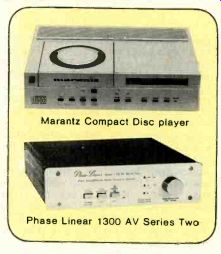
Phase Linear probably had the greatest number of new signal processors. In addition to the new CX decoder and graphic equalizer, the company showed the $250 Model 1300AV audio/video noise-reduction unit (see the last page in this roundup for more details) and the Model 180 Dimensional Sonic Localizer ($150). The Model 180, designed to increase depth and realism and improve stereo imaging, can be used with monophonic video equipment and other single-channel sound sources "for an enhanced monaural sound which creates a stereo effect." It's also designed to eliminate the feeling that the orchestra is inside your head when you're listening through headphones.

Cartoon: ... Mr. Walters called from the show. lie was demonstrating our new super equalizer and the people in the next booth said it was too loud and called the police and now he's in jail."
Headphones.
The impact on head phones of the Walkman-type personal portables was fairly evident. Audio-Technica announced that its Point One, Point Three, and Point Five headphones will all now come with 3.5-mm stereo pugs to fit the mini-portables' jacks and that the phones will be packaged with adaptors (also avail able separately) for the 1/4-inch jacks in most home equipment. The adaptor packed with the Point Five models will be combined with an extension cord, while the cord attached to the phones themselves will be shortened to prevent tangling. Since these small portables and their phones may be used outside in any weather, A-T offers ear muff-like Eskimo Winter Pad covers for small phones ($8).
Koss' Sound Partner phones, introduced at the winter CES last January, paid even more attention to portability: they come equipped with adaptors for 3.5-mm mono earphone jacks as well as 1/4-inch stereo ones, and they fold for easy carrying. Stanton's Model XII Micro Wafer phones come with similar adaptors, but only one per phone-mono with the XI Im, stereo with the X I Is. Kenwood introduced three Light 'N Easy phones, the KH-7, K H-5, and KH-3. Mura added the Model HS (S15) to its ultralight "Red Set" line plus the new "standard" lightweight HV- 190 ($30).
Sony. which started it all, expanded its miniature MDR headphone line with six new models, for a total of eight. Five of the six, ranging from the MDR-1T ($30) to the MDR-80T ($85), come with Unimatch adaptors for 1/4-inch stereo jacks. The sixth is (ES 81 the MDR-E33 ($35), lightest of the light, whose drivers hang directly from the ears without a headband.
Koss has created a new two-way studio design, the Pro/4x, employing both a piezoelectric tweeter and a moving-coil element for lower frequencies. The two appear to be coaxially mounted within circumaural cushioned, closed-back earcups. Pioneer has brought out three new models, with the Master-IS being a comparatively conventional design and the SE-L5 and SE L3 ultra lightweight types.
AKG's single new headset, the K-130 ($49), employs supra-aural earcups and transduction elements that are derived from moving-coil microphone elements. Beyer is using similar technology in a new line of three lightweight phones, the DT 330, DT 550, and DT 880.
Tape Accessories. The most common tape accessories were head cleaners. The new Allsop 3 Ultraline has dual cleaning pads for auto-reverse cassette decks and comes with replacement cleaning pads; it's $15 in a soft case with a large bottle of cleaning solution, $10 in a smoked-plastic box. Broughton's Clean-n-Check ($7) not only cleans the heads but measures on a built-in gauge how well the tape transport is working. Discwasher's first tape product, the Perfect Path head cleaner, uses a dry, non-abrasive approach.
Sony announced a slew of new tape accessories. For general use, there's a high speed tape eraser/winder, the BE-100 ($70), which rewinds and erases a C-60 tape in less than three minutes, and a $40 illuminated head demagnetizer. Another new entry, the RM-65 Synchro remote-control unit ($25), can be used to synchronize many of Sony's new cassette decks and turntables with each other for easier taping from records.
Sony also introduced two new timers, the PT-77 and PT-55. The PT-55 ($95) can be programmed to start and stop a tape recorder at one preset time up to twenty-four hours in advance. The PT-77 ($195) can be set for up to eight events over a seven-day period. Sansui added the $150 AT-15 timer, a one-event, twenty-four-hour model, to its Super Compo systems line. Onkyo too showed a new timer, for $125, with convenient forward/reverse time setting, and Pioneer's DT 510 timer ($120) was also on display at the show.
Disc Cleaners and Other Accessories.
For record care, Audio-Technica announced the Techni-Clean Audiophile Record Maintenance System ($25), a brush with a unidirectional plush pad and a conductive body to drain away static charges.
The kit includes a brush for cleaning the pad and a storage base to keep dust off it between uses. Hitachi had an automatic record cleaner that spun itself around the disc. Robins was the first I know of to pro mote the same accessories for audio and videodisc care: a forty-disc, L-shaped folding record rack and the Rob-o-Stat II anti static gun.
One could confuse the Mobile Fidelity Geo-Disc with a specialized turntable mat since it's round and black and is meant to sit on a turntable. But there the resemblance stops. Molded into its upper surface are bars and grids whose purpose is to help align phono-cartridge offset, overhang, and tracking angle. Osawa also offered a new alignment protractor, the OS-60P, a calibrated grid with spindle hole and a mirror top ($6.29).
Goldring showed a new accessory line: a balance-type stylus gauge; a stylus-care kit with mirror, brush, and 20X magnifier; and an ultrasonic stylus cleaner. The cleaner actually made its debut at the winter CES, as did Signet's ultrasonic model. And Osawa had a new stylus microscope on view. Nautilus displayed Super-Sleeves ($3.50 for a pack of ten), already in use as inner sleeves for the company's Superdiscs. To help you keep track of your discs, MJ Weber introduced its Record Finder kit, a color-coded labeling and indexing system with numbered record identifiers that can be placed to indicate where discs are misfiled or missing; it's $8.95 for a 120-record kit, $5.95 for a 90-record add-on. And Monster Cable announced that it will now distribute Cramolin, a contact preservative and cleaner made by Caig Laboratories. The $12 Cramolin kit includes both cleaner and preservative solutions.
New signal switchers showed up too.
Phase Linear rounded out its new accessory line with the Model 190 speaker-switching module ($95) designed for use with high-power amplifiers; it has switch positions for three speaker systems. Niles Audio also showed a speaker switcher, the four-system SPS-1. But more attention went to the company's unique matrix switchers: the CPM 2, which interconnects four components in any desired order, and the CPM-3I, which handles six. These units simplify even such jobs as patching an equalizer between two recorders for dubbing.
Power connections have also been getting more attention. CHELI International, of France, showed the Audio Stop, which turns sound systems off when their signals stop, or after a programmed time period.
And for remote power switching, BSR showed several new components in the X-10 microprocessor control system.
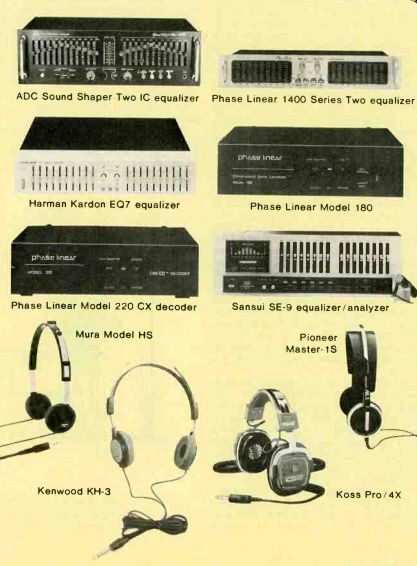
-------------- ADC Sound Shaper Two IC equalizer; Harman Kardon EQ7
equalizer Phase Linear Model 220 CX decoder Mura Model HS Kenwood KH-3 Phase
Linear 1400 Series Two equalizer Phase Linear Model 180; Sansui SE-9 equalizer
analyzer Pioneer Master-1S Koss Pro /4X
Audio / Video
We now have a true stereo-sound TV-of sorts-in the Mitsubishi 2582, which has a built-in 88- to 108-MHz stereo-FM tuner for simulcasts. It also has a complete stereo sound system with a 10-watt-per-channel rating (though distortion levels and frequency range are unspecified), independent inputs and outputs, and two-way air-suspension speakers.
Quite a few other sets have similar sound systems (except for the tuner). This equips them to reproduce simulcast sound from a stereo tuner or stereo from a videodisc player or stereo-sound videocassette recorder. Playing the sound through the set's own speakers may not be as satisfactory as playing it through your stereo system's speakers, but it is more realistic if your system's speakers don't flank the screen, and it lets you adjust the sound level with your set's remote-control unit.
Among the sets with stereo-sound systems having auxiliary inputs are: RCA's ColorTrak 2000 25-inch series (which also features 127-channel tuning to accommodate all current cable systems), Fisher's forthcoming 26-inch sets, Quasar's sets with "Audio Spectrum Sound Ill," GE's 25-inch models with "Performance Sound," some Sony consoles, and Sony's Profeel TV component system.
There are many variations on two-channel TV-sound systems. Toshiba, for example, offers MSSS (Multi Spatial Sound System) with two-way speakers and matrix pseudo-stereo plus audio-output jacks in its CA-2550W 25-inch console (about $1,300). Those RCA ColorTrak 2000 con soles already mentioned have "Dual Dimension Sound"-simulated stereo through the set's own speakers-and two 19-inch table models have it too, with output jacks to connect to your own stereo system. Some Sanyo sets and Sony consoles have a similar matrix-sound feature (it can be switched on and off from the remote control in Sony's version). Zenith has dual-channel systems with output jacks on six models, and five more models include 10-W/ch (watts per channel) amplifiers, bass and treble controls, and voice/music filter switches. And Fisher's new consoles have matrix in addition to true stereo.
Quite a few sets, moreover, have mono phonic-sound enhancements. Magnavox's "Star System" 19- and 25-inch sets have remotely controllable voice/music switches.
Sanyo's 91C92N and 9IC94N 19-inch sets have two-way speakers and, on the 94N, bass and treble controls and an audio-output jack. Several GE 25-inch models and two 19-inchers have audio-output jacks too.
Hitachi has separate audio-output recording jacks on many 19-inch and a few 15-inch models. Zenith has fourteen models in four screen sizes with audio jacks.
"Monitor" sets with audio and video in put and output jacks are catching on, and with good reason. Sound and picture (especially picture) are clearer when audio and video signals are fed directly from a VCR or a videodisc player than they are when first converted into a broadcast-like radio-frequency signal by the player's modulator (a micro-power transmitter) and then demodulated back into audio and video by the TV set's tuner. Last year there were only a few of these models-a 19-inch RCA model, 5-inch portables from JVC and Panasonic, and Sony's KV-4000 3.7-inch set. This year the flood begins: Grundig's new 26-inch and 20-inch table models (whose remote controls also run Grundig's new videotape recorders) have "DIN (IEC)" video sockets and (in the A 8800) two-channel sound. Zenith's new Gemini 1000 monitor set has two-channel sound too, with separate speakers on 12-foot cables so you can place them wherever they sound best. Several of Sony's consoles have monitor connections, as does their second 3.7-inch set, the KV 4100, which also has a built-in AM/FM tuner (mono only) and a microcassette audio recorder. Toshiba's new CA-045 (about $475) 4.5-inch set with monitor jacks is also the smallest set made in the U.S.
Component TV. Sony's VTX-1000R Profeel "access tuner" has an even greater variety of possible connections. The tuner is but a part of Sony's total component television system, which also includes two monitor screens and two speaker systems. Both the KX-2501 (25-inch screen) and the KX 1901 (19-inch) have quite a few inputs of their own: there's an eight-pin DIN jack with video, control, and stereo-sound inputs, plus separate jacks for all of the above.
There's also a thirty-four-pin RGB input, with separate red, green, blue, and sync in puts "for microcomputer and teletext applications." Both Trinitron monitors have built-in audio amplifiers with 5 W/ch and 6-dB-per-octave bass boost below 200 Hz.
Both the speaker systems are two-way, sealed-enclosure types. The smaller SS XIOA has a 3.3-inch woofer, and since it's designed to mount directly on the Trinitron monitor, it's magnetically shielded so as not to distort the color picture. The larger SS-X IA is a free-standing system with a five-inch shielded woofer and 3 dB greater efficiency. The separate 105-channel tuner has three aux video inputs and four stereo pairs of jacks for audio (aux I, 2, and 3 plus aux TV). There are also three sets of audio and video outputs, plus "multiple" outputs to feed extra screens. And like many of Sony's new TV sets, the Profeel tuner has two antenna input jacks selectable from the remote control; one is for direct connection to the cable, the other for connection through the converter needed for scrambled pay-TV channels. Unless your cable system has more than one pay channel, then, you'll be able to tune in any cable channel using just the set's remote control.
Though Sony's is the only full component system in home TV, component TV has been here in bits and pieces for some months now. Separate tuners and tuner timers have long been available for most portable video recorders, and NEC has had a tuner-less large-screen $3,600 projection system (using Kloss Novatron tubes built under license) for a while. Now Kloss too has a monitor-only screen ($2,495), while NEC has a separate tuner ($600) and a $500 19-inch monitor.
Projection Systems. Monitor inputs are proportionately more common in large-screen projection sets than in conventional, direct-view receivers. The difference direct video connection makes is far more obvious on a big screen, and the extra cost is proportionately far less significant in a $3,000 set.
Two-channel sound is more common in these systems too, and again for several reasons: the second sound jack costs less than the first-and is even more dwarfed by the cost of the set as a whole. The cabinets are wide enough to allow for real speaker separation (the wide screen seems to cry out for a wider sound source), and the buyer who'll pay that much for a set probably wants the best of everything.
So most of the new projection systems have monitor jacks and two-channel sound:
GE's Widescreen 4000, Magnavox's $3,495 Model 8505 and Sylvania's similar LSA5000 Super-Screen, Pioneer Video's LS-501 projection set (whose audio-output levels can be set by its remote control), Panasonic's CT4500, RCA's PFR 100R, Mitsubishi's VS-515U and VS-506U (which, like the Magnavox and Sylvania sets, have built-in space for a VCR or videodisc player), and Sanyo's $3,495 PV508OR (which also has a stereo matrix synthesizer and a voice/music filter). Fisher's TT-900 projection system will have matrix stereo plus three pairs of audio inputs against a mere two video inputs (the extra audio jacks are probably intended for use with FM simulcasts).
------------- Mitsubishi VS-5.5U projection TV
Zenith's first projection set, a 45-inch model that folds down into a traditional console, has monitor inputs and four speakers but, apparently, just one amplifier channel; it also has a built-in "Space Phone" that lets you dial calls though the remote keypad and answer them through the set's audio system and a timer to turn the system on and off at programmed times. Kloss' Nova-Beam has been revised to include monitor connections, but it has only monophonic sound.
-------------

VCR and Videodisc. After Akai's introduction of a stereo-sound videocassette recorder (VCR) with Dolby last year, I'd expected to see several more at CES, the more so since most Japanese manufacturers already have such models in their home lines. But those units will apparently have to wait until we get stereo-sound TV broad casting in this country (incidentally, Ger many just approved it); the only new Japanese VCR with stereo sound was a Hitachi prototype. Even Akai's own new non-portable deck had only mono sound. Akai did, however, release two stereo-program tapes ("Michael Nesmith in Elephant Parts" see review "Tom Jones in Concert") from Pacific Arts and promised more to come. Caballero, a supplier of X-rated tapes, also announced stereo-sound video fare (I didn't know people also listened to that stuff).
A non-Japanese stereo VCR did bow at CES, though: Grundig's Video 2x4 Super.
This uses neither VHS nor Beta tapes, but is based on the Video 2000 system sold in Europe and originated by Philips (whose U.S. subsidiaries, Magnavox, Philco, and Sylvania, sell VHS decks). While VHS and Beta are much alike in everything but speeds and dimensions, Video 2000 differs quite a bit from both. All other video cartridges sold here (VHS, Beta, U-Matic, and the Funai system sold by Canon and Technicolor) use the entire width of their tapes in one pass, so their tapes must be rewound between plays. Video 2000 (or 2x4 here) uses half the tape width in each pass, so the tape must be flipped over in the middle (auto-reverse models are planned) but need not be rewound at the end-much like the Philips audio cassette. Flipping the tape needn't be too onerous, though: it plays for 4 hours per side, giving it a total of 8 hours' playing time per tape, 2 hours more than the current VCR record.
Three more audio companies-Fisher, Kenwood, and Sansui-branched out into video by introducing their first VCRs. Both Sansui's SV-R5000 and Kenwood's KV 901 are VHS machines that play at three speeds ( 2/4/6 hours) but record only at two (2/6), a growing trend these days. Both have viewable fast-search functions at seven times normal speed on SP (2-hour) tapes, or twenty-one times on 6-hour EP tapes. Both have two-week, eight-program timers, optional wired ten-function remote controls, and fourteen-station tuners. The chief functional difference between the two is in their soft-touch control buttons: Sansui's are narrow and mounted in a short double row, while Kenwood's are larger and lined up in a single row. Fisher's VHS decks won't be available for some months yet, so we'll have to reserve details for later.
Kenwood also showed the KA-502 audio/video amplifier, an integrated amplifier delivering 70 W/ch. It has inputs for two VCRs plus videodisc and microphone mixing, with dubbing possible from the disc to either VCR or from VCR I to VCR 2 in mono, stereo, or "live" (pseudo-stereo) modes.
Videodisc systems are automatically of audiophile interest since their sound is potentially so much better than that of video cassette decks. Only one new stereo model was announced for production, the remote-control version of Magnavox's Magnavision LaserDisc player. The new Model 8005 will cost $769. No other new LaserVision players were introduced, but Magnetic Video announced that its initial LaserDisc re leases would include stereo sound on such titles as The Muppet Movie and Alien (they don't waste stereo on human casts?). Pioneer Artists also announced an association with Covent Garden Video Productions to produce LaserDiscs of the Royal Opera and Royal Ballet, and if those discs aren't in stereo, I'll eat them-or they should! No stereo hardware or software for RCA's CED disc system was shown-no surprise, since RCA distributed technical standards for CED stereo to its licensees only after the June show time. Toshiba's $525 disc player will have a jack for an eventual stereo adaptor, though, as will Hitachi's player.
The third-format "VHD" (Video High Density) disc players, to be here in early 1982, will all have stereo sound, of course, and MCA has promised VHD stereo versions of Sergeant Pepper's Lonely Hearts Club Band, Jesus Christ, Superstar, and Xanadu. Since MCA also has a prime stake in LaserVision, one could probably expect LaserDisc versions of those too, if they're not here already.
The VHD system also has an audio off shoot, the AHD digital-audio disc. AHD discs would require no separate player, merely a decoder to plug into a jack on the VHD unit. Aside from JVC (which developed VHD and AHD) and Yamaha (which has announced no videodisc plans), though, VHD manufacturers seem to be soft-pedaling this aspect of their system. That's probably because the laser-scanned Philips Compact Disc seems well en route to be coming a de facto standard.
Before CES, Sony and Matsushita (Quasar and Panasonic here) both announced their backing of the Philips disc. This is rather a striking development, for Sony is currently propagandizing against the videodisc, Matsushita is the main backer of the non-laser VHD system, and the two giants agree on technical standards just about as frequently as CBS and RCA do. Shades of SQ vs. CD-4 or Beta vs. VHS (though it's only fair to note that CBS is now pressing discs in RCA's CED videodisc system and RCA has adopted CBS' CX system).
The bandwagon looked even more crowded at show time. Prototypes of Philips' Compact Disc players were being shown by Marantz, Sanyo, Sony, and others. Sanyo and Optonica also showed new PCM adaptor boxes for digital-sound re cording on VCRs. Alpine, though not at the show, chose CES time to display a PCM digital-audio system with video capability using a cassette only slightly larger than a Noise Reduction. Noise reduction is finally coming to video-and high time. The audio signal-to-noise ratio of even the best home VCR is usually on the order of 40 dB; that's mediocre at best. But this show saw the introduction of two noise-reduction systems designed to clean up already noisy signals (unlike such systems as Dolby, dbx, and CX, which just keep signals from get ting noisier during recording).
The one billed specifically for video use was Phase Linear's new 1300AV ($250), which removes up to 12 dB of noise. There are separate inputs for a monophonic-video system and a stereo-audio system, both selected by a front-panel switch. It joins the KLH DNFI 201A for video-sound noise reduction that was made available last year.
National Semiconductor used mainly video program sources to demonstrate a $200 noise-reduction box from Advanced Audio Systems International. It uses National Semi's DNR dynamic noise-reduction circuit to achieve up to 14 dB of noise reduction. DNR is a dynamic filter system that rolls off high frequencies at 6 dB per octave in the absence of strong high-frequency signals. The cutoff frequency is said to vary from 30 kHz down to 800 Hz ac cording to high-frequency level. Of special interest to video users, though, was a modified DNR box that could be switched to cascade the action of the two stereo channels, giving roughly twice the noise reduction on a mono signal. The same effect can be achieved with the normally wired unit by patching the output of one channel to the input of the other.
---------------
Also see:
NEW PRODUCTS: Roundup of the latest audio equipment and accessories.
THE CASE FOR MINIMAL MIKING: The "back to realism" movement is invading the nation's recording studios.
Source: Stereo Review (USA magazine)