POWER AMPLIFIERS FROM A to AB ---All you need to know about amplifiers low distortion, Class A, Class AB, feedforward, feedback, and more / by Ralph Hodges .
--------------
BY RALPH HODGES
WHAT would the perfect power amplifier be like? It would take the input signal from a preamplifier and increase its amplitude to drive the speakers--without changing the signal in any other way. It would eliminate distortion either by perfect correction or by the use of a flawless circuit.
The perfect amp would be powerful enough to blow out windows, but it would still be small., light, dependable, and cool in operation. And it would have a suggested retail price of less than $200.
The perfect power amp does not exist. Some power amplifiers do excel in various areas, and some even combine two virtues, such as low distortion and low cost (probably at the sacrifice of high power), but there isn't one that has all the virtues. Different designers and manufacturers concentrate on different areas of excellence and work to achieve different goals, which is why you'll find so many models of amplifiers to choose from when you go shopping.
More than ten years ago in these pages, Julian Hirsch said, "We wonder if 700 watts is enough," and the super-power amplifier market began to percolate. After all, it stood to reason that an amplifier that (almost) never ran out of power would be superior. But some listeners just didn't care for the sound of these muscular novelties. Many of the complaints were attributable to overprotective protective circuitry and other de sign flaws, but exceptionally high power acquired a bad name among some audiophiles.
Nevertheless, my files show close to forty currently available power amplifiers rated at 250 watts or more per channel and ranging in price from $5,000, for the Audio Research D-250 (a vacuum-tube de sign), to $750 ($600 in kit form) for the Hafler DH-500A. The brands include both the relatively familiar, such as Marantz, McIntosh, SAE, Soundcraftsmen, and Technics, and the less familiar, such as AB Systems, Biamp Systems, FM Acoustics, and Strelioff.
Price does not necessarily follow power in these rarefied strata. It's more likely to follow weight. For example, the Harman Kardon Citation XX ($7,500-sorry, I lied about the top price point; I didn't want to scare you off too soon) is rated at 250 watts per channel (continuous average output into 8 ohms) and weighs 93 pounds. The Carver M-1.5+ ($799) is rated at 350 watts per channel (continuous average into 8 ohms for significant periods) and weighs a mere 16 pounds.
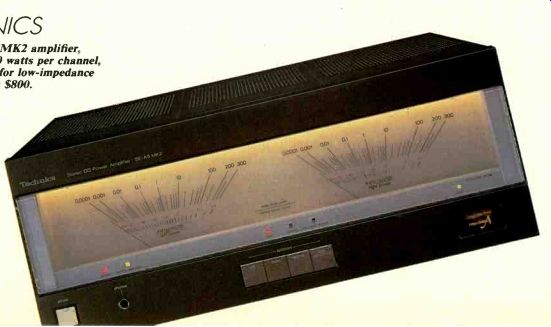
--- Technics :The SE-A5MK2 amplifier, rated at 150 watts per channel, is
designed for low-impedance loads. Price: $800.
Now why should one amp offer significantly more power at about a tenth the price and a fifth the weight? It seems to make no sense. Well, of course it doesn't unless you have some historical background for understanding power-amplifier design. Matti Otala, who designed the Citation XX, began by asking himself, "How do I build an amplifier so nearly perfect that it is unlikely ever to be faulted?" But Bob Carver asked himself a different question, "How do I build an amplifier that does what experience has shown me needs to be done yet costs next to nothing?" Otala's thinking resulted in a device so rugged and conservatively rated that it is deemed able to pass 200 amperes of current (which would melt most people's house wiring and loudspeakers) on a is not really rated for excessive cur rent capability, but I think if you tried to pass 200 amperes through it-or any other consumer amplifier I know of-you'd melt it down, except that its protective circuits would shut it off first. It should be clearly understood, however, that neither designer really expected a preposterous figure such as 200 amperes to be used for home sound re production. The point is merely that the Otala design goes so far beyond the requirements of its intended application that nothing could conceivably perturb it, while a knowing tester with malice afore thought could probably figure out ways to make the Carver amp stumble now and again. But at normal volume levels (which could be extremely loud with products of this caliber), few experienced reviewers would hear any differences between these amps even if they wanted to.
-------------
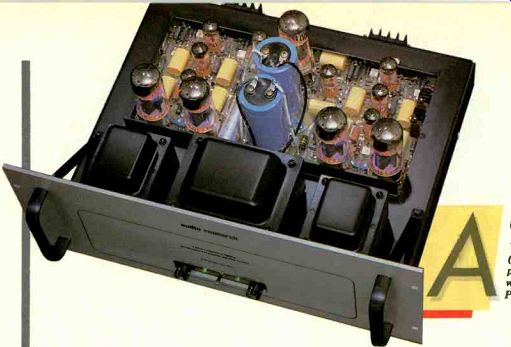
AUDIO RESEARCH---The D-70, a stereo 65-watt (into 16 ohms) vacuum-tube power amplifier, operates with Class AB biasing. Price: $1,995.
----------
"Digital ready" is a popular phrase in amplifier circles these days. Instead of emphasizing continuous average power, the "digital-ready" designs maximize dynamic headroom, the ability of an amplifier to put out brief bursts of high power to handle short-term musical peaks. Since music is neither continuous nor constant in level, two amplifiers with identical power ratings will perform differently if their dynamic head-rooms are different.
----
S/500 Series II is rated at 250 watts per channel. It can deliver a peak current of 35 amperes.
Price: $2,970.
The one with more dynamic head room will handle power-demanding passages with more aplomb and less clipping of high-level signals.
This was demonstrated by Phase Linear at the Las Vegas Consumer Electronics Show last January. With inputs from the Phase Linear Com pact Disc player, the outputs of Phase's DRS 900 power amplifier and Threshold's S/300, both rated at 150 watts per channel continuous average power, were displayed on an oscilloscope. As might be expected, transients demanding very high momentary power caused visible-but not necessarily audible clipping by the Threshold amp.
Amplifier power has two components, output voltage and output current. Increasing either will raise the output power. With a nominal rating of only 100 watts per channel,
HRESHOLD ARVER
The M-1.5T delivers 350 watts per channel into 8 ohms yet weighs only 16 pounds.
Price: $799.
Harman Kardon's hk870 power amplifier has an unusually high instantaneous output-current rating of 60 amperes. The manufacturer says that the amplifier's transient output power nearly doubles into 4-ohm loads and almost quadruples into 2 ohms. Soundcraftsmen's 1200 Digital/Dynamic Reserve power amp, designed for the high-current needs of digital material, is rated at 250 watts per channel but has a momentary reserve power of 600 watts. It uses a dual signal-tracking power supply.
LOW DISTORTION
While one group of designers sought more power, others were taking the complaints of discontented listeners to heart. These designers reasoned that distortion was responsible for objectionable sound. Now, even a ...
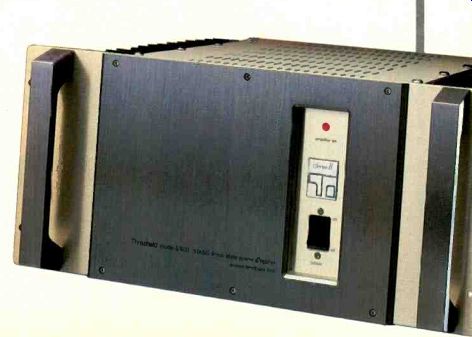
KENWOOD--The Basic M-2 is a 220-watt-per-channel amplifier that includes
the speaker cables in its feedback loop. Price: $600.
... decade ago it was hard to find a power amplifier with more than 0.2 percent of the conventionally measured harmonic and intermodulation distortions at rated output, and all experiments I'm aware of have found that 0.2 percent distortion is entirely inaudible in complex mu sic. But if people were upset, some thing had to be done. First, additional types of distortion that were not being successfully eliminated had to be identified. Second, the traditional types had to be reduced to the vanishing point just in case.
The first objective entailed intensive original research, which is still going on, although less avidly than before because many types of distortion have been discovered and cured or else pronounced inconsequential. The second objective was definitely easier to achieve, but the means used, negative feedback, caused the amplifiers to generate new types of distortion.
Feedback, which made ultra-low distortion amplifiers possible, involves returning a portion of the signal at the output of the amplifier to the input, where it is combined with the input signal to compensate for the mistakes (distortion) that the amplifier is going to make in processing the input. It's a sophisticated idea, and many popular amplifiers have used feedback in various ways. But the investigations of novel types of distortion have pointed a finger at excess feedback as a possible source of unwholesome sound.
During the design stage of Sony's Esprit TA-N900, for instance, it was reported that the amplifier sounded better and more natural if no negative feedback was applied in the output stage, so that was eliminated-even though negative feed back would have improved the spec for total harmonic distortion (THD). Still, the TA-N900, priced at $1,750, produces 200 watts per channel with a THD of 0.05 percent. Mission Electronics' d.c.-coupled Model 777 power amplifier uses a relatively low 14 dB of feedback for both the signal and d.c. bias. Local very high-feed back loops are used to achieve stability of the d.c. bias. The Model 777 has a THD of less than 0.02 percent (0 to 40,000 Hz) and a price of $1,400.
An alternative to feedback is feed forward, in which the signal path from input to output is actually two paths, one the workhorse circuit that actually does the job of driving the loudspeaker, the other a light duty conduit that can be made to behave precisely (well, almost) as the designer wishes. When the two paths converge, the workhorse signal is made to conform to the dictates of the light-duty signal, and distortion goes away. The technique can be implemented in several fashions, and when appropriately elaborated can actually impose addition al stability and regularized operating conditions on an amplifier.
Variations on this technique are Super-Feedforward by Sansui, Stasis by Threshold, and Current Dumping by Quad. Yamaha's Zero Distortion Rule feeds the input signal forward, compares it with the actual output signal, and then feeds the difference signal (representing distortion) back to the input to apply correction. Hence the Yamaha amps could be described as both feedforward and feedback devices.
The negative-feedback loop in Kenwood's Basic M2 power amp is extended to the speaker's input terminal to compensate for losses or other undesirable effects of speaker cable.
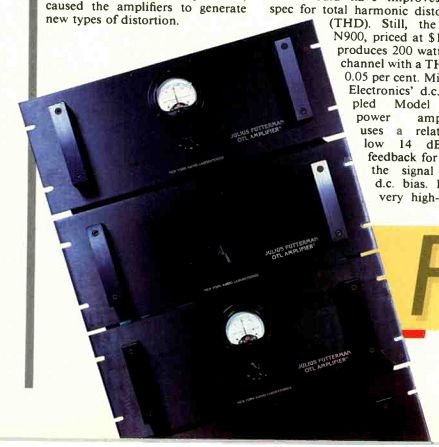
------FUTTERMAN---The OTL-I is rated at 150 watts per channel into 16 ohms
(65 watts into 8 ohms). A vacuum-tube amplifier, it stands nearly 4 feet tall
and has a 5-kilowatt regulated power supply. Price: $9,000.
The Power Linear Circuit in the Technics SE-A5MK2 (150 watts per channel, $800) is designed to compensate for low-impedance conditions said to occur during amplification of music signals. This is a development of the linear feedback circuit with emphasis on drive linearity of the output stage. All these products deserve commendation for ingenuity, but be aware that advertising agencies have occasionally gotten a bit out of hand. Claims have appeared that certain amps not only have no distortion, but less than no distortion, which is both scientifically and philosophically unacceptable.
HIGH CLASS
Most amplifier output stages operate in what is known as Class AB, loosely defined as a condition in which only about half of the output stage is functioning at any given moment. The other half is mostly resting for the brief instant its contribution to the signal waveform is not required. Afterward it must be suddenly roused to take over its share of the work, and the split second of grogginess (nonlinearity) that results is known as crossover distortion, which is measurable and, like any other form of distortion, undesirable. How disagreeable or audible it is in competent Class AB designs is disputed, but it can be essentially eliminated with Class A operation, in which both halves of the output stage are kept "awake" constantly, through the application of what could be called electronic "tension" (d.c. bias is the technical term), even though both halves of the out put stage are not constantly driving the loudspeaker(s).
---WHILE one group of designers sought more power, others reasoned that distortion was responsible for the objectionable sound. ---
My files show only two lines of amplifiers operating in pure Class A, one being the Mark Levinson ML-2 ($3,245, 65 pounds, and a mere 25 watts of mono power), and the other the Krell products, comparably priced and comparably (100 watts plus) in stereo as well as mono configurations. The reason for the substantial weight (and size) is the need to throw off the large amounts of heat generated by Class A biasing. Massive chunks of chassis will drain this heat away from semiconductor devices rather quickly, thereby stabilizing thermal conditions, which must be con trolled for proper circuit operation.
Alternatives to pure Class A are offered in at least a dozen amplifier models, most of them from Japan and all of them sliding or switching from Class A to Class AB biasing conditions depending on the dictates of the audio signal. Logically, crossover distortion will be a much higher percentage of total output at low-power levels, so the Class A mode is usually devoted to pianissimos and Class AB for the fortissimos. The savings in weight, size, and price are usually great, though a few critics claim to hear the switching and find the sound objectionable. Many amps that are claimed to be Class A are really like these Class A/AB amps.
VACUUM-TUBE SOUND
Vacuum tubes are still with us, even though you'd be hard pressed to find one in most electronics stores.
A cursory check revealed thirteen manufacturers marketing at least thirty-two vacuum-tube amplifiers, all of them quite expensive. A transistor is much, much cheaper to produce than a tube with its intricate hand-assembled innards. Many of the tube amps are meager in power output, such as the Audio Re search D-79C, with 75 watts for $6,000, and it isn't even the most expensive tube design. Other manufacturers of tube equipment, many of them American, include Beard, Counterpoint, David Berning, Conrad-Johnson, Electro-Companiet, Esoteric, Audio Research, Precision Fidelity, Schug Electronics, and Luxman (one model).
A genuine novelty is the Futterman tube amplifier, which contrives, by use of banks of paralleled output tubes, to dispense entirely with the heavy and expensive out put transformers that usually characterize tube amplifiers. The design is literally decades old, but the amp is still available, and in several versions, from New York Audio Labs.
--- BUT WHY tubes? Ask a tube-amplifier manufacturer and he'll just turn the thing on and play it for you.
---
Yet why tubes anyway? Why is the audio industry dabbling in antiquities? Inquire of a tube-gear manufacturer and he'll just switch the thing on and play it for you.
Since this practice has tended to generate sales on the spot, it is probably the best answer. For those who require verbal explanations, there are several making the rounds. One school of thought maintains that tubes clip more "gently" than bipolar-transistor output stages, which chop the waveform off brutally when overload conditions are reached. Some support for this argument is given by the popularity of transistorized amplifiers from NAD that incorporate "soft-clipping" circuits that simulate tube behavior.
(Of course, many transistor designers would retort that an amplifier has no business clipping anyway, and if it does, buy a bigger one.) Another theory has it that tube designs somehow "gloss over" with flattering distortions a number of problems that transistor equipment brings right out in the open, sharply etched. A third idea (which I'll at tribute to Threshold's Nelson Pass) is that vacuum tubes impose simplicity on the designer and that simple audio circuits have historically been applauded for sound quality.
Dozens of transistors can be used in a solid-state amplifier, but only one dozen tubes is a very heavy complement for a vacuum-tube design.
The introduction of MOSFET's (metal-oxide semiconductor field effect transistors) some years ago was expected to shed considerable light on the vacuum-tube question.
In a number of respects, FET's be have more like tubes than transistors, and there is hope that, with FET output devices finally available, a transistorized amplifier that will satisfy even the most diehard tube enthusiasts is possible. FET output stages are now offered by such prominent manufacturers as Acoustat, Hafler, Hitachi, Kyocera, Perreaux, Sherwood, Soundcraftsmen, and VSP. Yet, as good as these are for most uses, I have heard no re ports of tube amplifiers being abandoned by their loyal supporters.
And there is another extremely attractive advantage to FET output stages: they are very rugged and eliminate the need for complex protective circuits and their troubles.
POWER SUPPLIES
The configuration of the power sup ply has the greatest influence on the size, weight, and cost (including shipping cost) of a power amplifier.
The classic "good" power supply consists of a huge power transformer, huge filter/storage capacitors, and a not necessarily huge but definitely electronically husky rectifier bridge that converts the a.c. to d.c.
That's all that's needed. But economically the formula is inefficient.
What are the alternatives? "Switching" and "smart" power supplies have proved the most popular so far. Switching-supply technology, still very much in its infancy for audio applications, takes ad vantage of the fact that raising the a.c. powerline frequency above the nominal 60 Hz permits corresponding reductions in the size of transformers and capacitors for equivalent performance.
"Smart" power supplies use control circuitry to govern their operation, with the most straightforward type of control being strict regulation to prevent the supply voltage from changing no matter what demands are made on the output stage.
Perfect regulation is an impossible dream, but many designers consider close-to-perfect regulation well worth pursuing.
Other designers think that this sort of supply regulation is foolish and inefficient, so they incorporate circuits that cause the power sup plies to change state according to the requirements of the audio signal being processed. Apt and Carver have been the major proponents of this signal-tracking scheme. Soundcraftsmen's PCR800 purports to combine advantages of ultra-stiff regulation with the flexibility of state-changing circuitry.
PERFECTION
So suppose you decide that you want an amplifier with, say, an in put section from manufacturer A, the drive stage from manufacturer B, the output configuration used by C, and a power supply made by D. There is no way you could put together such an amplifier. And even if you could, it wouldn't be such a good thing. An amplifier can work well only if its component parts Interrelate compatibly, and substitutions usually court disaster.
Obviously there are many ways of building a good amplifier, and the choice of one particular way is probably only a reflection of where the designer's mind was at the time a germinal thought occurred to him.
All this information simplifies the choosing of an amplifier not at all, of course, but it does make the situation a little less anxious. Further more, it justifies the advice that most amplifier designers them selves give: Listen to the thing, preferably with the source and loud speakers you'll be using. You'll have to do a lot of listening if you're determined to own the "best." But, then again, if you choose wisely, you'll do a lot more listening later on, with pleasure.
----------------
Also see:
MAKING CONNECTIONS---Proper hook-up is vital to getting the best from your system / by Dawn Gordon