MUSIC FOR YUPPIES
UPSCALE CLASSICS RECOMMENDED FOR THE TURNTABLES, TAPE DECKS, AND COMPACT DISC PLAYERS OF THE MOST AMBITIOUS YOUNG URBAN PROFESSIONALS
BY WILLIAM LIVINGSTONE
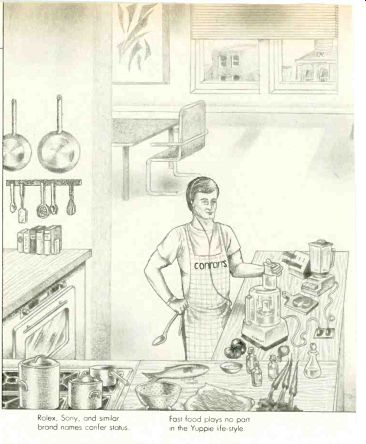
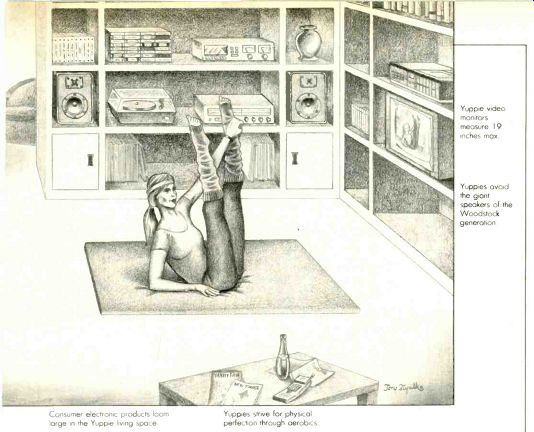
---- Above: Rolex, Sony, and similar brand names confer status. Fast food ploys no part in the Yuppie life-style. Room large in the Yuppie living space. Yuppies strive for physical perfection through aerobics. Yuppie video monitors measure 19 inches max. Yuppies avoid the giant speakers of the Woodstock generation
REMEMBER the preppies? Well, they're not in anymore. As the Baby Boom generation has grown older and more sophisticated, the spotlight has fallen on a trendier group, the Young Urban Professionals, or Yuppies.
Ranging in age from twenty-five to forty-five, Yuppies live in or near major cities, go to the gym or run after work, have brunch on Saturdays and Sundays, drink Perrier and other designer waters, and give high priority to the goal of a six-figure in come. Consumer electronic products are important to Yuppies.
The habitat, plumage, mating rituals, and ambitions of Yuppies have been described by writers Marissa Piesman and Marilee Hartley in The Yuppie Handbook, The State-of-the Art Manual for Young Urban Professionals. Published by Long Shadow, it is twenty-five dollars' worth of laughs for $4.95.
Yuppies, who want to live life in the fast lane, are extremely interested in the status value of certain brand names. Like the Sony Walk man, such things as the Burberry trench coat, the Rolex watch (his), the Cartier tank watch (hers), the L.L. Bean duck-hunting boots, and the Gucci briefcase are very fashionable props for the properly at tired Yuppie.
A Yuppie couple get extra points if their electronic equipment is in stalled in a media room. This room must contain an exercise mat so that the female Yuppie can do her workouts to the Jane Fonda fitness program on video cassette. Authors Piesman and Hartley do not indicate a status preference between Beta and VHS video-cassette recorders, but they have strong views on hi-fi furniture. Solid oak cabinets are good, they say, and black or white lacquer is excellent, but walnut veneer is not compatible with the Yuppie life style.
Leaving such details to decorators, I find the musical life of the Yuppie much more interesting. Ac cording to the Handbook, the Yup pie's day begins when the digital alarm activates a cassette recording of Pachelbel's Canon in D.
For a long time STEREO REVIEW'S "The Basic Repertoire" recommended a performance of the canon by the Jean-Francois Paillard Orchestra available on RCA or Musical Heritage Society, but our critic Stoddard Lincoln says that this version now belongs on a walnut-veneered shelf. It is far too bloated for Yuppies, who are devoted to less caloric nouvelle cuisine and the pursuit of physical perfection through aerobic exercise.
Lincoln recommends the leaner performance-on original instruments, of course-by Christopher Hogwood and the Academy of Ancient Music (Oiseau-Lyre DSLO 594). An extra point is given to this recording for spelling the title of the work as Kanon with the original K.
Piesman and Hartley have compiled a short list of favorite Yuppie records, topped by Vivaldi's Four Seasons as transcribed for flute by James Galway (RCA LRLI-2284).
In second place is Bessie Smith's "Empty Bed Blues" (Columbia G 30450). It's there, according to the authors, because Yuppies are fascinated by musical geniuses who died in miserable circumstances.
If that's the case, Yuppie collections must be well stocked with discs and tapes by the many jazz artists who died in miserable circumstances as well as by rock stars whose tragic deaths are as well documented as those of Mama Cass, Janis Joplin, and Elvis Presley.
For the benefit of Yuppies too busy to bone up on the miserable lives and deaths of some of the greatest musical geniuses in the classical field, I've run up a little list, something one could read before a meeting of the co-op board of directors. And I've chosen some suitably prestigious recordings of music by those geniuses to recommend to Yuppies in search of excellence.
DEATH IN VIENNA
First of all is Antonio Vivaldi him self (1669-1741). Quite successful in his church and teaching jobs in Venice, Vivaldi lusted after life in a faster lane. He converted his assets into cash and went to Vienna in 1740, but, failing to make it to the top at the court of Charles VI, he died there penniless the next year.
Galway's flute version of Vivaldi's Four Seasons is okay for back ground music for brunch, but a more upscale performance is the one by the English Concert con ducted by Trevor Pinnock with Simon Standage as violin soloist.
They've recorded it a couple of times, but you'll want the Archiv Produktion version (2534 003), which has the advantage (one extra point) of being recorded digitally.
Give yourself three extra points if you have this one on Compact Disc.
Then there was Mozart, who ranks among the greatest musical geniuses in history. From the time he was a child, he was admired by the rich and famous all over Europe, but he never succeeded in billing adequately for his services. Constantly in financial difficulties, he really needed a good money man ager. By the time he was thirty-six, he was so weakened by fatigue from overwork that he succumbed to what was probably typhus. The few friends who went to Mozart's funeral did not even accompany the coffin all the way to the cemetery, and he was buried in an unmarked pauper's grave.
For easing the fatigue of the over worked Young Urban Professional, I recommend the digital recording (Philips 6514 148) of Mozart's Piano Concertos Nos. 15 and 21 by Neville Marriner conducting the Academy of St. Martin-in-the-Fields with Alfred Brendel as soloist. Marriner and the Academy have the same British cachet as Bur berry trench coats, and Brendel has managed to reach a wide audience while maintaining his position as the thinking man's pianist. Their performance of these works is avail able on LP, cassette, and CD.
Mozart's Piano Concerto No. 21 is among his most familiar master pieces. The poignant slow movement was used to great effect on the soundtrack of the classic Swedish film Elvira Madigan-about a beautiful young woman whose lover shot her to prevent her from starving to death.
BESSIE SMITH IS A FAVORITE BECAUSE YUPPIES ARE FASCINATED BY GENIUSES WHO DIED IN MISERABLE CIRCUMSTANCES.
Ludwig van Beethoven (1770 1828) towers above all other com posers of the nineteenth century. He never lacked artistic recognition, but he suffered great anguish over the loss of his hearing, which began when he was only thirty. As his deafness progressed, he became bitter and morose, and his declining years were marked by isolation and depression.
Assuming that you bought recordings of Beethoven's nine symphonies and five piano concertos while you were still in college, I recommend that you amplify your collection with any of the piano trios re corded for Philips by the Beaux Arts Trio, especially the Archduke Trio (Philips 9500 895).
If you want more bankable names, get the recording of the Archduke by violinist Itzhak Perl man, cellist Lynn Harrell, and pianist Vladimir Ashkenazy (Angel DS-37818). Also highly recommended is the CBS Masterworks digital re cording of Beethoven's Sonatas Nos. 1 and 2 played by pianist Emanuel Ax and the glamorous young cellist Yo-Yo Ma (CBS IM 37251). It won a 1983 Record of the Year Award from this magazine.
The New Celibacy is a fact of the Franz Schubert (1797-1828) lives of many Yuppies-because they work so hard, not because of fear of sexually transmitted diseases. Things were different in the nineteenth century, when a few shots of penicillin might have altered the course of music history.
Franz Schubert (1797-1828) was only one of the composers of that time who died of venereal disease.
Probably the greatest melodist of the Viennese school, Schubert lived his brief life near the poverty level, yet his music is filled with lyricism and beauty. In 1822 he contracted syphilis, which destroyed his central nervous system over the next six years. He was only thirty-one when he died.
Every record collection should contain Schubert's Unfinished Sym phony (No. 8) and his Trout Quin tet, of which there are many excel lent recordings. Then, when you are ready for the Right Stuff or the Real Thing, go for the meditative, deeply moving works he composed in the last few months of his life.
Alicia de Larrocha, a wonderful artist at the height of her powers, has just recorded Schubert's last great piano work, the Sonata in B-flat Major (London LDR 71067).
Get that one. I also recommend London's fine new digital recording (LDR 71071) of Schubert's Quintet in C by cellist Christopher von Kampen and the Fitzwilliam Quartet, an impressive young ensemble that all your friends may not yet have discovered.
PERISHING IN PARIS
The Public Broadcasting Service has brought opera into the lives of a lot of Yuppies. Among the operatic geniuses who came to miserable ends must be counted the composer Vincenzo Bellini (1801-1835).
After a number of triumphs in major Italian opera houses, Bellini went to Paris, where he had a brilliant success with I Puritani. His annual summer bouts of diarrhea turned out not to be the result of a change of water or diet but symptoms of chronic amoebic dysentery, which killed him before his thirty fourth birthday. During Bellini's final illness his friends shunned him because his symptoms resembled those of cholera, which is highly contagious. He expired in a Parisian suburb alone.
Bellini's masterpiece Norma was a favorite vehicle of the superstar soprano Maria Callas (1923-1977), who sacrificed her career for life in the fast lane with Aristotle Onassis.
After she lost him, life had little meaning for her. Though rich, she wasted away at fifty-four in Paris, depressed and (except for her servants) alone.
Callas still lives, however, in her recordings. I recommend her stereo version of Norma (Angel S-3615).
Recorded in 1960, it has less than up-to-date sound, but its artistic value will enhance the quality of any record collection.
It was once thought that Georges Bizet (1838-1875), composer of the ever popular Carmen, died of a broken heart because that opera failed at its premiere. This story has been dismissed as melodramatic non sense. Carmen had more than thirty…
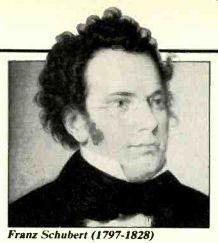
THE GREAT MELODIST FRANZ SCHUBERT CONTRACTED SYPHILIS, WHICH DESTROYED HIS CENTRAL NERVOUS SYSTEM. HE DIED AT THIRTY-ONE.
…performances in its first season. Bizet's modern biographers suggest that a persecution complex and the rigors of an unhappy marriage lowered his resistance so much that one of his recurrent attacks of quinsy (severe tonsillitis) killed him at the age of only thirty-six.
Carmen has never been more popular than it is today, with several different versions before the public on stage and screen. I recommend the new Deutsche Grammophon recording (274 1025) with Agnes Baltsa in the title role and Herbert von Karajan conducting. A digital recording, it is also available on cassette and Compact Disc.
GAY LIFE AND DEATH
The way of life described in The Yuppie Handbook encompasses several subcultures, including those of Buppies (Black Urban Professionals), Guppies (Gay Urban Professionals), and Juppies (Japanese Urban Professionals). Each of these has made contributions to the Yuppie mainstream. Guppies, for example, are credited with a major role in the Art Deco revival and with discovering Peter Allen records. A straight Young Urban Professional may tell you that some of his best friends are Guppies.
Czarist Russia, however, was not so tolerant of homosexuality. Consequently, the great Russian com poser Peter Ilyich Tchaikovsky (1840-1893) was tormented by guilt over his sex life and by fear of being exposed as a homosexual. This may account for the pervading melancholy in much of his music.
Until lately it was thought that Tchaikovsky died of cholera contracted by rashly drinking a glass of un-boiled water during an epidemic.
More recently musicologists have entertained the theory that he poisoned himself when a "court of honor" made up of his former law-school classmates ordered him to commit suicide to avoid a scandalous disclosure of details of his private life. Either way qualifies as a miserable end.
-- TCHAIKOVSKY WAS TORMENTED BY GUILT OVER HIS SEX LIFE AND FEAR OF BEING EXPOSED AS A HOMOSEXUAL --
Tchaikovsky's Nutcracker Suite is okay for kids, and the scores of his ballets Swan Lake and Sleeping Beauty provide some rhythmic mu sic for fitness workouts. For the Yuppie collection I recommend a hot performance of Tchaikovsky's dramatic Piano Concerto No. 1 by Martha Argerich with Charles Dutoit conducting the Royal Philharmonic Orchestra. It is being re-released in May in Deutsche Grammophon's Signature Series (DG 254 3503), and, paired with Liszt's Concerto No. 1, it is a super value at $6.98.
Tchaikovsky's melancholy side can be heard in his Piano Trio in A Minor. It has been beautifully re corded by Perlman, Harrell, and Ashkenazy (Angel SZ-37678) and by violinist Elmar Oliveira, cellist Nathaniel Rosen, and pianist Mikhail Pletnyov (CBS M 35855).
BRAIN DEATH
Little is known of the details of the private life of the French neo-Classicist Maurice Ravel (1875-1937). A composer of highly polished works for solo piano, he was also a superb orchestrator. Just as he was receiving his greatest accolades-an honorary doctorate from Oxford, a street named for him in his home town-he began to suffer attacks of aphasia and difficulty in muscular coordination. They signaled the on set of a brain disease that gradually imprisoned his active mind in a body that would not respond to his commands. He died after an unsuccessful brain operation.
Ravel's Bolero? Well, it's all right for Bo Derek fans, but Yuppies will want a classier act. I recommend pianist Martha Argerich's recording of Ravel's Gaspard de la nuit, Sonatine, and Valses nobles et sentimen tales (Deutsche Grammophon 253 0540). It's an analog recording available only on LP but excellent nonetheless.
Being struck down by incurable diseases is not a fate limited to European musical geniuses. The immensely talented American com poser George Gershwin died after unsuccessful brain surgery, coincidentally in 1937, the same year as Ravel. At that time Ravel was in his sixties, but Gershwin was only thirty-eight.
If Gershwin were alive today, he would be a sort of super-Yuppie.
Phenomenally successful as a song writer and author of Broadway shows, he had a bicoastal career, working in Hollywood as well as New York. He was a very serious musician who also composed sym phonic works and even an opera.
His most ambitious composition, Porgy and Bess, will have its Metropolitan Opera premiere next year.
For Yuppies willing to explore opera beyond Carmen, there is a complete recording of Porgy and Bess with soloists, chorus, and orchestra of the Houston Grand Opera conducted by John DeMain (RCA ARL3-2109). When it was re leased in 1977, our reviewer pronounced it the best recording Porgy and Bess had ever received.
Both Telarc and RCA have some instrumental works by Gershwin on Compact Disc, but it seems to me that the ultimate record for a Young Urban Professional's collection is the performance of Gershwin's two-piano versions of his Concerto in F and Rhapsody in Blue played by the sister team of Katia and Marielle Labeque (Philips 9500 917). It's Gershwin with a French accent, and the aura of international glitz and glamour that surrounds the Labeques finds its way appropriately into the performance.
RAVEL 'S BOLERO MAY BE ALL RIGHT FOR BO DEREK FANS, BUT YUPPIES WANT A CLASSIER ACT
Not all musical geniuses died young or in miserable circumstances---J. S. Bach, Brahms, Verdi, and Richard Strauss, for example, lived long, productive lives. The recommended recordings of music by those who did die miserably are not limited in their appeal only to young lawyers or other professionals who bill their clients for sixty hours a week. In fact, they can be enjoyed even more by someone who can take time to savor them.
Maybe life in the fast lane pre vents people from enjoying music to the fullest. If I could make only one musical recommendation to Yuppies (or anybody else), it would be to slow down a little and take time really to listen to music, to receive its spiritual message, to bathe in its healing power.
If, like me, you prefer ginger ale to Perrier, you may find Hogwood's performance of Pachelbel's Kanon on original instruments somewhat undernourished. I still like Paillard's version, and there's another lush one by Leonard Slatkin and the St. Louis Symphony on Telarc.
And, after all, what's so bad about walnut veneer?
RECORD MAKERS
BY CHRISTIE BARTER AND STEVE SIMEIS
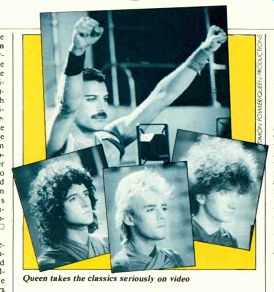
IF the four members of the British rock group Queen look especially serious, per haps it is because they have been working with some very serious artistic material. Their newest video, Radio GaGa. is intercut with scenes from Fritz Lang's si lent sci-fi film classic Metropolis. Interestingly, the band had to purchase the rights to the footage from disco producer Giorgio Moroder (of Donna Summer and Flashdance fame), who now owns Metropolis and plans to rerelease it with an electronic soundtrack of his own. Queen is slated to con tribute to the score of Moroder's project as well. THE first video-cassette release from Video Arts International, a newly formed company specializing in cultural videos, presents some of Russia's greatest dancers in some of its most celebrated ballets. Included is the Carmen Ballet to music of Rodion Shchedrin, danced by Maya Plisets kaya, and Khachaturian's full-length ballet Spartacus, with Vladimir Vasiliev, as well as a full-length Swan Lake with Plisetskaya. For a complete list and prices write VAI at P.O. Box 153, Ansonia Station, New York, N.Y. 10023.
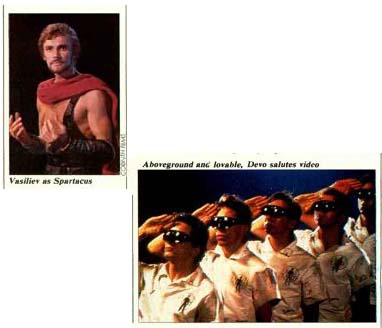
--Vasiliev as Spartacus ; Above-ground & lovable, Devo salutes video
LAST year an album featuring George Shearing and Mel Torme on the Concord Queen takes the classics seriously on video Jazz label won Torme his first Grammy, for Best Jazz Vocal Performance (Male).
It was recorded the year be fore at the annual summer festival held at the Paul Masson winery in Saratoga, California, from which a number of other recordings and films for television have come. A schedule of this year's concerts and other events is available free by writing to Paul Masson Summer Series, P.O. Box 1852, Saratoga, Calif. 95070.
Cheers!
THE just-released Angel recording of violin concertos by contemporary American composers Robert Starer and Earl Kim performed by Itzhak Perlman and the Boston Symphony under Seiji Ozawa represents a couple of firsts. It results from the first grant for a re cording ever awarded by American Express and one of the first large grants awarded to a major orchestra by the National Endowment for the Arts through its Music Recording Program.
American Express and the National Endowment contributed $20,000 each to make the project possible.
THE cast of A Chorus Line 2001? No, just those lovable spud boys of Devo, keeping a collective eye out for their newly released video album "We're All Devo" (see review on page 78). It's a collection of nearly all the group's promotional films since their underground, pre-Warner Brothers days, including the original Satisfaction and Jocko Homo.
The program also includes guest appearances by Saturday Night Live's Larraine Newman (as Donut Rooter, numero uno Devo fan and teeny-bopper heart-throb) and former Sixties acid guru Dr. Timothy Leary, whose reading of lines indicates that his brain pan has not yet been completely fried.
Available in Sony VHS stereo, Beta Hi-Fi, and Pioneer LaserDisc formats.
THIS year's Metropolitan Opera historic broadcast album is a live recording of Gounod's Romeo et Juliette with soprano Bidu SayAo and tenor Jussi Bjoerling in the title roles. Billed as "a performance still cited with a certain hushed reverence," it dates from the Saturday matinee of February 1, 1947, which was broadcast nation wide by Texaco. The album is available as a gift to those who contribute $125 or more to the Metropolitan Opera Fund, P.O. Box 930, New York, N.Y. 10023.
Carmen has al ways been a popular opera, but perhaps never in its hundred-plus years has it come in for so much "treatment" (some would say mis treatment) as in the past few months. This has been particularly true in films and on records. The latest entry is a film directed by Francesco Rosi that presents the opera straightforwardly as written.
It has the American soprano Julia Migenes Johnson in the title role and Placido Domingo as Don Josh. Lorin Maazel conducts. The film won't be released in this country until late summer or fall, but RCA is already selling Erato's soundtrack recording of Carmen complete or as a single album of excerpts on both LP and tape.
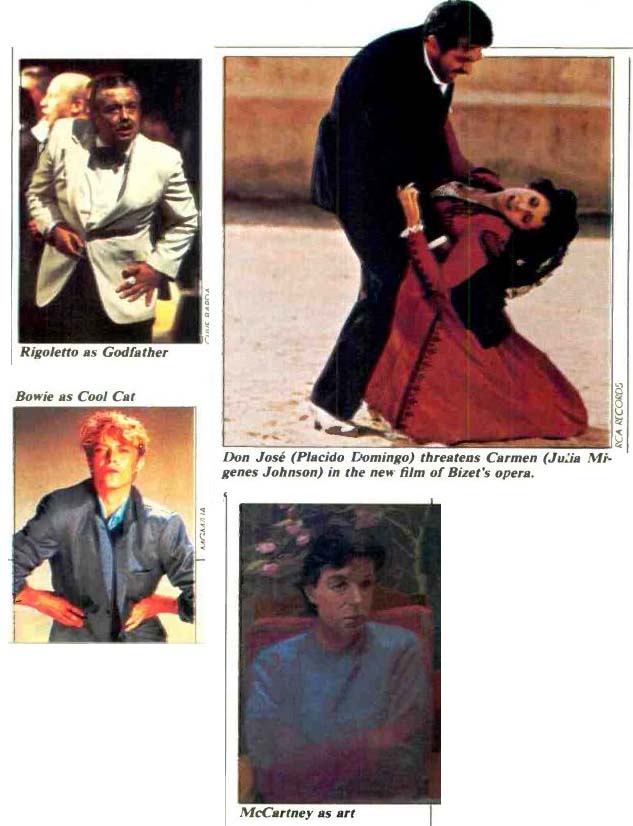
---Rigoletto as Godfather ; Bowie as Cool Cat; --- McCartney as art
Compact Discs will follow.... A live recording of a 1982 Peking production of Carmen, sung in Chinese (!), is available now on the Stil label, an AudioSource import.
THE current American tour of the English National Opera was preceded by a fair amount of controversy. It arose over the company's otherwise acclaimed production of Verdi's Rigoletto, to which a couple of Italian-American groups took exception-for its up dated setting, in Manhattan's Little Italy section downtown, and its explicit references to the Mafia.
Anyone unable to see and hear the production for him self fortunately can fall back on the "original-cast" recording, sung in English, with John Rawnsley in the title role. Angel is releasing it this month. Note, though, that the booklet accompanying the recording has been "corrected" for the American market.
MORE VIDEO NEWS: Just out from MGM/UA is "Cool Cats," a new home video program that proves once again that in rock-and roll the look is just as important as the sound. Subtitled "25 Years of Rock-and-Roll Don Jose (Placido Domingo) threatens Carmen (Juaa Mi genes Johnson) in the new film of Bizet's opera.
Style" (and based on the book of the same name from Delilah publishing company), "Cool Cats," like the earlier "Complete Beatles" and "Girl Groups" made by the same creative team, is a marvelous nostalgic glimpse of some legendary performers and bands, including Elvis Presley, David Bowie (looking far more flamboyant than he usually does in these pages), Blondie, Janis Joplin, the Stray Cats, and lots more. Commentary is supplied by noted pundits, including the Who's Pete Townshend. Also new and noteworthy from MGM/ UA: "The Everly Brothers Reunion Concert," a slightly longer version of the special aired recently on HBO. Both programs are available in VHS stereo, Beta Hi-Fi, and both disc formats.
National Portrait Gallery in London has just hung a painting of former Beatle Paul McCartney by Humphrey Ocean. It is only recently that a work of art representing a living British subject was accepted by the gallery, and until now rock-and-rollers, living or dead, have never been among them. The McCartney portrait resulted from an awards program sponsored by John Player, the cigarette manufacturer, in which Ocean was a 1982 winner.
GRACENOTES. The new Yes video, Leave It, the follow-up to their comeback smash Owner of a Lonely Heart, was delivered to the media in eighteen slightly differently edited versions as part of an April Fools Day prank by directors Kevin Godley and Lol Creme (formerly of 10cc). A spokesman for the band claims that the video is a remarkably innovative piece of work, with "no women or vintage auto mobiles or desert sands to be seen." . . . End of an Era:
The legendary Gold Star Studio in L.A., used at various times by everybody from Eddie Cochran to the Bee Gees but best known as the home of Phil Spector's "Wall of Sound" (thanks to the studio's un-duplicable echo chamber), has been bulldozed to make way for a commercial building. . . .
The irrepressible Flo and Eddie (a.k.a. Mark Volman and Howard Kaylan) are hard at work composing the score for the first home video-disc adventure game.
Tentatively titled "Quest," the game's music will be entirely computer generated.
The game itself was designed by Rick Dyer, who did "Dragon's Lair," the first arcade laser-disc game. . . .
JEM Records has just re leased an album that may weal overtake "Thriller" as the all-time sales champ, at least among sentient nonhumans. Entitled "Beatle Barkers," the LP collects twelve Lennon and McCartney classics as performed by an un-credited rock band and an ensemble of dogs and various barnyard animals. Wait till you hear the a cappella woofing on Paperback Writer.... STEREO REVIEW Record of the Year Award-winning pop-rocker Marshall Crenshaw is at work on his third Warner Brothers al bum. This time the production is being handled by Mitch Easter, who did the sublime "Murmur" for Georgia psychedelic revivalists R.E.M.
Best OF THE MONTH
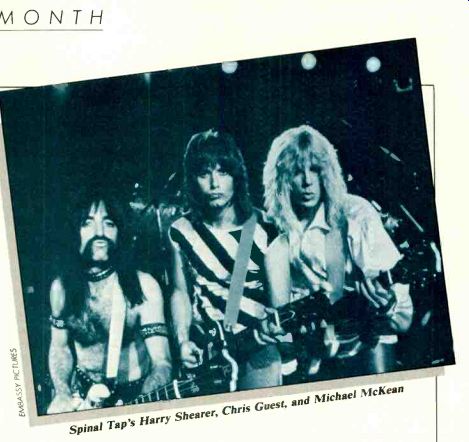
THIS IS SPINAL TAP: A DEVASTATING BUT AFFECTIONATE AND CONVINCING SEND-UP OF HEAVY-METAL ROCK
--- Harry Shearer, Chris Guest, and p Michael McKean
THE story of a dimwitted bunch of Sixties pop musicians hanging onto their careers well into the Eighties, This Is Spinal Tap is a mock-rock documentary in the tradition of The Rutles--and possibly the funniest movie ever made about rock-and-roll. What's especially nice about it, of course, is that it's an insider's parody, made by people who not only know the subject but have a lingering affection for it.
Polydor's new soundtrack album has the same virtues as the film.
While it's a devastating send-up of the most banal clichés of heavy metal, you can also tell that its creators take furtive, guilty pleasure at being able to reproduce the genre's idiocies so convincingly.
Largely responsible for this splendid lark is one Chris Guest, who's done similar parodies on National Lampoon albums. The approach is to take an aspect of the subject-for instance, the preposterous adolescent mysticism that's one of heavy-metal's secondary themes-and burlesque it. It's that direct. So when you hear a cut called Stonehenge, say, you should bear in mind that, as my late colleague Noel Coppage once observed, "Hard satire has to bypass a lot of throwaway laughs to stay on the point." Be assured, however, that there are some blatantly, deliberately ridiculous things here that are guar anteed to leave you writhing on your floor in helpless laughter.
Frankly, I can't even hear some of the song titles without breaking up.
My personal fave is Tonight I'm Going to Rock You Tonight (kind of says it all, don't you think?).
Perhaps the cream of the jest is that the band members-including Saturday Night Live alumnus Harry Shearer and Michael McKean, better known as Lenny from Laverne and Shirley-actually play their own instruments. And all the songs were written by Guest, Shearer, McKean, and director Rob Reiner, whose collective lyric-writing talent is nothing less than awesome.
("You're too young and I'm too well hung" might be the greatest line in the history of rock-and-roll ) This Is Spinal Tap may not put the real-life bands it evokes so brilliantly out of business, but whether you love heavy-metal or hate it, this is a good show.
Steve Simels
THIS IS SPINAL TAP (Guest, McKean, Shearer, Reiner).
Original-soundtrack recording. Christopher Guest (vocals, guitar, mandolin); Michael McKean (vocals, guitar); Harry Shearer (vocals, bass); David Kaff (key boards); R. J. Parnell (drums, percussion); Harlan Collins (synthesizer).
POLYDOR 817 846-I $8.98, 817 846-4, $8.98.
REFRESHING MODERN PERFORMANCES OF HANDEL CONCERTOS HAVING been inundated with recordings of the music of the Baroque masters performed on early instruments in the authentic style, I find it refreshing indeed to hear Handel's beautiful concerti grossi performed for a change on modern instruments in a contemporary manner. Not that there is any thing wrong with authentic instruments and styles, but some of the proponents of the "more authentic than thou" school tend to reject the validity of modern expression.
In a new Philips recording led by violinist-conductor Iona Brown, the Academy of St. Martin-in-the-Fields proves beyond a shadow of a doubt that Handel's music sounds just as invigorating on modern instruments as on early ones. These wonderful performances of the Op. 6 concertos bring out Handel's unique blend of energy and lyricism ...
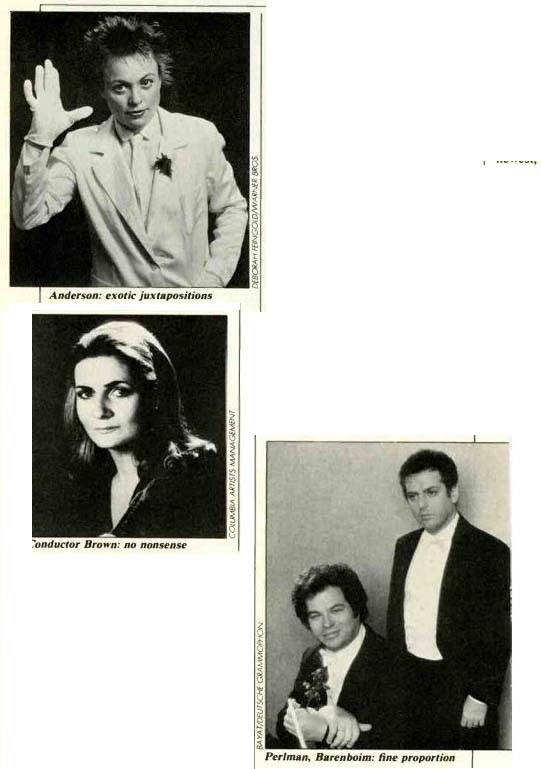
Anderson: exotic juxtapositions
...through straightforward, no-non sense readings. The recorded sound is first-rate too. Stoddard Lincoln HANDEL: Concerti Grossi, Op. 6. Academy of St. Martin-in-the-Fields. Iona Brown cond. PHILIPS 0 6769 083 three discs $35.94, 7654 083 three cassettes $35.94.
LAURIE ANDERSON'S FANTASTIC, HYPNOTIC-MISTER HEARTBREAK
LISTENING to "Mister Heart break," Laurie Anderson's new album, for the first time, I felt as if I'd been lifted from my office desk by a giant hand, set down on a tropical island on the other side of the earth, and handed a ringing tele phone. That's how disorienting Laurie Anderson is. "Mister Heart break" is the performance artist's Robinson Crusoe. The music is primitive, incantatory, hypnotic an organic blend of African percussion and wind instruments, with the occasional intrusion of electric guitar and bass, upon which Ander son's Vocoderized vocals are super imposed.
"Mister Heartbreak" juxtaposes the everyday and the fantastic. It's like walking into your bedroom and finding the furniture nailed to the ceiling. In Sharkey's Day, Anderson describes a man who's troubled by dreams he can't quite remember.
The connection between his environment and his conscious self has been short-circuited. The music is as dense and alive as a swamp in habited by a thousand small birds, bugs, and furry mammals. Above this buzzing thicket of sound-including Adrian Belew's screeching guitar-Anderson's matter-of-fact vocals are strangely calming.
It is the great paradox of Laurie Anderson's voice that it is so reassuring when everything around it seems like a soundtrack for Hieronymus Bosch. Nowhere is this so striking as in Langue d'Amour, a strange retelling of the fall of man in which love is the forbidden fruit and boredom, not pride, is Eve's undoing. Anderson's rich, measured voice is positively seductive when she describes the tongue of the snake as a flicker of fire.
"Mister Heartbreak" is brimming with the puzzling and the exotic. It yields up its meaning gradually and only with some effort, but the effort is well rewarded. Mark Peel
LAURIE ANDERSON: Mister Heart break. Laurie Anderson (vocals, Synclavier, violin, Vocoder, percussion); Adrian Belew, William S. Burroughs. Peter Gabriel, Bill Laswell, Nile Rodgers, David Van Tieghem, Phoebe Snow, others (vocal and instrumental accompaniment). Sharkey's Day; Langue d'Amour; Gravity's Angel; Ko KoKu; Excellent Birds; Blue Lagoon, Sharkey's Night. WARNER BROS. 25077 1 $8.98, 25077-4 $8.98.
Conductor Brown: no nonsense
SUPERB PLAYING IN TWO ROMANTIC VIOLIN CONCERTOS
FOR a work as well loved as Wienawski's Second Violin Concerto, it is astounding to find only four current recordings. The newest, on DG, has Itzhak Perlman Perlman, Barenboim: fine proportion as soloist with Daniel Barenboim conducting the Orchestre de Paris.
All around, it is probably the most attractive version of the work since the incomparable mono record by Isaac Stern with Eugene Ormandy was deleted some years ago.
The Saint-Saens Third Violin Concerto, which shares the new disc, is also superbly played. Perl man shows the same fine sense of proportion that Stern brought to the work in his CBS recording with the same conductor and orchestra. This is marvelous music making, and the sound is gorgeous. Richard Freed SAINT-SAENS: Violin Concerto No. 3, in B Minor, Op. 61.
WIENAWSKI: Violin Concerto No. 2, in D Minor, Op. 22. Itzhak Perlman (violin); Orchestre de Paris, Daniel Barenboim cond. DEUTSCHE GRAMMOPHON, 0 410 526-1, $11.98, CO 410 526-4 $11.98; 410 526-2, no list price.
POPULAR MUSIC DISCS and TAPES
------------------
REVIEWED BY CHRIS ALBERTSON PHYL GARLAND LOUIS MEREDITH ALANNA NASH MARK PEEL PETER REILLY STEVE SIMELS JOEL VANCE
------------------
LAURIE ANDERSON: Mister Heart break (see Best of the Month )
THE COUNTRY GENTLEMEN: Good As Gold. The Country Gentlemen (vocals and instrumentals); instrumental accompaniment. Good As Gold; I Just Got Tired of Being Poor; Guysboro Train; Hard Times; When They Ring Those Golden Bells; and seven others. SUGAR HILL SH 3734 $7.98.
Performance: A joy
Recording: Fine
The trouble with most bluegrass albums is that they sound the same from start to finish. If there is any variation at all, it's usually in the choice of lead singer, the tempo of the songs, or the inclusion of the obligatory instrumental tune. What a joy, then, to hear the new Country Gentlemen album, "Good As Gold," on Sugar Hill.
One of the first bluegrass bands to strive for a "progressive" sound, the Gents have probably converted almost as many people to bluegrass as Flatt and Scruggs. Part of their success must surely be traced to lead singer/guitarist Charlie Waller, the founder of the group and one of the most authoritative and affecting voices in bluegrass music. Waller is in even better form than usual on this al bum (his delivery of the late Stan Rogers's Guysboro Train is positively bone-chilling), probably in celebration of the return of mandolinist/tenor Jimmy Gaudreau, who performed on all the Gents' classic material from the late Sixties and early Seventies.
There's not a slow moment on the en tire LP. In the end, it's apparent that the Country Gentlemen are the bluegrass band most other groups only aspire to be, and "Good As Gold" is the album they can only hope for. A.N.
MENUDO: Reaching Out. Menudo (vocals); instrumental accompaniment. Like a Cannonball; Indianapolis; Heavenly
--------------
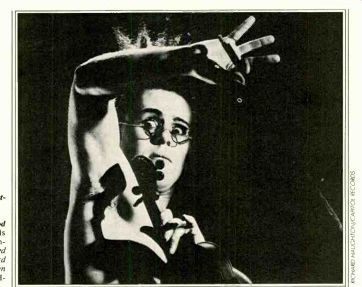
THOMAS DOLBY
THOMAS DOLBY'S EP "Blinded by Science" struck a nearly perfect balance between technology and pop music, rhythm and melody, mystery and slap stick. His new album, "The Flat Earth," never quite catches this balance. The songs lie at two extremes. At one, Dolby seems to be trying to outdo the rhythmic complexity of "Science." At the other, he works toward a softer, more subdued and overtly emotional effect. The first group includes Dissidents, Mu/u the Rain Forest, and Hyperactive, which are elusive, exceedingly busy, and largely unapproachable. The second group-Flat Earth, Screen Kiss, White City, and the Dan Hicks ballad I Scare Myself-while packed with Dolby's characteristic rhythmic tinkering and suffusion of sound effects, are far more appealing because they hold to a central melodic theme.
In general, "Flat Earth" is far less dense texturally than "Science." More important, Dolby steps out from behind his machines to take on a larger vocal presence.
He may be flat a good part of the time, but he is a zealous and sensitive interpreter, and his lyrics are clever and frequently disturbing.
Dolby also uses the human voice as a prop. There are half a dozen conversations going on here, the most intriguing one at the conclusion of White City, in which the subject, a man completely self absorbed in drug use, discourses convincingly but incoherently until he realizes no one is listening: "Oh, you're not there either." It's just one of many arresting, though essentially nonmusical, flashes of inspiration that make Dolby, at least this time out. a far more interesting story teller than music maker. Mark Peel
THOMAS DOLBY: The Flat Earth.
Thomas Dolby (piano, effects, vocals); vocal and instrumental accompaniment. Dissidents; The Flat Earth; Screen Kiss; White City; .lulu the Rain Forest; I Scare Myself Hyperactive. CAPITOL ST-12309, $8.98, 4XT-12309 $8.98.
--------------

Angel; Because of Love; Motorcycle Dreamer; If You're Not Here (By My Side); and four others. RCA AFL 1-4993, $8.98, AFKI-4993 $8.98.
MENUDO: A to-do rock. Menudo (vocals); instrumental accompaniment. Indianapolis; Piel de Manzana; Chicle de amor; Una buena razon; Todo va bien; Si to no restas; Amor en bicicleta; and three others. RCA INTERNATIONAL IL8 7241 $8.98, IC8-7241 $8.98.
--------------
Explanation of symbols:
= Digital-master analog
= Stereo cassette
= Digital Compact Disc
= Eight-track stereo cartridge
= Direct-to-disc recording
= Monophonic recording
------------------
Performances: The usual
Recordings: Good
Menudo's first English-language album, "Reaching Out," consists of translated versions of their biggest-selling songs in Spanish. The release raises the question of whether this super-popular Hispanic group, or its material, loses in translation.
It doesn't. A close comparison with Menudo's latest Spanish-language album, "A todo rock," reveals no major differences in attack or effect. The consistency is readily apparent in Indianapolis, the only song that appears on both albums. A tribute to that most American of all sporting events, the Indianapolis 500 auto race, the song sounds virtually the same in both versions-though it is per haps more fun to hear the title pronounced in Spanish as "In-dian-a-po lees!" The Spanish album is also a little more fun because it contains two numbers with a pronounced Caribbean flavor, Piel de Manzana and Todo va bien, the latter having a carnival spirit. In general, the songs on both albums are strictly main stream, inoffensive, maybe even bland, but undeniably appealing. All according to formula, true, but Menudo's formula works. P.G.
MISSING PERSONS: Rhyme & Rea son. Missing Persons (vocals and instrumentals). The Closer That You Get; Now Is the Time (For Love); Surrender Your Heart; Clandestine People; and six others. CAPITOL ST-12315 $8.98, 4XT- 2315 $8.98.
Performance: By prescription only
Recording: Over the counter If "Rhyme & Reason" came in bottles, you'd need a prescription for it. As it is, I lost five pounds listening to this speeded-up second album by Missing Persons, which is led by its drummer and fronted by a Bride-of-Frankenstein vocalist.
Drummer Terry Bozzio pushes the group through the music at what would be an ungovernable pace for most bands, yet they never miss a beat. His platinum-wire-haired wife, Dale, carries off her role as Blonde with the precision of a Blade Runner android. As a singer and as a sex symbol, she seems less human than electronic. The best I can say for the lyrics here is that they do rhyme. But as a strong dose of sonic and kinetic thrills, "R & R" gives fast, if temporary, relief. M.P.
DOLLY PARTON: The Great Pretender. Dolly Parton (vocals); vocal and instrumental accompaniment. Save the Last Dance for Me; Turn, Turn, Turn (To Everything There Is a Season); She Don? Love You (Like I Love You); We'll Sing in the Sunshine; and six others. RCA AHL I-4940 $8.98, AHK1-4940 $8.98.
Performance: Twilight Zone
Recording: Too much top end
Back in her old syndicated TV days, Dolly Parton would often open her shows with spirited rock offerings such as Takin' Care of Business, Burnin' Love, or whatever other pop song happened to catch her fancy that week. Her voice would soar over the melody with such verve and spirit that those of us who were then only marginal country fans would ache for the day when she would break out of her straight-country confines.
Now, some eight years later, along comes a whole collection of pop, soul, and early rock-and-roll classics, but I'm sorry to say it's an almost total disaster.
The blame lies not with Parton but with producer Val Garay, who has paired one of popular music's most emotional singers with some of the most vapid and vacuous instrumental tracks since the old 101 Strings albums. In the midst of this mess, however, is one of Parton's most affecting and wistful performances, a re working of Troy Seals and Donnie Fritts's We Had It All that probably cuts closer to the bone than anything else she's ever done. A.N.
STEPHEN FUNK PEARSON: Hudson River Debut. Stephen Funk Pearson (guitar). Thusslegarth; Ardea Herodias Waltz (Dance of the Great Blue Heron); Brunella the Dancing Bear; Tricoscopie I. II. III; Tubescent; and three others. KYRA K1001 $8 (from Kyra Records, 5 Willow Dock Road, Highland, N.Y. 12528).
Performance: Promising
Recording: Good
The cover photo of Stephen Funk Pearson's debut album shows the young guitarist sitting on a chair in a rubber boat, wearing a jaunty bow tie and newsboy's cap, and oblivious to the ice floes that surround him. Inside, naturally, one expects to find an eccentric folk artist who chortles on in witty lyrics about this warp-jawed world of ours, or perhaps an urban blues artist whose middle name was born of musical preference. Instead, the album reveals Pearson to be an unusually inventive instrumental performer (no lyrics) as well as a composer of a sophisticated hybrid of classical and popular music. Some of the eight selections, performed on the gut-string guitar, are melancholy and somber, while others, including Brunella the Dancing Bear, are charming and fanciful in a childlike way.
An impressive bow. A.N.
QUEEN: The Works. Queen (vocals and instrumentals); other musicians. Radio GaGa; Tear It Up; It's a Hard Life; Man on the Prowl; Machines (or 'Back to Humans'); and four others.
CAPITOL ST 12322 8.98, C) 4XT-12322 $8.98.
Performance: Overwrought
Recording: Humongous
I've resisted, even actively loathed, Queen's bombastic and self-mythologizing output in the past, but I find I'm developing a sneaky admiration for them and their new record. Suddenly the sledgehammer beat, the ridiculous sonic excess, the insanely layered background vocals begin to strike me as hilarious.
That's not to say that some of this stuff can't be taken straight. In fact, there's actually interesting music here----for example, Radio Gaga (the single), a skillful merger of contemporary synth-pop and old-time Brill Building panache, and Hammer to Fall. a devastating piece of Sixties hard rock successfully passing it self off as Eighties heavy-metal. Still, it's the calculated absurdity of "The Works" that puts the whole thing over. S.S.
THIS IS SPINAL TAP (see Best of the Month)
TRACEY ULLMAN. Tracey Ullman (vocals); instrumental accompaniment. Breakaway; Bobby's Girl; Shattered; Life Is a Rock; and six others. MCA, MCA 5471 $8.98, MCAC-5471 $8.98.
Performance: Fun
Recording: Good Singer-comedienne
Tracey Ullman, a big star in England, has appeared over here a few times, most notably on the Tonight Show. Obviously a topflight comedic ac tress, she specializes in impersonations of classic British types drawn mostly from the lower-middle or working classes. In these she can be hilarious. On records she also does some impersonations, in this case centering on the frantic "girl group" sound. When it works, as it does in Oh, What a Night and Bobby's Girl, the results are also hilarious and oddly touching. When it doesn't, as happens too often here, the results are strident and forced. I like her best when she just sings out on her own, as she does so well in the al bum's best track, Breakaway. P.R.
COLLECTION TROUSER PRESS PRESENTS THE BEST OF AMERICA UNDERGROUND. Chris Moffa and the Competition: You Know How Hot (It's Been Get ting Around Here). Martha Hull: Feelin' Right Tonight. Norman Salant: Tickets Are Free. Erector Set: Inside Out; and six teen others. ROIR A 124 $8 (plus $1.50 postage and handling charge from ROIR, 611 Broadway, Suite 214, New York, N.Y. 10012).
Performance: Consistently interesting
Recording: Inconsistent
Trouser Press was probably the first above-ground magazine to document the emergent independent singles scene that flourished in the wake of Patti Smith's trail-blazing mid-Seventies Hey Joe. This cassette-only release presents the editors' favorites. Not everything will be to every body's taste, but since the music runs a ridiculously wide gamut, from deliberately accessible pop to deliberately inscrutable avant-garde, chances are everything here will be to somebody's taste.
High points include Underwater Girl, an adorable Merseybeat confection by Boston's Tweeds; Martha Hull's Feelin' Right Tonight, a Fifties-style rouser featuring backup by rockabilly kingpin Tex Rubinowitz (!); the Residents' Booker Tease, a sinister instrumental whose appearance here clears up an old mystery, namely, was it originally meant to be played at 33V3 or 45 rpm?; the Bizarros' great garage-punk stomper, appropriately titled I, Bizarro; and, saving the best for last, The Independent Hitter, a tribute to a freelance killer by my long-time hero (and a former resident of the Elmira Reformatory) Armand Schaubroeck. Altogether, this is a terrific package, and just about everything rewards attention. As usual, ROIR has provided detailed and informative notes. S.S.
CLASSICAL MUSIC DISCS and TAPES
REVIEWED BY RICHARD FREED DAVID HALL GEORGE JELLINEK STODDARD LINCOLN ERIC SALZMAN
J. S. BACH: Trio Sonatas (B WV 525 530; Schdbler Chorales (814 V 645-650).
Ton Koopman (organ). DEUTSCHE GRAMMOPHON Archival 2742 006 two discs $17.96.
Performance: Brilliant
Recording: Great
Any organist who can get through Bach's trio sonatas without falling off his perch deserves the highest praise. Not only does Ton Koopman remain firmly seated, but he turns in virtuoso performances full of energy and excitement. The organ-at the Waalse Kerk in Amsterdam-is a splendid instrument, and Koopman exploits its contrasting registers to bring out the individual threads of Bach's complex textures. The results are stunning. S.L.
BRAHMS: Variations on a Theme by Paganini, Books I and II, Op. 25. SCHUMANN: Symphonic Etudes, Op. 13. Dimitris Sgouros (piano). ANGEL 0 DS-38075 $12.98, 4XS-38075 $9.98.
Performance: Good, but no cigar
Recording: Good
The young Greek pianist Dimitris Sgouros seems to be able to learn complex works literally overnight and to play the pants off them. Mstislav Rostropovich brought Sgouros to our shores two years ago to perform with him and the Nation al Symphony at Carnegie Hall and subsequently presented him in concerts he con ducted at Wolf Trap and in London. At the time Sgouros was only eleven or twelve years old.
Now, at the ripe old age of fourteen, Sgouros is making his recording debut in two of the most demanding works in the solo literature. Sure enough, he does play the pants off them, but the impression these exciting and highly charged performances leave is that the undertaking may have been a bit premature. For all Sgouros's unquestionable technical command and the obvious seriousness as well as abundant energy he brings to his playing, there is very little here in the way of mellowness or introspection at appropriate points. The exuberance is exciting, the technical brilliance impressive, but there is a breathless feeling about it all. If this obviously gifted youngster would just stop to take a breath or two, I think, he would surely emerge as one of the major musical figures of our time. R. F.
-----------------
ASHKENAZY 'S PICTURES
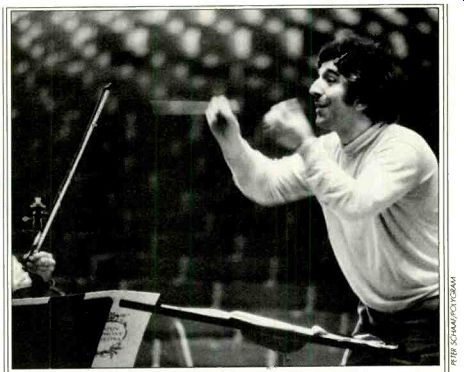
Some fairly bizarre transcriptions of Mussorgsky's Pictures at an Exhibition have found their way into concert halls and onto discs in recent years. But Vladimir Ashkenazy's symphonic arrangement, now available on a London recording with Ashkenazy conducting, is relatively sober-sided. Ashkenazy has orchestrated the entire work, including the "Promenade" omitted by Ravel in his celebrated and widely performed version, and he has done so on the basis of Mussorgsky's original, which Ravel did not have at his disposal at the time of his commission (1922).
There are some striking differences be tween the Ashkenazy and Ravel versions.
In Ashkenazy's, for example (and in his solo-piano recording), the start of "Bydlo" is a forthright forte, and the concluding diminuendo is the only dynamic change. As Ashkenazy points out in his sleeve note, however, it would be fairly simple to bring details of the Ravel orchestration into accord with the notes of the original Mussorgsky piano work.
As for Ashkenazy's instrumentation, there is less sheer razzle-dazzle than in Ravel's but there are a few very effective touches. Among them are the whip-crack in "Bydlo" and the use of massed wood winds instead of brass at the opening of "The Great Gate at Kiev." The use of solo violin instead of muted trumpet in the "Two Jews" episode is also effective, in its own way, although Ravel's portraiture in this instance is more vivid.
The performance of Borodin's Polovtsian Dances that fills out the disc is one of the very best among the many recorded versions. The chorus is not quite so dominating here as it sometimes is, and the whole thing comes off with enormous verve and brilliance. The recorded sound is very good too. - David Hall
MUSSORGSKY/ASHKENAZY: Pictures at an Exhibition.
BORODIN: Polovtsian Dances. London Opera Chorus (in Borodin); Philharmonia Orchestra, Vladimir Ashkenazy cond.LONDON 0 410 121-1 $11.98, 410 121-4 $11.98.
------------
------------
DVORAK: Symphony No. 9, in E Minor, Op. 95 ("From the New World"). Chicago Symphony Orchestra, Sir Georg Solti
---------
Explanation of symbols:
Digital-master analog
LP Stereo cassette
Digital Compact Disc
Eight-track stereo cartridge
Direct-to-disc recording
Monophonic recording
-----------
cond. LONDON 0 410116-1 $11.98. C) 410 116-4 $11.98; 410 116-2, no list price.
Performance: Straight and strong
Recording: Very good
Here is the sixth digitally mastered New World to find its way into Schwann. Oddly enough, its strongest competitor, interpretively and sonically, is from the same orchestra under James Levine on RCA.
In contrast to Levine's frankly sensation al (and wholly electrifying) treatment of this thrice-familiar score, Sir Georg Solti gives a very "straight" reading with a stress on fine detail that pays off most tellingly in the slow movement. In the finale, his pacing, like Levine's, is swift and urgent. D.H.
ELGAR: Symphony No. 1, in A-flat Major, Op. 55. Philharmonia Orchestra, Bernard Haitink cond. ANGEL 0 DS-38020, $12.98, 4X8-38020 $9.98.
Performance: Loving
Recording: A bit tight
The two Elgar symphonies pose a major challenge to any conductor who dares to essay them: their end movements, those of the A-flat especially, are complex both in architecture and textural density. Bernard Haitink, like Sir John Barbirolli be fore him, takes a more deliberate view than others of the A-flat Symphony. In the magnificent opening theme, which appears and reappears throughout, he is drawn less to its solemn tread than to its lyrical aspirations. In the main body of the end movements he lets the music un fold at a natural pace rather than driving it, but in the scherzo he adheres to an urgent yet steady quick-step tempo.
My only major criticism of this disc is the rather tight ambiance of the recorded sound, presumably a result of close miking. I'm sorry that the performance was not done with Haitink's own Concertgebouw Orchestra in Amsterdam, for the acoustics of that hall would have pro vided just the added glow this music needs. D.H .
HANDEL: Concerti Grossi, Op. 6 (see Best of the Month, page 69)
D'INDY: Piano Quartet in A Minor, Op. 7 (see SAINT-SAENS)
LALO: Cello Concerto in D Minor (see RODRIGO)
LUTOSLAWSKI: Concerto for Oboe and Harp (see R. STRAUSS)
MARTINU: Nonet; Trio in F for Flute, Cello, and Piano; La Revue de Cuisine.
Dartington Ensemble. HYPERION A66084 $13.98 (from Harmonia Mundi USA, 2351 Westwood Boulevard, Los Angeles, Calif. 90064).
Performance: Delicious
Recording: Fresh
Bohuslav Martinu was one of the first Europeans to take up jazz, and he used it very cleverly, as La Revue de Cuisine makes clear. The piece is a sextet made out of music from a ballet whose movements consist of a stylized tango and a bouncy Charleston preceded by an off beat fanfare and march and followed by a lively jazz-tinged finale.
The Trio in F, from 1944, and the Nonet, written in 1959 shortly before Martinu's death, reflect nothing of the traumas-international or personal-of those years. They are pure neo-Classical idealism, beautifully written, good-humored, and wonderfully played by these musicians from the contemporary music center of Dartington in England. A nice and fresh recording. E.S.
MOZART: Requiem (K. 626). Margaret Price (soprano); Trudeliese Schmidt (mezzo-soprano); Francisco Araiza (ten or); Theo Adam (bass); Leipzig Radio Chorus; Dresden State Orchestra, Peter Schreier cond. PHILIPS 6514 320 $11.98, 7337 320 $11.98; 411 420-2, no list price.
Performance: Excellent soloists
Recording: Seamless Peter Schreier is a rare case of a singer turned conductor, and, as might be expected, he shows here a great feeling for the vocal shape, as opposed to the sym phonic shape, of the Mozart Requiem.
All the more reason, then, to wonder at the relative recorded treatment of the soloists and chorus in this co-production between Philips and the East German state record company.
The choral sound is clear, creamy, and "white," though it seems to me to lack articulation. The solo voices, however, with the partial exception of Margaret Price, seem a bit wan, which is especially unfortunate with such good singers. Otherwise this is an excellent recording. E.S.
RAVEL: Bolero; La Valse; Alborada del gracioso; Rapsodie espagnole. Orchestre National de France, Lorin Maazel cond. CBS 0 IM 37289, IMT 37289, no list price.
Performance: Mannered
Recording: Spacious and airy
Among Lorin Maazel's early recordings that I particularly cherish are those he did for Deutsche Grammophon of the two Ravel operas, L'Heure espagnole and L'Enfant et les sortileges. On this new disc, I find that only the Rapsodie espagnole matches that standard. There is exquisite limning of detail here, and the fine sound affords a vivid sense of depth and localization. The performance of Alborada del gracioso is respectable enough, although it is missing the snap and ginger of Eduardo Mata's digitally mastered RCA recording. With the perfunctory Bolero and the mannered La Valse, I'm afraid, it is downhill all the way. D.H.
RODRIGO: Cello Concerto.
LALO: Cel lo Concerto in D Minor. Julian Lloyd Webber (cello); London Philharmonic Orchestra, Jesus Lopez-Cobos cond. RCA ARL1-4665 $10.98, © ARK1-4665. $10.98.
Performance: Excellent
Recording: Excellent
Joaquin Rodrigo's Cello Concerto was premiered by Julian Lloyd Webber, for whom it was written, in 1982, but it is certainly hard to think of it as a work of the late twentieth century. Except for the orchestration, which is very distinctive and imaginative, the concerto is a light, highly flavored, Spanish-style work of a most traditional character. This is not to deny its charm-a quality certainly in short supply these days. The Lalo was written well over a century earlier. Unlike the composer's Symphonic espagnole for violin and orchestra, it has only a trace or two of Spanish flavor. The first movement is conventional Romantic bombast, but the middle movement, an intermezzo, is quite elegant, and the lively finale is engaging.
Julian Lloyd Webber (Andrew's brother) is an excellent cellist and makes a fine impression in this music. It was his idea to go to Spain to seek out Rodrigo and convince him to write a concerto, and he has recorded it in fine style. E.S.
SAINT-SAENS: Violin Concerto No. 3, Op. 61 (see Best of the Month, page 70)
SAINT-SAENS: Piano Quartet in H-flat Major, Op. 41.
D'INDY: Piano Quartet in A Minor, Op. 7. Cantilena Chamber Players. PRO ARTE 0 PAD-164 $10.98, PCD-164 $10.98.
Performance: Exquisite
Recording: Very good
The Cantilena Chamber Players is a first class piano quartet, and I would like to be more enthusiastic about the repertoire on this recording. But the Saint-Saens is so sure, so careful, so conservative and tame that it leaves me dreaming of other times, other places. I awake with a start. I forget to listen to the music! The D'Indy, an early work, has more profile but is ultimately only a little more memorable. The effect of these pieces, however, is certainly maximized by the performances, which are sympathetic and exquisite. E.S.
SCHUMANN: Symphonic Etudes, Op. 13 (see BRAHMS)
SHOSTAKOVICH: Piano Trio No. 2, in E Minor, Op. 67. Borodin Trio. Piano Quintet in G Minor, Op. 57. Borodin Trio; Mimi Zweig (violin); Jerry Homer (viola). CHANDOS 0 ABRD 1088 $13.98, ABTD 1088 $13.98 (from Harmonia Mundi USA, 2351 Westwood Boulevard, Los Angeles, Calif. 90064).
Performance: Thoughtful, intense
Recording Mostly solid
Shostakovich's Second Piano Trio is a powerful work, and here it gets a consistently satisfying performance by the Borodin Trio, an ensemble of émigré Soviet musicians. Except for the slowish scherzo, the reading is notably intense, whether in the eerie cello harmonic that opens the piece, the deeply somber cadences of the third-movement passacaglia, or the terrifying danse macabre of the finale.
The quintet is lighter but beautifully put together musically. The highlights are the fugal adagio second movement, with its strong lyrical impulse, the lovely inter mezzo with its echoes of Bach, and the magical coda of the fifth-movement finale. The finest playing here is in the slow movements-the faster ones are taken a bit too slowly for my taste. The sound is rich but a shade over-reverberant, with more body on the trio side. D.H.
SOUSA: Peaches and Cream. The Stars and Stripes Forever; La Reine de la mer; The Gliding Girl Tango; The Thunderer; Myrrha Gavotte; Peaches and Cream Foxtrot; and six others. Cincinnati Pops Orchestra, Erich Kunzel cond. Vox CUM LAUDE 0 D-VCL 9063 $7.98, D-VCS 9063 $7.98; MCD 10005, no list price.
Performance: Rousing
Recording Brilliant
There is nothing as rousing as a Sousa march, especially in performances as rousing as these by the Cincinnati Pops under Erich Kunzel. The orchestra produces a splendid sound with a strong beat that keeps the body on the move whether the music happens to be a march or one of the dances, which are real charmers.
Wonderful sound, too. S.L.
R. STRAUS,: Oboe Concerto. LUTOSLAWSKI: Concerto for Oboe and Harp. Heinz Holliger (oboe); Ursula Holliger (harp); Cincinnati Symphony Orchestra, Michael Gielen cond. Vox CuM LAUDE 0 D-VCL 9064 $7.98, D-VCS 9064, $7.98; MCD 10006, no list price.
Performance: The best
Recording: Impressive
This is a very attractive recording. Richard Strauss's Oboe Concerto was written in 1945, near the very end of his life, and the composer chose to make it a light hearted, neo-Classical romp in the style of Der Rosenkavalier or Ariadne-only more so. The Double Concerto by Witold Lutoslawski, written for Heinz Holliger and his wife, is a curious and effective hybrid of modernism and lyricism.
Holliger may be, as some people think, the greatest oboist alive today. He certainly seems to have the widest musical range and the greatest virtuosity. His tone is strong and attractive, and his musician ship and powers of expression are unrivaled. As for the orchestra, it is beginning to sound as if Michael Gielen has rebuilt the Cincinnati Symphony into a world-class ensemble. These are impressive performances all around, and the quality of the digital recording is first-rate. E.S.
R. STRAUSS: Daphne. Lucia Popp (soprano), Daphne; Reiner Goldberg (tenor), Apollo; Ortrun Wenkel (contralto), Gaea; Kurt Moll (bass), Peneios; Peter Schreier (tenor), Leukippos; others. Bavarian Radio Chorus and Sym phony Orchestra, Bernard Haitink cond. ANGEL 0 DSBX-3941 two discs $25.98, 4X2X-394 I two cassettes $19.98.
Performance: Very good
Recording: Very good
A verbose libretto is a prerequisite in a Richard Strauss opera. The slowly winding melodic deliberations depend on that element and frequently offer rich re wards. Such is the case with Daphne, a "bucolic tragedy in one act." That act takes nearly two hours to perform and makes for a very long evening in the theater. In the home, on records, regarded as an extended vocal/orchestral tone poem, it can be an aural treat. The vocal writing looks ahead to the Four Last Songs in its soaring lyricism and serenity, and the orchestral sounds are ravishing.
In this new recording, Bernard Haitink captures the Straussian sonorities with exquisite refinement, and the three principals, all of whom sing music of extraordinary difficulty, deserve high praise. Lucia Popp is a touching Daphne, pure in tone even in the most passionate moments and despite occasional effortful stresses in music that simply cannot be sung effortlessly. Reiner Goldberg and Peter Schreier, who sing her rival lovers, likewise raise their lyric voices against the often unreasonable vocal demands Strauss makes on them. And for once the principals are supported by a strong ensemble of singers in the minor roles. A welcome release. G.J.
STRAVINSKY: Le Sacre du printemps. Israel Philharmonic Orchestra, Leonard Bernstein cond. DEUTSCHE GRAMMOPHON 0 2532 075 $11.98, 3302 075 $11.98; 410 508-2, no list price.
Performance: Straight to the point
Recording: Very good Whether readers will agree with my assessment of the recording here as "very good" will depend on whether they agree that the dryish acoustic of the Israel Phil harmonic's Mann Auditorium is well suited to Stravinsky's music in general and to Le Sacre in particular. While I find this acoustic a disaster for Mahler, I think it's just fine for delineating the texture and rhythmic impact of Stravinsky's 1913 masterpiece. And, of the three Leonard Bernstein recordings of Le Sacre, this one is the freest from manner ism and the closest to what Stravinsky wrote. D.H.
WIENAWSKI: Violin Concerto No. 2, Op. 22
(see Best of the Month )
---------------
Also see: