---
ABOUT THE AUTHOR: John Jackson is 43 years young. He's been interested in music and audio since his mid teens. He studied mechanical engineering at Slough Technical College in England. Besides DIY audio, his hobbies include squash racquets, off-road cycling, wind surfing, and gourmet cooking. He also collects LPs. He has been working as a flight attendant for the past 13 years.
---------
IF You, LIKE ME, have been following the cable controversy ever since J. Hiraga's translation appeared in the August 1977 issue of Hi-Fi News & Record Review and if you haven't succumbed to the marketing hype found in most hi-fi magazines, this article is for you.
(The most interesting articles on cables I've read have been in Hi-Fi News & Record Review, in TAA, and recently in Sounds Like.) I'm proposing a cable that is phase coherent up to a frequency of 100kHz.
In theory, this should make an ideal interconnect; it won't, however, be a filter for transistor nasties. I have de signed this cable primarily for use with tube equipment, although if you use it as an interconnect between a tube pre amp and a solid-state amp, performance should be okay.
From the information I've gathered by reading the above articles, 0.4mm diameter wire seems ideal. I've chosen silver-plated, solid-core copper with a very thin Teflon insulation (okay up to 900V), which means you can use this cable to hard-wire tube preamps and power amps. Teflon is probably the ideal dielectric, if not the best. One company in the UK uses Goretex as an insulator; this material has an even lower dielectric constant than P.T.F.E.
However, having said that, I don't think the dielectric is the most important parameter. Like a gourmet meal, it's combination that makes the meal- or cable. Wire material, diameter, di electric, and construction are all important, and not necessarily in that order.
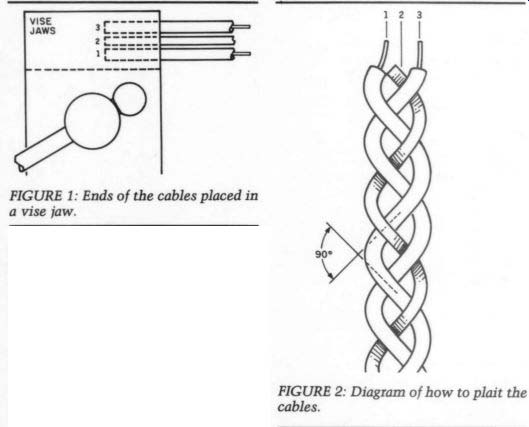
FIGURE 1: Ends of the cables placed in a vise jaw.
FIGURE 2: Diagram of how to plait the cables.
The best cable is none at all, but we all know how impractical that is. Next best is to keep cables as short as possible. Due to the use of thin wire, my pro posed cable lacks low resistance. How ever, due to its construction, inductance and self-inductance are very low and capacitance is fairly low. I suggest you keep all cable interconnects below 1M in length. You might need to double up, depending on the current flow; in tube equipment, it's not much.
I first tried my cable as a replacement for the coax cable used in the otherwise excellent Music Reference RM-9 power amp. It showed a definite improvement in dynamics, clarity, and three-dimensionality, and above all, it produced less hash/grundge. In all, this cable rendered listening to music less of a strain.
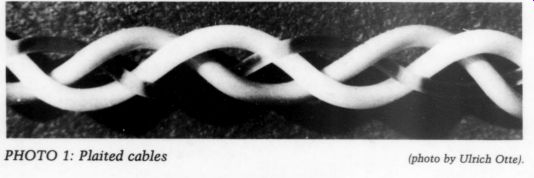
PHOTO 1: Plaited cables
With this method of construction, you'll lose about 20% in length. For ex ample, if you start with 1M strips, your cable will be 80 cm long. To make cables decide on finished length require, allowing for the 20% loss. Then use two different colored strips of wire and one length of fishing line of approximately the same diameter, 0.9mm 0.
(If the third strip has a smaller diameter than the two wires, you'll need approximately 20% more.) Place the ends of the cables (wires) and nylon in a vise after stripping off 3-5mm of insulation (Fig. 1).
Now start plaiting the strips; place wire 1 over wire 2, 3 over 1, 3 under 2, 1 under 3, and continue in this manner (Fig. 2 and Photo 1). Whoever does the work (and it is time-consuming) at 90° to cancel any magnetic fields caused by current flow.
This cable construction is impervious to hum. I've tried it as a P.U. cable for a low output Moving-Coil cartridge 0.3mV/5cm/sec^-1 without screening. If you think the cable should be screened, however, that's not a problem. I suggest you connect the screen to the source end; better still, use flying leads so you can connect it to one earth point. I've put my cables in silicon tubing, which is soft. You can also use heat-shrink tubing.
To finish the cable, you'll need a very good quality RCA phono plug, unless you intend soldering it or using Canon XLR plugs. The best phono plug I've seen is marketed in Germany by Monitor, PC model #80601. This plug is made from four parts-hot, ground, insulation, and sleeve-in comparison to others made from many bits and pieces. All contact surfaces are gold-plated. Its known specs are R = 0.130/M +20% 26AWG, C = 50pF/1.6M finished cable.
REFERENCES
1. Hawksford, Malcom, ‘The Essex Echo’.
2. Jung, Walt and Dick Marsh, "POOGE: A Mod Symphony for You Hafler DH-200 or Other Power Amplifiers,' TAA 4/81, p. 7.
SOURCES
Music Acc.
PO Box 100737
D-5270 Gummersbach
Monitor PC #8060
Music Link
Roentgenring 9 D-403 Ratingen W. Germany
++++++++++++++++
Also see: