EVERYBODY TRAVELS world wide these days It isn't easy to make a sensation any more by announcing, say, I've just been to JAPAN! Which I have. Unbelievable.
For my generation, the occasional big scale "junket" is a rare and often incredible experience, and I do not intend to lose my continuing sense of almost childish wonder that such things can actually happen-that I, myself and me, along with 17 other journalists and editors, could travel no less than 30,000 miles, more or less, as the guests of a munificent hi fi maker introducing a new line of quality goods in our field. Yamaha is the company, and Yamaha made possible the junket of my life, for which, hi fi aside, I am enormously grateful. And, hi fi not aside, I am impressed by the goods themselves, which are clearly all-out in the best and topmost Japanese manner. New speakers, new receiver lines, including an unprecedented FET power output.
Yamaha is officially Nippon Gakki Co. which means Japan Music Co. It has been first of all a musical outfit, a producer of an incredible array of Western-type musical instruments, most notably the Yamaha pianos that are now establishing themselves in the highest places everywhere, as a good many startled musicians have lately been discovering. In Yamaha's Tokyo retail store I played on one of the loveliest full-size concert grand pianos I have ever had the luck to touch. It was pure 1900 Steinway, light to the touch, shallow in key depth, with a silvery treble sound and an impressive bass. I own a 1903 Steinway-I should know. Opposite was a medium grand--straight Bechstein in the continental manner. That slightly woody treble that the Europeans love. The higher keys, stiffer action, that most new pianos have. Yes, Yamaha knows its pianos impressively well.
But my pleasure at Yamaha sound (and friends have told me that Yamaha guitars also are cannily modeled upon the several finest Western types in the same way) turned to utter astonishment when we got to our tour of the vast Yamaha factories in and around Hamamatsu, the company's home town. One gets the impression, around these parts-the States-that the art of piano building is a true craft, with everything hand made in painstaking detail, in ye olde manner.
Somehow, the mere idea that pianos could be automated seems a contradiction. Imagine, then, the sight of a hundred acres of humming factory automation, a thousand huge machines sawing and drilling and polishing, huge veneer/ plywood presses, enormous foundry operations, bright rivers of molten metal pouring into piano frames, the whole thing on a Detroit scale! Pianos, pianos, pianos--thousands of them. Vast automated rows of dangling curved frames, moving on assembly lines like car bodies.
Whole floors of semi-finished instruments as far as the eye could see.
Preliminary tuning, a soft, pervasive tinkle of a hundred tiny sounds, like an enormous flock of birds in song! And at the end of the lines, there were the great seas of shiny, finished instruments, big and little, grand and upright, sliding off towards the great world outside. How many hundred pianos a day?? I forgot to write it down, but I could not have believed that seven worlds or a dozen could absorb such an enormous output.
And Yamaha, as modern as Japan itself, has moved deftly into the electronic areas of music, as these have developed their importance. Miles and miles and miles of Yamaha electric organs. Hundreds of little blue-clad factory girls, testing the keyboards and the stops-whizzing fingers, obviously trained to play, earphones on for checking, an occasional out-loud chromatic scale at speed. Prrrrrr, up the keyboard. Some things are best done by human intelligence. They use those odd-looking Yamaha "ear shape" speakers for the organs, though these are not included in the new hi fi offerings which we were being shown.
Then there were the electronic factories, all solid state. You'll pardon me if I have lumped a dozen enormous installations together in my mind and can't really remember which was which; I simply must somehow give you the impressions I received, just as they came to me. We went into "every corner" of Yamaha's plant, quite literally, and after several days I was, shall I say, in a daze. In and out, up and down, back to the bus, out at another parking place with greenery (like all of Japan, Yamaha never loses the aesthetic touch), up a stairway, down an endless corridor, past another thousand blue uniforms--exhausting but fascinating too. I have so much to say that is irrelevant! Like the institution of safe backing up, for public busses... . Each bus has a hostess. She bows you into the bus and bows you out again and you bow back, if you have at least a sense of politeness. But her main job is backing. The instant the bus goes into reverse, the tiny hostess leaps out the door, dashes to the rear and starts frantically blowing on a police whistle. Tweep, tweeeeeep, tweep, tweeeep . . . . like a genial female maniac! Once we got sort of stuck on a narrow street and tried to back uphill for seven or eight minutes--I thought that little gal would bust; she never stopped for a second. All over Japan, I could hear those bus girls tweeping away, off in the distance, as the fleets of big tourist busses maneuvered around their parking places. Even with no soul in sight, in the middle of a virgin forest, the tweeps were mandatory. Great fun.
... Miles of electronics, semiconductors in all their magnificent proliferation, for Yamaha products, and for others as well. Including the new FET power producers. And finally, more miles of hi fi. The new speaker lines, the new receivers in all their silky brushed-satin glory. Mmmmm. Don't think I'm going to give you technical particulars; that's not my job and you'll be getting them soon enough, since the entire Yamaha line was introduced at the CES in Chicago this June. I'm just set on giving you the astonishing background into which this line fits and out of which it comes--a perfectly vast and huge company in the music field, out of a musical tradition, expanding and overflowing into the inevitable electronics and component area. In this respect I believe Yamaha is unique in Japan among the big hi fi makers, though whether this means in the end a better product I leave you to decide, along with the experts. It should make a difference, says this inveterate musician. I have never failed to believe that a musical ear and a musical tradition and a musical interest tend in hi fi to provide a healthy feedback toward wise, useful and intelligent componentry. As I've said a million times, the business of audio is music.
We were given an elaborate and formal presentation of the new hi fi in several lab sessions at headquarters, the technicians of the company lined up behind us, the top brass up front, the whole shining array of goodies displayed all around. To be frank, I didn't think too much of the acoustics of that lab. A curious big space behind the speakers, up front, a sort of thin transparent scrim blocking it off for the eye, but not the ear. We argued ourselves blue in the face with our usual enthusiasm as to exactly which setting on which speaker was best, but though the high ends were very definitely sibling on the two new featured models, the bass on the smaller NS 690 was oddly inadequate
-too much so, my ear immediately told me. As a musician at heart, I always hear loudspeakers first of all as music makers in an acoustic environment and I do not have, nor do I cultivate, the ability to hear the speaker itself out of context. In the home, in my own home, it's another story. One quickly discovers-over a period of days and weeks, that is-a loudspeaker's special characteristics, in the very process of listening to music in a familiar acoustic environment. Not so in an unfamiliar laboratory, with relatively brief bursts of sound. I distrusted that seemingly weak bass immediately, though the larger and more expensive top-of-the line NS-1000X seemed to do noticeably better, as we listened.
I think I was right. I heard the NS 690 later on in the big boss man's own private Japanese living room and there, lo! no problem. Again at the Osaka Audio Fair, in a very well designed listening room that was sealed off from outside noises, I heard the same two speakers and now I began really to recognize their qualities-no problem, again, with the NS-690 though the bigger and still more expensive NS-1000X still produced slightly heftier bass at top volumes.
Both speakers give that clean kind of bass one achieves with a solid sealed enclosure.
The Yamaha top end is not dull by any means-nor is it in any way strident. I found the word "shiny" returning to my mind each time I heard it.
Good description. We did much diddling with the midrange and high controls on the exposed front speaker panels and decided among ourselves that for pop and rock music the "flat" or normal position, as marked, was ideal, but for classical music a slight roll-down of both controls gave the ideal balance. We suggested, in fact, that two "normal" positions might be a good idea, one marked normal pop, the other normal classical. Continuously variable, of course, for those who want further to twiddle. Mind you, these two speakers, the NS-1000X brand new, head up a whole related line in which the NS-690 is roughly in the AR 3a price range, the 670, 645 and 625 ranging on downwards into the modest bookshelf category. How many of these will appear in the U.S. offering I do not at this point know.
As for those silky, shiny receivers and amplifiers, with the new power FETs for output, 1 will do no more than tell you how good they felt under the fingers-and sounded, insofar as one could judge in a laboratory demo, which means not much impact for my ears. Really well designed and expensive controls, nicest I've run into for a long time-silky smooth toggle switches, up and down, big volume and tuning controls, tiny de tents on most of the knobs which, ever so unobtrusively, set up points of reference without being gross and clicky. Maybe it's silly to talk of externals, but 1 do so deliberately; you'll hear plenty from others all about the insides and the FET power output.
One very big external: at last, a really workable and intelligent loudness control, like the very earliest ones years ago, before we slid into oversimplification, as on virtually all present component equipment. Apparent loudness depends directly on (a) volume setting and (b) acoustic environment and listening place. The loudness compensation curve is meaningless unless it is related to the actual, heard sound in a given room.
Yamaha has two controls, one for volume, one for loudness. Set your maximum desired volume, for your listening situation, and then use the loudness knob to lower it according to choice. It works! It always did.
Frankly, I find the usual loudness controls quite impossible and never use 'em if I can help it. I would have the Yamaha control in action virtually all the time.
To whet your curiosity, here are the Yamaha models we saw and heard. In the tuner department, CT by designation, two FM/ AM models, CT 800 and CT 600, and in the combined receiver category a full panoply, from the very fancy and expensive CR 1000 with no less than 30 control functions on its front panel, FM only, through the sleek CR 800 and similar CR 600, AM/ FM, and the relatively low-cost (but still very, very fancy)
CR 400, also AM/FM. Then in the amplifier-only area, another super model the CA 1000 stereo integrated amplifier and the CA 800, both of these with an interesting featured alternative, high-power class B operation or, via a switch, lower-powered distortionless class A. A CA 600 model carries this line down into the lower stratosphere. All of these with so many top-area features I would be foolish to try to write them all out, and won't. But don't forget the FET power amps in the higher-bracket models of the line. As of the present, nobody else has 'em, though Sony, I believe, has a license or equivalent and will go into them on its own in due course of time.
So there you are-obviously a component line intended to hit the very top quality bracket, and at prices that such equipment deserves, which is sad indeed for those who are penniless.
But the good life costs cash these days and there are a few pennies around, fortunately, to splurge on top quality hi fi. Yamaha wouldn't mind raking in a few of yours, needless to say.
Go look. I'm merely putting all this nice stuff out on a literary tray for your inspection-like the realistic food displayed outside Japanese restaurants in glass cases, so you can choose your menu piece by piece before you enter. Take it or leave it; that's your business from here on out.
As for Japan, you know me and you know that i can't ever detach mere hi fi from the rest of life as it floods around me and hits my senses.
And so I have come back from that country absolutely overflowing with impressions, and with quantities of stereo color shots, too, via Bert Whyte's brand new 20-year-old Revere, happily borrowed from him for the occasion. (Bert uses it all right, but keeps the thing so beautifully polished you'd never know.) I was really stunned by the size and power of Japanese westernization. I was delighted by the odd contradictions (from our viewpoint) between an old, old civilization, dating straight back on every hand to the sixth century, and such a new, new Western experience, relatively, that even the toilets have delicate instructions, with pictures, for those who haven't yet encountered that Western device. It has all happened pell-mell, it is happening, at breakneck speed, and in this incredible conversion ten years is a century, though in the long Japanese tradition a century is no more than a moment. Next month, then, I plan to take off from the Yamaha base and give you the side excursions I've saved up, the genuine "etc." elements of the big trip. In particular, that never-ending source of personal delight, the English language in Japanese guise, one of the most intriguing bodies of expression I have encountered in a lifetime of amateur linguistics. (I wish I could speak enough Japanese so I could afford them such a pleasure, the other way around!) Pigeons on the glass, arras. People who rive in grass houses shouldn't throw stones. So I'm off in my Yamaha rimsheen, and next month it'll be moshi moshi everybody.
+++++++
From The Lab
George W. Tillett
MY REMARKS concerning the methods used by Consumers Union for testing loudspeakers have brought some interesting letters from readers. Daniel Queen writes, "CU would have created less confusion if they had said, 'We made our measurements of power response by measuring pressure ... at 10 degrees....' The method used by CU involved taking a large number of pressure response readings at many angles, but in only two planes: one parallel to the vertical axis, the other parallel to the horizontal axis.
This method may be useful for measuring single direct-radiator loudspeaker systems with relatively symmetrical cabinets. It can lead to large errors in multi-radiator systems such as the two and three-way or the ‘direct-reflecting systems' where phase interference lobes and nulls appear throughout the polar response.
"Furthermore, CU measures the sound intensity within a sixty-degree solid angle in front of the speaker in order to determine the characteristic of the unreflected (direct) sound reaching the listener. However, the listener's head actually lies within a much smaller angle (which could easily be outside the sixty-degree cone) where one of the aforementioned lobes could occur. I agree, therefore, with your criticism of the use of this approach to derive a figure of merit. As I see it, error results due to the aforementioned lobes and nulls. The measurement would not indicate the presence of a severe lobe even when it falls within the sixty-degree included angle. This would cause a person sitting within a null to receive a reflected sound so much stronger than the initial direct sound, that directional perspective will be lost and attack transients muddied." Absolutely true. In my original article, (October, 1973), I said that a speaker with a 100 per cent accuracy would still sound like a loudspeaker. That is, it would still have some distortion and coloration.
Another reader, John Puccio of Concord, California, has this to say, ".. . but when Consumer Reports gets into the $200 to $300 speaker range and uses its same limited testing methods, I must protest.... The speakers were tested on only one aspect of their abilities to accurately reproduce sound, namely, their average omni-directional frequency response. The fallacy of basing total speaker accuracy on just one dimension of sound reproduction can easily be seen. A speaker may produce uniform sound pressure levels at all frequencies around 360 degrees of the speaker and therefore produce a flat omni-directional response. But the speaker may also be quite bright on-axis and quite weak when tested from the rear and the resulting graph will not reflect this. The average of the peaks and dips may still produce a seemingly flat response.... Furthermore, Con sumer Reports limits its omni-directional tests to the frequencies between 110 Hz and 14,000 Hz. Consumer Reports apparently feels that other measures of `high' fidelity are unimportant to the average person. In other words, according to the tone of the February CU article, such matters as low bass capability, bass distortion, high frequency capability, and treble dispersion are of concern only to the stereo snobs." I make no comment on that one, instead I would like to quote from Audio Times, a respected trade publication.
"There is, after all, a great deal more to a fine loudspeaker than a flat frequency response curve. What CU discovered is that comparatively inexpensive speakers reproduce most of the music. Magazine reproductions of fine paintings likewise reproduce most of the picture, most of the colors. But a high quality art reproduction reproduces more-for a lot more money. It may add brush strokes, exact tonal reproduction and other details simply not possible in an inexpensive print." CU notes that "most people would be just as content, we think, with speakers that offer comparable accuracy and less strain on the pocket book." True enough, and most people buy speakers in the $100 and under range. Speakers selling for $200 or more aren't for most people.
They're for the people who can tell the difference, who want that extra octave of bass, those extra brush strokes. The editorial goes on to imply that CU "tends to lay a veneer of pseudo-science and pseudo-objectivity over the results to convey an impression of omniscience." Ouch! But I must agree with John Puccio when he says that the danger of Consumer Reports is the reduction of all good things to a lowest common denominator; the elimination of the quest for perfection in favor of the mass-produced "bargain."
* * * A reader (who shall be nameless) asks somewhat querulously, "Is the statement that records are superior to tape the humble opinion of the writer?" The answer is no, it is not just my opinion, humble or otherwise (arrogant?)-it is a fact. Records made without a tape transfer are unquestionably superior.
In fact, test records like the CBS series with square waveforms cannot be made via tape. On the other hand-and here is what my critic might be thinking about the average open-reel tape is superior to the average record.
Which brings me to the subject of tape hiss, record pops, scratches, and so on. Most tape enthusiasts are aware of the advantages of compressor-expander systems, like the DBX, for instance, which can increase the dynamic range as well as providing an impressive 15 to 20 dB noise reduction. Now records have been made using the DBX system, and David Blackmer of that company told me that a dynamic range of 90 dB has been achieved! No hiss, no pops just a silent background.
Unfortunately, we are not likely to see such records around for some time (apart from a few made by such companies as Klavier in Los Angeles). The reason is simple: If one of the giant companies like CBS or RCA were approached, they would say, "Yes, it IS a remarkable improvement, but we can't make records like this because everyone would need a special decoder to play them." This is true-but there might, there just might be a way. If we get a standard quadraphonic system some day, then a DBX type of noise suppression expander system could be built right in. After all, the present CD-4 system incorporates an ANRS noise reduction system and the basic principle is the same, although the DBX is much more complex as it employs log amplifiers.
+++++++
ADs:
THE NEW VESTIGAL ARM, BY TRANSCRIPTORS
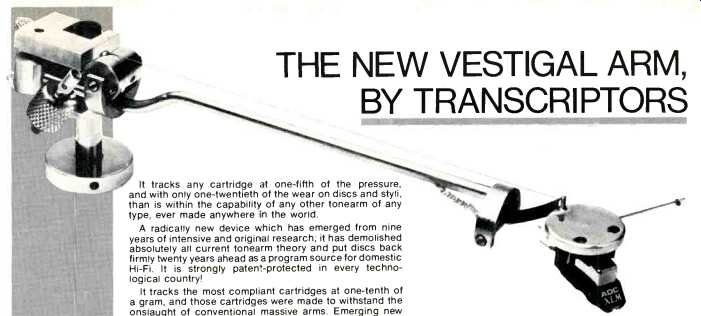
It tracks any cartridge at one-fifth of the pressure, and with only one-twentieth of the wear on discs and styli, than is within the capability of any other tonearm of any type, ever made anywhere in the world.
A radically new device which has emerged from nine years of intensive and original research; it has demolished absolutely all current tonearm theory and put discs back firmly twenty years ahead as a program source for domestic Hi-Fi. It is strongly patens-protected in every technological country! It tracks the most compliant cartridges at one-tenth of a gram, and those cartridges were made to withstand the onslaught of conventional massive arms. Emerging new generation cartridges will do far, far better still in this arm.
In the world of self-respecting Hi-Fi. all other disc playing systems are hopelessly outdated, all other arms hopelessly massive, destructive and wasteful.
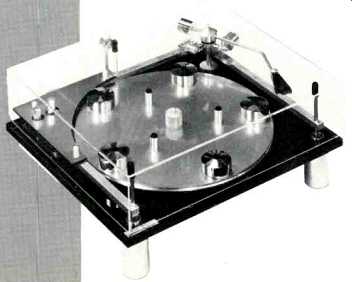
The VESTIGAL ARM is now standard on the fine TRANSCRIPTOR range of turntables, made in Ireland. These turntables are the acknowledged leaders in Europe, incomparable performance is coupled with such outstanding design that TRANSCRIPTOR turntables are on permanent exhibition in most European design centers and in your own Museum of Modern Art in New York.
TRANSCRIPTORS are now in New York offering sales and service for all our products.
Please send for our brochure.
TRANSCRIPTORS 509 5th Avenue New York, N.Y. 10017 212-586-5642
-------------------
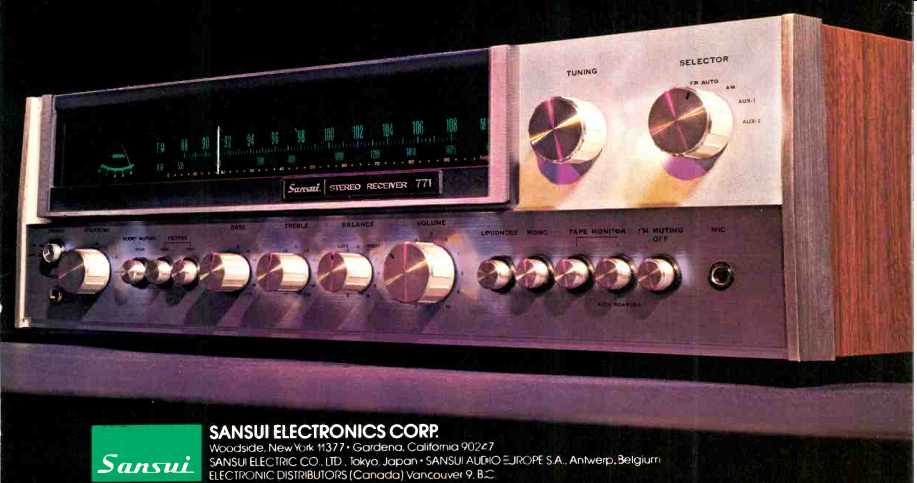
This is what makes the Sansui 771 so great:
Specs. Features.
Looks. And Price.
Sansui, already famous for quality and value has again outdone itself with the 771 receiver.
Look at the specs: powerful 80 watts RMS total, both channels driven into 8u-mare than enough to power two pair of speaker systems-at very low 0.5%, total harmonic distortion, an FM sensitivity of 2.3µV (IHF). Look at the features: two tape monitors, two auxiliary inputs, three pairs of speaker selectors, two filters (hi & lo) and more-even a microphone circuit. Visit your nearest Sansui franchised dealer and listen to the tremendous Sansui 771. Then listen to the price.
-----------
AR
The Classic.
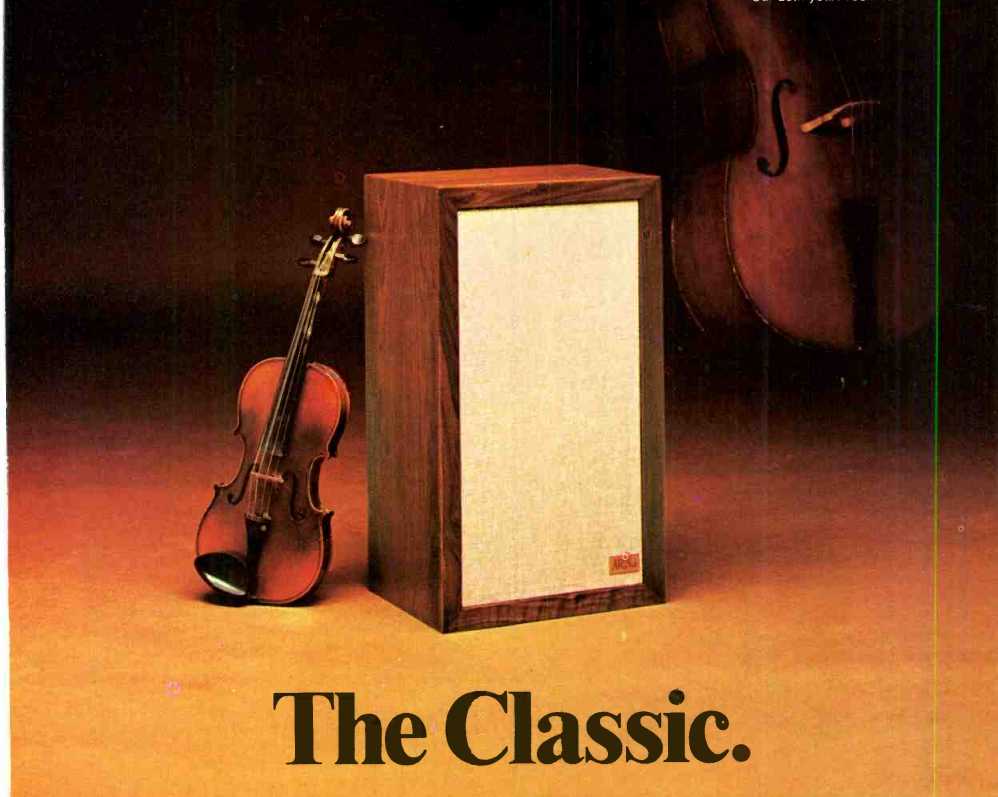
If you are serious about music, you want hear it the way the talented musicians played it, in concert or in the recording studio. Only then do you experience the artistry the conductor and performers put into it. That is precisely what you hear when music is reproduced through the AR-3a.
When it was first introduced. profession audio critics and musicians called the AR-3a the best speaker system ever designed for home use. It was the first loudspeaker to feature the highly sophisticated acoustic suspension woofer in a 3-way system It also incorporated the industry's first hemispherical dome mid-range and tweeter. These revolutionary drivers resulted in a new dimension of accuracy in sound reproduction.
The AR-3a remains unsurpassed in terms of low distortion, flat frequency response and broad dispersion. If you are serious about music End prefer to hear it as it was originally recorded, the AR-3a is the speaker for your high fidelity system.
For more detailed information and complete specifications, please write.
Acoustic Research, 10 American Dr.. Norwood, Mass. Our 20 th year. 1954-1974.
A Teledyne COMPANY.
----------------
Koss
Phase 2
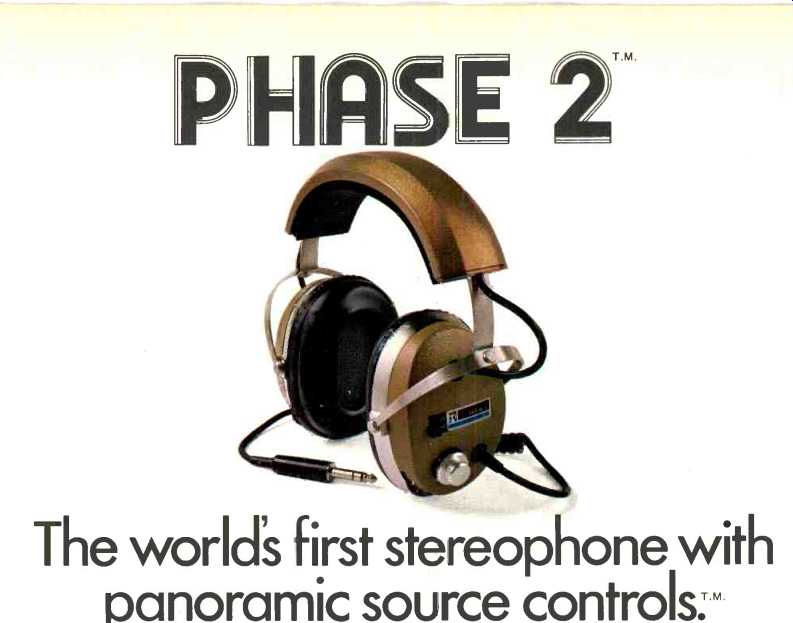

The world's first stereophone with panoramic source controls: M Koss engineers have developed a second phase to stereophone listening. A new concept so exciting and so different from other stereophones, we called it Phase 21. Indeed, in either the +1 or +2 phase positions, you'll hear a Sound of Koss never before achieved in a dynamic stereophone. And you'll be able to do things to your favorite recordings that, until now, only a recording engineer could do at the original recording session.
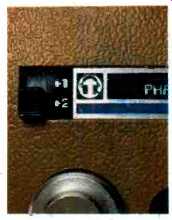
Slip on the new Koss Phase 2 Stereophone and flip the Phase Switch to +1.
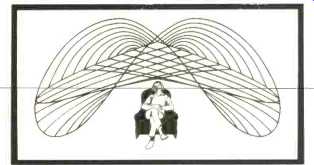
As you rotate the Panoramic Source Controls on each ear cup, you'll be drawn closer and closer, like a zoom lens on a camera, to the center of the performing musicians. At the fully advanced position you'll feel as though of both controls, you're brushing shoulders with the performers.
Indeed, the delicate, intimate sounds of breathing, fingers against strings, brushes trailing over cymbals, become so clearly defined that you'll feel you're actually one of the performers. And by adjusting one control separately from the other, you'll be able to move from one side of the performing group to the other.
Now flip the Phase Switch to the +2 position. As you advance the Panoramic Source Controls, you'll hear a dramatic expansion of the center channel on your recordings. You'll feel totally surrounded by the performing musicians. And as you rotate one Panoramic Source Control separately from the other, you'll feel as though you're sitting on the piano bench one minute and in the middle of the violin section the next.
All in all, Phase 2 will make listening to your favorite recordings a whole new experience. A panorama of new perspectives that creates a new intimacy and depth in your listening experience.
Ask your Audio Specialist to let you hear Koss Phase 2 Stereophones. And write for our free, full-color catalog, c/o Virginia Lamm. You'll find Phase 2 a whole new phase in personal listening.
Koss Corporation Stereophones from the people who invented Stereophones.
KOSS CORPORATION, 4129 N. Port Washington Ave., Milwaukee, Wisconsin 53212
--------------------
The new Leslie DVX Speaker: it adjusts to the geometry of your room! CBS Laboratories and Leslie Speakers have now developed an amazing new loudspeaker system that is...quite frankly... amazing! The Leslie DVX speaker is a unique high performance, low distortion four-way system. Its exclusive dipole coupler is swivel mounted... so that you can "aim" the mid-range and high frequency speakers to fit the geometry of your room. This dipole coupler also gives you the optimum balance of direct and reflected energy to pinpoint and anchor the stereo image in the manner intended by the recording director.
DVX MODEL 580 STUDIO/LAB MODEL
The bass frequencies are reproduced by a high energy 15" woofer housed in an aperiodic 4th order Butterworth ported enclosure and descend smoothly to the lowest registers.
Leslie Speakers was the first company to introduce a truly effective "augmentation" system (the Plus 2 speaker) to eliminate the standing waves in your room. Now comes the amazing DVX speaker. D for dipolar. VX for variable axis. A whole new alphabet for sound! Hear it at your nearest Leslie Plus 2/DVX dealer. 1 SPEAKERS DVX MODEL 570 ELECTRO MUSIC/CBS MUSICAL INSTRUMENTS, A DIVISION OF CBS, INC., 56 WEST DEL MAR BLVD., PASADENA, CA. 91105
---------------
(Source: Audio magazine, 1974; Edward Tatnall Canby)
= = = =