
by EDWARD TATNALL CANBY
PRESERVATION OF THE SPEAKIES
My excursion last month into the old question of what is music (and what isn't) has kept me thinking for another month on further implications, of a sort that are never very far from my mind. Sound-the basic subject matter of audio! We should pay more attention to the "audio" that is all around us, both live and reproduced, those sounds that are intended for practical purposes, and those that are purely accidental or, should I say, incidental. It's all part of our new sonic history.
Incident or accident, many sounds just happen and then take on their own sonic life. Yes, life. They are very alive when your sensitive ears hear them! Take the excruciating squeal of a sub way train rounding a too-sharp corner, for instance. Or the similar squeal of faulty automobile brakes. You can't call these sounds week-kneed. They stand up and hit you where it hurts. These and a billion more can be very potent in ways other than just the decibels.
And thereby they are full of emotional impact for our human sensibilities, mostly unintended but sometimes on purpose.
That emotion can be nasty, painful, even sickening. Or, in different sonic areas, quite pleasurable, amusing, satisfying, even intriguing, making you ask, "What is that peculiar noise I'm hearing?" Like the strange accidental combination of a lawn mower and a passing helicopter that had me baffled, last summer, until the chopper went away and the mower stayed put.
Or, of course, a new and strange visiting bird, its peculiar song unidentifiable. "What's that?" you ask. The last such, around my place, turned out to be a pileated woodpecker, big as a crow, black and white with red crest.
Squawk, squawk, in a pine tree over my head, then YAK-YAK-YAK, very loud, as he flew away, to land in a heap in another pine tree. They are clumsy birds as you watch them.
You could say that these sounds, and plenty more, have audio potential.
They are distinctive, they have an impact of one sort or another on people.
They could become part of an audio message, even an entertainment-or perhaps a piece of music, a work of organized sound, to be reproduced on audio equipment. Certainly no more far-fetched than the factory noises "organized" by Edgar Varese! And no more so, today, than the "music" of whales made into organized and play able compositions. Look in the Schwann catalog; you'll find the whale music, on records.
The phenomenon that provokes all these thoughts is sound recording. It remains, after more than a century, one of the more astonishing accomplishments in man's history. Was Napoleon a tenor or a bass? Did George Washington speak with a boom or a whine? Sketchy accounts may give an idea indirectly, but, like a picture, a recording is worth a thousand words. Did old man Caesar ever actually say "Veni, vidi, vici" ("I came, I saw, I conquered")? I, for one, would like to have heard him. Curious that in most Christian music, especially Lutheran music, the singing role of Christ is given to a bass. Was he a bass? The bass sound is not intended literally but simply rep resents dignity and quiet power in musical terms. In the same music, interestingly, the narrator of the story, when and if, is almost always a high tenor, as in the "St. Matthew Passion" and the "St. John Passion" by J. S. Bach. That would seem to be a practical thing, the tenor voice being more in the intelligible range of speech. A low bass, like a high soprano, has difficulty enunciating words, especially the vowels.
Before sound recording, there is, historically speaking, only an enormous silence. For centuries, millennia, millions of years. History, after all, is the entire remaining "record" of all those generations of man, back to the relatively recent times when writing was invented, and, much farther back, via artifacts, bones, the remains of buildings, tools, and the rest. We conventionally date modern history-the kind studied in the history departments of universities, as opposed to anthropology, paleontology, archaeology from the time of the invention of writing.
That's pretty arbitrary, what with all sorts of glyphs and pictures, from the Babylonian and Egyptian to the Mayan. What's more, a lot of the "writing" is still undecipherable or at best of doubtful meaning. (Editor's Note: A lot of current writing, unfortunately, is also that way.-E.P.) Still, that is the dawn of history in official terms and in most people's minds.
Wrong! It shows how abysmally short do we value the dimension of sound. Sound, audio when taken down and given our special treatment, is an enormously important part of human life. I suppose it isn't very useful to set the dawn of a more complete history, with sound, in Thomas Edison's day, but that is the case. Can you hear what I mean? A meager century of archaeological sound documents, and before that, thousands of centuries of total silence.
Remember the now-famous skull of a very ancient proto-young girl whom archaeologists named Lucy? If Lucy in fact lived some millions of years ago, what did her voice sound like? Much more important, did she have a language? We do not know because, liter ally, we have no record. We can only say that, by the shape of her bones, she might have spoken something.
What? Imagine if we knew. Would that be history! On a more modest scale, we do not really know how Queen Elizabeth I talked, though we have her language in terms of print. Yes, the scholars have done plenty of indirect sleuthing to figure out how those words were pronounced, but nobody on earth really knows, from first-hand (recorded) experience. All-silent sleuthing can give us clues, but no more than that.
Not the sound itself. Not an absolute proof, only an indication.
"Blow, blow, thou winter wind; thou art not so unkind as man's ingratitude." How do you pronounce that? What did it sound like as Shakespeare put it down in so many letters? (Was it actually "blou"? Most Shakespeare spelling has been modernized over the years.) These unanswered questions, and plenty of a great deal more importance, are the negative consequences of not having audio-not being able to preserve and collect the many sounds of civilization and its surroundings, over the entire span of human existence until just yesterday.
The existence and record-ability of a thing like language encourages us to do something more with that language than we've done before. When it be came possible to record words-not in sound, but visibly in writing-all the facts (and supposed facts) of history were put down by the ancient historians, and very soon also there was art'-words for organized entertainment, repeatable, whether serious or humorous. All these things appeared quickly, though we are told that the earliest Near East writings on clay were almost entirely routine accounts for business. How dull. It couldn't last.
That clay had potential. The Mayans, on this side of the world, did a lot more, if somewhat later: Elaborate accounts of kings and gods and generally awe some pomp and grandeur. Also that well-known, reliable calendar, which kept in step with nature more precisely than the European one then current, if I have it right.

I am just trying to put an enormous framework around our audio, to get it into a global focus. We are bigger than we think, not in dollars but in the sum of human civilization from 1877 on. We have a totality of tools that preserve an enormous area of life-good, bad, or indifferent-which has been slipping into eternity, vanishing, for the entire existence of this planet prior to 1877.
Therefore, I say, we are in the middle of the greatest sonic revolution in man's existence. Of course we should be aware of all sounds. Of course we should listen to all the sounds around us. You never know when one of these will become crucial in a day's audio work or an evening's home listening.
We don't listen well at all, and you can't really blame us. This is the noisiest environment in thousands of years, and we have to adapt, physically. We screen things out; we get so we don't listen. And yet, we also get so we can't manage without noise, constant sonics all the time. We go out and manufacture extra noise in the form of music, mostly very loud but also insidiously soft, and this noise never stops at all for most of us, day in and day out.
We are deathly afraid of that which brings out our most acute ear sensitivity, silence. Down in the mini- and micro-decibels, we are good; we can hear right to the threshold of Brownian movement, the sounds of basic particles in motion. Nature wisely stopped there, or we would be drowned in white noise. But do we use this acuity? Not often.
This has happened so fast! People born back in the age of occasional silence, a few decades ago, are profoundly distressed by the never-ceasing sound. It gets at you, into your very sense of living in a real world. This is not the world many of us were conditioned for. But it is for younger people.
And that is dangerous. They are losing the best virtue of one of our two crucial senses, not merely the ears themselves but the use of them. As the Bible might say, they listen and they hear not.
Please, then, listen to small sounds, listen to all sounds. And experience the cleansing, healing effect of silence-maybe a whole minute at a time. What a message for an audio man!
(by: EDWARD TATNALL CANBY; adapted from Audio magazine, 1987)
============
Vintage magazine ADs:
A/D/S
There are two tests for the electronic heart of a system. Music and time.
As you know, a/d/s/ began life as a speaker company. But it was only a matter of time before our interest in accurate musical reproduction led us to think seriously about the electronic portion of a sound system.

---------As you can plainly see, the R4's displays are extremely legible and easy-to-read from anywhere within a wide viewing angle.
The unit provides you with full information about its operating status, so you know what you're doing and not flying blind.
What we wondered was whether we could improve upon that which was available at the time.
The results appeared first in this country in 1983.
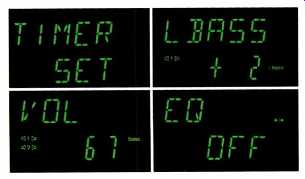
------------The R4. Its slim, spare design gives little hint of the technological sophistication and sonic power that reside inside.
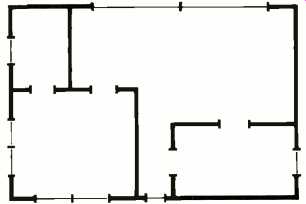
-----------The R4 gives you true multi-room capabilities, while the RC1 provides the means to control the system no matter what room you're in.
Lean, spare and understated, the Atelier Series was an articulation of our belief that high-grade electronic components needn't look like laboratory instruments. Nor require an engineering degree to coax into operation. Nor surrender to the indignities of planned obsolescence.
That philosophy today finds its expression in the Atelier R4 and its perfectly matched family of components.
A new class of component, as a look under the hood will attest.
At first glance, the R4 may appear to be a receiver. And it's true that the unit functionally incorporates the classic elements of that category of product. But beyond the impressive amplifier, pre-amplifier and tuner sections, the R4 bears about as much resemblance to a receiver as a BMW 735 does to a motor scooter. A look inside will illustrate the point.
We draw your attention first to what you'd least expect to find in a high fidelity product--a computer. Specifically, a microprocessor designed by a/d/s/ to provide a level of functionality never avail able before. For example, you can program the R4 to automatically turn on any combination of sources within your Atelier system for listening and recording, whether you're at home or off on an extended vacation.
When you are at home, you'll appreciate the fact that the R4 can give you access to any source from any room in your house-all by remote control. And when we say control, we mean control.
With the RC1, you can control the nuances of every remote-ready Atelier component in your system--the compact disk player, the cassette deck, the tuner, even Atelier components which have yet to leave the drawing boards at a/d/s/.
If you're a computer buff, you'll be pleased to know you have the option of controlling Atelier functions by connecting your pc to the RS-232 port in the R4.
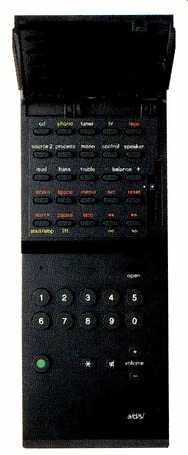
--------With the RC1 remote control unit, you can control every important function of every remote-ready Atelier component. You can do it standing up, sitting down or lying on your back. It issues more than 200 different commands.
Pertinent to the subject of control is the large scale integrated chip that's embedded within the R4's control circuit. This chip makes it possible for you to control volume, bass and treble settings in precise, digital increments-channel to channel, and with none of the variation in levels that are typical of "twirl-knob" systems.
The sonic purity is uncommon because the design is uncommon.
The R4's preamp signal paths are unusually noise free. That's because all circuits have been painstakingly protected from stray radiation by ample amounts of shielding-one of just many steps we've taken to preserve the extremely low distortion of the amplification stages.
As audio purists, we also feel compelled to tell you that the R4's microprocessor exists entirely outside the path of the audio signal. In other words, it keeps to itself, which is as it should be.
The FM portion of the R4 is as impressive as everything else about the unit. Fine-tuning is done in small, digital increments, which results in superb signal acquisition-the best possible, in fact-and eliminates distortion and "fuzzy" reception. Working down the signal chain, we come to the IF amps. Their bandwidth has been carefully designed to yield exceptional selectivity.
Finally, stereo decoding is, in a word, impeccable. The result: optimum stereo separation.
As for the prodigious amount of power the R4 produces for its size, that was accomplished thanks to our use of a proprietary rail-switching technology that automatically and instantaneously increases power for high energy music transients-well beyond its rated 75 watts per channel.
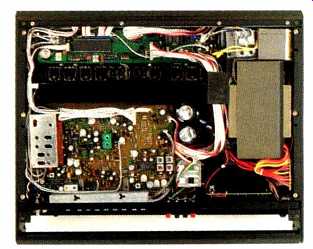
--------A glimpse inside reveals how carefully thought-out the R4 is. No space is wasted.
Electronic circuitry, heat sinks, transformers, etc., are all contained within a box that stands only 2 3/4" high.
When you need more power, we have more amplifier. Our PA4 amp provides 150 watts per channel, and nearly double that amount when bridged. Whether you use one or two PA4's in tandem with the R4, operation remains completely automatic.
Moreover, you don't surrender any of your remote control capabilities-a fact that nicely differentiates Atelier from its competitors.
One final point deserves to be repeated. When we entered the electronics arena in 1983, our stated goal was to produce superb audio equipment that never became outdated. The R4 is the product of that vision, and it won't.
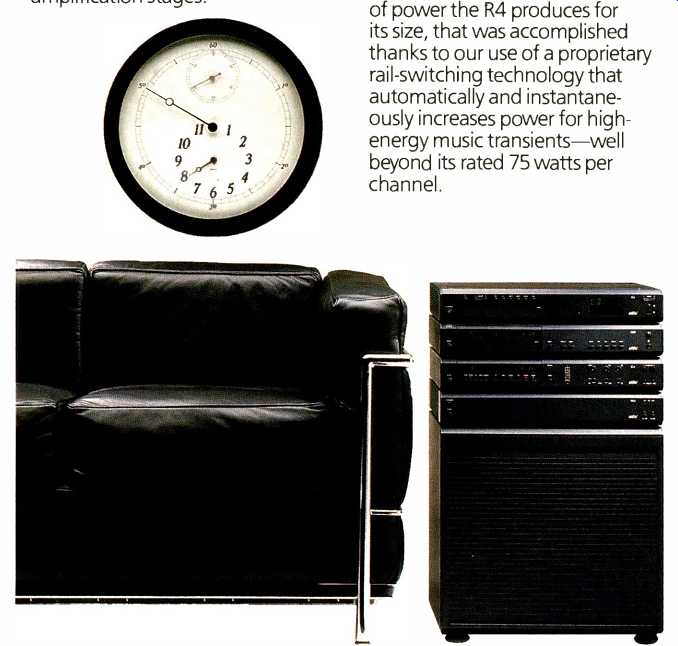
-------------The Atelier system of electronic components. From top to bottom, the R4, the CD4 compact disk player, the C4 cassette deck and the PA4 power amp. That's even an Atelier storage module they're sitting on.
Test them for yourself.
---------------------
Denon
Other audio engineers may listen to live music. Denon engineers also record it.
Denon. Where playback components are designed by recording engineers.
For the typical audio engineer, live music offers a chance to get reacquainted with the ultimate reference in audio reproduction. But for Denon audio engineers, live music represents an essential part of their day-to-day experience.
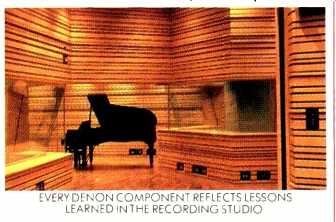
Every month, from the Semper Opera House in Germany to Clinton Studios in America, from Aoyama Tower Hall in Tokyo to The Hall of Artists in Prague, Denon audio engineers are producing records. In this exacting enterprise, nothing is overlooked. Microphone selection and placement. Hall reverberation and stereo imaging. Tonal balance. Phase integrity. Our technicians control, discuss and sometimes fight about every factor that determines sound quality.
In the process, Denon audio engineers have created award-winning operatic, symphonic, vocal and jazz recordings. They've developed an unrivalled sensitivity for the integrity of live music. And they've acquired technical expertise that fuels the advancement of Denon studio recorders, broadcast equipment, blank recording tape, and Denon audio components for the home and the car.
Look inside a Denon component and you'll find tangible evidence of our work in the recording studio. The Super Linear Converter in every Denon CD player is a direct outgrowth of Denon's early research into studio digital recording. The Non-Slip Reel Drive of Denon cassette decks reflects years of mastery in building open-reel machines. Even Denon receivers demonstrate this heritage. Their circuit design results from Denon experience at achieving playback accuracy in the recording studio.
More than circuits and transistors, our studio expertise defines a philosophy.
It dictates the uncompromising pursuit of better sound, the obsessive concern for musical nuance, and the eagerness to subject new designs to intensive listening tests.
At Denon, this symbiosis of recording and playback technology is nothing new. It dates back to the founding of our parent company in 1910. It stands behind Denon's reputation among the world's audiophiles. And it explains the rave reviews we've received from the world's audiophile magazines.
On the pages that follow, you'll see some of those reviews and learn about the Denon components that earned them. But no amount of words will substitute for the evidence of your own ears.

Your Denon dealer has all the expertise necessary to explain Denon audio clearly. And all the facilities to demonstrate Denon audio properly. So you can hear for yourself one simple truth. It's a lot easier to make audio sound like live music when you know what live music sounds like.
How a 77-year-old became the first name in digital audio.
---EVERY DENON COMPONENT REFLECTS LESSONS LEARNED IN THE RECORDING STUDIO.
Denon's been involved in every phase of music reproduction since the days of wind up record players. So after seven decades of break throughs in studio recording, disc pressing, home high fidelity and professional equipment, we were uniquely prepared to take the next step. A tape recorder so fundamentally different, it would obsolete every previously accepted notion of how good recorded sound could be.
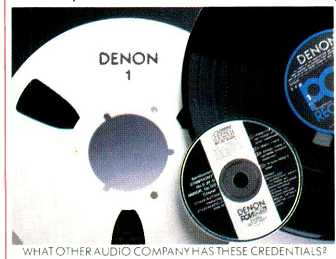
---WHAT OTHER AUDIO COMPANY HAS. THESE CREDENTIALS
In 1972, Denon researchers achieved their goal. The world's first digital recorder worthy of commercial record production, the legendary Denon DN-023R. We quickly put our digital innovation to use, producing digital processors, digital editors, digital mixers, and the world's first digitally recorded LPs.
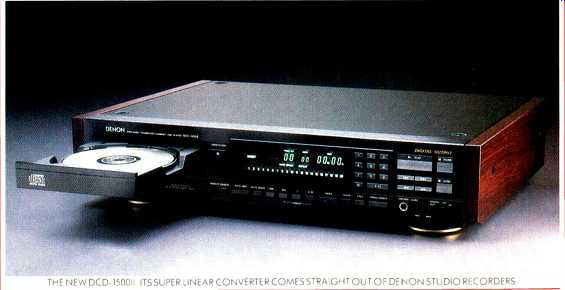
THE NEW DCD 1500II-- ITS' SUPER LINEAR CONVERTER
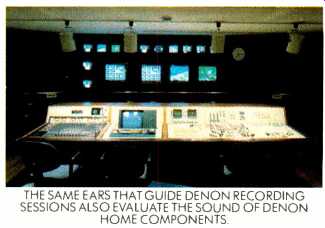
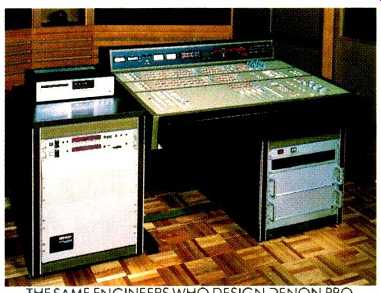
Today, Compact Disc players, regardless of brand, reflect the influence of the original Denon DN-023R. But this heritage runs strongest in CD players from Denon. Because the same engineers who design Denon pro machines design Denon home audio. And the same ears that guide Denon recording sessions evaluate the sound of Denon playback components.
Perhaps that's why each succeeding generation of Denon CD players is eagerly anticipated by the world's audio critics. And why they've variously hailed our CD players as "a winner on every count; "the player I recommend most highly," "superlatives have to be used; and "in several respects, the best I've ever heard: Reactions which simply demonstrate one point. It's a lot easier to make audio sound like music when you really know what music sounds like.
What happens when studio recording engineers also design home tape recorders.
What qualifies a company to build audiophile cassette decks? Try seven decades of intimate knowledge in every aspect of the recording process.
Creating award-winning blank tape. Recording award-winning classical and jazz releases.
---THE SAME EARS THAT GUIDE DENON RECORDING SESSIONS ALSO EVALUATE THE SOUND OF DENON HOME COMPONENTS.
Building transcription-quality open-reel recorders, multi-track decks for studio work, and finally the world's first digital recorder good enough for commercial record production.
Only one company has all these qualifications. That company is Denon.
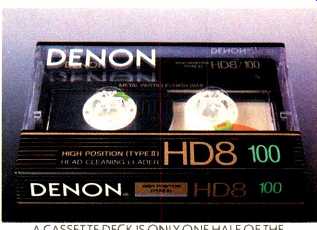
---- A CASSETTE DECK IS ONLY ONE HALF OF THE RECORDING SYSTEM. HERE'S THE OTHER.
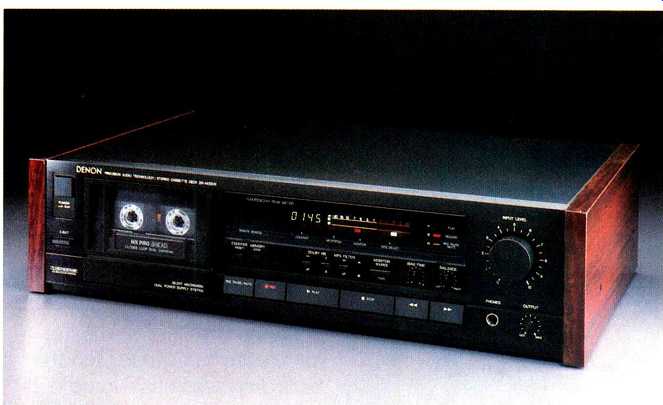
Consider Denon's DR M3OHX Cassette Deck. This machine's professional heritage is evident in the three-motor drive system for flawless tape movement, the high-overload heads with oxygen-free copper coils for the barest minimum noise, and the wideband DC playback amplifier for ruler-flat ply has separate windings for the audio circuits-for absolute minimum distortion.
Although not highly publicized, the control of supply reel back tension can be a cassette deck's Achilles' Heel. Over time, the typical friction clutch can wear down, disturbing tape-to-
head contact and degrading high frequency response. That's why Denon borrowed the response. Even the power sup open-reel concept of Non-Slip Reel Drive-servo-controlled back-tension that will not de grade over time.
-------THE DENON DR-M30HX. THREE MOTORS, THREE HEADS, DOLBY B, C, AND HX PRO DON'T BEGIN TO TELL THE STORY.
Denon incorporates such studio technology for one purpose only: its direct effect on sound quality. The proof is in the listening. Record the most difficult types of music on the Denon DR-M3OHX. You'll hear steady, unwavering pitch on sustained piano chords. And you hear cymbals and harpsichords with all their distinctive overtones.
You might expect audio components of this caliber to come with high-caliber price tags. Yet Denon cassette decks start at less than $250.* So for the price of far lesser audio components, you can do what studio engineers all over the world do. Record on a Denon.
How Denon turned receiver inside design out.
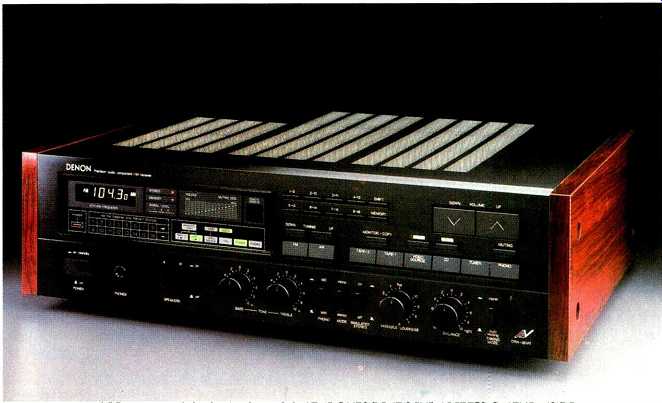
Audio companies must have a fairly low opinion of the receiver customer. How else to explain the bewildering array of buttons, lights and winking fluorescent displays that festoon so many of today's receivers? These outward trappings may impress the innocent, but they contribute not one iota to better sound.
THE SAME ENGINEERS WHO DESIGN DENON PRO EQUIPMENT DESIGN DENON HOME AUDIO.
With their rugged anodized metal front panels, Denon receivers are certainly as hand some as any on the market. But Denon never forgets that it's inside, among the transistors, power supplies and heat sinks, that sound quality is determined.
That's why Denon takes the typical priorities of receiver design ...and turns them inside out.
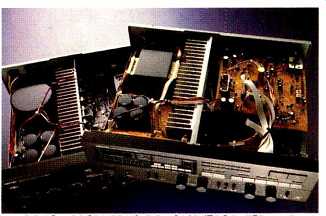
DENON RECEIVER VS. DENON INTEGRATED AMP ANY RESEMBLANCE IS STRICTLY INTENTIONAL.
For the results, look inside any Denon receiver. You'll find discrete output transistors, not cheap IC "power packs." You'll notice ample power supplies that handle the most demanding passages.
dynamic passages. In fact, the Pure Current Power Supply of the DRA-95VR reduces dynamic IM distortion by an impressive 60 dB.
----AS BEAUTIFUL AS OUR DRA-95VR IS ON THE OUTSIDE, IT'S EVEN BETTER ON THE INSIDE.
The circuit topology of every Denon receiver truly epitomizes the Denon credo, "Simple is Best: For example, the DRA-95VR conquers distortion without resorting to the negative feedback that can degrade transient performance.
And Denon's Non-Switching Class A output stage combines the purity of Class A with the efficiency of Class B.
Anyone with a Hi-Fi VCR will appreciate Denon's video switching. It makes audio/video integration a practical reality.
Anyone with an easy chair will enjoy the remote control sup plied with Denon's top Iwo models. It operates not only the receiver, but also a choice of Denon cassette decks and CD players.
While you might expel to pay more for a Denon, our receivers start at under $300* If they seem different from similarly-priced competitors, there's a good reason. At Denon, we pay more attention to the laws of acoustics than the dictates of fashion.
For people who love music as much as they love their car.
If you love music, you won't settle for the inaccurate, inadequate sound of so many factory-installed systems. And if you love your car, you want to enhance it. You'd never do anything to compromise its looks or reduce its resale value.
Like re-work the entire dash board just to install a receiver.
Or put up with a trunk that looks like an electronics store.
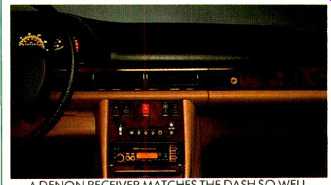
A DENON RECEIVER MATCHES THE DASH SO WELL, IT LOOKS LIKE ORIGINAL EQUIPMENT
At Denon, we feel the same way. That's why Denon speakers fit most cars without tedious modifications. Denon amps make even sophisticated multi-channel systems simple.
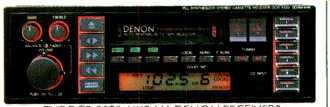
Denon receivers all have DIN-E chassis so they install with a minimum of disruption. You can mount them permanently or pull them out to protect both your system and your car from Midnite Auto Inc. For a modest additional cost, the receiver lights can even be matched to the color of your dashboard lights. So instead of clashing with your car's interior, a Denon system integrates seamlessly.
---- THE DCR-5520, LIKE ALL DENON RECEIVERS, HAS CONTROLS YOU CAN IDENTIFY BY TOUCH.
Of course, we never forget that superior performance is the only attribute that makes high-end car audio worth the money.
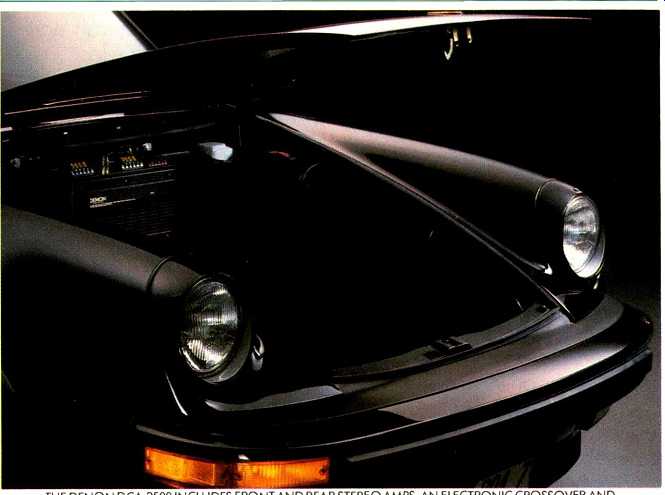
THE DENON DCA-3500 INCLUDES FRONT AND REAR STEREO AMPS, AN ELECTRONIC CROSSOVER AND A SU BWOOFER AMP-WITH ROOM LEFT OVER FOR LUGGAGE.
That's why we endow our car audio with such advanced technologies as the Denon Optimum Reception System to tailor FM tuning to the reception conditions. Or our Dynamic Expansion to restore depth and vibrancy to com pressed broadcasts and pre recorded cassettes.
Dual Azimuth Heads assure that both sides of a tape are played with extended frequency response. Non-NFB and Non-Switching Class A Amplification substantially reduce distortion. And a special Denon circuit eliminates the interference that often occurs when an amplifier is mounted in the trunk.
In terms of sheer sound quality, Denon car audio fully lives up to the standards set by Denon record production, Denon pro studio recorders and Denon home high fidelity.
Which means, no matter what you drive, you've finally found car stereo as good as your car.
= = = =