AC FILTER ... AND OTHER NOISY ISSUES--Start at your AC power line for better audio ... and video. By Darcy E. Staggs
Discover the key to better audio and video.
AC Filters ... and Other Noisy Issues
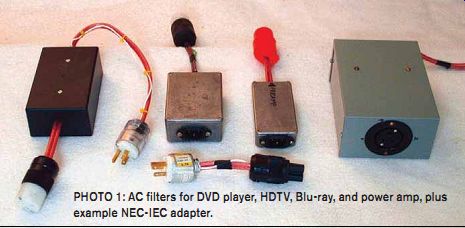
PHOTO 1: AC filters for DVD player, HDTV, Blu-ray, and power amp, plus
example NEC-IEC adapter.
Many years ago, my retired parents moved to a rural setting, where I visited them often with my then-young family. I was introduced to a neighbor, Mr. Moore, who spent WWII in China installing runway lighting at airports used by the Allies. I said, "I'm very glad to meet someone with your background, because I always have trouble debugging my electronic projects." The un forgettable reply: "It's simple. There's no such thing as electrical problems, it's all mechanical. If there's a place for the electrons to go, they'll go."
INTRODUCTION
In a piecemeal hobbyist fashion, I have installed AC line filters in the power cords leading to four of my electronic entertainment components (Photo 1). I have also improved other connections (described later).
The sophisticated AC line treatment systems appearing periodically in aX 1,2 have my admiration, but my experimenter's approach is to isolate the components of the entertainment system from each other as well as from the noisy world surrounding them, and identify "guilty parties," if, in fact, there are any.
I launched this project after replacing a 27" CRT NTSC television with a 52" LCD HDTV screen. Several items needed upgrading in support of this very significant advancement in home theater presentation, so I began the effort with the simple S-video connection from my now old but much modified Sony DVD player.
ELECTRONS ON THE GO
S-Video. I use my first (cheapie) S-video cable to test the Sony DVD player on a computer-partly to evaluate the improvement over using a composite video connection (the only input available on the old NTSC TV), and partly to see whether the S-video electronics in the player survived my intrusive modifications, which, I am thankful, they did.
I soon wished to send even better video from the Sony to the HDTV screen, so I used a Mogami S-video cable. Color purity and image sharp ness improved significantly. Now I was hooked-on to the next candidate.
Video certainly offers near-instant gratification from improvements.
DVD Player Filters. With all those digital circuits in the DVD player (and HDTV), I suspected that the player might be contaminating the AC line. So after testing a single-stage AC line filter, I used a two-stage version to feed the DVD player. Picture quality and audio improved slightly over a single-stage line filter, which by itself made a very welcome improvement in both video and sound.
AC is fed to the filter box with a three-wire cable, while the player is sup plied through the original two-conductor type cable. The ground lead of the three-wire cable carries filtered noise back to the wall outlet ground.
The DVD player contains a switching power supply, and the new TV almost certainly does too, so I wanted to see whether they were victimizing my audio.
In all fairness, some of the blame for contaminated AC must be shared by the three nearby cell-phone towers and a supermarket/shopping center.
Stereo. One guinea pig for an AC filter was the preamp. Again, I assembled a single-stage 10A filter-in-a-box, which sounded worse on both my, and another, preamp compared to no filter. I examined the filter and found it to be very old, having been ordered perhaps 20 years ago, so I replaced it with a new filter. Still no improvement for some reason, so I plugged the preamp directly into an outlet. The unused preamp filter now cleans power for the recently added Blu-ray player, and again improvements are obvious.
I made a generously proportioned 20A filter-in-a-box to feed the power amplifier. I figured that if it didn't improve much there, I could always put it into service on the HDTV. But, in fact, it cleaned up the audio even more, yielding better low-level detail, musical harmonics, and other welcome sonic benefits. Highly recommended.
HDTV I spent a few pleasant evenings becoming familiar with the improved sound from the amp filter. Then it struck me that it might be worthwhile to test it on the HDTV set. So one night I exchanged the TV power strip and amp filter to see whether video improvements might appear.
The already successful-looking DVD images experienced welcome improvements in color rendering, nuance, and sharpness. There was no going back--I kept the new line filter connected to the HDTV while I quickly placed an order for components for a dedicated amp filter. Meanwhile off-the-air programs sharpened up.
There is a three-wire power cord on the HDTV, so I made very sure all wires in its added filter assembly were of the correct polarity. Evidently, the HDTV contains a noise filter which uses the ground, and cares about line polarity.
FILTER COMPONENTS
Mail-order electronics suppliers carry a large variety of AC line filters. Their manufacturers, via the Internet, offer abundant documentation covering specific applications. So far, I have applied 10A and 20A filters hoping to keep impedance low for useful frequencies. Evidently this is succeeding, since the transient response of my electronics, both aurally and visually, appears to serve the most demanding program material.
The filter enclosures are sheet aluminum, cast alloy, and plastic. Any safe closed box will do. Both threaded and "fast-on" terminals are present on the filters, so I use insulated crimp-on wire terminations to suit. I always triple-check the hot, neutral, and ground connections. I replaced the two-wire outlets that served my entertainment electronics with three-wire many years ago, and made very sure they were polarized correctly.
AC cord wiring is accompanied by many choices. Contributor M. Danbury has found that generous conductors composed of the highest number of the smallest copper strands sound and display the best, so that's my choice also, having compared cords.
Sturdy, well-made AC line plugs and sockets are preferred (you can see some remaining budget plugs in Photo 1). The best AC hardware I have found is made by Marinco, sometimes available locally, otherwise orderable over the Internet.
Their very high quality makes installation a pure pleasure.
CONTACT!
Years ago, I read an account in which someone polished the prongs on audio component AC plugs, so I tested this on my own growing population of plugs.
The technique I applied was to polish the brass prongs with fine "crocus cloth," a fabric-backed metal-polishing system with a coating somewhat coarser than polishing-wheel rouge. I even took pains to polish in the direction of the long dimension of the prongs. The resulting surface finish feels "soapy" to the touch; quite a contrast to the as-milled metal.
The final AC tweak was to plug the amplifier filter into an outlet as far away as possible from the one supplying the HDTV. The music improved significantly in overtones and detail, and careful viewing showed detail and color purity gains in the video. The "third dimension"-video depth-now appears to be much better than in the past.
DIGITITIS
Years ago, during the assembly of my preamp, I became impatient and wired the input jacks with enameled solid cop per wire. Two by two I replaced them with Teflon-insulated co axial cable, to the betterment of the sound. The latest such replacement was in the circuit used for two-channel audio from the Blu-ray player.
I noted a sonic improvement in the "cleanness" of the upper midrange and highs while playing the I, Robot Blu-ray, but then began paying close attention to what was on the TV screen. Easily seen were improved image sharpness and subtleties in color rendering.
Digital sources seem to produce a halo of electronic haze within and near them, a fact I had not adequately appreciated. I do now3,4.
CONCLUSION
When the electrons you receive are the ones you actually use, things both look and sound far better for it. Home theater and stereo are very worthy of the best electrons. That means locating line filters inside the audio and video components where the AC cord first enters the box, which I haven't done, but will in the future.
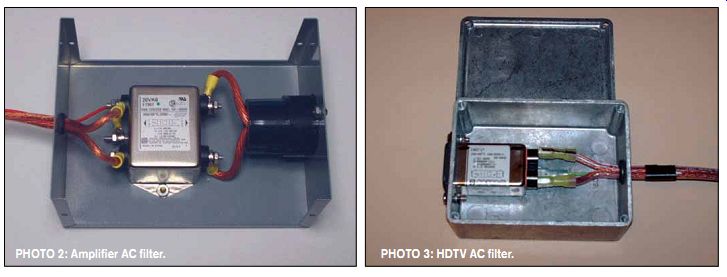
PHOTO 2: Amplifier AC filter. PHOTO 3: HDTV AC filter.
REFERENCES
1. C. Hansen, "The AC Power Line and Audio Equipment," aX 9/01 and 10/01.
2. L. B. Dalzell, "About Noise," The Audio Amateur, 2/91.
3. M. Williamsen, "Balanced Cable Hum," aX 5/09.
4. E. Simon, "Removing the Six 'Straight Wire' Kinks," aX 6/09
Also see: A Line-Cleaning Filter (Sept.)