Taping TV
Robert Long's article on do-it-yourself recording of "TV's Golden Moments" [Au gust] was most enjoyable, partly because I have experienced some of the frustrations and many of the joys he describes. He is certainly on-target in his references to the uneven quality of so many musical programs. Even so, there are many gems to be taped from TV, as I've been doing for more than a decade.
Among the collectors' items I've been able to get: Betty Grable doing the title number from Hello Dolly (which she was then per forming on Broadway but never recorded commercially), Bette Davis' 1963 foray into folk singing with the New Christy Minstrels, Carol Burnett's early-'60s spoofs of "Mimi Pizzaria" and "I Don't Want to Play Nelson and Jeanette Anymore," Helen Gallagher and Bobby Van doing a 1962 takeoff on Ruby Keeler/Dick Powell musicals (many years be fore they were teamed in the Broadway revival of No, No, Nanette), Danny Kaye and Lucille Ball's "Glory Hallelujah Twist," Kaye and Gwen Verdon's "The Tapioca," Angela Lansbury's "A Chance to Sing and Dance," plus any number of songs by such commercially under-recorded performers as Diahann Carroll, Kaye Ballard, Georgia Brown, and Larry Kert.
But best of all are the duets by people who never (or hardly ever) record together-such as Ella Fitzgerald with Frank Sinatra and Bing Crosby, Lena Horne with Tony Bennett, Julie Andrews with Harry Belafonte, Bob Dylan with Johnny Cash, Peggy Lee with Petula Clark, Dinah Shore with Duke Ellington, Ann Miller with Tiny Tim, and Judy Garland with Barbra Streisand.
Speaking of such combinations, isn't Mr. Long in error in referring to a performance of "Three little maids from school are we" as a collaboration of Joan Sutherland, Dinah Shore, and Carol Burnett on a Burnett show? My tape has Sutherland and Shore doing the song with Ella Fitzgerald on a 1963 Dinah Shore show, as well as collaborating (on the same program) on a version-to-end-all-ver sions of "Lover Come Back to Me." The Carol Burnett show has indeed produced some equally classic moments-for example, its 1971 version of "You Can Drive a Person Crazy" from Company with the unforgettably unlikely trio of Eileen Farrell, Marilyn Horne, and Miss Burnett.
When you can capture something like that, well, all the mediocre stuff you may tape from TV and then promptly erase doesn't matter!
Roy Hemming; New Haven, Conn.
Mr. Long replies: Mr. Hemming's tape con firms my memory-and the original draft of the article-on the "Three little maids" casting. The data was checked by our diligent research staff.
however, and the only concrete information it could obtain was as printed. More recently Music Masters (a New York record dealer specializing in esoterica) positively confirmed the existence of the version on Mr. Hemming's tape, but not that specified in the final article. Could there be two? This is a brief note of appreciation--and responsive-chord-striking--for Mr. Long's excellent article. There must be thousands of us tape nuts scattered around the country.
Ella Fitzgerald-One of the little maids? Talk about carrying things to extremes (not to mention, as Mr. Long did, getting up in the middle of the night-sometimes to record three super Warner Bros. films from 1:00 to 7:00 a.m.), I have a small TV in my office and have captured on C-120 cassettes a lot of films that for some obscure reason never seem to be shown during the evening hours. It's great fun to listen to them later, even without the picture; I guess I'm aurally oriented.
I have hundreds and hundreds of complete and excerpted soundtracks. Many thanks for vindicating my long-stood-by thesis that many of these one-of-a-kind items are irretrievable.
will never be shown again, and represent a (albeit minor) legacy that will give satisfaction and pleasant hours not only to myself, but to others who may inherit my collection.
William H. Smith San Francisco, Calif.
Mr. Long replies: Don't sell your collection short. Just think of the profits now being made from the "(albeit minor) legacy" of past radio shows, and hang onto your tapes. Just as commercial record companies often must buy or borrow copies of their own recordings in order to prepare LP reissues, so the TV networks may someday turn to amateurs like yourself to fill archival gaps for commercial issue.
Mr. Long did his readers a real disservice in casually dismissing the GE P-4930 portable TV-audio receiver, which sells for under $40.
It is the best available device for getting good TV sound. Simply connect it to your outdoor antenna or cable feed via a clip lead attached to your TV set's antenna terminals and plug a cable into the GE's headphone jack to feed the signal into your stereo system, and you'll get better sound than the Heathkit TVs provide and much better sound than usually is achieved by hiring a technician to wire a takeoff jack into a conventional TV set. If there is any complaint about the P-4930, it is that it is too good; it reveals all too clearly the wretched engineering common in both network and lo cal TV broadcasting.
I fully share Mr. Long's enthusiasm for taping TV audio. I would not part with my tapes of Laurence Olivier, Orson Welles, Kate Hepburn, and Robert Morley (all chatting with Dick Cavett); Peter Ustinov swapping concert anecdotes with Leopold Stokowski and vocalizing a bassoon solo for the maestro; or Kenneth Clark's "Civilisation" series (his grand generalizations have even more thought-provoking power without the distractingly beautiful visuals). On long automobile drives out of range of decent FM, I play cassettes of old late-show film soundtracks; after you've seen Casablanca or The Maltese Falcon a couple of times you can relive the entire film by hearing the audio track, supplying the video mentally.
Paul Henreid is even more noble than usual, and Sydney Greenstreet even more smooth and villainously clever, when heard in a darkened car speeding down an interstate highway late at night.
Peter W. Mitchell; Charlestown, Mass.
Mr. Long comments: I defer to Mr. Mitchell, who reviewed the GE unit for the Boston Audio Society. In one respect, however, his report shows it to have a common failure for the recordist: nonlinearity in its response, requiring equalization if its full sonic potential is to be realized Since few amplifiers have tone controls ahead of the tape-recording jack, that may mean either an outboard equalizer of some sort or tone-control adjustment each time you play a tape. But the GE also appears to have one signal advantage: low levels of extraneous noise, which can be a big pain in the recording head with conventional TV receivers.
You should have carried a strong note of warning about hooking up to a TV set. There is a shock hazard present in many sets connected to and grounded through a stereo amplifier. In many cases a qualified technician's best suggestion might be to forget about connecting the two.
Donald R. Hoger Hyde Park, N.Y.
The article stated plainly that this is a job for "a competent service technician," but the warning is worth repeating.
A Pressing Problem
I wish to comment on remarks concerning the quality of our pressings, made in some recent reviews appearing in your magazine.
A fact little known outside record-manufacturing circles is that the supply of vinyl for record pressing is a monopoly controlled, I am told, by two suppliers for the entire U.S.! As is customary, we scheduled a large (fifteen-album) fall release last year. Unfortunately this coincided with the peak of the vinyl "shortage," when we were told we were lucky to get any pressings at all, at whatever price.
Here is a true irony: A composer will pour his heart and soul into a piece of music; an art ist will spend half a lifetime perfecting his art so as to give his best for the performance; the record company will spare no effort to achieve an outstanding recording, zealously guarding every step of the operation, taping, editing, mastering (production is never authorized be fore a test pressing is approved; sometimes it takes as many as six tests before we are happy); and then what? It is a sad reflection on the state of commercial record pressing in the U.S. that with the finest of materials and equipment (and prices certainly among the finest and growing finer all the time!), the av erage U.S.-made pressing is no match for its European counterpart.
The nub of the problem is that the entire U.S. record industry is pop-oriented. The sound levels of most popular-music records are such that surface quality matters hardly at all. With classical pressings accounting, we are told, for less than 5% of the total, it is hardly surprising that pressing plants are indifferent to the plight of the classical-record manufacturer.
Importing pressings is obviously not the answer. Any suggestions?
Giveon Cornfield; President, Orion Master Recordings Malibu, Calif.
In recent years your editorial, letters, and review columns have been full of well-warranted complaints about poor pressing quality. I have seen no comment, however, on what I consider the most pernicious kind of record defect: off-center pressing. I would estimate that at least two-thirds of the records I buy, on a wide variety of full-price and budget classical labels, are pressed visibly off-center on at least one side, by which I mean that the tone arm can be seen wavering in and out as the record rotates. This problem seems to afflict even the most prestigious imported labels, acclaimed for their high pressing quality.
The various kinds of surface blemishes to which we are perpetually subjected at least leave the music undistorted, while requiring the listener to hear it through a screen of extraneous noise. But off-center pressing deforms the music itself. A record that is markedly off-center is likely to display a pronounced pitch wobble, especially toward the end of the side.
A lesser degree of deviation will produce sub-tier degradations in the sound. often audible as a slightly sour quality or as a sound that is not quite so clear and well-focused as it ought to be. Needless to say, any degree of off-center effect renders worthless the wow and flutter characteristics of high-quality turntables.
---Correction: In R. D. Darrell's review of the Juilliard Quartet's "Miniatures for Strings" album (August HF), the Schubert Quartensatz included on the recording is the D. 103 of 1814 rather than the D. 703 as listed. Our apologies to Mr. Darrell. ---
Having failed in fifteen years to learn how to produce a decent stereo pressing with any degree of consistency, the industry is now trying to entice us into the realm of four-channel, where pressing quality is even more critical. I have no plans to convert to four-channel now or in the foreseeable future, but I do demand higher quality in the stereo discs I buy. If some of the energy and expertise going into devising four-channel gimmickry were applied to improving quality control, it might be possible to make stereo-disc reproduction live up to its all too seldom fulfilled promise.
Daniel Morrison; Albany, N.Y.
Record Sequencing
Although I am one of the "purists" referred to by Mr. Kile Baker ("Letters," July] and shudder at the thought of stacking records, I must confess that when they are played manually the order doesn't really make much difference. So why not surrender gracefully to those who obviously don't bother with Dust Bugs or who like to remain immobile for several hours?
My main concern is with the quality of the recording and the performance itself. Further more, with the current vinyl shortage added to the ever-existent problem of a small market for classical discs, we'd better stop quibbling over minor matters such as the sequence or resign ourselves to having no new releases.
Julie Renouf; Bradford. Mass.
We'll buy that. And there, dear reader, the question rests (for this time around).
Review the Performances
A weary word to your classical-record critics: Please endeavor to spare us the amateur sociology-just review the performances. Pretentiousness does have its limits! Robert C. Marsh's August Elgar review, intending to be august indeed, would have been greatly improved by invisible ink.
One arrives in high expectations, of course. After all, three columns [actually barely one and a half.-Ed.] on Falstaff the Cockaigne Overture, and the First Symphony will surely yield an in-depth comparison of all listed performances with special attention to tempos, phrasing, dynamics. recorded sound, and filler couplings. Sadly it is not to be. We find instead a trite and stereotyped analysis of the British upper classes, Elgar's difficulties with social insecurity, and a total inability to separate music from its cultural sources and liter ary allusions.
It is one thing to be a poor historian. (I don't think "stately ceremony" and "smug self-love" would do justice as summaries of any era.) It is quite another to praise Falstaff be cause it has "a real character to depict" and condemn the symphony for its "sinful pride." That is to be an uncomprehending musician as well.
Mr. Marsh seems to be under the illusion that music is "about" things. I had hoped that critics since Hanslick knew better. I defy Mr. Marsh to play the Cockaigne Overture to a novice. Will the apt pupil pipe up, "Aha, Hyde Park, there go the lovers"? Drivel! It's not a movie. I only look forward to the next re view of the Beethoven Third: I haven't had a good lecture on Napoleon in some time.
As I said, just review the performances!
Steven W. Kruger; New York, N.Y.
Gesualdo Texts
I was interested to read Susan Thiemann Sommer's August review of Telefunken's box of Gesualdo madrigals. In her review, she criticizes Telefunken for not supplying either texts or translations and opines that one would have to have access to a research library to remedy this omission. But-madrigal buffs take note this isn't necessary, at least not for the first three books. These have been released by the Musical Heritage Society (MHS 917/9) with the same performers (apparently the same recording as the Telefunken) in a package containing the Italian text, an English translation, and an introduction to each madrigal.
I should add that, despite the title "Five-Voice Madrigals." Book I is for six voices. The Quintetto Vocale Italiano is joined for this hook by the sonorous bass Dimitri Nabokov.
Gladys Rudolph; Toledo, Ohio
Gershwin's Gershwin David Hamilton was right-the latest Gershwin reissues certainly don't exhaust the topic ["Will We Be Ready for the Gershwin Centenary?", July]. Some of his most interesting works remain hard to get.
I have the acoustically recorded Rhapsody in Blue on 78s. as well as the later electrical recording. There is a marked difference be tween the two. The acoustic recording is of the jazz-orchestra version originally played at Aeolian Hall in 1924. It is the rescoring for "symphonic orchestra" that we hear in the 1927 electrical recording. Since then the Rhapsody has been rescored several more times, until most modern versions sound very different indeed from the original! In the jazz-orchestra arrangement one senses a certain period charm partly lost in the 1927 recording, and I have yet to hear an LP Rhapsody that had any of this feeling. RCA, please dig through your vaults and find the masters for Victor Blue Label 55225 and reissue it.
The Hamilton article also made no mention of the greatest injustice of all to us Gershwin fans. Everyone knows of the numerous sym phonic arrangements from Porgy and Bess, but not many people know that they don't have to be content with imitations. In 1936 Gershwin himself wrote Catfish Row (also known as Suite from "Porgy and Bess") for Alexander Smallens and the Philadelphia Orchestra. It contained a lot of music cut from the original 1935 production, as well as some of the more popular songs from the opera. (I believe the transition from the Jasho Brown music to "Summertime." which Hamilton states has never been recorded except by Gershwin himself, is found in this suite.) After about a dozen performances of this suite (his last orchestral work ).Gershwin died and it was forgotten. It surfaced briefly around 1959. when Maurice Abravanel and the Utah Symphony brought forth a first (and, it now appears. last) recording of it (Westminster WST 14063). Reviewers were very enthusiastic. hoping that this would put an end to efforts to "improve" on Gershwin. that this suite would supersede Robert Russell Bennett's Porgy "symphonic picture" on record shelves.
Well, here it is 1974 and Gershwin's suite is nowhere to be found. ABC/Westminster would do us all a great favor by reissuing the Abravanel recording on Westminster Gold, and other orchestras would do us a great favor if they were to record it. Until then, we'll just have to struggle along with our "improved" Gershwin. (If Gershwin were alive today. would everyone still be trying to improve and rearrange his music? I doubt it.)
Steve Lenius; St. Paul. Minn.
Follow the Bouncing Syntax
Jordan Ramin ("How to Launch a Hit Song," August( has it backwards. The famous "Music to Watch Girls By" Diet Pepsi TV commercial did not show "beautiful girls strolling by people drinking Diet Pepsi." Rather it showed beautiful girls drinking Diet Pepsi strolling by people.
Dave Barry ; South San Francisco. Calif.
Even Diet Pepsi needs exercise? Electrostatic Omission In his June speaker article ("How Do Speakers Work?"), Robin Lanier shows one particularly lamentable piece of ignorance in regard to electrostatic speakers: He evidently has not heard of, let alone heard, the Dayton-Wright speaker, made here in Ontario. This full-range electrostatic does not have "twenty square feet or more" of area, and it produces bass--lots of--it-and all perfectly real. Mr. Dayton-Wright does it by enclosing the electrostatic elements in a sort of bag of inert gas, which enables him to use far higher voltages than in most designs.
His discovery is unquestionably a giant step forward in electrostatic design, and it seems a pity that there is no mention of it in an article that purports to give us the latest. No realistic slate of candidates for The Best Speaker There Is could fail to include this unit.
Jan Narveson; Waterloo. Ont.
The Dayton-Wright electrostatic was described a year earlier [HF, June 1973] by Irving M. Fried in an article on new loudspeaker designs.
We had asked Mr. Lanier to survey the loudspeaker types available on the U.S. market to help our readers understand the various classifications into which they fall. Since the Dayton-
Wright is available here only in extremely limited areas and quantities, he did not include it though we agree it is an exceptionally interesting design.
Academic
I'm getting fed-up-to-here (and my hand is not pointing to my gullet) with the careless and cryptic type of review given to the Desto disc of Ned Rorem's Ariel and Gloria ["In Brief." July] essentially: 1) that the composer sought refuge and approval, artificially, via the "angularity" of his writing, and 2) that "academic new mu sic" (whatever that is) is something to be ashamed of--if not scorned.
Such phrases as "safely angular settings" and "really no worse than a lot of academic new music" strike me as cowardly and noncommittal. The review implies two things.
Isn't it time we got off the exasperating High Horse and returned to a discussion of music as music? On the basis of this review one is left in the dark because the reader is at the mercy of a reviewer concerned more with the how in stead of the what. To judge a work solely on the basis of its "newness" or "originality." rather than its artistic merit, is the reason. I suspect that we are now in the midst of "rediscovering" Joplin, Janacek, Delius, Nielsen, and many other composers who wrote "academic new music" for their time.
Harry Atwood; Tucson. Ariz.
Tchaikovsky Echoes
In his July review of Shchedrin's ballet Anna Karenina. Dale Harris states (as does the record jacket itself) that the work contains "echoes" or "reminiscences" of the Tchaikovsky Fourth and Sixth Symphonies, Nutcracker, Swan Lake, and Eugene Onegin.
Since, after repeated hearings. I can find no trace of actual quotations from these works in the ballet. I find it odd that no mention is made of "those Tchaikovsky works that have been clearly utilized.
Considerable use has been made by Shchedrin of the Andante from the third movement of the Second String Quartet, much as a recur rent theme throughout the work. Also the mazurka from the Theme and Variations for Piano, Op. 19, No. 6, has been orchestrated and is used for Anna's solo. Finally, three fragments from the opening and closing movements of the Third Symphony are quite distinctly heard.
The score is wonderfully evocative of the Tolstoy novel, and I look forward to seeing the ballet.
Charles Marootian; Paterson. N.J.
-------
+++++++++++++++++
Vintage magazine ADs:
Watts Record Care Kit

You could clean your records with just about anything including tears.
It's a crying shame that the devices many people mistakenly use to clean their records, actually can damage them. Using sprays, cleaning cloths, lint-loaded tissues, even penknives, to eliminate dust, dirt and grit from record grooves can add pops, clicks, distortion and loss of high frequencies. The only positive way to restore the brilliant sound of your records is to clean, maintain and protect them with the Watts Record Care Kit. In addition to the now classic guide, "Professional Methods for Record Care & Use," it includes every thing you need to remove dust, dirt, grit and static charge from record grooves safely and professionally.
Without tears. Only $24.95. Watts record care equipment and kits are available at hi-fi dealers and record counters everywhere. Elpa Marketing Industries, Inc., New Hyde Park, N.Y. 11040 / Scottsdale, Ariz. 85260 "Professional methods fur record care and use" Record Care Kit for the life of your records
AVAILABLE IN CANADA THROUGH SMYTH SOUND EQUIPMENT LTD.
+++++++++
++++++++++
It's one thing to make the most.
And another to make the best.
We do both.
We make 2 out of every 3 automatic turntables in the world. That's more than all the other makes put together. So BSR is big, all right. But we also make what we sincerely believe is the best automatic turntable in the world. The BSR 8100X for sophisticated systems.
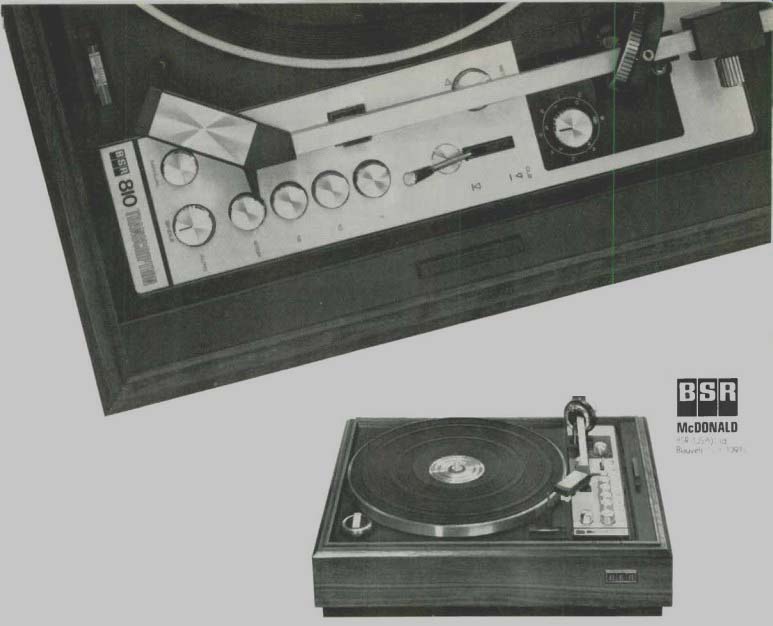
Don't take our word for it. Take it right from High Fidelity magazines technical reviewer. "Taking it all together- performance features, styling--the BSR 8100X moves into ranking place among the best automatics we know of." The 8100X at fine audio retailers. Ask for a demonstration or write for free literature BSR / McDONALD
+++++++++++
RTR
Introducing the MX-12.
A new speaker for a new problem.
When receivers boasted modest power, virtually any well-designed speaker system could handle the Load.
But this is the Super Ear era; a musical age of bass-heavy rock, driven by super-powered receivers and amps.
And that's a problem--if your ears and speakers can't stand the strain without squawking.
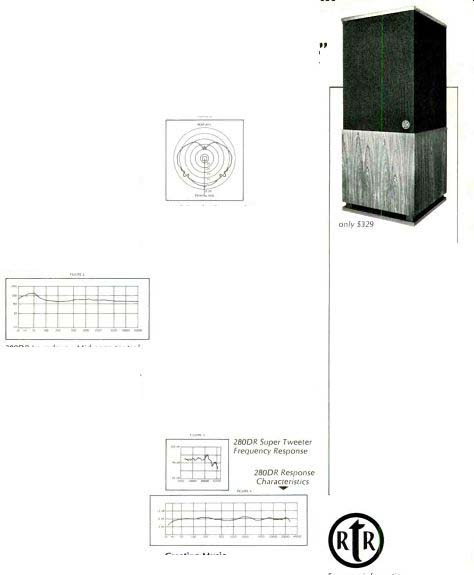
The MX-12 can. It's a new 3-way acoustic-suspension speaker system designed to cruise smoothly and effortlessly at today's listening levels by a new division of the company that invented moving-coil loudspeakers in 1915.
Unheard of power-handling capacity from a speaker nobody ever heard of before.
The power-handling capacity of the MX-12 is impressive. In tests at 30 Hz, it with stood an applied voltage (necessary to pro duce rated watts) of 25 volts. (Speakers with more famous names grumbled and rumbled at 15 volts.) The MX-12's high power-handling ability- made possible by a rugged box and high-temperature cement in the long-throw voice coil- permits you to use enough power to fill even the largest living room with music at satisfying loud levels, with gratifying low distortion.
Linear response for natural sounds. Naturally.
Moreover, the response is slab flat. From the deep frequencies super receivers are capable of (and the MX-12's low resonance reproduces accurately), clear across the spectrum to 20 kHz.
And because the MX-12 is more efficient than many other speakers of its class, you enjoy smooth listening even when you drive it with amplifiers of modest power.
Dispersion is excellent, too, the result of high-frequency drivers of exceptional off axis response and wide cutouts on the grille an extra nicety you'll learn to expect from MX Components.
But that's our philosophy: a lot of extras at no extra charge. So, before you go out to A-B any speakers, we suggest you listen to this page.
To learn more about the MX-12-and IN We'll be heard from.
the MX-1C (10" woofer), the MX-15 (15" woofer), and MX turntables, stereo and receivers-see your MX dealer. For his name, write: MX High Fidelity Component Series, The Magnavox Company, 1700 Magnavox Way, Fort Wayne, Indiana 46804.
Specifications:
12" high-compliance (long-throw voice coil) 2" hemispherical dome 2" phenolic ring cone 8 ohms 25 Hz to 20 kHz 45 Hz Woofer:
Mid-range:
Tweeter:
Impedance:
Frequency response:
System resonance:
Front-mounted controls under removable, acoustically transparent foam grille:
Mid-range level: + 3 dB, nominal,-3 dB Tweeter level: + 3 dB, nominal,- 3 dB
Crossover freqs.: 1500 Hz, 4500 Hz
Cabinet finish: Oiled walnut veneer
Dimensions: 25 3/4" x 15 3/4" x 13 1/4"
Weight: 40 lbs. (approx.)
Recommended minimum amplifier input power:
10 watts
FTC Maximum power handling: 75 watts RMS
RMS continuous power at 200 Hz. measured by applying the voltage necessary to produce rated watts into an 8 ohm load. At standard room conditions, the unit would be capable of sustained operation at test voltage. MX engineers consider this rating to be very conservative; this is a much more stringent continuous power test than would be encountered in musical programs.
+++++++++++++
BIC Venturi Speakers
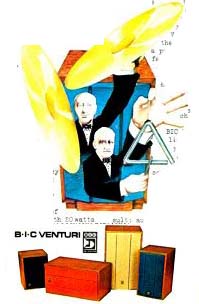
We give you the softest soft to the loudest loud. Choose any model. You won't get 'clipped:
Today's best recordings can reproduce music's full dynamic range, from the softest soft to the loudest loud. Most of today's popular low and moderate efficiency speaker systems can't. But BIC VENTURI speakers do.
A speaker's dynamic range depends mainly on its efficiency and power handling rapacity.
Low-efficiency speakers can't get started without a good deal of input power. And, they tend to get stifled when driven beyond their capability.
BIC VENTURI speakers are efficient! They need as little as one fifth the amplifier power of most air suspension systems for the same sound output. So, you can listen louder without pushing your amplifier to the point where it starts clipping the tops and bottoms of musical peaks.
Today's popular, low-efficiency speakers require about a 50-watt per channel amplifier to deliver lifelike sound levels. Even our Formula 2 will deliver that same sound level with only 25 watts of amplifier power; the Formula 4 with 20 watts and our Formula 6 with only 9 watts! With BIC VENTURI, your amplifier can loaf along with plenty of reserve "headroom" to reproduce musical peaks cleanly, effortlessly. It's as if your present amplifier suddenly became two to five times as powerful. BIC VENTURI can handle lots of power, too. A typical, low-efficiency system is rated for a maximum safe power input of about 50 watts. Feed it more power and you're likely to push it into distortion, or even self-destruction! With a BIC VENTURI you can turn up the power, without distortion or speaker damage.
Even our compact Formula 2 can safely handle 75 watts per channel. With that much power feeding it, it will deliver 210% more sound output than a low-efficiency system will at its power limit. Drive our super efficient Formula 6 at its maximum, and it will deliver nearly 1300% more sound power! the loud half of the story.
With soft music (or when you turn down the volume) you want to hear it soft.
With most speakers, turn down the volume slowly and you reach a point where the sound suddenly fades out because the speakers aren’t linear anymore.
But BIC VENTURI's are. The sound goes smoothly softer, without any sudden fadeout, retaining all the subtle nuances that add to the character of the music.
But, even though BIC VENTURI speakers remain linear, there is a point where your ears do not. At lower sound levels, your ears lose their-pass and treble sensitivity. So, our DYNAMIC TONAL BALANCE circuit (pat. pend.) takes over. As the volume goes down it adjusts frequency response, automatically to compensate for the ear's deficiencies. The result: aurally "flat" response, always! Our Formula 2 is the most efficient of its size. The Formula 4 offers even greater efficiency and power handling. And the most efficient is the Formula 6. The Formula 1, our newest and smallest model, outperforms all other speakers of its size and in its under-$75 price class. BRITISH INDUSTRIES CO. Westbury, N.Y. 11590. Div. of Avnet.
+++++++++++++
THE AGONY OF BUYING A MIRACORD.
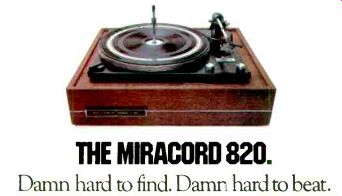
First, the good news. We're proud to announce the arrival of a brand new automatic turntable. The Miracord 820 by name.
Next, the not-so-good news. You shouldn't expect to find one in just any old store.
Your feet may hurt, your eyes may burn, and your head may throb, but you'll congratulate yourself for being so intelligent for wanting one. And so persistent for locating one.
You see, we're very particular about the way we build our new Miracord 820. And just as particular about where we sell it.
But once you experience the pleasure of playing your favorite record on a Miracord turntable, you'll know it was worth the slight inconvenience.
The reason is that the 820 operates simply and beautifully.
Setting the turntable speed for 33-1/3 or 45 rpm automatically programs the tonearm for the proper record size. A touch of the button lifts and positions the tonearm, gently and automatically setting the stylus in place.
The features in the 820 are the kind you'd expect to find in turntables costing much, much more.
You get things like our asynchronous motor. Light-touch push button start and stop. Variable pitch control- up to 5% range- with built-in stroboscope ring for 'perfect pitch: Calibrated anti-skate for both elliptical and conical styli. Cueing that is viscous-damped both up and down. Tracking as low as one gram. Plus our exclusive Magic Wand spindle that holds up to 10 records. And another spindle for playing a single record.
The 820 is the newest member of the Miracord family of automatic turntables. If you'd like the full story on our full line, just drop a line to: Miracord Products, Benjamin Electronic Sound Co., 40 Smith Street, Farmingdale, New York 11735.
Yes, searching for a Miracord can be a bit of an agony.
But finding one is pure ecstasy.
THE MIRACORD 820.
Damn hard to find. Damn hard to beat.
+++++++++++++++
Bose 901
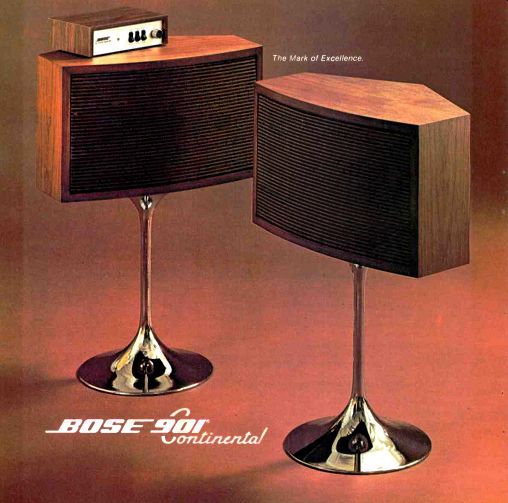
The loudspeaker that has achieved international distinction as the most highly reviewed speaker, regardless of size or price, is now available in a new, exciting continental styling option.
For information, write. BOSE, Dept., H c , The Mountain, Framingham, Massachusetts 01701
+++++++++++
The Rectilinear 5: end of the myth of rock speakers vs. classical speakers.
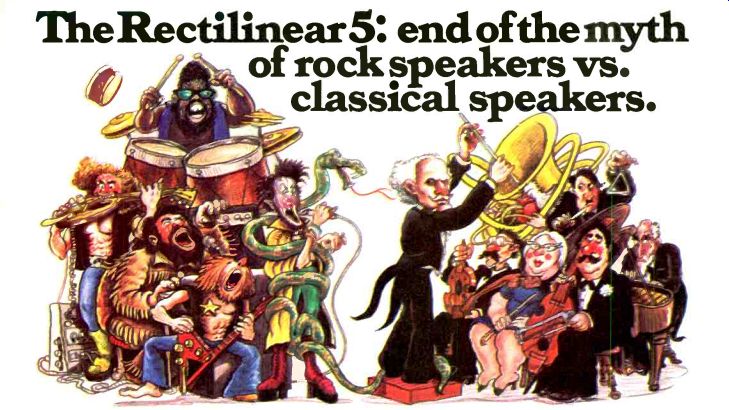
The new Rectilinear 5 is capable of playing very, very loud. Rock-festival loud. Even with a medium-
powered amplifier.
At the same time, it's uncannily accurate. It sounds sweet, unstrained and just plain lifelike at all volume levels.
The temptation is great, therefore, to one-up that prestigious manufacturer who some time ago announced "The first accurate speaker for rock music." But we refuse to perpetuate that mythology. It's perfectly obvious that the Rectilinear 5 reproduces classical music just as accurately as rock. We could never see how a voice coil or a magnet would know the difference between Jimi Hendrix and Gustav Mahler.
So we'd rather use this opportunity to set things straight once and for all.
Thus: There's no such thing as a rock speaker or a classical speaker. Any more than there's a late-show TV set or a football-game TV set.
There are, however, speakers that impose a hard, sizzling treble and a huge bass on any music. And others that round off the edges and soften up the transient details of any music. That's the probable origin of the myth; but these aren't rock and classical speakers, respectively.
They're inaccurate speakers.
It's true that an aggressive treble and a heavy bass are characteristic of most rock music, even when heard live. It's also true that some record producers exaggerate these qualities, some times to a freakish...
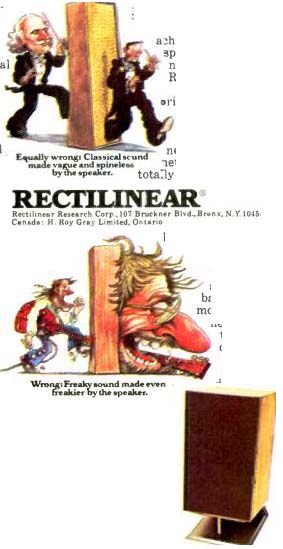
---Wrong: Freaky sound made even freakier by the speaker.
...degree, in their final mix of the recorded sound.
But that doesn't mean the speaker can be allowed to add its own exaggerations on top of the others.
A loudspeaker is a conduit. Its job is to convey musical or other audio information unaltered. If the producer wants to monkey around with the natural sound that originally entered the microphones, that's his creative privilege. He'll be judged by the musical end results.
But if the speaker becomes creative, that's bad design.
By the same token, if some classical record producers prefer a warm, pillowy, edgeless string sound, that doesn't mean your speakers should impart those same qualities to cymbals, triangles or high trumpets.
(Stravinsky's transients can be as hard as rock.) And if you like to listen at very high volume levels : after all, that's what rock is about out sc is Die Gotterdammerung), you still don't need a speaker that a2hieves high efficiency through spurious resonances. What you need is something like the Rectilinear 5.
Everything in this remarkably original design was conceived to end the trade-off between efficiency and accuracy. The four drivers are made to an entirely new set of specifications. The filter...
--- Equally wrong: Classical sound made vague and spineless by the speaker.
...network that feeds the drivers is totally unlike the traditional crossover network. Even the cabinet material is new and different.
Of course, those who feel threatened by all this fuss about accuracy and naturalness will point out that the monitor speakers preferred by engineers and producers in recording studios are usually of the zippy, super-aggressive variety.
That's perfectly true, but the reason happens to be strictly nonmusical.
"I use the XYZ speaker only as a tool," a top producer explained to us. "I wouldn't have it in my house.
It really blasts at you when you crank up the volume, so that any little glitch on the tape hits you over the head.
After eight hours in the studio, that's what it takes to get your attention. I know how to deal with those unpleasant highs; they're in the speaker, not on my tape." It's easy enough to find out for yourself.
Any reputable dealer will let you hear the Rectilinear 5 side by side with a "rock" or "monitor-type" speaker. Adjust each speaker by ear to the same high volume level, Rectilinear 5 making sure the amplifiers are Contemporary of good quality.
Then listen.
Laboratory Series bookshelf/floor
To rock or classical.
speaker system, $299.00
Then and there, the myth Rectilinear Dispersion will crumble. Base t patent pending optional.
RECTILINEAR---Rectilinear Research Corp. 107 Bruckner Blvd., Bronx, N.Y.10454
Canada: H. Roy Gray Limited, Ontario
++++++++++++++++++
You can expect sound value from Dynaco
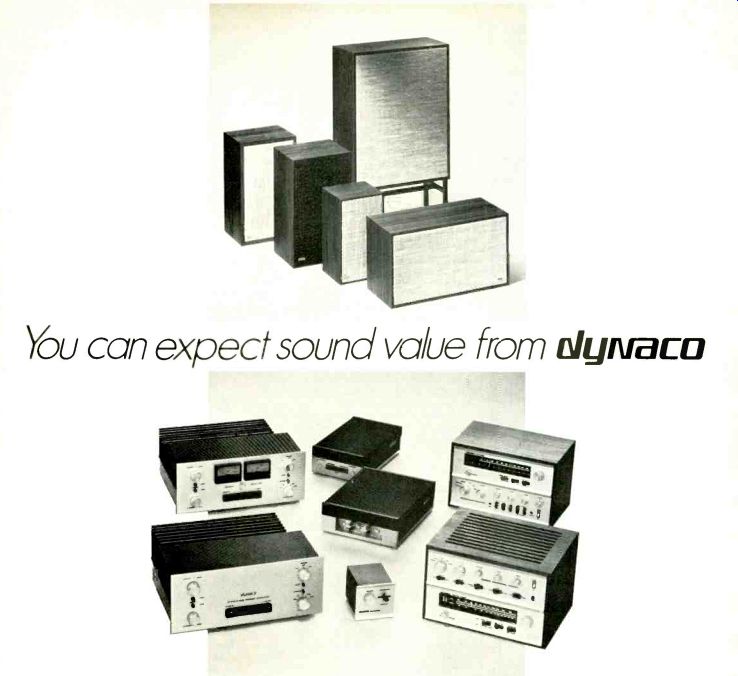
If the quality of your music system is important to you, please critically listen to and examine Dynaco components. We'll help by sending you factual specifications and detailed information, plus impartial published test reports on request. And our Customer Service De partment is available by mail or phone.
You'll find Dynaco speakers, amplifiers and tuners properly demonstrated by the dealer who cares. The one who does care about you as a happy customer, and about r L good music for the joy of it-is worth your full attention. He doesn't make a mint on Dynaco, so he'll sell it only if you insist on it, or if he's as enthusiastic about good sound as we are.
We build hi fi products we believe in-and the sheer power of their performance has pushed many of them to the top in sales. But the value implicit in making them sound better, longer, is what turns us (and hopefully you) on.
You save even more when you build Dynakits.
They're far easier than most, even for beginners. Just look inside one at your dealer's.
And our reputation has been achieved on the consistency with which home-built Dynakits meet or exceed the same specs we publish for our assembled units.
Whether you are looking for the best super-amp, the Stereo 400; or the leading stereo/quad amplifier, the SCA-80Q; or for the most chosen speaker in the world, the A-25;
STOP, LOOK and LISTEN. You'll see why Dynaco is IN1CREDIBLE.
Please send complete test reports and full specifications on all Dynaco amplifiers, tuners and loudspeaker systems.
Name Division Tyco Laboratories Address City State Zip
Box 88, Blackwood, N.J. 08012 Also available in Canada from Dynaco of Canada Ltd.
You can expect sound value from Dynaco
If the quality of your music system is important to you, please critically listen to and examine Dynaco components. We'll help by sending you factual specifications and detailed information, plus impartial published test reports on request. And our Customer Service Department is available by mail or phone.
You'll find Dynaco speakers, amplifiers and tuners properly demonstrated by the dealer who cares. The one who does care about you as a happy customer, and about r L good music for the joy of it-is worth your full attention. He doesn't make a mint on Dynaco, so he'll sell it only if you insist on it, or if he's as enthusiastic about good sound as we are.
We build hi fi products we believe in-and the sheer power of their performance has pushed many of them to the top in sales. But the value implicit in making them sound better, longer, is what turns us (and hopefully you) on.
You save even more when you build Dynakits.
They're far easier than most, even for beginners. Just look inside one at your dealer's.
And our reputation has been achieved on the consistency with which home-built Dynakits meet or exceed the same specs we publish for our assembled units.
Whether you are looking for the best super-amp, the Stereo 400; or the leading stereo/quad amplifier, the SCA-80Q; or for the most chosen speaker in the world, the A-25;
STOP, LOOK and LISTEN. You'll see why Dynaco is IN1CREDIBLE.
Please send complete test reports and full specifications on all Dynaco amplifiers, tuners and loudspeaker systems.
Name Division Tyco Laboratories Address City State Zip
Box 88, Blackwood, N.J. 08012 Also available in Canada from Dynaco of Canada Ltd.
+++++++++++
+++++++++++++++
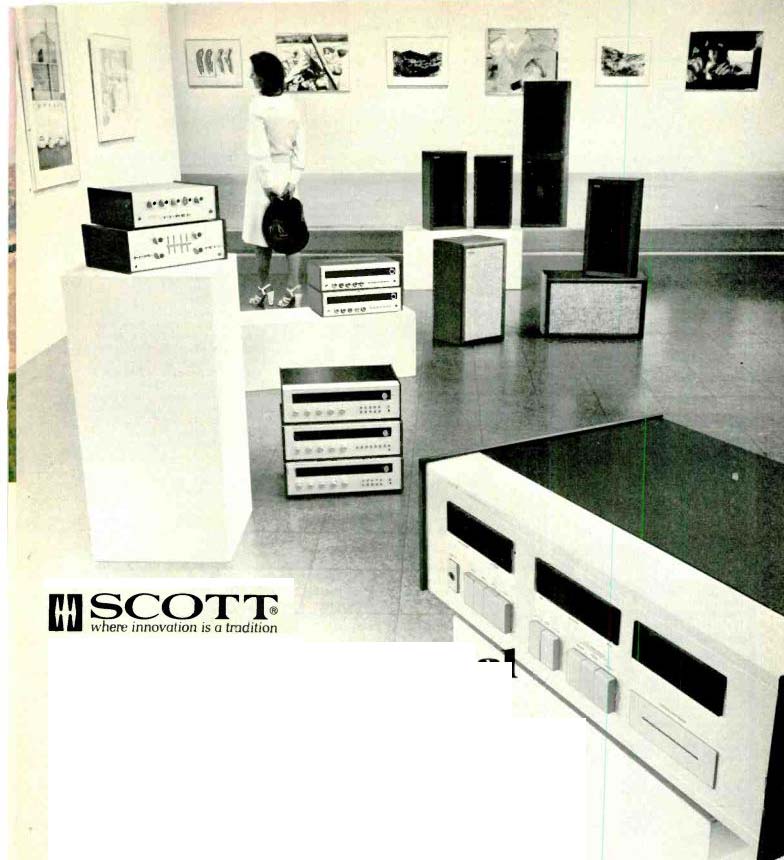
Maybe you hadn't thought of it, but when you buy a Scott audio component, you buy an original, not a copy. Scott originated many of the standard features of today's stereo systems during its past quarter century of innovation in high fidelity. The first stereo amplifier, the first stereo multiplex FM tuner, the first successful solid state receiver, the first FET transistor front end, the first high fidelity components to make use of integrated circuits, the first complementary power output stage, the first four-channel amplifier, the first digital FM tuner and many other developments were introduced by Scott, only to be copied later by others. Many of the brand names widely advertised today weren't even around when Scott introduced the first stereo components commercially in 1958.
When your plans call for the purchase of a high quality receiver, tuner, amplifier or pair of speakers, don't settle for a copy. Buy a Scott original. It costs no more.
See your Scott dealer today for a demonstration of the Scott originals. Or circle reader service number for complete product information and list of demonstrating Scott dealers in your area.
SCOTT --- where innovation is a tradition. H.H. Scott Inc., III Powdermill Road, Maynard. Mass. 01754
++++++++++++++
What's natural sound reproduction? It's sound so real you can see swaying palm trees and grass skirted dancers ... feel the sun-warm sand beneath your feet ... and smell the salt sea air ... right in your own living room.
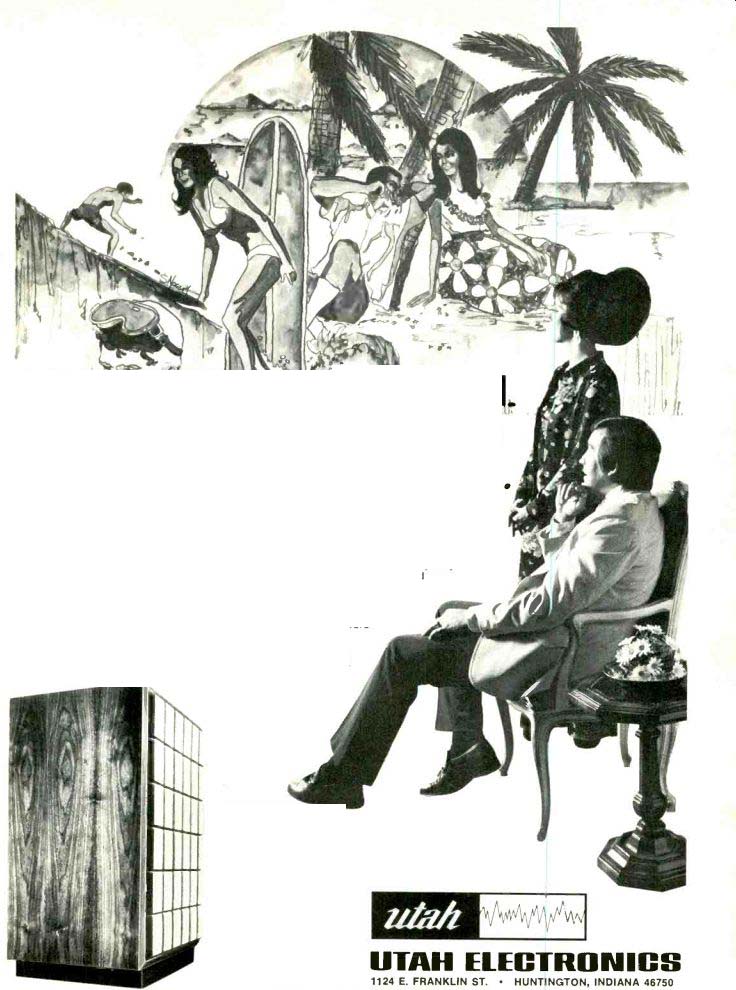

Making a speaker deliver sound this accurate takes years of experimenting and testing as well as solid engineering know-how. Here at UTAH, speakers are our only business. Our sound specialists never stop trying to find ways to improve the quality of our speakers. In fact, we design, engineer, and produce more speakers and speaker systems than any other manufacturer in the country.
When you play your favorite music through a UTAH speaker, you're hearing those clear, thrilling highs, deep, resonant bass notes, and smooth, mellow mid-range tones as closely as you can to the way they were originally recorded.
Natural sound reproduction. What else did you expect from the country's largest speaker manufacturer? The best ... naturally.
Write for the name of the UTAH dealer nearest you.
It.
MP 3000.
This superb speaker sys tem boasts 2 tweeters, 1 mid-range, aid 1 woofer.
Featuring separate controls for tweeters and mid-range, the MP-3000 handles 50 watts pro gram material (100 watts peak). Frequency response: 20-20,000 Hz.
Cabinet: 27" x 20 1/2" x 14". Shipping weight: 70 lbs. $199.95
utah-- UTAH ELECTRONICS 1124 E. FRANKLIN ST. HUNTINGTON, INDIANA 46750
++++++++++++++
Why nearly every record player is like a car that doesn't steer straight.
If you've ever driven a car with badly aligned front wheels or a defective steering mechanism, you know what we're talking about.
It's a queasy feeling when you can't make the car point in the same direction as the road is pointing.
There happens to be a distinctly comparable problem with record players, except that it's a nearly universal deficiency, not just a malfunction.
Of course, in this case there's no human life at stake, only the fidelity of the reproduced sound.
And sometimes the life of the record.
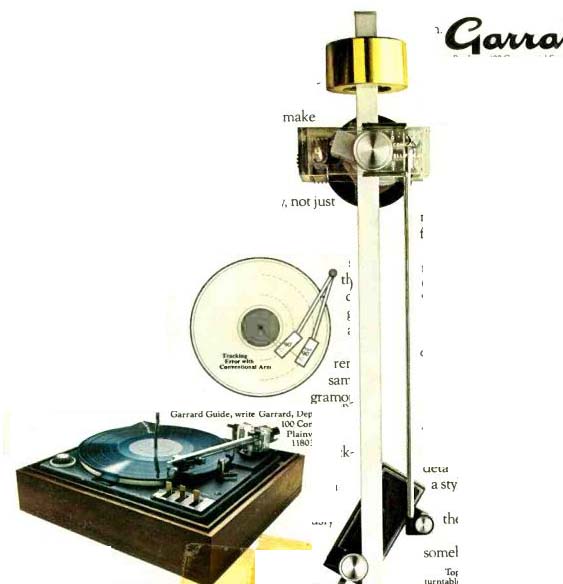
Like a car, the phono cartridge (or pickup head) should point where it's going. Right down the middle of the groove. Not at an angle to it.
A more scientific way of saying the same thing is that the head should remain perpendicular to the line drawn through the stylus tip and the turntable spindle.
Any deviation from this ideal is known as tracking error. It's measured in degrees and it causes distortion. Inevitably.
The trouble is that there's no way to avoid tracking error and the resulting distortion with any conventional pivoted tonearm. Why? Because the head swings in an arc and is therefore at a continuously changing angle to the groove as it travels across the record.
The problem has remained fundamentally the same since the Emile Berliner gramophone of 1887. It has been minimized, thanks to improvements in tonearm.
geometry, but it hasn't been eliminated.
With one important exception.
In the current line of Garrard automatic turntables, the top models are equipped with Garrard's unique Zero Tracking Error Tonearm
Div of Plessey Cons
This remarkable invention ends tracking error once and for all. The head is always properly lined up with the groove because it's hinged instead of fixed and keeps adjusting its angle during play. A simple idea, yes, but the engineering details took the world's leading manufacturer of turntables seven years to perfect.
The Zero Tracking Error Tonearm is a major technological coup, not just a glamour feature. You can hear the difference.
The "Acoustics" column of Rolling Stone magazine, for example, reported that the original Garrard turntable equipped with the new arm "sounded markedly 'crisper' than the other turn tables" tiler "It probably is the best arm yet identical test conditions.
offered as an integral part It's true. Just like a car of an automatic player " that doesn't steer straight.
-High Fidelity Magazine
tracking eliminate make a .
nasty sound.
It can even cause unnecessary record wear!' The information engraved in the grooves of the new CD-4 discrete four channel records is so finely detailed that it can be partially wiped out by a stylus that doesn't sit absolutely square and true_ Ask your nearest Garrard dealer about the Zero Tracking Error Tonearm.
It's absurd to tolerate a problem that somebody has already solved.
Top of the line: Garrard Zero 100c, $209.95. Other Garrard automatic turntables from $49.95 up. To get your free copy of the new 16 page full color Garrard Guide, write Garrard, Dept. G-9, 100 Commercial St., Plainview, N.Y. 11803.
++++++++
(High Fidelity)
Also see: