
Copland's second Third. On his recent European tour, Aaron Copland re-recorded
his Third Symphony, which he first did for Everest some fifteen years ago with
the London symphony. The orchestra this time was the New Philharmonia; the
CBS producer was Roy Emerson.
During the sessions, we're told, Copland reported a recent unexpected visit he received at home from Mstislav Rostropovich. Copland warmly accepted Rostropovich's offer to play for him (he had his cello in tow), but the composer hasn't yet responded affirmatively to Rostropovich's urgings that he write a cello concerto for him. Rostropovich is known for his powers of persuasion; we wish him well in this pursuit.
DG's operatic schedule. Deutsche Grammophon has resumed an active operatic schedule. Current projects include Verdi's La Traviata and Nicolai's Merry Wives of Windsor.
Ileana Cotrubas, Placido Domingo, and Sherrill Milnes are the Traviata principals, with Carlos Kleiber con ducting Bavarian State Opera forces.
Edith Mathis and Hanna Schwarz are Nicolai's merry wives, with Kurt Moll as Falstaff, Bernd Weikl as Ford, Helen Donath as Anne Page, and Peter Schreier as Fenton; Bernhard Klee conducts the Berlin State Orchestra.
In Vienna, DG will press Karl Bohm and the Vienna Philharmonic into the service of Mozart, recording Idomeneo (with a largely Salzburg-based cast including Schreier, Julia Varady, and Donath) and La Clemenza di Tito (recently recorded by Colin Davis for Philips). DG is also planning to record Bohm's Salzburg Don Giovanni live (Milnes is slated for the title role), as was done with his 1974 Cosi fan tutte.
Haitink's Beethoven. Having completed his Philips symphony cycle with the London Philharmonic, Bernard Haitink moves to his other home base, Amsterdam, to complete the Beethoven concertos. For the triple concerto, the soloists are the members of the Beaux Arts Trio. The piano concertos with Alfred Brendel (the second cycle for both pianist and conductor) are scheduled for completion in April, when the Second Concerto and Choral Fantasia are to be taped.
(For the record, Haitink has recorded the violin concerto not once, but twice in the last two and a half years, both with the Concertgebouw-first with Henryk Szeryng, then with Concertgebouw concertmaster Herman Krebbers. Krebbers, a formidable artist only now actively pursuing a solo career, has also recorded the Brahms concerto with Haitink and the Mozart Nos. 2 and 4 with David Zinman and the Netherlands Chamber Orchestra.
Released at mid-price in Europe, these excellent records are unfortunately unlikely to be released domestically.) EMI and DG in Chicago. Carlo Maria Giulini and the Chicago Symphony have recorded the Mahler Ninth symphony, the Prokofiev Classical Symphony, and Mussorgsky's Pictures at an Exhibition for Deutsche Grammophon; for EMI they were scheduled to record the Bruckner Ninth Symphony and, with Itzhak Perlman, the Brahms violin concerto.
DG has also recorded the Mahler Resurrection Symphony with the Chicago Symphony, conducted by Claudio Abbado. It was planned to follow this with another Abbado Mahler symphony recording: the Third, with the London Symphony.
The operatic Schumann. EMI and East Germany's Deutsche Schallplat ten have continued their adventurous collaboration with the first recording of Schumann's only completed opera, Genoveva. Kurt Masur conducts the Leipzig Gewandhaus Orchestra, with a cast headed by Edda Moser, Dietrich Fischer-Dieskau, and Theo Adam.
Another coproduction, Carlos Kleiber's Wozzeck, was delayed by the conductor's indisposition. In its place, the Dresden sessions were turned over to Richard Strauss's comedy Die schweigsame Frau, with Marek Janowski conducting a cast headed by Jeanette Scovotti, Hermann Prey, and Adam.
Mahler's opera. One of the more remarkable operatic hybrids, Mahler's realization of the sketches left by Weber for Die drei Pintos, has been recorded by RCA. Gary Bertini conducts the Munich Philharmonic and a cast headed by Lucia Popp, Werner Hollweg, Hermann Prey, and Kurt Moll.
Dresden Bruckner. With his London Philharmonic Brahms symphonies now complete and his London symphony Beethoven symphonies well begun, Eugen Jochum has added a third project to his EMI schedule: a new cycle of the Bruckner symphonies with the Dresden State Orchestra, produced by EMI's regular man in Dresden, David Mottley. As in his DG cycle, Jochum will use only the Nowak editions (which, unlike the Haas editions, incorporate the revisions that Bruckner made after what Deryck Cooke calls the "first definitive versions"). If all proceeds according to schedule, by February Nos. 3, 4, 7, and 8 will be on tape.
Troilus and Cressida. After more than twenty years. William Walton's Troilus and Cressida has finally been recorded complete. EMI taped four performances of the new production at Covent Garden last November, for which Sir William "substantially revised" the work, first heard (also at Covent Garden) in 1954. The title roles are taken by Richard Cassilly and Janet Baker; the cast also includes Elizabeth Bainbridge, Gerald English, Robert Lloyd. and Benjamin Luxon. The conductor is Lawrence Foster, who replaced an ailing Andre Previn. (The first-night audience, too, had health problems. "We have taped the coughing in the highest fidelity," producer Christopher Bishop told HF's Edward Greenfield.) First edition. Our spies who regularly comb the Neiman-Marcus catalogue report news of a First Edition symphony Collection offered by the giant department store in collaboration with RCA. The four-disc set includes previously un-reissued (and even some unissued) performances by Leopold Stokowski and the Philadelphia Orchestra (a 1931 Beethoven Fifth symphony and Brahms Fourth), Serge Koussevitzky and the Boston Symphony (Strauss's Don Juan, 1946), Eugene Goossens and the Cincinnati Symphony (Respighi's Fountains of Rome, 1946), Artur Rodzinski, Pierre Monteux, Charles Munch, Hans Kindler, and Karl Krueger. The price is $31.20 postpaid, from Neiman-Marcus, Box 2968, Dallas, Tex. 75262.
Rostropovich's Tchaikovsky. In an October blitz Mstislav Rostropovich has recorded all the Tchaikovsky symphonies (including Manfred) with the London Philharmonic for EMI. He even found time to record a group of Russian songs with his wife, soprano Galina Vishnevskaya.
The Rostropovich Tchaikovsky cycle has no effect on the one Riccardo Muti will be doing for EMI with the New Philharmonia. Scheduled for November sessions was Romeo and Juliet, to be coupled with the Second Symphony.
=========
Hello, Backbeat--Farewell, Lighter Side
With this issue HIGH FIDELITY makes the most radical single editorial change in our twenty-six-year history: an all-out expansion of our popular music coverage. We won’t be slighting either classical music or audio, the traditional mainstays of HF. Rather, we are adding six teen pages of material, which when combined with the pop and jazz re views from our former "Lighter Side" department, gives us a new section of approximately twenty-four editorial pages devoted to the contemporary pop scene each month. And, as we have always done with our classical and audio coverage, we will deal with popular music intensively, envisioning a seriously interested reader.
The new section, BACKBEAT, will function almost like a magazine within a magazine. It has its own musical, music business, and audio features, columns, and reviews.
Audio features? Yes, for BACKBEAT is designed not only for those who wish to read about pop music, but for those who actively participate in it. My philosophy in editing HF has been based on the belief that our readership comprises special-interest groups: the minority of music-lovers whose passion is for the classics (and for whom we might devote six pages of discussion to a single thought-provoking recording); the minority of audio equipment owners who are sufficiently de voted to high fidelity to buy a publication about it (and for whom we have available the incomparable facilities of the CBS Technology Center); and now the minority of pop-including jazz-aficionados who are interested enough to become actively involved with it. We figure that there are a lot of equipment-crammed basements around the country where our readers make live recordings (which are hardly likely to be symphonic in scope) and that we can be of as much service to the active pop recordist as we have always tried to be to the classical music listener, whose recording activity has generally been confined to taping off the air.
At the same time, we are expanding our "Equipment in the News" column to allow for more professional and semiprofessional equipment designed for the pop/jazz musician and recordist.
BACKBEAT it self includes an instruments and accessories section to keep the reader up to date on the latest in electric keyboards and guitars, wah-wah pedals, and the like, while its review department covers records, folios, and appropriate books.
Editing the section is Susan Elliott, who up until now has been- would you believe?-managing editor of MUSICAL AMERICA. That's really not so extraordinary: Susan, a professionally trained musician and editor, is from the generation in which a commitment to the classics does not preclude an equally intense commitment to rock. (At our staff parties, the MUSICAL AMERICA personnel always seem to be the wildest rock contingent; BACKBEAT, in fact, was conceived in a chat I had with Susan during a ten-minute band break at a staff bash.) She has long been a pop song-writer and knows the music business from the inside.
Theater and film record reviews will remain outside of BACKBEAT and will now follow the classical reviews. Gene Lees, who has made a career in these pages of attacking rock-and who, grinning slyly over the paradox, is now counting his money from the two rock songs he contributed to the Streisand A Star Is Born-will also appear outside the new section. In fact, this month Gene begins a long series of articles dissecting the various elements that led to what he feels contemporary pop has become: "An Art Gone Astray." Never let it be said that we force our writers into any musical party line.
And now, whatever your musical predilections, I hope you find them fully satisfied in the enlarged HIGH FIDELITY.
========
Audition free for 10 days Karl Bohm's superb Deutsche Grammophon recording of SPECIAL BONUS: Mozart's Piano Concertos Nos. 12 and 26 All 4 International Award-Winning Records For Less Than The Price Of 1! Your Introduction To The Unique Money-Saving Program That Offers Free Auditions Of Prize-Winning Recordings By The Leading Concert Artists Of Our Time!
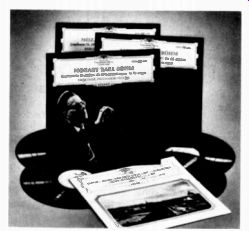
Wolfgang Amadeus Mozart--music's greatest natural genius-divinely gifted beyond any other musician who ever lived! And into his six greatest symphonies he poured a multitude of his most astonishingly beautiful, incredibly moving inspirations! Symphony No. 41, "Jupiter" Symphony No. 40 in G-minor Symphony No. 39 in E-flat Symphony No. 38, "Prague" Symphony No. 36, "Linz" Symphony No. 35, "Haffner" Extra! Symphony No. 32 Now you are invited to hear these miraculous works in their finest recording ... interpreted with extraordinary empathy by Karl Bohm . . played to perfection by the Berlin Philharmonic Orchestra ... captured in unsurpassed stereo realism by Deutsche Grammophon. So outstanding is this recording that it has won three of the music world's most eagerly sought honors: the Grand Prix International du Disque, Edison Award and Deutsche Schallplatten Prize! In addition, you will also receive Mozart's Piano Concertos Nos. 12 and 26, "Coronation," superbly performed by soloist Geza Anda with the Salzburg Camerata Academica - winner of the coveted Grand Prix des Discophiles.
Now enjoy and keep these 4 superb albums for less than the price you'd pay for 1! Because these magnificent recordings have met with almost unprecedented acclaim, they have been chosen to introduce you to The Great Awards Collection, a totally new concept in home listening. You may enjoy all eight masterpieces, on four superb-quality, imported records, for 10 days absolutely free. Then keep all four, if you wish, for only $6.98 (that's less than the price you'd pay for just one record)! Simply mail the coupon at right today.
Here's how the program works... As a member of The Great Awards Collection you will receive only the finest recordings of prize-winning concert performances by preeminent orchestras, conductors and soloists. There is no minimum number of recordings you must buy.
And you can cancel your membership at any time.
What's more, every superb recording you choose to examine comes to you on a free 10-day trial basis. So you'll never waste a penny on disappointing purchases!
Approximately 14 times a year you will receive the current issue of our Great Awards Collection Bulletin highlighting an exceptional Selection of the Month and other brilliant classical releases recommended by a distinguished jury of musicians, scholars and musicologists. If you want to examine the Selection of the Month you need do nothing. It will be shipped to you automatically.
If you want any other selection, just mark your choices on the order card you will receive and re turn it by the date specified. If you don’t want any selection, just check the proper box on your order card and return it by the date specified. It's that simple! Special half-price bonus offer saves you money! In addition to great music, you'll enjoy great savings with our half-price bonus plan. For every record you buy at our low members' price (always well below suggested retail), you may choose an other one from a list of award-winners and other critically-acclaimed LPs and pay just half that price! A truly economical way to build your library of superb classical recordings.
How many records are you committing your self to buy when you return the attached coupon? None at all! Even your introductory set of Mozart's Six Greatest Symphonies and Piano Concertos 12 and 26 comes to you on approval.
Audition it free for ten days, then either return it - or keep it for only $6.98 for all four records (plus a small postage/handling charge). Here at last is the ideal way to acquire a connoisseur's record library in easy stages. You listen at home to every award-winning selection you elect to examine before deciding whether to buy it! Please act today! Begin your money-saving, no-obligation membership in The Great Awards Collection by mailing the coupon for your free trial, with four – for-less - than- the- price-of-one purchase option of this essential collection of Mozart's Six Greatest Symphonies and exquisite Piano Concertos Nos. 12 and 26.
Eight ways The Great A wards Collection helps you enjoy fine music more than ever!
1. The greatest music by the world's immortal composers.
2. A major, award-winning recording yours to audition each month.
3. Superior imported LPs - silent surfaces.
4. Free ten-day trials of all selections.
3. All selections always far less than retail price.
6. Extra savings with Half-Price Bonus Plan.
7. No obligation to buy - no minimum purchase.
8. Money-saving introductory offer.
Send no money now - Mail coupon TODAY!
Listen for 10 days free. Keep all 4 for less than the price of 1!
The Great Awards Collection. 175 Com munity Drive. Great Neck. N.Y. 11025.
Please send me. for my free audition, the triple-award-winning recording of Mozart's Six Greatest Symphonies by Karl Bohm. together with Gera Anda's award-winning performance of Mozart's Piano Concertos Nos. 12 and 26 I may return the set after 10 days and owe nothing, or keep * and pay only $tore for all four Deutsche Grammophon records, plus a small postage/handling charge This is all four records for less than the regular price of one! Each month I will also be notified of 1114,01 award-winning recordings available to Great Award Collection members free for 10 days For every one of these records I buy at your members price (always below suggested retail), I may also choose one record at half that price from your special list I am not obligated to buy any minimum number of records I may cancel my membership at any time.
-----------------
Shure
The Test of Time.
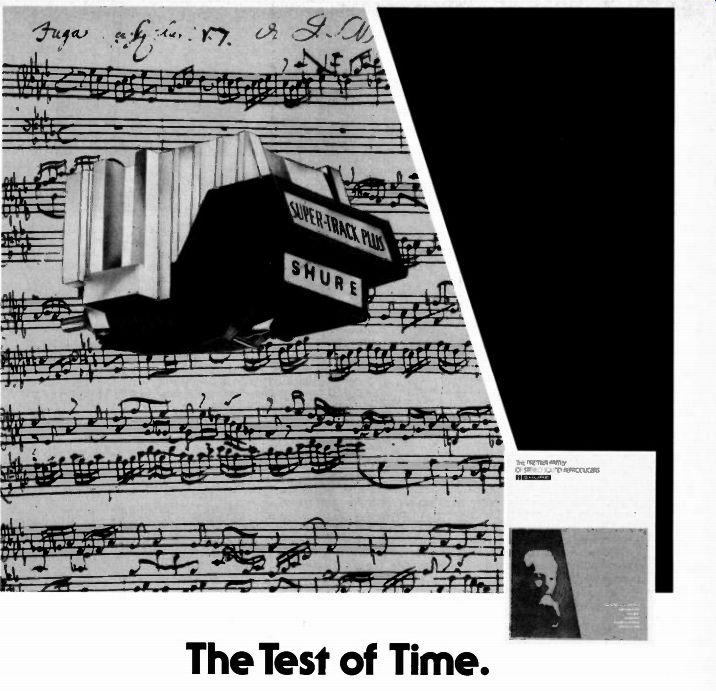
Critics were most generous in their praise when the Shure V-15 Type III phono cartridge was first introduced. The ultimate test, however, has been time. The engineering innovations, the uniform quality and superb performance of the V-15 Type III have made it the audiophile's choice as the source of sound for the finest music systems both here and abroad.
Consider making the relatively modest investment of a new cartridge to upgrade the performance of your entire hi-fl system. It will make a difference you can hear!
The original manuscript by J. S. Bach shown is reproduced by kind permission of the Trustees of The British Museum.
Shure Brothers Inc.
222 Hartrey Ave.
Evanston, IL 60204
In Canada: A. C. Simmonds & Sons Limited
TECHNICORNER MODEL V-15 TYPE III
Tracking Force Range: 3/4 to 1 1/4 grams
Frequency Response: 10 to 25,000 Hz
Typical Tracking (in cm/sec peak recorded velocity at 1 gram:) 400 Hz. 26 cm/sec 1,000 Hz. 38 cm 5,000 Hz . 35 cm/sec 10,000 Hz. 26 cm see Channel Separation (Minimum): 25 dB at 1 KHz: 15 dB at 10 KHz
Stylus: Model VN35E Biradial Elliptical.
5 x 18 microns (.0002 x .0007 inches)
Also available: Model V-15 III G with the VN3-G Spherical stylus, 15 microns (.0006 inches)
Model VN78E Biradial Elliptical stylus, 13 x 63 microns (.0005 x .0025 inches) for mono 78 rpm.
MANUFACTURERS OF HIGH FIDELITY COMPONENTS. MICROPHONES. SOUND SYSTEMS AND RELATED CIRCUITRY.
------------------------
Experience the genius of the "great musician of all time"--as you may never have experienced it before …
The Definitive Beethoven Collection
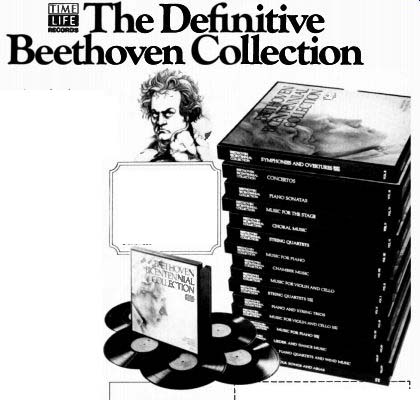
As your introduction to THE BEETHOVEN BICENTENNIAL SERIES listen to the first 6 symphonies for10 days free!
Over the years there have been many record albums devoted to various works of the immortal Ludwig van Beethoven. But there has never been a complete collection of all his works. That is why TIME-LIFE RECORDS assembled this magnificent collection in 17 volumes that contain every important work the master ever wrote-even some rare vocal pieces never before available! It's the BEETHOVEN BICENTENNIAL COLLECTION, recorded by the famous Deutsche Grammophon Company of Germany.
This feast of Beethoven is performed by such world-renowned artists as Conductor Herbert von Karajan, supreme interpreter o Beethoven's symphonic works; the great violinist Yehudi Menuhin; opera's greatest dramatic soprano, Birgit Nilsson; Wilhelm Kempff, dean of Continental pianists; silken toned cellist Pierre Fournier; Britain's brilliant Amadeus Quartet; and the Berlin Philharmonic Orchestra.
10-day free audition: To introduce you to this incomparable collection we invite you to audition Volume I, the first six symphonies plus the popular Leonore Overture No. 3, for 10 days FREE. These selections were performed by the renowned Berlin Philharmonic Orchestra under the direction of Herbert von Karajan. Highlighted in Volume 1 are: O SYMPHONY NO. 3 in E Flat Major-the "Eroica."
SYMPHONY NO. 5 in C Minor-The opening is probably Beethoven's most well known theme.
SYMPHONY NO. 6 in F Major-the "Pastoral." Only the beginning: If you decide t keep the five records of Volume 1 for the low price of $19.95 plus shipping and hand ling, you become entitled, as a subscriber, t audition approximately every other month, future albums in this fantastic 17-volume Beethoven collection for the same low price.
Some of the magnificent works contained i future volumes are: The 9th Symphony--a revolutionary work in that it was the first choral symphony ever composed.
MISSA SOLEMNIS-An exhilarating synthesis of symphony, opera and church music.
EGMONT-the complete incidental music to the heroic drama by Goethe.
The 16 Quartets-showing Beethoven's evolution from the classical style of Haydn and Mozart to the highly original and exciting style of the last five quartets.
No risk or obligation: To receive Volume 1 for 10-day free audition, return the post paid card. If you decide to keep it, we will include, free, the giant guide on Beethoven described at right. You are under no obligation to purchase any minimum number of volumes and you may cancel your subscription at any time. Mail the attached card or use the coupon at right.
---------- Beethoven's achievements are a reflection of the man himself, for his music is like a diary into which he poured his life, his desires, his regrets, his furies, his melancholies and his loves Beethoven was al constant odds with his society-a society steeped in a stormy world ol revolution He transposed his own personal struggle to the scale of the whole human race, and dreamed of bringing to it by and universal brotherhood
------------- PLUS a FREE Beethoven Volume
This huge, handsome commemorative volume-now out of print- covers the master and his work i rich detail. Includes much material never available to the public be fore. 267 pages, 269 illustration in color, and black and white music scores, paintings, drawings manuscripts, etc.
TIME-LIFE RECORDS TIME & LIFE BUILDING.
Chicago, Ill. 60611
Yes, I would like to examine the first album of the Beethoven Bicentennial Collection. Please send it to me-together with my free $29.50 Beethoven book-for 10 days' free examination and enter my subscription to the Beethoven Bicentennial Collection. If I decide to keep the first album, I will pay $19.95 plus shipping and handling. I then will receive future albums in the Beethoven Bicentennial Collection, shipped an album at a time approximately every other month. Each is $19.95 plus shipping and hand ling and comes on a 10-day free-examination basis. There is no minimum number of albums that I must buy, and I may cancel my subscription at any time simply by notifying you.
If I don’t choose to keep the first album, I will return the album and the guide within 10 days. my subscription will be canceled and I won’t be under any further obligation.
Name Address City Apt. No. State Zip (or Prov.) (or Code)
----------------
THE DISC WASHER GROUP OF COMPANIES which produce and distribute quality audio products present HIGH FIDELITY's
100 Years of Recording


A series of four original acrylic paintings by Jim Jonson Inspired by the centennial of the phonograph and planned by HIGH FIDELITY'S editors, this series of four originals will be published during 1977. The series will depict the development of recording through its leading figures in music and the recording business, its dominant means of sound reproduction, and its principal innovations in audio technology.
Jim Jonson, a Connecticut resident, has produced paintings for Saturday Evening Post, Sports Illustrated, Fortune, Reader's Digest, Boys' Life, and other journals and has fulfilled commissions for corporations ranging from Capitol Records to American Airlines and the Ford Motor Company. His work has been exhibited in the Denver Art Museum, Art Museum of Sport, and the Los Angeles County Art Museum, among others, and his one-man shows have been seen in many major galleries. A portfolio of Mr. Jonson's drawings and paintings was recently published by Prentice-Hall.
The Discwasher Group is proud to present the first of this distinguished artist's portrayals of "100 Years of Recordings."
Part 1: The Cylinder Era
The Cylinder Era The spirit of Thomas Edison dominates the opening quarter-century of phonographic history, and in this - the first of a series of paintings illustrating that history for us - artist Jim Jonson has represented Edison. the central figure, much as he appeared in the Brady Studio portrait taken in Washington. April 1878. Edison had gone there to demonstrate his tinfoil phonograph to President Rutherford B. Hayes and other political and scientific dignitaries. The Brady photograph does not show the lock of hair falling across Edison's brow: most other photographs do.
The drawing at the top center is the true original sketch of the phonograph. dated November 1877: the more familiar "August 1877- sketch was drawn later and the date added only in 1917. To the right is the invention's first commercial embodiment: a talking doll. Continuing clockwise, we see violinist Albert Spalding, a stalwart of the Edison stable well into the disc era, recording simultaneously into three horns (the only method short of pantographic mechanical copying by which identical copies of a given performance could be produced until Edison introduced the molding process). An artist might spend an entire day continuously recording a single selection, only to do so again if stocks ran low.
Below the Edison laboratory in Menlo Park. New Jersey, is the original hand-cranked tinfoil phonograph built by John Kruesi on December 6, 1877, using Edison's sketch.
Later models had flywheels to smooth out the cylinder's motion. clockwork drive (like the model at the bottom right), or even battery-powered electric motors.
As the fame of "the wonder of the age--grew, demonstration--lectures became a popular entertainment. The traveling lecturers were superseded, before the turn of the century. by the nickelodeons: early models used listening tubes to prevent dissipation of the feeble sounds from the wax cylinders.
While the Edison Company concentrated on popular ballads and comedy routines, one Gianni Bettini was applying the cylinder to higher callings. He began by making mechanical improvements on Edison's cylinder recorder. With it he recorded some of the most eminent voices of his age - including diva Nellie Melba, who is shown here listening to herself on the Bettini equipment.
Most early vocal recordings were accompanied by piano, often an upright mounted on a high platform for best pickup by the horn. The pianist here is imagined as the child prodigy Josef Hofmann. who did record Edison cylinders, though not in the studio and presumably not on such a piano. Edison sent him a water-powered phonograph on which he made cylinders at home in Berlin. Hofmann appears again in the group of five figures at the top. Next to him is George Washington Johnson. whose "Laughing Song" made him the first black recording star. although blackface routines were commonplace among white performers, such as W. F. Denny, at the center of this group. All three were Edison artists. Recordings of Pope Leo XIII were made by Bettini after he had begun distributing his cylinders commercially. Beside the Pope is diva Marcella Sembrich. One of her Bettini cylinders was discovered in New Zealand a few years ago and issued on disc: the only accessible surviving memento of musical importance by which modern ears can assess the quality of Bettini's contribution and the tragedy of its almost total destruction.
------------
Without an electron microscope gas liquid chromatography mass spectrographic analysis electronic balances reverse osmosis purifications and triple buffering analysis You Have...
A Choice: Disposable Records or The New D3 by discwasher
THE SUPERIOR RECORD CLEANER
CAUTION ---KEEP OUT OF REACH OF CHILDREN
Net Contents 16 Fl. Oz.
MADE IN USA
Cleaning ability that is chemically "directed" at fingerprints and common disc contaminants.
Chemical protection and buffering to protect critical vinyl additives.
A Chemical "release system" that pulls contamination away from micro-grooves and into the patented Discwasher fabric.
A non-adhering static reduction system.
by discwasher
THE SUPERIOR RECORD CLEANER CAUTION KEEP OUT OF REACH OF CHILDREN
MADE IN U S A
Discwasher Group
PROVIDENCE COLUMBIA, MO 65201
Only from Discwasher labs.
Better performance without increased price.
---------------
Nakamichi
better than records ... and easier than you'd think. You can make recordings on the Nakamichi 550 that rival the best LP discs available today.
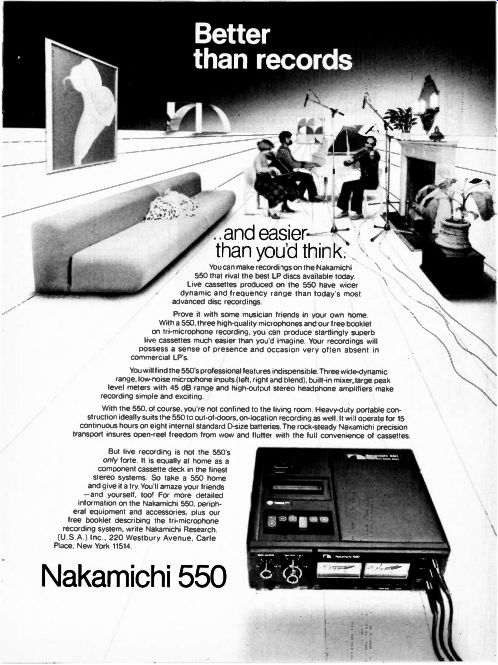
Live cassettes produced on the 550 have wider dynamic and frequency range than today's most advanced disc recordings.
Prove it with some musician friends in your own name.
With a 550, three high-quality microphones and our free booklet on tri-microphone recording, you can produce startlingly superb live cassettes much easier than you'd imagine. Your recordings will possess a sense of presence and occasion very often absent in commercial LPs.
You will find the 550's professional features indispensible. Three wide-dynamic range, low-noise microphone inputs (left, right and blend), built-in mixer, large peak level meters with 45 dB range and high-output stereo headphone amplifiers make recording simple and exciting.
With the 550. of course, you're not confined to the living room. Heavy-duty portable construction ideally suits the 550 to out-of-doors, on-location-recording as well. It will operate for 15 continuous hours on eight internal standard D-size batteries. The rock-steady Nakamichi precision transport insures open-reel freedom from wow and flutter with the full convenience of cassettes.
But live recording is not the 550's only forte. It’s equally at home as a component cassette deck in the finest stereo systems. So take a 550 home and give it a try. You'll amaze your friends--and yourself, too! For more detailed information on the Nakamichi 550. peripheral equipment and accessories, plus our free booklet describing the tri-microphone recording system, write Nakamichi Research. (U.S A.) Inc.. 220 Westbury Avenue, Carle Place, New York 11514.
Nakamichi 550
-----------------
-------------
(High Fidelity, feb. 1977)
Also see: