Music from Mannheim
What a few have long known, Archiv now shows the world: These pioneers didn't just make history, they made music!
by Paul Henry Lang
The rediscovery of the " Mannheim school" at the beginning of our century created a musicological sensation. The term has since become familiar even to laymen, and the group is always mentioned with respect, even though very little of its copious output is encountered.
The Mannheimers were a spunky lot. The city was twice leveled to the ground by the French and twice rebuilt, and when it was made the capital of the Palatinate in 1720, the Elector Carl Philipp promptly embarked on an ambitious building program.
Since his architects started from ashes and rubble, they could plan an entire new city, and like their musical colleagues, they were modern and forward-looking. The straight streets and regular blocks resemble those of an American city, but the architecture does not. The electoral palace (the greatest in Germany), the fine opera house, the churches and other public buildings were all splendid, and the electors, with equal determination, saw to the creation of an excellent musical establishment.
Carl Theodor (reigned 1743-78) was particularly interested in music, and by spending fantastic sums of money, he made the city a world center of the art of music.
The Mannheim orchestra had no peer, and all visitors praised it unstintingly: Burney called it "an army of generals"; Mozart could not get over its precision and dynamic nuances; Daniel Schubart wrote that "its forte is like thunder, its piano like the breath of spring, and its crescendo like a cataract." In the opera house, most successful works from Venice and Naples were placed in the repertoire within a couple of years of their premieres.
Carl Theodor, like his predecessor, the "architect elector," wanted instant results, so he recruited distinguished musicians from the Austrian crown lands to add to the existing musical household; together they constituted a formidable aggregation of talent. It is here that we face the first of many misunderstandings that still cling to this important segment of musical history.
The Germans usually reserve all the achievements to themselves, yet the Mannheim school-more precisely, the original style setters-were practically all immigrants and really formed an enclave, a musical island in Germany, one not at all congenial to, or admired by, the North. Johann Stamitz (1717-57), the founder and leader of the school, came from Bohemia, Franz Xaver Richter (1709-89) from Moravia, Ignaz Holzbauer (1711-83) from Vienna, and there were also a couple of Italians and a Belgian. After Bohemia became Czechoslovakia sixty-three years ago, it became fashionable to refer to these German Bohemians as bona fide Czechs; Johann Stamitz became Jan Stamic, Franz Richter, Frantisek Richter, and so forth. Of course, this won't do either. Nor can the claim that the Mannheim school was the sole predecessor of the classic German symphony be accepted, because significant contributions to the new style came from Vienna and, of course, from Italy. Nevertheless, the Mannheim school was epoch-making.
What Stamitz and the others accomplished was a bold and logical transition from the baroque and Emp/indsamkeit to an entirely new style. Polyphony became a means, no longer a style; composers no longer worked from the bass upward, but from the top down, the resultant texture making the basso continuo obsolete and dispensable; they established the rule of the symmetrical two-, four-, and eight-measure periods; the sequence lost its significance and became a sort of ornament or an agent of modulation, and continuity was achieved by thematic development.
But what most astounded the musical world was the establishment of a new symphonic/orchestral idiom and technique. This was entirely different from the old practices, because style and technique were now entirely interdependent. Stamitz and Christian Cannabich (1731-98) corn posed for orchestra, they did not orchestrate.
This required a regrouping of the orchestra, and we see the familiar classical scheme of woodwinds and brass in pairs supported by a substantial string body. The orchestra was disciplined and highly trained; both Stamitz and Cannabich were outstanding violinists, and they saw to uniform bowing and all the other niceties of ensemble technique hitherto unknown except in Paris. The symphonic/orchestral bent was so strong that even Stamitz' trios, notated in the old trio-sonata manner of two violins and basso continuo, are clearly intended for orchestral delivery. (His Trio, Op. 1, is so performed here to entire satisfaction, though a bass fiddle should have been added to the ensemble.) Aside from these trios, it is quite obvious that in the concertos and symphonies the basso continuo is already superfluous.
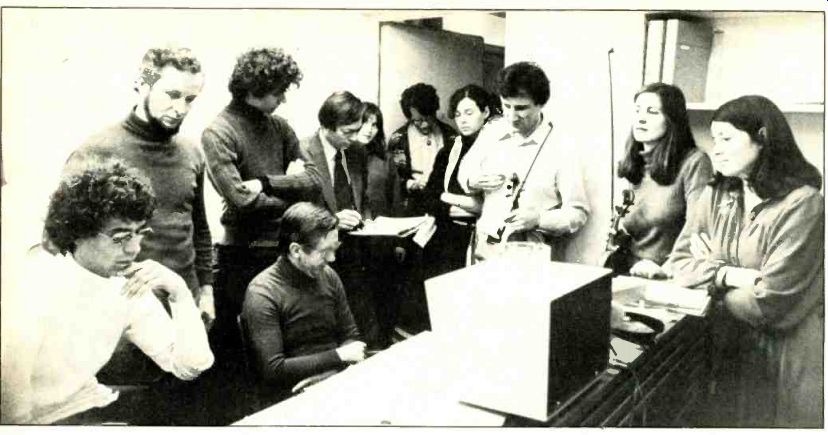
-- Seated at playback, cellist Thomas Demenga and producer Gerd I'loebsch; concertmaster Thomas Füri gestures at right.
In 1778 the Elector Palatine, having inherited the Duchy of Bavaria, moved his residence to Munich. Most of his musicians followed him, and the orchestra, combined with the Bavarian court musicians, remained supreme. It was this orchestra that played in the Munich production of Idomeneo; Mozart's uncommonly rich orchestration of his first great opera shows what he learned from this superb group. But- and this is the second major misunderstanding that must be corrected-the Mannheim school proper ends here, be- cause the stay-at-homes, the second -generation Mannheimers, no longer represented the bold and innovative pioneers of Stamitz' circle. Even his own sons Carl and An- ton turned out to be mere provincial musicians who could not hold a candle to their elders, let alone their contemporaries of Haydn, Mozart, Rosetti, Dittersdorf, and all the others. [See "Classical Reviews."-Ed.] Leopold Mozart found them old-fashioned, unoriginal, and mannered. Even the orchestra declined; Mozart, who was greatly impressed by the original Mannheim school, was sadly disappointed when later he heard his Figaro performed there. To re- iterate, these rear -guard Mannheimers should not be considered members of the Mannheim school proper.
The selections in this album are good, showing the principal orchestral genres established and practiced by the school: symphony, concertante symphony for strings or for winds, and solo concerto; with the exception of Richter's flute concerto, all are recorded here for the first time. It is per- haps churlish to criticize such a valiant and important venture, yet it seems to me that a somewhat later orchestral trio by Stamitz, the one in C minor that exudes a virtually Beethovenian symphonic "furor," would have been more rewarding. Beethoven, who knew these works from his teacher, Neefe, in Bonn, based the scherzo of his own C minor symphony verbatim on this trio. But perhaps the able editors at Archie wanted to show the very inception of the new style by presenting Stamitz' Op. I, and it is indeed a revelation. There is the new triadic type of symphonic incipit-no longer a melody or a significant musical entity, but a "subject" that gains its significance by thematic elaboration. Then there are the new Mannheim dynamics, the "rollers," or long, growing orchestral crescendos that were to become so important and characteristic in the classical symphony. Stamitz' slow movements show a fine melodic gift, while the newly inserted minuet-here is the prototype of the classic four -movement symphony/sonata-shows the trans- formation of the French dance into a sym- phonic piece. All the great masters who followed Stamitz were indebted to him, and echoes can be followed to Beethoven's final period. This is not formula music like that of his sons and their colleagues; it is emotional, affective, with a delicate feeling for rhythmic and agogic niceties, yet it also has dramatic force.
Among the older Mannheimers, Richter was a good composer who absorbed the new orchestral style and idiom, but he did not have Stamitz' imagination and inventiveness; his music, though fluent and fine -sounding, still shows a lot of sequences and little thematic elaboration.
Anton Filtz (1733-60), who regrettably died at the age of twenty-six, could have been one of Stamitz' worthiest disciples. He was a noted cellist and must have composed the concerto recorded here for himself. It is a solid piece, passionate yet tinged with melancholy, full of good ideas; the orchestral writing is very imaginative. There is a decided resemblance here to Pergolesi, not only because of his untimely death, but by reason of a genuine musical kinship.
Holzbauer's concertante symphony for violin, viola, cello, and strings is another good piece that shows how this Viennese musician became acclimatized in Mannheim.
Though the symphony uses only strings, one constantly "hears" woodwinds, horns, and trumpets, so closely is its style hound to the orchestra. His Symphony in E flat, another attractive work, does use the winds to advantage, and the majestic slow movement recalls his Austro -Italian musical origins.
Ludwig August Lebrun (1752-90), whose father, a Bruxellois, played oboe in the orchestra, is an authentic Mannheimer, born in the city. In his day he was one of the foremost oboe players, and the concerto for oboe presented here was undoubtedly for his own use. Luckily, it is performed superbly by Heinz Holliger, the outstanding oboist of our day. Lebrun (who did not follow the orchestra to Munich) is still very little known, but this somber concerto is close to the "dark" Mozart, the D and G mi- nor Mozart; and its romping finale/ rondo is very much in Haydn's vein. If this fine concerto is representative, Lebrun must have been one of the important minor masters of the classical era.
That leaves Cannabich, who was a near contemporary of Haydn. As a composer, he does not quite belong to the original Mannheim school. However, as the leader of the orchestra-he succeeded Stamitz in that office-he is very much of their breed; Mozart considered him "the best conductor I have ever seen." Cannabich was already a modern conductor in his technique of rehearsing his forces, demanding disciplined attention, accuracy, and expressive playing. Though he still discharged the concertmaster's duty, playing the violin while leading the orchestra, he actually controlled the ensemble by gestures with his head, elbow, and bow. His concertante symphony for wind solos and full orchestra is not great, but very pleasant; the tootling of the solo winds is delightful, virtuosic, and transparent. His B flat Symphony is also well made, and it is astonishing how much warmth the clarinets add to the orchestra. It was in Mannheim that Mozart heard the new instrument for the first time, and he instantly fell in love with it. Cannabich was well acquainted with lommelli, then the opera maestro in Stuttgart, and the influence of such a powerful musical personality is noticeable; the Italian, on the other hand, also learned a good deal from Cannabich's orchestral style.
This is an important release, especially for those who like to know "how music got that way"; furthermore, the performances and the sound are first class and very enjoyable. In addition to Holliger, the master oboist, soloists include Thomas Füri, violin, and Thomas Denlenga, cello, both superb instrumentalists with exceptional security of intonation and warm tone; and all the others are from the top drawer. Füri is also listed as "concertmaster and leader," for nowadays it is not considered bon ton to talk about a "conductor" when it comes to eighteenth-century music.
Well, I don't know whether he conducts "with his head, elbow, and bow," but he does a fine job. Perhaps one of these days he will overcome this make-believe historical inhibition, put down his violin, and reach for a baton; he might do even better.
And now a little postscript for the performance-practice zealots. The Mannheim orchestra had fifty-five members when Stamitz took it over, and in its heyday it had eighty-five! And when Stamitz' works were performed in Paris-he was a great favorite at the Concert Spirituel-he led a fine orchestra of sixty-five players.
Haydn's little band of twenty-three in Esterháza was by no means the pre-classic/classic norm. Trying to recapture the "thunder" and the "cataract" Schubart talks about with the puny original-instrument orchestras Harnoncourt and his co-religionists advocate could yield only a musical sneeze and a puddle.
----------
THE MANNHEIM SCHOOL.
Auréle Nicolet, flute`; Heinz Holliger, oboe'; Manfred Sax, bassoon'; Thomas Füri, violin"; Christoph Schiller, viola"; Thomas Demenga, cello"; 1Srg D:ihler, harpsichord; Camerata Bern, Thomas Füri, dir. ¡Gerd Ploebsch and Andreas Holschneider, prod.] ARcrIry 2723 068, $29.94 (three discs).
STAMITZ, J.: Concerto for Violin and Strings, in C**; Trio for Orchestra, in B flat, Op. I, No. 5. RICHTER, F.X.: Symphony in B flat; Concerto for Flute and Strings, in E minor`. FILTZ: Concerto for Cello and Strings, in G." f HOLZBAUER: Sinfonia concertante in A";'''; Symphony in E flat, Op. 4, No. 3.
LEBRUN: Concerto for Oboe and Orchestra, in D minor. CANNABICH: Sinfonia concertante in C ; Symphony in B flat.
-----------
-------------
(High Fidelity, USA print magazine)
Also see: