CLASSICAL:
THE ESSENTIAL TOSCA
Zubin Mehta successfully meets the challenges of a celebrated "conductor's opera" RCA's new recording of Giacomo Puccini's Tosca was released just a little too late to be considered for inclusion in my "Essentials of an Opera Library" in the December 1973 issue, but I will so consider it now: it is the best recorded treatment of this opera in twenty years, the best since the classic Callas-Di Stefano-Gobbi-De Saba ta effort (still available) on Angel 3508.
Even more than other Puccini works, Tosca is, in many ways, a conductor's opera. Given three first rate principals, mere competence in the pit can of course achieve satisfying results, but any extraordi nary realization of this melodrama demands a conductor whose musicianship is combined with exceptional theatrical insights. Victor De Sabata's reading in the Angel recording cited above demonstrated this fact consistently. So did Herbert von Karajan's (though not quite so consistently) for Lon don, and so, on this occasion, does Zubin Mehta's. There is dramatic tension throughout, from the opening Angelotti scene to the very end, an integral tension that arises, without need of overemphasis, out of the music itself. The direction is admirable in its well-judged tempos, in its clarity, and in its non-indulgent yet considerate treatment of the singers. Puccini's sagacious score markings are scrupulously followed: only one espressivo is glossed over (in Tosca's "Ah, piovete volutta, volte stellate" in the first-act love duet), too small a matter to detract from an otherwise inspired and extremely effective realization.
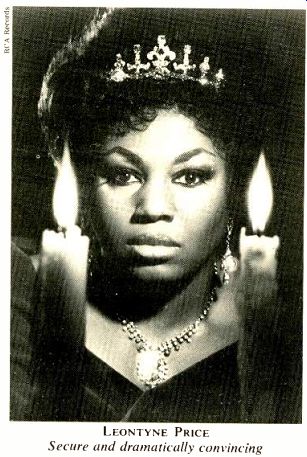
LEONTYNE PRICE--- Secure and dramatically convincing.
Within this exceptional orchestral framework we are treated to Leontyne Price's tempestuous Tosca, a portrayal which has grown more secure and more convincing dramatically without compromising the vocal virtues the singer so triumphantly revealed under Karajan's direction ten years ago. I do not, in fact, recall experiencing vocal acting of such conviction from Miss Price in any previous recording, and I wish that she were less reluctant to appear on stage in a role she has so thoroughly mastered.
Placido Domingo's Cavaradossi cannot be fault ed. He sings his two arias with consistent tonal beauty, and then goes on to surpass them in the third-act duet "O dolci mani." Sherrill Milnes' Scarpia is not on the same level vocally: the high tessitura is troublesome for him, and some of his E's and F's are poorly centered.
There are good vocal moments, however, including some effec tive uses of mezza-voce, and his interpretation, which stresses the character's unremitting villainy and brutality, is well conceived dramatically.
The role of Angelotti is exceptionally well realized by the Australian bass Clifford Grant, Paul Plishka's Sacristan is se cure but a bit colorless, and the other supporting singers are adequate. The sound of the New Philharmonia Orchestra is superb, a fact the excellent engineering does absolutely nothing to hide, and the choral contributions of the John Alldis Choir and the Wandsworth School Boys' Choir will add further luster to their reputations. To repeat: this is now the best stereo Tosca (by a slight margin over London 1284) now in the catalog. George Jellinek PUCCINI: Tosca. Leontyne Price (soprano), Floria Tosca; Placido Domingo (tenor), Mario Cavaradossi; Sherrill Milnes (baritone), Baron Scarpia; Clifford Grant (bass), Angelotti; Paul Plishka (bass), Sacristan; Francis Egerton (tenor), Spoletta; John Gibbs (bass), Sciarrone: Michael Rippon (bass), Jailer; David Pearl (boy soprano), Shepherd Boy. New Philharmonia Orchestra: the John Alldis Choir; Wandsworth School Boys' Choir: Zubin Mehta cond. RCA ARL 2-0105 two discs $11.96.
----------------
JANET BAKER'S DISTAFF SCHUBERT
Seraphim's two-disc set of songs for female voice is simply a must for lieder lovers.
COMPLEMENTING Deutsche Grammophon's two-volume, twenty-five-disc Schubert anthology with Dietrich Fischer-Dieskau and Gerald Moore, Seraphim has released a two-disc set devoted to Schubert songs that call for a female interpreter. Seraphim's singer is Janet Baker, whose interpretive authority in this repertoire is matched by few and exceeded by none today, and Gerald Moore is the decidedly uncommon denominator in the two ventures.
The Seraphim set includes some of Schubert's greatest songs (Gretchen am Spinnrade and Die junge Nonne unquestionably answer that description), several others that are topflight, a few more that are unfamiliar (though they do not deserve to be), and a few trifles that may lack weight and sub stance but are rendered with an appealing beauty that makes them immediately significant.
Outstanding among the unfamiliar songs are Delphine (1825), with its bold, operatic vocal line and inventive piano accompaniment, the tender and delicate Das Mudchen (1815), and Berthas Lied in der Nacht (1819), Schubert's only setting of a work by Franz Grillparzer, the poet who was to write his famous epitaph. I cannot explain why such marvelous songs are so little known, but then even the popular Wiegenlied (D. 498) is seldom recorded. I suppose it is all Schubert's fault for having written songs in such unmanageable abundance.
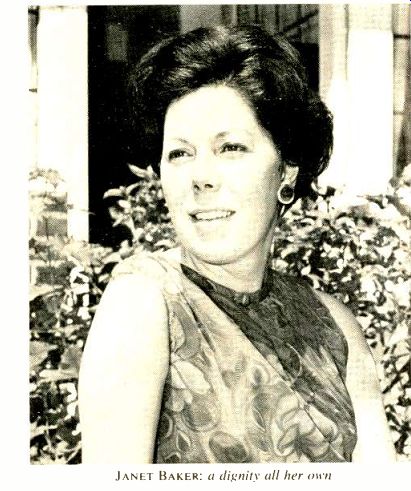
---- JANET BAKER: a dignity all her own.
But where does one begin to enumerate the virtues of such a complete mistress of the singing art as Janet Baker? Let me single out her perfect taste, the superb control of her vocal resources, the unmannered artlessness of her delivery, and her marvelous command of dynamics. Schwestergruss- a sensitive and evocative musical setting of a common place poem- provides a superb example of her use of dynamics; the line "Ach der mich lieht and kennt" in the fourth "Mignon" song is another breathtaking example. Some may be willing to settle for less absolute control in exchange for more passion and abandon, to which I would counter that there is deep involvement in Janet Baker's singing.
Her expressive means are controlled by a dignity all her own, an exquisite vocal art cherishable for its own uniqueness.
As always, Gerald Moore holds his own impressively in the artistic combination, though this time his playing is not always captured to best advantage-the piano articulation in Gretchen am Spinnrade is not as clear as it might have been. Full texts and translations are provided with this exceptionally rewarding release.
-George Jellinek
SCHUBERT: Janet Baker Sings Schubert. Gretchen am Spinnrade: Suleika I and II: Schsvestergruss; Schlum merlied; An die untergehende Sonne; Four "Mignon" Songs; Berthas Lied in der Nacht; Epistel an Herrn Josef von Spaun; Baste, Krieger!: Jager, ruhe von der Jagd; Ave Maria; Hin and wieder; Liebe Schwarmt: An die Nachtigall; Des Mudchens Klage; Delphine; Wiegenlied (D. 867); Wiegenlied (D. 498); Die Manner sind mechant; Iphigenia; Das Mddchen; Die junge Nonne. Janet Baker (mezzo-soprano); Gerald Moore (piano). SERAPHIM SIB-6083 two discs $5.96.
------------
CAPTIVATING RENAISSANCE MADRIGAL COMEDY The Western Wind skillfully revives Orazio Vecchi's /OW comedy and high finks ORAZIO VECCHI (1550-1605), Maestro di Capella at the Cathedral of Modena, is best known for his madrigals and most specifically for his madrigal comedy L'Amfiparnaso, just now available in a delightful new recording by Nonesuch. First presented in 1594, the comedy consists of a series of scenes involving commedia dell' arte characters, young and old, lovers, servants, and rascals, the whole strung together by a plot that might be capsulized as Love, Late Sixteenth Century Italian Style.
With the exception of a few moments spent on an unrequited love and consequent threatened suicide, the material ranges from low comedy- misunderstandings between servant and master, burlesque dialects, and an elderly stutterer- to sophisticated musical wit- imitations of lute sounds and a parody treatment of a Cipriano de Rore madrigal. Following the text and (supplied) translation is necessary while listening because the music is treated poly phonically- that is, any one character is apt to be sung by anywhere from three to five voices simultaneously. That may sound formidable, but try it, for the music, the words, and-far from least in this case-the performance are all entirely captivating.
The choral group called the Western Wind does a superb job with this material, realizing the varied affects and dramatically pacing the sections with enormous skill. The voices are beautifully modulated and blended, the characterizations neatly point ed. I have no hesitation in recommending this fine-sounding recording of an important (and highly entertaining) late-Renaissance work, one which has been recorded on occasion before (a Deller Consort version with instrumental doublings, an equally excellent performance, is available on the European Harmonia Mundi label), but at the moment this is the only domestic version. Don't miss it.
Igor Kipnis
VECCHI: L'Amfiparnaso. The Western Wind (Janet Steele and Janet Sullivan, sopranos; William Zukof courter-tenor ; William Lyon Lee, tenor; Elliot Levine, baritone). Steven Urkowitz, dramatic supervision. NONESUCH H-71286 $2.98.
POPULAR
BONNIE RAITT: WARMTH AND CHARM
The singer's latest for Warner Brothers is as strong and solid as her talent.
BONNIE RAITT'S vocal style has, I think, a time less appeal; it will never be very seriously imprisoned or trivialized by whatever may be pop music's Big Thing of the Moment. Her voice is a fine instrument, honest and direct, but it is also flexible and capable of the kind of subtle coloration that has nothing to do with posturing.
Her new album, "Takin' My Time," ingratiates itself slowly, somewhat hesitantly, because such songs as You've Been in Love Too Long and the zany Let Me In just don't seem at first like efficient ways of using that scarce plastic. But then efficiency begins to seem less important; indeed, the kind of warmth Bonnie has to give would be at odds with real efficiency most of the time anyway. Yet, Wah She Go Do, recorded under the influence of Van Dyke Parks, still in the flower of his Trinidad Mad ness, is a waste of Bonnie's talent. The good songs easily swamp that, though, and in the bargain settle my minor upset over a slight tendency to slickness in the production.
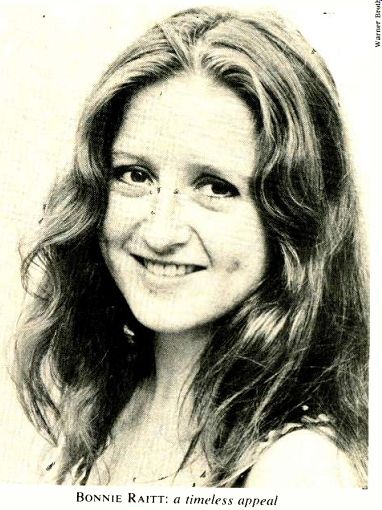
BONNIE RAITT: a timeless appeal
Bonnie's readings of the sad bluesies-Joel Zoss' I Gave My Love a Candle, Eric Kaz's Cry like a Rainstorm (this one featuring weirdly but nicely stylized harp backing by Taj Mahal, who's one spacey cat), and Chris Smither's I Feel the Same have great integrity; they click emotionally as few interpretations do. I would go so far as to say that the Smither thing alone is worth the price of the album. As a bonus, there's the Mosey phrasing on Mose Allison's Everybody's Crying Mercy, and, as another, some fine slide guitar work by Bonnie on some Fred McDowell music. It is not quite the great album Bonnie's talent suggests she is capable of, but it is still a strong and solid one. I think you've charmed me, Bonnie Raitt.
- Noel Coppage
BONNIE RAITT: Takin' My Time. Bonnie Raitt (vocals, guitar, slide guitar); Bill Payne (piano); John Hall (guitar); Earl Palmer (drums); others. You've Been in Love Too Long; I Gave My Love a Candle; Let Me In; Every body's Cryin' Mercy; Cry like a Rainstorm; Wah She Go Do; I Feel the Same; I Thought I Was a Child; Write Me a Few of Your Linesl Kokomo Blues; Guilty. WARNER BROS. BS 2729 $5.98, M82729 $6.97, 0 M5 2729; $6.97.
---------------
WHATEVER IT IS, SIEGEL-SCHWALL HAS IT
Their latest album is a sterling exception to the adage "don't take any Wooden Nickels"
WITH "953 West," the Siegel-Schwall Band has produced the third in a series of apparently casual little album masterpieces-"casual" because the focus is on superior performance rather than exceptional material. I would not say that the songs lack profile utterly, but if I were not looking at the album jacket as I write this I would not remember that it is Good Woman that features that wonderful Jim Schwall mandolin solo or that Just Another Song About the Country Sung by a City Boy proves that Corky Siegel is a master of tasteful, laid-back blues piano and probably the world's best white blues harpist as well. That title Just Another etc. is hard to forget, of course, and I know I'll remember Schwall's I Think It Was the Wine because it appears to be one in a series of songs about a funny, sad-sack character, but for the rest all I have is an undifferentiated impression of a string of knockout performances, and pinning down the specifics means I have to go hunting along the tracks with my trusty tonearm.
Siegel-Schwall would appear to be a group of somewhat limited ambition. They seldom tour out side the Midwest, and what is perhaps their best known recording is not even all theirs-it is Three Pieces for Blues Band and Symphony Orchestra, Op. 50, a commissioned work by William Russo that grew out of conductor Seiji Ozawa's hearing Siegel-Schwall in a Chicago club. The band performed the piece with the San Francisco Symphony Orchestra, Ozawa conducting, and Deutsche Grammophon recorded it (2530 303- see Paul Kresh's review in the June 1973 issue). In the meantime, the group has been putting out these glorious albums on Wooden Nickel and having themselves a great old time with that thrill of discovery only fine musicians know. Who was it said "Man, everybody's lookin' for it but I got it"? Wasn't Siegel-Schwall, but they surely do have it.
-Joel Vance
-------------
SIEGEL-SCHWALL BAND: 953 West. Corky Siegel (harmonica, piano, vocals), Rollow Radford (bass, vo cals), Jim Schwall (guitar, vocals), Shelly Plotkin (drums, vocals). Traitor from Decatur; Good Woman; When I've Been Drinkin'; Old Time Shimmy; Off to Denver; I Think It Was the Wine; Just Another Song About the Country Sung by a City Boy; I'd Like to Spend Some Time with You Tonight My Friend; Tails; Reed Zone; Blow Out the Candle.
WOODEN NICKEL, BWLI-0121 $5.98, BWSI-0121 $6.95, BWK 1-0121 $6.95.
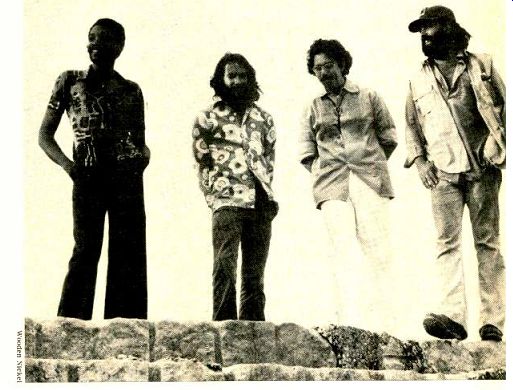
--- SIEGEL-SCHWALL: Radford, Siegel, Plotkin, Schwan
-------------
Also see: