"...I'm proudest of our unique ability to preserve the best of the past, and of other cultures, and then to expand it in a new culture."
by Roy Hemming
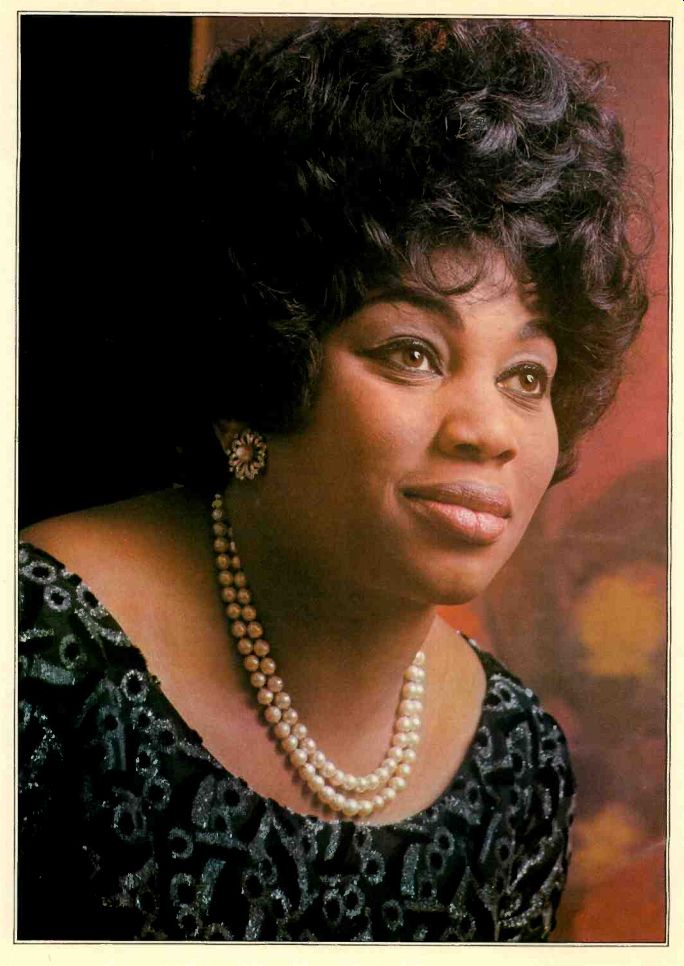
THE Metropolitan Opera is now preparing a new production of Giuseppe Verdi's Aida with Leontyne Price in the title role. Its first performance is scheduled for February 3, precisely one week after the fifteenth anniversary of Miss Price's debut at the Met.
Her career is presently divided into three areas: opera performances, recitals, and recordings. "I not only restrict the number of each," she says, "but I do just one thing at a time, for ultimate concentration. When I'm doing opera at the Metropolitan, for example, I stay in New York and do no traveling. That time is set apart for me to be available, as a professional, with my voice, my body, my mind, and my energies intact.
When the public accepts you, they expect certain things of you, and you can not give your best if you're on a plane or train every night." As we chatted in Miss Price's Greenwich Village townhouse in New York City, she emphasized this point. "I learned the hard way that I do not function well when I'm trying to be ten, fifteen, or sixteen places at once. I used to do that. And because I stopped it, my vocal apparatus has rewarded me.
It is, thank God, intact. And I want to keep it that way as long as I can." One of the handful of today's leading operatic sopranos, Miss Price is frank in admitting that the road to the top has not always been smooth. The Mississippi-born diva grew up in an era when the idea of a black prima donna singing leading roles in the operas of Mozart, Verdi, or Puccini was simply unheard of. Fortunately, beginning in the mid-1950's, the combination of her having one of the great natural voices of the century and changing public attitudes catapulted her into the international spotlight. She sang first in the opera houses of San Francisco, Vienna, Milan, and London and then finally at the Metropolitan.
Did she grow up listening to the Met broadcasts every Saturday afternoon? "No, I'm afraid not. The first one I ever heard was when I was in college in Ohio, around 1945 or 1946. It was Tristan and Isolde with Melchior and the fantastic Helen Traubel. The first opera I ever saw was Puccini's Turandot a few years later at the New York City Center with Frances Yeend singing Turandot. That same year I went to the Met for the first time and stood for a Salome with Ljuba Welitsch. The Met at that time was sort of like Shangri-La to me. It was something very special and almost untouchable-at least for a black." Miss Price began thinking of a singing career only after she had been in college for some time. When younger she had played the piano for Sunday school, and in college she became a church choir soloist and was encouraged to begin serious vocal studies. The result, of course, is her well-documented international career. "I guess I'll always be chauvinistically American," she comments. "I feel that I belong, that I'm not just exotica. I can't complain that I haven't first been encouraged by many fine people and then accepted in my home place.
"I think I have a little more objectivity about this than I used to," she continues. "I'm more aware today in a positive way about the wonderful, beautiful thing about myself-and that's of being a black human being. That's not to say I don't know that I am somewhere up there as an international performer. But I like people to relate to all of me. So I say: Don't overlook my color."
Miss Price is clearly bothered by rumors that she twisted the Met's arm to do this season's new production of Aida especially for her. "I am neither the heroine nor the culprit in this case," she insists. "To be honest, I haven't a clue why they decided to do a new production of Aida this year. It's certainly not at my request. I had absolutely nothing to do with it.
"In fact, those words 'new production' are words I never mention as far as my relations with the Met are concerned. I did at one time earlier in my career, but not any more. With the financial problems the Met has, the last thing I'd do is to be even indirectly responsible for one dollar going for any thing that is not going to be lucrative for the cause!" That does not mean, however, that Miss Price has any reservations about doing the new Aida. Quite the contrary. "I rather like to think I'm not just a pretty good Aida but one who re ally gets into the role," she said. "Aida has always been very special to me and not just because I save the theater make-up. As a character, Aida represents my people, and my interpretation is always synonymous with the way I feel about how we are as blacks today.
So it's always a challenge to sing this part-especially right now since it has so much to do with how I've grown as a black, as an ex-token black. I feel that now I'll have the freshest approach to Aida I've ever had. After years of exposure and experience with the role, I now see many more things in Aida as a human being, as a black." How does she feel about her two Aida recordings-the first made in Rome in 1961 with Georg Solti con ducting, the second in London in 1971 with Erich Leinsdorf? "From a person al point of view there are many things in the second one that are more elastic.
I don't mean that it's necessarily bet ter. But there's a type of maturity in it that I know some people like and others don't. The first time I recorded it I did many things innately, from an al most naive, natural point of view.
"I maintain that what you are as a person at any particular time is bound to show vocally," she added, "because the voice is the most personal instrument. It's not only in you, it is you. In my case, it really is me. When I'm at ease, it sounds at ease. When I'm agitated, it sounds agitated." Are there any characters in opera she has not felt at ease with? Her voice shoots up a full octave as she answers, "Oh-h-h-h! The list is at least a page long! I was a disastrous Tatiana in Eugene Onegin. I'm not the world's greatest Fiordiligi in Cosi Fan Tutte--I think I had a flair for singing her, but histrionically it wasn't my thing.
"Now, that's not a putdown of those roles," she stresses. "It's a kind of objectivity I didn't have before. I couldn't admit I wasn't going to be all right in something. But I don't agree with those who say La Fanciulla del West wasn't my thing." The reference is to the 1962 Met production of the Puccini opera, during which Miss Price's voice gave out, and she had to withdraw from the production.
"It was the timing that was a disaster," she says. "I was overtired. I was trying to do too much that year.
Fanciulla represents something I will never, never do again-and that's to try to function under pressure. It proved to me that I am just not capable of functioning, vocally or any other way, un der intense pressure. And it was in tense. Look, I was the first black to be invited to open a Metropolitan season--just a year after my debut. Do you see me saying 'no' to that? It was such a marvelous challenge. You really have to be black to feel it. I felt some thing like Jeanne d'Arc on a mission.
"I had come to the Met from Broad way-and primarily by way of Europe an opera exposure. There was my Town Hall recital debut, the NBC Op era's Tosca, then Europe. All of a sudden I was the black on the scene. I was it. I felt that if I failed, more than me would be failing. Maybe that was an over-noble mental attitude, but I had it.
I felt I had to prove all sorts of things.
So I just plunged in-full speed ahead! I had absolutely no sense of what I was getting myself into, and that was the year I was my tiredest, because I'd been everywhere trying to do every thing at once. Finally, it took its toll in Fanciulla." Would she be willing to try Fanciulla again? "I did do it again!" she shoots back. "I tucked myself together and did it on tour with the Met later that same year." One role she is firm about not doing again is Bess in Gershwin's Porgy and Bess-which she sang with great success in a 1950's revival throughout both America and Europe. "I've already re fused to sing Bess for this Bicentennial year," she says. "Porgy and Bess did great things for me, but it represents a certain time in my life, a time that is finito. Let it launch someone else.
"Personally, I can't attach any reality to the story of Porgy and Bess. I never did. And where we are now is definitely not where Porgy and Bess is.
So I wouldn't touch it with a ten-foot pole. Musically, it's here to stay. It's a kind of masterpiece. But the work it self, and especially the role of Bess, doesn't relate to me at all-period. I don't believe in it." What about roles she's still dying to do? "I'm not sure there's any role I'm dying to do," she replies with hearty emphasis. "But I would like to give La Traviata a try. It's a part of what I think I'm now ready to get into-per haps as a lark, but more because I think the voice is in a good condition to try something more florid. I'm also studying and getting very involved in some of the German literature. Eventually ...so much remains to be done... that's why I'm pacing myself to be around a while longer." I'd like to sing the Marschallin in Rosenkavalier-it's such a heavenly part. And possibly the Kaiserin in Strauss' Die Frau ohne Schatten. I've already learned, ages ago, the Countess in The Marriage of Figaro, so I probably will do that eventually." Since Miss Price has had a distinguished recording career and a long association with RCA, I asked about her plans for future recordings. "I'm looking forward to doing Puccini's Manon Lescaut [a role she sang last season at both the Met and San Francisco Opera]. With all its difficulties, I love every minute of that part. I also have in mind a whole record of Samuel Barber songs. To me Barber is our musical Monet--and Monet is my favorite painter. As a matter of fact, I don't think I've given a recital in my whole career without Barber's songs. That's how much I love his music." Which of her recordings is she proudest of? "At this particular point," she answers, "I think my Rich ard Strauss recording is a humdinger.
That's the one with the arias from Die Frau ohne Schatten, Guntram, and Rosenkavalier, plus the Four Last Songs which I recorded as a memorial to my mother." I asked about the album of pop songs by Rodgers, Kern, and others that she recorded in 1967 with Andre Previn, and which RCA has recently reissued.
"I loved doing it," she says, "and would love to do another. I think we Americans are much more ambidex trous musically for things like that than the average European is. There's a song in the Broadway show A Chorus Line that I think is absolutely brilliant: What I Did for Love. How I'd love to record that one! "I just love the American musical," she continues. "When I'm not performing, I go to the theater as often as I can. I go to concerts occasionally, but I cannot go to the opera. I just can't sit comfortably in the audience knowing about all the insanity that's going on backstage."
SINCE Miss Price had spoken so highly of the American popular musical, I asked her what she thought-this being the Bicentennial year--had been America's greatest contribution, musically speaking, over the past two hundred years. "I think what I'm proudest of," she replied, "is our unique ability to preserve the best of the past and of other cultures, and then to develop this or expand it in a new culture. With black culture, for example, we have our folk lore and all our contemporary palpitations, yet we've been able to forge everything into meaningful art forms: jazz, soul, spirituals.
"Musically, I think we Americans are very beautiful people. We're less clannish, very international. I think we've done a lot to break down the snob appeal that opera and concert music once had. Since the years of Maria Callas, opera has been able to create the kind of popular excitement in America that only baseball used to be able to do. And Callas, sans doute, is the one who did that. Still, the snob bism lingers in some ways. Some people still hesitate to come to the opera house or the concert hall. They were shut out so long that they're still afraid to come.
"I must admit I'm also worried about the economic state of music in America today," she continues. "I think it's still considered a luxury item here instead of a necessity. In Europe, every little province has a concert hall or an opera house supported by the government. Here, it's not taken seriously enough.
"That's why I think we really need somebody lobbying to subsidize our arts. With the government spending and even wasting I needn't tell you how many trillions on other things, it's simply ludicrous that we don't have subsidies for something as important in everyone's life as the creative arts. This worries me--deeply.
"So many of us have come so far, and yet so much remains to be done," she declares. "That's why I'm pacing myself to be around a while longer."
Also see:
THE SURVIVAL OF THE AVANT-GARDE--It is axiomatic that new music needs recording-but by whom?
CAN YOU REALLY HEAR THOSE HI-FI SPECS? It all boils down to dynamic range and achievable loudness.
Source: Stereo Review (USA magazine)