PIONEER INTRODUCES AN AMPLIFICATION SYSTEM THAT WILL FORCE YOU TO TAKE A HARD LOOK AT YOUR SPEAKERS.
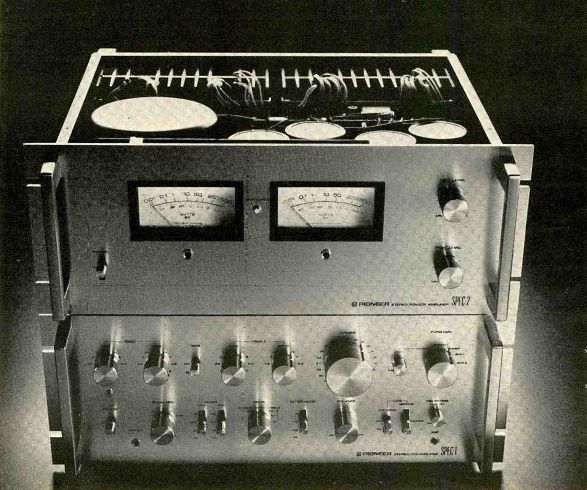
Pioneer's new Spec 1 and Spec 2 are capable of producing a level of high-quality sound most speakers are simply incapable of reproducing.
So, unless you're willing to listen to Spec 1 and Spec 2 at something less than their full potential, don't make the decision to invest in them if you're not pre pared to invest in a new pair of speakers.
SPEC 2: 250 GOVERNMENT-APPROVED WATTS A CHANNEL
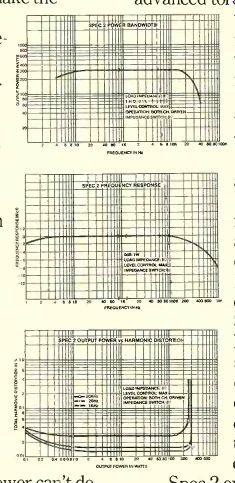
Spec 2 was the first power amplifier designed to deal with the new F.T.C. power regulations. It has a continuous power output of 250 watts per channel minimum RMS. At 4 or 8 ohms. From 20 to 20,000 Hz. With no more than 0.1% harmonic distortion.
Other power amplifiers that used to claim a lot more power can t do that anymore.
WHO NEEDS ALL THIS POWER AND WHY
When you listen to a live performance it can have an average sound level of 84 dB. Which most high fidelity systems can reproduce with half a watt of power. But a sudden musical peak of 110 dB takes four hundred times as much power. Which means you need 200 watts of power to reproduce that peak.
If your amplifier doesn't have that much reserve power, you get "clipping:' Which doesn't happen during a live performance.
So, if you want your system to be able to give you all the power, all the sheer presence of live performance, you need an amplifier with all the reserve power of the Spec 2.
STATE-OF-THE-ART DESIGN
Spec 2 not only produces an uncompromising amount of sound; it does so in a totally uncompromising manner.
For example, Spec 2 uses an advanced toroidal coil power transformer. It's a more expensive transformer than most amplifiers use.
But a more efficient transformer. And one that keeps magnetic flux leakage to an absolute minimum.
Also unlike many power amplifiers, Spec 2 doesn't use fans. Because fans can cause noise. Instead, Spec 2 has massive heat sinks and special Pioneer-developed protective circuitry to keep the operating temperature under control.
Spec 2 even has wattage meters that indicate music output in RMS watts at 8 ohms. These had to be specially designed, too.
Because conventional VU meters couldn't give an accurate enough power reading.
SPEC 1: TWICE THE CONTROL OF MOST PREAMPLIFIERS
Most preamplifiers have two tone controls. Some have three.
But Spec 1 has four. Each of which is calibrated in 1.5 dB click-stops. All together, they give you a total of 5,929 ways to compensate for any deficiencies in program material or listening area.
And, so you can make sure you've made all the right adjustments, Spec 1 has a "tone off' switch that lets you compare your setting with a completely flat setting.
Spec 1 even has its own microphone amplifier, with its own volume control. So you can mix into any program material without touching the main volume control.
THE BEAUTIFUL SOUND OF NOTHING
One thing Spec 1 doesn't do is add anything to the sound it reproduces. The phono section has a completely inaudible signal to-noise ratio of 70 dB (IHF, short circuited A network). All other inputs are rated at 90 dB. Which is even more inaudible. And it has a total harmonic distortion of no more than 0.03%. Which is five times under what your ear is capable of detecting.
DESIGNED FOR EIA MOUNTING
Both Spec 1 and Spec 2 are 19"wide. So you can place them in any standard EIA laboratory rack.
Or you can stack them like conventional home entertainment components.
Which they definitely are not.
SPEC 1, SPEC 2 by PIONEER
U.S. Pioneer Electronics Corp., 75 Oxford Drive, Moonachie, New Jersey 07074
Also see:
Source: Stereo Review (USA magazine)