STEREO REVIEW'S SELECTION OF RECORDINGS OF SPECIAL MERIT--BEST RECORDINGS of the MONTH--Vocal: Dietrich Fischer-Dieskau's new Songs of a Wayfarer (Mahler) and old Jedermann (Martin), National Lampoon's "Good-bye Pop 1952-1976," Al Green's "Full of Fire," and Bill Wyman's "Stone Alone." Orchestral: Virgil Thomson's "Music for the Films".
----------
A Spacious New Recording of Virgil Thomson's Down-to-earth, Contemporary-sounding Film Scores
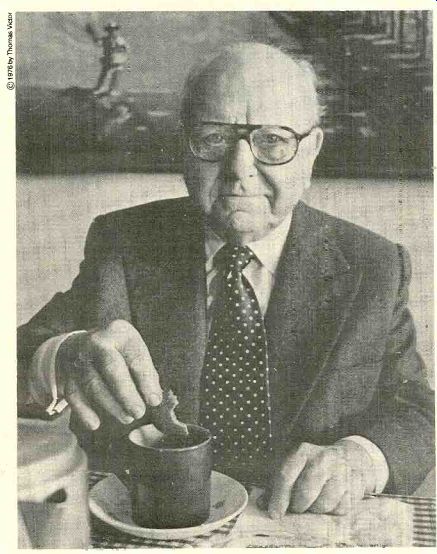
Above photo, caught in the act: a respecter of the old-fashioned American tradition of dunking.
VIRGIL THOMSON'S film scores ring with a sassy, outdoorsy vigor that goes well beyond the call of mere background-music duty to become entities in themselves. Indeed, the scores date better than some of the films do. A documentary such as The Plow That Broke the Plains, for example, might seem a little pompous now with its sententious narration/oration by director Pare Lorentz about the "treeless wind swept continent of grass" and "the most tragic chapter in American agriculture" preluding ghastly scenes of ruined Depression-era farms. Thomson's score, however, is down-to-earth and contemporary-sounding, smoothly blending, in a very American way, pas sages from the doxology hymn ("Praise God from whom all blessings flow"), cowboy songs, and the moan of the blues.
His score for The River, though more ambitious, is rooted in the same under lying simplicity: a hint of Dixie, a hymn tune, and such old favorites as A Hot Time in Old Town Tonight are woven with dissonances suggesting factory sounds and, later, jazzy echoes of a high-spirited Saturday night-homely tunes, homely instruments. No wonder that Aaron Copland, after hearing this score, wrote Thomson that the music for The River was "a lesson in how to treat Americana." Indeed, Copland himself apparently took the lesson to heart, for he followed a similar line when he composed his ballet scores Billy the Kid and Rodeo.
These two Thomson film scores are so good that I rather wish, perhaps selfishly, that Angel had rounded out its just-released Thomson disc with one of the suites from the music for the movie Louisiana Story. As it is, there is Autumn, a concertino for harp, strings, and percussion drawn from material in some of the composer's earlier works. Even in this comparatively minor piece, however, there are a win some freshness, Thomson's typical sturdiness of structure, and exquisite passages for the admirably played harp of Ann Mason Stockton.
The music for The River and The Plow That Broke the Plains is available on an earlier disc (Vanguard 2095) with Leopold Stokowski molding everything to his usual compelling will. Conductor Neville Marriner is more relaxed in this Angel recording, yet he somehow man ages to make more of the big moments.
The sound is remarkably spacious, especially in SQ-matrix quadraphonic, and Richard Freed's well-researched notes, along with passages excerpted from the narration for The Plow That Broke the Plains, add to the value of an album both excellent and timely.
-Paul Kresh
THOMSON: Music for the Films. The Plow That Broke the Plains; The River; Autumn (Concertino for Harp, Strings and Percussion). Ann Mason Stockton (harp, in Autumn). Los Angeles Chamber Orchestra, Neville Marriner cond. ANGEL 0 S-37300 $6.98.
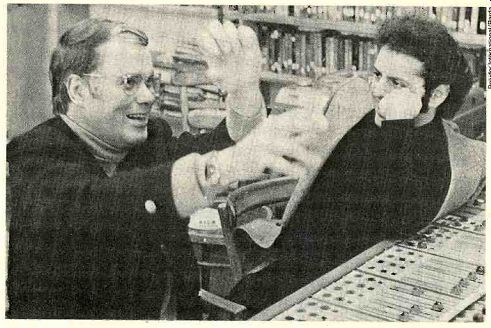
----------------- DIETRICH FISCHER-DIESKAU: at a recent playback with
Daniel Barenboim
An Unusual Coupling By Fischer-Dieskau: Mahler's Wayfarer Songs, Martin's Jedermann
IT was an inspired notion on the part of somebody at Deutsche Grammo phon to juxtapose two slightly unusual repertoire items on one disc: Dietrich Fischer-Dieskau's second recorded interpretation of Gustav Mahler's highly emotional Wayfarer Songs (a new re cording) and his interpretation of Frank Martin's brooding set of Monologues based on Hugo von Hofmannsthal's version of the German morality play Jedermann (a reissue-the original re lease, which took place about a dozen years ago, was DG 138 871).
Fischer-Dieskau sings the first and fourth Mahler songs with mellow tonal beauty and an apparently inexhaustible range of colors and dynamics that seem to be always right. But the high tes situra of the second song ("Ging heut morgens fibers Feld") is uncomfortable for him now, and he cannot resist over-dramatizing the third ("Ich hab' ein gluhend Messer") to the serious detriment of the musical line. The overall effect of the cycle, therefore, is rather uneven, but conductor Rafael Kubelik provides a beautifully detailed frame work with his loving treatment of Mahler's flavorful scoring.
The singer's voice was in a healthier youthful estate when he recorded the Martin Monologues, and more responsive therefore to his superb musical and intellectual command. The music, midway between operatic utterance and parlando dramatic expression, is of the kind designed not for mass popularity but for those whose special de light is that arena in which singer meets song. I find it unceasingly compelling, brilliantly orchestrated, and exception ally masterful in word-setting. Fischer Dieskau, moreover, makes every syllable ring with meaning. With the com poser conducting an exemplary performance and the engineers producing a technically beautiful recording, we have something as close to definitive as we can ever hope to get in music.
George Jellinek
MAHLER: Songs of a Wayfarer.
MARTIN: Six Monologues from "Jedermann." Dietrich Fischer-Dieskau (baritone); Bavarian Radio Orchestra, Rafael Kubelik cond. (in Mahler); Berlin Philharmonic, Frank Martin cond. (in Martin). Deutsche GRAMMOPHON 2530 630 $7.98.
Indecent Burial: National Lampoon's "Good-bye Pop, 1952-1976" FUNNY-not funny ha-ha but fun ny curious-how the various National Lampoon enterprises such as Lemmings, the Radio Hour, the sneaky influence they're having on television, and so on, are usually funnier than their granddaddy, the magazine itself.
NatLamp seems to be particularly strong in treating the radio medium, and the strengths carry over well into their new album. "Good-bye Pop, 1952-1976" takes up where Lemmings left off with the business of giving rock (here broadened to "pop"-you of course heard that little slap-in-passing at the Randy Newman song So Long Dad) a fitting (which is to say indecent) burial.
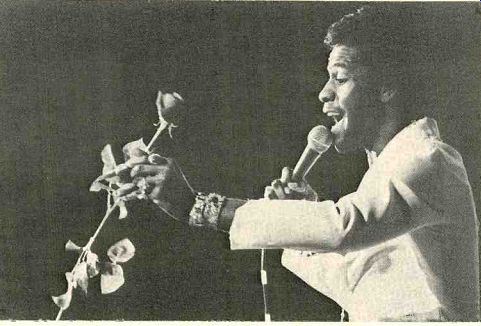
----------- AL GREEN: easy cajoling tone and nervous grace.
This is satire, first and foremost, and there's no way to compare it to the zany cutting up of Monty Python, whose medium is television, or the convoluted, unclassifiable surrealism of the Firesign. Theatre. Take a subject and lampoon it; it works that directly.
Hard satire has to bypass a lot of throwaway laughs in order to stay on the point, so it can't be counted on to break you up every minute or so. But, on the other hand, there are some tangled, concentrated parts you can stand to hear several times-you can't do that with the ordinary comedy record and even the music is decently played.
Kung Fu Christmas is a slashing par ody of the "politics" in soul music ("Lavender Caddy and Super Fly clothes ... Kung Fu fightin' under mistletoes ... "), and then there's an accurate send-up of the self-pitying country sanger ("I've never had a bul let on the hit-parade of life . . . and clap is just the B side of love"), plus a very interesting study of a women's lib song being recorded, one some of our more militant sisters are sure to label purest MCP (although it does remind me that Mary Travers, bless her, re fused to record I Am Woman because she just couldn't get by the line "I am invincible" without cracking up).
There's more: Neil Young is done up brown with a "Neil Young song" by Tony Scheuren that sounds so much like all Neil, Young songs that some radio stations mistook it for the real thing. Art Rock Suite ("Fall with me up the staircase to a blue electric room ... ") grows a bit tedious by sticking to its silly subject, but Down to Jamaica redeems simply everything with an imitation of an old hero of ours going out on some reggae scat-singing:
"Oh, guava jelly! Fil6 gumbo natty lox!" Well put, NatLamp, well put, but you forgot the violin. Noel Coppage
NATIONAL LAMPOON: Good-bye Pop, 1952-1976. Paul Jacobs (vocals, guitars); Gloria Radner (vocals); Christopher Guest (vocals, other things); Sean Kelly (editor-?--and various tasks); other musicians and satirical individuals. Good-bye Pop; Kung Fu Christmas; The B Side of Love;
I'm a Woman; Old Maid; Art Rock Suite; Down to Jamaica; and some stuff between selections. EPIC PE 33956 $6.98, C) PEA 33956 $7.98.
How to Have Just As Good a Time as "Full of Fire" Al Green Does
IF Al Green's new release "Full of Fire" on the Hi label doesn't make you feel good, then I'm afraid nothing short of a lobotomy probably ever will.
It's an album full not only of the "fire" of Green's slam-bang vocal style but of life, high spirits, and a kind of dancing, joyful boisterousness over being able to perform as well as he does. From the opening Glory, Glory track, which he races through with the sure-footed, ground-covering ease of a greyhound cold-nosing a mechanical rabbit, to the final cloudburst of vitality called Let It Shine, Green is pure entertainer all the way. He wrote most of the songs him self, and they aren't really up to much-except that they are the perfect outlines for him to fill in with the special tricks and effects of which he is a master.
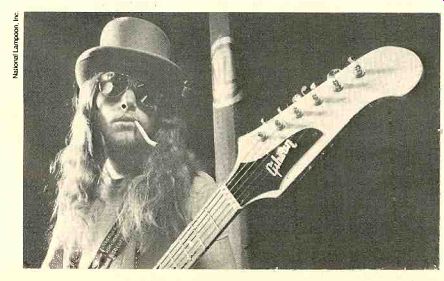
--------- TALENTED PAUL JACOBS: looks like Leon Russell ever
see them together?
Take as an instance Always (not the Berlin classic): the easy, cajoling tone and the nervous grace are the performer's and not the song's; they could only come from a singer who understands that his audience looks to him for assurance that, whatever he's doing, he knows what he's doing, that it will al ways come out right in the end. Another might be There's No Way, on the face of it as solemn a piece of soap-opera claptrap as you're likely to tune in on any Wednesday afternoon, a hymn of unrequited devotion. Green's approach is a whiney, metronomic complacency that tells us the poor object of his sticky affections has about as much chance of getting rid of him as a case of chronic psoriasis. Uriah Heep in Love is what it really is, but if you want to take it as passion undying, that's all right too. Either way you'll be superbly entertained.
There are lots of other good things here, including the title song and a hugely energetic, completely satisfying Soon As I Get Home, a title that per haps needs no further elucidation.
Green's been around quite a while, and it shows in the best ways possible: intelligence, style, humor, and, above all, craft. He knows how to give the listener a good time every time. How many others are there around right now who can make the same claim? Peter Reilly
AL GREEN: Full of Fire. Al Green (vocals); orchestra. Glory, Glory; That's the Way It Is; Always; There's No Way; I'd Fly Away; Full of Fire; Together Again; Soon As I Get Home; Let It Shine. Hi SHL 32097 $6.98, SHL8 32097 $7.98, SHL5 32097 $7.98.
Bill Wyman "Stone Alone": A Guitarist Steps Out of the Shadows My interest in the Rolling Stones is, I confess, limited, tending to falter after their 1969 recordings. I further found Stones bassist Bill Wyman's solo essay "Monkey Grip" to be pleas ant, unassuming, and, in all, no great shakes. But wow, what a dandy his latest effort "Stone Alone" is! I haven't been able to take it off the turntable since I first heard it.
The arrangements (terrific) are Wyman's own, as are most of the songs: Soul Satisfying uses reggae tastefully, Apache Woman has an ominously sexy combination of blues and something approaching a cha-cha-cha, and No More Foolin' features late-Twenties New Orleans jazz instrumentation. The vocals are a happy compromise between what Wyman's heart wanted and what his tonsils could deliver-he often sounds like Ringo Starr hyperventilating-but what his voice lacks in timbre and technique is made up for by his sly, shy delivery.
It is the funny, catchy, genial songs, however, that make the album a win ner. Wyman's earthy humor runs through them all, sex being for him only a comedy turn in the whole vaude ville of life. Another bassist, John Entwistle of the Who, writes this kind of material as well, but where he is glee fully salacious Wyman is all bruised innocence.
Of the three selections Wyman didn't write, two are reprises of oldies: Jimmie Soul's If You Wanna Be Happy and U. S. Bonds' Quarter to Three. The third is by Danny ("Kootch") Kortch mar, a longtime sidekick of James Taylor. Without taking anything away from Wyman's accomplishments, the lyrics to Kortchmar's Feet are the best in the album, among the best, indeed, of the year. An excerpt: Feet, down in my shoes I'm depending on youse To walk away from my baby . . . Mind, stop changing back and forth Stop blowing South to North Stop coming up with "maybe". . . See? A little Randy Newman, a little Tom T. Hall, and a dash of Ogden Nash. Classy.
Two other aspects of the album are noteworthy: The first is that "Stone Alone" is a rare successful example of a type of disc common nowadays and nearly always a failure: a sideman from a well-known band making a solo at tempt supported by all-star pals. The sideman is usually uninteresting or even incompetent as a soloist, and the buddies play mechanically. But Wy man appears, on this recorded evidence, to be an inspiring leader, and Kortchmar, Pointer Sisters Ruth and Bonnie, Van Morrison (on sax), Dr. John, Nicky Hopkins, Al Kooper, Joe Walsh, Ronnie Wood, and assorted other notables all play like they mean business.
The second aspect is that, hearing "Stone Alone," you're likely to say "That's real rock-and-roll, just the way it ought to be." But a good deal of it is not, in fact, rock: most of Wyman's ideas for his arrangements come from Latin, jazz, c-&-w, Caribbean, or Eng lish music-hall sources. It is therefore certainly not "rock" as we have known it for these last six dreary years; parts of it are, in the sense that they recall the muscular charm of the form when it was young and adventurous. And it may not be an accident that the bassist for the Rolling Stones pays no more than token attention to "rock" when he steps out front to declare himself an individual.
---------------
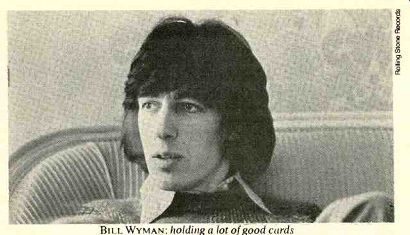
BILL WYMAN: holding a lot of good cards.
"Stone Alone" is, in short, a person al artistic triumph for Bill Wyman.
There was much speculation not long ago about who the Stones would pick to replace guitarist Mick Taylor; they may soon have to start looking again.
This album makes it clear that Wyman can either have two careers simultaneously or go permanently solo. It's his deal, and he's holding a lot of good cards. Joel Vance
BILL WYMAN: Stone Alone. Bill Wyman (vocals, bass, piano, guitars); other musicians. A Quarter to Three; Gimme Just One Chance; Soul Satisfying; Apache Woman; Every Sixty Seconds; Get It On; Feet; Pea nut Butter Time; Wine & Wimmen; If You Wanna Be Happy; What's the Point; No More Foolin'.
ROLLING STONES COC 79103 $6.98, TP 79103 $7.98, CS 79103 $7.98.
Also see:
Source: Stereo Review (USA magazine)