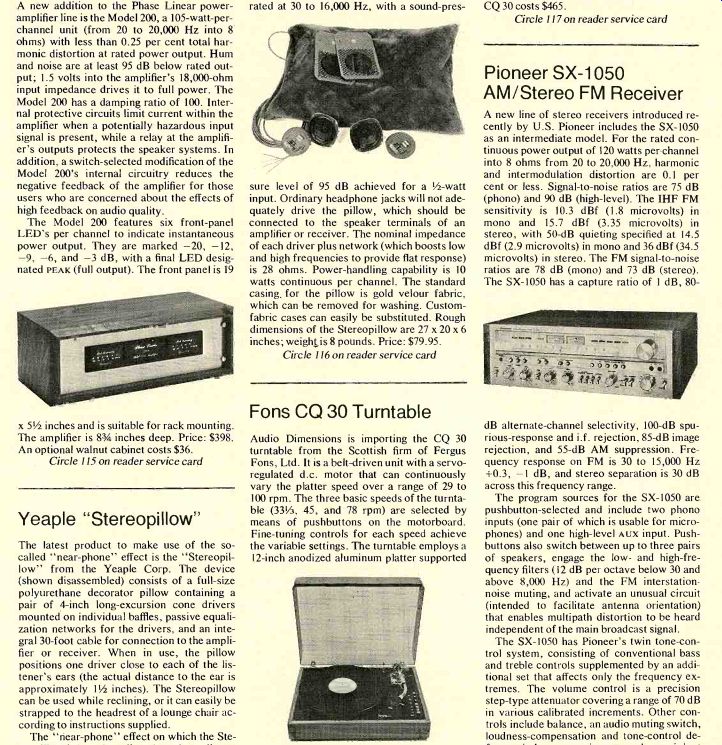
Phase Linear 200 Stereo Power Amplifier A new addition to the Phase Linear
power-amplifier line is the Model 200, a 105-watt-per-channel unit (from
20 to 20,000 Hz into 8 ohms) with less than 0.25 percent total harmonic distortion
at rated power output. Hum and noise are at least 95 dB below rated output;
1.5 volts into the amplifier's 18,000-ohm input impedance drives it to full
power. The Model 200 has a damping ratio of 100. Internal protective circuits
limit current within the amplifier when a potentially hazardous input signal
is present, while a relay at the amplifier's outputs protects the speaker
systems. In addition, a switch-selected modification of the Model 200's internal
circuitry reduces the negative feedback of the amplifier for those users
who are concerned about the effects of high feedback on audio quality.
The Model 200 features six front-panel LED's per channel to indicate instantaneous power output. They are marked-20,-12, -9,-6, and-3 dB, with a final LED designated PEAK (full output). The front panel is 19 x 51/2 inches and is suitable for rack mounting. The amplifier is 8 3/4 inches deep. Price: $398. An optional walnut cabinet costs $36.
Yeaple "Stereopillow" The latest product to make use of the so called "near-phone" effect is the "Stereopillow" from the Yeaple Corp. The device (shown disassembled) consists of a full-size polyurethane decorator pillow containing a pair of 4-inch long-excursion cone drivers mounted on individual baffles, passive equalization networks for the drivers, and an integral 30-foot cable for connection to the amplifier or receiver. When in use, the pillow positions one driver close to each of the listener's ears (the actual distance to the ear is approximately 1 1/2 inches). The Stereopillow can be used while reclining, or it can easily be strapped to the headrest of a lounge chair according to instructions supplied.
The "near-phone" effect on which the Stereopillow is based predicts that when a listener's ear is significantly closer to the front of a speaker cone than to the back, normal front-to-back acoustical cancellation of lower frequencies will be much less pronounced than for a remote listener. Therefore, satisfactory low-frequency response can be obtained with a simple flat baffle rather than a full enclosure for the driver.
Frequency response for the Stereopillow is rated at 30 to 16,000 Hz, with a sound-pressure level of 95 dB achieved for a 1/2-watt input. Ordinary headphone jacks will not adequately drive the pillow, which should be connected to the speaker terminals of an amplifier or receiver. The nominal impedance of each driver plus network (which boosts low and high frequencies to provide flat response) is 28 ohms. Power-handling capability is 10 watts continuous per channel. The standard casing, for the pillow is gold velour fabric, which can be removed for washing. Custom-fabric cases can easily be substituted. Rough dimensions of the Stereopillow are 27 x 20 x 6 inches; weight is 8 pounds. Price: $79.95.
Fons CQ 30 Turntable
Audio Dimensions is importing the CQ 30 turntable from the Scottish firm of Fergus Fons, Ltd. It is a belt-driven unit with a servo-regulated d.c. motor that can continuously vary the platter speed over a range of 29 to 100 rpm. The three basic speeds of the turntable (331A, 45, and 78 rpm) are selected by means of pushbuttons on the motorboard.
Fine-tuning controls for each speed achieve the variable settings. The turntable employs a 12-inch anodized aluminum platter supported by a precision bearing. A suspension system built into the base isolates the mechanism from external shock and vibration. Rumble is said to be less than-79 dB; wow and flutter are under 0.03 percent. The unit has a walnut base and a hinged dust cover. Dimensions are 17 1/2 x 13 3/4 x 6 1/3 inches. The basic turntable is supplied without a tone arm at a price of $300. With a factory-installed SME tone arm the CQ 30 costs $465.
Pioneer SX-1050 AM/Stereo FM Receiver
A new line of stereo receivers introduced recently by U.S. Pioneer includes the SX-1050 as an intermediate model. For the rated continuous power output of 120 watts per channel into 8 ohms from 20 to 20,000 Hz, harmonic and intermodulation distortion are 0.1 percent or less. Signal-to-noise ratios are 75 dB (phono) and 90 dB (high-level). The IHF FM sensitivity is 10.3 dBf (1.8 microvolts) in mono and 15.7 dBf (3.35 microvolts) in stereo, with 50-dB quieting specified at 14.5 dBf (2.9 microvolts) in mono and 36 dBf (34.5 microvolts) in stereo. The FM signal-to-noise ratios are 78 dB (mono) and 73 dB (stereo).
The SX-1050 has a capture ratio of 1 dB, 80-dB alternate-channel selectivity, 100-dB spurious-response and i.f. rejection, 85-dB image rejection, and 55-dB AM suppression. Frequency response on FM is 30 to 15,000 Hz +0.3,-1 dB, and stereo separation is 30 dB across this frequency range.
The program sources for the SX-1050 are pushbutton-selected and include two phono inputs (one pair of which is usable for micro phones) and one high-level Aux input. Push buttons also switch between up to three pairs of speakers, engage the low- and high-frequency filters (12 dB per octave below 30 and above 8,000 Hz) and the FM interstation noise muting, and activate an unusual circuit (intended to facilitate antenna orientation) that enables multipath distortion to be heard independent of the main broadcast signal.
The SX-1050 has Pioneer's twin tone-control system, consisting of conventional bass and treble controls supplemented by an additional set that affects only the frequency extremes. The volume control is a precision step-type attenuator covering a range of 70 dB in various calibrated increments. Other controls include balance, an audio muting switch, loudness-compensation and tone-control de feat switches, stereo/mono mode, an in/out switch for any external signal processor that might be connected to the receiver, and complete tape-monitor and tape-duplication switching for two tape decks. The SX-1050 has tuning meters to indicate channel center and signal strength; illuminated legends identify program source and mode as they are selected. A stereo headphone jack and two microphone inputs are provided on the front panel.
The receiver measures 20.33 x 6 3/4 x 17 7/8 inches and weighs 51 1/2 pounds. Its top and sides are enclosed by walnut-veneer panels.
Approximate price: under $700. Two other models in the new Pioneer line, the SX-1250 and the SX-950, have rated power outputs of 160 and 85 watts per channel, respectively, and otherwise similar performance specifications and features.
Celestion UL Speaker Systems: Rocelco Inc., North American distributor for the English Rola Celestion and Ditton products, has announced the introduction of the UL series of Celestion speaker systems. The three UL models comprise one three-way and two two-way systems, with the two-way de signs employing passive radiators to augment low-frequency response. The smallest, the UL6 (shown), has a 1-inch dome tweeter, a 6-inch woofer, and a 6-inch passive radiator. The crossover frequency is 2,500 Hz, and overall frequency response is rated as 80 to 20,000 Hz 13.5 dB. Power-handling capability is 20 watts continuous.
The Model UL8, next in the line, employs the same tweeter plus an 8-inch woofer and passive radiator, with crossover occurring at 2,000 Hz. Frequency response is 70 to 20,000 Hz ±3 dB, and power-handling capability is 25 watts continuous. Finally, the three-way Model UL 10 has a 10-inch woofer in a sealed cabinet, along with a 2-inch dome mid-range driver for frequencies from 700 to 5,000 Hz and a 3/-inch dome tweeter for the range above that. Its frequency response is specified as 40 to 20,000 Hz ±2 dB, with a power-handling capability of 50 watts continuous. All three systems have impedances ranging from 4 to 8 ohms. Enclosure dimensions, including the removable shaped grilles, are 16 x 11 1/2 x 8 3/4 inches (UL6), 23 x 11 x 9 1/4 inches (UL8), and 26 1/2 x 12 1/2 x 15 inches. All cabinets are finished in walnut veneers. The UL6 is well suited to horizontal shelf placement, while the UL8 and UL10 are more appropriate for vertical free-standing installation. Prices, in the above order: $179.50, $249.50, and $349.50.
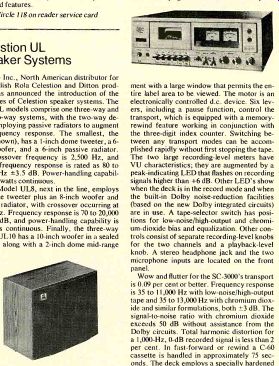
Sansui SC-3000 Stereo Cassette Deck: The SC-3000 is Sansui's first front-loading cassette deck. The single-motor design holds a cassette upright in an illuminated compartment with a large window that permits the en tire label area to be viewed. The motor is an electronically controlled d.c. device. Six levers, including a pause function, control the transport, which is equipped with a memory-rewind feature working in conjunction with the three-digit index counter. Switching between any transport modes can be accomplished rapidly without first stopping the tape.
The two large recording-level meters have VU characteristics; they are augmented by a peak-indicating LED that flashes on recording signals higher than +6 dB. Other LED's show when the deck is in the record mode and when the built-in Dolby noise-reduction facilities (based on the new Dolby integrated circuits) are in use. A tape-selector switch has positions for low-noise/high-output and chromium-dioxide bias and equalization. Other controls consist of separate recording-level knobs for the two channels and a playback-level knob. A stereo headphone jack and the two microphone inputs are located on the front panel.
Wow and flutter for the SC-3000's transport is 0.09 percent or better. Frequency response is 35 to 11,000 Hz with low-noise/high-output tape and 35 to 13,000 Hz with chromium dioxide and similar formulations, both ±3 dB. The signal-to-noise ratio with chromium dioxide exceeds 50 dB without assistance from the Dolby circuits. Total harmonic distortion for a 1,000-Hz, 0-dB recorded signal is less than 2 percent. In fast-forward or rewind a C-60 cassette is handled in approximately 75 seconds. The deck employs a specially hardened permalloy record-playback head that is said to be unusually resistant to wear. Dimensions of the SC-3000 are approximately 17 1/2 x 6 1/4 x 11 1/2 inches. Approximate price: $360.
PUBLISHER'S NOTICE: Recent fluctuations in the value of the dollar will have an effect on the price of merchandise imported into this country. So, please be aware that the prices quoted in this issue may be subject to change.
------------
Also see:
UNDERSTANDING RECORD PLAYERS: What you should know before you go out shopping, JULIAN D. HIRSCH
In the Groove: Close-Up View of Record Wear (Audio, Sept. 1980)
EQUIPMENT TEST REPORTS--Hirsch-Houck Laboratory test results on: the Akai GXC-325D stereo cassette deck, Stax SR-5 stereo headphones, Design Acoustics D-2 speaker system, and Lenco L-85 turntable, JULIAN D. HIRSCH