By William Anderson
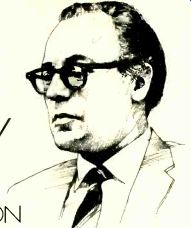
SEED MONEY, ETC.
I think it was W. H. Auden who said that the poetical nature thrives on natural disaster, that it exults in the flood, thrills to the thunderstorm, and embraces the hurricane. I have a friend (he must be very poetical) who agrees: he lives impractically astride the San Andreas fault and swears that the imminence of a disastrous earthquake lends his life a certain edgy uncertainty, a piquant, zestful fatalism that quickens the blood, lightens the step, and sharpens the mind.
I am quite prepared to believe that there are those (I'm not one of them) who delight in dwelling thus on the lip of the abyss, otherwise why would all those poets continue to work for the Metropolitan Opera? Though each succeeding year's budget looks more and more like a petition in bankruptcy (the 1976-77 season's deficit is over $12 million), they continue to hang on, not exactly filled with hope but rather, like New York's Mayor Beame, hoping against hope and, in a strange way, thriving on it. Myself blessed with a sanguine nature, I rather doubt that this tottering mendicant of the arts will be allowed to topple--there are too many jobs involved, and the spectacle would seriously unbalance our international cultural posture, leaving us to cut a brutta figura in the eyes of (gasp!) Mos cow and other capitals in a way we haven't had to talk ourselves out of since Sputnik.
One of the reasons I think so is the announcement in early December of a "matching grant" program (an earlier, less urbanized society would have called it "seed money") involving U. S. Pioneer Electronics Corp., their 2,500 authorized dealers throughout the country, the general public, and the National Endowment for the Arts. Between them, in a formula yet to be worked out, Pioneer and the National Endowment will match every dollar contributed with three more; the goal is $100,000 in donations, $400,000 for the Met.
A long way from $12 million, but it's a start.
As the National Endowment's Nancy Hanks makes clear in the announcement to the press, this is an excellent example of business and government working together in an area of joint concern; nourishing our cultural heritage is as much government's business as safeguarding the political one, and no one needs a diagram to trace the relationship between the world of music and that of audio.
Avery Fisher's staggering precedent (how much is it now, $15 million?) with the New York Philharmonic aside, it is to be hoped others in the industry will find Pioneer's example worth emulating, even at the risk of spoiling the fun of a few poets or Russians.
TECHNICAL Editor Larry Klein is just back (see his report in this issue) from Japan, whence all our hi-fi blessings lately flow. He returned with lots of news and a few electronic souvenirs, but most interesting to me was a little something he picked up from SAE in Los Angeles: an electronic pulse-noise suppressor (otherwise known as a disc "de-pop per and de-ticker"), a typically American solution (a length of haywire) to a typically American problem (dealing with the low quality that is one of the by-products of mass production). Our Japanese brethren may be amused by these gadgets because they don't need them, but we do. There are several on the market, and there will be more coming un less domestic disc quality improves. None of them are what you would call cheap, and it is interesting to speculate how many pennies per disc spent at the right places in American pressing plants would make such stop-gaps redundant. Never fear--the irony gets even sweeter: these machines work so well that they will make it possible for record quality to deteriorate even further. Perhaps I'd better add that I'm not advocating that.
CHANGE, as every philosophical wit will in time remind you, is the only constant in life.
At STEREO REVIEW the game of changing musical chairs is played largarnente, but a chair is occasionally vacated: the antically lovable Steve Simels is surrendering his this month to answer the siren call of television writing.
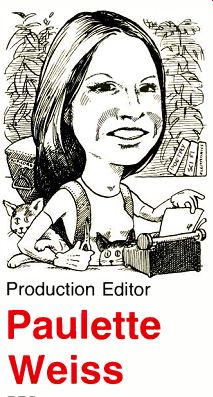
Production Editor Paulette Weiss, with sinuous grace, has already slipped into it. She will begin stamping the Pop Beat with her own personality next month; you're in for a treat.
Introducing the Staff...
(orig. in Oct 1975)
Production Editor Paulette Weiss
Since readers from time to time understandably display a natural human curiosity about the backgrounds of the writers and editors who bend their ears each month in these pages, we will be offering, in issues to come, a series of capsule biographies and autobiographies designed to satisfy that expressed need and at the same time to circumvent some of the hazards of mere speculation.
-Ed.
WIDE-EYED and puppy-ignorant of the ways of the world upon graduation from Brooklyn College in 1970 with a B.A., cum laude, in English literature, found my talents unappreciated--nay, ignored--by employment agencies. Refusing merely to type for my supper, I criss crossed city streets for several months and grew ever more hungry. Had it not been for SR Managing Editor Bill Livingstone's understanding nature, I might today have the symbols "J K L ;" as permanent in taglios on the fingers of my right hand.
Biochemical research had been my first career choice, but lack of deep commitment to the field caused my withdrawal from a two-year major, also at Brooklyn.
The catalyst of this decision was a white laboratory mouse named Johnny Weismuller, whose required death and dissection were thwarted by his mysterious disappearance from my lab table and subsequent reappearance, safe and happy, at my home. The fascination with living things has remained, however, and my upper West Side apartment is filled with a variety of plants, some ugly fish, and a pair of boisterous, charming tabbies named The Pink and The Black, who persistently try to devour the former two edibles. 1, in turn, consume biological texts with gusto, and am often found helplessly following Konrad Lorenz books about.
Although I was for three years a licensed teacher, teaching was not to be my vocation either. Urged on by Czechoslovakian-born parents seeking stability for their American offspring, I had en rolled in one education course only to emerge semi-blinded by the glare of flashing engagement rings. "Why," thought I at this juncture, "can't I pursue something impractical but beloved?" Always a voracious reader (with heavy emphasis on science fiction, poetry, and, in the morning, cereal boxes), I toyed with the idea of a literary career. But first, the Big Decision--would it be the Average Life or the Unusual? Others might have consulted a professional counselor: I decided to leap out of a plane at 2,500 feet. Here's the rationale: if I jumped and lived, I was des tined to be Unusual; if I chickened out, I was Average; if I jumped out and my 'chute failed to open, I was dead. Simple. I jumped, I lived, I was, to quote Mel Brooks, "thrilled and delighted." AND so I dropped in on STEREO REVIEW, to become (after an apprenticeship of one year) simultaneously its first female editor and youngest staff member. Adjustments to the situation were soon made by all. I proudly claim responsibility for introducing denim and comfort to my sartorially benighted colleagues, and for bringing them a tiny breeze of the winds of Women's Lib raging outside. In its turn, SR grabbed me by my puppy collar, civilized me, and made me grow. I was taught editing techniques and through the "Installation of the Month" feature was given a first opportunity to write for a national publication. Encouraged by this, I under took freelance writing assignments, mostly about stereo equipment, for Rock and other four-letter magazines. More prosaic are the essential responsibilities of this production editor's in-house routine, including traffic control of material going to and coming from the printer, design and editing of selected page layouts, picture research, and occasional proofreading.
In 1973 I built my own integrated amplifier, became a Certified Audio Consultant, and now can toy with equipment innards and electrocute myself with the best of 'em. Which is why WNYC radio invited me to be a guest on its half-hour "Men of Hi-Fi" talk show (must change that title) in February of this year.
I have lived in every borough of New York except Staten Island, but my interests consume so much time that I have rarely been found at home wherever it has been. To ameliorate this situation, my cats have been trained to answer the phone courteously and take messages in my absence. Always a good swimmer, I have dunked the body in many seas of the world.
Tennis serves to limber the biceps, bicycling and ice-skating the gluteus maximus, and disco dancing covers the rest. I dabble in gourmet cooking, but eat out often. My goal in life musically is complete mastery of Hindemith's Mathis der Maler transcribed for kazoo.
-Paulette Weiss
Introducing the Staff ...

Contributing Editor: Igor Kipnis
When a personal opinion, particularly a publicly expressed one, grates on our nerves, one of the commoner responses is to ask, either under or at the top of our voices, just who that so and--so thinks he or she is. The question is asked of STEREO REVIEW with respect to our regular contributors and staff many times each month, and in this column we endeavor to supply the answers.
-Ed.
Music almost literally surrounded me as a child. My mother's father, Heniot Levy, a pianist, composer, and head of the piano department at the American Conservatory in Chicago, gave me some early lessons. My uncle Hans Heniot, who later became one of the first conductors of the Utah Symphony, did his share by exposing me to the orchestral classics. And, of course, my father, Alexander Kipnis, who was singing leading bass roles with the Berlin State Opera at the time I was born, took care of the vocal end. The family phonograph loomed large in my early years, partly because of my father's many 78-rpm discs of lieder and operatic arias.
Before the age of eight, I had traveled with my parents virtually all over the world. We finally settled in the United States just before the outbreak of World War II, when my father joined the Metropolitan Opera. I spent my teens in West port, Connecticut, where I had a normal sort of schooling, took further piano les sons (without any particular thought of be coming a professional performer), and madly collected records.
I had one project: trying to earn enough money to buy Edwin Fischer's piano re cording of Bach's Well-Tempered Clavier, complete in five volumes at a total price of some ninety dollars. I was disgusted when I found that the final volume contained, in addition to the last four preludes and fugues, two other 78's included as filler.
On these the second English Suite was played not on the piano by Fischer but on the harpsichord by Wanda Landowska. As it turned out, this apparent rip-off soon fascinated me more than any of the many Bach piano discs I had, and I longed to try a harpsichord in the flesh sometime.
At Harvard, where I majored not in music but in social relations and dreamed of winding up in either radio or TV production or doing a-&-r work with a record company, I finally had my chance to try a harpsichord as part of a project in Randall Thompson's Handel course. I was thoroughly smitten. Nothing happened, however, until 1957, when my parents imported a small instrument for me to fool around with after work.
Work up to that time had included two years in the army teaching signal communications to basic trainees, a few months selling books and records at a Doubleday store in Grand Central Station, and a few months as assistant record librarian at New York's top-forty station WMCA. When I got my first harpsichord, I was art and editorial director of West minster Records, which meant that I was in charge of all covers and liner notes. I began reviewing records for the American Record Guide at that time as Well.
In 1961, two years after my debut as a harpsichordist, I went free-lance. There was a fair amount of harpsichord continuo work available, including a number of Baroque trumpet albums for Kapp Records.
There were also writing assignments for the New York Herald Tribune, and I joined the STEREO REVIEW roster of record critics. I was extraordinarily lucky with my own records: my first solo discs for Golden Crest were followed, in 1964, by a CBS contract and eight years later by one from Angel, and I have now made twenty-six solo albums.
IN 1971, I left New York for Redding, Connecticut, where I live with my wife Judy and our son Jeremy, who is almost twelve years old. For four years I taught full time at Fairfield University, but my concert schedule now includes more than fifty recitals and orchestral dates a year and involves tours of Europe, Australia, Israel, and South America as well as the United States and Canada, and that has necessitated cutting back on other activities. I have also become artist-in-residence at Fairfield, and readers will have noticed that my contributions to STEREO REVIEW have therefore dwindled considerably.
I still like to keep my hand in, though, so that my reviewing hat will never have to go into permanent storage in the attic. And although I have a lot less time for it now, I just cannot get rid of that terrible habit of collecting records. That even includes searching out old 78's, which I enjoy transcribing onto cassette so that I can play them in my van while hauling my harpsichord to the next concert.
-Igor Kipnis
ADs
Kenwood
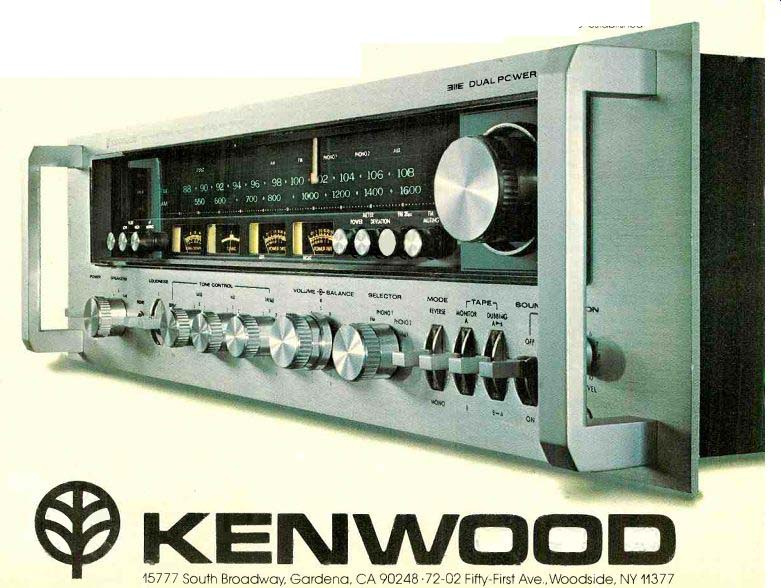
Now you don't have to starve your treble to feed your bass.
Our KR-9600 Receiver puts independent power supplies behind each channel, so demanding musical passages in one channel won't cause distortion in the other.
At 160 watts per channel minimum RMS power at 8 ohms, from 20 to 20,000 Hz, with no more than 0.08% total harmonic distortion, the KR-9600 is the most powerful receiver we have ever made.
What's more, the KR-9600 is loaded with special features. A mid-range presence control, MIC mixing and source fading, a deviation meter for perfect off-air recording and 2 big power meters, to mention a few.
Impressed? All this and more, on the KR-9600. At just $750* it's the best watts-per-dollar value around.
Suggested resale price. Actual prices are established by Kenwood dealers.
KENWOOD. 15777 South Broadway, Gardena, CA 90248. 72-02 Fifty-First Ave., Woodside, NY 11377
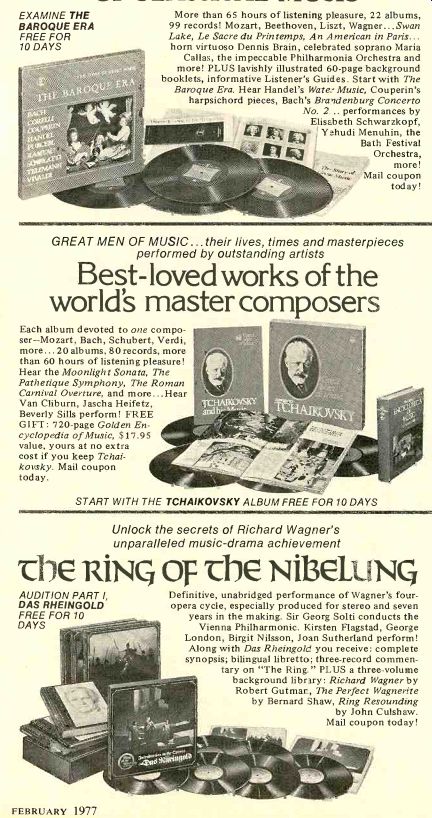
Auditionone of these three superb record collections FREE for 10 days.
The Story of Great Music...a dazzling look-and-listen journey through THREE CENTURIES OF CLASSICAL MUSIC EXAMINE THE BAROQUE ERA FREE FOR 10 DAYS
More than 65 hours of listening pleasure, 22 albums, 99 records! Mozart, Beethoven, Liszt, Wagner... Swan Lake, Le Sacre du Printemps, An American in Paris...
horn virtuoso Dennis Brain, celebrated soprano Maria Callas, the impeccable Philharmonia Orchestra and more! PLUS lavishly illustrated 60-page background booklets, informative Listener's Guides. Start with The Baroque Era. Hear Handel's Ware.- Music, Couperin's harpsichord pieces, Bach's Brandenburg Concerto No. 2 .. performances by Elisabeth Schwarzkopf, Yehudi Menuhin, the Bath Festival Orchestra, more! Mail coupon today!
GREAT MEN OF MUSIC ... their lives, times and masterpieces performed by outstanding artists Best-loved works of the world's master composers Each album devoted to one compo ser-Mozart, Bach, Schubert, Verdi, more ... 20 albums, 80 records, more than 60 hours of listening pleasure! Hear the Moonlight Sonata, The Pathetique Symphony, The Roman Carnival Overture, and more... Hear Van Cliburn, Jascha Heifetz, Beverly Sills perform!
FREE GIFT: 720-page Golden Encyclopedia of Music, $17.95 value, yours at no extra cost if you keep Tchaikovsky. Mail coupon today.
START WITH THE TCHAIKOVSKY ALBUM FREE FOR 10 DAYS Unlock the secrets of Richard Wagner's unparalleled music-drama achievement the RING OF the NIBELUNG
AUDITION PART 1, DAS RHEINGOLD FREE FOR 10 DAYS. Definitive, unabridged performance of Wagner's four-opera cycle, especially produced for stereo and seven years in the making. Sir Georg Solti conducts the Vienna Philharmonic. Kirsten Flagstad, George London, Birgit Nilsson, Joan Sutherland perform! Along with Das Rheingold you receive: complete synopsis; bilingual libretto; three-record commentary on "The Ring " PLUS a three-volume background library: Richard Wagner by Robert Gutmar, The Perfect Wagnerite by Bernard Shaw, Ring Resounding by John Culshaw.
Mail coupon today!
TIME, LIFE TIME-LIFE RECORDS Time & Life Building, Chicago, Ill. 60611 Yes, I would like to examine
The RECORDS Baroque Era. Please send it to me for 10 days' free examination and enter my subscription to THE STORY OF GREAT MUSIC. If I decide to keep The Baroque Era, I will pay $19.95 plus shipping and handling. I then will receive future albums in THE STORY OF GREAT MUSIC series, shipped an album at a time approximately every other month, each at the above price and free 10-day trial basis.
There is no minimum number of albums that I must buy, and I may cancel my subscription at any time simply by notifying you. If I do not choose to keep The Baroque Era, I will return the album within 10 days, my subscription for future albums will be canceled, and I will not be under any further obligation. RAAAG2. Name Address Apt City State Zip (or Prov.) (or Code)
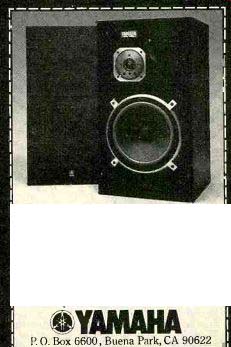
The Sensuous Speaker.
Yamaha's new two-way beryllium dome NS-500.
A very responsive speaker with a rich, luscious sound. A deep, involving sound.
Highly defined, finely detailed.
The NS-E00 is created from the same advanced beryllium technology that's made Yamaha's revolutionary NS-1000 Series speakers, in the eyes and ears of many audio experts, the highest standard of sound accuracy. (specific benefits of Yamaha's beryllium technology have been documented in a paper presented to the 52rd Convention of the Audio Engineering Society.) With the NS-500, you get all of beryllium's advantages (transparency, detail, and lack of distortion that go beyond the best electrostatic speakers), but at a price roughly half that of the NS-1000. Only $500 the pair, suggested retail price.
The joy of beryllium.
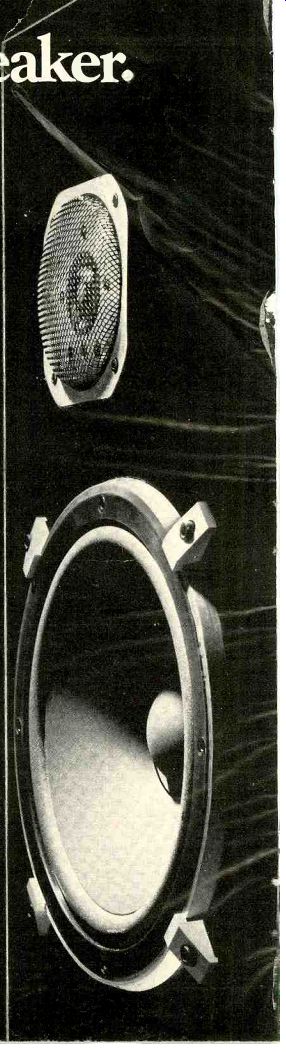
The ideal dome material for a high frequency driver must respond instantly to changes in amplitude and frequency of the input signal. So toe ideal dome material must be virtually weightless as well as extremely rigid.
Beryllium is the lightest and most rigid metal known. Its density is less than two thirds that of commonly used aluminum, and its rigidity is a-most four times as great--thus preventing dome deformation and consequent distortion. What's more, beryllium's sound propagation velocity is twice that of aluminum.
The beryllium dome found on the NS-500's high frequency driver is the world's lightest-about half the weight of one petal of a small sweetheart rose. Which is one of the reasons for this speaker's exceptional sensitivity and response. And for its sensuous sound.
A closer look.
To be able to offer the sophistication of beryllium at a more affordable price, without sacrificing quality of performance, Yamaha designed the NS-500 as a two-way bass reflex system.
This gives the NS-500.a trace more emotion at the low end than the resolutely objective NS-1000. But it also gives the NS-500 more efficiency (91dB SPL at one meter with one watt RMS input). Which means you don't have to invest in the highest powered amplifiers or receivers in order to drive be NS-500 to its full rated output, or an optimum match with the beryllium sweeter, Yamaha developed a very light, very rigid "shell" woofer. And a special hermetically-sealed air core LC crossover with a carefully selected 1.8kHz crossover point.
As a result of these design parameters, the NS-500 boasts an insignificant 0.03% THD below 50 dB SPL, from 40 Hz to 20 kHz, making it the perfect complement to Yamaha's state-of-the-art low distortion electronics.
Underneath the sleek monolithic styling of its solidly crafted enclosures, the NS-500 is full of many exclusive Yamaha features and distinctive Yamaha touches of craftsmanship.
But to fully appreciate the beauty of the NS-500, you really should visit your Yamaha Audio Specialty Dealer.
Which brings us to something else.
Something more than just another speaker pamphlet.
Yamaha's Reference Handbook of Speaker Systems is a very thorough guide encompassing all aspects of speaker design, performance, and evaluation. Starting with a detailed explanation of speaker design principles, the discussion then turns to a solid base of objective criteria, written in easily understood language, to help you properly evaluate any speaker in any listening environment. Already a much sought-after reference work among audio professionals, Yamaha's Reference Handbook of Speaker Systems is available at your Yamaha Audio Specialty Dealer.
At $5.00 a copy, it's well worth the cost.
However, if you clip out the coupon in the bottom corner of this page, take it to your Yamaha Audio Specialty Dealer and hear a demonstration of the exciting NS-500 or any other Yamaha speaker the book is yours for half the price.
And if you're not familiar with the name of your local Yamaha Audio Specialty Dealer, drop us a line. In turn, we'll also send you a free preprint of the Audio Engineering Society paper on Yamaha beryllium technology mentioned above.
1 This coupon is worth $2.50 off the $5.00 suggested retail price of Yamaha's Reference Handbook of Speaker Systems, when presented to any participating Yamaha audio dealer, with a demonstration of any Yamaha speaker system.
Offer expires March 1, 1977
YAMAHA. P.O. Box 6600, Buena Park, CA 90622 USA.
Also see:
NEW PRODUCTS: Roundup of latest audio equipment and accessories.
THE TOKYO AUDIO FAIR: A report on breakthroughs, trends, and approaches (Feb. 1977).
AUDIO QUESTIONS and ANSWERS: Advice on readers' technical problems, by LARRY KLEIN
EQUIPMENT TEST REPORTS: Hirsch-Houck Laboratory test results on the: JVC JR-S600 AM/FM stereo receiver, Marantz Model 1250 integrated stereo amplifier, KLH Model 354 speaker system, and Micro Seiki DDX-1000 turntable and MA-505 tonearm
Source: Stereo Review (USA magazine)