Departments:
New Products--latest audio equipment and accessories
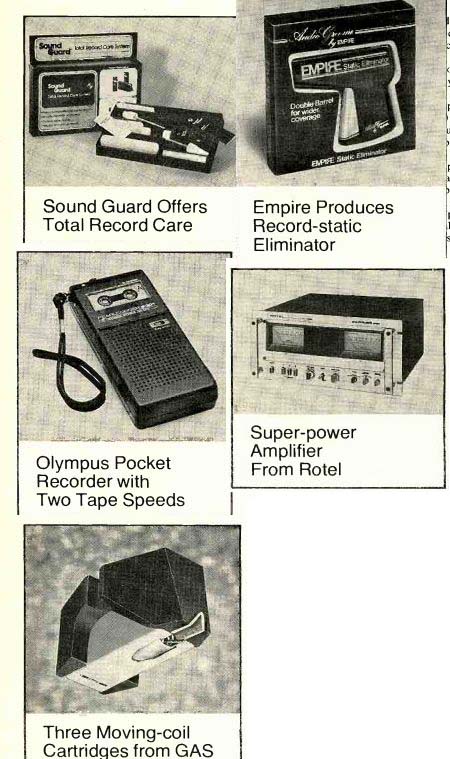
Sound Guard Offers Total Record Care
Ball Corporation's new Sound Guard Total Record Care System brings a record cleaner together with the familiar Sound Guard "record preservative," essentially a dry lubricant suspended in a carrier fluid that is sprayed onto the record surface and worked into the grooves with a velvet pad. This leaves a thin-film residue of the lubricant. The record cleaner is also in liquid form and a pump-spray applicator is provided. A sponge-like pad is used to remove grime from the record a velvet pad is included for touch-up wiping. There is also a foam pad for cleaning the velvet. All components are assembled in a permanent storage box. In addition to the various pads and two pump sprayers, the complete kit comes with 2-ounce bottles of cleaner and preservative. Price: about $15.
Three Moving-coil Cartridges from GAS
Great American Sound is offering three new moving-coil phono cartridges, all structurally similar and differing primarily in stylus geometry. They are low-mass (5 1/2 grams) de signs and have low-"Q" 6-ohm moving-coil elements which are said to be insensitive to electrical loading. For each cartridge, channel balance is better than 1 dB, and the rated out put at a 5-centimeter-per-second recorded velocity is 0.3 millivolt. Recommended tracking force is 1.8 grams for all three models.
The super elliptical model, with a 0.3 x 0.6-mil elliptical stylus tip, has a frequency response of 5 to 40,000 Hz. Compliance is 15 x 10^-6 centimeters per dyne, and stereo separation is 30 dB at 1,000 Hz (20 dB at 10,000 Hz).
The elliptical model has an identical stylus tip but slightly different specifications. Response is 10 to 35,000 Hz, compliance is 13 x 10-6 centimeters per dyne, and minimum separation is 27 dB. The spherical model has a 0.6-mil-diameter spherical stylus tip, a response of 10 to 30,000 Hz, a compliance of 13 x 10^-6 centimeters per dyne, and a minimum separation of 25 dB. Price of the super elliptical cartridge, $200; of the elliptical, $180; of the spherical, $160.
Olympus Pocket Recorder with Two Tape Speeds
The S-301 is a new addition to Olympus Corporation's Pearl-corder line of microcassette tape recorders. The special feature of the S-301 is its provision of two recording speeds, 15/32 and 15/16 inch per second. With the slower speed, a full two hours of recording time is possible on one microcassette; one hour of recording time is possible with the faster speed with fidelity considerably in creased. The S-301 has a built-in electret con denser microphone plus a miniature phone jack for a remote microphone. Recording level is automatically adjusted. Pause, cue, and review functions are provided, and there is a LED for checking battery strength and recording level.
The S-301 has a frequency response of 300 to 7,000 Hz at the 15/16-ips tape speed and 300 to 4,000 Hz at 15/32 ips. It uses two 1.5-volt penlight batteries ("AA" type) but has an adapter for use with a.c. line power. It measures only 53 3/8 x 2 1/2 x 1 inches and weighs about 11 ounces. Price: about $200.
Empire Produces Record-static Eliminator
Empire is offering the Static Eliminator, an electronic device for neutralizing the static charge on record surfaces. The Static Eliminator is part of a new line of record-care products bearing the name Audio Groome. It has a piezoelectric element that develops a high electrostatic voltage at the emitting points when the trigger is squeezed. This voltage ionizes the air around the points, thereby allowing the charge on the disc to drain off. There are two emitting points ("double barrel") for wide coverage. Price: about $40.
Super-power Amplifier From Rotel
Rotel's newest contribution to the ranks of mammoth power amplifiers is the Model RB-5000, rated at 500 watts per channel continuous power into 8 ohms. It includes three distinct power supplies, one for each channel and a third small one for the front-panel meters and LED's. The meters, which read aver age power, are calibrated from 0 to 1,000 watts and have adjustable sensitivities (0, -10, and-20 dB). Set screws are provided under each meter for calibration. The LED...
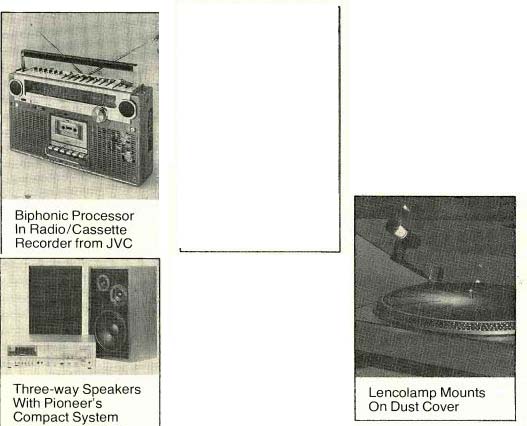
...power indicators display peak power levels, and there are additional LED's to indicate overload, activation of protection circuitry, and stand-by condition. A power-limiter switch sets maximum output at full, one-half, or one-fourth power, and there is a switchable subsonic filter. There are output jacks for three pairs of loudspeakers, with pushbutton switches for speaker selection; however, the amplifier will not drive more than two pairs of speakers at once. A protective circuit automatically rejects one pair if all three are selected.
Heat dissipation is aided by a built-in fan. The separate left- and right-channel gain controls are of the step-attenuator type.
The RB-5000 has a frequency response of 0 to 100,000 Hz ±1 dB at 1 watt. Total harmonic and intermodulation distortion is below 0.009 percent from 20 to 20,000 Hz. Input sensitivity is I volt at the standard phono-jack inputs and 0.775 volt at the Cannon-type input jacks (for sound-reinforcement applications). Signal-to-noise ratio is better than 120 dB (IHF A weighting). The RB-5000 has approximate dimensions of 93.2 x 19 1/4 x 17 1/4 inches and weighs 118 pounds. Price: about $2,350.
Three-way Speakers With Pioneer's Compact System
The KH-767 compact stereo system from Pioneer includes a built-in cassette recorder and an AM/FM stereo receiver. A pair of three-way loudspeaker systems, each with a 10-inch woofer, 4-inch mid-range, and 3-inch cone tweeter, are part of the package. The cassette recorder has pushbuttons for setting bias and equalization for ferric and chromium-dioxide tapes. Recording-level controls are provided for each channel, and the tape-transport mechanism has a pause function.
The FM section has a channel-center tuning meter and a pushbutton that controls both muting and mono/auto selection (the tuner is in the auto mode with muting on and in mono with muting off). There are separate controls for bass, treble, balance, and speaker-system switching.
The amplifier section of the KH-767 is rated at 12 watts per channel continuous power into-8 ohms, with total harmonic distortion at 0.08 percent. FM sensitivity is 1.9 microvolts (10.8 dBf), capture ratio is 1 dB, and selectivity is 60 dB. The stereo-FM separation is 40 dB. The tape-transport system has 0.15 percent wow and flutter. Approximate dimensions of the receiver/cassette deck are 6 x 20 x 15 inches; the speakers measure about 22 1/2 x 13 x 10 3/4 inches. Price: about $370.
Biphonic Processor In Radio/Cassette Recorder from JVC
JVC has introduced the RC-828 portable radio/cassette recorder incorporating its unique bi-phonic processor, a device intended to produce an illusion of "depth" from binaural recordings without headphone listening.
The two-head cassette recorder can be used (with a special optional microphone) to make binaural recordings that can be played back through the processing circuitry for the bi phonic effect. Regular stereo tapes can be played back through the processor (as well as stereo FM broadcasts) and some enhancement will result. The recorder has two built-in condenser microphones for normal stereo re cording as well as separate recording-level meters and controls for each channel. The level meters double as FM signal-strength and battery-strength meters. Bias and equalization are selectable for ferric or chromium-dioxide tapes. Also provided are a pause function, a three-digit tape counter, and a variable monitoring function (which allows adjustment of the monitoring level without affecting the recording level).
The radio section of the RC-828 receives FM, AM, marine, and three shortwave bands.
Slide controls are used for bass, treble, and left- and right-channel volume. Pushbuttons are provided for mode selection. The RC-828 has a 6 1/2-inch woofer and a 2-inch tweeter for each channel, driven by the system's 2 1/2 watt-per-channel power amplifier. Dimensions are 103/4 x 18 1/2 x 5 inches, and the unit weighs about 14 pounds. Available as an option is the HM-200E binaural headphone/ microphone combination (about $90). Price of the RC-828: $260. The HM-200E binaural headphone/microphone comes with an acoustic dummy head.
New Book Catalog From Howard Sams
Howard W. Sams and Co., Inc. has released an updated catalog of its more than 350 publications for technical workers, hobbyists, and do-it-yourselfers. Included are twenty three titles specifically in the audio/hi-fi area, such as ABC's of Tape Recording, Easy Speaker Projects, and Hi-fi Stereo Handbook.
The eighty-page catalog contains brief descriptions of all the books and a complete price list; it is arranged by subject area and indexed by title. The catalog is available free of charge from the publisher at 4300 W. 62nd Street, Indianapolis, Indiana 46206.
Lencolamp Mounts On Dust Cover
Lenco's new "Lencolamp" is an accessory lamp for lighting the platter of a turntable. It clips to the left side of the dust cover and has an on/off switch placed so that the lamp comes on whenever the dust cover is opened; closing the dust cover automatically shuts it off. The Lencolamp has a 7-watt bulb and plugs into the a.c. line. No tools are required to install it. Price: about $20.
Distortion Indicator For Crown Amplifiers
Crown is introducing Input-Output Comparator (IOC) circuitry in its DC-300A and D-150A power amplifiers. The IOC circuits trigger a front-panel LED whenever the amplifiers are even momentarily driven above their rated distortion specifications. The sys tem monitors the feedback-generated correction signal at a point that enables it to detect any difference between input and output. Its main advantage over the conventional over load/clipping LED is that it responds very rapidly and will detect such short-lived phenomena as slewing-induced distortion. By virtue of its location it will report any nonlinearities in the signal.
Inclusion of the IOC in new DC-300A's and D-150A' s will add $50 to their current suggest ed prices. The IOC circuitry can also be in stalled in older units. Factory installation costs about $60 and includes a complete checkout.
Crown is also now offering optional rack-mount assemblies with grab handles for the DC-300A and D-150A. They are user-installed and cost $20.
Dual-woofer Speaker System from Rank
The Leak 3050 loudspeaker system, a new addition to the Rank Hi Fi line, is a "time-delay compensated" system, with two 6 3/4-inch woofers mounted several inches forward of tine 3/4-inch dome tweeter in an acoustic-suspension enclosure. The drivers are crossed over at 4,000 Hz by an 18-dB-per-octave net work whose electrical phase characteristics complement the locations of the staggered drivers.
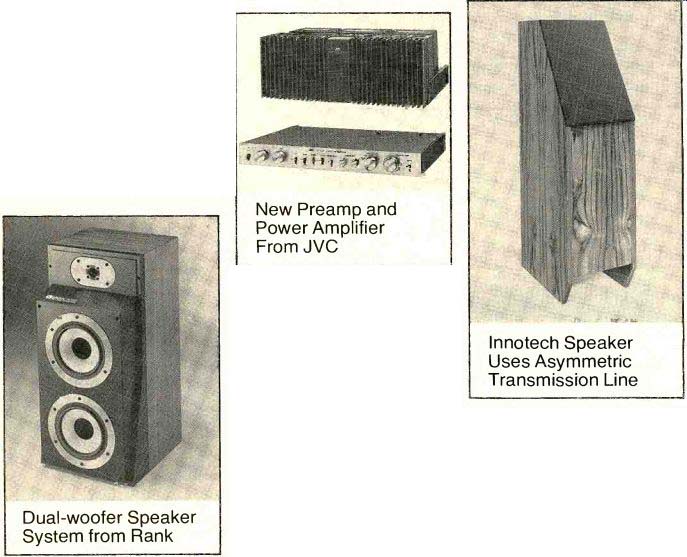
The frequency response of the 3050 is 48 to 22,000 Hz ±3 dB, and nominal impedance is 8 ohms. Amplifiers delivering between 12 and 60 watts per channel continuous power are recommended; maximum continuous input is 50 watts. The 3050 produces a sound-pressure level of 85 dB at 1 meter with a 1-watt input.
The cabinet is finished in walnut veneer and measures 25 1/4 x 11 3/4 x 13 3/4 inches. Weight is 42 pounds. The Leak 3050 speakers are sold in matched pairs. Price: $600 per pair.
New Preamp and Power Amplifier From JVC
JVC has introduced its new Model P-3030 preamplifier and Model M-3030 power amplifier. The P-3030 is a low-profile unit that provides a wide variety of cartridge loads as well as a pre-preamp ("head" amplifier) for low-output moving-coil cartridges. Input impedance can be selected at 100, 33,000, 47,000, or 100,000 ohms; input capacitance can be set at 100, 220, 330, or 470 picofarads.
The program-source selector has settings for tuner, auxiliary, and three phono inputs (one of which is the moving-coil input). There is a tone-control defeat switch as well as a switchable 18-Hz subsonic filter with a 6-dB-per-octave slope. Switching for tape dubbing and monitoring is provided.
Input sensitivity of the P-3030 is 2 millivolts (mV) at the regular phono inputs and 0.1 mV into 30 ohms at the moving-coil input. The phono overload point is 300 mV for the regular inputs. Total harmonic distortion is 0.005 percent at a 10-volt output for the regular phono inputs and 0.05 percent at a 1-volt out put for the moving-coil input. Signal-to-noise ratios are 76 dB for the regular phono inputs, 66 dB for the moving-coil input, and 96 dB for the high-level inputs. Approximate dimensions are 2 1/2 x 16 1/2 x 13 3/4 inches. Price: about $400.
The M-3030 direct-coupled power amplifier-which is, in effect, two mono amplifiers on one chassis-employs three separate power supplies for its driver sections and output stages. It has a direct-coupled input together with a separate input incorporating an 18-Hz subsonic filter. The M-3030 is rated at 100 watts per channel continuous power into 8 ohms. Frequency response is 0 to 100,000 Hz +0,-1 dB. Total harmonic distortion is 0.007 percent and intermodulation distortion is 0.05 percent at rated output. Input sensitivity is 1 volt into 50,000 ohms. Approximate dimensions are 6 1/2 x 16 1/2 x 11 3/4 inches and weight is about 42 pounds. Price: about $700.
Innotech Speaker Uses Asymmetric Transmission Line
Innotech's new Model D-24 loudspeaker system utilizes a transmission line of asymmetric geometry, said to enhance woofer output while avoiding standing-wave problems.
The system has two 5-inch woofers with Bextrene cones; the rear radiation from these drives the line, which is damped with lamb's wool and long-fiber polyester. A three-way system, it also employs a 1 1/2-inch dome driver for the upper mid-range and a 3/4-inch dome tweeter loaded with a shallow, flared horn.
Crossover frequencies are 3,500 Hz and 11,000 Hz. The drivers are mounted on a baffle board set at an angle of 30 degrees from the vertical to improve dispersion. The transmission line radiates from the base of the floor-standing enclosure.
The D-24 has a rated frequency response of 25 to 25,000 Hz. Minimum impedance is 5 ohms. Innotech recommends amplifiers rated 24 at a minimum of 35 watts per channel continuous power to drive the speaker. The cabinet is finished in walnut or optional rosewood veneer and has approximate dimensions of 36 1/2 x 10 1/2 x 15 1/2 inches. Price: $375.
Hammond Industries announces a new rack for owners of rack-mounting-adapted audio equipment. The Audio-File is a standard 19-inch rack constructed of brushed aluminum. It is available with black Plexiglas side panels and shelves so that it can support free standing as well as rack-mounted equipment.
Space is provided for record storage at the bottom of the rack. The Audio-File stands 48 inches tall and takes up a floor area of 22 x 19 inches. It is available without the Plexiglas panels and is sold in kit form. Price with Plexiglas panels: $350; without: $210.
Low Phase Shift in A & E Preamplifier
The SCA-2000 is A & E Technical Research's latest preamplifier. It employs direct-coupled circuitry that results in unusually low phase shift (between 0 and 3 degrees) over the 20- to 20,000-Hz frequency range. Phono input impedance is selectable at 100, 1,000, 33,000, 47,000, 68,000, and 100,000 ohms.
The SCA-2000 is a "bare-bones" unit, with controls for volume and balance but no tone controls; it is intended for use with a separate equalizer. There is also a low-cut filter and a low-boost function (which increases output by 6 dB below 100 Hz), as well as a 15-dB audio-muting switch. Other front-panel push buttons select the program source (two tape decks and two phono inputs are accommodated) and handle tape-dubbing operations. The volume control is a thirty-two-step attenuator switch.
The rated frequency response of the SCA-2000 is 1 to 500,000 Hz for the phono in puts. There is a low-frequency filter in the phono-signal path that attenuates signals be low 1 Hz; for the high-level inputs response extends down to 0 Hz (d.c.). Total harmonic distortion is below 0.01 percent, and signal to-noise ratios are 80 dB for the phono inputs and 90 dB for the high-level inputs. Phono input sensitivity is 2 millivolts, and maximum output is 10 volts. Slew rate is 22 volts per microsecond. Approximate dimensions of the SCA-2000 are 3 1/2 x 19 x 11 inches. Price: $950.
Magnetic Speed Control On Denon Turntable
The DP-790 is a new direct-drive turntable from Denon featuring that company's magnetic speed-control system. The inner rim of the turntable platter is coated with a ring of magnetic material on which a series of close-spaced electrical pulses are recorded. A special magnetic sensor picks up the recorded signals and detects any speed fluctuations, which are then corrected by the servo system.
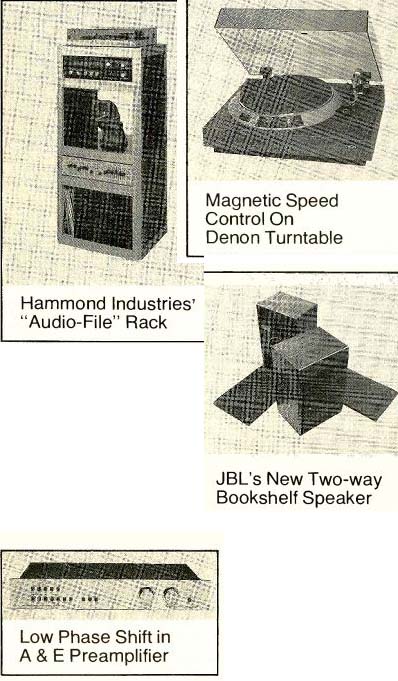
A slide switch on the platter support selects the speed (33 1/3 or 45 rpm) and a pitch control provides up to ±3 percent speed variation.
The "S"-shaped tone arm is mounted on visco-elastic bushings that damp out vibrations from the turntable base. It has viscous-damped cueing and adjustable antiskating. The base has rubber feet for acoustic-feed back insulation.
The DP-790 has less than 0.019 percent wow and flutter (wrms), and rumble is better than-75 dB (DIN B weighting). The platter comes to speed in under 1.8 seconds. The turntable base is of laminated wood, and approximate dimensions with the dust cover are 6 3/4 x 9 x 16 inches. Price: $298.
JBL's New Two-way Bookshelf Speaker
The L40, JBL's new two-way bookshelf loudspeaker system, employs a 10-inch woofer and 1-inch dome tweeter in a vented enclosure. The woofer has an extra-large dust cap-4 inches in diameter-intended to as sure adequate output at higher frequencies up to the crossover point of 1,800 Hz. A fiber glass acoustic-resistance shell is mounted over the rear of the woofer to smooth the system's low-frequency response. High-frequency output of the system is within 6 dB of on-axis output for angles as great as 75 degrees off-axis at 15,000 Hz and 45 degrees off-axis at 20,000 Hz. A level control is provided for the tweeter.
The nominal impedance of the L40 is 8 ohms, and sensitivity is 75 dB sound-pressure level at 15 feet from a 1-watt input. JBL recommends amplifiers delivering between 10 and 60 watts per channel continuous power to drive the speaker. The cabinet of the L40, which measures approximately 23 x 15 x 12 inches, has an oiled-walnut finish and is avail able with a stretch-fabric grille cloth in brown, rust, or tan. Price: $207.
NOTICE: All product descriptions and specifications quoted in these columns are based on materials sup plied by the manufacturer.
Recent fluctuations in the value of the dollar will have an effect on the price of merchandise imported into this country. Please be aware that the prices quoted in this issue may be subject to change.
==============
Audio Q. and A.
By Larry Klein, Technical Director
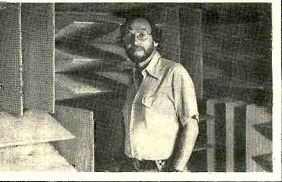
--- Klein posing (quietly) in front of the sound-absorbing wedges in Allison
Acoustics' semi-anechoic chamber.
Distortion Perspective
Q. My questions, prompted by Peter Fryer's August 1977 article on the audibility of distortion in loudspeakers, are these: if it takes at least 5 to 6 percent intermodulation distortion to be detectable in loudspeakers under some circumstances, does the same hold true for distortion in electronics? If so, how can one reconcile IM figures of 5 to 7 percent in some high-quality cassette machines, as reported by another magazine's test lab? On the other end of the scale, why do some preamps boast IM figures of 0.001 percent? The whole thing doesn't seem to make sense. Can you help put these figures in perspective?
F. B. SCHMIDT, New Hamburg, Ontario
A It's obvious that distortion is one of those controversial audio topics that suffers from an extremely poor signal-to-noise (which is to say sense-to-nonsense) ratio. Test results and tightly controlled listening experiments are frequently overwhelmed by noisy, technically invalid, and highly subjective opinions-much to the confusion of people like Mr. Schmidt. Let's try for some noise reduction. To answer the first question; yes, it was our finding in the first experiments we did in 1973 that, on certain types of complex pro gram material, measured amplifier distortion of about 6 percent frequently went unheard.
Over the years, our test results were con firmed by many other researchers throughout the world. And although STEREO REVIEW'S experiments used an amplifier-distorted test signal, it doesn't seem to make any difference (in respect to the ear's sensitivity to it) whether the audio-waveform distortion originates in an amplifier or a speaker as long as we are referring to distortion levels of under 7 or 8 percent. Of course, a mistracking phono cartridge, an overdriven speaker or tape recorder, or a clipping amplifier is readily audible if the problem is either severe enough or lasts long enough.
In regard to your second question: the "5 to 7 percent" intermodulation distortion measured on high-quality cassette machines by one of the other test labs (not Hirsch-Houck) is quite simply a misinterpretation of their instrument readings. Without going into details, various signal disturbances peculiar to tape which are not particularly audible can produce very high IM distortion readings that, if they were real, certainly would be audible.
This appears to be a case of a blind (deaf) faith in meter readings without adequate analysis of exactly what the test instruments are actually measuring.
As to your third question: we've been juggling this hot potato for several years now.
It's obvious-to me, at least-that the human ear's threshold of sensitivity to a variety of acoustic signals under a number of circum stances has not been completely investigated or adequately described. The journals of the Acoustical Society of America and of the Audio Engineering Society regularly print articles revealing new psychoacoustic data or challenging old data, but what the human ear can and cannot hear is still very much unresolved. Therefore, the safest and most scientific approach to any question dealing with auditory perception is to preface all statements with something like: "At the moment, in the light of available evidence, it appears that...." So it appears that distortions below about 0.1 percent are not audible under virtually any circumstances, and distortions slightly above that point can usually be heard only on pure tones, listening through headphones, or, maybe, when the moon is in the proper phase. So why do manufacturers push specifications of 0.001 percent? Why not?--if they can be achieved without paying a price elsewhere in the equipment's performance or reliability. As I've suggested previously, it may be that, in pursuit of these ever-lower distortion figures, problems get solved in passing that do have audible consequences. That's called serendipity.
Playing 78's
Q. The recent "New Products" listings " have included two record players capable of speeds of 78, 45, and 33 1/3 rpm. These are relatively fixed speeds, which are fine as far as LP's and 45's are concerned, but what good is a fixed 78-rpm speed? Columbia and other record manufacturers didn't standardize their playing speeds until the late 1920's. Be fore that, speeds ran as low as 74 rpm and up into the 80-rpm area. The old wind-up phono graphs therefore usually had a playing-speed control lever that would adjust for different re cording speeds. Unfortunately, the modern Lenco player with continuously variable speeds hasn't been available for over a year.
RALPH MORAN; Wilmington, Del.
A. I'm pleased to report that the Lenco continuously-variable-speed turntables are once again available. For example, the four-speed Model L-55SBD can play at any speed between 30 and 86 rpm, with click stops at 16 2/5, 33 1/3, 45, and 78 rpm. The machine is priced at $185 (including base and dust cover) and should be at local audio shops shortly. If you have trouble locating a dealer in your area, you may write directly to Mort Lesly at Neosonic Corp., 180 Miller Place, Hicksville, N.Y. 11801.
Antiskating Brush Force
Q. I own a Technics SL-1300 turntable outfitted with a Pickering XUV-4500Q cartridge. and I'm not sure where to set the calibrated antiskating-force control knob. As you know, the cartridge incorporates a brush that travels in front of the stylus. Pickering's instructions state that the stylus force must be set 1 gram above their recommended minimum of 1 gram in order to compensate for the weight of the brush. Technics says only that the antiskating force must match the stylus-tracking force. So where do I set the antiskating--for 1 gram or 2?
DONALD T. JUDD; Canyon, Texas
A. When the tonearm is playing, position the brush is resting on the record, so the extra 1-gram force you dialed in to compensate for its weight is not applied to the stylus or record groove. The tone arm, however, is relating to the record with a 2-gram force even though only I gram is applied at the stylus tip, which might indicate that the equivalent of 2 grams of antiskating are required. I tried to work out the question intuitively and got immediately bogged down. Therefore, I thought it best to ask those who should know the answer from practical test experience. I'm pleased to report that Pickering, Technics, and Julian Hirsch all agree that the antiskating dial should be set a gram higher than "normal" to compensate for the presence of the brush.
Unfulfilled Wattage
Q. Driven by obscure desires, I purchased Radio Shack's inexpensive power-level meter to connect to my amplifier. Allowing for even a grossly large margin of error in its readings, I am astonished by the results. Driving two very large ported speakers, my amplifier (if the meter is to be believed) was never called upon to deliver more than ten watts per channel at very loud (but not painful) levels.
Are ported speakers that efficient, or does my meter actually display pilot-light output? If ten watts is indeed the maximum that my ears can handle, why do I have this nagging sense of guilt and (gasp) impotence, feeling that my life is unfulfilled with only a 65-watt-per-channel amplifier? Although I cannot hear any distortion, I know something must be wrong with me. I do not want to live the rest of my life in a 65-watt-per-channel closet, but if the meter is to be trusted, why buy more watts? Maybe a couple of aspirin would help.
DALE PIZZINI; Springfield, Va.
A. Like many other readers, Mr. Pizzini can undoubtedly trace his lurking sense of un-fulfillment to unrealized power fantasies.
Whether his difficulties are part of an un resolved childhood-deprivation syndrome or whether they arise from more esoteric causes is beyond the scope of this column. So I will stick to the audio aspects of the question.
I, too, have a power-indicating meter (the Heath AD-1307) hooked up to my system.
When I am listening with average low-efficiency speaker systems, I find that 2 watts or less is background level, 20 watts or so on peaks is loud, and 200 watts can be reached on momentary very loud peaks. Each step represents a 10-dB increase in power delivered to the speaker(s). I've also had speakers under test at home that in A-B comparison with the previous pair required about 10 dB less power to achieve the same loudness level (only 0.2, 2, and 20 watts were required under the same listening conditions). It therefore does not seem improbable to me that Mr. Pizzini's 65 watts per channel is more than adequate for his "very large ported" speaker systems.
When dealing with conventional dynamic speaker systems, there are several rules of thumb regarding efficiency. The larger the system, the more efficient it is likely to be.
And a horn or bass-reflex (ported) system is likely to be more efficient than an acoustic-suspension or infinite baffle system of equivalent size. However, given a pair of equivalent of the two is likely to have less very low bass response.
To Mr. Pizzini's question "Why buy more watts?" I would respond, don't-unless you really want to. Until recently I found that 350 watts per channel was adequate for my needs, but I had this dream the other night . . . .
Discwasher/Sound Guard
Q. I would like to know if Discwasher fluid will wash away the dry lubricant from a disc treated with Sound Guard. While Sound Guard does reduce the need for cleaning, it does not entirely eliminate the problem of micro-dust and visible debris, and obviously the economics of using such a product is questionable if a disc so treated cannot thereafter be cleaned. I hope you can clarify the matter.
RICHARD E. REX; Bountiful, Utah
A. I have been informed that elaborate tests by both the Sound Guard and Discwasher companies indicate that properly "bound" Sound Guard will not be removed by Discwasher's D3 fluid. In fact, normal cleaning with the Discwasher fluid has been found by both Ball and Discwasher to remove unneeded, excess lubricant but not the effective, "attached" compound.
Because the number of questions we receive each month is greater than we can reply to individually, only those letters selected for use in this column can be answered. Sorry!
+++++++++++++++
=============
Audio News -- Views and Comment
By George Tlannsa
Stereo AM
In the not too distant future you may be finding stereo-AM, stereo-FM receivers in your local hi-fi shop-if the FCC gives its nod, that is-for stereo AM is now being seriously considered as an additional channel for commercial broadcasting. There are four pro posed stereo-AM systems currently under scrutiny: those of Kahn Communications, RCA, Magnavox, and Motorola. The Kahn system has been around for a while, as has RCA's (a joint effort with Belar Electronics Laboratory, a broadcast-studio-equipment manufacturer). The National AM Stereo phonic Radio Committee (NAMSRC), advisers to the FCC, completed on-the-air tests of the RCA, Magnavox, and Motorola systems on August 21; Kahn refused to participate, citing the exorbitant costs involved and the fact that its system had already undergone extensive use tests elsewhere. The FCC has been soliciting comment from broadcasters and the public on the stereo-AM issue; with this data and the report of the NAMSRC in hand, it expects to issue a ruling-or a reaction-on the matter sometime this month.
Although the notion of stereo AM goes back a long way (as far as 1925!) AM radio was not seriously promoted as a stereo medium when stereo discs were coming into their own largely because of its fidelity problems.
The two major difficulties were limited audio-frequency bandwidth and poor signal-to noise ratio, and these are still with us. AM stations are technically capable of broadcasting a frequency range of 50 to 10,000 Hz, but this still doesn't equal FM's range of 30 to 15,000 Hz. Noise problems are significant in AM too; AM receivers respond to amplitude variations in the received signal-any amplitude variations, including all sorts of natural and man-made noise. FM receivers are de signed to respond to frequency-not amplitude-modulation, which eliminates most of this kind of noise.
In most of the current proposed systems, a stereo-AM signal is broadcast by using the two "edges" of the band to carry the additional information while a conventional AM radio gets a normal mono signal. All the pro posed systems appear to be workable, with at least 8 to 12 dB of channel separation being available. This may not be very impressive to an audiophile accustomed to 25 to 30 dB of separation, but it may well sound very good in another rapidly growing market: mobile sound. Considering all the ambient-noise high-frequency masking that goes on in the average car, the loss of highs in AM may not be that significant to the average listener. And with car speakers mounted the way they usually are, the AM separation available would work well enough for a distinct stereo effect.
Consider also that one major advantage of AM over FM is most observable in a moving vehicle-AM signals are not subject to flutter effects and multipath distortion as FM signals are. And AM signals are also longer-range than FM. Will we soon be listening to the AM talk programs in stereo? Only the FCC knows for sure. In any case, even if it's in stereo, it certainly won't be hi-fi.
"Instant" Cassettes
If you think that all cassettes provide "instant" recording once you press the proper button, you're right-except that they do it only when you get past the 6 seconds or so of blank non-recordable leader section spliced to the head and tail of the tape pack. The leader is used to prevent tape stretch or breakage at the point where it is attached to the hubs and where, of course, it is most subject to stress from sudden halts after fast wind or re wind. Now someone at 3M has had a good idea: use standard recordable 1.5-mil tape for the leaders and splice to it whatever thickness of "body" tape is required for the various re cording capacities of 30, 60, or 90 minutes.
The IRC (Instant Record Cassettes) series is economy-priced and specially designed for re cording at lectures and other situations where really instant recording is necessary.
High Cost of Car FM
According to Donald A. Thurston, chairman of the board of the National Association of Broadcasters, many Americans do not have FM receivers in their cars because of the high prices charged by auto manufacturers for factory-installed AM/FM radios. In testimony before the House Small Business Committee, Thurston suggested that the FTC and the Justice Department look into possible antitrust violations in the situation, since despite in creases of as much as 73 percent in the number of home radios with FM tuners in the ten year period between 1965 and 1975, only 37 percent of all car radios had FM tuners in 1975, an increase of 31 percent over the 1965 figure.
In addition, he stated that the cost of an AM car radio purchased from the car's manufacturer could well run upwards of $75, with an AM/FM set costing twice as much and an AM/FM stereo set three times that amount.
These figures he compared with the typical production costs of a car radio, which in 1974 were $13.52 for parts and labor for an AM-only set and an additional $6.95 for an AM/ FM set, according to a 1974 survey by the A.D. Little Company. In that year Congress considered legislation requiring all radio receivers to be capable of receiving all commercial stations, both AM and FM. Though the bill did not make it through the House at the time, Thurston is apparently hoping that similar legislation will be considered again in the immediate future.
=================
Audio Basics
LEARNING TO LISTEN
----------
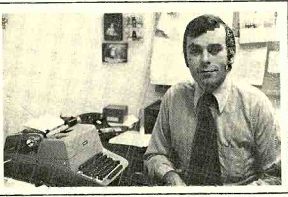
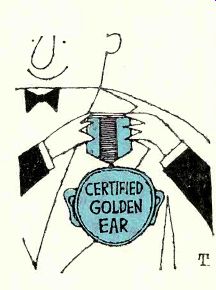
I AM always a little surprised, and more than a little taken aback, when a neophyte audiophile suggests to me with something like awe that it must be wonderful to possess so rare a talent as being able to listen to audio systems and tell immediately what's right (or wrong) about them, for I am not accustomed to looking upon this skill as any big deal. I won't go so far as to say there is no such thing as a "golden-eared" listener, for plainly there is:
an appreciable number of people earn their livings at least in part through their super-sensitive auditory faculties. But this, I feel, has little if anything to do with any neurological or physiological gift. Critical listening is a skill acquired through practice and concentration.
(Some might also call it a curse, like perfect pitch, because once you have really learned to listen, it is difficult to tolerate anything that falls below your standards, and the simple pleasures of a transistor radio on the beach may be lost to you forever.) To be useful to an audiophile-or to anyone else-critical listening must be both analytical and diagnostic. Stories abound of conductors who can unerringly pick out the one off-key violin in a string section of sixty members.
"Argh!" such a conductor might say, which is of no help to anyone. But if he follows that expletive up with "My 'Argh!' is directed at the violins, which sound awful," that's analytical. And if he continues, "Furthermore, it is directed specifically at that violin, which is mistuned," that's diagnostic.
HAVE encountered few audiophiles who could be called universal masters of analysis and diagnosis. Sometimes a diagnosis is beyond an audiophile because, though he can plainly hear the flaw in the reproduction, his technical knowledge is not sufficient to suggest to him what might be going wrong. Or he might be indifferent: "I recognize the existence of such-and-such a fault in my system, but it really doesn't bother me that much, and the system has many other things going for it that I'm really more demanding about." His attitude, if sincere, might make him a poor consultant in the choice of someone else's equipment. He may have become too much a critical specialist in his own areas of preference and too little concerned with any number of problems that may be setting other people's teeth on edge-this is particularly true where there are striking differences in musical taste or hearing acuity.
How does one become a useful member of the critical-listening "trained-ear" fraternity? First, by listening, and in particular by listening critically to whatever you want to evaluate. I can't fully subscribe to the view that you should listen exclusively to live music in order to pass judgment on reproduced music, for two reasons. First, in microphone perspectives, equalization, and mixdown practices in general, the recording industry seems to be moving further away from the live-music experience and closer to something that it considers more dramatic and captivating.
Hence live music can actually lead you astray ...
----------- CERTIFIED GOLDEN EAR
...if you expect a high-fidelity system to sound exactly like it; if the record grooves don't have "live" sound in them, then no matter how good the audio system, it won't sound "live"-and it shouldn't. Second, if you want to learn to be analytical and diagnostic, you have to pay attention to context. I have heard, from a poor seat in an otherwise respected concert hall, a sonic effect that exactly mimicked the sound of a dirty phono stylus. I have also heard a recorded tenor voice that I was certain was rife with distortion until the record's producer demonstrated that the soloist in question was trying to "force" his way through a bad chest cold. Hardly a common-denominator case, but even the most acute listeners have been innocently fooled a time or two by a "distorted" original.
Therefore, if you want to learn about con cert-hall acoustics, instrumental intonation, ensemble playing, and great spontaneous entertaining, by all means attend live music performances whenever possible. But if you want to learn about hi-fi equipment, concentrate on listening to that, with regular reference to live music, if only for philosophical edification. Do not, in any case, confuse the two, because the cause of genuinely bad sound in the one is almost never the cause of bad sound in the other.
WHAT does one listen for? This is a good question that has perhaps never been satisfactorily answered. In a way it's a personal mat ter. Some expert listeners I know are immediately sensitive to frequency balance and colorations. The "ocean-roar" noise often heard when the tone arm is lowered to the edge of a record will often tip them off to something right or wrong even before the music starts.
Of course, they need some experience with the way this noise should sound on audio systems of proven "correctness" to acquire this skill, and this has often been sharpened in some cases by dabbling in speaker design. For my part, a variety of musical experiences during my school years gave me the ability to "play back" a virtually note- and noise-perfect rendition of a recorded performance in my head, so that I at least have some standard of comparison if not an absolute standard. Combining this with the experience of hearing those recordings reproduced on good systems has added perspective-and a sense of what could stand even more improvement.
Above all, I would say that acquiring the ability to listen analytically, being aware of the individual contributions of all the instruments and even of the acoustic space around the instruments is of paramount importance.
This skill does not come easily. I keep on hand a small collection of distinctively distorted recordings so that I can demonstrate to the concerned and curious what this blight upon reproduced music really sounds like.
But drawing their attention to a particular distortion "tree" will not work until they have learned to ignore the "forest," learned to separate an undifferentiated "mass" of sound into its component parts.
BUT I feel certain that the trick of analytical listening can be learned-learned, anyway, by anyone for whom music has a vital appeal.
Once he has mastered it, the listener will be able to hear the chest cold or the dirty stylus instantly, even if he can't positively recognize its cause. If he wishes to get further involved with the technicalities of high fidelity, the di agnostic skills will follow. Unfortunately, learning to listen critically may well require a reasonably analytical sound system on which to sharpen your senses. That's why so many audiophiles find that their first equipment purchases in time come to be seen as merely a set of training tools by means of which they were able to make a much wiser decision the next time around.
=================
Tape Talk
Microseconds Query
Q. My cassette has switch markings for 70 u-sec and 120 u-sec. What do these numbers mean, and what do they have to do with cassette performance?
MARIANNE SPIVEY; New York, N.Y.
A. The abbreviation "u-sec" stands for "microsecond" and refers to what the engineers call the "time constant" of the high-frequency portion of your cassette's playback circuitry. The concept of a "time constant" is useful from an engineering standpoint since it is simply the product of the actual resistor-capacitor values necessary to create a particular frequency-response curve.
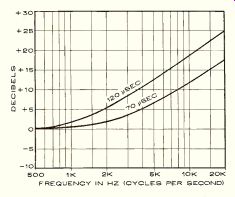
In order to achieve flat overall frequency response, all tape decks employ what amounts to a treble boost in their playback section. The frequency at which this effective boost begins to take place is determined by the circuit's time constant (frequency = 1 / 2 π TC, or, more simply, just divide 159,155 by the stated time constant, in microseconds, to find the frequency). As can be seen from the curves in the diagram below, a 70-µsec treble boost starts (its 3-dB point) at 2,274 Hz. It is used for chromium-dioxide (and cobalt-treat ed ferric), tapes. Because ordinary ferric ox ides require much more treble assistance on playback, a 120-µsec curve which starts at 1,326 Hz is used.
The greater treble boost required for regular ferric oxides means that their hiss level, on playback, will be amplified more (by about 4.5 ...
------ FREQUENCY IN HZ (CYCLES PER SECOND) dB,
... the difference between the two curves) than that of CrO2 tape or its equivalents. That is why tape manufacturers today are rushing to produce more and more 70-u-sec cassettes.
Not So Rack-mountable
I recently purchased an open-reel deck, a cassette deck, a tuner, and an amplifier which were all advertised as "rack mounting." All of them have the standard 19-inch width, and if I move each individual unit up and down the front of the rack I can line up the notches for its front mounting screws with the drilled and tapped screw holes provided in the frame of the rack. But when I try to stack the units on top of each other, panel to panel with no spaces between them, the way they look in every rack installation I've ever seen, the slots don't match the mounting holes any more.
Why? Is there anything I can do about it?
BOB SILVERSTEIN; Brooklyn, N.Y.
A. Having had to spend countless hours with drills, hack saws, coping saws, and files, making up custom adaptors to make so-called "rack mountable" equipment fit in my own multiple six-foot racks, I was touched in a very tender spot by your question. All the American-built "rack mountable" equipment I own fits standard EIA racks (the type sold in this country) perfectly.
But, while there are a handful of exceptions (usually specifically designed for profession al, not home use), the Japanese-built "rack mountable" equipment I have used won't fit my standard racks any more than it will fit yours.
The problem lies in this: EIA standard rack mounting specifies not only the 19-inch width and the spacing between the notches for screw mounting, but it also specifies very precisely, using a standard that has not been changed in the many decades since its first promulgation, the permissible panel heights.
To fit standard racks, every panel must have a height that is an exact multiple of 1 3/4 inches, less 1/64 inch at top and bottom for clearance.
Units measuring 1 3/4, 3 1/2, 5 1/4, 7, 8 3/4, or 10 1/2 inches, given standard notching, will fit a standard rack in any combination (up to the maximum height of the rack, of course). No other will, and no others should be advertised and sold as designed for standard rack mounting unless the manufacturers of the nonstandard, pseudo-rack-mounting units will supply the necessary nonstandard blank panel strips (top and bottom) to space the panel height out to the next standard multiple. Since increasingly large numbers of pieces of high-fidelity equipment are being designed to look as if they were "rack mountable" and are being advertised as if they were (it's very "in" these days), I believe that either voluntary or enforced compliance should be obtained, per haps through the Federal Trade Commission.
Now that you've been stuck, however, there is an alternative open to you. I have found at least one firm (Sansui Electronics, 55-11 Queens Boulevard, Woodside, N.Y. 11377) that manufactures a kind of rack which uses a slotted channel and rear-mounted clamps to take the place of the notch-and-screw mountings. With this you can set up nonstandard panels on top of each other and have to worry only about the need for a single nonstandard blank spacing panel at the very top or bottom of the rack.
Decoding Dolby FM
Q. My new cassette deck has a Dolby FM . feature that's supposed to let me decode Dolby broadcasts whether I record them or not. The instructions say to set my receiver's switch to "25 microseconds" or to connect the cassette unit to the receiver's "Dolby output" jacks. My receiver, however, doesn't have any special Dolby jacks or switch that's what I thought the Dolby FM feature of the cassette was supposed to take care of. Can you explain what's going on and tell me if there's anything I can do besides buy a new receiver?
OLIVER J. MULDOON, Seattle, Wash.
A. To judge from my mail, you're not the only reader with this kind of question, and happily for each such situation there is an answer, although which answer will apply varies with the individual circumstance.
To understand "what's going on," you must appreciate that Dolby-FM broadcasts differ from regular FM broadcasts in two ways, not one. First, and obviously, the FM audio signals are Dolby-encoded using the same "Dolby-B" system incorporated in most hi-fi cassette recorders. Most prerecord ed cassette and open-reel tapes are now also Dolby-B encoded. But second-and here's where the difference comes in-when an FM station converts to Dolbyized broadcasting (at last count about 160 had) it also changes its "pre-emphasis" from 75 to 25 microseconds (p. sec).
This pre-emphasis change means that the broadcaster starts using less overall treble boost in his audio signal than formerly--a welcome change, since with many of today's music sources the old 75-µ,sec boost leads to high-frequency overloads that have to be con trolled by limiters that detract from broadcast fidelity. At the same time, however, the Dolby-B encoding process boosts the low-level treble frequencies, so that if your receiver is not Dolby-equipped and is designed for the old 75-u-sec boost, a Dolbyized signal with the 25-u-sec pre-emphasis sounds close enough to a "regular" broadcast subjectively that most listeners won't spot the differences. This "compatibility" with existing, non-Dolby receivers is an obvious inducement to the broadcaster to make two changes that have the potential both to improve the signal-to noise ratio and to improve the fidelity with which he can transmit high-level high frequencies. People whose receivers have full Dolby facilities have both a switch that changes the receiver's operation from 75 to 25 sec (matching part of what the broadcaster did) and a Dolby-B decoder, and only these listeners get the full benefit of Dolby noise reduction.
Dolby-B decoders raise the cost of a receiver somewhat, of course, so if there aren't any Dolby-FM stations in your area (or if you don't like their programs), you wouldn't be willing to pay for a decoder you couldn't use.
On the other hand, including a switch and a jack (plus a capacitor and a resistor or two) to change the de-emphasis alternately from the 75-u-sec normal setting to the 25-p,sec setting suitable to feed into an outboard Dolby unit costs the receiver manufacturer very little.
Thus, most recent receivers in the mid and upper price range do incorporate the switch for 75-to-25-psec FM de-emphasis or they give you a "Dolby-output" jack that provides the 25-u-sec de-emphasis without switching.
It's a nice compromise on the receiver manufacturer's part. Budget-price receivers (and older models that predate the introduction of Dolby FM) don't have this feature, however, and this now presents a problem for a cassette manufacturer.
Since cassette decks already have a built-in Dolby system, it doesn't cost the cassette manufacturer too much to provide the necessary switching and level controls so you can use your cassette's Dolby system for decoding Dolbyized broadcasts. But it becomes a little tricky, for the Dolby-FM switch in the cassette unit can be designed either with or without the capacitor and resistors necessary to convert the incoming FM signal from a 75 u-sec de-emphasis to a 25-psec one. Most cassette "Dolby-FM" switches do not have this conversion built in, for not only does it cost something to provide it, but if the cassette's Dolby FM provides the 75-to-25-p,sec treble change and it gets used with a receiver that al ready has a Dolby-FM switch or jack, the treble will be altered twice, and this will cause trouble in the decoding.
For anybody who owns a receiver that lacks the 25-psec Dolby-FM output and whose cassette deck's Dolby-FM feature does not provide the 75-to-25-usec conversion, Switchcraft offers a plug-in module, Model 621 PI ($13.60 list from your local parts-supply store or from Switchcraft, 5555 N. Elston Avenue, Chicago, Ill. 60630), which goes between the receiver and the cassette deck. It provides either a bypass mode (for taping regular, non-Dolby FM programs) or a 75-to-25-u-sec conversion (for taping Dolby-FM broadcasts). Unfortunately, however, this device cannot be used with every receiver-specifically, the receiver output impedance must be less than 2,000 ohms (most are).
If this information is not given in your receiver's instruction manual, you must write to the manufacturer. If the Switchcraft unit is not suitable for your receiver, you can get information on build-it-yourself devices that will work by writing Dolby Laboratories, Inc., 731 Sansome Street, San Francisco, Calif. 94111
================
Technical Talk
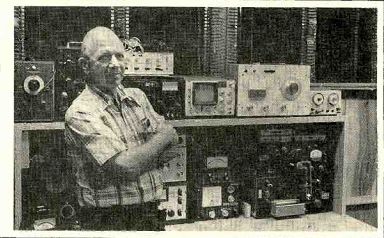
By Julian D. Hirsch
ARE MEASUREMENTS VALID?
Many people are so accustomed to interpreting the performance of high-fidelity components solely through measurements and specifications that they tend to lose sight of the real significance of those data. I see evidence of this in letters from readers and questions from friends that often indicate a preoccupation with the test numbers and a lack of under standing of what they really mean.
The only meaningful way to describe most physical processes exactly is in mathematical terms, although the meanings may then be somewhat obscured. For example, a large amount of data can be presented in a limited space in the form of a curve on a graph, and this is usually more easily interpreted than the mass of raw numbers that went into its crea tion. An oscilloscope waveform, such as a square wave or pulse response, is another "instant" expression Of a rather complex mathematical result which is (potentially, at least) easily interpreted.
Measurements themselves vary widely in the ease with which they can be made. Only rarely is the process so simple as connecting a test-signal source to the input of a device and reading the output on a meter or other instrument. Usually, a large number of special test conditions must first be specified in order for the measurement to be repeatable in another environment. (I am not talking about accuracy, which is another matter entirely, but merely repeatability.) To ensure repeatable (and therefore comparable) measurements, various organizations have issued standards that define all relevant factors in the test conditions. These are modified or superseded periodically as technological changes dictate. The goal remains one of interchangeability of test results, so that after Manufacturer A or Reviewer B has obtained a set of performance data on a product, I have a reasonable chance of duplicating the results when I come to test the same product.
You may have noted the "catch" in the preceding statement. Only very rarely will I be testing the same serial-numbered unit that was used by a manufacturer or anyone else to measure the performance. The manufacturer's specifications are derived from tests on a number of units and include (we hope!) a reasonable safety factor to allow for individual performance variations. Sometimes, competitive marketing pressures may lead a manufacturer to rate performance too close to the statistical mean of his quality-control distribution curve (some do this as a normal practice) instead of the more conservative approach of guaranteeing that every production unit will, as a minimum, satisfy the advertised claims.
In general, the test unit sent to a reviewer is taken from regular production (it would be prohibitively expensive for a manufacturer to design and construct a special review model of any complex electronic device). It may well be selected from the best performers from that production run or simply from those that meet their specifications by a reasonable margin. We request that manufacturers pre test the sample submitted to be sure that it is operating properly and that they send us a copy of their test data. The reason is simply to check on our own test results, so that we are alerted if some measurement is far off the mark.
Lest the reader conclude that we are sent "ringers" that do not accurately reflect regular production performance, we can say (regretfully) that only a small percentage of the manufacturers comply with our request for pretesting. As a matter of fact, we often receive a recently introduced product before its instructional literature or printed specifications are available. And in a growing number of cases we find units that in one or more measurements fail to meet-usually by a very small margin-advertised ratings. This is not quite the same as our problem of some years ago, when a significant percentage of test samples were defective on arrival or failed Tested This Month Sherwood Micro/CPU 100 Tuner ADS 810 Speaker System Yamaha CR-620 AM/FM Receiver Sankyo STD-2000 Cassette Deck dbx 128 Noise-reduction System (blew up!) during testing. This rarely happens today, but sometimes the effect of a small departure from rated performance is, from our standpoint, much the same as that of a total failure. For example, if a tuner with a rated IHF sensitivity of 1.9 microvolts is measured by us at 2.5 microvolts, there is likely to be total consternation on the part of the manufacturer. From our point of view, this is by far the most trivial "defect" a tuner can have ("backlash" in the dial mechanism is far more serious to me, and it will elicit a much stronger reaction than a sensitivity discrepancy of a couple of decibels). But since 1.9 microvolts is a published rating, the discrepancy is viewed with great concern, not only by the manufacturer, but by many readers as well. In a later article I will deal with the real importance of various ratings (and some of the much more important unpublicized and un rated factors).
PERHAPS you can see where all this is leading. There are basically two different aspects of measurements as they apply to high-fidelity components. First, the accuracy and repeatability of the actual measurement, and second, the significance of the measurement. Are deviations of a fraction of a microvolt in sensitivity-or a fraction of a percent in distortion, or a watt or two in power-anything that we really should be concerned about? And, following from this, what should be measured in order to define the performance or quality of a product? There are no easy answers (or any other kind, for that matter) to that last question simply because subjective values-which are quite different from objective costs-enter into the judgment. In the last analysis, we are not dealing only with electrical performance (or should not be, at any rate). Of course, that is a valid part of the story and one which can not be ignored, but it is given far too much emphasis and tends to be misinterpreted both by audiophiles and by the general public because of their desire to find an objective number that represents quality.
Sooner or later, we come to the human listener and how he perceives the sound field created in his immediate vicinity, whether from "live" instruments or from loudspeakers. The number of variables affecting that audible end result is so large that I would hardly be exaggerating if I called it nearly infinite.
Immersed in this mass of unknowns is a relative handful of measurements, such as noise and distortion, frequency response, and per haps a few hundred more that are routinely made on the components of a music system. I can say definitely, without fear of contradiction, that some of our measurements under some conditions sometimes correlate with audible effects. But sometimes they don't.
So what do we do-ignore all measurements and depend on subjective opinions alone? Some people believe this to be the right way (or at least at the moment the best way) to judge audio components, and there is, given the present state of affairs, a certain logic to their argument. However, individual tastes differ so widely that even the most perceptive, accurate, and unbiased listener (as though subjective criticism could ever be unbiased!) cannot hope to give meaningful advice to others whose taste in sound differs even slightly from his. To further complicate things, even the most open-minded people have an incredible capacity for self-delusion, hearing pretty much what they unconsciously expect to hear.
I see no likelihood that any objective test method will ever be devised that will be able to assign a figure of merit to the sound of a music system so that no one will have to listen to a component or system before he buys it.
Although all of us-manufacturers and re viewers alike-are constantly striving to arrive at measurements that minimize the vast uncertainty of objective testing, the goal continues to elude us.
In columns to come, I will be describing the individual measurement procedures used for each type of component, pointing out some of the limitations of the tests, and calling attention to some of the unspecified qualities of audio products that, to me at least, can be much more important than many of their advertised ratings.
======================
Regulars:
Editorially Speaking
THREE CHORDS AND SIX CHANGES
ASKED by an interviewer whether the blues is folk music, Big Bill Broonzy was predictably only half serious when he replied, "It's all folk music, 'cause horses don't sing." But troubadour James Taylor, inter viewed in this issue, was quite serious when he made very much the same observation:
" . . it's actually all folk music, what we listen to today. It has a self-made tradition, people who go out and shop for their own education rather than having one delivered to them. Sure, I'm a folk musician." But even that formulation, qualified as it is by the limiting not general enough for me: isn't all popular music, today and yesterday, the result, as Taylor puts it, of whatever "happenstantial kind of random musical environment" its composers grew up in? (There is, of course, very little that is "random" about a classical musical education.) No one, after all, grows up in a musical environment that is identical, either in quantity or in quality, to anyone else's. What we folk hear-and the order in which we hear it-goes irrevocably into the mix, and when we get around (like the Beatles, Joni Mitchell, or James Taylor) to producing music of our own, that mix is the one we must work with. And work it must, for we haven't run out of music yet.
Which is why it is a little difficult to take cultural vigilantes seriously when they prophesy that the degenerate cacophony of rock, or disco, or whatever, means at the very least the destruction of a whole generation's musical sensibilities, and perhaps the end of music itself. Of course we all know what "good" music is-it is that uniquely communicative, serious, soulful, wholesome, intelligently crafted, toe-tingling, mind-filling, and simply wonderful combination of sonic materials that has earned our personal endorsement, the kind of entertainment anyone in his right mind will agree deserves all the prizes and the right to ravish the world's ear. So why doesn't it work out that way? Why is there all this un musical crud around? There are at least a couple of reasons, one of them being every generation's psychological imperative: discover your identity and establish your autonomy. One of the ways this is done is by inventing a music that will define your uniqueness while maximally insulting the musical prejudices of your parents.
Another reason is that "mix." It is one of the sad facts of American culture that the arts particularly music-are given scandalously short shrift in our schools. The average young person in this country knows nothing about music-what it is made of and how it is put together-after eight years in elementary school, eight more in high school and college.
Little wonder that they often settle, in their "folk" music, for three chords and six clumsy changes. Why, instead of denouncing these perfectly valid though technically simple expressions, don't parents insist that a little music be taught in schools? ( Reading mu sic is, after all, no big deal; five-year-olds can do it.) If the parents and the schools have been lax in fulfilling this obligation, perhaps it will be picked up by a different educational medium.
Washington, D. C. station WETA-TV last fall ran a series of programs "guaranteed to make youngsters love music while they're learning about it." Each program covered a different aspect of music-"Music Is . . . Rhythm" (and Melody, Harmony, Tone Color, Form, Style, Composed, Conducted, Improvised) with examples drawn from Baroque to rock and everything in between. The series was also made available for rebroadcast by other public-TV stations. If you missed it, hold your breath-the producers are already at work on a sequel, and Congress is at work on a bill for further funding. If the good senators have been listening to the new wave of "folk" music lately, it's bound to pass.
=============
LETTERS TO THE EDITOR
Comparing Loudspeakers
The "Safe Speaker Reviews" item in the October "Audio Q. and A." and the November review of the ESS amt lb speaker system make some good points about speaker comparisons that I would like to add to. My experience is that the human mind has almost no memory for the quality or details of sounds.
Differences between speakers do show up clearly if you are listening to one and then switch suddenly to the other--but after a few seconds you lose track of what the first speaker sounded like. Therein lies a danger for the unaware speaker shopper. Any speaker he listens to for a period of time will come to be the norm, since the memory of how other speakers sounded is as short-lived as a dream upon awakening. And without a live source to com pare them to, quite different speakers may seem to be equally good. Finally, to confuse the matter further, a given speaker may sound different depending upon one's position relative to it. One study I have heard about even suggests that the differing shapes of people's outer ears and even ear canals account for some of the differences in our perceptions of sounds!
FRANK CICCONE; Naugatuck, Conn.
Technical Director, Larry Klein replies: I find that the trick when evaluating speakers by ear is to focus on what sounds wrong, rather than on what's right. If you are able to mentally characterize a given speaker system as boomy, shrill, or nasal (or, more scientifically, as having response peaks at 100, 8,000, or 2,000 Hz, respectively), you are then in a position to re member-and compare-its special sound "signature." Of course, this will work only with speaker systems that have specific characteristics that can be clearly labeled-which is why it is difficult to differentiate between accurate speakers.
The physical idiosyncrasies of people's outer (or inner) ears are not really relevant to how they perceive loudspeakers, since both live and reproduced music will be affected the same way. However, this factor may influence the relative performance of headphones, since the ear itself is the "acoustic environment" into which headphones radiate and differently shaped ears may relate differently to the same headphones. It is possible to change the subjective frequency response of some head phones (particularly the stethoscope type) by moving them about on, over, or in one's ears, since this may affect how well the high-frequency radiating part of the phones is focused on the tympanic membrane (the eardrum).
Government Support
Although I don't always agree with William Anderson's editorials, I find them consistently well thought out and effectively argued. "Culture Snobs" in the November is sue is certainly no exception. For the most part I agree with it. The tax dollars of opera and symphony goers in New York City help pay my salary at NASA; why then should I get upset if a much smaller fraction of mine goes to support culture in New York (and, of course, elsewhere as well)? My only reservation is that whatever the federal government supports it eventually seeks to control, and whatever it controls it screws up-and I love good music enough to be awfully scared at that prospect. I hope that in the arts we will see federal support without federal interference, but my hope is mixed with trepidation.
DAVID R. SCHRYER, Hampton, Va.
The Editor replies: Mr. Schryer has a point. What makes me nervous is the possibility of bureaucratic elephantiasis, with all the grant money being swallowed up in administrative paperwork-reports, position papers, studies, and surveys-before it reaches the performing level. There has already been a move by Sen.
Abraham Ribicoff (D-Conn.) to put the National Endowment under the control of HEW or the new Department of Education. Now I wonder why he'd want to do a thing like that? JT and JB
Applause to Peter Reilly for his superb re view of Barbra Streisand, "The Indomitable One Is Back," in the October issue. I have one question, however, with respect to his otherwise excellent review of James Taylor's "JT," in which he states that "Taylor re mains the single artist in pop who can tell it like it is without sending you off either to the hills with a hatchet, a flint, and a hunting dog or straight to the nearest Disney movie." Has Mr. Reilly never heard of Jackson Browne?
DONNA L. BOTT Davis, Calif.
More Beatle facts
Some time ago I came across the August 1977 issue of STEREO REVIEW. The article en titled "Rediscovered Historical Beatlefacts" by Steve Simels especially caught my attention, but when I got one of the records discussed in it--"Live! at the Star-Club in Ham burg," issued by Lingasong-I had a surprise.
I think that was the record Mr. Simels held in his hands, but there are discrepancies be tween the list of songs on it given in the article and those actually on the record. I Saw Her Standing There, Twist and Shout, Reminiscing, and Ask Me Why were on the list but not on the record, and I'm Gonna Sit Right Down and Cry, Where Have You Been All My Life, Till There Was You, and Sheila were on the record but not on the list.
JERZY BOJANOWICZ; Pruszkow, Poland
Mr. Simels "held in his hands" the version that was released in the United Kingdom and Germany (note that he said it was an imported record). The version later released in the Unit ed States (and Poland, apparently!) had the four replacements Mr. Bojanowicz mentions but it wasn't available here until after the magazine had gone to print.
TV Sound
In his answer to a reader's letter about the possibility of adding a TV-audio function to FM receivers (October 1977 "Audio Q. and A."), Larry Klein says that it would cost "perhaps $50" extra and concludes that "if any manufacturer was convinced that there was a large enough TV-audio hi-fi market out there, he would do his best to stake out his share of it." I, for one, would be willing to pay as much as $100 more for such an addition. I'm a movie buff and, as a hobby, tape the soundtracks of films shown on TV. Every so often Channel 6 in my area broadcasts a musical and I am able to play it through my receiver; the sound is rich and full, far better than that heard from current TV sets. Can you check whether any manufacturers are working on this?
JOHN G. WINDSOR; Langley, British Columbia
Larry Klein replies: So far as I can tell, every one is watchfully waiting to see what the next guy does--and how successful TV sound is in the hi-fi marketplace. Several Japanese manufacturers have expressed interest, and there are even a few TV-audio tuners (some with a three-inch picture tube!) on the domestic Japanese market. But for some reason they seem shy about bringing their TV-sound products into the U.S. If I see any prototype AM/FM/ TV tuners at the IHF Trade Show in Atlanta this spring, I'll let y'all know.
Joan Baez
A few years ago, music critics were at tacking the political nature of Joan Baez's recordings. Now Paul Kresh attacks her person al songwriting on "Blowin' Away" (November) as full of "self-pity" and "self-absorption." He completely ignores the compassion in such songs as Luba the Baroness and The Altar Boy and the Thief, and he totally misses the leavening humor of Time Rag (which, judging by his inaccurate summary, he hasn't really listened to). Mr. Kresh says he would gladly trade in the "new" Baez for the old one, but they are the same. How about trading in his review for one by Peter Reilly?
TERRY HARPER; Loma Linda, Calif.
Paul Kresh replies: I love to hear Joan Baez sing. I just don't like her much as a songwriter. On the other hand, she has made such a profession out of sounding hurt that I would be the last to want to wound her further. If I didn't understand Time Rag, which hollowed faithfully with the text, it wasn't for lack of trying. Anyhow, if ballads are going to be writ ten about magazine interviews, where will it all end? The next thing will be rhymed attacks on record reviewers. Who could bear it?
Direct-to-Disc
In the October editorial, "Cottage Industry: Direct-to-Disc," William Anderson presents some strong arguments against the d-to-d idea. The prices ($12 to $16) are, admittedly, impractical, and the technique does not allow for large-quantity pressings. But having recently cut my first d-to-d recording ("Grant Johannesen in Recital, Direct-to-Disc versus Tape-to-Disc"-Golden Crest CRDS-1, two discs), I cannot agree with Mr. Anderson's impression that the outcome is "not free, spontaneous music-making, but pussy-footing carefulness." I had previously made recordings only via the tape method, and when I was asked to consider putting what amounts to a concert performance onto discs I naturally hesitated.
We have been spoiled by the recording studio, where with rare exceptions artists opt for a "collage" performance-which is hardly "spontaneous music making"! I emerged from the d-to-d session strangely exhilarated.
The clinical aspect of recording was absent.
True, there are some performance flaws in the result, but something else, something spontaneous, also surfaced in these readings.
The "nagging imperfections" Mr. Anderson points out that we risk by direct cutting are more than compensated for by the superior sound ("absolutely fantastic sound" in his words). For a performer, the possibility of gaining a true mirror of his immediate expression seems to me reason enough to choose this method. It may be that d-to-d records are necessarily limited editions. The mass industry needs a reminder from time to time of the ordinariness built into it! Recently I have ob served that young listener are seeking out old 78-rpm recordings for performing inspiration.
Might it not be possible that they recognize there a purer musical thought process than the stitch-work they have grown up with?
GRANT JOHANNESEN; President, Cleveland Institute of Music; Cleveland, Ohio
There have been several essays recently in STEREO REVIEW criticizing the general lack of consistent high quality in the mass production of phonograph records and touching upon "new" recording techniques. For the past fifteen years I have spent part of almost every day debating the relative merits of technical improvements in record manufacturing as they affect the music on the discs. I believe that a record buyer hopes to get a performance that will, in the current idiom, "turn him on." The producers of rock recordings go to great lengths in the recording process to achieve that result, and producers of classical recordings have no less a responsibility.
The record buyer must assume that the producers have engaged performers who have the ability to produce inspired performances.
But no reasonable or conscientious producer can expect even the most brilliantly gifted performers to be technically perfect and inspired all the time. To ask an artist to give a note-perfect, musically inspired performance over a period of fifteen to twenty minutes, as in direct-to-disc recording, is clearly inhibiting. In a tape session, we do everything we can to help the artist forget he is playing into a microphone. He is asked to take every risk that he might consider justified in a live performance, and to understand that if there is any error or miscalculation, the passage can be corrected. Inserting one or two corrected notes seldom has any effect on the curve of a beautiful phrase, whereas leaving obviously wrong notes in can be irritating to the listener who buys the finished product. Therefore, Editor Anderson is absolutely right (in October's "Editorially Speaking") about the aesthetic limitations of direct-to-disc recording.
Moreover, with advances in tape formulations and the recording and reproducing electronics, a taped performance has virtually the same potential for high-quality sound as a direct-to-disc recording. The greatest technical problem in records today is not the quality of the original master but that of the pressing the consumer purchases. It is both theoretically and practically possible to produce a disc that is as quiet as the source material it re produces, without the clicks, pops, tearing sounds, etc. that plague so many records to day and anger consumers.
E. ALAN SILVER; President, Connoisseur Society, New York, N.Y.
Correction
An uncaught printer's error in the caption on page 24 of the December 1977 issue changed "uninsulated" to "insulated." The sentence should, of course, have read . . . make sure not to touch the uninsulated parts of the prods."
=================
Books Received
The Devil's Music: A History of the Blues, by Giles Oakley. Taplinger Publishing Company, New York (1977), 287 pages, $14.95.
"Africans brought African music into white society. They took white music and changed it to African. And then they changed it back again. So we have ragtime (pure), jazz (impure, hot, mainstream, cool . . ), and of course the spirituals (Amen). But underneath all this . . . we have-permeating all-the blues, and who can blame us?" Who indeed? From the cotton fields and "piney woods" of the Mississippi Delta to Jackson and Memphis and St. Louis and Chicago and Detroit and New York, the blues traveled this country.
Giles Oakley allows the musicians and their friends who were there to tell the history of the blues, to define the blues in anecdote and song lyric. It is a fascinating story. Moreover, this is a handsome book, illustrated with con temporary drawings and photographs. Originally published by the BBC in Great Britain, The Devil's Music includes an index, extensive references, a selected bibliography, and a short discography. Excellent.
-L.G.B.
Musical Chairs (A Life in the Arts), by Schuyler Chapin. G. P. Putnam's Sons, New York (1977), 429 pages, $12.50. In this apologia the author traces the principal events of a career in musical administration that led, with a good deal of unattractive tergiversation on the part of the management, to his appointment as general manager of the Metropolitan Opera in 1973 following the tragic death of Goeran Gentele. In 1975 he was unceremoniously dismissed, and this, for lovers of back stage intrigue, is his account, recollected in tranquility, of How It Happened. Toward the end there appears a regret-filled observation that perhaps ought to have been made the motto of the book: "I sensed once again the undercurrent of viciousness and cruelty that seems to be a historic part of the artistic life of the world, the desire to pull down anyone who reaches a certain pinnacle, the unspoken jealousy of desire and envy. This is a human condition, one that applies to any walk of life and activity, but in the arts it seems especially painful as one is essentially dealing in some thing that is supposed to be beautiful and bring beauty to others. . . ." But it is a compelling story, and there must now be more than a few who have cause to regret that Mr. Chapin can write.-W.A.
Starmaking Machinery: Inside the Business of Rock and Roll, by Geoffrey Stokes.
Vintage Books, New York (1977), 234 pages, $3.95 softbound. Village Voice writer Geoffrey Stokes offers a thorough and accurate account of the producing and selling of one album by the country rock group "Commander Cody and His Lost Planet Airmen" in 1974. Through a chronicle of events and conversations that take place in studio sessions, legal offices, and backstage dressing rooms, Stokes exposes the complex maze of machinery and men that is behind the business of making records to make money. This unglamorous look at the industry may not thrill rock fans, but it is a must for anybody planning to enter the arena. (The original hardbound edition of Starmaking Machinery was published in 1976 by the Bobbs-Merrill Co., Inc., $8.95).
The Tuning of the World, by R. Murray Schafer. Alfred A. Knopf, New York (1977), 301 pages, $12.95. This rich, ambitious book is a discussion of two interrelated new disciplines: acoustic ecology and acoustic design.
Schafer's concern is with the sonic environment-the "soundscape"-and the way it tends to be degraded from a naturally "hi-fi" state to a "lo-fi" one in which interesting and meaningful sounds are swallowed up in an ever higher level of background noise. Many of his proposals will seem utopian, but they are thought-provoking nonetheless, and his descriptions of a wide variety of natural and man-made sounds and soundscapes--including many "endangered species"-are alone worth the price of the book. Indexed, with glossary, appendices, notes, and illustrations.
The World of Earl Hines, by Stanley Dance. Charles Scribner's Sons, New York (1977), 324 pages, $14.95 hardbound, $7.95 softbound. Stanley Dance has been listening to Earl "Fatha" Hines since 1928. He corresponded with him for several years after World War II (Hines replied on tapes and of ten filled out a tape on the piano), and since the middle Sixties he has served as a kind of amateur manager for the pianist. Would that more great men had such knowledgeable and sympathetic biographers. The World of Earl Hines is an "oral history," much of it told in the first person by Hines himself, which is supplemented by a chronology, a bibliography, a discography, and a general index.
There are reminiscences by such jazz luminaries as Teddy Wilson, Milt Hinton, Dizzy Gillespie, Trummy Young, and Charlie Carpenter, and everything is surrounded by photographs, over 120 of them. Good reading, good looking.
-L.G.B.
Recorded Sound Research (1506 W. Barker, Peoria, Ill. 61606) offers several pamphlets of interest to record and tape collectors. Col lectors' Contact Guide 1975 (58 pages, $4) lists dealers for specialized recordings, service places for antique equipment (such as Edi son cylinder machines), and special-interest societies and associations of collectors, as well as giving bibliographies of other directories, discographies, etc. Sound Search (35 pages, $7) lists sources for recorded material in several specialized areas (such as radio broadcasts, railroad sounds, "Watergate"--related items, and dance music), plus an extensive bibliography of the free magazines in the audio field. The Unauthorized Duplication of Sound Recordings (61 pages, $6) is a reprint of a 1957 Senate subcommittee study concerning the application of copyright law to records and tapes.-D.S.
==============
The Pop Beat
By Paulette Weiss
Gary Lawrence (right) and vocalist Frank Scafuri with Pop Editor Weiss during a recent Sizzling Syncopators engagement (photo by Bill Spilka)
BING CROSBY (1901-1977)
BING CROSBY made an appropriate last exit (laughing, you may be sure) on a golf course near Madrid last October. We were saddened, but not shocked as we were at the death of Elvis Presley, for Bing had led a long, rich, thoroughly enviable life. Written tributes, eulogies, and perhaps even scholarly musical studies will continue to keep his image before us for some time to come, but it took the "hot" medium, television, to put into focus for me one aspect of this artist that I have always found particularly appealing:
Bing performing in tandem with another pro is, I think, proof positive of God's good will toward mankind.
On October 24, CBS rebroadcast the TV special celebrating Bing's fiftieth anniversary in entertainment. Although the one-and-a-half-hour-long program featured him soloing often and delightfully (notably in one sparkling medley of twenty-two hits), he rekindled my affection most endearingly in a series of brilliant, laid-back duets with other famous folk. His comedic timing was exquisite with the mock-raunchy Pearl Bailey on Gone Fish-in', his scatting with the Mills Brothers on Di nah was a piece of jazzy improvisation that warmed the heart, and the jaunty duet on Accentuate the Positive with Bette Midler illustrated on the spot why the Divine Miss M said she would have been content just to "stand here and worship you up close." The TV camera caught Bing in one rare accidental moment that spoke volumes about his art. As Pearlie May rose from her seat in the audience, robustly complaining in a "spontaneous" reaction to Bing's performance, Bing could be seen ever so faintly mouthing her lines. Even when she joined him on stage and the rehearsed nature of the little skit became obvious, all those prepared quips still seemed as bright as new pennies.
Bing was a master of that kind of easy re partee, a fine recent example being the wonderful extra-musical dialogue with Fred Astaire on their last album together, "A Couple of Song and Dance Men" (United Artists LA-588-G). That material was authentically spontaneous. Still, the moment of revelation on the tube started me wondering just how many of those light, witty past collaborations were actually plotted out. But after hours of rummaging happily through old discs pairing Bing with the likes of Frank Sinatra, Louis Armstrong, and Johnny Mercer, and giggling as the famous team of Hope and Crosby once again trekked down all those Roads on the TV screen, it hardly mattered. Manufactured or not, the flip, improvisatory dialogue has kept its freshness over the years.
I look forward to more of the same in Bing's last two TV specials (yet to be aired at the time of this writing), one with David Bowie, the other the traditional Crosby family Christmas show. Recordings of these programs seem destined to join the flood of memorial discs that has already begun. MCA, now the owner of the Decca label for which Crosby recorded the bulk of his early work, has reissued a two-disc "Best of" package (MCA 2-4045), plus a disc of Christmas material, two more of Irish ditties, and another "Greatest Hits" album (MCA 3031). Polydor is to release Bing's last recording before his death, "Seasons," in early December. United Artists will be adding a two-disc collection including material from Bing's 1977 London Palladium stint to be called "Something to Remember You By" on the heels of a disc called "Beautiful Memories," and London, Columbia, Epic, RCA, and small labels like Vocalion, Biograph, and Spokane are all moving into production with their own bits of Crosbyana.
Bing Crosby taught pop music how to lean back, relax, and talk to us. Leaving us late in a year of extraordinary loss in the entertainment world (Elvis, Groucho Marx, Paul Desmond, Leopold Stokowski, Maria Callas, Marc Bolan, three members of Lynyrd Skynyrd, Guy Lombardo . . .), Bing is one old acquaintance who will not soon be forgotten.
=====================
Going on Record
PIPE DREAMS
YEARS ago I was doing a lot of research in European libraries and archives, searching for music, particularly seventeenth- and eighteenth-century trumpet music, that had sufficient interest to be worth recording. Such was a major part of my low paying but highly interesting job at the time. In my researches, I ran across a mention of a trumpet concerto by Wolfgang Amadeus Mozart. Now that would obviously be a major find. I had never heard of a trumpet concerto by Mozart, but if it in any way approached the level of the Haydn concerto-and how could it not, seeing it was by the great Mozart?--it would have to turn out to be one of the masterpieces of the trumpet repertoire.
It has been too long for me to remember just where I saw that reference, but I know I followed the trail of the Mozart trumpet concerto until it petered out in the wilderness.
Wolfgang Mozart's trumpet concerto was either irretrievably lost or had never existed at all. Perhaps the commentator had mistaken the trumpet concerto by the father, Leopold Mozart, for an early work by the son. Leopold's concerto, fairly well known and recorded a number of times, is quite a different animal from what his brilliant son might have produced (being technically rather difficult and musically something of a bore).
I still want to hear Wolfgang's concerto, even if it never existed. And the tantalizing thought of it recently set me to imagining what other works that had never been written I was also hungry to hear. Composers, even long-lived ones, don't always get around to doing everything they plan, and lots of promising compositions get left at the sketch or even the thought stage. But even beyond those, there are works one simply wishes the composer had essayed, works he may never even have considered.
I can think of few more desirable works to have in the repertoire than a string quartet by the mature Gustav Mahler. Why? Because the particular style and tone cultivated by Mahler does not otherwise exist in the quartet literature, and the restrictions of that medium might well have drawn from him a tighter and more consistently intimate music than he composed elsewhere. It is quite a historical jump from the last quartets of Beethoven and Schubert and those of Brahms to the Schoen berg First. Mahler would bridge the gap.
One might also wish for an opera from Mahler, or, if not actually wish for it, at least wonder why this man who was so great an op era conductor never tried to write one him self. Certainly he knew how to write for the voice (witness his songs), and certainly he knew what made operas work. But he never got around to trying one, and that is a disappointment.
Hugo Wolf had far less going for him to be a successful opera composer, and yet he did write one opera (Der Corregidor) and begin another. Unfortunately, he didn't seem to know what makes operas work, and his, de spite many fine things in it, doesn't. Wolf, of course, was a great admirer of Wagner. It is a pity he didn't like Brahms better, for he might then have chosen to write us a set of Liebes lieder Waltzes in emulation of the two sets by the older man. A bittersweet love song was something Wolf understood far better than an opera. A pity he didn't get around to writing a set of them for four voices and piano four hands.
One can think of all sorts of things to want from Schubert: more quartets, more symphonies, more songs, more trios, more Masses, and on and on; the man was both so great and so young when he died. One might reasonably ask for a piano concerto, though Schubert never wrote a real concerto of any sort and may simply have had no interest in the form.
What I really want from Schubert, though, is a Viennese operetta. Operettas have been made from his music (it is absolutely amazing the melodic inspirations Schubert threw away in little dance pieces for piano), but the genre of Viennese operetta developed after his death, and he never had the chance to write one. His operettas are of a different genre entirely, and the Vienna in which he lived be came "romantic" only retrospectively.
FROM Brahms, I think, I would like a triple concerto, for he did so well with the Double.
Whether it should be the Beethovenian combination of violin, cello, and piano, or some thing else, like violin, viola, cello, I haven't yet decided. From Beethoven himself I can see an oratorio on the lines of Haydn's Creation. As a matter of fact, I can virtually hear it in my head, and I'm sure I'm not the only one who can. Beethoven and Haydn had some words together about The Creation, and that may very well be why he never tried anything of the sort (I'm sorry, but Christ on the Mount of Olives is not in the same league).
Moving farther afield, I would certainly re quest from Rossini a symphony or two. Yes, he wrote a Sinfonia of sorts, but that turned out to be an operatic overture, and I want a real four-movement symphony in his best quicksilver style. And speaking of quicksilver, I have always wanted another string octet to play after the Mendelssohn. I'm sure he could have given us a second one, but how about one by Maurice Ravel? I certainly would have liked another opera from Debussy, not to show that he could write Pelleas again (though I'm a great booster of Pelleas), but to show another side of his complex and fascinating personality. Debussy wanted another one too, and he had exactly the right story for it: Edgar Allan Poe's Fall of the House of Usher. He never got beyond sketches for it; another pity.
We did get a few operas from Vaughan Williams (though God knows we hear them seldom enough), but not the one I want. VW's literary taste never did seem to go in that direction, but can you imagine a Pickwick Papers from him? Or some other Dickensian subject? I can. I can almost taste it, let alone hear it.
THE imagination tends to work faster the more one gets into this sort of thing. To close with a rush then, let me just list the others.
From Vivaldi, a concerto for two trombones.
From Grieg, a violin concerto based on Norwegian fiddle tunes (as is his Skitter for piano solo). From Purcell, a bawdy oratorio.
From Weber, a ballet score (a real one). From Moussorgsky, a movie score. From Haydn, some viola quintets. From Copland, a set of "little operas" based on short stories by Irwin Shaw. From Chabrier, a group of cabaret songs. And from Leonard Bernstein, all I want, alas, is another Candide.
-----------
====================
Also see:
Source: Stereo Review (USA magazine)