Jackson Browne's "Running on Empty": Mature, Chance-taking Phono-realism
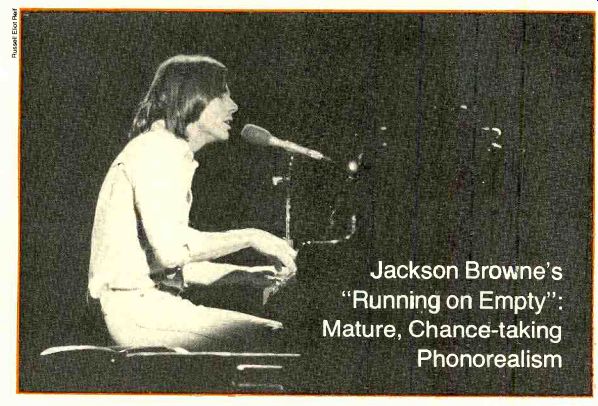
ON the face of it, nothing would seem less likely right now than a gritty, unsentimental, insightful revitalization of one of rock's most played-out themes-the psychic travails of Life on the Road-by a singer/song writer whose previous recorded Laments have verged perilously (to echo Doonesbury creator Garry Trudeau) on mere Whines. But clearly Jackson Browne, heretofore recognized as the Mellow Sound's Premier Metaphysical Pretty Face, is toughening up his act, and "Running on Empty," his latest al bum for Asylum, has both the real rocker's raw-edged sensibility and a film maker's unflinching reportorial eye.
The film reference is not gratuitous.
"It's a rock-and-roll band or a movie, you can take your pick," Jackson sings toward the end of the albuni, and in fact the whole structure of the thing re calls cinema verite documentaries a is the Maysles Brothers. It was recorded live in a variety of settings, both in and out of concert halls, the apparent idea being to convey some sense of how a touring musician lives and how this life reflects upon the way he plays, to portray the alternately numbing (Cocaine, complete with somewhat updated lyrics) and inspiring (The Load-Out) effects of musical communication as a vocation. It's a concept fraught with the perils of mawkishness and self pity, but it is brought off sensationally, even the potentially hokey stuff, as when an acoustic hotel-room version of Danny O'Keefe's The Road suddenly segues in mid-song into an on-stage, full-band electric performance, or when a long and lovely tribute to Jack son's audience metamorphoses into that most sublime of early r-&-b chest nuts, Maurice Williams' Stay. Jackson's music has never been so startling; for the first time, there's real rock-and roll bite to his performances. Truth to tell, his records have always had a superficial patina of "prettiness" that undercut what he seemed to want to get across. Here, however, his regular re cording band works out with a vengeance, and the raw clatter adds a weight and an authority to his lyrics that the relative perfection of the sounds of his studio efforts never could.
In short, "Running on Empty" represents the work of an artist newly matured and unafraid to take risks, a breakthrough comparable to Neil Young's post-"Harvest" realization that the wonders of studio technology do not necessarily provide a path to Total Enlightenment. And, finally, it gives' the most resonant and interesting answers to all the questions implicit in the Byrds' oversimplified So You Wanna Be a Rock-and-Roll Star? It's a marvelous, compelling piece of work that has converted this rather halfhearted admirer into a total, unabashed partisan.
Phonorealism has never before sound ed this good.
-Steve Simels
JACKSON BROWNE: Running on Empty. Jackson Browne (guitar, piano, vocals); David Lindley (fiddle); Russ Kunkel (drums); Craig Doerge (keyboards); other musicians. Running on Empty; The Road; Rosie; You Love the Thunder; Cocaine; Shaky Town; Love Needs a Heart; Nothing but Time; The Load-Out; Stay. ASYLUM 6E-113 $7.98.
Honegger's Jeanne DArc au Bucher In Its Best Recording to Date ARTHUR HONEGGER'S Joan of Arc at the Stake is an uneven work, and its reputation has, I suspect, tended to affect the composer's stature by ob scuring the virtues of his symphonies and other compositions. There is no question that his King David is a superior work: it has more musical integrity and a more judicious balance between musical and dramatic elements. Joan, a staged oratorio on the play by Paul Claudel, is one of those daringly ambitious efforts that is ultimately admired more for objective and motivation than for actual accomplishment. There was at least one Belgian recording of Joan before the microgroove era, and Columbia has given us two LP versions one in mono, in French, under Eugene Ormandy and, about ten years ago, a stereo recording in English under Seiji Ozawa, both of these with Vera Zorina in the title role. That no recording in either language is listed in the current Schwann seems to confirm a general lack of enthusiasm-but there is a new version from Supraphon now, in French. and it might well succeed in bringing about a more receptive attitude toward the work. It is, in any event, the strongest case yet made for it in recorded form.
This conjecture is based not so much on the idiomatic control of the score shown by Serge Baudo and the Czech Philharmonic (who have recorded together all the Honegger symphonies and several of his other works) as on the unprecedentedly credible realization of the work's dramatic content and the superb integration of the music and drama with each other. Both the children's and adult choruses are Czech, as are four of the seven solo singers, but Baudo brought all the actors with him from France, and they are, without exception, men and women who have lived with the work, who obviously believe in it, and who know how to bring it to life. They triumph over Claudel's frequently stuffy text by avoiding the grand declamatory style in favor of thoughtful characterizations on a con vincing human level, and by allowing the action to flow with the music.
Nelly Borgeaud, in the title role, succeeds in giving us a real flesh-and-blood Joan, a nineteen-year-old girl who knows fear and pain and simple joys as well as her sense of divine mission, rather than the self-conscious warrior-saint so often thrust at us. It' is to her that much of the credit for the success of this performance must go, for with out her-without her sort of Joan-all the fine singing and playing would count for little. She, Baudo, and their various associates ake it hard for any listener to remain unaffected by the work, uneven though it may be.
Supraphon has done a fine job of recording. The booklet and box indicate SQ quadraphonic sound, but the discs are labeled to indicate only two-channel stereo, in which mode the sound is rich and clear. The Ondes Martenot is (are?) heard to great effect without being given undue prominence, and the choruses are well balanced with the orchestra. I only wish the words sung by the choruses were more consistently intelligible-but perhaps this could not be achieved without altering the well balanced sonic frame. A forty-page booklet gives the text and annotation in French, English, and German.
-Richard Freed
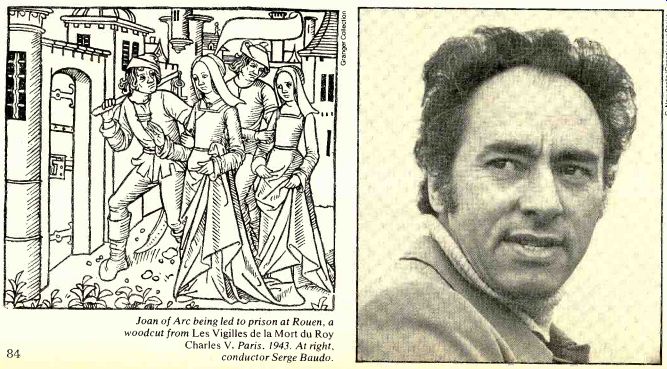
--- Joan of Arc being led to prison at Rouen, a woodcut from Les Vigilles de la Mort du Roy Charles V, Paris. 1943. At right, conductor Serge Baudo.
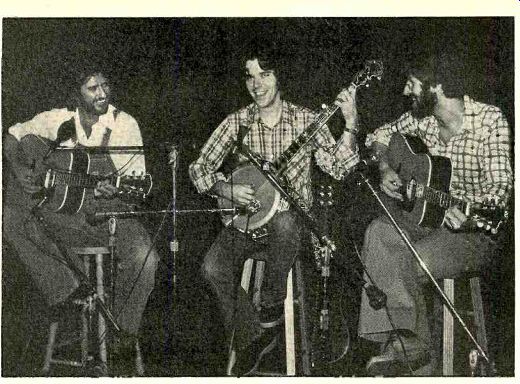
--- Larry McNeely (center), with cohorts Jack Skinner (left) and Geoff Levin (right), live at McCabe's.
HONEGGER: Jeanne d'Arc au Bikher. Nelly Borgeaud, Jeanne; Michel Favory, Brother Dominique; Rene Brun, Regnault de Chartres, Jean de Luxembourg, a Peasant, the Priest, the Ass; Francois Loup (bass), Second Herald, Guillaume de Flavy, the Usher; Annie Gaillard, a Voice, Mother Wine; Tony Jacquot, Heurtebise, Bedford, Third Herald, Another Peasant; Anne-Marie Rodde (soprano), Marguerite, Perrot; Christiane Chateau (soprano), the Virgin; Huguette Brachet (alto), Catherine; Pedro Proenza (tenor), Le Clerc, First Herald; Zden6k Jankovskjt (tenor), Porcus; Lenka Loubalova, a Child's Voice; Frangoise Deslogeres (Ondes Martenot). Czech Philharmonic Chorus; Kuhn Children's Chorus; Czech Philharmonic Orchestra, Serge Baudo cond. SUPRAPHON 1 12 1651/1652 two discs $15.96 (from Qualiton Records, 65-37 Austin Street, Rego Park, N.Y. 11374).
Larry McNeely, New Banjo King: Fast, Clean, And Original YOUNG Larry McNeely is my nomination for next king of the banjo.
You might not have suspected it if you heard him a few years ago in Roy Acuff's band, but he's got great imagination and verve, and I believe he's finding new directions for the instrument to take. You can't go by crowd noise where banjos are concerned, of course-crowds tend to cheer a banjo before it's even played-but Mc Neely's new Takoma recording with Jack Skinner and Geoff Levin, "Live at McCabe's," shows the difference between that kind of cheering and the surprised, involuntary kind that hap pens because the thing was so good.
The three performers hit it off chemically as well as musically. Levin does some impressive flat-picking, especially in the very first piece, and Skinner's sunny, engaging personality influences the whole album. McNeely was a little farther out than this in his studio album released a few months ago-and, you might say, a little more inventive. This one is more basic and condensed, but take a listen to Giza, which he wrote, if you want to hear some original ideas about the banjo. If you want technique, listen anywhere; of all the banjo players I know about, only two-Earl Scruggs and Vic Jordan-may be able both to conceive and to execute in the same class with McNeely, and I'm not sure even they can play as fast and as clean at the same time. Have I made myself perfectly clear? I think the kid is super.
-Noel Coppage
LARRY McNEELY: Live at McCabe's. Larry McNeely (banjo, guitar, vocals); Jack Skinner (bass, guitar, vocals); Geoff Levin (guitar). Earl's Breakdown; Hilltop; Silver-bird; Giza; Shuckin' the Corn; Honeysuckle; Grey Eagle; Jerry's Breakdown; Slow Train; Midnite Rider; Number Five. TAKOMA D-1060 $6.98.
Liszt's Faust Symphony: Bernstein and the Boston Surpass All Predecessors ERANZ LISZT was no traditional symphonist; the free form of the sym phonic poem was his true orchestral medium. Nonetheless, on the two occasions when he chose symphonic scope for his grandiose designs-the Faust and Dante Symphonies-he achieved remarkable results.
Of course, he was not one to adhere rigidly to classical symphonic design.
The three long movements of the Faust Symphony are "character sketches" for Faust, Gretchen, and Mephistopheles. The choral apotheosis added to the third movement abandons the sardonic point of view that precedes it in favor of a solemn philosophical perspective, thereby giving the work an uplifting summation. Leonard Bern stein is not alone in suggesting, in the notes for Deutsche Grammophon's new recording of the work, that the Faust Symphony is "perhaps the one authentic orchestral masterpiece that Liszt ever wrote." There are a number of master strokes that support that contention: the profusion of intense themes in the first movement, so descriptive of Faust's restlessly searching character, the delicate Berlioz-like orchestration of the Gretchen movement, and the ingenious use of parodied "Faust themes" in the last movement to characterize Mephistopheles as the spirit of negation.
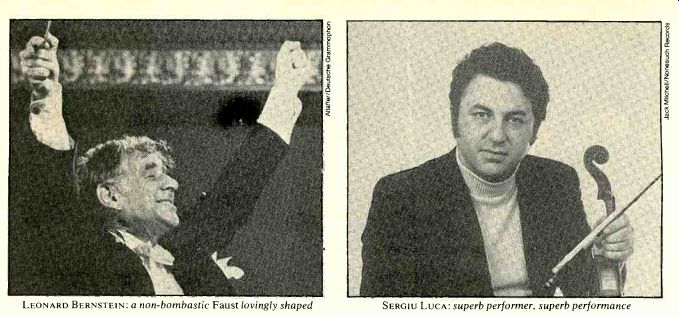
---- LEONARD BERNSTEIN: a non-bombastic Faust lovingly shaped; Luca: superb
performer, superb performance
Of the several previous recordings of the Faust Symphony, two have been rated as generally superior to the others: Beecham's early stereo version with the Royal Philharmonic (Seraphim 6017) and Bernstein's more up-to-date effort with the New York Philharmonic (Columbia MG-699). I am happy to re port that Bernstein's new recording surpasses all its predecessors. He paces the music in a more leisurely manner now, and this makes the first movement more eloquent and the slow movement more affectionate. He also obtains a more polished orchestral performance from the Boston Symphony players than he did from the New York Philharmonic's a dozen or so years ago, as well as richer and better-balanced sonics from his engineers.
This is an altogether admirable performance, dignified, non-bombastic, and lovingly shaped, with orchestral details realistically captured. And it should be added that tenor Kenneth Riegel is a sweet-toned and expressive soloist in the closing Goethe text.
It was a splendid idea to let this whole program "go to the Devil," so to speak, by devoting the fourth side to the exciting Prologue to Boito's Mefistofele. The orchestra here is the Vienna Philharmonic, and it responds stunningly to Bernstein's lusty leadership.
The chorus is good, if not the last word in incisiveness where Boito's clever verbal high jinks are concerned. And Nicolai Ghiaurov, ever a commanding singer. is not as formidable in projecting his lines as he was in his vocally sumptuous and effortlessly solid rendition for Silvio Varviso a number of years ago (London 26021). Technically, the recording is excellent. Deutsche Grammophon also deserves praise for its uncommonly silent surfaces.
-George Jellinek
LISZT: A Faust Symphony. Kenneth Riegel (tenor); Tanglewood Festival Chorus; Boston Symphony Orchestra, Leonard Bern stein cond.
BOITO: Mefistofele: Prolog. Nicolai Ghiaurov (bass); Vienna State Opera Chorus; Gumpoldskirchner Spatzen (Boys' Choir): Vienna Philharmonic Orchestra. Leonard Bernstein cond. DEUTSCHE GRAMMOPHON 2707 100 two discs $17.96, 3370 022 $17.96.
Bach in Authentic
Performance: the Technically Impossible Becomes Merely Difficult
FRANKLY, I have always found the unaccompanied violin music of Bach a little hard to take. For one thing, the musical concepts seen') to be larger than the medium for which they were written. The Ciaconna, as every body now knows, is best realized in Busoni's piano transcription (try De Larrocha, London 6866, or Bolet, RCA ARL 1-0357), the dances are best transcribed for harpsichord, and so on.
Playing the modern violin, performers of this music are faced with almost in surmountable difficulties that cause them to struggle just to hit the notes.
And because Bach suggests more than he actually writes, many violinists have assumed the additional burden of trying to find, interpret, and project those suggestions. The result is an effortful superfluity of music making, or, in cur rent parlance, overkill.
With these thoughts in mind, I put on Sergiu Luca's new album of the sonatas and partitas with great misgivings and a few prejudices honorably come by. After one minute of his playing, my whole concept of these works was completely changed. The first quality that struck me was the ease of performance and the beautiful and clear tone of the instrument. Everything was relaxed, there was none of that feeling of struggle to overcome the impossible.
Much of this is doubtless the result of playing on an original instrument namely, an un-modernized violin built by Nicolo Amati (1669)-with a bow made between 1650 and 1700. In other words, the music is being played on the type of instrument for which it was written, and thus the impossible be comes the "merely" difficult.
While the use of an original instrument may lower many of the technical hurdles and offer solutions to some of the stylistic problems, it is still the per former who makes the performance, and Mr. Luca is a superb one. He, the music, and the violin become a unit, clarity is the order of the day, and every tempo is chosen to reveal the texture and harmonic rhythm rather than demonstrate technical brilliance. Further, Mr. Luca projects what is written only, leaving the listener to fill in the implications-nothing is forced on us.
In the heavily ornamented first movements, Mr. Luca knows what to throw away as simply decorative and what to emphasize as critically structural. In the dance movements we can almost hear Bach taking a dance master's little pochette fiddle in hand and inspiring his dancers to a grace of movement and a suppleness of body that they never imagined they were capable of.
This three-disc set is, to my mind, a must for Baroque buffs and violinists as well. They will want to add it to their libraries at once, as will musicologists interested in authentic performance practice. But the main appeal, I think, will be to musicians and music lovers of whatever period or instrumental preference. This performance is one of those rare perfect marriages of historical research and musicianship.
-Stoddard Lincoln
J. S. BACH: Sonatas and Partitas for Unaccompanied Violin (BWV 1001-1006). Sergiu Luca (violin). NONESUCH HC-73030 three discs $11.98.
Ellington by Crosby, Clooney, Bennett, and Herman: a Great Tribute To a Great Composer GREAT artists are seldom very well served by recorded "tributes" to them, particularly if they are musical giants of the stature of Duke Ellington.
It is much better in most cases simply to rerelease some of their own best performances; they make a better testament, a more lasting monument. But there is the occasional exception to this rule as there is to all others, and here's one: Concord Jazz's new release "A Tribute to Duke," which employs the formidable talents of such performers as Bing Crosby, Tony Bennett, Rosemary Clooney, and Woody Herman to present the almost incredible creative vitality of a man who was one of America's greatest and most influential musicians. It is music that can bear the end less reworking of numerous performers' interpretations and still delight, year after year, just as that of Gershwin, Porter, and Rodgers does.
The Duke was a Compleat Musician, and the performers here are Compleat Interpreters. Bing Crosby-sadly, now gone as well-offers a reading of Don't Get Around Much Any More that is as definitively unspoiled Crosbiana as it is pure Ellingtoniana. Tony Bennett does I'm Just a Lucky So and So and Prelude to a Kiss with only a suggestion of his usual Parmesan sentimentality, and the results are just lovely. (It is testimony to something that two things as seemingly antipathetic as Ellington's music and Bennett's style can come together at all, let alone as satisfyingly as this.) And, best of all, there are two lovely performances by the great Rosemary Clooney (I'm Checking Out-Goom Bye and the classic Sophisticated Lady) that show she's aged and mellowed like some rare private-stock California brandy only a few have been lucky enough to get their hands on yet.
(The vibes here suggest that Clooney just may be on the verge of a second career, one even more dazzling than her first.) Woody Herman turns up too, and proceeds to deliver a performance of In a Sentimental Mood that would perhaps have gladdened Duke's heart even more than it did mine.
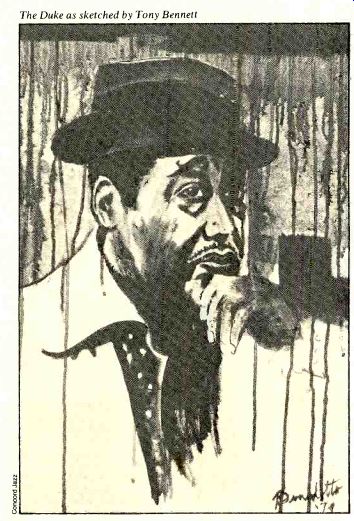
------- The Duke as sketched by Tony Bennett
"Tribute to Duke" includes a spoken introduction by U,N. Ambassador An drew Young and liner notes by Walter Cronkite and Ed McMahon. All very high-powered and totally unnecessary.
Proceeds from the album's sales will go to the Duke Ellington Cancer Center.
You couldn't spend your money better: a worthy cause, a memento of one of the twentieth century's greats, and some of the best entertainment the young year 1978 has so far given us.
-Peter Reilly
BING CROSBY, TONY BENNETT, ROSE MARY CLOONEY, WOODY HERMAN: A Tribute to Duke. Bing Crosby, Tony Bennett, Rosemary Clooney (vocals); Woody Herman (clarinet); Nat Pierce (piano); Scott Hamilton (tenor saxophone); Bill Berry (trumpet); Monty Budwig (bass); Jake Hanna (drums). Spoken introduction by Ambassador Andrew Young. Don't Get Around Much Any More; Main Stem; In a Sentimental Mood; I'm Checking Out-Goom Bye; Prelude to a Kiss; It Don't Mean a Thing If It Ain't Got That Swing; I'm Just a Lucky So and So; What Am I Here For?; Sophisticated Lady. CONCORD JAZZ CJ-50 $7.98.
Also see:
Source: Stereo Review (USA magazine)