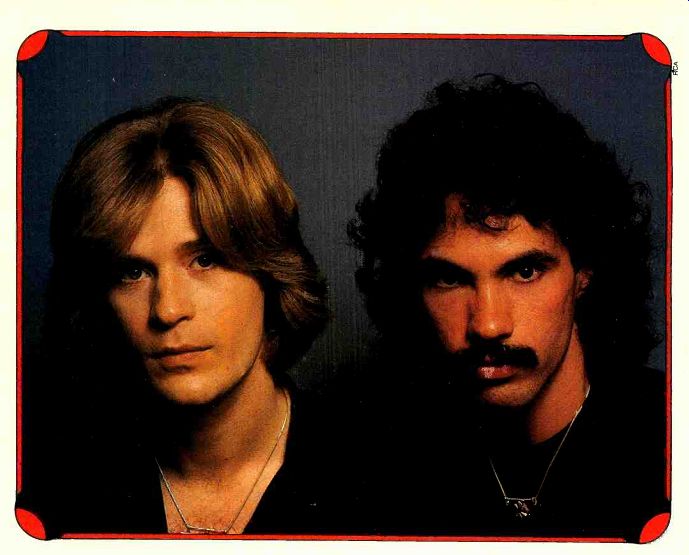
HALL & OATES--They prefer that you don't call their music "blue-eyed soul" .
"Nobody works any harder than we do.
This is as hard as any profession in the world . . . it's a twenty-four-hour job."
By Phyl Garland
ABOUT a decade ago, Daryl Hall and John Oates were two creatively driven youngsters separately trying to inch their way into the music business by playing with Jersey Shore bands and working recording sessions with the shapers of the Philadelphia soul sound. When they met as students at Temple University back in 1967, these parallels seemed to suggest that some sort of collaboration was in order.
Though John was a journalism major, his true love was the guitar, which he had played, visions of Elvis Presley dancing through his head, from the age of eight. Daryl, skilled on keyboards, was a sort of teenage prodigy of the funk circuit, having made his first record with Kenny Gamble and the Romeos at eighteen. Both not only sang well but were also pouring their late-adolescent sensibilities into com positions of their own. Their coming together so fortuitously in the develop mental stage has produced one of popular music's more luminous and long standing unions, a professional relationship so seamless that even the initial friendship has remained intact (as we know, it doesn't always).
The fruit of their association has been a steadily growing popularity, at tested to by a string of recordings that have regularly turned vinyl into gold and even platinum. Yet Hall and Oates do not readily fit into any conveniently labeled musical niche. From their first major effort, "Whole Oats" (Atlantic SD 7242), a gentle, understated album in what might be called a Sixtyish Philadelphia folk mood, to the current rakish, rock-based "Beauty on a Back Street" (RCA AFLI-2300), they have favored various styles, always attempting to fuse them into a more personal form of expression. This has created some confusion among their fans, who aren't sure just what to expect from each successive album. And what is their music anyway-rock, pop, soul, or some highly palatable hybrid from somewhere in between? Some might diagnose their case as musical schizophrenia, but Hall and Oates, at least, seem to know just where they are coming from-and where they're going to-at any moment, and they readily addressed them selves to the question when I met with them in Daryl Hall's apartment off Sheridan Square in New York City's Greenwich Village.
The room is spacious, uncluttered, and light-washed, giving little hint of the owner's personality except for an electric piano occupying a bright spot near a front window. There are only neutral walls, a faded Oriental rug, some tapestries, and unobtrusive pieces of traditional furniture; nothing fancy, showy, or even indulgently comfortable. It is the sort of deliberately peaceful room in which an artist might feel free to entertain his creative fantasies protected from the urban turmoil just beyond the door.
THE initial impression the two convey is of a cool, but not unfriendly, aplomb, an efficiency in manner and expression that comes from years of trying to get ahead in a highly competitive field. But beyond that common air of repose, they present a striking physical contrast.
Daryl Hall is tall, reed thin, and ash blond. Wearing high boots, fitted jeans, and a white shirt, he perches on a sofa, speaking rapidly and intensely, as though his inner cassette-recorder but ton were set on fast forward. At twenty-nine, he is mature and assertive, bearing little resemblance to the languid-looking, long-haired youth who graced the cover of "Whole Oats." John Oates seems a little more at ease in a low seat across from the sofa.
His publicly touted punk image is be lied by a reserved, even shy manner.
He listens more than he speaks, contributing concise, carefully thought-out comments sparingly. One year younger than Hall, he is short, compactly muscular, and dark, with curly black hair cascading to his shoulders. His own apartment is only a few minutes' walk away, but he blends comfortably into this setting as easily as he fits into the duo's music.
It is Hall who tries to explain how they define their music.
"People have tried to peg us as all different kinds of things," he says.
"Because of our roots and our experience we got pegged as Philadelphia r-&-b for a while. Most of our hits, like She's Gone, are in that style. But that really doesn't fit us because other different streams run through our music.
We have some very impressionistic ballads, we have English-influenced hard rock, we have r-&-b. We have all these different things that we're synthesizing and developing almost separately from album to album. If you take any one of our three styles, you can trace its development back to our early albums, though its first example might differ from anything else on that particular album.
"When we started, we were coming However their music is defined, they prefer that it not be called
`blue-eyed soul.' out of the Sixties and consciously trying to be very simple and quiet and calm. Then we started drawing on our Philadelphia roots, as we did with
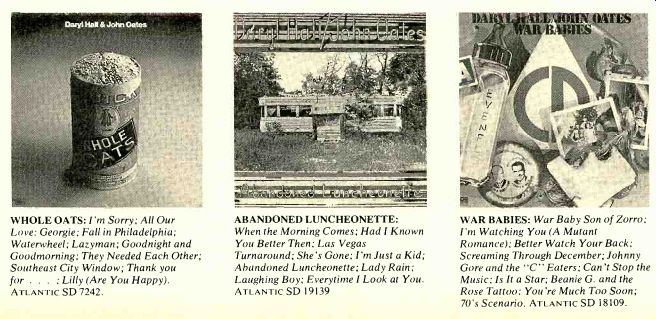
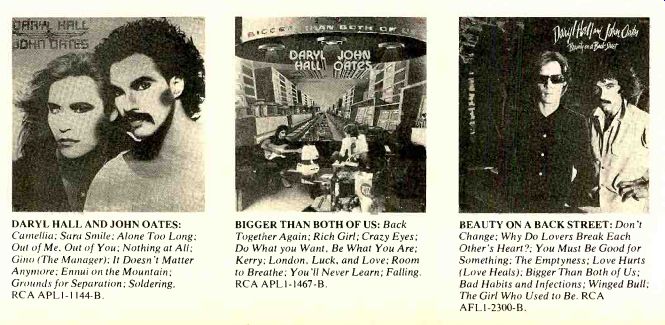
'Abandoned Luncheonette' (Atlantic SD 7269). But our third album for Atlantic was 'War Babies,' mostly New York hard rock. It was somewhat similar to 'Beauty on a Back Street'." "War Babies" (Atlantic SD 18109), which came out in 1974, has been de scribed by Hall and Oates as "cold, metallic, nihilistic," a response to the dislocations they experienced in moving to New York. But in 1975, when the duo left the Atlantic label, their first al bum for RCA bore little resemblance to their previous one. Called simply "Daryl Hall and John Oates," it was, at least in visual terms, an attempt to grab broader attention, though they deny it involved any artistic compromise. The silver cover was a glitter put-on, showing the two in heavy make-up, air brushed into an artificial prettiness. A fuchsia pull-out featured Daryl posturing androgynously while John lounged as a Grecian nude.
"We had to pretend we were gay," John says with a chuckle. "But the mu sic did represent a softer approach, a return to our more traditional main stream sound." That album, which contained the hit Sara Smile, preceded a noticeably sharp turn back to rock on their second RCA set, "Bigger Than Both of Us" (RCA APLI-1467).
But there was a mellowness to much of "Bigger," and Rich Girl, its hit single, was very much in their old Philly r-&-b vein. Then came "Beauty on a Back Street," with its more pronounced rock flavor, though, again, the softer element remained quite prominent.
di-r HAT album took a lot of people by surprise.." comments Hall, "but we've been going through a kind of metamorphosis, one thing evolving into another all through our career. Some people deal with only one of these different styles, but we try to put them together in some sort of coherence." Asked whether this metamorphosis has now led them to make a permanent shift to ward hard rock, he replies, "It's hard to say. I don't think we're ever going to lose the essence of the soul tradition we grew up in, the way we feel. But we don't live in Philadelphia any more. We haven't lived there in years, so I think we're moving farther and farther away, into more of a New York sound." But however their music is defined, they prefer that it not be called "blue eyed soul." "I'm offended by that; the term implies imitation," says Hall, while Oates nods agreement. "I did the same things as other r-&-b musicians. I even started out singing in church. It's all coming from the same place." Oates underscores the point. "When we were kids, we were influenced by the sort of things we heard, mostly on the radio. The black sound was the mainstay of Philadelphia music. In fact, some of the first radio stations in America to play rock-and-roll were in Philadelphia." Their background suggests that the
--- 62 "I don't think we're ever going to lose the essence of the soul tradition we grew up in, the way we feel. But we don't live in Philadelphia any more." pair have a just claim to some r-&-b turf. Both grew up in the outermost sticks of Philadelphia, Daryl in Potts town, about forty miles from the core of the city, and John in North Wales, comparably remote. The towns were too far away to be considered suburbs; as Oates recalls, "It was definitely the country and Philadelphia was the big city. It was always a big adventure to go there on weekends to buy records and clothes." But those small towns were not beyond the pale as far as pop-music radio was concerned. Like many other youngsters, they listened, liked what they heard, and eventually tried to play it themselves.
For Daryl Hall, music was a natural choice. Both his parents were classical musicians. His mother trained him in piano, and his father, who also sang in gospel groups, coached him in voice.
"I could sing from the time I could talk," Hall recalls. "I was singing at the age of two. I got a sense of harmony from singing in church choirs." But though his exposure to classical music was extensive, he never felt inclined to make a career out of it. "It was a training period that enabled me to relate to music purely," he explains.
"It gave me the technical facility to be able to grasp many styles, but I never felt very close to traditional classical music. I was always into something more vital to this century." The power of pop music drew him into Philadelphia to sing with local groups and to back up such visiting acts as Smokey Robinson at the Uptown Theater. "I used to back up a lot of Motown acts in the Sixties," Hall says, "and I was very close to the original Temptations, especially Paul Williams.
Their singing style was a big influence on me, particularly Paul, David Ruffin, and Eddie Kendricks." The blond youth quickly became a conspicuous regular on the soul scene, working as a session musician at Sigma Sound with the Stylistics, the Delpbonics, and others. "For years, when I was a teenager and up until 1971, I worked really closely with Kenny Gamble, Leon Huff,. and Tommy Bell, doing sessions. I was one of the MFSB people for a while-I started with them so that was a big influence on me. But I also feel that I helped to develop that sound. I left it because I felt that I wanted to move on, wanted to go in a different direction." MEANWHILE, John Oates was growing up in North Wales, listening to some of those same radio stations.
He recalls, "I think one of the reasons I began to play guitar was Elvis Presley. I had sung from a very early age, just naturally, and felt that the guitar was the perfect instrument to accompany my singing. But Elvis really did it for me, his attitude and style. He was a lot looser than the other performers.
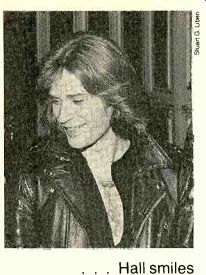
Hall smiles He seemed somehow to speak for all young people. I don't think it was even really conscious. No one knew what it was at the time. It just appealed to everyone. He was the forerunner of a lot of things that were to happen.
"From the beginning, I was also influenced a lot by the bands. I go back as far as songs like Night Train-the saxophone-combo type of thing-then everything from Elvis and U.S. Bonds on up. When I was about eighteen or nineteen, I began to get into the same sort of thing Daryl was into-Motown, the Temptations. I started doing some sessions and made my first record with some of the same people. Bobby Mar tin (he does arrangements for Gamble and Huff) and I began to work that scene when I moved to Philadelphia.
From there on out, my story and Daryl's are more or less the same." When the hard-rock sound became
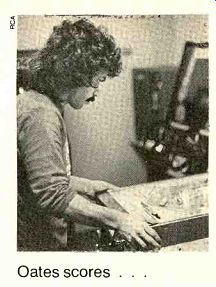
--------- Oates scores . . .
dominant in popular music, both young men felt an urge to move in that direction. Says Hall, "Even when I was working at Sigma Sound and doing those sessions, a group of us formed a spin-off band and started doing some Beatles-influenced rock. There were al ways different influences coming together at the same time." Given the similarity of their activities, it is not surprising that the Hall and Oates paths eventually converged.
"We knew about each other," says Oates. "We both had bands, called by various names. We both had records cut, though they were nothing anyone would remember. The bands disband ed, so I teamed up with Daryl when we were at Temple, and we became room mates." The two soon began writing songs together. "It was nothing serious, just two friends writing together, but eventually it developed into this." As the musical relationship solidified and the songs began to pile up, they at tempted to get a recording contract.
When they were signed by Atlantic in 1972, they put together a first album from their backlog of material, compositions dating back to 1968 and 1969 that they had written separately and together. But "Whole Oats" sold sparsely and hardly ushered them into stardom. "It wasn't the sort of album that jumped out and grabbed you. It was very quiet, very introspective and subtle," says Oates.
"Pretty artsy and craftsy," says Hall.
They hit their stride in 1973 with their second disc, "Abandoned Luncheonette," notable for its airy, free-flowing melodies, flawlessly blended vocals, and pleasantly restrained rhythms. It holds up well today, both commercially and in the opinion of its creators. "1 hear those songs on the radio and they still sound great to me," Hall says, "and at this point I must have sung She's Gone at least a thou sand times." THOUGH there is plenty of excitement in their performances, with close interaction and smooth showmanship, gimmicks are avoided. Band members might appear in rather dramatic attire (they joke about one of those Hell's Angels leather outfits for one of them), but the visual element is deliberately low key.
"We don't go in for the usual rock-'n'-roll ostentation," Hall says, "because we feel our music is able to stand on its own. It always has. We don't want anything to divert people's attention from the music. No smoke bombs, none of that junk." Because success has come to them not as a flash flood but as a gradually swelling stream, they haven't forgotten all the effort that went into building their career.
"I don't want it to stop," Hall says when asked whether things might taper off at some point. "I mean, it's taken so many years to get here. If we can just stay at this level for, say, five years, and then taper off for another five years, that's a pretty long career right there. We're both musicians, we've always been musicians, and I don't feel a need to go in to other areas.
I think I'll always be making music.
How many people it sells to is a question mark, but I'm concerned with how I progress artistically and musically.
Financial security is certainly an element, but artistic expression is the motivating factor in what we do." Yet he admits there is tremendous pressure to produce consistent hits.
"You get this tugging back and forth.
Since we've come this far and we've worked so hard, we want to make money We are making it and we want to keep on making it, because we feel it's time to get some of the benefits of our hard work. Nobody works any harder than we do. This is as hard as any profession in the world . . . it's a twenty-four-hour job. You're always thinking. It's taxing to your body and your mind, and most musicians who work hard deserve the money they get.
I want to live at a certain financial level, but if I had to make a choice, I'd rather do what I want to do than have the money-if I had to make that choice." While their public identity is almost that of a single person, Hall and Oates have widely divergent interests they ...
---------------
WHOLE OATS: I'm Sorry; All Our Love: Georgie; Fall in Philadelphia; Waterwheel; Lazyman; Goodnight and Good morning; They Needed Each Other; Southeast City Window; Thank you for . . . ; Lilly (Are You Happy). ATLANTIC SD 7242.
ABANDONED LUNCHEONETTE: When the Morning Comes; Had I Known You Better Then: Las Vegas Turnaround; She's Gone; I'm Just a Kid; Abandoned Luncheonette; Lady Rain; Laughing Boy; Everytime I Look at You. ATLANTIC SD 19139 WAR BABIES: War Baby Son of Zorro; I'm Watching You (A Mutant Romance); Better Watch Your Back; Screaming Through December; Johnny Gore and the "C" Eaters; Can't Stop the Music; Is It a Star; Beanie G. and the Rose Tattoo; You're Much Too Soon; 70's Scenario. ATLANTIC SD 18109.
DARYL HALL AND JOHN OATES: Camellia: Sara Smile; Alone Too Long: Out of Me, Out of You; Nothing at All; Gino (The Manager); It Doesn't Matter Anymore: Ennui on the Mountain;
Grounds for Separation; Soldering. RCA APL I-1144-B.
BIGGER THAN BOTH OF US: Back Together Again; Rich Girl; Crazy Eyes; Do What you Want, Be What You Are; Kerry: London, Luck, and Love; Room to Breathe; You'll Never Learn; Falling. RCA APL I-1467-B.
BEAUTY ON A BACK STREET: Don't Change; Why Do Lovers Break Each Other's Heart?: You Must Be Good for Something; The Emptyness; Love Hurts (Love Heals); Bigger Than Both of Us; Bad Habits and Infections; Winged Bull; The Girl Who Used to Be. RCA AFL 1-2300-B.
---------------
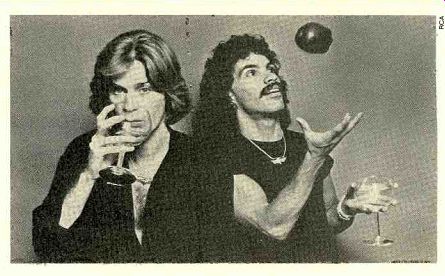
---- "We are like the sun of our own solar system; our everyday reality is pretty much what we want it to be."
-----------
... pursue separately-when time permits, and it permits precious little. "I feel the pressure of time," says Oates, tensing up at the mere thought of it. "Time seems to be the factor that colors everything I do. There's never enough time to do what I want to for relaxation or even to work-to write, for in stance. Either we're doing interviews or rehearsing or putting a band into clothes or working out lighting." Yet he finds some time to enjoy auto racing. "Not to watch it, but to do it. I'm just now getting into it, because it's a very expensive hobby. But it's some thing I've always wanted to do." He has acquired his dream car, a Porsche.
He also likes to read, is weaning him self from TV, and has an enduring interest in film. "I took some film courses in school and I've read a lot about it. I like to watch from a technical stand point as well as for pleasure. Some day I'd like to write film scripts." HALL, on the other hand, is all but consumed by his love of music. "I write all the time. Something comes out every day." Otherwise, he is tuned in to a rather special frequency. "I'm very metaphysically oriented. For quite a while I've been interested in genuine magic-not magical tricks. I'm interested in the practical side of it, not just the theory . . . like making things appear rather than disappear." He doesn't say just what it is that appears, but adds, "You have to be careful. It's real. It's very real." Their separate identities will be enhanced by the solo albums both hope to release shortly. Hall has his already in the can. Oates has plans: "I want to use it as an opportunity to stretch out.
Recently I've begun to play keyboards and I want to do some work on them, along with guitar. Basically it would be just a departure from what we do together, but I won't know exactly what it is until I do it." The directions these solo efforts take should prove interesting, for neither of the two is deeply impressed with cur rent developments in the rock field, though they express respect for such groups as Television, the Ramones, and Patti Smith.
"It's all been homogenized," Hall begins. "And distilled," Oates ends.
"And sucked down into this mega-corporate business," Hall continues, "which has washed some of the wild ness out of it--the musical wildness.
There's not as much room for expansion and creativity and taking chances.
Everybody's so concerned with selling records, the constant pressure to make everybody into a salable commodity.
There are very few people just doing whatever it is they want to do without any kind of stops put on them. And there's no outlet for it on radio stations anyway-FM doesn't exist any more as an experimental medium. Five years ago an FM programmer just played what he felt like playing. Now every body has play lists, your top twenty and your top forty. FM is the same as AM, so if you are doing anything out side the boundaries, nobody'll hear about it, only a few people who go to the clubs. The New Wave is a perfect example. Nobody hears it." Though they are aware of what's going on in the pop-music world, it is of ten difficult for them to find time to check out new talent. A contributing factor is that, like many popular artists, they travel a lot but nonetheless live in a relatively small world surrounded by a surrogate family composed of those with whom they work.
"We are like the sun of our own solar system; our everyday reality is pretty much what we want it to be," says Hall. "This is great in some ways, but it's also very restricting. We see the same people all the time. Those outside our immediate circle tend to become unreal; in the worst cases it's almost incestuous."
OVERALL, they seem content with their lives and foresee no problems even with all the pressures. They have adjusted to life on the road and feel no need to be in one place all the time, though they talk about buying a large estate in Connecticut that they and their associates could retreat to.
Both are single, though Daryl is "with someone" and John was "with some one until today." They seldom go back to their home towns: the distance be tween them and the world they now work in looms large for a moment as Daryl muses, "Most of the people I grew up with have homes and kids now. I can't remember when I've seen any of them." Instead they look forward to other types of things, such as an upcoming tour of Europe and the East, including Japan and Australia. Given their susceptibility to fresh influences, the trip, a first for them, might well have some impact on their music. Anybody out there ready for a little Australo-Nipponese rock-funk?
Also see:
Source: Stereo Review (USA magazine)