-------------
EQUALIZERS -- They are much more than just a fancier set of tone controls
by DONALD SHEFFIELD
Maybe what your system needs is one of the new EQUALIZERS, an audio accessory that can tame a wild acoustic environment (or wake up a comatose one) second-guess a recording engineer's equalization decisions supply a discreet little boost or cut to less-than-ideal amplifiers or speakers help you sharpen your ears for more discriminating equipment evaluation
By Donald Sheffield
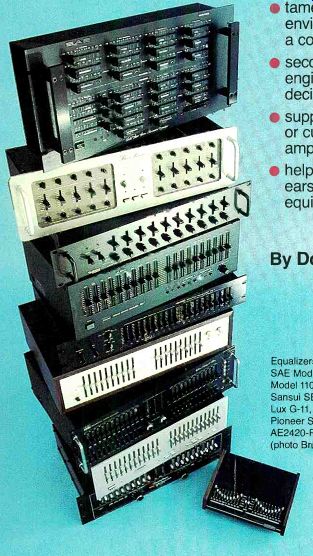
Equalizers top to bottom:
SAE Model 2800, Phase Linear Model 1100, Technics SA -9010, Sansui SE -7, Nikko EQ-1, Lux G-11, ADC Sound Shaper Three, Pioneer SG -9800, Soundcraftsmen AE2420-R, and MXR Stereo Graphic (photo Bruce Pendleton).
ADVERTISEMENTS for the increasingly popular audio components known as equalizers have been making some hard -to -believe claims about what the latest models can do.
They claim that an equalizer can: (1) upgrade the sound of a stereo system without requiring new amplifiers or speakers, (2) cut down on tape hiss and other types of noise, and (3) "reshape" the sound of existing recordings to accentuate certain instruments. Skeptics will be surprised to learn that all these claims are true, that an equalizer can do all that-and more.
During the past several years there has been a steady growth in the numbers of equalizer brands and models on the market as this useful audio accessory caught the fancy of the hi-fi public. But along with audiophile interest there inevitably came a certain degree of confusion about the various types of equalizers (graphic, parametric, octave, one -third -octave, etc.), about just how they worked, and what they could do for the average listener. For one thing, it became clear that the equalizer, more than most other components, requires some understanding of the science of acoustics (in addition to a grasp of conventional audio technology) if it is to be used effectively.
For starters, an equalizer can be considered as a rather fancy set of tone controls that adjusts not only the bass and treble but also the deep bass, upper bass, midrange, lower treble, high treble, and so on. It can therefore do a variety of things ordinary tone controls cannot do, such as decreasing lower -treble sounds while simultaneously in creasing upper -treble sounds to, say, give a feeling of liveness to cymbals and guitars. (Ordinary tone controls cannot do this because any attempt to cut back on the lower treble will also reduce the upper treble range.) Small changes in equalizer settings can have very noticeable effects on a musical program because equalizers actually modify the proportions of high-, middle-, and low-pitched sounds (see chart, "The Frequencies of Music," on page 75). Detailed scientific studies, many of them carried out over the last few years, continue to confirm that the ear is extremely sensitive to frequency response, so this factor is among the most important things to be considered in optimizing the sound fidelity of a stereo system. As a matter of fact, many of the sonic aberrations audiophiles think of as colorations or distortions are sometimes rather small (per haps less than 1 dB) variations in frequency response.
Among equalizers, the graphic units are the most common. They have slide (instead of rotary) controls, and the term "graphic" comes from the fact that the slider knobs, when in their desired positions, form a rough graph of the frequency-response modification.
There is no great disadvantage to using rotary controls, by the way, and some equalizers (especially professional ones) use them to save space.
Parametric equalizers allow the user to vary the frequency center as well as the amplitude (volume) of each band of frequencies controlled. Thus, a band centered at 1,000 Hz can be shifted to use, say, 900 or 1,200 Hz as its operating center. Further, the width of the band of frequencies affected can also be varied in some models. This characteristic may not be useful to people who set their equalizers by ear, but it is necessary for precise adjustments. If the object is to flatten out a ragged room response, for example, a parametric equalizer can make the curve flatter than any ordinary equalizer can, but only if the operator is able to monitor the response with instruments that show where the peaks and valleys are on a detailed response curve.
It is a simple fact of life that a re cording being played back in a home listening room is not going to sound the same as the live original. Aside from what may have happened to the fidelity of the audio signal between the time of the original performance and its embodiment on a tape or disc, the listening room itself contributes an assortment of unwanted effects (which we will get to in a moment). An equalizer can overcome these effects to a large degree, making the sound more like the original or, failing that, at least more agreeable.
Most professional recordists use equalizers to shape the frequency -response curves of the recorded material for what they hope will be the most positive listener response. This means, of course, that rock, disco, and classical music may all get different equalizations, and different engineers are likely to have differing notions as to the preferred EQ (equalization) for any given recording anyway. But despite (or maybe because of) all this in -studio equalization, the listener often finds a recording is not all it could be when it is played through his own equipment.
Room effects are among the major contributors to the way any playback sounds. The sound waves coming from the loudspeakers inevitably reflect off walls, ceilings, and floors, and multiple reflections cause what are called "standing waves" at frequencies that depend on the size of the room. At a particular spot (or areas) in the room some one low note will likely be rein forced because the sound waves reflected from two opposite (parallel) walls will meet each other repeatedly at that spot and substantially increase the note's intensity. At other points, however, the sound waves will be out of phase and will cancel each other instead.
The frequencies (pitches) to which your own room is "tuned" depend on the distances between each pair of parallel walls and between floor and ceiling. Say, for example, that your room length is 20 feet. To find the frequency that will be enhanced by this spacing, divide 565 by 20. (The number 565 is the speed of sound in air, in feet per second, divided by two-for half a wave length.) The lowest, or fundamental, resonance for that room length is 28.25 Hz, and if your speakers produce that frequency it will have its maximum acoustic energy at the far ends of the room and little in the middle. Standing waves also occur at multiples of a room's fundamental resonances. In the case at hand, at 56.5 Hz (a tone much more likely to be encountered), three areas of maximum energy are produced: two at the far walls and one at the room's center.
There are other enhancements, and also cancellations, for each wall-to-wall spacing in the room. All of this adds up to a fairly jagged response curve for the overall playback system that includes the listening room. A typical example of such a curve is shown in the figure on page 76, which plots the frequency response of a high -quality playback system measured from a specific spot in a normal room. Most of the peaks and valleys are caused by the room's standing waves, and these variations would very likely be different if the position of the measuring microphone were changed, even by as little as a few inches.
Aside from the measurable room effects, the audible effects may include a mushy, boomy mid-bass sound or, conversely, a weak or thin mid bass that is lacking in warmth and body. At the treble end, rooms provide sound enhancement (as a result of reflections from hard walls, panels, and windows) or sound absorption (by rugs, drapes, and upholstery) at various frequencies.
Again, the equalizer can help compensate for the unwanted effects.
Loudspeakers and phonograph cartridges-the electromechanical, or "transducer," devices in your system are likely to be the weak links in the reproduction chain not only because of their own internal flaws but because of problems that may result due to incompatibilities with the associated equipment. Thus, while individual components may have reasonably flat frequency responses under laboratory conditions, the real home system in which they are used together can nevertheless suffer from a variety of frequency aberrations large and small. The best solution is therefore to equalize the system as a whole for minimal deviation from flat response. (Note that an equalizer can compensate for electronic frequency -response aberrations everywhere in the room, but acoustical problems can usually be compensated for only in one chosen listening area.) What You Need The question most often asked about equalizers is "How many frequency bands do I need?" Consumer models are offered with anywhere from four to twelve bands. Some have the ability to control the left and right stereo channels independently, which immediately doubles the number of controls; other models have frequency controls that handle both channels at once. For many prospective buyers, even this ground-level decision involves a bewildering variety of brands and models.
The main thing to be considered in choosing an equalizer is the amount of flexibility you need, want, and can use in your system. For people who have the ears, the time, the talent, and perhaps the response-monitoring equipment to do the job properly, units with ten or more frequency bands per channel are appropriate. But listeners who don't want to put up with all that expense or complexity will be happier with six or fewer bands that can be adjusted by ear, and they will seldom need individual left- and right -channel controls.
Not entirely apart from the question of complexity, there is a decision to be made about cost. A higher-price equalizer often has a better "feel" to its controls (smooth, tight action), greater re liability, and a more appealing, up-to date appearance. Reliability, too, is not a trivial matter in equalizers, for the controls in cheaper units tend to be come noisy after a few years. In addition, the more expensive units some times provide a flatter response when their controls are set to zero or "flat." Some models have detents (a mechanical "notch") at the zero positions, making the "flat" setting easy to find by feel alone.
All audiophile (rather than studio) equalizers have switching that permits installing them in a receiver's, amplifier's, or preamplifier's tape -monitor loop (substitute tape -monitor switching is provided), and some have additional switching that permits equalization of the signal going to or coming from the tape recorder. Some equalizer models have level controls that enable the user to adjust the equalized signal to the same subjective loudness as the unequalized signal. This is important if you want to do an A/B comparison between the two so as to judge the precise effect of your equalization efforts. Several units also have LED indicators that show when the input and output signals are equal-to reinforce the judgment of your ears.
The less expensive equalizers usually have a poorer signal-to-noise ratio, expressed in the specifications as a lower number of decibels. Is this important? Not for most users. Even the cheapest of today's equalizers have lower noise than most recordings, and by a factor of about ten. The noise in even the worst-case equalizers would be noticeable only as a soft hiss at very high volume levels, in a quiet room, and with very low noise in the associated equipment.
If that level of noise bothers you, then you may want a signal-to-noise ratio of 90 dB or better. Similarly, an equalizer's usually very low harmonic distortion will be masked by the much worse distortions in other links of the audio chain.
Some of the new models have built-in readouts and/or signal sources that aid in making adjustments by instrument rather than by ear. Several models also have a plug-in microphone as well as LED indicators for each frequency band to show the actual sound level in the room. The user plays "pink" noise (a random "shushing" sound containing equal energy within each octave) and sets the equalizer controls so the LEDs light up in a straight line; the system/room response has then been flattened to a high degree-at the location of the microphone, that is.
-------------------------------
EQUALIZER MANUFACTURERS
The FOLLOWING is a list of companies making equalizers for home use.
The list does not include those producing only car-stereo, sound-reinforcement, speaker-system, and recording-studio equalizers.
Ace Audio, 532 5th Street, East Northport, N.Y. 11731
Audio Control, 6520 212th Street S.W., B-1, Lynnwood, Wash. 98036
Audio Dynamics Corp., Route 303, Blauvelt, N.Y. 10913
Audio Reflex International, 11 Progress Avenue, Unit 15-16, Scarborough, Ontario M1P-4S7, Canada
Crown International, 1718 West Mishawaka Road, Elkhart, Ind. 46514
Heath Company, Benton Harbor, Mich. 49022
JVC, 58-75 Queens Midtown Expressway, Maspeth, N.Y. 11378
Lux Audio, 160 Dupont Street, Plainview, N.Y. 11803
Marantz, 20525 Nordhoff Street, Chatsworth, Calif. 91311
MXR Innovations, Inc., 247 North Goodman Street, Rochester, N.Y. 14607
Nikko Audio, 16270 Raymer Street, Van Nuys, Calif. 91406
Onkyo, 42-07 20th Avenue, Long Island City, N.Y. 11105
Phase Linear Corp., 20121 48th Avenue West, Lynnwood, Wash. 98036
Pioneer, 85 Oxford Drive, Moonachie, N.J. 07074
Radio Shack, 1400 One Tandy Center, Fort Worth, Texas 76102
Rotel, 1055 Saw Mill River Road, Ardsley, N.Y. 10502
SAE, 701 East Macy Street, Los Angeles, Calif. 90012
Sansui Electronics Corp., 1250 Valley Brook Avenue, Lyndhurst, N.J. 07071
Soundcraftsmen, 2200 South Ritchey, Santa Ana, Calif. 92705 Spectro Acoustics, Inc., 3200 George Washington Way, Rich land, Wash. 99352
Superex Electronics Corp., 151 Ludlow Street, Yonkers, N.Y. 10705
Teac Corp., 7733 Telegraph Road, Montebello, Calif. 90640
Technics, One Panasonic Way, Secaucus, N.J. 07094
-----------------------
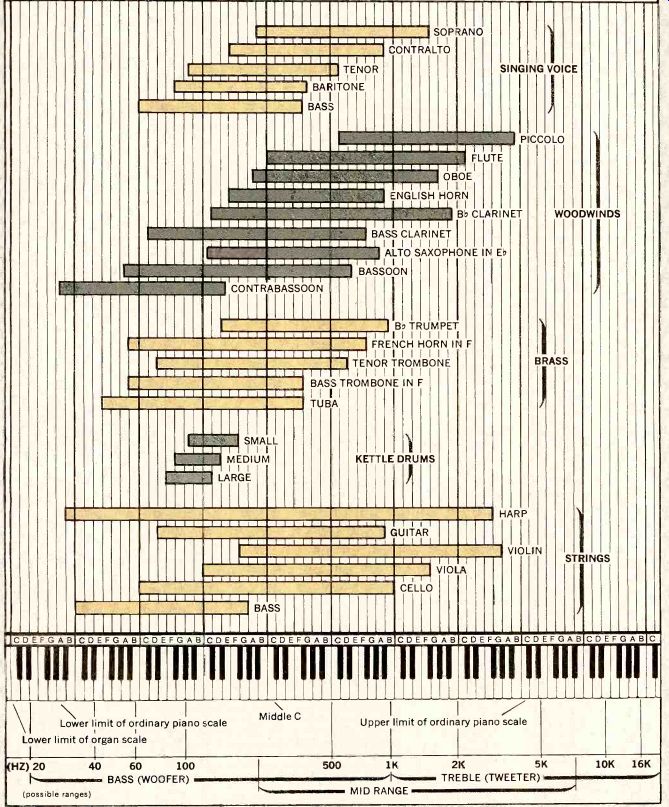
------ THE FREQUENCIES OF MUSIC (Ranges of the fundamental
frequencies of instruments and voices)
The harmonic frequencies generated by instruments and voices extend off the right side of the chart, though at volume levels far below those of the fundamental frequencies shown. The A above middle C is usually set at the standard tuning pitch of 440 Hz.
--------------------
Using an Equalizer
Although I may find myself accused of heresy, I believe that there is actually no need for the average home listener to spend a lot of time fine-tuning his equalization. Anyone only moderately interested in technical matters should simply play some music with a wide frequency range, adjust the equalizer by ear, and then mostly leave it alone. The difference in sound quality achieved with that kind of adjustment as opposed to the best instrumented adjustment is small indeed. Instrumented adjustments are for people who enjoy the process of tuning and who take pride in feeling they have achieved the best possible result. But my advice to most people is, "Do it by ear." Ten -control equalizers can be set up initially by adjusting two adjacent controls at a time, thus simulating a five -control type. The right and left channels should also be adjusted simultaneously initially (assuming separate adjustment is possible). Fine tuning can then be done afterward as required with individual control adjustments.
Some recordings will sound best with additional boosts or cuts, especially in the treble area. Most loudspeakers could use a little deep -bass boost-provided it does not lead to overload. One should be careful about overdriving tweeters also, because the overload condition might not be evident until the moment the tweeter burns out. There fore, any boost beyond 3 dB or so should be applied very cautiously unless your speakers are known to be very robust. Keep in mind also that every additional 3 dB of boost means doubling the power demand on the amplifier. That being the case, it's easy to find yourself asking more of an amplifier than it is capable of delivering. When an amplifier is driven beyond its power rating it "clips" the waveform, and such clip ping (which generates much high -frequency energy) is the prime cause of tweeter burnout even if the boost is applied in the bass or midrange rather than in the treble range.
So much for adjusting by ear. For those who prefer working with instruments, the best place to start is the owner's manual supplied with the equalizer, following the procedures outlined therein very carefully. A test record is the usual signal source, and a calibrated microphone is used to make measurements.
IF the results of an instrumented adjustment are disappointing, try moving the microphone or sound-level meter around to several positions within a foot or so of where your head is normally located while listening. Make averaged settings for these positions rather than relying on only one position. The reason for this was mentioned earlier: a room's standing -wave pattern can change radically with small changes in position.
And since the ear's directional- and binaural -perception characteristics are not duplicated by a microphone, be pre pared to fine-tune the equalization by ear. Also, distortion bothers the human ear, and its presence may therefore dictate a treble cut; the microphone, remember, responds only to frequency.
Some experimentation and a little ear training are all that are required in or der to use an equalizer to solve many of the sonic problems that arise during re cording in the studio and during reproduction in your home.
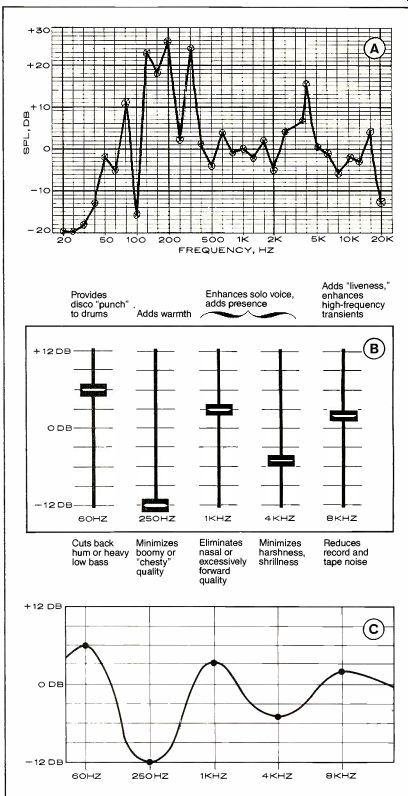
-- (A) A hand -drawn curve showing the frequency response
of a typical room -plus - equipment combination. The narrow dips and
peaks (at frequencies basically determined by microphone placement and
room dimensions) are not as audible as the major "trends" such
as the rise between 70 and 400 Hz. (B) Compensating equalization is applied
by a typical five -band equalizer in an effort to flatten the response
of the room-plus-equipment setup of (A). Specific control settings
are determined by the characteristics of the equalizer used. (C) Curve
of the (approximate) compensations applied by the equalizer. (Noted for
each of the five equalizer controls is the subjective audible effect
of boosting or cutting each band of frequencies.)
----------------
Also see:
Misc. ads collected (May 1978)
Source: Stereo Review (USA magazine)