.
THE PAST RECORDED
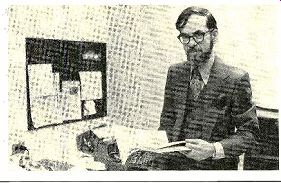
IT says something about the continuity of culture in the western world that virtually every great public collection of art or artifacts has as its core the once private collections of one or more individual connoisseur collectors. Those who espouse the socialist point of view that all art belongs in museums would do well to keep that fact in mind. And so it is no great surprise to me that even in 1980, in an era of unprecedented accumulation of objects by government and other nonprofit institutions, a public collection is to be vastly enriched by the gift of a private collector and citizen. A recent news release from the Library of Congress tells of the collection of 40,000 records and 500 cylinder recordings presented to the Library by Mr. Jim Walsh of Vinton, Virginia, a retired reporter and columnist for Variety magazine and, for thirty-eight years, the writer of a column on early recordings for Hobbies magazine.
The Library of Congress itself began to collect recordings only in 1925, and the bulk of Mr. Walsh's collection is of pre -1926 material. It is not a collection of arias by golden -age opera stars, however; apart from documentary recordings of speeches by Wilson, Harding, Taft, Pershing, and the like, it consists largely of popular entertainment of the day-jazz, pop songs, vaudeville, humorous monologues, and show tunes. The names of many of the artists involved-Billy Murray, Irving and Jack Kaufman, Ada Jones, Henry Burr-are hardly familiar to us today, but they were top stars of the early years of recording, and their work is part of both American sociology and American musical culture.
By the purest coincidence, I had just re quested for possible review, from Merritt Sound Recording (223 Grimsby Road, Buffalo, New York 14223), a few cassettes of old-time popular material-Billy Murray, Ada Jones, Moran and Mack-and they arrived simultaneously with the Library communiqué. These privately produced, hand -labeled cassettes are little concerts of the records of the artists involved, introduced and narrated by one or another enthusiastic expert and collector. How neat to find the two cassettes of Billy Murray narrated by Mr. Jim Walsh of Vinton, Virginia! I don't want to intimate that you will be as excited by the performances of Billy Murray as Mr. Walsh is, but you may have some fun with some of these cassettes. The repertoire is one that senior citizens will actually remember and that juniors will have had introduced to them through records by Joan Morris and Bill Bolcom and Lucy Lowe (see "Best of the Month," March 1980). It is a repertoire that deals (strangely, or even perhaps obnoxiously, to us to day) with the diversities and dialects of American life: the Irish number, the Jewish number, the "Cherman" song, the black song, the Midwestern epic, the cowboy song, the Indian chant, and the Bowery bal lad ("Hully chee!").
THE singers were all rather expert in dialect (or what passed for typical German, Jewish, Irish, English, black, cowboy, or tough -guy dialect in those days), and they all had the sort of supremely clear diction that primitive recording equipment seemed to demand. At any rate, you will have far less trouble understanding the words than with any Joan Sutherland recording. To me, they all, in spite of their reputations (Ada Jones was the first really big female recording star) seem to lack strong personality.
All, that is, except for the non -singing duo of Moran and Mack, who, under the name Two Black Crows, give us some embarrassing moments but also some comic routines and plays on words that are every bit as classic as the famed "Who's on first?" Abbot and Costello masterpiece. Jones and Murray (the Irving Kaufman material was not available when I asked) also have some spoken routines, but not in the same class.
You can hear them at their best in such musical numbers as Waiting at the Church, I've Got Rings on My Fingers, Oh By Jingo, The Irish Were Egyptians Long Ago, The Cubanola Glide, Heine, You'd Be Surprised, Come Josephine in My Flying Ma chine, and When Francis Dances with Me ("Hully Chee!"), with all the verses as well as the chorus. Different recordings are available in different formats: disc, cassette, cartridge, reel. You might write to Merritt, at the address given above, for their in formative little catalog.
Also see: STEREO REVIEW THROWS A PARTY-- Celebrating the 1979 Record of the Year awards
Source: Stereo Review (USA magazine)