POPULAR DISCS and TAPES: Soundtrack: 1941 , Natalie Cole and Peabo Bryson , Gail Davies: "The Game", Anita Ellis Returns.
Reviewed by: CHRIS ALBERTSON EDWARD BUXBAUM NOEL COPPAGE PHYL GARLAND PAUL KRESH PETER REILLY STEVE SIMELS JOEL VANCE
AEROSMITH: Night in the Ruts. Aero smith (vocals and instrumentals). Reefer Head Woman; Cheese Cake; Mia; Three Mile Smile; Remember (Walking in the Sand); and four others. COLUMBIA FC 36050 $8.98, 0 FCA 36050 $8.98, FCT 36050 $8.98.
Performance: Crud
Recording: Loud
You may have noticed a photograph of Aerosmith's Steve Tyler appearing at an anti -nuke benefit concert in January's "Pop Rotogravure." Tyler is apparently concerned about energy, so I'd like to make the following proposal: since record vinyl is a petroleum byproduct, let Aerosmith retire and allow all of its existing albums to go out of print. I don't know how much oil this would save, but it would probably be enough to keep Aerosmith's fans warm through one more winter. This noble sacrifice will serve humanity, the U.S., and a re viewer who has tried, with Christian charity, to be good-natured about the group's execrable writing, sloppy playing, and brutishly offensive noise level. J.V.
JOHNNY CASH: A Believer Sings the Truth. Johnny Cash (vocals, guitar); vocal and instrumental accompaniment. Wings in the Morning; Gospel Boogie; Over the Next Hill; He's Alive; I've Got Jesus in My Soul;
Explanation of symbols:
= open -reel stereo tape
= eight -track stereo cartridge
= stereo cassette
= quadraphonic disc
= digital -master recording
= direct -to –disc
Monophonic recordings are indicated by the symbol
The first listing is the one reviewed; other formats, if available, follow it.
When He Comes; I'm a Newborn Man; Oh Come, Angel Band; and twelve others. CACHET CL3-9001 two discs $10.98, 0 CL8 9001 $10.98, 0 CL9-9001 $10.98.
Performance: Coffee-table classic
Recording: Very good
It is logical that Johnny Cash, with that idiomatic voice, should do a gospel album, and that he'd give it often-rollicking secular arrangements in the manner of Willie Nel son's "The Troublemaker." But this is so big. Well, it came out just before Christmas, and no doubt many of Cash's long term hard -country fans-much of the gospel -album market-saw it as a dynamite alternative to the coffee-table book as a gift to give or (better still) receive. And indeed it is. It should have some appeal beyond the gospel -album market also, for it includes some off -beat, modern -slant songs as well as standards, and the guest talents include, -among others, the lovely voices of Cash's sister-in-law Anita Carter and his daughter Roseanne Cash.
The pieces range from the folkie, Weavers -oriented Children Go Where I Send Thee through several Baptist and Method ist standards to new songs by the likes of Billy Joe Shaver and Cash himself. The instrumental backing is simple and right; horns are brought in where horns are needed, and a single acoustic guitar is about all you hear where that is appropriate. And Cash's singing is convincing. He is indeed a believer-a big supporter in recent years of fundamentalist preacher Jimmy Snow, son of country music's Hank-and he sounds like a believer. But he's not preachy about it. Sentimental, perhaps-he dedicates the album (on a new label) to his mother and writes, "This is my proudest work"-but not preachy. The album cycles through various states of reverence, but its conscious ness is basically everyday -life secular, and, all in all, staunchly musical. N.C.
DAVID ALLAN COE: Compass Point.
David Allan Coe (vocals, guitar); instrumental accompaniment. Heads or Tails; 3 Time Loser; Gone; Honey Don't; Lost; and four others. COLUMBIA JC 36277 $7.98, 0 JCA 36277 $7.98, 0 JCT 36277 $7.98.
Performance: Very good
Recording: Above average
This is Coe's best since "David Allan Coe Rides Again," and the most impressive thing about it is how straightforward and free of claptrap the production is. The thing was recorded in Nassau (Coe lives in the Florida Keys nowadays and likes to spruce up his image with nautical garb), but they brought in Billy Sherrill-he of the Nashville Sound gimmicks and string sweetening-to produce. Lo and behold, he just let Coe's band, which is a pretty good modern country ensemble, play. So the sound be hind Coe has the feel, often including the spontaneity, of a club date. The songs themselves aren't as wild or as exciting as some of Coe's earlier ones. They're also straight forward, often derivative and workaday, but they're solid; there isn't an embarrassment in the batch. The problem, of course, is that Coe has set us up to assume that being outrageous is what he's good at, and now he seems less interested in being outrageous. In that sense, this one is listenable enough to at least start changing people's expectations without turning them off. Coe deserves more success than he's had, but he also, I feel, can do better work than he's done so far. Maybe this is a kind of gathering of energy. N.C.
TYRONE DAVIS: Can't You Tell It's Me.
Tyrone Davis (vocals); vocal and instrumental accompaniment. Can't You Tell It's Me; Be with Me; Heart Failure; and three others. COLUMBIA JC 36230 $7.98, JCA 36230 $7.98, JCT 36230 $7.98.
Performance: Good, but . . .
Recording: Good I don't think I've consciously heard a Tyrone Davis record since Turn Back the Hands of Time, a hit single from the 1960s.
Davis struck me then as a smooth and ingratiating singer, and he's lost none of his touch on this outing. What spoils the album is a programming gimmick so old and ineffective that I thought it had been retired years ago: they've put all the ballads on one side and all the jump stuff on the other.
Since the upbeat material is halfhearted disco it's a total flop-disco is an all -or -nothing affair. This side's being unlistenable came as a rude disappointment, since I thoroughly enjoyed Davis' skillful handling of the ballads on side one and was looking forward to more. J. V.
THE EMOTIONS: Come into Our World (see Best of the Month, page 91) DAN FOGELBERG: Phoenix. Dan Fogelberg (vocals, keyboards, synthesizers, guitar, percussion); instrumental accompaniment. Tullamore Dew; Gypsy Wind; Face the Fire; Beggar's Game; Longer; and five others. EPIC FE 35634 $8.98, 0 FEA 35634 $8.98, FET 35634 $8.98.
Performance: Easy and familiar
Recording: Good
Dan Fogelberg makes familiar, predictable music-on a surprisingly high technical level-that goes down as easily as a cheese burger and fries. It's about as memorable too, even though he has a distinct fondness for strained lyrics ("I saw her first in a beg gar's game/Her eyes were wild but her laugh was tame . . .") and even though his synthesizer work often reaches virtuoso heights. The best song here is the title track, but even that sounds like something you might have heard ten or twelve years ago (and enjoyed very much then). Y'know, like that really great cheeseburger you had in a little joint in . . . well, you can't remember exactly where, but you do remember that you liked it. As cheeseburgers go.
P.R.
DOBIE GRAY. Dobie Gray (vocals); instrumental accompaniment. In Crowd; Stumblin' Back to You; Sunny Day to Rain; You Can't Keep a Good Man Down; Fool, Fool; and four others. INFINITY INF 9016 $7.98, e INFT 9016 $7.98, INFC 9016 $7.98.
Performance: Comfortable
Recording: Good
Something about Dobie Gray reminds me of an affectionate lapdog. His records of late have been dependably good, emphasizing soothing fare about sunny days and love affairs getting better or worse. Stylistically there is an easygoing, countryish feel to them. They are comfortable. Gray has a rounded, almost cushiony voice and a ring of sincerity in the way he handles lyrics. Of course, this is not the most exciting kind of musical company to have, so for contrast here he makes a stab at an up -tempo number, an extended disco version of his old hit The In Crowd. It feels like a shoe on the wrong foot. Perhaps he should just stick to being comfortable. P.C.
TOM T. HALL: 01' T's in Town. Tom T. Hall (vocals, guitar); instrumental accompaniment. The Last Country Song; Old Habits Die Hard; Jesus on the Radio (Daddy on the Phone); The Old Side of Town; Greed Kills More People Than Whiskey; The Different Feeling; and four others. RCA AHL1-3495 $7.98, e AHSI-3495
$7.98, AHK1-3495 $7.98.
Performance: Getting back
Recording: Clear
Tom T. Hall's muse, who's been moping around like a walleyed calf through a few albums, seems here to be getting back to business, recasting Hall in the role that suits him-pop sociologist/cracker-barrel philosopher of the New/Old South. Hall isn't as subtle here as he can be-although the directness and plainness go with the rather hard country sound and flavor he's given the album-but at least he's back to noting what goes on in the world. Noteworthy among his notes are Jesus on the Radio (Daddy on the Phone) and Greed Kills More People Than Whiskey. The former illuminates a familiar scenario in the Good Old Boy culture, in which the Little Woman, who's got or always had religion, has the task of policing Daddy, who likes to drink beer in bars. The latter is a Tom -listening song, of the Faster Horses mode, in which a grizzled elder lays down some wisdom: he was a cowboy, about fifty years old in a big Western hat/I said, 'Sir, did you say greed kills more people than whiskey?/ If my taxi don't come tell me more about that.' " The Last Country Song warns cryptically about dissension in the genre, but the main thing about it is the lively, catchy sound it has. The whole first side of the al bum, in fact, will keep you entertained as well as informed. The second side sags, though, with inconsequential love songs; its two exercises in pop-soc, one about a marriage breakup and one about its aftermath
------------------------
95 Jahn `Williams' "1941"
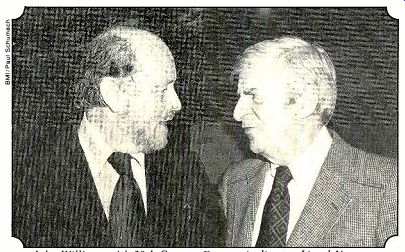
John Williams with 20th Century -Fox music director Lionel Newman (yes, of those Newmans) at a reception following Williams' Carnegie Hall debut as new conductor of the Boston Pops.
V HAVE not seen the "comedy spectacular" 1 1941, which apparently treats World War II as the greatest fun war since the Crusades, nor,, taking my cue from the few movie critics I trust, do I intend to. But I have heard John Williams' introductory March for the soundtrack, first as an encore at Mr. Williams' debut as new permanent conductor for the Boston Pops Orchestra at Carnegie Hall on January 22, and subsequently on the soundtrack recording itself.
It is, in brief, an absolute wowser, the best thing on the whole Carnegie Hall program, and all you need to hear of the film score (it is really a kind of overture that contains the thematic seeds for the whole works). It is gorgeously orchestrated, no surprise for anyone who has heard Mr. Williams' other film scores, and such a sassy, wise -cracking American musical utterance that you want to stand up and cheer. It contains sly intimations of the immortal Col. Bogey, Stars and Stripes Forever, and other touchstones of the march genre, plus the most graceful interpolations of jazz inflections imaginable-the whole studded with repeated re minders that the march is, after all, a dance rhythm (don't be surprised if it turns up in your local disco). Mr. Williams seems to have rather a flair for this kind of thing (the Superman march was also on the Carnegie program), and I would not be at all surprised if what we have here is (among other useful things) a New American March King-in which case this album will soon become a collector's item.
-William Anderson
1941 (John Williams).
Original -soundtrack recording. Orchestra, John Williams cond.
March; The Invasion; The Sentries; Riot at the U.S.O.; To Hollywood and Glory; Swing, Swing, Swing; The Battle of Holly wood; Ferris Wheel Sequence; Finale. ARISTA AL 9510 $8.98, e A8T 9510 $8.98, ACT 9510 $8.98.
------------------------
------ Natalie & Peabo
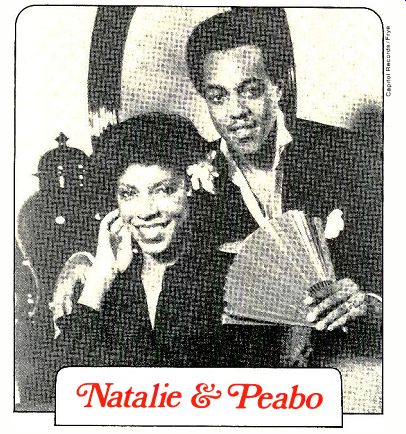
IN the past, few black singers managed to cross over the thin but clearly defined gap separating identifiably black music from the popular mainstream where a broader audience and greater commercial rewards might be reaped. Probably the most successful of all was the late Nat "King" Cole, an excellent jazz pianist and singer who, more than twenty years ago, managed to bridge that gap while holding his grip on audiences on both sides. Today his daughter, Natalie Cole, has accomplished much the same remarkable feat, though hers is a smaller talent being marketed in stylistically far less restrictive times.
Her albums and singles commonly cross over, for everybody seems to like her-and not only because she's Nat's daughter.
Though her style owes more to such soul predecessors as Aretha Franklin than to the silken warblings of her father, Natalie Cole sings with a buoyant effervescence that makes all her albums welcome visitors to the turntable. She has sufficient taste to know exactly how far she can go without forcing or overdriving her material, which is carefully tailored to suit those who like their soul with a touch of class. Yet a feeling of spontaneity prevails; her singing never seems studied or stilted. Hers is a fine act for other aspiring crossover artists to emulate--or to latch onto.
On her new Capitol album, "We're the Best of Friends," she is paired with Peabo Bryson, my choice as the best male soul balladeer to emerge within the past two years.
Partnering Natalie Cole is a promising course for him to pursue, as he is a sweet singer who often incorporates a lyrical soft ness into the songs he writes. Bryson is sufficiently gifted in his own right to stand tall with Ms. Cole on this outing without having to coast along on her vocal coattails.
On several tracks each takes a chorus as soloist, then they join in some deliciously pleasing harmony. On others, they strike out together at a healthy pace, strutting through the song like a dance team that has worked together for years. They are almost equally represented with original compositions, and Bryson also produced several selections. The hit opener, Gimme Some Time, a Cole original, is catchy but forget table. Other pieces seem to have more staying power, such as Cole's and Marvin Yan cy's This Love Affair, which best showcases the vocal clarity and control of both singers, and Your Lonely Heart, an ideal crossover number with a countryish flavor.
Natalie Cole's star is already firmly set in the pop firmament, and this seamlessly smooth collaboration should aid Peabo Bryson in finding a suitable place to hang his.
-Phyl Garland
NATALIE COLE/PEABO BRYSON: We're the Best of Friends. Natalie Cole, Peabo Bryson (vocals); instrumental accompaniment. What You Won't Do for Love; We're the Best of Friends; I Want to Be Where You Are; Love Will Find You;
Let's Fall in Love/You Send Me; This Love Affair; Your Lonely Heart; Gimme Some Time. CAPITOL SW -12019 $7.98,0 8XW 12019 $7.98, 4XW-12019 $7.98.
----------------------------------
(in which the daddy can't get into his former house to see his child), are too sentimental to indicate that Hall's muse is fully recovered. The country, acoustic -dominated back-up is generally better than the average nowadays, and sometimes much better.
There's a back -to -the -basics motif to this one, and such moves have awakened muses before. Now to prod the old girl back to her former alertness. N.C.
HEAD EAST: A Different Kind of Crazy.
Head East (vocals and instrumentals). Specialty; Keep a Secret; Feelin' Is Right; Lonelier Now; Morning; and five others.
A&M SP -4795 $7.98, O 8T-4795 $7.98, CS -4795 $7.98.
Performance: Okay
Recording: Good
Head East represents some kind of acme of geographic pluralism. The band started in the Midwest, but it's managed by a Los Angeles firm; this album was recorded in Atlanta, but the mastering was done in New York; the Head East fan club is in La Crosse, Wisconsin. Head East's sound is a mixture of L.A. smoothness and Midwesern primitivism. The group is competent but not startling, average by L.A. standards, better than most of the current Midwestern outfits-for whatever that's worth. J. V.
HIROSHIMA. Hiroshima (vocals and instrumentals). Lion Dance; Roomful of Mirrors; Kokoro; Long Time Love; and four others. ARISTA AB 4252 $7.98, 0 A8T 4252 $7.98, ACT 4252 $7.98.
Performance: Okay
Recording: Good
Hiroshima is a group of Japanese -American youngsters playing a variety of Eastern and Western instruments. Their overall sound is polite pop/jazz with an occasional reference to rock thrown in-something on the order of Sergio Mendes. It's pleasant enough to listen to until it fades into the background of the consciousness as most mood music does. The vocal styles are based on Sixties lounge -act jazz warbling, which also fades pretty fast. Not a bad album, but ten minutes after listening to it you've for gotten most of what you heard. J. V.
RECORDING OF SPECIAL MERIT
RUPERT HOLMES: Partners in Crime.
Rupert Holmes (vocals, keyboards, saxophones, synthesizers); instrumental accompaniment. Escape; Nearsighted; Lunch Hour; Drop It; Him;. and five others.
MCA/INFINITY MCA -9020 $7.98, MCAT -9020 $7.98, MCAC-9020, $7.98.
Performance: Magical
Recording: Good
Rupert Holmes is no newcomer to vinyl. In addition to his four previous LPs, which have garnered a sizable cult following, he is known as a producer, most notably for Bar bra Streisand (he produced her "Lazy Afternoon" album, and he's guilty of writing some of the music for A Star Is Born).
More than anything else, though, he is a songwriter, a musical craftsman with a sense of style and a sense of humor.
"Partners in Crime," Holmes' fifth al -bum, is full of magic tricks, rhyming rabbits jumping out of funny hats. His recent Top -10 hit, Escape-about two people who get together through the personal columns be cause they like pinia coladas-is only part of the picture. Other gems here include the title song, Answering Machine (the handy little devices do have their drawbacks), the lilting The People That You Never Get to Love (about those attractive strangers who always get off the elevator before you do), and a haunting ballad about Holmes' own poor eyesight ("I won't change my point of view/Nearsighted, all I need to see is you").
There are no happy endings here, just happy middles. Holmes casts a keen eye on the entanglements of contemporary life; he's a musical journalist, an urban storyteller who pokes fun-in all seriousness-at all our relationships. Add to that lyrical base some strong melody lines, an appropriately sparse production, and a voice that sounds like the best of the rest of us in the shower, and you've got a new musician for the masses, for all of us who spend our days battling life's machinery and wondering why the real thing just doesn't measure up to the movie version.
-Rick Mitz
HORSLIPS: Short Stories/Tall Tales. Horslips (vocals and instrumentals). Summer's Most Wanted Girl; Soap Opera; Amazing Offer; Rescue Me; Ricochet Man; and five others. MERCURY SRM-1-3809 $7.98, 8-1-3809 $7.98, Cl 4-1-3809 $7.98.
Performance: Uneven
Recording: Uneven
This Irish pop -rock band turns in some good performances here that are undone by poor programming. Ricochet Man is a standout, but it's buried as the fourth cut on side one, all of whose other songs are ho -hum. Side two has the three other winners-Summer's Most Wanted Girl, Amazing Offer, and Rescue Me-all in a row, followed by The Life You Save, a toss -tip, and Soap Opera, a certifiable dud. The sound is not all it could be either. The vocals are not clear enough, being mixed too closely with the thick overall band sound. The only exception is Rescue Me, which has a folk arrangement using only a guitar and an accordion. In all, then, there are some nice moments here, but you have to dig for them.
J. V.
MAHALIA JACKSON: Amazing Grace Mahalia Jackson (vocals); vocal and instru mental accompaniment. Amazing Grace; A Satisfied Mind; I Complained; The Man Beyond the Clouds; God Is So Good to Me; The Bible Tells Me So; Somebody Bigger Than You and I; and five others. COLUM BIA SPECIAL PRODUCTS/ENCORE P 14358 $7.98.
Performance: Historic
Recording: Very good
When Mahalia Jackson died in 1972, at the age of sixty-one, she was called "the Queen" and known as " America's greatest gospel singer"; her performance of Amazing Grace was once described as "the pinnacle of noble expressiveness." Born in New Orleans, the daughter of a stevedore who was also a Baptist minister, Mahalia began singing in church choirs as a child. In 1927...
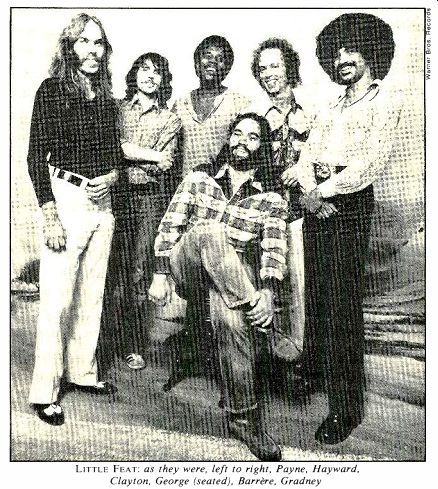
---------- LITTLE FEAT: as they were, left to right, Payne, Hayward,
Clayton, George (seated), Barrere, Gradney
...she went to Chicago, where she survived doing mostly menial jobs but kept singing with Baptist church groups. Her joyous gospel style was a secret not to be kept from the public forever, and her reputation slowly spread all over America and to the principal cities of Europe, leading to a famous series of Carnegie Hall concerts in the Fifties, TV appearances, and best-selling albums. In her later years she worked closely with Martin Luther King in the civil-rights movement, but she never stopped singing at jazz festivals, in concert halls, and on records, spreading through music the gospel in which she so devoutly believed.
Mahalia Jackson would never sing jazz or the blues, only gospel, but she sang that better than anybody else in the world. This reissue offers a generous sampling of the songs she most favored, from such familiar ones as Amazing Grace, The Bible Tells Me So, and Lead On to less familiar ones such as There Is No Color Line Around the Rainbow and The Man Beyond the Clouds.
The fervor of her florid voice on this disc with lovely backing by the Fall Jones Ensemble and the Jack Halloran Singers in several numbers-makes it hard to believe she ever really left us. It is good to hear her again. P.K.
LITTLE FEAT: Down on the Farm. Little Feat (vocals and instrumentals); Bonnie Raitt (vocals); other musicians. Six Feet of Snow; Perfect Imperfection; Kokomo; Be One Now; Straight from the Heart; and four others. WARNER BROS. HS 3345 $8.98, W8 3345 $8.98, W5 3345 $8.98.
Performance: Reined–in
Recording. Good
I believe that this project, "the real last Little Feat album," was partly finished when Lowell George, who was producing it, died.
In an interview with Mikal Gilmore published in Rolling Stone in April 1979, just before George's solo album came out, George said of the Feat: "We've attempted things outside of our reach before, with poor results." The album seems to go out of its way to help him remedy that, often assigning the Feat's sophisticated rhythm section to gentle funk -cooking, putting in more holes, augmenting the newly restrained guitars -and -slide front end with r-&-b-style horns, and of course using a number of low -
profile songs that seem at home in such a setting. The ones that go best on the radio are Straight from the Heart, written by George and keyboardist Bill Payne, which does let the guitars work out a little bit, and the title song, a novelty thing by Paul and Gabriel Barrere that gets the album off to a quirky start with a frog saying "ridip" and a person saying "shut up" for a few seconds. Beyond that, it is curiously devoid of hooks.
It is deceptively simple, and it does grow on you; still, you'd probably have to be a fanatic about Little Feat to give it the time it seems to need. N.C.
JOHN MAYALL: No More Interviews. John Mayall (vocals, guitar, harmonica); vocal and instrumental accompaniment.
Hard Going Up; A Bigger Slice of Pie; Stars in the Night; Take Me Home Tonight; Wild New Lover; and four others.
DJM DJM-29 $7.98, 0 DJM8-29 $7.98, 0 DJ MC -29 $7.98.
Performance: So-so
Recording: Good
This is John Mayall's umpteenth album, and for the umpteenth time I hear little of interest in the latest installments of the apparently endless saga of a garrulous British blues singer who takes himself and the form too seriously. There is one good cut-Hard Going Up by Bettye Crutcher, who wrote Some of the early Johnnie Taylor material on Stax in the Sixties-but the rest, all by Mayall and his band, is pretty dull stuff.
Mayall's outfit is primarily a touring band, a second -circuit act, and they will probably forever be playing Saturday nights some where and sporadically releasing albums on various labels. It's not exactly a cruel fate, but it's not what I'd call exciting. Neither are the records. J.V.
SERGIO MENDES/BRASIL '88: Magic Lady. Sergio Mendes/Brasil '88 (vocals and instrumentals). I'll Tell You; Let It Go; Magic Lady; Summer Dream; and four others. ELEKTRA 6E-214 $7.98, ET8-214 $7.98, TC5-214 $7.98.
Performance: The pits
Recording: Fair
Brasil '88 is the new name for the Sergio Mendes group that started out as Brasil '66.
After experiencing this album I began to wonder whether the numbers indicate Mendes' musical I.Q. rather than the years-but that doesn't work, because this record certainly doesn't indicate a twenty two -point improvement. I won't bore you with how good he was years ago; let me just warn you that these performances are the very pits, and Mendes' production and arrangements serve only to make them sound gummier. P.R.
FRANK MILLS: Sunday Morning Suite.
Frank Mills (piano); instrumental accompaniment. Peter Piper; Most People Are Nice; Ski Fever; After You, Mister Trumpet Man; Interlude; Piano Lesson; and five others. POLYDOR PD -1-6225 $7.98, e 8T 1 -6225(A) $7.98, CT -1-6225(A) $7.98.
Performance: Bland
Recording: Good
It's something of a shock to hear an instrumental album so unabashedly aimed at the background -music market. This is the kind of aural goo that's piped into elevators, air ports, and fast-food emporiums, and it comes complete with liner notes that gush about how the artist and his audience go so well together.
Frank Mills is a Canadian pianist who had a hit single last year with Music Box Dancer, a cute ditty about as substantial as a puffball. The American market hasn't been penetrated by such a trifle since the late Sixties (rock's heyday!), when there were two: Alley Cat by Bent Fabric (a Dane) and A Walk in the Black Forest by Horst Jankowski (a German production).
But now we have Frank Mills. Almost ...
--------------------
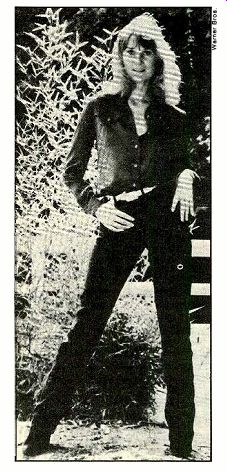
Gail Davies Springs Up Full-grown
PEOPLE at Warner Bros. think Gail Davies, coming more or less out of nowhere, may be the first woman in the history of the world to produce her own country album.
The distinction may be slightly technical:
Dolly Parton is said to accomplish some thing similar through hirings and firings, and Emmylou Harris, who also suddenly appeared before us as a fully matured talent, is married to her producer. Nevertheless, it's a rare position to be in-and Gail Davies seems absolutely natural there. She has the soul, the writing and singing talent, and the savvy about music generally to pull off a lot more than this before she's through.
For the moment, though, "The Game" should keep us occupied. It is the freshest so-called country album by a woman since Roseanne Cash's excellent "Right or Wrong." I say "so-called" not pejoratively this time. It is country, here and there, but it is also rock here and there, and there are other things so engaging they cause one to postpone indefinitely the tedious job of la-beling the music. It is just good: plenty of melodies, fairly simple but adult lyrics, arrangements (by Davies) with enough sparkle in the basics that they can stand the occasional string sweetening-which never gets heavy anyway-and a voice you can believe.
It's a "pretty" enough voice, with clear, warm tones and never a hitch in phrasing, but that's not the thing about it. The thing about it is that it sounds experienced. You can be as jaded and cynical as a pop -music critic, and it will still reach you because you can hear certain credentials. This singer has lived; she does not come peddling a certain dangerous innocence you would have to use some energy to deal with-you can just listen. You can trust her. She knows some thing about what it's like out there.
Davies' voice has none of the patented country -girl -Angst whine that came with several generations of newcomers trying to imitate Tammy Wynette. Emmylou and Crystal Gayle had just about wiped out that fashion, and Davies should put the quietus to it. Like Emmylou, she comes to country from outside the territory. She was born in Oklahoma but grew up in Seattle, listening to Hank Williams and Patsy Cline records.
She has done a little jazz singing some where in her past, which also included a Lifesongs album and a single (called Some one Is Looking for You) some people have heard. Country singer Zella Lehr recorded one of her songs, and her writing has al ready attracted a small group of Davies watchers. Her brother Ron wrote Long Hard Climb for Helen Reddy and It Ain't Easy for Three Dog Night.
Burr mostly she seems to have sprung up full-grown before us with "The Game." Fittingly, it was Emmylou, who did the same thing, who called her to the attention of Warner Bros.' movers and shakers. The al bum isn't like one of Emmylou's, or any body else's; I didn't know there was a vacuum there until the album filled it. The thing is eminently civilized, even delicate and lacy sometimes (there's a lovely bit of filigree on acoustic guitar by Pete Carr in Never Seen a Man Like You), yet it is also tough and knowing. When it is romantic, as in Care less Love, it absolutely kills you softly with its melody, but the muse behind this never goes across the line to become mawkish. We could use a little deeper lyric in a couple of songs, but, all things considered, it is clear that Gail Davies has put the right person in charge: Gail Davies.
It's been quite a while since I added a new name to my little bitty list of Real People, but here goes. -Noel Coppage
GAIL DAVIES: The Game. Gail Davies (vocals, guitar); Jeff Tassin (guitar); Randy McCormick (keyboards); Joe Allen (bass); other musicians. Blue Heartache; The Game; Good Lovin' Man; Careless Love; Love Is Living Around Us; Sorry That You're Leavin'; Never Seen a Man Like You; Like Strangers; Drown in the Flood; When I Had You in My Arms. WARNER BROS. BSK 3395 $7.98, M8 3395 $7.98, M5 3395 $7.98.
--------------------------------
... everything he plays is a harmonic variation-and not that much of one-on Music Box Dancer, and all require a keyboard reach between the index finger and pinkie of one hand. I am frankly amazed that such music is still being recorded. Indeed, I stand in awe of such a proud display of innocent mediocrity. J.V.
JOHNNY PAYCHECK: Everybody's Got a Family-Meet Mine. Johnny Paycheck (vocals, guitar); instrumental accompaniment.
The Cocaine Train; Ragged Old Truck; Drinkin' and Drivin'; Billy Bardo; Fifteen Beers; and five others. EPIC JE 36200 $7.98, JEA 36200 $7.98, JET 36200 $7.98.
Performance: For fans
Recording: Good
Is Johnny Paycheck just another pretty face or pretty set of tattooed arms or what? Actually, he's a honky-tonk singer, but at the opposite end of that small spectrum from George Jones. Where Jones expands the form, Paycheck compresses it. What he does well, basically, is sing about getting drunk and beat up in bars. Sometimes the beater is a man and sometimes a woman, but Johnny is almost always the beatee. A rather narrow act, I agree, but on this album he has the good sense to be simple and bluesy, and the backing instrumentals are gutsy and alive. Taken one cut at a time and not taken too seriously, it might help put your Dan Fogelberg and Phoebe Snow records in some kind of perspective. I use it myself to clean Kenny Loggins out of my system. But taken as a whole, it's strictly for fans-the big ones that hang down from the ceiling. N.C.
WILSON PICKETT: I Want You. Wilson Pickett (vocals); vocal and instrumental accompaniment. I Want You; Love of My Life; Groove City; Superstar; and three others. EMI/AMERICA SW -17019 $7.98, 8XW-17019 $7.98, 4XW-17019 $7.98.
Performance: Fair
Recording: Good
Wilson Pickett's long -dormant career might be revived by this expedient plunge into extended ballads and disco whoopers, but time may already have passed him by. Even in his palmy days in the Sixties his vocal style was derivative of the Little Richard/James Brown axis, and what propelled him was a combination of his undeniable energy with superior songwriting, back-up musicians, and production. Black music has become more clinical, more frankly commercial, and much more blasé in the last ten years, and Pickett, like other black artists of an earlier generation, has bad trouble adapting. When he sets up a bowl it is no longer a novelty. Mere howling won't suffice the way it used to; today it just seems decorative instead of instinctive. The songwriting, accompaniment, and production on this al bum are not particularly inspired, nor am I by listening to it. J.V.
PRETENDERS (see Best of the Month, page 88) LOU RAWLS: Sit Down and Talk to Me.
Lou Rawls (vocals); instrumental accompaniment. One Day Soon You'll Need Me;
Ain't That Loving You; When You Get Home; Old Times; You Are; and three others. PHILADELPHIA INTERNATIONAL JZ 36304 $7.98, OR JZA 36304 $7.98, © JZT 36304 $7.98.
Performance: Predictable
Recording: Satisfactory
Maybe I'm a hard -luck snob, but I much preferred Lou Rawls back in the days be fore he became so comfortably predictable.
About a dozen years ago, when he still seemed to be surprised by his evolving success, his material reflected the dues he'd paid. Everything he sang was laced with the pungently realistic flavor of the blues, of hard times on Chicago's South Side and nights of dodging "the hawk," as the Windy City's wintry blasts are called. But it is a long way from his memorable renditions of Stormy Monday and Tobacco Road to the bland, superficial songs he's been dishing up lately.
Since Rawls is a pro, he sings well here and tries to inject some meaning into songs that are seldom worth the effort. This is standard Philly International fare, and, though for a time I liked much of what Gamble, Huff, and Co. produced, the formulas are beginning to- wear thin. The names of the featured artists change from album to album, but there is a tedious sameness to the songs. Probably only a few combinations are possible when you work with limited elements to produce so much for so many so often. Lou Rawls certainly isn't benefiting from this treatment.
Only two songs here even begin to show what he can do. The best track is a Bunny Sigler/Ronnie Tyson number, When You Get Home, that puts Rawls in the blues -like context where he belongs, and Old Times, a Dexter Wansel contribution, is a light but appealing tale of love lost. The rest is glossy but dull. P.C.
RECORDING OF SPECIAL MERIT
CLIFF RICHARD: We Don't Talk Any more. Cliff Richard (vocals); vocal and instrumental accompaniment. Doin' Fine; Monday Thru Friday; You Know That I Love You; Rock n Roll Juvenile; Sci-Fi; and five others. EMI/AMERICA SW -17018
$7.98, e 8XW-17018 $7.98, 4XW 17018 $7.98.
Performance: Bright and boisterous
Recording: Excellent
"I wanted to make an energy -packed al bum," Cliff Richard says in the notes scribbled, in his own handwriting, on the back of this album, which turns out to be not only full of energy (what pop record nowadays isn't?) but full of intelligence as well.
Thanks to lively tunes, literate -sometimes even witty -words from his lyricist, B. A.
Robertson, and his own willingness to sing those words with a clarity rare to the rock scene, Richard engages and sustains the listener's attention. His performing style is matched by a supple voice that manages to retain its appeal even in falsetto reaching for a high note. There is a refreshing absence of self-pity in these songs-Doin' Fine, for example, is about how good it feels not to feel bad, Sci-Fi is a kind of miniature Star Wars in a couple of spaced -out stanzas, and Language of Love celebrates the universality of tender passion -that lifts "We Don't Talk Anymore" out the ordinary. The title song, an afterthought added because Richards had just completed a single of it, is the only sour note in a sweet serenade further distinguished by fresh, un cluttered arrangements and a clever use of stereo imaging. P.K.
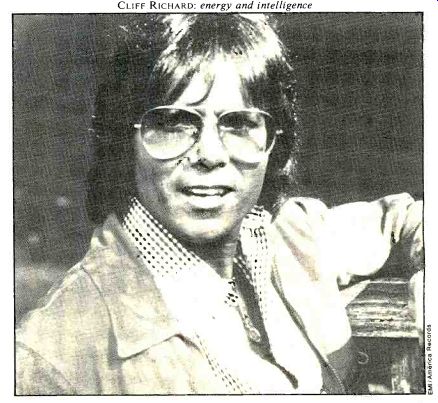
----------- CLIFF. RICHARD: energy and intelligence
TURLEY RICHARDS: Therfu. Turley Richards (vocals, guitar, saxophone); Mick Fleetwood, Kenny Malone (drums); Bob Welch, Jack Williams (bass); Reggie Young (guitar); other musicians. You Might Need Somebody; All Over the World; When I Lose My Way; Baby. Please Don't Go; Stand by Me; and five others. AT LANTIC SD 19260 $7.98.
Performance: Decent pap
Recording: Clean
A little note on the sleeve here says, "This album has been arranged for the majority of the mass in order to stimulate their inner most forces and bring it to the surface where they can play with themselves . . . not like the minority who rush off into dark and lusty canyons to fill their emotional pockets with rocks of love." You'll notice I left out a whole passel of (sic)s that ought to go in there; subject -verb agreement is not that much of a problem in the lyrics -lack of ambition is what holds sway there. The album does indeed seem engineered for the masses, although I doubt whether anything about it is deep enough to stir their innermost forces. More likely, it will cause a majority of feet to tap a few times, as it is tuneful and the performances are tight and disciplined. Richards sounds like a cross between Dave Loggins and the Cate Brothers, and the backing seems to be mostly Nashville under the influence of Mick Fleetwood ("executive producer"), yielding a calm but personable blue -eyed -soul sound that seems to benefit from being under a tight rein. Still, all it wants to do is pleasantly kill some time. In most moods I'd rather do that with Bullwinkle and Dudley Do -Right. N.C.
THE ROCKETS: No Ballads. The Rockets (vocals and instrumentals); other musicians. Desire; Don't Hold On; Restless; Sally Can't Dance; Takin' It Back; and five others. RSO RS -1-3071 $7.98, 0 8T-1 3071 $7.98, CT -1-3071 $7.98.
Performance: Good, but . . .
Recording: Fine
I've said it before, but it bears repeating: live, the Rockets, some of whom used to be members of the lamented Detroit Wheels, are a classic hard -rock outfit, but they have yet really to cut loose for a whole record in a manner befitting their potential. On "No Ballads," as on their previous albums, they do it only a couple of times: on an appropriately spiteful version of Lou Reed's Sally Can't Dance, a song I would not have suspected was worth covering, and on drummer John Badanjek's Takin' It Back.
Everything else here is likable, flashy with out being obnoxious, but utterly convention al. Badanjek remains the most exciting Six ties r- &-b-influenced drummer around (I've said that before too), and I'd pay money to see these guys work out in a grungy bar somewhere. But the album is a pro found ho -hum. S.S.
RECORDING OF SPECIAL MERIT
ROOT BOY SLIM & THE SEX CHANGE BAND WITH THE ROOTETTES: Zoom.
Root Boy Slim (vocals, harmonica); vocal and instrumental accompaniment. World War III; Do the Gator; The Loneliest Room in the World; Dare to Be Fat; Motel of Love; Dozin' and Droolin'; and five others.
ILLEGAL/I.R.S. SP 006 $7.98.
Performance: Kowabunga!
Recording: Very good Root Boy Slim, the sleazy darling of Washington, D.C., and environs, erupts for the second time, and on a new label. His previous album, two years ago for Warner Bros. (BSK 3160, already out of print), was startling, vulgar, ribald, hilarious, and -un fortunately -not widely heard. Let's hope this one is more successful. It is a dose of rock-and-roll nihilism that inspires laughter and clears the brain.
Visually, Root Boy is a caricature of the slob mob -rock audience (your basic booze -and -pot types). His guttural vocals are somewhere between Howlin' Wolf's and Captain Beefheart's, with a mixture of Wolf's farmland savvy and Beefheart's elfin fantasies. Hearing him a second time is not as overwhelming as the first time, but as the initial shock wears off it is easier to appreciate not only his humor but how well his band supports him -and how necessary that support is. There are no mehadies in his material; he yawps, grunts, and throws in spoken sotto voce asides while the band frames his acting with arrangements that describe what the "song" is about. Some times the band provides emotional counter point to what Root Boy is saying, as on She Wants to Move In, where the arrangement implies sympathy with the poor girl who's daffy for Root Boy, who doesn't want her except for an occasional bounce.
While Root Boy excels in comic descriptions of the sexual hunt, whether successful or not, he also offers ditties (which I guess are autobiographical) on the delicate subjects of jail time and mental health. These are not exactly bitter or morbid, but they do have the chilling flavor of unvarnished re call. Root Boy presents himself as not only an experienced fool but a brutalized one.
All in all, though, he's quite a fellow. If you didn't hear his first album, I suggest you be sure to catch him this time around. J.V.
THE SLITS: Cut. The Slits (vocals and instrumentals); Budgie (drums). Instant Hit;
So Tough; Spend, Spend, Spend; Shoplifting; FM; and five others. ANTILLES AN 7077 $5.98.
Performance: Tortured
Recording Good
The Slits, in case you hadn't heard, are for quite a few critics this week's Future of Music, which should make you suspicious right away. Actually, they strike me more as updates of the fictional heroines of the late, lamented mid -Seventies TV series Rock Follies in that they're obviously college -educated, they're older than their audience, and they make absolutely all the right moves. The right moves in 1980 terms, of course, means that they play a doomy, dissonant, metallic music several light years beyond minimalist, sing deadpan lyrics about oh -so -modern relationships, and over lay the whole thing with just the slightest reggae influence -reggae being to British art/punk what the blues was to British progressive rock: the mother lode. I'd call it all horribly nonmusical and a real grind to lis ...
---------------------
Anita Ellis
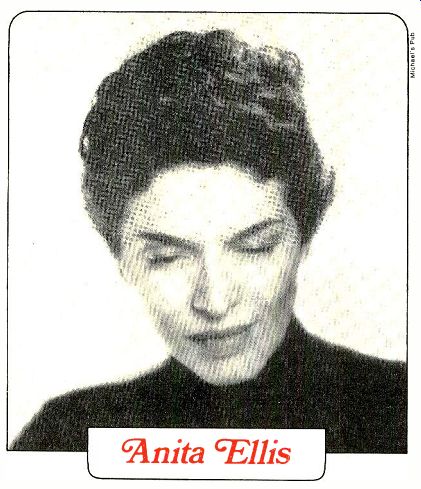
A HOT bit of "inside" gossip in the olden, golden days of Hollywood fandom-a part of which also encompassed my own golden youth-was that certain Star Delectables, although represented as past mis tresses of the art of song, were actually only moving their glossy lips while Someone Else did the actual singing. It was whispered that Someone Else, not Rita Hayworth, was the sultry voice panting through Put the Blame on Mame in Gilda and in all the sub sequent films Hayworth made at Columbia.
That it was Someone Else who sang for Vera -Ellen in both of her films with Fred Astaire at Metro. It didn't make much difference to us who adored-a Star didn't have to do anything, she only had to be there-but others read it as classic Holly wood exploitation. Little Someone Else was being Abused By The System, forced to use her God-given talents anonymously in the slave pits of the industry.
Well, surprise, surprise! Guess who just put out two fine new albums? Someone Else, that's who. The by -now legendary Anita Ellis is with us again, spreading joy all over the place, in "Echoes" on the Michael's Pub label and in "A Legend Sings" on Orion.
Dubbing was, of course, only part of the Ellis career. She was the star of her own radio show during that medium's heyday in the 1940's, her small but avidly collected catalog of recordings is a part of any serious popular -music collection, and, of late, she has resumed in -person performing in selected clubs.
What is the rare Ellis magic? Part of it has to do with a suberbly trained and maintained voice (at one time she studied for opera); part of it is musicianship of a caliber rare in the pop world; part of it is her ability to siphon personal meanings and motives from even the most shopworn lyric and communicate them to the listener. The sum of all these parts, however, is her truly unique, almost magical ability to cast and control mood. Cole Porter's What is This Thing Called Love must have been sung by everyone from Eleanor and Jane Powell to Raymond and Ilona Massey, and by all the Sinatras. It's a great song, to be sure, and most singers of Ellis' stature approach it as a work of light art to be restored to its original grandeur and left clean, cold, and perfect, ready for display as if in a brightly lit museum. Anita Ellis attends dutifully to the restoration during the first few bars, but even then one senses something else bubbling underneath. By the time she lets out her full, passionate voice on the lines "Who can solve its mystery?/Why should it make a fool of me?" it's clear that Ellis' artistic choice is hardly the moony regret that custom has encrusted on the song, but instead a massive, purplish mood of sexual rage Havelock and Anita Ellis, one might say. It all works superbly, of course, not only be cause it is a legitimate, valid approach but because Ellis has the technique and the intelligence and the heart to make it work. On lesser -known but no less worthy material, such as Sondheim's poignant Anyone Can Whistle Or Willard Robinson's Four Walls and One Dirty Window, Ellis still peels away at the expected until she is at the Triangle One of stark lyric, bare music, and dramatic impulse that seems to be the starting point of all of her interpretations.
I hope that the implied cerebration of all this doesn't give you the impression that Ellis is some sort of pop diva intent on microscopically examining each opus so that other members of the club can nod appreciatively. No, it is more that she is obviously a thinking listener's singer. She must go to the very root of a song to get the purity and unity of effect that she so consistently achieves. How else could she wrench such vivid, electric performances from such now -greying material as Early Autumn and Anywhere I Hang My Hat Is Home?
ORION'S "A Legend Sings," Ellis in tandem with Ellis Larkin at the piano (these paired names are going to get to me yet!), has a slight edge in my affections here, but only because the repertoire is more to my taste. "Echoes" benefits from the enlarged accompaniment and it contains Ta Luv, my favorite of all the tracks, but it is marred for me by the occasional performing presence of Larry Kert, Miss Ellis' brother. Mr. Kert, better known for his creation of the leading male role in the original West Side Story and in later years for performing several thousand push-ups in rapid succession on the Johnny Carson Show, may well be a fine Broadway singer, but on recordings he sounds tense and braying. Otherwise, it's roses all the way.
Anita Ellis, even in her days of being Someone Else (which, incidentally, was an extremely lucrative non -career while it flourished), was the kind of natural perfectionist, blessed with enormously communicative emotional gifts, who owned your ear the moment you heard her. She still is.
-Peter Reilly ANITA ELLIS: Echoes. Anita Ellis (vocals); Larry Kert (vocals); instrumental accompaniment. Pleasure of Your Company;
Dance of Life; Drinking Again; Big Red Apple; Echoes; Ta Luv; Early Autumn; Guitar Country; If Someday Ever Comes; Anywhere I Hang My Hat Is Home; Good Companions. MICHAEL'S PUB EPM2 151627 $7.99 (plus postage and handling charge from Liberty Music, 450 Madison Avenue, New York, N.Y. 10022).
ANITA ELLIS: A Legend Sings. Anita Ellis (vocals); Ellis Larkin (piano). A Flower Is a Lovesome Thing/Spring Will Be a Little Late This Year; Anyone Can Whistle; What Is This Thing Called Love?; Four Walls and One Dirty Window; Who Can I Turn To?; Lazy Afternoon; Prelude to a Kiss; I Hear Music; Summertime; Wait Till You See Him; But Beautiful; I Wonder What Became of Me; Sometimes I Feel Like a Motherless Child. ORION ORS 79353 $6.98.
-----------------------
-----------------------
Millie Jackson
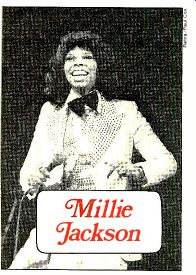
THE cover of Millie Jackson's new album, "Live and Uncensored," bears a small, perhaps censorial label indicating it is in tended "For Mature Audiences Only" and warning that it "contains explicit language which may be considered objectionable by some listeners." No wonder, for this double -
disc set, recorded live last summer during an engagement at the Roxy in Los Angeles, finally presents the real Millie Jackson, free of any restraints that might have inhibited her, however minimally, on previous recordings. Over four sides, this bad -talking, Georgia -born siren (who's now at home in Teaneck, New Jersey) mixes lustily rousing soul singing with racy raps on sex and life that are absolutely hilarious in their blunt ness and black (ethnic) humor.
In this respect, the album is somewhat like those forbidden "party" records comedian Redd Foxx used to make in the years before he was emasculated by television.
But it accomplishes far more than merely showcasing what just might be the dirtiest mouth in captivity. The performances on this recording were a major breakthrough in Ms. Jackson's career, for some local critics were inspired by them to rate her above such reigning pop divas as Bette Midler, Donna Summer, Diana Ross, and Linda Ronstadt. It was about time, for Millie Jackson has a winning quality those others do not. Disdaining posturing and cute contrivances, she comes across not like a star but as a woman much like those in her audience--with one exception: she is willing to air all of her funky linen in public.
And air it she does, in the colorfully fractured English laced with profanity and irony that is commonly heard in the bars, beauty shops, and apartments of America's black ghettos. You always get the impression listening to Ms. Jackson that just be fore hitting the stage or stomping into the studio she had rolled out of bed with some man. Yet mere semi -pornographic titillation is never her objective. She successfully taps the reservoir of humor in male -female relations, which transcends racial lines. One needn't be black to appreciate her tales about wives who would like to lay a different log on their fires or frustrated women involved with married men who are unavailable on holidays, even Halloween. And one need not be a woman to be rocked by her raunchy intensity. She attains a kind of delightfully bawdy universality.
No doubt the sexually suggestive nature of Ms. Jackson's patter (or "rap") has been an impediment to broader acceptance.
Some of her best numbers are so explicitly descriptive they cannot be played on the radio, where so many potential record -buyers do their aural browsing. Furthermore, her style and material automatically limit even the cuts that can be aired to black -oriented radio stations, which are currently caught up in an orgy of disco. But, a true individual, Millie Jackson has chosen this period of plastic conformity to revive traditions that date back to the gloriously open-minded era of the so-called "classic" blues, which set a high standard in double-entendre.
ON the new album, which closely follows a successful collaboration with Isaac Hayes (see review in February "Best of the Month"), she ranges all over the pop -music terrain, interspersing Rod Stewart's Da Ya Think I'm Sexy and Kenny Rogers' Sweet Music Man with items that are distinctively her own, such as All the Way Lover, It Hurts So Good, and Never Change Lovers in the Middle of the Night. Some of them have been on her earlier albums, but they never sounded quite like they do here. Hollering out in a rough, froggy -bottomed voice, she mixes in some of the most impassioned shrieks to be heard on discs since James Brown and Wilson Pickett trans formed screaming into an art form nearly a decade ago.
Though some live albums cheat the fan by overplaying audience response at the expense of the music, this one has a proper balance between the artist and those on the other side of the footlights. As on good blues recordings, their back -talking responses obviously serve to spur the performer on to greater heights. And the heights Millie Jackson scales are definitely impressive.
-Phyl Garland
MILLIE JACKSON: Live and Uncensored.
Millie Jackson (vocals); vocal and instrumental accompaniment. Keep the Home Fire Burnin'; Logs and Thongs; Put Some thing Down on It; Da Ya Think I'm Sexy?:
Just When I Needed You Most; Phuck U Symphony; What Am I Waiting For; I Still Love You (You Still Love Me); All the Way Lover; The Soaps; Hold the Line; Be a Sweetheart; Didn't I Blow Your Mind; Give It Up; A Moment's Pleasure; If Loving You Is Wrong (I Don't Want to Be Right); The Rap; Never Change Lovers in the Middle of the Night; Sweet Music Man; It Hurts So Good. SPRING SP -2-6725 two discs $11.98, 8T-2-6725 $11.98.
-------------------------
....ten to, but I don't want to sound like my parents. S.S.
REX SMITH: Forever. Rex Smith (vocals);
vocal and instrumental accompaniment.
Tonight; To You; Saturday Night; Super hero; Everytime I See You; and five others. COLUMBIA JC 36275 $7.98, JCA 36275 $7.98, JCT 36275 $7.98.
Performance: Okay
Recording: Good
Rex Smith has sung with regional bands as well as on tour with Ted Nugent, Boston, Foreigner, and other major groups. His last album, "Sooner or Later," based on a TV show in which he appeared as an actor, and his single You Take My Breath Away both did very well. And he's good looking. What it adds up to is that he is today's David Cassidy, another preteen/mid-teen heart-throb, good for maybe a couple of years of heavy exposure, in the great line that began in the 1950s with Fabian. Smith writes and sings mass -market pop stuff, and he does it pretty well, but for anyone over eighteen this is kid stuff. J.V.
SYLVAIN SYLVAIN. Sylvain Sylvain (vocals, guitar); vocal and instrumental accompaniment. Teenage News; What's That Got to Do with Rock 'n' Roll?; I'm So Sorry;
Emily; Without You; and five others. RCA AFL1-3475 $7.98, AFS1-3475 $7.98, AFK1-3475 $7.98.
Performance: Good try
Recording: Dry
Sylvain, of course, is an alumnus of the New York Dolls. Like David Johansen, his former partner in musical crime (and totally unlike Johnny Thunders, the other celebrity Doll), Sylvain has been, uh, cleaning up his act of late. Although his musical and lyrical concerns remain much the same as they were in the Glitter Era, these days, with the help of an almost slick little band, he makes bright, professional, catchy pop/ rock with a certain amount of wit and style.
Granted, he doesn't reach the depths Johansen occasionally plumbs, but he has a good ear for the hook, and as a result this debut solo album is fairly promising even though the best thing on it (Teenage News) is a five -year -old leftover from the Dolls' Red Chinese period. It's all as lightweight as can be, to be sure-an asthmatic's wheeze could blow it away-but it rocks, and it's kind of cute. Which, at least this early in 1980, will do. S.S.
THE UNDERTONES. The Undertones (vocals and instrumentals). Family Entertainment; Girls Don't Like It; Male Model;
I Gotta Gotta; Teenage Kicks; Wrong Way; and ten others. SIRE SRK 6081 $7.98, e M8S 6081 $7.98, M5S 6081 $7.98.
Performance: Believable
Recording: Okay
If you can imagine the unlikely pairing of Buddy Holly with the Ramones you might get an idea of what the Undertones are up to here. Within the three -chord amped-up limitations of a mainstream punk format, these Irish youngsters manage actual melodies, hooks, and lyrics about teenage concerns, mundane and otherwise, that ring as ...
--------- THE WHISPERS: soothing soul
unerringly true in their touching adolescent romanticism as anything in the Holly catalog. Furthermore, lead singer Feargal Shar key (that's his name, honest) sings it all in a most distinctive choked manner, sort of like a prepubescent Noddy Holder for those of you who remember Slade. Jimmy Jimmy, the tragic tale of a Mommy's Boy, is the classic here (although the Undertones lack the instrumental genius, I'd compare it with the great early Who track I'm a Boy), but almost everything is fun on some level. If the Ramones' glue -sniffing pinhead act puts you off, you might just find the Under tones an appealing alternative. S.S.
BOB WELCH: The Other One. Bob Welch (vocals, guitar); vocal and instrumental accompaniment. Rebel Rouser; Love Came 2X; Future Games; Old Man of 17; Hide away; Don't Let Me Fall; and four others.
CAPITOL SW -12017 $7.98, 8XW-12017 $7.98, 4XW-12017 $7.98.
Performance: Dull
Recording: Good
Since leaving Fleetwood Mac to go solo, Bob Welch has had a few hit singles here and there, but he hasn't really established himself as an individual performer. I doubt that "The Other One," his new album, will add much to his reputation. It disconcertingly reminds me of Gerry Rafferty's last album; both Welch and Rafferty are skillful guitarists without a particularly arresting
vocal style. Their material tends to be rather ho -hum, and just about anything they sing comes out sounding equally bland. The trouble with musicians like them is that they have nothing to say-and keep on saying it over and over. J.V.
RECORDING OF SPECIAL MERIT THE WHISPERS. The Whispers (vocals); instrumental accompaniment. A Song for Donny; My Girl; Lady; Can You Do the Boogie; and four others. SOLAR BXL1-3521, $7.98, BXS1-3521 $7.98, BXK1-3521 $7.98.
Performance: Vocally gorgeous
Recording: Good
Somehow, in the midst of all the hyper-frenetic hullabaloo of ten thousand hopefuls struggling to have their terrible songs played loudly enough on tacky radio stations to become hits, the Whispers manage to remain cool. They simply sing, with the velvet harmonies that have been difficult to find in r -&-b since the Miracles and the Temptations were scrounging around for carfare to get to their gigs. However their soft, soothing music is described-the laid back Southern California soul sound?-it's balm to jangled nerves, and I hope no one ever comes along to change it.
This album is about two-thirds rhapsodic vocal gorgeousness and one-third adequate dance fluff. The outstanding track is the opener, a tribute to the late Donny Hathaway with lyrics by Carrie Lucas. I don't know which one of the five Whispers sings lead here, but his sensitive interpretation catches the essence of Hathaway's artistry.
Recommended listening. P.C.
WIRE: 154. Wire (vocals and instrumentals); other musicians. I Should Have Known Better; 2 People in a Room; The 15th; The Other Window; Single K.O.; In direct Enquiries; A Touching Display; and six others. WARNER BROS. BSK 3398 $7.98, e M8 3398 $7.98, M5 3398 $8.98.
Performance: Up to the concept
Recording: Excellent
Some inspirational verse from Wire's The Other Window: "The seat was hard/The carriage fetid/He was dressed for summer/ But still he sweated." Actually, all of "154" is like that. You respect the intelligence be hind it (despite the drag, these guys are far too well educated to be punks), but ... well, a bundle of laughs it's not. Come to think of it, Wire's doomy, apocalyptic minimalism (not to mention the critical yammering it's inspired; they're a lot of rock writers' favorite band) generally strikes me as the late Seventies/early-Eighties equivalent of the self-conscious psychedelic over-reachings we all went wild over for about a week in 1967.
Along the lines of, say, the Clear Light al bum, or the first Strawberry Alarm Clock LP-which, believe it or not, was briefly considered "experimental." On the other hand, perhaps this music is the future of something or other. We'll just have to wait a few years to see. S.S.
RECORDING OF SPECIAL MERIT
NEIL YOUNG AND CRAZY HORSE:
Live Rust. Neil Young (vocals, guitar, harmonica); Crazy Horse (instrumentals).
Sugar Mountain; I Am a Child; Comes a Time; After the Gold Rush; The Loner; Lotta Love; Sedan Delivery; Cortez the Killer; and eight others. REPRISE 2AX 2296 two discs $13.98, e 2W8-2296 $13.98, 2W5-2296 $13.98.
Performance: Unpretentious
Recording: Generally very good
It's awfully hard to improve on what Steve Simels once said about Neil Young: he may be a bozo, but he's a great bozo. Young has come to mean so much more to many of us than the sum of his talents. Most of the negative stuff said about him is said affectionately, as when a jock in my region said of this album, "He sings on key most of the time." In fact, in "Live Rust" Young's sense of pitch is pretty good, and he handles himself well on the guitar, switching back and forth between acoustic and electric and playing the lead most of the time. He's not a great singer or a great guitarist, and he probably isn't even a great songwriter-al though he does have a good, strong, healthy, dependable voice as a writer-but there's an extra ingredient that can transcend this technical -prowess stuff, and Young has it.
Nobody can quite describe this quality one can circle around it by saying Young has style and soul, which is true but not the whole truth-but it is easy to recognize. It comes shining through "Live Rust," which has the unpretentious air of a "typical" con cert (this one interrupted at one point by a rainstorm) by a band on the road, an unfussy approach that's hard to get in two -record live albums. It has a sense of proportion, and it works both as a well-balanced album and as a retrospective by one of the few hip pie musicians who haven't sold out. N.C.
DISCO
BRASS CONSTRUCTION: 5. Brass Construction (vocals and instrumentals). It's Alright; Watch Out; Music Makes You Feel Like Dancing; Shakit; and three others. UNITED ARTISTS LT -977 $7.98, 0 EA -977 $7.98, CA -977 $7.98.
Performance: Souped -up funk
Recording: Just souped up
I don't know why the nine men in this group call themselves Brass Construction. The arrangements are not particularly brassy.
What they are is heavy funk, souped up and disciplined enough to work for a wide disco audience as well. The busy, even hectic orchestrations are supported throughout by the beat-the basically sexy bump of funk.
Music Makes You Feel Like Dancing gets its energy from a combination of brass and percussion. Right Place sets a big -band horn section against violins. Get Up to Get Down opens with the guys singing a cappel la and goes on to feature the album's best freewheeling vocal work. It's Alright spot lights a sexy bass voice mixed way up front and has an insane percussion interlude I'd give anything to hear in a real disco atmosphere. The trouble with all these songs is that the good moments are too fleeting. The group too quickly drops an idea to rush off to something else. The best cut, I Want Some Action, is the only one in which a single musical idea is sustained and developed; moreover, the busy arrangement is pulled back just enough that the voices, in attractive close harmony, have more of a chance to be heard. There's nothing really wonderful here, but there's also nothing that's less than solid dance music. If you like your disco souped up and funky, you'll have a good time with this. E.B.
RECORDING OF SPECIAL MERIT
FESTIVAL: Evita. Festival (vocals); instrumental accompaniment. Don't Cry for Me Argentina; Buenos Aires; She Is a Diamond; Eva's Theme: Lady Woman; and three others. RSO RS -1-3061 $7.98, 8T 1-3061 $7.98, CT -I-3061 $7.98.
Performance: Inspired
Recording: Excellent
What an opportunity for a rip-off! Splash "Evita" across the jacket and you could probably sell any junk record these days.
But producer/arranger Boris Midney has clearly been inspired by the music from the rock opera turned Broadway hit, and he has worked hard to produce wonderful disco versions of six of its songs, plus a new one of his own. The album is crammed with vigorous arrangements, gutsy vocals, dramatic electronic augmentation, and driving, high energy, dance rhythms. Best of all, it is beautifully paced; the orchestral bridges mesh perfectly with Andrew Lloyd Webber's original music, and the richly varied arrangements show more imagination. than nine out of ten other disco releases. "Evita" is, in fact, well worth listening to even when you don't feel like dancing.
Some high points: when Buenos Aires rides out on "I'm just a little stuck on you." and moves, uninterrupted, through dark chords and terrific percussion into a bouncy rendition of I'd Be Surprisingly Good for You; the bell -like synthesizer tune that runs through High Flying, Adored; the epic opening to Rainbow High; and every single second of Don't Cry for Me Argentina.
Midney's new song, Lady Woman, gets the busiest arrangement of the bunch, and, though it has as solid a dance beat as the rest, it adds more noise than substance to the album. Points off for this, but not enough to make Festival's "Evita" anything less than a superb achievement. E.B.
DELORES HALL. Delores Hall (vocals); vocal and instrumental accompaniment.
Never Needed You Anyway; Snapshot; Sing a Happy Song; Like a Promise; and three others. CAPITOL ST -11997 $7.98, e 8XT-11997 $7.98, 4XT-11997 $7.98.
Performance: Aborted talent
Recording: imbalanced
What Delores Hall has is a gospel -strong voice. It is a dynamic instrument with no discernible upper limit and a focus guaranteed to make each listener feel it is directed at him or her alone. This kind of voice should work well with disco, especially in arrangements as juicy as these, which have everything from swirling strings to syncopated sticks, bells, chimes, and a huge horn section. And all the cuts have an up -tempo that can seem downright joyous. So what's wrong? As too often happens in disco productions, the singer gets lost. The engineering and arrangements rob Delores Hall of all command, largely restricting her vital, vibrant voice to the middle and lower registers and leaving us with an anonymous vo cal performance.
There are some good moments. Born to Be Free is a good song (disco or no) with a superior orchestral break marked by jazz--like piano and bass solos. The album's longest number, Snapshot, builds lots of energy, thanks mainly to the simply terrific back-up vocal work ("Come on and take it, take it, take my picture") and the driving beat. And for all-around good spirits, it would be hard to top the joyful Sing a Happy Song. But these successes have more to do with the superb production than with the singer. I was left exhilarated by the album's dance power but with no feeling for who Ms. Hall is as a performer. E.B.
DAN HARTMAN: Relight My Fire. Dan Hartman (vocals, keyboards); vocal and instrumental accompaniment. Hands Down; Relight My Fire; Just for Fun; and three others. BLUE SKY JZ 36302 $7.98, JZA 36302 $7.98, JZT 36302 $7.98.
Performance: Good, but . . .
Recording: Bright
Disco's answer to Billy Joel is back, with his piano, a gang of friends, and a new LP that is, in its best moments, a reprise of Instant Replay, Dan Hartman's big hit of a year or so ago. Free Ride, Relight My Fire, and, especially, a little number called Hands Down all recapture precisely the same gleeful high spirits, and they are all performed at the same fast, driving tempo with the same party atmosphere. But only the title song here manages to be something special.
Otherwise, it's all just good dance music with little to distinguish one song from the next or Hartman from other performers.
The guy really works hard, at least. The energy in these cuts is enormous, but too of ten the result seems relentless rather than energizing. And, sadly, when Hartman tries to do something different, as in the Stevie Wonder -inspired Love Strong, it just reveals his vocal limitations. E.B.
M: New York - London - Paris - Munich. M (vocals and instrumentals). Pop Muzik; Moderne Man/Satisfy Your Lust; That's the Way the Money Goes; and five others. SIRE SRK 6084 $7.98, M8S 6084 $7.98, M5S 6084 $7.98.
Performance: Spotty
Recording: Good
Protest -disco? Well, not quite. M is a New Wave group, and, although the album has a dance beat (Pop Muzik was a big rock -disco hit as a single), the arrangements are satiric. Robin Scott wrote and produced the album and is also responsible for the arrangements and lead vocals, which are not sung but spoken in a voice like a British tour guide's. The material mostly says that society, the great bugaboo, ruins our lives.
Some of Scott's material is funny; most of it is predictable and repetitive. J.V.
WALTER MURPHY: Discosymphony. Disco-symphony Orchestra, Walter Murphy cond. Bolero; Mostly Mozart; Classical Dancin'; and three others. NEW YORK INTERNATIONAL BXL1-3506 $7.98, BXS1 3506 $7.98, BXKI-3506 $7.98.
Performance: Ordinary
Recording: Ditto
If Disney's Fantasia could help introduce a generation to Bach, Beethoven, and Stravinsky, one might reasonably argue that Walter Murphy's "Discosymphony" will lead the disco generation to Mozart, Brahms, and Ravel. Perhaps. Murphy's ninety -piece orchestra discos its way with disarming faithfulness through a collection of well -loved classical themes. Bits of Mozart's Symphony No. 40 emerge from the twenty-two violins with a semblance of true symphonic style, Malagueila begins virtually straight before the beat enters, Bolero (Ravel) leads off with perfectly authentic woodwinds, and so on.
---------------------------Utopia: Future Smirk
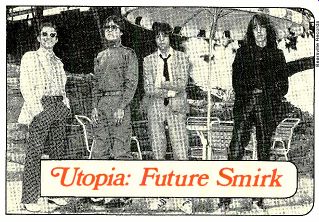
I HAVE seen the future and it smirks. That's what I should have said the first time I encountered Todd Rundgren's "music," which is to say his engineering and synthesizer programming and general modernizing of every tone that occurred to him.
The idea that the music of the future will be less and less touched by human hands is popular with some science -fiction writers and with a lot of grade -B movie makers they've been going at least as ape as Rundgren does on the subject ever since they were given the theremin-and has gone so long unchallenged that a group like Devo can incorporate it into a whole career of satire. Now-follow me carefully here's Rundgren's band, Utopia, with "Ad ventures in Utopia," which curries favor with such groups as Devo while at the same time continuing the "futuristic" shtick that made such groups guffaw and satirize in the first place. Still, I think the damned thing is smirking, knowing it's turning a teeny-bop per head or two and fooling enough of the people enough of the time.
All the material in it originally was performed for the television production Utopia, which hasn't been shown in my area. By "futuristic" I don't mean the lyrics actually set the little cycle of songs in the future, and by "Utopia" the band apparently doesn't mean a place with no problems. But the main jacket decoration is a TV test pattern, and the lyrics (hewing, as usual, to Rundgren's semi -articulate teenager language) are printed by some kind of computer -like device, and the impressions mount up fast when you add the production, which has the gritty, hissy quality of turned -up treble but without much real grit or hiss (in addition to being hard -surfaced and shiny, the future is clean, especially when it comes to fingerprints). The impression you're left with is that most of the sounds are squeezed through as much electronics as possible.
There's some recognizable electric guitar, of course, but almost never is there any thing as organic and old-fashioned as a twang. The other impression that keeps recurring is that Utopia actually tried for a raw sound-apparently by applying still more engineering tricks-and failed.
As for trying for credence with people like Devo (or perhaps with people who are vaguely aware of people like Devo), there's a full-blown ditty on the subject: Last of the New Wave Riders. Really, now. Reacting against people like Rundgren was largely what created the New Wave, and here he is singing, "So I packed up my Fender and ran down the hall/Back to the fields and forests/Now I am one of them." That needs no comment.
You might get the idea from what I've said so far that this piece of work has no redeeming value, but there are, in fact, ture Smirk some nice washes of sound and vocal harmonies in it, and there are quite a few catchy tunes. Overall, though, the thing not only fails to sound raw but lacks immediacy; the sense that music is being made here is missing. Like everything, it's a matter of degree. The future no doubt will include the synthesizer, but making music will also continue to involve musicians bouncing off each other in the most existential, least-programmable manifestations of mood and moment. It is this essence, whatever the instrumentation, that eluded Utopia here. I happen to see no reason why acoustic guitars couldn't coexist with space travel or gleaming cities, but then I'm more the Walden II type when it comes to utopias.
The point is, whatever you play, if you want it to come out music, you have to play it like a musician, not like an engineer.
-Noel Coppage UTOPIA: Adventures in Utopia. Utopia (vocals and instrumentals). The Road to Utopia; Set Me Free; Second Nature; Shot in the Dark; Caravan; Last of the New Wave Riders; You Make Me Crazy; The Very Last Time; Love Alone; Rock Love.
BEARSVILLE BRK 6991 $7.98, 0 M8 6991 $7.98, © M5 6991 $7.98.
-------------------------
Unfortunately, an awful lot of the new music here is extraneous filler. Except for Bolero, which goes on almost as interminably as the original, the extracted melodies are sandwiched between great slabs of face less dance -rhythm stuff. The power of such arrangements to move a novice to explore classical music is even more questionable since everything here, from Tchaikovsky to Mozart, ends up sounding pretty much the same. And if what you want is to dance to this record, be prepared for a sedate evening. These arrangements are for suburban supper clubs, not disco joints. E.B.
NARADA MICHAEL WALDEN: The Dance of Life. Narada Michael Walden (vocals); vocal and instrumental accompaniment. You're Soo Good; Lovin' You Madly; Crazy for Ya'; Tonight I'm Alright; and four others. ATLANTIC SD 19259 $7.98, TP 19259 $7.98, CS 19259 $7.98.
Performance: Relentless
Recording: Fine Everything in this album sounds the same.
It's all relentlessly aggressive disco with heavy arrangements and more horns blaring at you than you'll ever need. Only in spurts is there sufficient ingenuity to lift the material out of the ordinary. The songs, all written by Walden himself, are undistinguished wistful lost -love songs with repetitious lyrics that never dig, surprise, or amuse. There are some bright spots in the arrangements. The Chic -like Tonight I'm Alright is the best song, but the hand -clap ping middle of I Shoulda Loved Ya', with its syncopated piano, comes closest to being fun. And the one purely orchestral work, The Dance of Life, may be impossible to dance to, but it's pretty music, with a simulation of Far Eastern bell and gong sounds and a simple melody on a sitar -like electric guitar.
Unfortunately, most of the album is less interesting. Song after song blasts away, and Walden sings them almost in a shout.
The one ballad shows him to have a pleas ant, husky voice when he doesn't push, but, like the album, it lacks distinction. E.B.
RECOMMENDED DISCO HITS
MERRY CLAYTON: Emotion. MCA, MCA -3200 $7.98, MCAT -3200 $7.98, MCAC-3200 $7.98.KLEER: Winners. ATLANTIC SD 19262 , $7.98, TP 19262 $7.98, CS 19262 , $7.98.
GIORGIO MORODER: American Gigolo. POLYDOR PD -1-6259 $7.98, 8T -I 6259 $7.98, CT -1-6259 $7.98. TALKING HEADS: I Zimbra. SIRE PRO -A-846 disco disc -$3.98.
(List compiled by John Harrison.)
THEATER FILMS MGITAL SPACE: SPECTACULAR MU SIC FOR FILMS (see Classical Discs and Tapes, page 141) THE ELECTRIC HORSEMAN. Original - soundtrack recording. Willie Nelson (vocals); instrumental accompaniment; chorus and orchestra. COLUMBIA JS 36327 $8.98, JSA 36327 $8.98, JST 36327 $8.98.
Performance: Willie's fine
Recording: Good
I haven't seen The Electric Horseman, which was directed by Sydney Pollack and features Jane Fonda, Robert Redford, Willie Nelson, and Valerie Perrine. I can tell you, though, that the album plays on the dichotomy between the electric now and old-time cowboy imagery. Willie Nelson sings about cowboying on side one, and Dave Grusin's movie program -music disco score takes over side two.
Nelson's side is just fine except for one or two annoying intrusions of string sections.
Mostly it's just him and a few pickers doing familiar "outlaw" songs. But Grusin's side is dull as hell without the pictures and may be even with them. As an album this has too neatly split a personality and contains far too much garbage. N.C.
PIANO BAR (Rob Fremont -Doris Willens).
Original-cast recording. Kelly Bishop, Karen DeVito, Steve Elmore, Jim McMahon, Richard Ryder, Joel Silberman (vocals); orchestra, Joel Silberman cond. ORIGINAL CAST OC-7812 $8.95 (plus $1 for shipping from Original Cast Record Company, P.O. Box 496, Georgetown, Conn. 06829).
Performance: Coy but clever
Recording: Very good
Piano Bar is one of those gentle, un-pretentious musicals that used to abound off Broadway and could be relied on for an evening of unforced diversion. It has the same overly knowing, arch approach to life that used to plague this kind of piece-a little like being trapped on the contest page of an old issue of New York magazine-yet it has virtues too.
A simple book about the happy -hour habitués of a bar called Sweet Sue's allows the characters to develop through the songs they sing. True, they don't develop very far, and the songs are not the kind you go away whistling later, but, like Stephen Sondheim's, the ballads have certain dour charms. Despite such rueful ditties as Pigeon Hole Time and Scenes from Some Marriages, Piano Bar ends happily: the two couples who met when the lights went up stay on when they finally go down. And, de spite a preoccupation with human frailties, on disc the musical has the kind of disarmingly innocent sophistication that makes for pleasant listening. P.K.
THE UMBRELLAS OF CHERBOURG and THE GO-BETWEEN (see Classical Discs and Tapes-LEGRAND, page 133)
-------------------
Foxy Disco
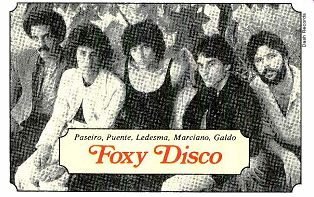
-------- Paseiro, Puente, Ledesma, Marciano, Galdo
FOR many of us discomanes, it truly began to change when Rod Stewart released Do Ya Think I'm Sexy? By "it" I mean, of course, the music we dance to. Stewart's record was clearly rock, but it was also hot dance music. Suddenly a distinction was clear between "disco" as a kind of music and "disco" as a kind of dancing-free, self -choreographed dancing with an aura of erotic ritual. And ever since then folks have been talking about "the death of disco" in one or the other (or both) of these senses.
All this is by way of introduction to a new record that provides rock -solid proof that, whatever we call the music or however we describe the ritual, America is going to keep right on dancing through the Eighties. Some guys who call their group Foxy have come up with a pure -rock dance album called "Party Boys." The group's leader, Ish Ledesma, wrote all the songs. He comes to Foxy from a rather less -than -glorious solo career in rhythm and-blues. As the title suggests, the album is meant for dancing. But Ledesma's roots show on virtually every cut. The group opens easy with Girls, a syncopated item punctuated with percussion and sung largely in a toughened -up version of standard r -&-b falsetto. A touch of scat singing distinguishes the opener, but only after Foxy moves into a much heavier set starting with Let's Be Bad Tonight do they hit their stride. This number is rock-'n'-roll pure and simple, with a ride -out that has all the energy of a live concert performance.
The stage is now set for some virtuosity.
A good-natured hyper -samba, Sambame' Rio, and a simple, effective ballad with Ledesma doing a very good job as vocalist, I Belong to You, show off Foxy's versatility and pave the way for the real heart and soul of the album. Four tremendous cuts follow, building steadily from She's So Cool (check the moment in the middle of this when the group's voices are set against an electric guitar), through the exciting, free wheeling vocalism of I Can't Stand the Heat and Rrrrock, and on to the best of the bunch, Fantazy, which really lets 'er rip.
WTH Fantazy's last two words we're suddenly, dramatically into a lovely ballad, Pensando en Ti. This beautifully programmed transition illustrates Ledesma's idea of making an album flow like a con cert. And the concept carries through right to the end. Foxy sends us "home" smiling with the title song, the closest thing to standard disco (music) on the album. It's my nominee for the Donna Summer Soundalike award, with its hypnotic Sunset People synthesizer and a lyric that echoes Bad Girls.
I know, I know: there are soaring strings in the background of Rrrrock, and every once in a while someone picks up the beat by blowing a police whistle. Rock purists will have none of this. But, as we move into the future, it becomes clearer every day that no music idiom remains "pure" for very long. The list of hyphenated rock styles grows and grows. Welcome, everybody, to good old hyphenated dance -rock.
-Edward Buxbaum
FOXY: Party Boys. Foxy (vocals and instrumentals); instrumental accompaniment. Girls; I Can't Stand the Heat; Let's Be Bad Tonight; Sambame' Rio; I Belong to You; She's So Cool; Rrrrock; Fantazy; Pensando en Ti; Party Boys. TK/DASH 30015 $7.98, 0 30015 $7.95, 30015 $7.95.
Kenny Rogers
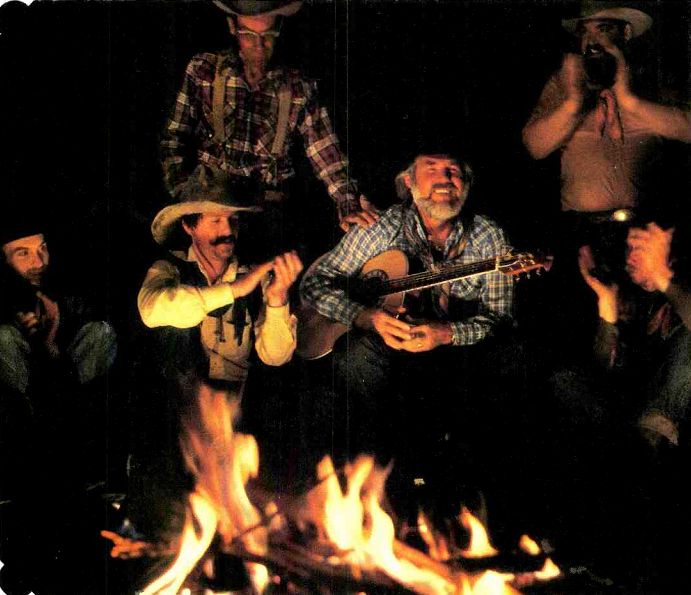
"I'm on a hot spell right now, and I figure I've got two and a half years left on it." By Alanna Nash
ON the cover of a recent album, Kenny Rogers stares coldly, defiantly, resolutely into the camera, like a man who knows what he wants and how to get it. His hands are full of money, and the eyes of those around him are brimming with excitement and greed. With the chips piled high, the dealer flips a card. But the outcome is predictable. Kenny Rogers, "The Gambler," as it says on the frame above his head, is on a roll.
The latest payoff came last October, when Rogers played host for the Country Music Association awards show and took home three of the top honors, for Male Vocalist of the Year, for Duo of the Year (with Dottie West), and for Album of the Year, "The Gambler." If he was disappointed at not being named Entertainer of the Year, for which title he was nominated, Rogers could take some comfort in the fact that the Academy of Country Music bestowed that honor upon him several months before, and its Top Male Vocalist award as well. At this writing he is up for a slew of Grammies (his first, in 1978, was for "Lucille"), and his single of The Gambler has already been certified gold. The album of the same name went double platinum and threatened to turn triple platinum, selling in excess of three million copies by last Christmas.
Fittingly, although The Gambler had been recorded by no less than a dozen artists (including the likes of Bobby Bare, Johnny Cash, and its author, Don Schlitz), it took the grainy, low -life voice of Kenny Rogers to drive home its sad irony and deliver the hook that would set toes a-tappin' all across America. Then again, maybe it was Fate, a matter of the right song waiting for the right singer, for Kenny Rogers has always been a gambler, switching from one musical style to another in search of the combination that would bring the big payoff. As he sang in the now immortal refrain, "You've got to know when to hold 'em/Know when to fold 'em/Know when to walk away/ And know when to run." ONE of eight children of a Houston shipyard worker, Rogers signed his first recording contract while still in high school. "When I first got started in music," he said before a show in Indianapolis recently, "I think Sam Cooke and Ray Charles made the two biggest impressions on me. To this day, I think I try to sing like Ray Charles in some situations, and a lot of my phrasing would still be attributable to Sam Cooke." Hit songs were to come early to Rogers, who, in 1956, along with his do-wop band "The Scholars," had a million -selling record with Crazy Feeling, produced by Rogers' brother.
The country influence was not to be ignored, though. "I was Kenny Rogers I, because George Hamilton IV was very big at the time, and I thought if it was good enough for him, it was good enough for me," he remembers with a self -mocking smile.
While studying music and commercial art at the University of Houston, Rogers sang and played upright bass with the Bobby Doyle Trio, which he describes as an "avant-garde jazz" band. After six years, he joined a popular folk group, the New Christy Minstrels. But a year and a half later, in 1967, Rogers and several others of the Minstrels-Mike Settle, Terry Williams, and Thelma Camacho-split off to form the First Edition and record Just Dropped In to See What Condition My Condition Was In, a contrived little ditty (with a Glen Campbell reverse -track guitar solo) that Rogers' high-school friend Mickey Newbury wrote to cash in on the growing trend toward psychedelia and acid rock.
LIKE much of the material Rogers performs today, the songs of the First Edition did not fit neatly into any one category. Ostensibly a Top -40 rock group, the band built most of its fame with several country -flavored numbers, the most memorable being Mel Tillis' Ruby, Don't Take Your Love to Town and Reuben James, written by Alex Harvey, a high-school band teacher whose finely crafted songs were to show up on Rogers' albums with increasing regularity for the next ten years. In retrospect, it appears that the First Edition played a not -too -small but largely unheralded role in helping bridge the gap between country and rock.
"When you look at most of our big hits, they were really country records," says Rogers. "But Warner Brothers, the label I was with at the time, did not have a country -music department, so they merchandised us as a pop act, or a rock act, because this was the time when the Jefferson Airplane and Vanilla Fudge and all those groups were around." After nine years, four gold albums, nine gold singles, and a syndicated television show, Rollin', that played on 192 stations in the United States and Canada for two years, the First Edition called it quits. "We reached a point of what I call creative stagnancy," Rogers recalls. "We had done about everything there was, and there was just no fresh input. If we'd stayed together, I think we probably would have gone downhill, because there was so much misdirection in that group. We had many different talents, and everybody was pulling his own way. There was never a unified approach to anything. Terry wanted to go be a rock-and-roll singer, and I have always been and will always contend that I have always been a country singer.
"I think that during those days I may have been searching for an identity," admits Rogers, now a clean-cut L.A. type who leans toward velours V-neck sweaters and expensive gold jewelry.
"First of all, I had to grow a beard to get into the First Edition, because I was seven or eight years older than the other guys, and they didn't want me in the group because I was too old. They were looking for a young surfer kind of guy.
So I was trying to find a way to look younger. The beard helped, and I ended up at one point with an earring in my ear." In 1976, Rogers headed down to Nashville in search of a solo career.
His third marriage had just broken up, "and I'd given up everything I'd made in my last career because I didn't want my ex-wife involved in my future." Clearly, Rogers was figuring on making a killing, and to ensure it (as he told a reporter in 1977) he and United Artists producer Larry Butler "put our game plan together, and it worked." The first hint of solo success came with Love Lifted Me, followed by Home made Love, While the Feeling's Good, and Laura.
ROGERS wasn't to foresee just what a star he would become, however, until 1977, when he and Butler struck gold with a classic country story -song, Roger Bowling and Hal Bynum's Lucille. By then the formula by which he and Butler plan all their albums was already in evidence-a little contemporary folk, a little pasteurized country, a little half-baked rock-and-roll, a few string -swathed love songs and ballads, and lots of good-natured congeniality.
"Not everybody's gonna like every thing," Rogers surmises correctly, now sitting in a tune-up room backstage in Louisville, "but the trick is not to turn off anybody with anything. So I do some pseudo rock-and-roll and some country things and try to find a nice balance in between." The Kenny Rogers image, then, is a non -image, or that of the proverbial Nice Guy who has no rough edges to his homogenized music and does nothing to offend anyone either on stage or off. Gregarious and witty, he's the perfect guest for the Mike Douglas Show and Hollywood Squares, and his live shows, with his tambourine -tossing brand of casino rock, make him a natural shoo-in for the gaudy showrooms of Vegas. Or, actually, for just about anywhere. Not so long ago, President Carter invited him to the White House on the occasion of the signing of the Egyptian/Israeli Peace Treaty.
Rogers is, in fact, so visible on the tube and at public -relations functions these days that at a recent press conference a reporter asked him how he ever finds time for his music. To his credit, Rogers pulled no punches. "The way I record is totally unique from anybody I've ever seen," he said.
"When I come into Nashville [on one of his two private jets], Larry Butler will have collected an enormous amount of songs for me and weeded them down to about thirty. I'll sit down with him in the morning and listen to those thirty, and we'll weed them out to four. And then we'll go in the studio that night and record them. I learn the songs when the band learns them. But I've found that by doing that, there's a certain spontaneity that happens. Once I do a song for five or six months, I get bored with it. So I get the most out of a song the first few times I do it. I probably sing it better later, but I don't think it does the song as much good." FOR the last .ten years, the man masterminding Rogers' career has been Ken Kragen, an L.A.-based artists manager. Together, Kragen and Rogers have achieved some sort of record.
In September, when Rogers' gold star was placed on Hollywood Boulevard, Capitol Records gave him a special award acknowledging $100 million in record sales since 1976. ( Rogers' new album, "Kenny," shipped platinum.) According to Kragen's PR, the $100 million mark has been hit only once before-by the Beatles.
"My manager is always warning me not to talk about music in terms of dollars or in terms of investments-he says people don't like that," Rogers told reporter Bob Allen in 1977. But Rogers appears to have forgotten that since then, because despite recording Alex Harvey's wonderful Making Music for Money, which lambasts the commerciality of "the music machine," Rogers constantly refers to his career from a businessman's point of view. When he isn't talking directly about money, he emphasizes the strategy, methodology, and calculation entailed in making him a star. When his tour stopped in Chicago last summer, he said, "That's something that I thoroughly enjoy about this business, the manipulation-uh, bad choice of words-the maneuvering involved. It's like, if I can get on the Tonight Show, that gives me enough exposure to do such and such; and if I can host the Tonight Show, that will make me a headliner in Las Vegas. Those kinds of things." A few days later, in Indianapolis, he added, "I really study all this . . . it's kind of a game with me." From there, he rattled off the latest "demographics," and when asked if he might do another television series, answered, "You name me someone who has a weekly TV show, and I'll name you someone who doesn't sell records." The reason for all this? "I'm on a hot spell right now, and I figure I've got two and a half years left on it," he "You can't stay as hot as you are. You have to attempt to get hotter to maintain. If you don't, you will get colder." admits. "The rule of thumb is about three years, because the record -buying public changes on that three-year cycle.
By then I won't be as hot as I am now, but I'd be a basket case if it kept goin' any longer than that . . . and I'll be ready for it then. My wife [Marianne Gordon, a regular on the syndicated TV show Hee Haw] has made me realize that my career is not the most important thing in the world to me. 'Til my hot spell ends, though, I feel that I owe her the benefit of whatever I'm capable of doing. And I love what I'm doing. I would do it for a lot less money.
But you've got to amortize your income over a lot of years, and my feelings are that it would be very unfair of me to end up with my wife and we're sixty-five years old and say, 'Honey, I've had a great time. I'm sorry we're broke.' " Rogers is not embarrassed by any of that, nor does he feel uncomfortable discussing the strengths and weak nesses of his talent. "First of all," he starts, his fingers poised at the tip of his salt -and -pepper beard, "we've been really lucky in finding hit material.
That seems to be our biggest single factor. I've never felt I'm a particularly good singer, but I've always felt that I have a very commercial voice. Actually, my voice is probably my weak ness. There are certain types of songs that I can't do because I don't have a great deal of range any more. And I have that country, Texas twang which eliminates me from doing a lot of things. But I think I have an excellent ear for hit songs. I try to find songs that have a hook, that have something to say, that touch people, and then I do that song the way I think it should be done. And that's been very successful for me. Primarily, I don't consider myself a singer or musician. I consider myself an entertainer. And I think as long as I can keep that attitude, I'll be able to do okay and survive. I'm willing to give as long as I get something back.
I need that feedback from people." Having broken more than thirty attendance records at state fairs last summer, Rogers is at no loss for feedback. He doesn't need an over abundance of it, however, such as when he's showering in a motel and the pianist from the lounge band insists on meeting him, or when he and his wife are out shopping for antiques for their twelve -room Bel Air home and run into a herd of autograph seekers. For that reason, he says, "I'd just as soon not get any hotter. But unfortunately this business is one of those where there's no such thing as status quo. You can't stay as hot as you are. You have to attempt to get hotter to maintain, and if you don't attempt, you will definitely get colder." To guard against that, Rogers, whose second network TV special, Kenny Rogers and the American Cowboy, was aired last November, has his first dramatic acting stint lined up. Come spring, he'll play the title role in a made -for -TV film based loosely on "The Gambler." At forty-two, Rogers will play a character sixty-five years old, and, more surprisingly, he will not sing.
BUT there is something even more daring on the horizon. "I'm not really aesthetically oriented," Rogers says, "but I'm doing a new project now that'll be out in April or May that's very aesthetic. It's a concept album, written by Kim Carnes and her husband, Dave Ellingson, who were both with me in the New Christy Minstrels.
It's called 'Gideon,' and it's about a guy who was a cowboy. It starts at his funeral and ends at his funeral, and through the course of it there are little vignettes of things that happened to him in his life. It's very moving, and I love it."
-------------
Simels Live
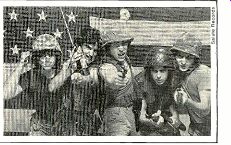
Shrapnel: new commandos of rock-and-roll?
DODGING THE SHRAPNEL
THOSE of you who find something of a void in your life now that you don't have Dick Nixon (a true pop genius, cartoonist Jules Feiffer called him) to kick around any more may recall some of the loose talk that used to emanate from the vicinity of the Watergate White House-specifically, the stuff about the sinister left wing cabal that controlled the country's me dia. Myself, I always found this somewhat mystifying; it was difficult to visualize, say, the editorial chambers of the New York Times as a den of aging Trotskyites.
Still, though I doubt Spiro the rock press in mind when he made his famous "nattering nabobs of negativism" crack, in their case he would have been right on target. No one has ever, to my knowledge, conducted a poll on the subject, but if you've ever read Rolling Stone and other lifestyle journals for any length of time you'll know that rock critics as a group are, and traditionally have been, creatures of the Left.
Which brings us to punk, specifically the English variety. Despite Joel Vance's February assertion to the contrary, the thrust of English punk has also been almost entirely left-wing, give or take a conservative anomaly or two like the Jam. While not entirely innocent of cold-blooded marketing concerns, English punk was a calculated attack on the status quo that had quite a lot in common with the countercultural movements of the late Sixties, no matter how much the punks themselves professed to hate hippies.
In the light of what subsequently happened to punk as a "movement," the general alarm with which it was greeted seems fairly paranoid now (as Lester Bangs put it, "These little nerds yelping 'please kill me' were going to threaten this society?"), but it also helps explain the glee with which American rock critics by and large jumped on the bandwagon: they were being offered a second childhood.
The irony, of course, is that punk at its American inception--by which I mean the Ramones and Punk magazine-was any thing but the kind of music calculated to hearten old campus radicals. It was, in fact, a reaction against everything they stood for-the music, if you will, of their kid brothers. Punk was a glorification of American teenagers as the Master Race. Punk said that Trash was the closest America had come in the way of producing a real culture; punk theoreticians to this day will spend hours discussing the symbolic intermingling of characters on Green Acres and Petticoat Junction. And what punk finally said was that if you couldn't relate to all that, you were either a commie or a faggot-or a disco freak, in which case you were both.
Which leads me to the reason for this historical ramble. There is a very popular little band currently working New York City and environs that has suffered a virtual press blackout because they flirt with attitudes the old lefties of the rock press apparently deem unacceptable even as satire. They're called Shrapnel, they're from New Jersey, they're all in their late teens, and they hap pen to be one of the cleverest, most energetic outfits I've heard (at CBGB's most recently) in a while. They're a sort of Raw Power -period version of the Stooges, but with real melodies, pop hooks, and an instrumental prowess that belies their years.
So why don't they get written about? Be cause they dress up in combat drag, write songs about military subjects, and give the impression that they either don't remember or don't care about Vietnam.
Now I'll grant you that as a gimmick this is pretty one-dimensional, but if you accept it in the context in which it's being offered-which is that these guys grew up reading comic books like Sgt. Fury and His Howling Commandos-it is also pretty funny. And I find it both a little sad and a little weird that the same writers (the aging radicals mentioned earlier) who conveniently overlooked the much more disturbing but equally cartoonish Nazi trappings of the early Ramones are utterly outraged when Shrapnel's lead singer Dave Wyndorf bran dishes a toy machine gun on stage. I sup pose it's sort of the punk equivalent of the "we are not amused" school that insists on taking Randy Newman's satire seriously, but it's as dumb as hissing Larry Hagman on the street because the character he plays on TV's Dallas is a lousy s.o.b.
--------
Also see:
Source: Stereo Review (USA magazine)