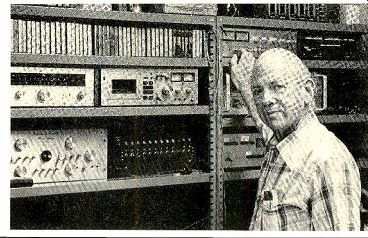
By Julian D. Hirsch
More on Stereo Imaging
WHEN I wrote about stereo imaging in this column for October 1979, I did so partly as a devil's advocate to see what response might be elicited from readers; nonetheless, I meant just what I said. The response was heartwarming, for I now know that there are quite a few independent thinkers out there reading these pages. I received a host of letters taking me to task for my "tin ear," lack of acoustic judgment, and inability to appreciate the finer points of sound reproduction. Apparently I touched a nerve in some of those readers who wrote me, and perhaps in many others who did not bother to write. I think some clarification is in order, although I doubt that we will come to any meeting of the minds on this matter, which is surely more controversial among audio enthusiasts than either politics or religion (although it seems to contain elements of both, judging from the indignation often expressed).

I do wish, however, that my respondents had read what I said with the attention they devoted to taking me to task for supposedly saying something else. I did not say that I prefer to sit in the rear of the auditorium, but rather that half the audience (actually, more than half if one includes the balconies) sits in the rear half of the hall. This seemed to me such an obvious statement, requiring no more than grade -school arithmetic for its proof, that I was taken aback at its misinterpretation. Yet, every one of the letters I received upbraided me for my supposed preference! I will stand by what I wrote about the degree of localization of sound that I hear from such locations. I gather that none of my correspondents would be caught dead in the no -man's land behind the median row, which makes me wonder how they can be so certain they can identify the position of every instrument so precisely from back there (most of them made such a claim, or else strongly implied it). I will not dispute their claims, but I must decline to say that I hear things when I do not; I cannot admire the emperor's new clothes when I can't see them.
ONE correspondent, a performing musician, assures me that he can localize instruments on stage. Of course he can, but that is not what I was talking about. Can he do that from behind the auditorium's median row, where the less fortunate masses will presumably be found? Actually, he says he can do just that, for which ability I envy him: the psychoacoustics of the situation indicate that his talents border on extra -sensory perception. In any case, it is a talent I do not have.
Incidentally, I do not like to sit 'way "up front" because I do not enjoy the high sound levels that exist close to the orchestra; I prefer to be far enough away to hear the orchestra as a performing group rather than be made aware of each instrument. (I wonder if my critics prefer to watch TV from a two -foot distance so that they can resolve the line structure and pronounce critical judgment on the video deficiencies of the picture, or are they willing to sit back at a reasonable distance and see the entire picture, literally as well as figuratively?) In the same vein, when I visit an art mu seum I like to stand far enough from a painting that I can appreciate what the art ist was trying to say, rather than examine it at close range, studying each brush stroke. But I suppose either approach is valid-what it comes down to is what each of us hopes to get from experiencing a work of art, in which category a musical performance is certainly included.
Another writer made a different point, claiming that phase coherence throughout a system (including the loudspeakers) is vital for a natural perspective and imaging of the sound. Since I have written on numerous occasions that I am not convinced that phase coherence in loudspeakers has much to do with their ultimate sound quality, he sees an irony in my strong positive reaction to the Carver C-4000 preamplifier. Why have an elaborate electronic means of pro viding spatial effects that (he says) can be obtained directly from the record with a phase -coherent playback system? Why, indeed? No reason, except that al though II can't hear the reputed beneficial effects of speaker phase coherence, I do hear discrete images through the Carver C-4000. I have spent many hours listening to it to learn what it can and cannot do.
Since the "holographic" effect depends on critical phase modifications of the acoustic stereo signals reaching the listener's ears, it functions at its best only with reasonably phase -coherent speakers. With these, the C-4000 produces a set of images whose positioning is positive and most impressive. Difficult as it may be for some people to believe, even I can hear these images with no difficulty. But-and this is crucial-I do not hear, nor have I ever heard, that effect at a performance of live music. I like the "Sonic Hologram" effect-it is fascinating and sounds the way I always wished live music would sound-but (to me, at least) live music seldom sounds that way! Sorry about that, purists-but I'll continue to listen to it and enjoy it anyway! One point made by several of my correspondents is the totally subjective nature of the listening experience. Nonetheless, if I hear things differently, or do not react to something the way they do, I am deemed to lack some essential quality or talent! Even when they acknowledge, as most of them do, that different people simply prefer different listening experiences, they are adamant in defining their own preference as being the correct one! I am afraid I lack the arrogance to make a similar claim for my personal choice. To each his own, but I must listen where and how I please, and describe what I hear in my own words. Every one of us has the same right, but I would suggest that no one is any more or less "right" in his views than anyone else.
One letter, from a reader active in the re cording industry, raised a number of extraneous points that suggest to me an unwillingness to understand what I was trying to say. For example, he made the obvious statement that from the positions occupied by the recording microphones, anyone can identify the locations of the performers (anyone, that is, who does not mind hanging from a wire 20 feet above the orchestra, or, conversely, having his head 4 feet away from an instrument). This is true, but does it have anything to do with the issue at hand? Mikes are placed for very practical reasons associated with the recording art, and I am amazed that anyone would consider such a location suitable for listening to a live performance. Another red herring was thrown into the argument when he stated that he has shown that home music systems are capable of creating phantom images when provided with proper program material. Agreed-that is one of the things the Carver preamplifier does very well, and, given the right recording, any number of more conventional stereo components could doubtless do much the same thing. My contention is that this situation does not exist in the typical concert hall, at least beyond the near -field sound of the performers, and that, in any case, is not what the present argument is all about.
I FEAR it is impossible to resolve this matter here, since in respect to sonic imaging, as in so many other aspects of life, it all comes down to a matter of individual preference.
It should be a source of gratification that high-fidelity systems today can create al most any sonic image that one might wish to hear, even if no two people hearing the result would agree on just what they were hearing-or even whether they enjoyed hearing it.
Also see: AUDIO BASICS: Preamplifiers, ROBERT GREENE
Source: Stereo Review (USA magazine)