CES 1982--The latest hi-fi trends and product introductions from the Summer CES
By Ralph Hodges
HELD under the auspices of the Electronic Industries Association, the Consumer Electronics Shows (CES) are trade fairs where manufacturers and retailers get together and the latter have an opportunity to order new and interesting products to display in their stores.
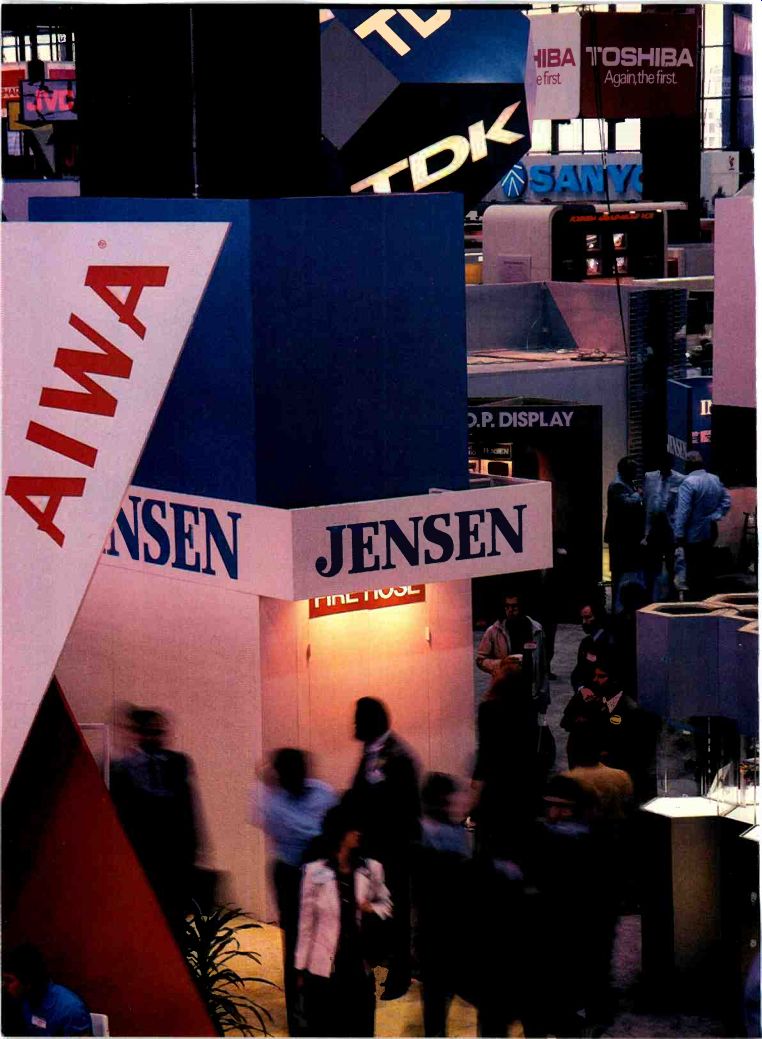
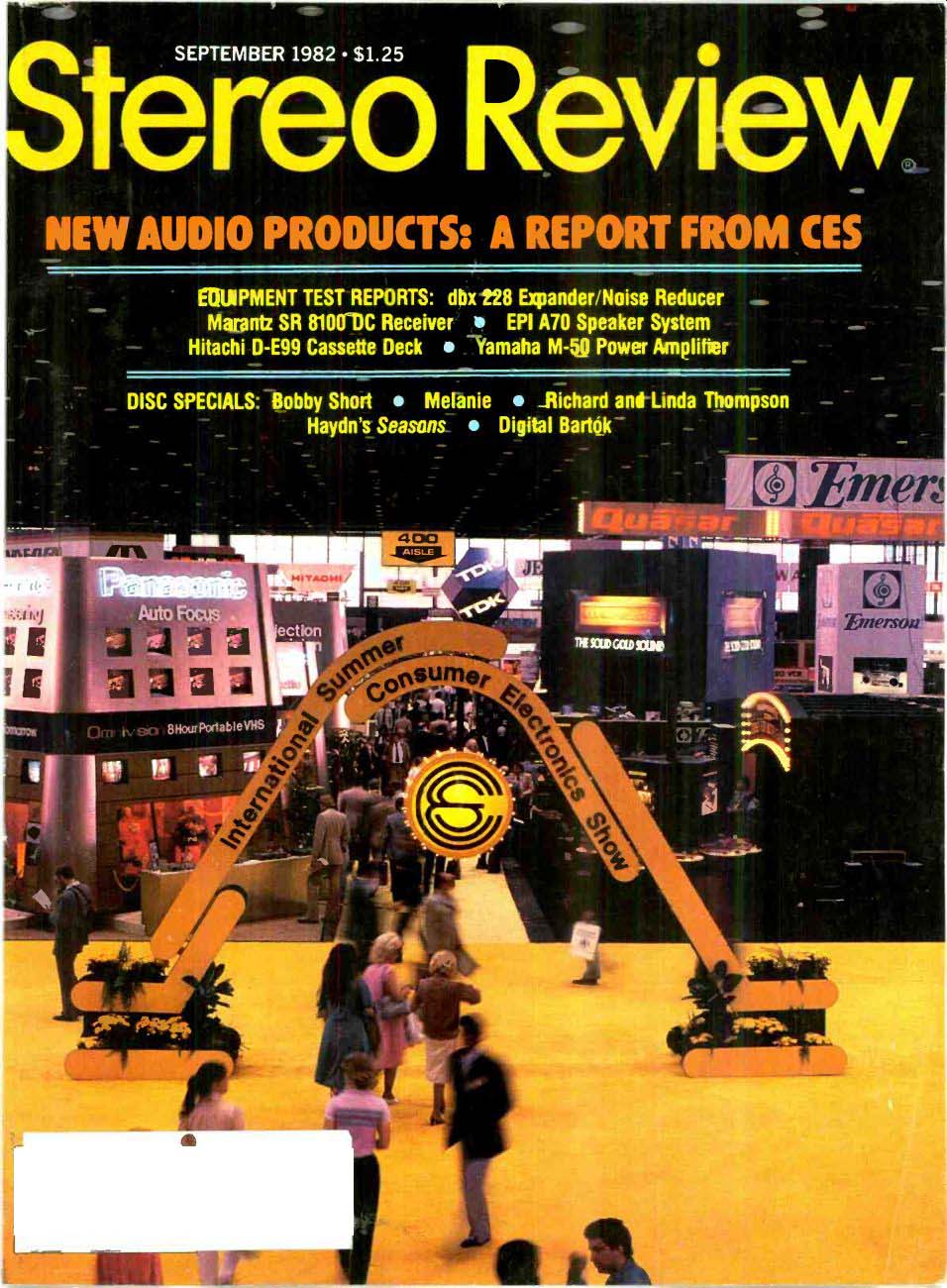
Since consumers are not admitted to the shows, which are held at McCormick Place in Chicago in the summer and in Las Vegas in the winter, STEREO REVIEW reports on each CES to tell you what you can expect to see on dealers' shelves in the near future.
Back in 1973, when this magazine first reported on CES, there was only one show a year, and all the news and hi-fi products could be covered comfortably in a six-page article.
Since then the industry has grown tremendously. There are now two shows a year, and the number of new-product introductions has risen from a few dozen to well over a thousand.
Accordingly, it is no longer possible to cover every new product adequately in a survey article. In this issue we describe only the highlights of this summer's CES, covering trends and developments in the hi-fi industry to give you back ground. This should help you evaluate the newly introduced units you will be reading about in coming months in our enlarged "New Products" section. There we can give a more complete description and include a photograph.
Incidentally, our first CES article was written by Ralph Hodges, who also wrote this one. In 1973 he was STEREO REVIEW'S Associate Technical Editor; today he is a successful free-lance writer and audio consultant.
-Eds.
JUST as actors have nightmares about going on stage and forgetting their lines, some of us audio journalists harbor a fear that one day we will walk into a Consumer Electronics Show and find no new high-fidelity equipment to write about. That wasn't what happened at this year's SCES in Chicago.
New goods were actually rather plentiful, even if innovation in product design was rare. For the most part, receivers and integrated amplifiers remained moderate in size and power and leaned heavily on convenience features to stir interest. There were many new turn tables, a few with novel design approaches. There were also rack systems and midi systems and mini systems by the boxcar-full.
In the following pages, which are not intended to be comprehensive, I will try to map out current trends and directions and point up some noteworthy examples. Elsewhere in this issue, Craig Stark reports on new developments in tape and tape gear, and Fred Petras does the same for car stereo.
AM Stereo and Digital Audio Discs
Let's begin with two much anticipated developments that have not quite come to pass: AM stereo and the digital audio disc. Ever since the FCC abdicated responsibility for choosing one AM-stereo system from the five candidates, the industry has been wringing its hands over the stalemate and wondering how AM stereo, as a concept, can survive. National Semiconductor came to the show with samples of its integrated circuit intended for the Magnavox system (although adaptable to others, it is said), which presumably pleased equipment manufacturers with its low cost and compactness. Representatives of the Harris Corporation had a spectrum analyzer demonstrating how scrupulously their system respects available channel bandwidths, which reportedly cheered those broadcasters who attended. Sansui made a frontal attack on the situation with a prototype component tuner that decodes the Magnavox, Harris, and Kahn/Hazel tine systems, switching automatically between them. However, nobody seemed to believe this was the solution for the all-important car-stereo receivers of the future. And I don't think any body left Chicago feeling the AM-stereo dilemma was any closer to being resolved.
As for the digital audio disc, the joint project of Philips and Sony, known as the Compact Disc (CD), seems in the strongest position of any such system today. And progress toward the marketplace has been quite gratifying, at least overseas. PolyGram, the European record giant, rented a huge room at CES and played selections from the CD catalogs of Deutsche Grammophon, Decca/London, Philips, Phono gram, Polydor, and Mercury. There will be two hundred of these discs by year's end, says PolyGram, and thirty more each month thereafter. But until next June they'll all be over there, not over here, nor are they likely to get here by next June if there are no machines to meet them.
Speaking of the machines, mean while, top executives from Sony of Japan sat with the press and explained that the uncooperative attitude of U.S. record makers toward the new format meant that there would be no CD players for us until next year either.
Large U.S. record companies are balking at the royalties Philips wants for every disc. Somewhere down the line Sony will accommodate adventurous U.S. labels with custom CD mastering and pressing facilities in Japan. But until the U.S. gears up to manufacture CD's on its home shores, record buyers should be prepared to pay top dollar for the imported product. And they should be prepared to wait for discs (and therefore for machines) until both Japan and Europe have satisfied their home markets.
Of course, CD players (or prototypes CES thereof) weren't hard to find at the show. You couldn't walk down an aisle without tripping over several. I saw machines from Aiwa, Denon, Hitachi, Kyocera, Mitsubishi, Onkyo, Optonica, Pioneer, Sansui, Sanyo, Technics, and Yamaha, as well as the Philips player that was used by PolyGram. For good measure, Yamaha also displayed its AHD/VHD disc machine, which uses the same player for both audio and videodiscs. Marantz did not choose to show a CD player in Chicago, although the company has done so at previous shows.
There is no point in listing model numbers and features at this time.
With about another year to go before U.S. introduction, even those machines that are now operational will probably change substantially before we can buy them.
Receivers and Tuners Some twenty years ago Harman Kardon introduced what was generally considered the world's first stereo receiver: about 15 watts per channel, rather basic in control facilities, and costing a couple of hundred 1960s dollars. At this show Harman Kardon introduced the hk330i receiver, 20 watts per channel, rather basic in control facilities, and despite inflation-costing a couple of hundred 1980s dollars. Of course, the new H-K model is undoubtedly better in a number of audible and inaudible ways. But the big point is that the receiver has, as a category, weathered twenty years of evolutionary pressure to remain pretty much what it started out to be: a no-frills, no-fuss electronics package for Everyman's hi-fi system.
One or two of the show's new receivers approached or exceeded 100 watts per channel, and many of them sported dig ital tuning readout, station presets, and push-pads rather than rotary controls for volume and tuning.
The significant new receiver feature to appear in a number of products at this show was built-in decoding for CBS's CX phono noise-reduction system, trotted out in a single model from Marantz and two each from Onkyo and Toshiba. Although the CX disc-encoding scheme is not yet in widespread use, the decoding electronics for it contribute only a minor expense to the overall cost of receivers. Undoubtedly there would have been many more CX product introductions if CBS and others had been more forthcoming with the soft ware. Next winter's CES should tell the tale for CX. The 55-watt Marantz SR620CX ($495) has a front-panel CX calibration control to match the output of the phono cartridge used to the operating level of the CX circuitry.
Most audio receivers still have two or at most three-tone controls, but a few manufacturers continue to favor multiband equalizers. JVC has done so from the beginning, and its three top models for this year retain the five-band "S.E.A." graphic controls that are a company trademark.
Sansui is a relative newcomer to built-in equalization, but its enthusiasm for it is apparent in the 120-watts-per-channel Z-9000 ($950), with a seven-band equalizer, a signal processor that adds reverberant decays of up to 3 seconds' duration, and a built-in timer that shares the digital display and fifteen-button keypad of the tuner section to permit programming of two daily on-off cycles and one single-event cycle.
Like JVC, Sansui has incorporated what it considers its most sophisticated amplifier and tuner technology in its top receiver models. Both companies also introduced less expensive models with fewer features.
Sony has designed its two new receivers and one new tuner to forgive mis programming by jumping to the nearest available signal when there proves to be nothing on a channel that has been erroneously preset. The tuner will also automatically scan through those channels entered into memory, ignoring other signals on the dial.
Convenience features aside, three of the show's new tuners and one new receiver offered several different FM-circuit innovations intended to deal with weak and/or interference-troubled radio signals. In the Carver TX-11 FM-only tuner ($550, and now at last avail able), noise and multipath products are to a large degree canceled without affecting stereo separation. The NAD Model 4150 tuner and 7150 receiver use the recently developed Schotz circuit to get the best from whatever signal is coming in by tracking the strength and noise content of the signal and varying the detector bandwidth accordingly from moment to moment.
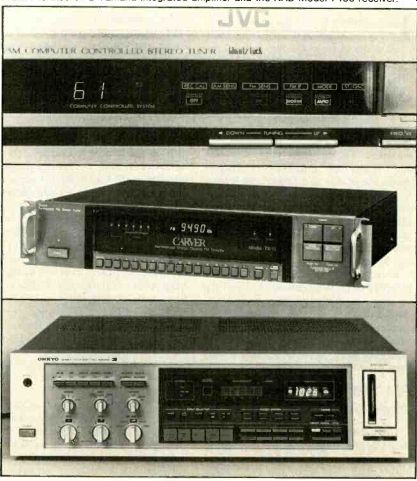
------------ JVC's new T-X55 tuner (top) features a unique digital
signal-strength display and a "computer that selects the optimum tuner
operating mode. Carver's TX-11 tuner (center) features proprietary multipath-canceling
circuits that were impressively demonstrated at the show. The Onkyo TX-61
receiver (bottom) features CX disc decoding and a record-output selector
that allows the user to listen to the tuner while taping from a record player.
This feature is also on a Yamaha integrated amplifier and the NAD Model 7150
receiver.
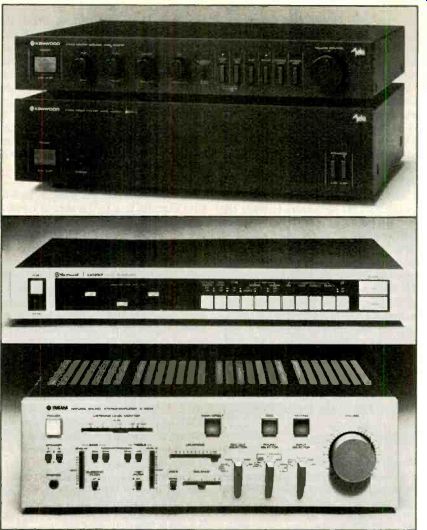
------------ The Kenwood Audio Purist Basic C1 preamplifier
(top) and Basic M1 power amplifier have the spartan appearance of more exotic
units. Sherwood introduced an attractive line of separates exemplified by
the S-6020CP preamplifier (center). Yamaha's A-460II integrated amplifier
(bottom:, has many controls and convenience features.
The amplifier section of the NAD 7150 is identical to the Model 150 integrated amplifier from the same manufacturer, providing 50 watts per channel with a dynamic headroom of 3 dB and NAD's "soft clipping" feature. The Carver and NAD products all share digital station-frequency readouts and ample station presets (sixteen for the Carver TX-11).
JVC has a different approach to reception problems. In the T-X55 tuner a microprocessor evaluates the incoming signal and then decides whether to attenuate it by either 25 or 10 dB to pre vent r.f. overload, to leave it alone, to switch to the narrow-band i.f., or to switch in the quieting-slope control circuit for best reception of weak signals.
This $350 tuner also has a 1-dB-increment (0 dB to 99 dB) digital signal-strength display that makes antenna adjustment easy and is also fun to play with.
Preamplifiers and Amplifiers There just aren't very many new trends this year in audio preamplification and power amplification. We al ready have class A, quasi-class A, class H and variants, power supplies that go from nothing to everything depending on the signal, feedback loops that en compass the loudspeakers, feedforward, dynamic-headroom enhancement, clip ping relaxers, low-negative-feedback designs, distortion eliminators based on comparator techniques, non-mechanical function switching, and lots and lots of gold-plated connectors. Somewhere it was decided that both manufacturers and consumers needed a rest, and so the SCES brought us just a little bit more of the same, plus some features hereto fore found only outside the separate-component market.
For example, the CX4200 preamplifier from Soundcraftsmen has CX decoding circuitry in addition to the company's excellent ten-band equalizer with separate controls for each channel and a calibration system that ensures unity gain within 0.1 dB when the equalization section is engaged. The Sony TA AX44 integrated amplifier is controlled exclusively by push bars or push pads and is equipped with memory that permits up to three inputs to be preprogrammed for special equalization and filtering; it will perform that way when ever one of those inputs is selected. The $280 unit, together with the matching ST-JX44 tuner, is also designed to accept wireless infrared remote control, as are four Sony record players and a large number of cassette decks, by means of retrofits for that purpose now becoming available.
These shows tend to spawn huge power amplifiers with huger price tags and purist preamplifiers costing almost their weight in gold. This show had its share of those, but it also had the Kenwood Basic MI power amplifier (105 watts per channel), which looks like a very serious piece of business but which costs a mere $330, and its companion Basic CI preamplifier, as spartanly purist as you could wish in its control facilities (except for a continuously variable loudness-contour adjustment), at a mere $225. The power amplifier employs Kenwood's signal-sharing scheme between medium- and high-power output stages together with a negative-feedback loop that includes the loudspeakers, while the preamp automatically adjusts to phono-cartridge types, including moving-coil devices.
On the other hand, the new Kenwood L-02A integrated amplifier (170 watts per channel) goes for $3,000, weighs a great deal, features nonmagnetic construction, and has special interface pro visions for the new L-02T tuner (also $3,000). The tuner has the capability of enclosing the L-02A's inputs in a negative-feedback loop.
Next on the price scale is the Harman Kardon Citation XXP, the preamplifier mate to the previously introduced XX power amp. Its appearance is simple but pretty, its features are conventional but unstintingly elaborate in execution, and its price is unavailable at the time of writing. But expect the highest.
The big-amplifier market has be come attractive to Studer/Revox, (ES which has derived its new B740 power amplifier from a professional unit in tended for music and broadcast studios.
Rated power is 100 watts per channel, the power supply has 60,000 microfarads capacity, and the audio circuits contain no IC's-a feature that, like minimum negative feedback, some amplifier makers like to make much of these days. Price: $2,299.
Down a bit from these rarefied strata is the Yamaha A-960II, a 105-watt $495 integrated amplifier that has a certain satisfying busyness and purposefulness to its front panel. Yamaha has lately been building amplifiers that counter distortion by developing a correction signal in a side chain and then introducing it into the signal path out of phase to cause distortion cancellation.
The manufacturer has been employing the Carver-based X power supply, and this new integrated amplifier seems a good example of what Yamaha's techniques are all about.
Carver will be introducing its first integrated amplifier this fall, the Model 120-IA (price not yet announced), which offers 120 watts per channel, the Carver "magnetic-field" power supply, and a "Sonic Holography" generator that expands the stereo image by canceling interaural crosstalk signals from the two stereo loudspeakers. These features, which will be familiar to readers who follow audio developments, require more explanation than can be given here. But they do make this new Carver product unique-and interesting.
Unique to Sherwood is a line of ambitiously targeted separate components that includes a frequency-synthesizing tuner, a preamplifier with CX decoders, and a power amplifier that, because of MOSFET output stages, is able to drive 8-ohm loads at 100 watts, 4-ohm loads at 180 watts, and 2-ohm loads at 250 watts.
JVC also deserves some attention for the depth of its audio introductions at this show, including six integrated amplifiers, several of which incorporate the manufacturer's five-band equalizer plus illuminated indicators to show the nominal operating level of each band; the prodigious M-L 10 power amplifier and a companion preamplifier, both wrapped in high-gloss lacquered "furniture" shells; and a hearty helping of other devices.
A final amplifier development, and one that warms my heart, is the avail ability of the revered Stewart Hegeman's Hapi 2 preamplifier in kit form ($479 kit, $650 assembled), courtesy of Adcom. Wiring electronic kits is emotionally therapeutic and somewhat cost-effective, and in this case it should produce a fine purist preamplifier.
Record Players
In 1979, when Technics brought out the first of its enticingly compact and aesthetically pleasing radial-tracking turntables, only one phono-cartridge configuration would fit the machine and it was the configuration of a Technics cartridge. When the turntable be came very successful, however, a number of cartridge manufacturers began redesigning their top models so that they could plug directly into the Technics arm. In the intervening years, the resultant style of cartridge body began to be called a "P-Mount," probably referring to the fact that the four signal-carrying pins were the "plug" that se cured the cartridge to the end of the arm. Now that the P-Mount cartridge is ubiquitous, Technics has decided to convert its entire line, radial-tracking and pivoted arms alike, to the P-Mount system, and company representatives speak confidently of its becoming an industry-wide standard.
In this, Technics has made a significant contribution to the ease of owning high-fidelity equipment. No chore in setting up an audio system has been quite as exasperating as installing and aligning the phono cartridge in the tone arm. The industry has been under pressure for years to do something about it, and Technics, with its simple socket and set-screw, has done something about it. There are some liabilities involved-with a P-Mount system one has to rely on the record-player and cartridge manufacturers to establish correct record-playing geometry since no user-adjustable parts are provided.
At a time when lateral and vertical tracking-angle errors are coming under increased scrutiny, we can only hope that the manufacturers involved are taking proper care.
The new Technics record, players-a total of nine, of which only the $1,700 SP-10MK3 is provided without an arm-are so thoroughly locked into the P-Mount concept that a tracking-force adjustment range of only 1/2 gram is provided. According to Technics, this range is adequate to accommodate its own P-Mount cartridges (the latest of which is the $50 EPC-P28) as well as those now offered by Audio Technica, Empire, Ortofon, Pickering/Stanton, and Shure.
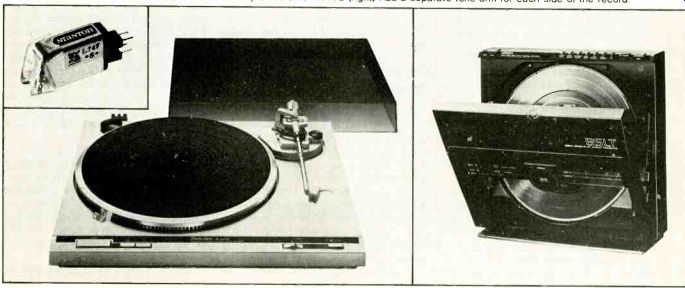
---------- P-Mount phono cartridges such as the Stanton L747 S (inset)
are becoming more common; Technics introduced a line of pivoted-arm turntables
such as the SL-020 (left) to use them. Optonica's RP-114VL (right) has a
separate tone arm for each side of the record.
Technics may have popularized radial-tracking tone arms (as it did direct-drive turntables), but it no longer dominates the market. Sherwood, in a surprise move, has come up with two low-cost players that accept P-Mount cartridges only. JVC's new radial-tracking offerings are similar in price and features. (However, JVC's deluxe introduction for this show, the $500 QL-Y55F, employs a pivoted tone arm, but it is dynamically controlled by servo-motors to maintain stability under play conditions.) Sansui is there too with the $360 radial-tracking P-L50, which is microprocessor-controlled for sequential selection of record bands and for automated interface with Sansui's newer cassette decks.
I can remember when radial-tracking record players were impressively expensive, and so, evidently, can Studer/Revox, whose $749 B791 was the most costly such machine at the show. It does, however, provide platter-speed adjustment in precisely calibrated increments of 0.1 percent, and it comes with Shure's top-of-the-line P-Mount cartridge (other cartridges can be substituted later, but the Shure TXE-SR is indeed part of the purchase).
If radial tracking doesn't fill your bill, perhaps you'll be moved by the turntable-in-a-drawer approach being taken by Sony and Pioneer. First seen, I believe, in an innovative product introduced by Aiwa a few years ago, the drawer turntable, at the touch of a but ton, motor-drives the platter out of the front of its base where you can easily get at it for record changing and cleaning. Another touch of the button causes it to retreat, and play commences. The turntable no longer needs to be the top component in a stack. For its new models, Sony has made the rubbery wheels on which the drawer mechanism travels the key element in the turntable's suspension. Pioneer has done much the same thing with two of its new turn tables. Both manufacturers have used conventional pivoted arms and have equipped their machines with degrees of automation commensurate with price.
Massive turntables, defying both human lifting strength and seismological disturbances, continue to be introduced. Thorens, now distributed here by Epicure, again sent its physically overwhelming "Reference" turntable to the show; this year it was accompanied by the only slightly less imposing TD 226 ($1,600), with a broad, glossily finished wood base that has ample room for another tone arm in addition to the SME unit supplied. Denon displayed another enormous reference-type turn table-evidently meant, like the Thorens, not for sale but for show and edifi cation-and Kenwood enlarged its Audio Purist series with a big brute, the $2,500 L-07D, that it seems to have every intention of selling. However, if your floors are weak, or if you are, be aware that both Harman Kardon and Yamaha, among others, have intro duced extensive new lines of conventional record players at conventional prices from $400 down to $150.
Not at all conventional is the Optonica RP-114VL, which plays records in a vertical rather than horizontal position (not unique) and plays both sides of them without operator attention (unique, except for jukeboxes, since the demise of the Fisher robot turner-over of the 1950s). It accomplishes the latter feat with two linear-tracking tone arms, two magnetic phono cartridges, and a record-support mechanism that engages the center rather than the periphery of the disc. Optonica's parent company, Sharp, has taken the concept and applied it to various integrated music systems, including, of all things, an enormous portable boom-box.
Among the show's new phono cartridges, Empire's introductions were the most numerous, including the company's first moving-coil cartridge (the MC Plus 20, $90), six P-Mount models, and a pair of new moving-magnet pick ups designed to carry static charges off the record via conductive surfaces. Denon hit the $1,000 point with its lowest-mass moving-coil design yet, and Nagatron spoke of two introductions, one with a sapphire cantilever, scheduled for a few months hence. A surprise was Klipsch's entry into the phono-cartridge business with four moving-coil models.
Audio for Video Sound that's at least as good as the picture shows signs of becoming an ob session with a number of home-entertainment manufacturers. This is per haps a good time, then, to get interested parties forewarned of the developments about to be sprung upon them.
First, some justification. If you question the desirability of experiencing Laverne and Shirley in stereo with 16 to 24,000 Hz response and a 90-dB dynamic range, welcome to the club. But there are circumstances in which good audio in support of video really counts.
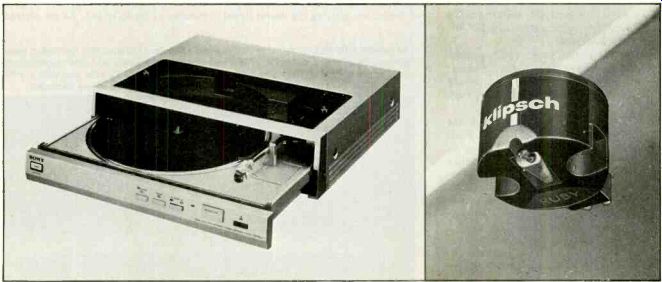
-------- The turntable-in-a-drawer design, available from Sony
(the PS-FL3, left) and Pioneer, makes it possible to place a record player
anywhere in a rack. The Klipsch MCZ series moving-coil cartridges are available
with aluminum, boron, ruby (shown, right), or diamond cantilevers.
At this show Proton, a company closely affiliated with NAD, demonstrated its new 19-inch video monitor (a picture tube without audio or TV-reception cicuits) with twenty minutes of excerpts from The Empire Strikes Back on 3/4-
inch videotape. The monitor gave a de cent account of itself, but what held the largish audience in that dark and stuffy room was not the 19-inch picture but the sound, taken directly off a Dolby surround-sound master, decoded appropriately for noise reduction and surrounds, and heard through a quartet of minispeakers, arranged four-channel style, and a subwoofer. This was the soundtrack the way it was meant to be heard in better movie theaters, and I wouldn't have believed the difference it made with a TV picture if I hadn't experienced it for myself.
It seems that videocassette pirating of Star Wars forced 20th Century-Fox to release tapes of the film under its own label just to get in on some of the profits that others were reaping at its expense. Consumers should soon be able to purchase videocassettes with stereo soundtracks that truly represent the sophisticated audio mixes now available for the movie theater. We'll also find that many of them have a very bright upper midrange designed to punch through cinema screens and de feat their masking effects.
From this moment on, it seems certain that all videocassettes and video discs will be released with stereo sound if the original source material has stereo to offer. There will also be noise reduction, which is rapidly shaking down to Dolby-B for videocassettes and CBS CX for videodiscs.
It appears that super audio accompanied by impeccable video is some where down the road. But if you would like to get involved immediately, here are the latest temptations.
Marantz is first with a stereo Betamax VCR incorporating Dolby-C noise reduction: the Model VR 200, priced at $1,295. My first question was whether the generally poor quality of VCR sound might reveal noise-modulation problems in the C-type system that have otherwise been undetectable, but in two visits to the Marantz exhibit I failed to unearth program material with which compander-type noise reduction could make an audible difference anyway.
Jensen is the first company to come out with a complete audio/video receiver (AVS-1500, $990) designed to receive AM, FM stereo, and TV/CATV transmissions while controlling switching with video monitors, TV sets, speakers, VCR's, videodisc players, phono graphs, and audio tape recorders. It also features simulated stereo, variable DNR, a proprietary ambiance-enhancement circuit, and a 50-watt-per-channel amplifier. The company's new video products line also includes an FM-only receiver with video switching facilities and two speaker systems de signed to be used in close proximity to a TV screen without distorting the picture. Scaled to the Jensen 19- and 25-inch video monitors, they cost $125 each and employ 51/4-inch woofers, 51/4-inch passive radiators, and 1-inch soft-dome tweeters.
Kenwood's AM/FM (no TV-audio reception) receiver, the KVR-510, is an outgrowth of the KVA-502 integrated amplifier, with its claim to video applications residing in a circuit that "stereoizes" mono signals and a filter array that is said to suit the noise characteristics of TV audio. Power is 30 watts per channel, and price is $419.
"Stereoizers" and special filters comprise about the only other offerings on the audio-for-video component scene.
Audio Control has introduced its Video Detailer, a $129 video-soundtrack five-band equalizer with a proprietary stereo simulator using comb filters, delay and phase-shift circuitry, and DNR noise reduction. The unit is designed to be installed between the audio output circuits of any video unit and a preamplifier or receiver. RG Dynamics includes a dynamic-range enhancer with its $180 VC-1 "Videosonic Stereo Phasor." Superex's VAP-3 ($270) has equalization in four bands, dynamic-range enhancement, and a "stereoizer" that works by splitting the mono signal and delaying one of the signal paths for a few milliseconds.
Speaker Systems
There were, as usual, many new speaker systems introduced at CES, but only a relative few of them can be touched on here, and only those with some apparent novelty or interesting engineering angle at that. Apologies in advance to all the unremarkable-seeming brown boxes, among which may have been found some of the show's finest new loudspeakers.
The AR9LS ($750) has replaced the esteemed AR9 in Acoustic Research's lineup, offering a uniformity of vertical sound dispersion that matches the al ready excellent lateral directional characteristics of the AR9. This has been achieved with the so-called Lambda "Dual Dome" array, a midrange/ tweeter assembly that places the 1 1/2-inch dome midrange and 3/4-inch dome tweeter so close together that they are able to share the same magnet structure. This proximity, combined with a properly chosen crossover frequency, ensures that the spacing between drivers is always less than one wavelength of any frequency they handle jointly.
The two side-firing woofers of the AR9 have been replaced with a front-firing 12-inch driver and a downward-aimed 10-inch one. Acoustical contouring of the 10-inch woofer's response is said to correct for the effects of the rear-wall reflection that the AR9's side-firing woofers were meant to eliminate. Another new AR design, the AR98LS, also employs the Lambda array and is adjust able for floor or shelf placement.
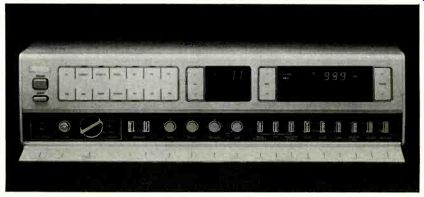
-------- The Jensen AVS-1500 is an AM / FM/TV (audio and video)
receiver that can switch inputs from various antennas, cable TV, VCR's, videodisc
players, audio tape, and record players and feed the appropriate signal to
video monitors, conventional TV sets, and VCR's. It has a 50-watt-per-channel
amplifier, stereo synthesizer, and Dynamic Noise Reduction.
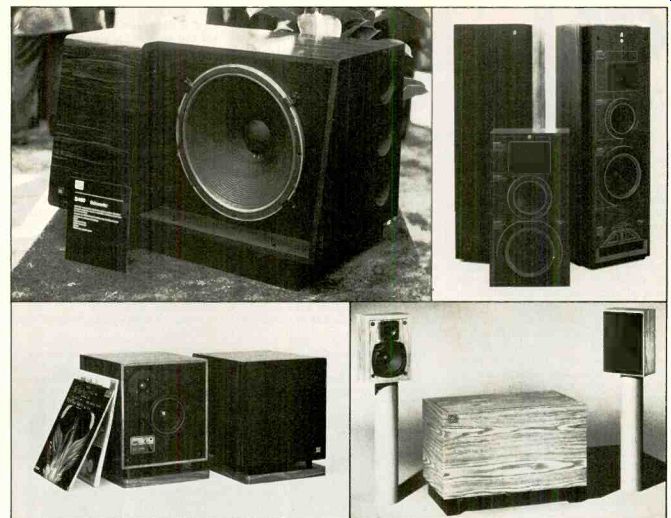
------------- An 18-inch woofer dominates the cabinet of JBL's B460
subwoofer (top left). Acoustic Research redesigned its AR9 and AR98 speaker
systems as the AR9LS and AR98LS (top right). The larger AR9LS has a downward-firing
woofer; both have a tweeter/ midrange assembly with a shared magnet. Design
Acoustics uses a downward-firing woofer in its PS-10 three-way bookshelf
speaker (bottom left). There were many subwoofer/satellite speaker systems
at the show; a typical example was Cerwin-Vega's SW 12 and SAT. I combination
(bottom right).
JBL introduced an ambitious tower system (or perhaps more of a leaning obelisk in this case), the $600 four-way L250, which rises from a 14-inch woofer at its broad base to a 1-inch dome tweeter at its lofty top. As an alternative to the L250's rather arresting performance, JBL also demonstrated a sort of satellite system made up of a pair of the company's new two-way L15's, with 61/2-inch woofers, and a 112-dB-plus subwoofer, the $900 B460, which has an 18-inch driver in a ported cabinet of monumental proportions.
Like many manufacturers this year, JBL is emphasizing the furniture ap peal of its designs with enclosures avail able in walnut, stained birch, ebony, rosewood, and oak.
Infinity is still building downward from its $25,000 Infinity Reference Standard, and this year it has reached price points ranging from $260 to $565 for four systems in furniture-quality enclosures with diffraction-avoiding rounded edges (the edges are also fluted, but whether this is meant to be functional or just decorative is not clear). Polypropylene woofers, Poly-Dome midranges, and EMIT tweeters are used throughout the series. Three bookshelf models, at $98 to $199, round out the Infinity introductions.
Allison did not overlook furniture appeal for this show. The familiar configurations of the company's "Room-Matched" speaker systems are suddenly not so familiar, their appearance having been completely restyled to yield the Models Nine, Eight, and Seven ($495 to $225). All are resplendent in pale oak, with clean, striking planes and angles.
Polk's Stereo Dimension Array I ($1,600 the pair) consists of two towers rising a little higher than belt level. Audibly the effect somewhat resembles Carver's Sonic Holography, but Polk can't reveal details pending patent resolution. The new Design Acoustics "Point Source" loudspeakers employ baffle sizes as small as possible (to minimize diffraction) and woofers that are front-loaded by the bookshelf systems' bases.
"The digital era is going to blow out all our loudspeakers" is a threat we've heard plenty of lately, and whether or not we're inclined to take it seriously, Cerwin-Vega claims to have done something about it with nine new "Dig ital Design" systems, including a satellite model and two subwoofers, ranging from $250 to $450. Like all other Cerwin-Vega loudspeakers, they can play loud enough to hurt.
Every show has its share of new "miracle materials" that, used in conventional or unconventional driver technology, are said to produce dramatic sonic improvements. Sansui's latest is "PMC," a proprietary combination of polypropylene, mica, and carbon that is said to work well as woofer and mid range cones. Scott is equally enthusiastic about "Ppf" (polypropylene foam), which makes stiff, light, inherently well-damped tweeter domes that are beginning to turn up in the company's line. 1, Infinity seems to have something similar, Poly-Cell, which is doing the (ES very same thing for that company.) RTR has been working for a while with an acrylic-film dome reinforced with a criss-cross of glass thread. The company thinks it is close enough to the impossible dream to have made a preliminary announcement of the AFT-1, the first system slated to use the 1-inch dome. For Winslow Burhoe, now de signing for Energy in Canada, the miracle material is aluminum foil, a 10-inch strip of which forms the diaphragm of a "ribbon" tweeter in a very new Energy prototype. The diaphragm is driven by a one-turn voice coil bonded to its back, and it is operational down to 200 Hz.
Aluminum foil turns up again in a true ribbon tweeter (the diaphragm is driven directly, not through a bonded or etched "voice coil" that adds mass) from Magnepan and demonstrated at the show in the new Tympani IV system. The tweeter is about six feet (!) high, with the ribbon perhaps a half-inch in width over this length. Its con figuration is said to make it a highly effective line source with near-ideal later al omnidirectionality, while its length and extreme thinness result in an essentially resistive load suitable for virtually any amplifier. Integrated behind the grille with one of the Tympani IV's planar magnetic midrange panels, it can not be seen. But it certainly can be heard, and it sounded so good that I for got to ask the price (my recollection is that the complete system is a bit over $2,000 the stereo pair).
Another show dazzler-two of them, actually-came from Acoustat in the form of new electrostatic panels. I'm not sure quite how to describe them, but remember the monolith from 2001:
A Space Odyssey? Well, dress it in an off-white grille sheath and . . . . The huger of these two new monsters, both literally higher than I could reach, was in use along with sundry other speakers by a company called Sonic Arts to demonstrate four-channel recordings of prop-airplane flyovers. Those of us emerging from elevators to plunge directly into this din prepared to run for cover to avoid being strafed.
B&W announced an excellent-sounding minispeaker in a cast-metal enclosure that is electrically, acoustically, and physically designed to adapt to the specific needs of both car and home use. A flick of a switch changes both its frequency and impedance characteristics to optimize its performance in the selected listening environment.
I think I was still a schoolboy when Klipsch last came out with a new loud speaker, but this show did bring another one, the $200 Klipsch kg2, least expensive model from this manufacturer and an obvious attempt to court the two-way bookshelf market.
One-brand Systems Rack systems, stack systems, shelf systems, mini systems, and other such one-brand systems have become a fact of life at Consumer Electronics Shows.
And despite their hi-fi-by-the-yard concept and appliance-store image, they have been attractive to component buyers, but there is no consensus as to exactly how successful they've been.
Yamaha has brought out several at tractive rack systems, and they must sell for Fisher, because a major part of this manufacturer's line is one-brands.
Yet other companies say they have taken a beating from the one-brand market and are now backing off. Still other companies, such as Sansui, "suggested" complete systems that the dealer and customer are free to alter to their liking (last January Kenwood inaugurated al most-one-brand systems by arranging for JBL to supply loudspeakers for them, thereby mitigating the one-brand curse of pretty good electronics with "who-knows-what" speaker systems).
But there is one clearly advantageous aspect to one-brands. The components can be designed to interact more effectively with each other. For example, microprocessors in Sansui's new "intelligent" Super Compo Series get the system fired up, the input source selected, and the program source going at the push of a single button. They also supervise dubbing onto cassette decks with similar automation.
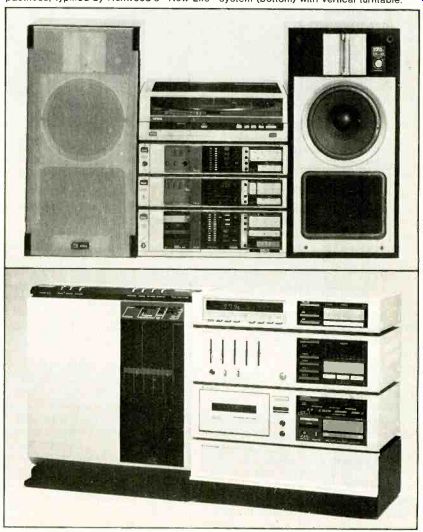
------------- One trend in one-brand systems was towards integrated
control of the various components in a system. The Aiwa V-1000 (top) can
be set up so that the touch of a button activates the turntable and tape
recorder simultaneously. Another trend is towards compactness, typified by
Kenwood's "New Life" system (bottom) with vertical turntable.
Aiwa's V-1000 "midi system" goes one better. It can be set up so that a touch of the phono switch selects that source, shunts the amplifier's tape-
monitor switch to source, puts the cassette deck into record, adjusts recording and bias levels, and makes a tape. An other nice feature is the system's rack, which has prewired connectors that mate with those of the components, very much easing system setup.
Sony is this year's big advocate of re mote control, and a single wireless unit the size of a pocket calculator provides control functions for virtually all of the components in the company's F-4500R Music Lab system. Future Sony systems will be accessible to the same sort of remote control as well. The new one-brand introductions did not exceed $2,000 in suggested retail price in any instance I noted, and they generally tended to feature separate tuners and integrated amplifiers rather than all-in-one receivers. Most included cassette decks as well as record players, but in a few cases you could opt for an equalizer.
Accessories Once again, equalizers and head phones led the field of new accessories.
Of equalizers, JVC had a new seven-bander for $200, while Onkyo appeared with a $180 ten-bander featuring LED-illuminated sliders ganged for the two channels. Sony's two new equalizers are nine- and eleven-band devices. The equalizer built into the new Soundcraftsmen CX4200 is also available separately as the CD2214. Soundcraftsmen's AE2000 "Auto-Scan-Alyzer" contains the same basic equalizer as well as a hundred-LED real-time analyzer and a pink-noise generator to develop a test signal for it. Audio Control has continued to be strong in this product category, again with a ten-band equalizer but also with a simple meter-plus-LEDs system that is switched between bands in an orderly and systematic sequence, letting the user proceed with adjustments band by band. A calibrated microphone is included in the $329 price.
The Technics SH-8065 equalizer ($500) ups the band ante to thirty three per channel. It comes equipped with a switch that provides the inverse response to what's shown by the slider controls, enabling the user to "dial in" his system's existing response irregularities and then flatten them with a push button. JVC offers a similar feature.
Another type of accessory, back for another run at the market, is the ambiance enhancer that simulates reverberation through multiple delays. Both Technics and Sansui have seized on new "bucket-brigade" integrated circuits to provide their delays. The Technics SH-8040 is designed for ambiance enhancement only. The Sansui RA-990 has two-channel mixing facilities that encourage a greater degree of signal processing, such as doubling vocal or instrumental solos.
Headphones are divided into home-type instruments and those adorable little "personal" things you wear to the supermarket or the jogging path. Koss introduced two new home phones at this show ($30 and $40), calling them evolutionary improvements on previous models, and Nakamichi made much of the output capabilities and response contouring of its new $70 SP-7 headset.
Koss was right there as well with a new personal model, the budget-price ($20) P-19, Audio-Technica added $30 and $90 models, and both Kenwood and Sony introduced in-the-ear designs.
Needless to say, the show brought the usual number of new brushes, pads, ointments, and antistatic treatments for records, but the one new disc accessory that still stands out is the platter-vacuum system for flattening and damping discs, first introduced as part of a turn table by Luxman and as an add-on accessory by Audio-Technica, and now joined by a somewhat-similar model from Nakamichi.
I WAS four days late getting out of Chicago this year, so I was able to watch the forklifts and tear-down crews participate in the CES post-closing ceremonies. It took those four days to get everything out of McCormick Place, and the show left town in a line of trucks that stretched as far as you could see down Lake Shore Drive.
I wonder how, in these troubled times, all that equipment will manage to get sold. It is possible, as always, that you will never see some of it in stores, because the lukewarm response of dealers at this show "canceled" the product or because distribution doesn't yet extend to your part of the world.
Please don't write for further information, since we usually don't have any. If you would like a few addresses of manufacturers, we will be pleased to supply them, but only if you include a stamped self-addressed envelope with your request. Write to: Stereo Review, Dept. CES, One Park Avenue, New York, N.Y. 10016.
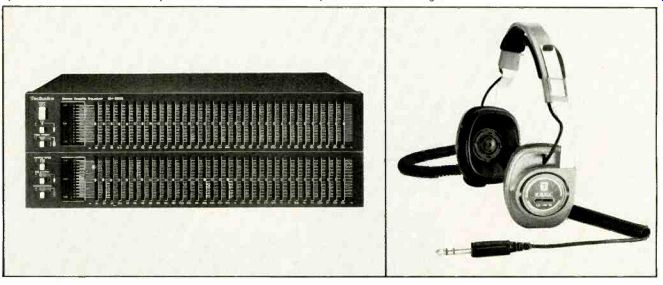
------ The Technics SH-8065 graphic equalizer (left) has thirty-three
one-third-octave bands per channel and an "invert" switch that
enables the user to set the sliders in a curve approximating a system's output
and then invert it to flatten the response. Like many other companies, Koss
updated some of its established products--the new K/ 6XLC headphones are
shown at right.
Also see:
NEW PRODUCTS--Roundup of the latest audio equipment and accessories
NEW AUDIO PRODUCTS AT CES '81, PART 2: A report on accessories and audio/video developments
Source: Stereo Review (USA magazine)