| Home | Audio mag. | Stereo Review mag. | High Fidelity mag. | AE/AA mag.
|
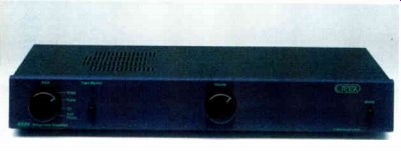
---------- Creek 4330R integrated amplifier
Little Feat was, in my humble opinion, the greatest American rock'n'roll band of all time. Back in the early '70s, I'd drive for hundreds of miles just to see them open for other bands. Then I'd drive home - usually without ever seeing the "main" act. But then they seemed to stop touring, except for visits to such bedrocks of Feat fandom as Washington, DC and Port land, Oregon. Heck, keyboardist Bill Payne was reduced to touring as part of the Doobie Brothers. But around 1975, they finally hit the big time and toured as headliners.
I'd always wondered about that gap in their touring schedule, though, and when I discovered that Meridian America, Inc. VP Andy Regan had toured with them as a roadie, I asked him about it. "It's simple," he said.
"Nobody wanted to come on after Feat had blown the audience away. The big acts just had to work too hard - and they hated it." I understand how those pampered rock stars felt. This is a review of the Creek 4330R, a component Sam Tellig wrote about in Vol 20 No.11. Sam's just too good at what he does -- he didn't leave me with a lot to say - but John Atkinson still felt a full review was appropriate. Sam is our elite scout unit - he does the reconnaissance, gets the interesting stuff faster than us ordinary ground troops, and then reports back first.
-------------
Description: Solid-state integrated amplifier with MOSFET output stage and passive preamplifier section.
Power output: 40Wpc into 8 ohms, both channels driven (16.0dBW), 45W into 8 ohms, one channel driv en (16.5dBW), 65W into 4 ohms, one channel driven (15.1dBW). Frequency response: 3Hz-26kHz,
-1dB. 1H D: 20Hz-20kHz, <0.05%. Slew rate: >40V/ps. Input sensitivity: 350mV for full output. S/N ratio:
>100dB (A-weighted). Channel separation: >60dB at 1kHz. Power consumption: 40W (idle), 200W (full power 10% 1H D). Dimensions: 2.4" (60mm) H by 16.5" (420mm) W by 9" (230mm) D. Weight: 10 lbs.
Serial number of unit reviewed: 80145.
Price: $595 with remote control,
$495 without remote capabilities.
Approximate number of dealers: 60. Manufacturer: Creek Audio Ltd., 2 Bellevue Road, Friern Barnet, London N11 3ER, England, UK. Tel: (44) 181 261-4132. Fax: (44) 181-361-4136.
Distributor: Music Hall, 108 Station Road, Great Neck, NY 11023.
-----------------
Small wonder The Creek 4330R is a compact, solid state 40Wpc amplifier with a passive preamplifier inside the box. Preamp? Okay, source switcher and volume pot only in the stock unit, as reviewed here, but a gain module ($60) is available as an add-on should you require the extra juice. There are also moving-magnet ($60) and moving-coil ($90) phono cards that can be added if you're an ana log kinda guy. This makes it a pretty versatile little amp, and you have to pay only for the features you need. (Oh no, maybe I've started to channel ST! But I do admire that kind of consideration myself.) Speaking of paying only for what you need, the 4330R has remote control - of volume and mute, at any rate -you still have to get up and switch the source selector yourself. But if you don't want the remote, or if you're on a tight bud get, the amplifier is available sans re mote, as the 4330, for $495, a hundred bucks cheaper.
Did I mention that the 4330R is small? Well, it is. It's so tiny that it feels positively heavy at 10 lbs. It's nicely built, in a no-nonsense kind of way, and more opulently appointed on the inside, where it's packed with high quality parts, most noticeably a 120VA toroidal transformer that occupies a full third of the chassis. This feeds a high current bridge rectifier and six physical ly small reservoir capacitors totaling 20,000p.F. Creek claims that using mul tiple smaller capacitors produces "amazing" reductions in power-supply impedance and inductance, "vastly" improving the sound at no extra cost.
The 4330R is DC-coupled from input to output. Servo monitoring circuitry controls the DC output voltage, eliminating the need for capacitors in the signal path. Creek claims a continuous output of 40W into 8 ohms with both channels driven, with a massive 18A current reserve, making the 4330R capable of delivering 370W into a 1 ohm load (!). I'm not about to drive a pair of Apogee Scintillas with a $600 integrated, but it does mean that, short of the Scintillas, the 4330R should be able to drive just about any speaker you'd care to pair with it.
The Creek's controls are pretty basic: a rotary source selector, a source/monitor button, a volume control, and a power switch are all you get-or need, actually. The mute function is available only through the remote. The rear panel is just as basic: four pairs of line level inputs (three if you have one of the phono boards installed), tape in and out, two sets of substantial speaker binding posts (of the new "Euro-friendly" variety - am I the only American who mourns the passing of the great-sounding but flimsy-looking Deltron connector?), and an IEC three-wire mains socket. Wait, there's one more - a pre amp out if you ever feel the need for more power or biamping.
In engineering, a simple solution to a complex problem is referred to as "elegant." The 4330R is extremely elegant.
These praises are not small or few Forget the hype surrounding Godzilla - most of the time, size doesn't matter. If it did, Creek would have never man aged to fit all that music into the 4330R's tiny little box. The Creek 4330R isn't just a great amplifier for the money, it's a great amplifier, period.
I did something cruel to it, you see. I dropped it into my reference system, replacing the Conrad-Johnson ART and the Audio Research VT200 combination, but keeping the Meridian 508-24 as the source and the B&W Silver Signatures as the speakers. nut's right, I replaced over $20k of high-class tube electronics with a $600 solid-state integrated. And I loved it! No, the Creek wasn't the equal of those two in refinement or soundstaging or inner detail, but I've got to tell you that, time after time as I listened to it, I asked myself "How can it get much better than this?" The real answer is that it can, but it takes a lot of moolah - money some people would rather spend on such frivolities as college loans, vacations in Provence, or IRAs.
The fact is, had I bought a Creek 4330R 15 years ago, I might never have become an audiophile. Instead of thinking, Something's got to sound realer than this, I would have settled back in my listening chair and thought, Sounds about right.
Now, where's that copy of Don Carlos? First off, the Creek was really punchy. It got the bass right. Not just the power, which it renders awesomely, but the sense of rolling thunder in an Entwistle riff, or the sass and strut in Fr. Ron Carter's best efforts. It didn't sound small at all.
Robert Baird has been talking up Massive Attack's Mezzanine (Virgin 45599-2) around the office, so I thought I'd check it out. The group is aptly named: the sound was huge, with a subterranean cellar and sheets of sound so thick that I'm sure I ducked at least once when they seemed to be hurtling my way. Mezzanine is electronica, with acoustic instrument sounds mixed in among the samples and synths. The Creek did a grand job of sorting them Forget the hype surrounding Godzilla - most of the time, size doesn't matter.
If it did, Creek would have never managed to fit all that music into the 4330R's tiny little box.
all out. I found the sonic landscape aggressive and oblique, but that certainly wasn't the 4330R's fault -the music is supposed to be aggressive and oblique, I think. (I have to admit that there was one particular strategy the group employed that totally baffled me: When they sampled from LPs, they seemed to pay more attention to the surface noise than to the musical tiffs they borrowed.) I was also intrigued by another RB fave, Rufus Wainwrighes eponymous debut (Dream Works drmd 50039), which boasts co-production and string arrangements from Van Dyke Parks.
Shorthand description: love-child of the Beach Boys and the McGarrigles. The songs are quirky and fun, and the sound is exquisite: lots of natural-sounding instruments -including a very wheezy accordion and oodles of delicate string overtones - and an uncannily present sounding Wainwright. The Creek made this disc sound open and spacious, with lots of lateral spread and impressive depth. Perhaps I should say fairly impressive depth - the Creek didn't, as you would suspect, make the room's front wall disappear the way the C-J/ARC system did. The soundstage was smaller and shallower, and didn't have that effortless U-R-There feeling the big rig did. But it didn't sound puny either -it had all of the high-priced spread's qualities, just not as much of them as 20 grand of tubes can buy.
Nor, as Sam has pointed out before me, did the Creek have that tonal rich ness that seduces the ear -the plangent luster, say, an Amadi cello has, and that the very best hi-fi can re-create. But it didn't sound harmonically threadbare either. Compared to the burnished rich ness of my favorite topnotch gear, the 4330R had the sense of unvarnished "reality" that videotape has when you compare it to the rich color saturation of film. Some people prefer that; they seem to mistrust their emotional response to beauty. Not me.
That doesn't mean the Creek wasn't beautiful in its own way. I thought it was, and I suspect that most people would -but I wouldn't throw away my reference system for it. On the other hand, I could understand people who owned the Creek and didn't want to trade it for an enormous, room-dominating stereo that threw off massive BTUs. The Creek was good enough to make its owners content, placid even.
It also boogied like a good'un. (Oh my, now I'm channeling JA!) I found myself playing air guitar when I cranked
------------
Associated Equipment:
LP playback: Linn LP12 turn table, Naim Armageddon power supply, Naim ARO toneann, van den Hul Frog phono cartridge; Linn LP12/Lingo/Cirkus/Ekos/ Addy.
CD playback: Arcam Alpha 9, Meridian 508-24.
Phono preamplifier: Sutherland PH-5000. Preamplifier: Conrad-Johnson ART.
Power amplifier: Audio Research VT200.
Loudspeakers: B&W Silver Signatures, REL Studio II sub woofer.
Cables: Sikech interconnect, WireWorld Gold Eclipse III speaker cable.
Accessories: CinePro PowerPro 20 AC line conditioner, Magro Stereo Display Stand, Sound Organisation two-tier rack.
Sound treatment: ASC Tube Traps, Studio Traps, Bass Traps; RPG Abffusors; brady-kinetic kitty.
-Wes Phillips
------------
up Phil Manzanera's Diamond Head (Polydor 2302 062). And when my wife was out shopping yesterday, I was embarrassingly spastic, singing second lead to James Brown on "It's a Man's World" (Star 'Tinte, Polydor 849 109-2). Not that Mr. Dynamite needed a second lead, but it just felt so good to yelp my "Man's" in response to his. Yeah, the 4330R had "it," whatever "it" is when it comes to riddum and pace.
No small praise If you think a product has to cost an arm and a leg to be "high-end," then the
Creek 4330R could shatter your notions of what that term means. It's small and not terribly expensive, but it is superbly well made, brilliantly thought out, and sounds great - good enough to give some separates manufacturers the cold sweats. (Now I'm channeling James Brown - somebody help me!) Partner this baby with a Rega Planet and a pair of B&W 302s and you have a true high-end system for $1500 - even less if you don't need the remote.
Manufacturers of hideously expensive hi-fi may very well find the Creek 4330R a tough act to follow.
-----------------
Measurements
After being run at 'n-power into 8 ohms for an hour, the 4330's chassis was too hot to touch. This is very much a worst-case situation for an amplifier with a class-B or -AB output stage, but it does show where the cost cutting has taken place: in the heatsinking. With its volume control all the way up, the Creek's voltage gain was a healthy 3325dB. The output was polarity-correct, and its input impedance measured 11.3k ohms at 1 kHz. Its out put impedance was a very low 0.07 ohms across most of the audio band, rising to 0.09 ohms at 20kHz. The amplifier will show very little interaction with the load impedance of the loudspeakers with which it is used.
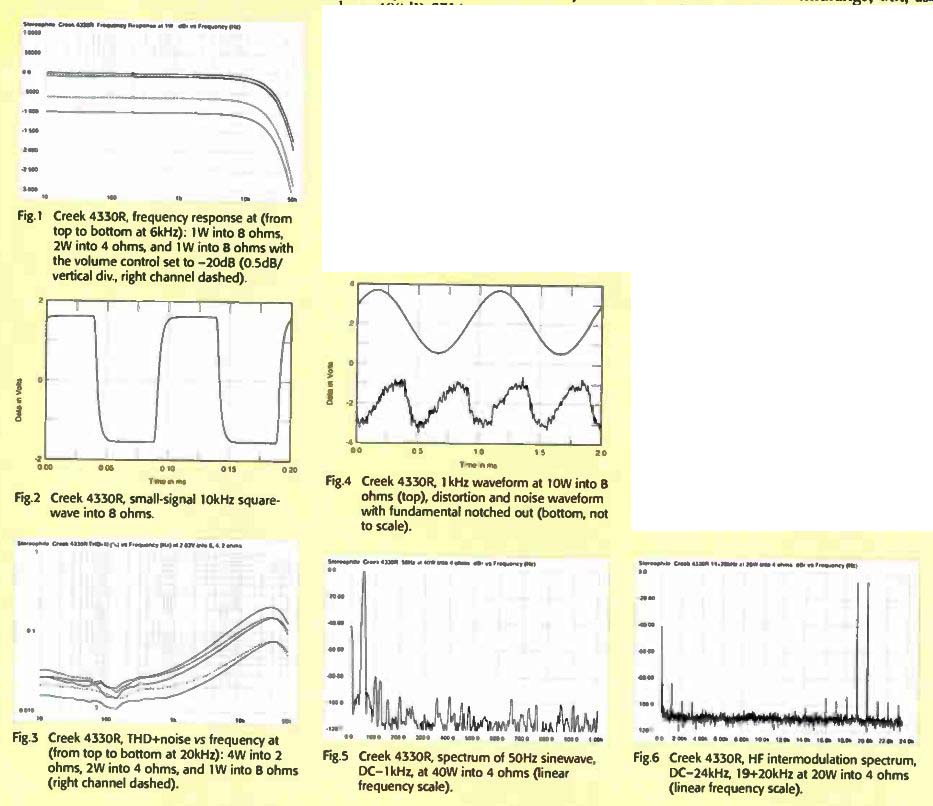
Fig.1 Creek 4330R, frequency response at (from top to bottom at 6kHz): 1W into 8 ohms, 2W into 4 ohms, and 1W into 8 ohms with the volume control set to -20dB (0.5dB/ vertical div., right channel dashed).
Fig.2 Creek 4330R, small-signal 10kHz square wave into 8 ohms.
Fig.3 Creek 4330R, THD-noise vs frequency at (from top to bottom at 20kHz): 4W into 2 ohms, 2W into 4 ohms, and 1W into 8 ohms (right channel dashed).
Fig.4 Creek 4330R, 1-kHz waveform at 10W into 8 ohms (top), distortion and noise waveform with fundamental notched out (bottom, not to scale).
Fig.5 Creek 4330R, spectrum of 50Hz sinewave, DC-1 kHz, at 40W into 4 ohms (linear frequency scale).
Fig.6 Creek 4330R, HF intermodulation spectrum, DC-24kHz, 19+20kHz at 20W into 4 ohms (linear frequency scale).
I measured the Creek's intrinsic noise with the volume control at full and the inputs shorted. Referred to 2.83V into 8 ohms (1W), the unweighted wide-band figure was 76.5dB, this improving to 82dB when the measurement band width was reduced to 22Hz-22kHz. A weighting the measurement gave a further improvement, to 87.5dB. There should be no hiss problems with the little Creek unless it is used to drive horn loaded speakers with a sensitivity well above 100dB/W/m.
The top pairs of traces in fig.1 show the 4330's small-signal frequency response into 8 and 4 ohms. Basically flat from the very low bass all the way up to 10kHz, there is then a slight (-03dB) rolloff by 20kHz. The lower maces were taken with the volume control set to -20dB ( 11:30). The fact that the preamp section is passive does not introduce any additional HF rolloff, but note that an imbalance of 0.4dB has appeared, due to less-than-perfect channel tracking of the inexpensive volume potentiometer at this setting.
The rolloff continues smoothly at ultrasonic frequencies, indicating an absence of HF problems. This is con firmed by the 10kHz squarewave plot (fig2), which has a gently rounded leading edge but no ringing. The channel e separation (not shown) was only fair: in the midrange and low treble, decreasing to 50dB or so at 20kHz due to capacitive coupling between the channels. This is adequate but not great performance.
The Creek has moderately low distortion in the bass and midrange, but, as revealed in fig. 3, the THD+noise rises both with reduced load impedance and increasing frequency. This should not be a problem, however, as it can be seen from fig.4 that the distortion content is heavily second-harmonic, which is subjectively benign. This is also shown in the fig.5 spectrum, taken with the amplifier working hard into 4 ohms - a trace of 120Hz power-supply noise can be seen just above the second harmonic of the 50Hz driving signal at 100Hz. Note that even at this high level, all the harmonics are at -80dB or below. That this is a very linear design is also seen in the high-frequency intermodulation spectrum (fig.6). Plotting the Creek's continuous out put power against the distortion and noise content into 8, 4, and 2 ohm resistive loads gave the traces shown in fig.7 These were taken with just one channel driven; Table 1 compares the clipping power (defined as 1% THD+noise) with one or two channels driven. In the latter condition, the 4330 just fails to meet its 40Wpc specification, probably due to the low AC line voltage in our lab. But considerably more power is available into low-impedance loads.
Using the Miller Audio Research Amplifier Profiler, I tested the little Creek's maximum output power on a toneburst signal more typical of real music program. (The distortion is plotted in decibels below the power; -40dB corresponds to 1% THD.) The black trace in fig.8 is the burst output power into 8 ohms - over 60W, with a peak current output of almost 2.8A. As the load impedance halves (red is 4 ohms, blue is 2 ohms, green is 1 ohm), you can see that the output power almost doubles each time. In fact, into 1 ohm on this toneburst signal (10 cycles on, 40 cycles off) over 320W is available, with a peak current of 18A! Despite its diminutive dimensions, this is one pow erhouse of an amplifier. With music drive, on a watts per pound basis, the 4330 is one the best bargains around.
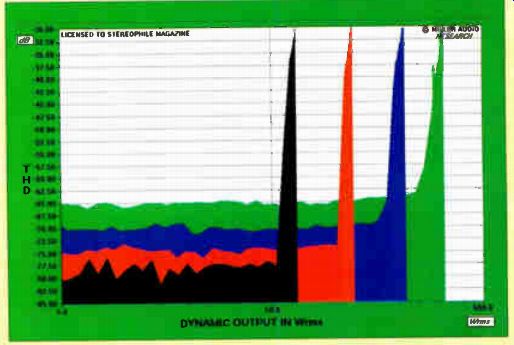
The analyzer's display enables you to see the toneburst waveform progressive ly affected by the droop in power-supply voltage into this punishing load - the tenth sinewave was distinctly smaller than the first-but the amplifier didn't give up. This can be clearly seen in fig.9, which plots the output voltage delivered into a load plotted against THD+noise (again in dB). The maximum voltage available to drive the speaker varies only a small amount as the load is reduced from 8 ohms (black trace) to 2 ohms (blue). The distortion at lower levels does rise by about 6dB each time the impedance is halved, but still remains low, particularly when you remember that it is mainly the benign second harmonic. Only into 1 ohm does the supply voltage start to decrease significantly - but there's still plenty left!
-John Atkinson
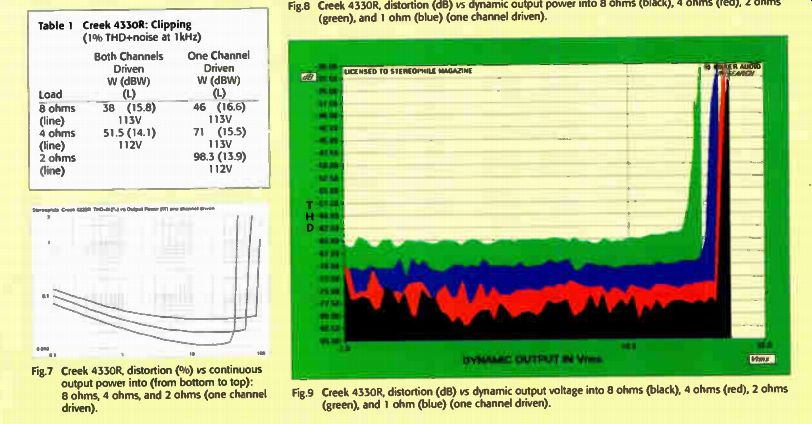
Table 1. Creek 433012: Clipping (1% THD+noise at 1-kHz)
Fig.7 Creek 4330R, distortion (%) vs continuous output power into (from bottom to top): 8 ohms, 4 ohms, and 2 ohms (one channel driven).
Fig.8 Creek 4330R, distortion (dB) vs dynamic output power into 8 ohms (black), 4 ohms (red), 2 ohms (green), and 1 ohm (blue) (one channel driven).
Fig.9 Creek 4330R, distortion (dB) vs dynamic output voltage into 8 ohms (black), 4 ohms (red), 2 ohms (green), and 1 ohm (blue) (one channel driven).
------------------
Also see:
AUDIO RESEARCH PH1 PHONO PREAMPLIFIER
(review)
Prev. | Next |