
| Home | Audio mag. | Stereo
Review mag. | High
Fidelity mag. |
AE/AA mag.
|
|
This is the second time we are using our new box number and Pennsylvania address; in our last issue we were still so unaccustomed to Box 978 that in the article on digital equipment we parenthetically referred the reader to the " Box 392" column. Sorry about that. Of course, we could have asked for our old box number at our new post office; it might have been available but would probably have created misunderstandings about our new location. Just remember the change if and when you write. Letters in this column may or may not be excerpted, at the discretion of the Editor. Ellipsis (...) indicates omission. Address your letter to The Editor, The Audio Critic, P.O. Box 978, Quakertown, PA 18951. The Audio Critic: What a pleasure it was to receive the two latest issues of The Audio Critic, my long-lost favorite audio publication. I certainly appreciate that these issues were credited to my original subscription, and I enclose payment for a new subscription to show my enthusiasm and support. I once heard that one of the difficulties in preparing the original publication was the pressure of finding for each issue some new, significantly better component that could "blow away" the competition- sort of an audio scoop. After 40 years as a serious audio hobbyist I have concluded that these breakthroughs do not occur with that frequency, in spite of much of the high-end audio press's desire to convince us otherwise. Many dependable audio products have proved their long-term excellence. In the category of speakers alone I could mention the original Quads, the Pyramid ribbon tweeter (one of your scoops) and the Janis subwoofer system. I suspect there are enough interesting and worthwhile audio topics ripe for illumination by your unique approach, without too much emphasis on convincing the hap less audiophile that he should be discouraged with equipment that, as Stan Freeberg put it, "has been obsolete for at least a week." My personal view of the scene is that the future is in the integration of audio and video. I believe there is so much to be done to improve video and TV sound that a lot of tweaking and breakthroughs are needed and seem to be slowly forthcoming. The two technologies seem to be growing together in the new generation of multiple-purpose digital players, stereo TV's and recorded movies with decodable 4-channel sound. Golden eyes are not required to judge the current crop of commercially available video products. Sincerely, Lohr H. Gonzalez San Juan, Puerto Rico What a pleasure it is, if we may echo your own words, to agree with everything a subscriber writes. The component-of-the month approach to audio journalism tends to serve small-time marketing interests, not the cause of good sound. A new issue of an audio journal should bring the reader new knowledge, not a new yuppie shopping list. As for the marriage of high-end audio and video, our views were expressed in the Harman/Kardon VPM 600 review in Issue No. 12 and are fully in accord with yours. -Ed. The Audio Critic: ...Good luck. We really need fresh air and new, uncommon views. Go ahead, but take care: the Japanese with their big and strong artillery, the Europeans with their unique combination of art and technology, are both fully active. The Yankees are under big pressure, but they have the potential and the experience--who will be Napoleon? Very kind regards, Lily Rendon; Lima, Peru Napoleon? Forget that wimp! To an audio journal with a Hungarian editor, the role model is Attila the Hun, who was known as "the Scourge of God." -Ed. The Audio Critic: I thought you might like to see a copy of the letter I wrote to The Absolute Sound. It goes along with your idea of trying to correct misinformation that appears in the audiophile press. I thought the comments concerning The Audio Critic and the Carver speaker were quite unfair. One thing I cannot understand about the various audiophile publications is why they are so hostile to Carver equipment. Is it because the equipment really isn't up to audiophile standards but the very visible ads claim that it is? Or could it be the opposite, that the equipment sounds too good for what it costs? Any thoughts on this? Sincerely, Gene D. Robinson Geology Department James Madison University Harrisonburg, VA To the Editor [of The Absolute Sound]: I would like to comment on the portion of your answer to Gene Steinberg (Letters, Issue 56) concerning Peter Aczel and the Carver speaker. You stated that Aczel "became very unclear when discussing the power needs of Carver's Amazing Loudspeaker." He says in his report on the speaker (The Audio Critic No. 11) that "Sensitivity is quite low: 82 dB SPL at 1 meter with 2.83 volts input...," and a bit later, "You need 200 watts but you could use 1000." What's unclear about these statements? You also say that the Carver speaker has an "amazing" (what a nice play on words) rise in its low-frequency response and that this was "documented by none other than Julian Hirsch." Once I regained consciousness after the shock of seeing you refer to anything Julian Hirsch would write, I looked up his report on the speaker. In his close-miked measurement of the woofer response, he did document a rise in frequency response of "6 dB per octave from above 100 Hz down to its maximum at about 26 Hz..." But in the very next sentence, which you perhaps missed, he says that this rise "exactly compensates for the normal low-frequency loss of a planar speaker, making the system's actual bass response flat down to the maximum point, 26 Hz..." From reading the technical description of the speaker, it appears to me that this is exactly what the system was designed to do. Why do you ignore this part of Julian Hirsch's report? I would not accuse you of selectively referring only to material that supports your position, but one wonders. Sincerely, Gene D. Robinson Geology Department James Madison University Harrisonburg, VA Thank you, Gene; you have kindly spared us the trouble of writing an item in our "Hip Boots" column about this. No one ever accused Harry Pearson of fair ness. The entire paragraph from which you quote the "unclear" bit is an irresponsible exercise in snide, undocumented innuendo. For reasons best known to himself, we make Harry feel insecure, even though his publication is older than ours, with more subscribers and more advertisers. He appears to be thinking about us much more often than we think about him. (Does he imagine we strive for technical and journalistic excellence just to make him and his staff look bad?) At any rate, you give him far too much credit by allowing the possibility that he overlooked part of Julian Hirsch's review. First of all, you can safely assume that he did not look up the review before making his comments; that kind of accountability is alien to his nature. Secondly, we doubt he would recognize the principle of the Carver speaker design if it bumped into him at high noon on the Long Island Expressway. We are willing to concede his love and under standing of music; we do not deny his past role in the furtherance of high-end audio; we even consider him a better than aver age writer; but he is untutored in science and engineering and knows nothing about cause and effect in electroacoustics. His credibility is close to zero in the academic and professional circles of audio. Memories of his Infinity-IRS-in-a-telephone booth reference setup still elicit giggles in the trade; only the tweako interests continue to fear him and court him. Let them. As for the anti-Carver bias of the "alternative" audio press, we offered our thoughts on the subject in Issue No. 10 (see page 32, right-hand column) and have little else to say at this point. The best example of a Carver product that sounds a lot better than the price would lead you to believe is the "Amazing Loudspeaker." -Ed. The Audio Critic: As you know, McIntosh stereo components are highly popular, and old McIntosh components are greatly in demand. And yet, I have never, ever, seen Mcintosh equipment reviewed, either favorably or unfavorably, nor have I ever seen McIntosh on a list of recommended components. Can you enlighten me, and us, on what in the world goes on here? Sincerely yours, Lester F. Keene Fredericksburg, TX There is absolutely nothing sinister going on. You have obviously missed several fairly recent Mclntosh reviews. After a very superficial three-minute search of our magazine shelves, we found a review (quite favorable) of the MC 2002 stereo power amplifier by Larry Greenhill and Dave Clark in the April 1985 issue of Audio-and we know there are others. It is true that McIntosh keeps its distance from the "undergrounds" and does not solicit reviews by them, probably figuring that the fickleness of the subjective reviewers is likely to do more harm than good in the long run to an already prestigious product. -Ed. The Audio Critic: ...Regarding digital audio: A brief remark in Issue No. 11, "Those whose hearing is so exquisite as to require better figures are out of luck," doesn't seem to do justice to a topic (audio bandwidth requirements) that has occupied your letters column and editorial comments as much as it has. I recall favorable comments directed toward Mitch Cotter's NF-1 filter whose upper corner was substantially above the 20-odd kHz that CD and DAT provide. Ditto the built-in filter(s) provided on the NAD 3020 and a number of others. Julius Futterman sent a letter endorsing those in the limited bandwidth camp, and numerous other statements in the older issues indicate that bandwidth-limited systems are the way to go, a conclusion I don't disagree with. What does concern me is that I've seen nothing indicating that anyone really knows what the upper limit ought to be. Am I unjustly suspicious, or are there reasons beyond foiling D/D copies of CD's that caused the DAT folks to go to 48 kHz? Why did Mitch Cotter and other designers choose frequencies near 35 kHz for their upper corner? Should I and others conclude from your CD experiences that there really is nothing worth pursuing above 22 kHz and that the controversy has finally been laid to rest? I'm confident that with improvements in the IC fabrication processes, LSB, MSM and all SB errors will become a quickly forgotten part of audio history, but I can't help but feel a bit shortchanged with a brick-wall upper frequency limit not so far from what I could hear a few years ago. A bit more insight on this would be appreciated by at least one reader. ...[Regarding] the "alternative" press: Over the last few weeks I have had the experience of reading several recent issues of the slick Stereophile and feel compelled to let you know how much it increased my already substantial appreciation of your publication. When I originally subscribed (shortly after the first issue), I had no way of knowing just how different you were. Your periodic, semi-snide comments on the state of alternative audio reviewing don't even come close to describing just how terrible a job the others (well, at least Stereophile) are doing. The crowning touch of my Stereophile experience was a single line from JA on page 27 of the October [1988] issue regarding DO's cable test. It said that those who feel that single- or double-blind testing of the cables would have been the only valid way to do the test should not be reading Stereophile. I've taken them at their word. My personal belief is that your old report on the state of wires and cables is the model of a scientific approach to semi popular reviewing and informing. I under stand that not all technical aspects of the audio business are quite so easily nailed down, but you are doing the best possible job, again in the opinion of one reader whose background is in related fields. Thanks. Barry Janiss Ben; Lomond, CA Any discussion of the audible effects of bandwidth limiting inevitably separates into two discussions. One has to do with the limits of hearing, the other with the time-domain characteristics of analog low pass filters. Keeping that upper corner of the filter well above the highest frequency to be accurately reproduced has always been considered good engineering practice, especially with high-order filters, and old-timers like Futterman and Cotter were certainly of that school. The digital filters used in the latest D/A converter circuits do not raise that issue, although they have their own problems, and the computer optimized (we hope) analog filters on the recording end of the digital chain are get ting better and more forgiving all the time. We have no evidence whatsoever, not even the slightest, that the CD/DAT standards are skimpy with regard to bandwidth. We are willing to concede the slim possibility, however, that the difference between the 22.05 kHz and 24 kHz cutoffs of CD and DAT, respectively, is audible on cymbals, Snares, triangles, etc., to an occasional youngster of freakishly keen hearing. Our perspective as regards the alter native audio press is that we represent normal competence and accountability, such as you always had the right to expect, and they are the new breed of intellectual and moral lightweights currently accepted in so many formerly demanding sectors of our culture. What they purvey is trendy consumer chitchat, not knowledge. -Ed. The Audio Critic: I was delighted to discover... that your publication has returned. I've missed your lucid, thoughtful and well-written (al ways) commentary and frank perspective. You steered me wrong a few times (DCM "Time Windows"?!), but not to worry, you're human, and those few stray paths are a minor deviation from what is regularly a very clear and penetrating voice in the abrasive static that has become audiophile journalism. I still have and delight in my Quad ESL's and Futtermans to which you introduced me years ago. (They even survived a 3-year hiatus with Quad ESL-63's.)... Sincerely, Gary E. Martoni Weehawken, NJ Corrections: It is strictly a matter of opinion that we are human; some would disagree. The DCM Time Windows of 1977-79 were far from a bum steer; they were probably the best medium-priced speakers in the world; what happened later is another matter. DCM is a totally different operation today; we still have a lot of respect for one of the partners, Steve Eberbach, both as a person and as a speaker designer, but we have absolutely no confidence in any company that hires Bob Park as president. The man is a walking credibility gap in our opinion; our schlock warning light goes on the moment he enters the picture. And yes, the original Quad ESL had more delicately etched highs than the 63 and is still preferred by some audiophiles for that reason. -Ed. The Audio Critic: ...In you continuing quest to debunk humbug in the business, I wonder if you could better explain the implications of your new and loftier editorial standard, of "accountability." Perchance this implies that if products fail to satisfactorily live up to your praise, you'll personally guarantee a refund? Sorry, but I just couldn't resist it. Aside from some signs of strain versus your last issue, the latest continues to doggedly reflect the same idiosyncratic and iconoclastic style, and stylish flair for words and ideas, that always made TAC one of the most readably delightful pubs in the business. Cordially, Michael D. Riley Santa Monica, CA The kind of refund you talk about has to do with the accountability of the dealer who sold the equipment, not the reviewer who praised it. The reviewer must be accountable for his praise or any other opinion he publishes. That means (1) laboratory measurements to back up his listening tests, (2) listening tests to verify, or at least relate to, his measurements, and (3) reasonably plausible scientific/engineering explanations for (1) and (2). As for our doggedness, what else would you expect of a breeder and exhibitor of Bullmastiffs, but how can you call us stylish? Of course, it is possible that in Southern California analytical thinking and a literate use of English are considered an optional choice of style, like expensive sunglasses or cowboy boots. (Sorry, but you gave us little motivation to resist that one.) -Ed. The Audio Critic: ...I still believe that we are dealing with a number of distortions and subtractions and additions which are quite audible and yet defy our current standards of measurement. Equipment simply does not be have as well as it measures-so something is still missing from the data bank. It is my opinion that we have an idea how good or poor a piece of equipment is by our current measurements; however, there is far more to be done before we can say that we can measure and quantify all audible performance variables. Presuming, for the sake of further discussion, such a premise to be valid, the implications extending from it become obvious: when the "measurement" school of reviewers can only be certain of incomplete and flawed data, we must rely on what our ears tell us. And then the whole nebulous area of "subjective" analysis so well lampooned by you comes into play. Despite our desire to be accurate in some absolute sense, we find ourselves once more at the mercy of subjective reviewing as a valid tool for judging equipment. And opinion takes on exaggerated importance, as if it were scientific data. So, where [am I] headed with all this? Please bear with me. I think your Issue No. 12 presents the problem very clearly. On the one hand you discuss ABX testing; on the other, it is hard to deny the "anecdotal" evidence, however scientifically shoddy, presented by Christopher W. Russell! I had intended to take this point up with you previously, anyhow; however, Issue No. 12 just handed me the ideal opportunity to discuss it in terms of views already expressed by others, a much easier task, to be sure! First of all, I believe Mr. Russell, and I feel that his observations are absolutely valid, even without the anecdotal evidence! What he recounts is close to what my own senses have told me for years, and the results of ABX testing, apologetics not withstanding, do not quite square with my experience. And therein lies the problem. Am I asserting that my hearing is "superior" to that of ABX subjects? Certainly not! Am I validating the "snake-oil" views held forth as "gospel" by others without concrete evidence beyond their own subjective reactions? Possibly so. I believe that ABX testing often gets less than conclusive results because it fails to attack the comparison as directly as it first might appear to! If you have a continuously running piece of music, and you interrupt it with switches from one component to another as it plays, you are not comparing apples with apples, even though it would seem that you would be! Because, at each switch, you are listening to the section which follows what you just heard- and any difference might have to be quite pronounced to reliably show up on a test like that. However, if it could be arranged, even with the fallacy of relying on memory, to hear instead a repeat of what you had just heard from the other component, you might get far more dramatically conclusive results. Those who hear "dramatic" differences between components do hear them, and not entirely for emotional or subjective reasons. There is a real difference-it is just that the ABX test often fails to pick it up because the listener is asked to compare ABCDEF with GHIJKL! No two moments in music are so close in sound as to make such comparisons valid for any but dramatic variances; hence, the equivocal ABX results differing from the opinionated results of "subjective" reviewing. I would also qualify this observation by saying that comparing A on Tuesday with B next week Friday, as some reviewers attempt to do, is a fraud. The components must be compared at the same time, and through the same system. But, if one repeats a section of music just heard on an other piece of equipment seconds before, assuming the volume level is the same, I feel that a great deal can be revealed, and even to the casual listener... Best wishes, Harrison Pierce Reed III Gloversville, NY Out of the 37 single-spaced, narrow margined pages you have written us so far (very hard for an editor to ignore!), the above excerpt is probably closest in subject to what currently occupies our mind. Regrettably, your elaborate exegesis is of a point of view we have by now put behind us, although we were thinking much along the same lines some years ago. In fact, your ABCDEF vs. GHIUKL argument appears, somewhat differently word ed, in our Vol. 1, No. 1 (early 1977), of which we believe you have one of the few surviving copies. The argument still has the same validity as ever-as recently as in Issue No. 11, we brought up the idea of programming a CD player to recycle the same 20 seconds of music for really critical ABX testing-but our experience is that the more we try to outmaneuver the ABX box, the more stubbornly it keeps presenting the same results. Your problem is that you are a True Believer and would rather write 37 pages of audio philosophy or argue for 37 hours than actually perform the one simple experiment that might destroy your belief system. That experiment has only two essential requirements: (1) the two amplifiers or preamps or CD players, or whatever you are comparing, must be matched in output level within 0.1 dB (by meter, not by ear!), and (2) you must not have the slightest clue as to which is which, only that this is sound A and this is sound B. No ABX switching system is necessary; just listen. You will be frightened out of your wits because your cherished beliefs will be crumbling-even if you shakily manage in the end to tell the two apart. No audiophile is willing to believe just how much a Pioneer or a Radio Shack Realistic sounds like, say, a Krell or a Mark Levinson before actually trying this without cheating. It appears to us from your letters that you never did try it-not all the way. -Ed. The Audio Critic: Glad you're still with us and hope you get bigger. I've enjoyed all three issues [Nos. 10, 11, and 12]. One hope: please keep witty but not catty. All are entitled to their opinion, even if it's proven wrong. Joe C. Palladino Lander, WY Your admonition typifies the Middle American aversion to intellectual confrontation, an attitude we understand, even respect to some degree, but totally disagree with. Erroneous opinions advanced modestly and in good faith should be corrected patiently and without rancor, that much we admit. But anyone who loudly, aggressively and/or pompously proclaims that: 2 + 2 = 5 should be instantly and publicly humiliated-in our modest opinion. Otherwise the loudmouthed ignoramuses will get bolder and bolder and eventually demand to correct those of us who know that 2 + 2 = 4. That has already happened in some sectors of audio. -Ed. The Audio Critic: With respect to your criticism of my technical competence on p. 38 of Issue No. 12 of The Audio Critic, note that I said "pulse," not "square wave," in the Stereophile review from which you quoted. The two are not equivalent. A few minutes' reflection concerning the difference in the spectral nature of the two and a better understanding of the nature of the Fourier transform should lead you to agree with me: A loudspeaker must indeed have both flat frequency [response] and the ability to produce whatever is the acoustic equivalent of a DC voltage step (as well having a minimum-phase characteristic) in order to reproduce a single rectangular pulse without modifying its shape. It only need have a flat frequency response and a minimum-phase characteristic to reproduce a square wave (which is, of course, symmetrical about the time axis). Despite the undoubted design talents of Bob Waterstripe (Huh? Not Steve Eberbach? See below.-Ed.), the convincing nature of DCM's literature, or even the florid nature of your prose, neither the DCM Time Window nor the Time Frame TF-1000 can do anything other than simulate a high-pass filter when confronted by a unidirectional pulse. A clue: 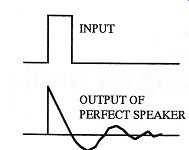 INPUT; OUTPUT OF PERFECT SPEAKER (Totally wrong. See below. -Ed.) "Rankest nonsense"? Hard to be right all the time, isn't it? If you are going to continue in your self-appointed role to watch the watchers, it would be a good idea for you to put on your hip boots when you read your own writings in The Audio Critic. Yours sincerely, John Atkinson Editor Stereophile; Santa Fe, NM P.S. For your information, I am told that Larry Archibald was regarded as a damn fine "automobile repairman." Perhaps you should take a critical look at your social attitudes after you have brushed up on your engineering theory. Oh, boy! You certainly know how to snatch defeat from the jaws of victory. You had the perfect opening because we had been so sloppy as to accept your in sufficiently specific reference to an "input pulse" at face value, failing to ask whether it was a Dirac impulse, a step function, the usual function-generator-type positive or negative pulse (merely an offset square wave), or what have you. You could have pretended, for example, that you had really meant a step function (a step from 0 to a + or - plateau and no return to 0), and we would undoubtedly have lost the argument then and there. But no! You draw a little sketch for everyone to see that your input is the common, garden-variety positive-going square pulse, and then you totally blow it by showing a high-pass-filtered step function as your output-and through an under damped, ringing high-pass filter at that. Some "perfect speaker," man! You obviously receive coaching from the sidelines in these matters but seem to be unable to keep your signals from getting mixed up. Now, what we had in mind as the input was naturally also the square pulse you show, since that had been what Steve Eberbach used as his test signal at DCM (not Bob Waterstripe, for crying out loud--he was the marketing man) and what we, too, use routinely in our speaker testing. That is the pulse you meant; that is the pulse we meant; and that is the pulse which passes through a "perfect speaker" exactly as shown below, in a simple computer simulation, confirming what we wrote in "Hip Boots" and leaving you with egg on your face. (You and Dick Olsher ought to join some kind of breakfast club.) The perfect speaker we hypothesized for the simulation was modeled by a 2nd order Butterworth high-pass filter (i.e., a slope of 12 dB per octave, Q = 0.71) with a passband frequency of 16 Hz That is about as perfect as one can get, you will have to agree. The computer program is not the most refined and actually exaggerates the graphics of the input/output relationship, but that works to your advantage. Despite the peculiar labeling of the time axis, the grid represents 0.2 msec per division. The pulse duration chosen is typical for speaker testing. The important point is that the output is a virtually perfect replica of the input, without the slightest ringing, leaving your explanations very close in deed to the "rankest nonsense." We are flattered by your implication that we are right all the time, except- at last!-- in this case, and we are not stung by your opinion of our prose, since you are obviously of a very different literary per suasion as witnessed by the sharpness of your repartee. One would have to go to a school playground to hear the equal of your so's--your--mother style of punch line about "Hip Boots." As for Larry Archibald, we brought up his previous business to indicate that he did not come to the magazine from the world of audio, not because we think an automobile repairman is socially déclassé. That was your dirty little thought, not ours. "By George, sir, the poor beggar was in trade. Pity, what?" Once an Englishman, always an Englishman... -Ed. 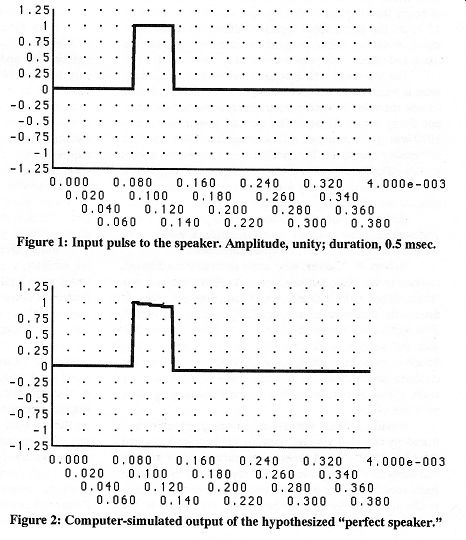 Figure 1: Input pulse to the speaker. Amplitude, unity; duration, 0.5 msec. Figure 2: Computer-simulated output of the hypothesized "perfect speaker." ------- [adapted from TAC 13] --------- Also see: Various audio and high-fidelity magazines Top of page |
|
| Home | Audio Magazine | Stereo Review magazine | AE/AA mag. |