by Edward Tatnall Canby
Years back when this magazine was adolescent and I used to make up my own zany titles, I occasionally resorted to a sort of catch-all phrase that keeps ringing in my head. Obviously, it originated in the Italian-American community: DIS'A AND DATA. Or was it out of somebody like the Schnozzola Durante? Credit where credit is due. A good rhythm, a give-and-a-take --like to and fro, here and there, back and forth, up and down, His & Hers, take it or leave it. DIS'A AND DATA! I can hear its sonic ambience so nicely--say in a certain passage out of the Berlioz Fantastic Symphony, which you may locate for yourself if you can. But on paper the most interesting sort of dis'a and data is the kind of back-and-forth exchange that the rhythm implies--out of our far-flung correspondents. (Just got a recording from Singapore and a super-8 sound film from Hong Kong, for which I have no projector.) There's only one reason why our energetic correspondents don't appear in all our departments regularly every month for a really lively exchange of ideas--it takes SO long.
You can talk to a sourdough or an Eskimo in Alaska for pennies by phone, and we can pour water out of a bottle on Mars. But a three-minute (reading time) exchange via magazine is like a phone call to Mars. You ring up and ask, hey, how's the weather up there? And more than half an hour later at the speed of light you hear, fine, but the smog is sort of red. It takes even longer in a terrestrial exchange of words via magazine. It's grotesque.
What with the initial transportation via pony express (courtesy of the Postal Service), the accumulation in the Off ice Memory Bank (a file folder), the re-forwardation to the ultimate destination (me), and then the answeration, back by snail express to the Edi tor, and the copy reader, and the printer, and the distributor, and eventually, all in due time, to YOU. One can grow old answering correspondence and one often does.
So hail, all you Rip Van Winkles, glad to welcome you aboard. For instance, there is (was) Brian Berkeley, a (then) senior in EE at MIT and author of one of the most genially and totally unintelligible papers presented last autumn at the AES (that is, unintelligible for me --I haven't really learned the digital lingo yet), called "A Floating-Point Digitally Transcribed High-Fidelity Audio Mixing System." Phew! (But I do get hic essential point or purpose, which is to begin that rather painful process of intermediate digital conversion as applied to the many and degrading steps in the audio chain that now must come between a digital original recording and a finished commercial record.) Lo--Mr. Berkeley can also write English, a language that I am often able to comprehend, and he wrote me a few millennia ago to remark on my "digital" column of February, 1978, pointing out one rather import ant technical error I had made, inadvertently, in my enthusiasm for the astonishing new parameters of digital recording.
Misunderstood Hyperbole
Thank the Lord, the man liked my piece, and commended me for waving the digital flag, as he put it. But, he said, "I was somewhat disturbed when I read 'signal to noise at virtual infinity-- there is no noise; 90 dB is the acceptable figure. "Now that phrase of mine, you understand, was mere English hyper bole, not intended as a precise engineering description. I should have said, even so, that in practical terms, in effect, as the listener listens, there is no noise. If noise is measured as 90 dB down by any system I know of, then it is really not a noticeable interference to the basic audio signal! Yet Mr. Berkeley was right just the same, and a conscientious engineer and thinker.
What amazed me was that not another one of our readers in all their thousands picked me up on this basic point--for it is that. Let me continue with the Berkeley letter, which applies precisely as well today as it did when written.
"There is noise! In a fixed-point representation, the noise is equal to the last significant bit, simply because the signal is not specified to any better resolution. In a floating-point system, things are a little different, but certainly, again, you can't get infinite S/N ratio (i.e. no noise) without having an infinite number of bits in the mantissa.
"At any rate, to achieve a S/N ratio of 90 dB (and essentially a dynamic range of 90 dB), one must use a representation scheme at least 15 bits wide with a fixed-point system, motivating a floating-point scheme. The problem with such a wide representation is that conversion devices (A/Ds and D/As) fast enough to do the job are too expensive to be practical (presently) for home or professional use."
Correct Rhetoric
At that point I will allow you engineering experts to carry on --I stand corrected on the essential point, which is that one must not use casual infinities like NO noise when such phrases, even rhetorically, are in fact technically inaccurate. I am sorry to have observed, in this connection, that in fact a number of the new and sensational digital products are described just this way --perhaps in some cases technically accurate, in other cases surely not. Described not by me, nor my writing colleagues, but by the promoters themselves. How about, for instance, "Print-through: NONE." I suspect that it might take a lot of our readers a few moments of thought to decide whether that one is technically allowable from a strict engineering viewpoint.
Why else do you suppose that many writers take to using weasel words, to avoid trouble (rightly)? So-and-so travel offer is possibly the finest bar gain ever to be made available. That new Broadway play is perhaps the greatest play in the last 25 1/2 years. Our magazine is virtually the only one that prints good equipment reviews.
(Ugh--please not that. Because it is possibly not the truth.) I admit to using these terms and similar, once in awhile, if only because I also display a varying amount of noise in my own signal and I try, always, to define that noise element as accurately as I can, opening up or closing down my parameters to fit each case. Horse laughs from you who merely read, and do not write! But the essence of good writing remains in every area to fit your words, your terms, as closely as possible to the case in hand.
Not having done a study, I cannot say that 59 percent of our readers do not know how to spell. Nor could I say that only a few of them are bad spellers. Without the slightest doubt, some of them, quite a number of them, maybe even many of them, even very many of them, are poor spellers. I have much evidence before my very eyes. It exists! There is spelling noise in our readership signal.
Dare you deny it? But which words would you use to describe same? For instance, friend Berkeley, in his latest letter of long-distance, time-delayed follow-up, has proposed a new term that I had not seen before in my craft as a writer. I like it. Volumn! Now that may be a digital term, for all I know, like another he uses, namely two's. Volumn is like column and I suppose that the adjective, columnar in one case, must be volumnar in the other. Or maybe volumnious? What I cannot tell you is how to pronounce this new digital term. Should we say "vol-yoom" (and so, of course, col yoom) --or is it vollum and collum? I wouldn't know. Brian Berkeley, if you wish to short circuit the time delay, may now be reached at Carnegie-Mellon University, Dept. of Electrical Engineering, Schenley Park, Pittsburgh, PA 15213.
Let's round this out with another error exchange, time-lagged as usual.
You may remember, back a few infinities, that I got myself all fired up over the terminology used in European languages for the common hi-fi equipment items --and ended up with the thought that the word deck was a good one and might be extended by us, as it has been in other languages than ours. Milford S. Brown of El Cerrito, CA, promptly picked me up on this point and he is still right, if the problem is not exactly earth shaking.
Scientific Semantics
Instead of a "turntable," I had thought, why not a record deck. I was talking about the reissued AR manual unit, then and now on the market as a basic device for producing sound from the LP (and 45) disc. If your hi-fi system makes use of a tape deck, then why not a record deck? Well, a good reason, as Mr. Brown makes clear. A tape deck is a more complex machine in some respects than a record playing unit, for it includes a preamplifier, equalized to tape-playback parameters. The record player depends on a preamp built into your --uh, let's see, what shall I call it? You know what I mean. A record deck, then, should rightly include a built-in preamp for its phono cartridge, if it is to be comparable to a tape deck. But, like the tape deck, no power amplifiers.
"A record deck seems like a good idea (says Mr. Brown) because it minimizes the distance between the low level output of the cartridge and the first stages of amplification. In addition, all of the decks in the system could be connected to a switching-volume-tone-etc. unit, which could either be separate from or combined with the power amplifier. Or even better, do away with the power amp as a separate chassis (the box in/on which the bits and pieces are assembled) and put one in each speaker enclosure ... This complete separation would avoid the cross-channel interaction of a common power supply, and the room that contained the (equipment) would look less cluttered." Well, I was mainly talking semantics; I thought that receiver was a fuzzily inaccurate term as compared to the alternative tuner, and still think so.
Table goes off at still another slant, semantically, and I offered the deck alternative as a useful beginning to wards better and more consistent names for the things we make and sell.
Again, I stand corrected. So let's have record decks with built-in preamps.
It is quite possible that in due time this may indeed become a new and standard arrangement and for good reasons. I think it would help to simplify the present horrendous complexities of internal switching and external cabling that still clutter our, er, whatever-you-callems. You wouldn't have to switcha preamp built into a record deck. It would just be there and act automatically, like the equalized preamp in the tape deck. Though I suppose for awhile a switch would be needed, in case you preferred to use an external preamp as at present, the one built into the next chassis in line.
Well, one thing I know. The semantic demise of the old term chassis for what is now called a receiver was a move in the right direction. Mr. Brown would agree. That was decking the fi with boughs of folly.
(Audio magazine, May 1979; Edward Tatnall Canby )
=========
European Letter
by Donald Aldous
DBX is recognized as one of the leading manufacturers of top-end consumer and professional audio equipment, particularly tape and disc noise-reduction systems and dynamic range expanders. In my letter, published in July, 1978, Audio, I mentioned noise reduction devices, including the dbx system.
In January, it was announced here that BSR Ltd., a major British company whose range of record players and changers is known all over the world, have --through their subsidiary company BSR (USA) --acquired the whole of the issued share capital of DBX of Boston, for the sum of $8 million, pay able in cash.
The present management will continue to be responsible for the administration and development of the company. The two principal shareholders have signed service contracts for a minimum period of two years. This move certainly makes a change from our American and Japanese friends buying into the British electronics and TV market.
One outstanding example of this sort of move is the Rank-Toshiba operation, in which the joint TV and audio manufacturing group began production in UK towards the end of 1978 and announced a £3 million investment plan.
The new company is 70 percent owned by The Rank Organization and 30 percent owned by Toshiba. It will concentrate on television and audio items under the Rank Radio International brands, Bush, Murphy, and Rank-Arena, and also for Toshiba's UK and European marketing outlets. The chairman of the new company is Kenichiro Hiyama, President of Toshiba UK.
Turning now to Italy, Zanussi, one of the biggest Italian electronics organizations, has introduced a line of high-class hi-fi products, under the trademark Seleco. A test line of tuners (SIC 1010), a preamp (STC 2000), and an 80-watt power amplifier (STC 3000) are being used to investigate the potential of the market. If well received, more modest hi-fi units will be created to be in direct competition with the Japanese ranges.
In closing this business section of my current letter, after the announcement of the closure of Norway's Tandberg company, which is state-owned, the employees of one of the plants have been carrying on the production of Tandberg TV, hi-fi, and radio equipment by forming a new company. Another company has been registered, with the Norwegian government financial assistance, to continue production of its industrial and laboratory equipment. The German Siemens concern is showing interest in the data processing side of Tandberg, but the continued manufacture of Tandberg brown goods (furniture, etc.) is not considered to be feasible.
Coming down from the dizzy heights of industry finance, let's look at the "music-center" growth in Britain. Regarded as only a step on the path to the "real hi-fi," the compact three-in-one combination for home audio has expanded in the last few years from sales of around 450,000 in 1974 to nearly 900,000 systems last year, with even more projected for this year.
More sophisticated models have come on to the scene today, not unworthy of comparison with modest hi-fi systems, but a change in the potential market has come about with the "rack" or "tower of power" arrays of separates, which have such a following in Japan. These are more versa tile than music-centers, allowing each link in the chain to be individually selected, as well as being available in compatible series with suitable furniture to house them.
One all-British system is the Ferguson, produced by the Thorn Industries group. System 25 incorporates a long-wave, medium-wave, and stereo VHF tuner; belt-driven, die-cast turntable with electronic speed control and Shure M7565 cartridge; a 25-watt amplifier, and a cassette deck with Dolby N/R and bias and equalization switching for all types of tapes. It comes with matching floor-standing loudspeakers, plus horizontal housing unit, with smoked glass door. This system is made entirely in the UK, with an imported material content of only about 2 percent.
Some trade prophets believe that this year may well prove to be the last year for mass sales of music-centers, with horizontal towers and stacking racks taking over the mass audio market. Certainly some elegant systems from Japan (Sony, Hitachi, Toshiba) are appearing in Britain. Another growth area here is the radio-cassette recorder which, in the better designs, can be considered as good stereo equipment with hi-fi pretensions.
British tape and disc record care and cleaning accessories continue to appear from many sources, with Bib items finding a world outlet. One product, from a miniscule company, GA Audio, 82 Bromsgrove Road, Red-ditch, Worcs., is attracting a lot of attention by audiophiles seeking to extract the last ounce of distortion-free sound from their systems. This is a Soundisc glass turntable mat designed as a direct replacement for the usual rubber mat found on most turntables.
Critical listeners claim that the mat offers an increase in clarity and stereo imagery when used on a first-class, hi fi system.
This Soundisc is available in two thicknesses: the standard model is 6.5-mm thick requiring a spindle length above the platter of 8 mm (with the existing mat removed, of course), and the Soundisc 4 requiring a 6 mm spindle length above the platter. Getting the local glazier to fabricate these mats is not as easy as it might seem, what with choosing the right type of glass, cutting it, and drilling the center hole in exactly the right spot, Price in Britain is a little less than £10 sterling.
With the thinner types of LP disc now being produced, warpage --as well as clicks and pops --is among the complaints common to the present day record collector with fastidious standards. One way of tackling this problem is the use of a heavy weight placed over the spindle of the turn table to flatten out the LP during play.
Such a weight is now available in the UK and weighs just over 2 lbs., while another device to cope with this defect is a screw-on clamp, going over the spindle.
The old shellac 78s or the early heavyweight, thick-vinyl LPs did not suffer from this defect to any great extent, as I recall, which may be why a growing number of recording enthusiasts are getting a lot of pleasure in finding, refurbishing, and displaying old phonographs and cylinder machines.
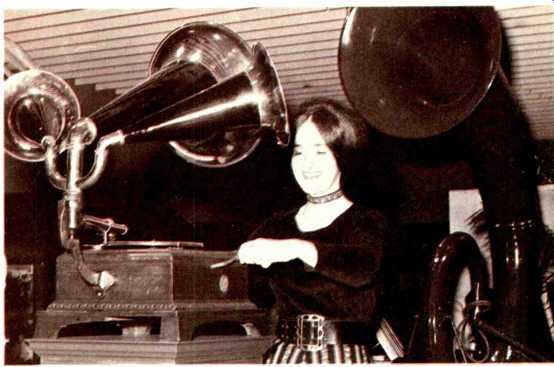
Several exhibitions of early reproducers (cylinder and disc) have been mounted in Europe in the last year or so. At the Royal Scottish Museum in Edinburgh, to celebrate the 1977 Edi son Centenary, a vast array of such models was shown. The accompanying picture shows the Triple-horn table gramophone supplied to the Amerixan Manufacturing Co. (of Hamburg, Germany). This type was not uncommon in Europe, particularly when fit ted for coin-slot operation. On the right can be seen the Auxetophone Gramophone, successfully developed by the Hon. (later Sir) Charles Parsons.
This early design dates back to 1903, and production models in 1906 employed compressed air through a special soundbox. This idea of modulating the compressed air "carrier" in a way analogous to normal speech had been outlined by Edison in his British Patent No. 1644. Several other machines of this type were invented by Pathe Orphone, Fortophon, Stentorphone and Mammut-Aerophon. These machines certainly amplified the sound, as I have heard, but were noisy in operation, due to the compressed air carrier.
As further indication of the current nostalgic interest in the record-playing systems of yesteryear, a new magazine has just been issued in the UK called Sounds Vintage. Due for bimonthly publication, this magazine will survey vintage wireless sets, acoustic gramophones, cylinder machines, works of the pioneers, and collector information. Published from 28 Chestwood Close, Billericay, Essex, England, this is not the first publication of this kind, as there are two long-established journals, Talking Machine Review (issued by the doyen of collectors, Ernie Bayly, of Bournemouth) and The Hillandale News, the official publication of The City of London Phonograph and Gramophone Society. Inaugurated in 1919, the society must be the oldest group devoted to this subject any where.
=========
ADs:
Onkyo
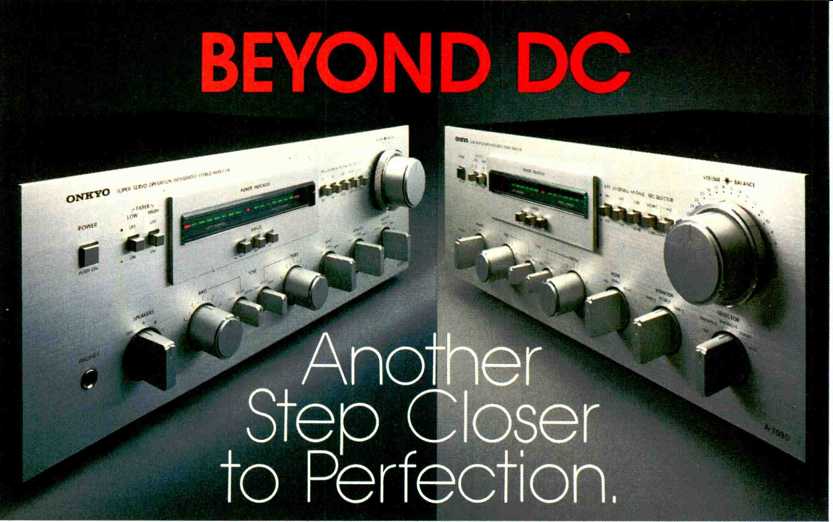
ONKYO'S EXCLUSIVE SUPER SERVO INTEGRATED AMPLIFIERS.
Just when you think audio technology's reached its peak, along comes Onkyo, making it even better. Our latest is an improvement on the superb performance of DC amplifiers.
Super-Servo circuitry--another Onkyo exclusive uses the extraordinary characteristics of operational amplifiers in a unique, negative feedback loop. Thus you get the benefits, particularly at the low (2Hz and below) frequencies not offered by other DC amps.
Going to DC amps was not the end. For Onkyo, it was the beginning.
While DC amplifiers increased bandwidth for better high frequency performance, spectrum analysis in Onkyo's labs found that very low frequency components below 2Hz, resulted from interactions with the amplifier's power supply. True, at 2Hz or less, you had to see it rather than hear it, but we felt that any unwanted component should be eliminated.
We did, the result was three-dimensional imaging such as you've never heard. Sound you won't hear in conventional amplifiers. Or in other DC amplifiers. Only in Onkyo's Super-Servo amplifiers.
You have a choice of three, Super-Servo Integrated Amps:
A-7040-50 watts per channel, minimum RMS at 8 ohms, both channels driven from 20-20,000Hz with no more than 0.026% THD.
A-7070-70 watts per channel, minimum RMS at 8 ohms, both channels driven from 20-20,000Hz with no more than 0.02% THD.
A-7090-110 watts per channel, minimum RMS at 8 ohms, both channels driven from 20-20,000Hz with no more than 0.018% THD.
Talking about power is only part of it. Onkyo's Peak Power Indicator is an array of LED's which light up according to power output per channel, from the very bottom to, and over the top... calibrated in watts at 8 ohms.
Of course you get everything else you'd expect from Onkyo. Multiple inputs and outputs. Total protective circuitry for speakers and amplifier. Human engineered control placement with sound-shaping noise and filters.
An immense, cool-running power supply.
Hear the brilliant audio quality of Super-Servo performance at your Onkyo dealer, or write for additional information. Super-Servo ...another example of how Onkyo stays a step ahead of state-of-the-art.
Artistry in Sound
ONKYO Eastern Office: 42-07 20th Avenue, Long Island City, NY 11105
(212) 728-2970
Midwest Office: 935 Sivert Drive, Wood Dale, IL 60191
(312) 595-2970
West Coast Distribution Center: Damark Industries, Inc. 20600 Nordhoff Street, Chatsworth. CA (213) 998-6501 Canada: Sole Distributor, Tri-Tel Industries, Ltd., Ontario, Canada
-------------
Dual
The problem maybe your tonearm. Not your amplifier or speakers.
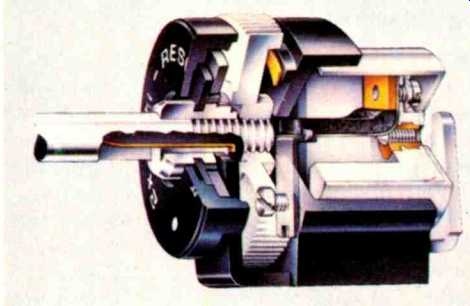
--------Cutaway view of anti-resonance counterbalance.
(A feature of Dual models 604, 621, 721 and 1246)
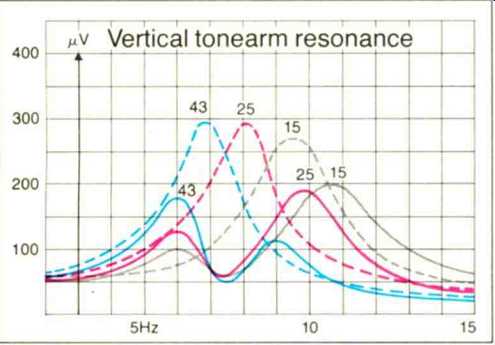
------ Solid lines show effectiveness of anti-resonance filters in damping resonant amplitudes of three different cartridges (compliance 15, 25 and 43 x 10^-6 cm/dyne). Broken lines show higher resonant amplitudes with conventional counterbalance.
If you've been wondering why your high-powered amplifier and great speaker system don't deliver deep bass as cleanly as you'd like--especially at high listening levels
-the problem may well be the effects of resonance on the stylus.
Ideally, the stylus should move only in response to the contours of the record groove. But in reality, the stylus tip also responds to various resonances: its own (with the stylus shank) and the combined resonance of the tonearm/cartridge system.
These subsonic frequencies, though inaudible in themselves, can have very audible effects. Especially with warped records. They can drain amplifier power and cause excessive movements of the low frequency driver. They can cause the tonearm to vibrate and even to momentarily leave the groove. All of which results in audible distortion.
Competent tonearm designers know all this and do their best with materials, masses and compliances to establish the inevitable resonances at the least harmful frequencies (usually between 8 and 10 Hz) and with the lowest possible amplitudes.
Dual's tonearm designers have taken a significant step beyond this.
The unique counterbalances of our direct-drive models (604, 621 and 721) and our top belt-drive multiple-play model (1246) contain two mechanical anti-resonance filters.
These are specially tuned to damp resonant energy in the tonearm/cartridge system and chassis.
The startling effectiveness of these filters in lowering the resonant amplitude of three cartridges having different compliances can be seen in the graph. Whether the improvement in the bass is subtle or obvious to you depends on the other components and your listening environment.
We've prepared a technical paper on this subject which we'll send to you if you write us directly. You may discover that you don't have to replace your amplifier or speakers after all.
For the life of your records.
United Audio, 120 So. Columbus Ave., Mt. Vernon, NY 10553. Dual
---------------------
Osawa
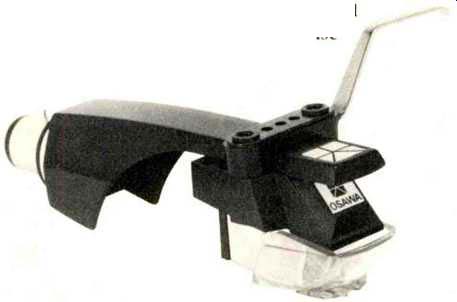
High technology lowers the price of high performance.
Introducing the new MP cartridge by Osawa.
With innovative engineering, Osawa has made superior cartridge performance affordable.

In the new MP cartridges, Osawa uses Permalloy to modulate the magnetic field generated by a cobalt magnet. This unique, lightweight, high-output combination ensures high signal-to-noise ratio and a freely moving stylus for perfect tracking of highly modulated grooves. You get clarity, frequency response and a dynamic range that only the most expensive cartridges can match.
The cantilever is perfectly formed (and made of carbon fiber in our top 300MP model) for high strength, low mass and uniform frequency transmission. It's supported in a special "Butyl" synthetic rubber damper to provide just enough restraint to keep the tip in the groove. Butyl is virtually unaffected by temperature and humidity, so your music won't change with the seasons.
The new Osawa MP cartridges are priced from $35 and up. So there's one for every budget. Each is available unmounted or conveniently pre-mounted in the unique Osawa Universal Head Shell. Visit your Osawa dealer for a complete demonstration. When you hear the MP perform, you won't believe the price.
Be sure to ask your dealer for a free copy of Osawa's "Consumer Guide to Phono Cartridges."
Or write directly to us.
OSAWA----OSAWA & CO. ( USA) INC./521 Fifth Avenue New York, N.Y. 10017/(212) 687-5535-9/TELEX: 236593
------------------
ortofon
The Concorde.


The reason for its name is obvious.
Less apparent is that the Concorde launches a new era in the reproduction of sound from records. A strong claim, but true.
Consider. The weight or mass of your phono cartridge as well as the "headshell" of the tonearm in which it is installed, is a most decisive factor in record wear and distortion.
Although the new Ortofon Concorde (shown actual size) combines a cartridge and headshell within a single form, it weighs less than most headshells alone! And since only low mass can respond adequately to record warp, the Concorde offers the best way to track every record--even those that are badly warped.
What about the cartridge of the Concorde? First, it weighs 1.5 grams.
That's 1.5 grams! Second, the cartridge operates on the variable magnetic shunt (VMS) principle. This patented system provides high separation and astonishingly low distortion (less than 1%!).
That's less than 1%! Quite obviously, the VMS design and unparalleled low mass, places Ortofon at the frontier of cartridge technology. The dividends it offers to those who love music and struggle to protect their records is incalculable.
We suggest that you contact us for complete information about the Concorde.
From Ortofon, 122 Dupont St., Plainview, N.Y. 11803.
----------------------
Shure
Revolutionary! Sound-shaping taping mike.
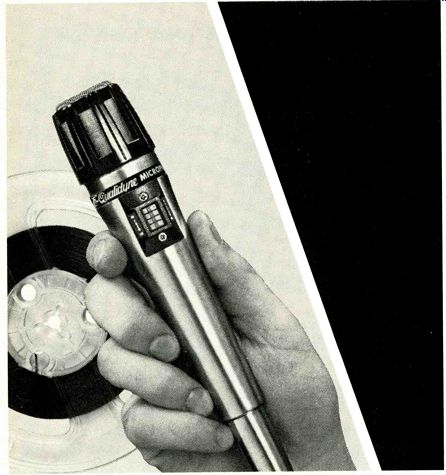
Never before-a single microphone that gives you the versatility of 16 microphones! Four tiny frequency filter switches built into the new Shure 516EQ E-Qualidyne Microphone let you tailor sound for studio effects in virtually any recording situation: flick a switch to add sizzle to vocals . . . flick another switch to highlight the sound of a bass drum. You can even compensate for the acoustic response of a room --right from the Microphone! In all, the 516EQ creates 16 different response variations that can add a new, professional sound to every tape you make. Available singly or in pairs for stereo recording. Ask to hear a recorded demonstration at your participating Shure dealer.

Shure Brothers Inc.
222 Hartrey Ave., Evanston, IL 60204
Manufacturers of high fidelity components, microphones, sound systems and related circuitry.
-------------------------
Sansui
Many amps can deliver pure sound.
The Sansui AU-919 delivers pure music.

Today's audio engineering has reached the point where you can select among a number of affordable high-power amplifiers that have virtually no "total harmonic distortion." That's good. But THD measurements only indicate an amplifier's response to a pure, continuously repeating, steady-state test signal (be low, left). They don't tell you how the amp responds to the never-repeating, rapidly-changing transient waveforms of real music (below, right. And only an amplifier designed to reproduce the demanding dynamics of music signals can satisfy the critical audiophile. An amp like the Sansui AU-919.
------SINE WAVE; DYNAMIC MUSIC SIGNALS
Because low THD without low TIM is like sound without music, the Sansui AU-919 is designed to respond well to both simple sine-wave test signals and also to handle the jagged, pulsive edges required for realistic reproduction of music without imparting that harsh, metallic quality known as "transient intermodulation distortion" (TIM).
The Sansui AU-919 sounds better than conventional amps because Sansui developed a unique (patent pending) circuit that is capable of achieving both low THD and low TIM simultaneously.

Our DD/DC (Diamond Differential/DC) circuitry provides the extremely high drive current necessary to use proper amounts of negative feedback to re duce conventionally-measured THD (no more than
0.008%, 5Hz-20,000Hz into 8 ohms at 100 watts, min. RMS: without compromising our extraordinary 200V/ASec slew rate, ensuring vanishingly-low TIM, as well. The power amplifier frequency response extends from zero Hz to 500,000Hz.
Shoe ultimate tonal quality depends on more than the power amplifier alone, Sansui also uses its DD/DC* circuitry in the phono equalizer section where current demands are also particularly high-to prevent TIM. ICL (input capacitorless) FET circuits are used throughout the AU-919, and a "jump switch" is provided that will let you run pure DC from the Aux. input to the output.
Visit your authorized Sansui dealer today, and he'll show you a lot more that the AU-919 has to offer. Like twin-detector protection circuitry and our Penta-Power Supply system. Two-deck monitoring/recording/dubbing facilities. And a high-performance ICL/FET pre-preamp for moving-coil cartridges.
Then listen to the AU-919 with the most demanding music you can find. You'll hear the way the music should sound. Like music. Not just like sound.
Diamond Differential, DC. Sansui’s (patent pending) totally symmetrical double-ended circuitry with eight transistors, is named for its Diamond-shaped schematic representation.
SANSUI ELECTRONICS CORP.
USA: Lyndhurst. New Jersey 07071; Gardena, Ca. 90247
Sansui Electric Co., Ltd., Tokyo, Japan Sansui Audio Europe S.A., Antwerp, Belgium In Canada. Electronic Distributors Sansui
---------------
Nikko
Dawn of a new age in separates.

The Nikko NA-590 Integrated Stereo Amplifier and the NT-790 AM/FM Stereo Tuner. We designed them specifically for those who want professional quality and the new low-profile look in a home stereo system.
There was a time when the only way to get a high quality sound system was to purchase expensive, bulky professional electronics. But now, Nikko delivers all the precision, accuracy, flexibility and reliability of professional components--at a reasonable price.
The NA-590 is both a low-distortion amplifier and a full-function pre-amplifier. It will drive most home loudspeakers accurately at comfortable listening levels. The NA-590 delivers 35 watts per channel, minimum RMS, both channels driven into 8 ohms 20 to 20,000 Hz with no more than 0.05% total harmonic distortion.

The NA-590 features a subsonic filter to reduce distortion caused by turntable rumble or warped records, loudness contour, a professional-type attenuated volume control, and exclusive Nikko protection circuit breakers. Its LED function indicators, ultra-thin styling and professional appearance will be at home in any listening environment.
The NT-790 AM/FM Stereo Tuner utilizes Nikko sophisticated circuitry, plus LED tuning indicators, FM high blend (to eliminate background hiss), and T-Locked FM automatic fine tuning for low distortion, high signal stability and wide frequency response with excellent stereo separation.
The NT-790 also features professional matte finish, ultra-thin profile and optional kit for rack mounting.
The NA-590 and NT-790: excellent stereo sound made simple, at a cost you can't afford to pass up. See them, as well as the complete line of Nikko separates, at your Nikko Audio dealer. Write for complete in formation and specifications, or call toll-free (800) 423-2994 for the name of your nearest Nikko dealer.
Nikko Electric Corp. of America 16270 Raymer St., Van Nuys, CA 91406 (213) 988-0105 320 Oser Ave., Haupauge, N.Y. 11787 (516) 231-8181
In Canada: Superior Electronics, Inc.
Nikko Audio For those who take their stereo seriously.
---------------
Discwasher

DISCWASHER presents
The Clean Truth About Your Naked Stylus When your stylus plays over one light fingerprint or one tiny "bead" of vinyl stabilizer, the clean naked diamond becomes a glazed, dust-holding abrasive weapon wearing away at your records and masking their true sound.
This unseen build-up may actually hold the tracking tip of the diamond out of the record groove.
----Accumulated grit on stylus that looks "clean" to the naked eye.
The SC-1 Stylus Cleaner from Discwasher is designed with a brush that is stiff enough to remove harmful accumulation, but gentle enough to avoid damaging delicate cartridge assemblies. Two drops of Discwasher's D3 Fluid add extra cleaning action to the SC-1 without the side-effects of alcohol, which can harden rubber cantilever mountings.
------ After cleaning with SC-1 and D3 Fluid by Discwasher.
The retractable, walnut-handled SC 1 includes a magnifying mirror for convenient inspection of stylus/cartridge alignment and wiring.
Get the clean truth from your records: get the SC-1.
SC-1 STYLUS CLEANER
discwasher, inc.
1407 N Providence Rd Columbia. MO 65201
----------------------
Pioneer
THE STRUGGLE BETWEEN THE CLASSES IS OVER.

For years people have clashed over which amplifiers are best. Class A or Class B.
Expensive Non-switching Class A amplifiers are known to offer the lowest levels of distortion. At the same time, they also offer the highest operating temperatures.
And while Switching Class B amplifiers increase efficiency, they also increase distortion.
So if you're not paying through the nose for a heat-producing Class A amplifier, you'll be paying through the ear for a distortion-producing Class B.
At Pioneer, we believe most of today's Class A and Class B amplifiers are pretty much in the same class. The class below Pioneer's SA 9800.
---- CLASS A AMPLIFIER.
LEAST DISTORTION BUT MOST HEAT.
CLASS B AMPLIFER.
MOST DISTORTION BUT LESS HEAT.
------------ SA-9800.
LESS D STORTION, LESS HEAT, AND MORE POWER.
Pioneer's Non-switching SA 9800 offers the efficiency found in the finest Class B amplifiers.
With a distortion level found in the finest Class A. An unheard of 0.005% at 10-20,000 hertz.
And while you're certain to find conventional power transistors in most conventional amplifiers, you won't find them in the SA 9800. You'll find specially developed RET (Ring Emitter Transistors) transistors that greatly increase frequency response. So instead of getting distortion at high frequencies, you get clean clear sound. Nothing more. Nothing less.
Instead of slow-to-react VU meters that give you average readings or more sophisticated LED's that give you limited resolution, the SA 9800 offers a Fluroscan metering system that is so fast and so precise it instantaneously follows every peak in the power to make sure you're never bothered by overload or clipping distortion.
And while most amplifiers try to impress you with all the things they do, the SA 9800 can even impress you with the one thing it simply doesn't do. It doesn't add anything to the sound it reproduces. An impressive 110dB S/N ratio is proof of it.
While these features alone are enough to outclass most popular amplifiers, the SA 9800 also offers features like DC phono and equalizer sections and DC flat and power amps that eliminate phase and transient distortion. Cartridge load selectors that let you get the most out of every cartridge. And independent left and right channel power supplies.
Obviously, it took revolutionary technology to build the SA 9800. But the same technology and skillful engineering that went into the SA 9800 also goes into every amplifier in Pioneer's new series.
At Pioneer, we're certain that others will soon be entering the class of 9800. And though they all may be built along similar lines, in terms of value Pioneer will always be in a class by itself.
AND SO IS THE FIGHT ABOUT TUNERS.
At one time the struggle between amplifiers was won by the amp that had the most muscle. And the tuner that brought in the most stations also brought in the most acclaim.
Today, there's one series of amplifiers whose technology has put it in a class by itself. And now, with Pioneer's new TX 9800 tuner it's met its match.
While other tuners offer features that just sound great, every feature in Pioneer's TX 9800 helps to produce great sound.
Unlike ordinary tuners that are content with ordinary circuitry, the TX 9800 has a new Quadrature Discriminator Transformer that works with Pioneer's exclusive PA 3001-A integrated circuit to reduce distortion to 0.05% at 1 KHz and raise the signal-to-noise ratio to 83 dB. Whew! Many of today's tuners use sophisticated low pass filters to remove the 19 KHz pilot signal that's present in every stereo broadcast. But while they're effective in removing the pilot signal, they're also effective in removing some of the music.
The TX 9800 has Automatic Pilot Cancel ling Circuitry that makes sure every part of the music is heard all of the time. And that distortion is veritably unheard of.
-------- SIGNAL STRENGTH AND CENTER TUNING METERS FOR A DRIFT-FREE PERFORMANCE.
INSTANTANEOUS FLUROSCAN METERING THAT LETS YOU WATCH EVERY PERFORMANCE WHILE YOU HEAR IT.
The crowning achievement of most tuners today is the sensitivity of their front end. And though it's much to their credit to bring in weak stations, it means nothing unless they can do it without spurious noise or other interference.
The TX 9800's front end has three dual gate MOSFET's that work with our five gang variable capacitator to give you an FM sensitivity of 8.8 dBf. And also make sure that your favorite music is not disturbed by what's playing elsewhere on the dial.
And while most tuners today give you one bandwidth for all FM stations, the TX 9800 gives you two. For both AM and FM. A wide band that lets you bring in strong stations loud and clear. And a narrow one that finds even the weakest station on a crowded dial and brings it in without any interference.
All told, these scientific innovations sound mighty impressive. But they wouldn't sound like much without an even more impressive tuning system.
The TX 9800 has a specially designed Quartz Sampling Lock Tuning System, that fortunately, is a lot easier to operate than pronounce.
Simply rotate the tuning dial to your desired station. When the station is tuned exactly right a "tune" light comes on. By releasing the tuning dial you automatically lock onto that broadcast. And automatically eliminate FM drift.
By now, it must be obvious that the same thinking that went into Pioneer's new amplifiers has also gone into their new line of tuners.
So just as Pioneer ended the class struggle between amps, they won the fight between tuners. With a technical knockout.
We bring it back alive.
1978. U S. Pioneer Electronics Corp High Fidelity Components. 85 Oxford Drive, Moonachie, N.I.07074.
--------------
=========
= = = =