by Edward Tatnall Canby
Time delay! It's the latest thing in listening, though it's been around ever since our recording engineers and broadcasters discovered ambience, via the new microphone, back in the earliest 1930s. Now, delay is digital and for home consumption, direct and to choice, which makes things much more interesting and up to date.
Several years back I reacted with great vigor, as they say, to my first all out experience with this new kind of home facility, the Audio Pulse system--not only for what it could do to astonish the ear via perfectly normal recordings of familiar sorts, but because it also so clearly implied an important change in recording (and broadcast) technique, whereby the producer could no longer control the effects of space and size and ambience in which his music was to be heard in the home.
Since Audio Pulse, there has been the ADS 10 system, which supplies you with everything from built-in 100-watt amps to a second pair of speakers. I've been chafing to try this big system for more than a year but meanwhile, that sober and highly innovative firm, Ad vent Corporation, has produced a more basic digital delay unit for home listening, and it is that one which now adorns my living room, if not quite in the manner Advent intended, as you will shortly see.
Maybe you thought that by this time I must have reverted from four channels back to a solid stereo pair, like al most everybody around. Not so, and I wouldn't actually need the extra gear that ADS so conveniently supplies. A while back, in fact, I beefed up my system by setting out pairs of speakers for each channel, matched, right around the room. Now, prompted by Advent, I've brought in even more-six channels. Everything I had before plus Ad vent too. Works like a charm. After all, if Advent and the others require an upgrade from two to four, then why not from four to six? It took me awhile, I'll admit, to reach that staggering conclusion. But it turned out to be a good answer.
Speaker Saver
As a matter of fact, in case you are one of those who hang on to your old speakers instead of trading them in (how I wish I hadn't sold my Model A Ford for $200 about 1935...), I just made a count and discover that I have no less than 17 speaker systems right now in my living room, and 10 of them actually working. Not to mention the tube-type Motorola AM radio on the table. The silent ones are oldies, dead heading, serving out their time as convenient tables and stands here and there. Most of them could be fired up in an emergency if needed. Nothing very fancy here, you understand--but there's safety in numbers. Just look at the high-priced speaker spreads, all full of multiple woofs and tweets in a single expensive package. Same with me, only separate.
The reason I can still walk around is that these units are stacked up in vertical columns a' la AR 9, two active speakers, one above the other, and sit ting on a third, a silent support, old but sturdy. You'd be surprised how easily these tall, thinnish columns blend into the interior landscape, especially the newer active speakers with those inconspicuous black grilles.
Very great economy of space, I can tell you.
In the back corners, wide apart, I have two of these columns, reaching high so they shoot over my head as I listen. Corner placement helps bass.
Up front are two more identical columns in stereo position, these without the deadhead support and lower down. Floor helps bass. That's 10 units, eight of them active and playing four channels. Now I've added channels 5 and 6, an ad hoc arrangement that just might become permanent. At left middle is another slim column of three speakers, only the top one active, and across the room to the right is its mate standing on top of my equipment cabinet at the same height. All in all, this addition has removed about one more square foot of living room space.
All of these speakers, you must note, are either in matched pairs, or fours.
Necessary if you want sonic stability, whether in six channels or two.
Now about these six channels.
When the Advent Sound Space Control arrived I began with the thought of setting it up just as indicated, two stereo speakers in front and two more for the delay somewhere between the sides and the back, for best effect. The unit passes the "front" signal straight through and adds its subtly variable delay processing to the second set of speakers to make a surround effect.
The back (or side) channels, then, contain all the digitized information in two basic parameters, the length of delay, translating into simulated room size, and the "die-away" or reverb time, which simulates the degree of liveness or deadness in the synthesized space. Both, of course, are abundantly and usefully variable via the controls, as is the volume level of the delayed signals in respect to the front.
Since I had my four channels all set up already, my first thought was simply to disconnect my enhance/logic equipment and reconnect my four channels to Advent's specs. What else? So I did. And I was in business, technically speaking.
But here the argument became confused. Now wait-a-minit, I muttered, this isn't right. I am notcom paring the sound of a stereo system to the same with Advent added, which is obviously the intention. Instead, I am comparing two quite radically different means for making use of a full four channels already in situ, installed and operable. Interesting, but-. Moreover, there was no way I could figure to make even this comparison in AB form. In order to install Advent I had to remove the other stuff. So it would be a four-way memory comparison at best--how does this new synthesized digital delay ambience compare with the variable decode-with-logic sound I have been hearing through the selfsame amps and the same four channels of speakers?
Distribution Differences
I think it is important to get straight right here the really profound difference between these two approaches to the same thing. The decode/enhance logic system, via any of the various matrices and the differing logic circuits, once or still available, distributes sound differently to each of the four channels with more or less directional sensitivity, according to clues, mostly phasing and volume differences, that are built into the recording itself. Whether these are controlled by deliberate coding or are casual and random--the delayed reflections of actual room sound and placement as captured in stereo- the principle is the same. The decoders, all decoders, tend to separate the delayed ambience reflections from the direct signals and variably to distribute these around your speaker array, both front and back. There are many formulas for this and, as we remember, even more heated arguments as to which is right and best- no matter. (If you have a choice, you are in the clear.) The principle remains good and useful today.
Those random decoded differences between your four channels, or the deliberately coded differences, do in deed provide a very real and natural sense of room or hall space, not at all unrelated to the original.
The digital delay principle also distributes carefully chosen "reflections" and randomized die-away reverb to your surrounding speakers, for a similar effect of room space and liveness.
But here the idea is altogether different. The delays do not occur at the point of recording- they are created in your living room, out of the whole signal in its stereo form. Thanks to the sophistication- and complication--of current digital circuitry you have very sophisticated controls over the effect, changeable at will. Unlike that of the decode/enhance space, this one can be radically altered in an arbitrary manner. But you are leaving the re cording technician out of the picture! Or you can, if you wish to, ignore him.
You can create a grotesque cathedral sound where the producer had thought of a modest concert hall.
Should you? No law against it, of course.
Synthetic Space What I noticed in my earlier experience with Audio Pulse- not in my own living room- was just this extraordinary versatility, fooling the ears into hearing spaces that were totally synthetic. Crazy! Wonderful. Often grotesque. (That system was operating in six channels as I listened.) With the more circumspect Advent machinery, set up in the very familiar circum stances of my home living room, I noticed right away that here you must be careful. This is NOT a natural ambience. Yet it must not sound synthetic--not, at least, for any sort of extended listening. The built-in ambience of the recording, remember, is still a part of the signal. The recording has its own intended space, large or small, near or distant, live or dead. Out of this, we are building something further. It must be done with reasonable thought, unless we want pure stunt sound. I am quite sure that this is Advent's philosophy and, in the long run, it is good.
On the Advent unit there are indeed a brace of well-mannered controls for the synthesizing. A large variation in the delay time, from 0 to 99 milli seconds in bright red display numbers.
You flip a switch and the numbers race forward or back as the apparent room size gets bigger or smaller. Oddly, al ways one millisecond too low (as if that could matter to you and me!): the maximum is 100 milliseconds at 99 on the display. Decay time, i.e. reverberation time, is controlled by a simple volume-type knob, short to long, making your synthesized space either deadish or liveish as though 20 tons of sound padding were being put down or removed with two fingers. You can also set what I might call the degree of obtrusiveness via a back-channels volume control, which I found vital. Too much is too much when it is overly loud. You can get an optimum balance via a "direct" position, no processing, the same signals in front and in the added speakers, and Advent's directions here are excellent in detail. You can monitor at three choices of input sensitivity via flashing level and over load signals for each delayed channel.
(They indicate a considerable and, no doubt, carefully randomized cross-channel digitalization, an important aid to naturalness.) And yet- I floundered. At first I got all sorts of unpleasant and artificial twangs and buzzes and metallic surges out of the delay speakers. And there was that nasty "door-spring" effect, right out of the early and relatively crude spring-actuated mechanical de lay units! I was pushing too hard. (I had at least to try the stunt aspect.) No go. This Advent, emphatically, is not a stunt machine. It was several days be fore I got over this initial discouragement, for even my first comparisons with a more sober approach were not favorable. I missed the solid, if less controllable, ambience of my regular decode/enhance arrangements, minus all door-springs.
Hang on! I'm not finished yet. When you change brands of car, doesn't the new one often seem pretty cranky, until you get the hang of it? What I learned is, I think, fundamental. In this synthesizing business we need not only moderation but respect. We do have an already built-in and intended effect of delayed sound on every record. Advent can profitably enhance that effect, if you will just listen first, and act accordingly.
To convert a dead studio sound into a cathedral roar is fun but silly. It sounds fake. The Advent really won't take it, though it tries. The machine under this provocation goes into twangs and buzzes at the slightest pop or click or sudden transient and the door-spring sound is always just around the corner. Avoid it! When used properly, all this disappears and the Advent is docile as a lamb. In a word, you enhance what is on your record, you do not change it into something it isn't.
Added Ambience As soon as this dawned on me I knew what to do and Advent's instructions backed me up. Switch the delay channels to DIRECT, or to OFF. And listen to the recording as it is. Get the producer's intention. Then flip back and adjust delay and reverb to suit what you have heard, maybe adding just a bit of extra size and ambience.
There is flexibility, if you understand.
Fairly intimate chamber music (or jazz and pop the same) will not take more than 30 or 40 milliseconds on the delay readout. Most concert music does well from 50 to 75. Reverb (decay time) to taste, but usually no more than half way to maximum. And the whole at a lowish, unobtrusive volume- this is room sound, not the main direct message. Some of the more spectacular recordings, big orchestra and chorus, organ recital, will take up to 90 milli seconds and more--not many! Mostly you must cleave to the original, whatever, and interpret it. That's the whole idea.
Six channels? One night I started thinking. Advent doesn't operate on the regular front channels, the normal stereo sound. So why not hook up both systems simultaneously, taking advantage of an Advent tip that the best place for delay speakers is often at the sides rather than in back. Perfect! Feed the Advent delay into a fifth and sixth channel set up just that way, at the sides. Use the stereo feed-through, or the second main output on my versatile preamp control unit, to feed the decode/enhance equipment as before and so on into the original four channels front and back. The rest is merely switching. Next day the whole thing was done in minutes.
Now I have the advantages of both approaches combined. More than that, I can make any "A-B" test comparison you could possibly want at the push of a button or flip of a toggle. For instance- flip off Advent's delay and you have my old four-way system exactly as it was. Then push "2 CH" on the decode/enhance unit and there's straight two-channel stereo in front only. Flip Advent back on again and I have Advent-only sound, exactly as recommended by the manufacturer, via front and side speakers. Finally, push any of the three decode/enhance buttons and I get full six-channel sound, combining both systems, with variables to taste and all over the place. As they said in the sixties, it's a gas.
I find that in the six-way mode Ad vent works just as it does in four, to widen and open out the matrix-decoded ambience already in the recording and so further enhance the recorded message. Same rules apply, and this is as it should be. All in all, this thin black box with the red flashing numbers is a very useful, high-level gadget to have around.
(Audio magazine, Jun 1979; Edward Tatnall Canby )
============
Vintage magazine ADs:
Celestion
When you Test-drive the best speakers from Britain you'll drive home with real sound.
You're a confirmed audiophile and nobody can fool you with a lot of promises.
You're ready for the ultimate test and only your ear will be convinced.
When you test-drive the best from Britain we know we'll have your ear and maybe a lot more.
When you're ready, take a variety of recorded music into your dealers. (Use direct disc recordings so you can put our speakers to the real test.) We know you'll be amazed at the accuracy.
And we'll have turned another confirmed audiophile into a dedicated Anglophile.
We've been convincing lovers of sound in Britain for over half a century.
And we've earned our reputation as the leader by not compromising.
We don't rely on gimmicks. Every speaker in our completely new line of systems is based on sound engineering principles and tested thoroughly.
As you know, with everything in audio, it's the end result that counts, not the means to get there.
But we don't neglect the means either. To get your ear, we use our English craftsman's pride in carefully putting together the right components for delivering a broad range of sound smoothly and uniformly so you get the flattest response possible.
When you take a look at the specs you'll see what we mean.
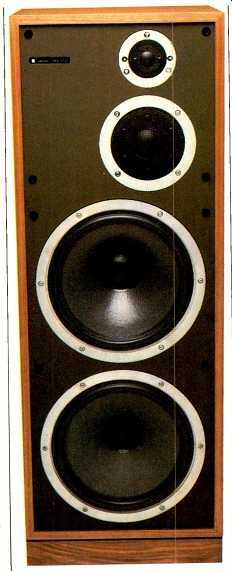
We've shown the Ditton 662, but all three new Ditton speakers, besides being technologically superb and precision engineered, are beautifully styled and assembled in the fine English cabinet making tradition, to fit into any decor.
And we've used a completely different design concept for each of them to satisfy your individual taste and budget.
So now that you've grown up to real sound, you can test-drive your choice of the best sound from Britain.
But you won't be able to find them at just any dealer. For our select list of shopkeepers who carry Celestion, simply drop us the coupon and we'll send you the list by return post.
But don't delay, the traffic may be heavy.
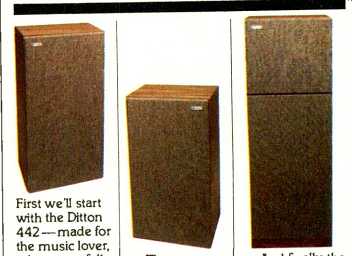
First, we'll start with the Ditton 442-made for the music lover, who wants full bass sound.
Large presentation for hi power system.
Sealed box design--inside, a second sealed infinite transmission line en closure for the mid-range unit.
Drive units: FC 121, 330 mm bass unit with 46 mm voice coil.
FC 61, 130 mm mid -range with 25 mm voice coil.
HF 2001 treble unit with 19 mm voice coil.
Controlled by 14 element dividing network with fuse protection for the treble unit. What you get is less restriction, overall balance openness with no coloration.
Then move up to the Ditton 551
For outstanding dispersion--tight sound.
A vented box design with improved bass response from a smaller bass unit.
Drive units: PC 101, 290 mm bass unit with 50 mm voice coil.
MD 701 mid -range with 46 mm voice coil.
HF 2001 treble unit with 19 mm voice coil.
Controlled by 15 element network with fuse protection and failure light for the treble unit.
Also level controls for treble and mid-range up to 2 dB boost and 6 dB cut.
And finally, the top of the line, the Ditton 662.
Our passive radiator (ABR) system gives solid bass, smooth response and dispersion, and stereo imaging.
Use with all power amplifiers.
Has 3 active drive units and passive radiator.
Drive units: FC 122 bass unit, 330 mm passive with double suspension for pure axial movement.
MD 501 mid range with 52 mm voice coil.
HF 2001 treble unit with 19 mm voice coil.
Controlled by 14 element network with fuse protection for treble unit.
Celestion.
Nobody sounds better than the British.
----------
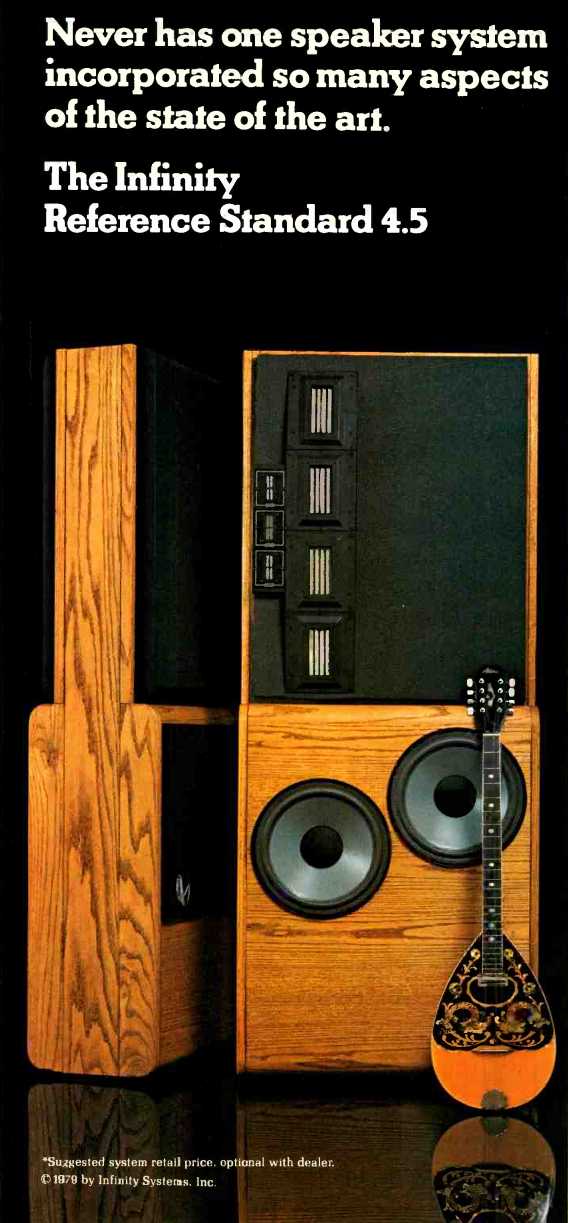
Never has one speaker system incorporated so many aspects of the state of the art.
The Infinity Reference Standard 4.5
This is a system of breathtaking clarity and detail, yet capable of the awesome punch and power demanded by the finest contemporary digital and direct-to-disc recordings.
The Reference Standard 4.5 frees the intimate warmth of the human voice, the robust sheen of the strings, the fiery attack of the brass, the stab and snap of the bass. The speakers seem to disappear, revealing a concert stage breathing life, delicacy and fury. You hear the musicians, not the speakers.
How does the 4.5 work its musical miraoles? The profoundly accurate bass and midbass are partly the result of a remarkable new cone material, poly propylene. It has dramatically less mass, yet significantly greater internal damping than paper cones or other exotic materials. Our polypropylene piston, combined with our exclusive Infinity/Watkins dual-voice-coil woofer principle creates bass frequencies with the snap and definition of the finest dipoles, yet retains the ultra-low frequency response (flat to 23 Hz) that has made Infinity famous.
The transparent crystalline treble issues from our world-acclaimed EMIT tweeters in dipole array.
Midrange warmth, smoothness and unprecedented definition are the progeny of our lustrous new dipole EMIM Electromagnetic Induction Midranges.
Like the EMITs, they employ powerful magnets of rare-earth samarium cobalt and etched voice-coils on low-mass diaphragms.
A separate electronic crossover/ equalization unit allows you control over variable source material and room anomalies, either in single or bi-amp mode.
A remarkable technological story.
And like all great stories, this one ends where it began: with the music. Which is the real reason you should spend $3000` on the Infinity state-of-the-art Reference Standard 4.5.
Infinity.
We get you back to what it's all about. Music.
For the nearest dealer's name and address, phone toll-free 800-423-5244, or, from California. 800-382-3372.
*Suggested system retail price, optional with dealer.
1979 by Infinity Systems. Inc.
---------------
Maxell
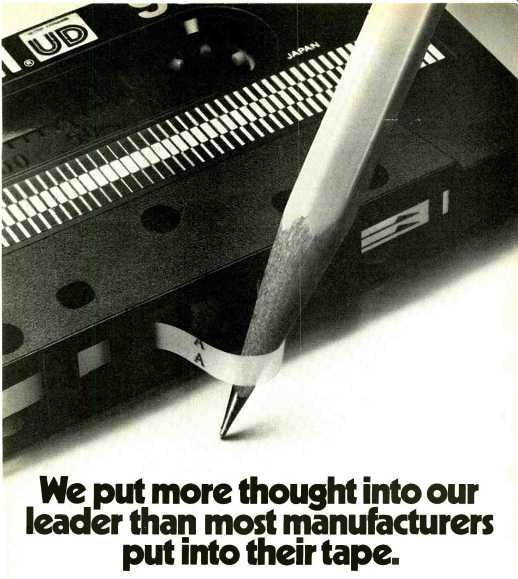

We put more thought into our leader than most manufacturers put into their tape.
One of the reasons Maxell has such a great following is because of our leader.
It has a built-in non-abrasive head cleaner designed to remove the oxide residue other tapes leave behind, without damaging your tape heads.
It also points out what side of the tape you're on (A or B) as well as which direction the tape is traveling. So it's almost impossible to make a mistake.
It even gives you a five second cueing mark, so you can set your recording levels without wasting tape. Or time.
Obviously, all the thought that went into our leader was designed to help you get more out of our tape.
So if you thank our leader sounds impressive, wait till you hear what follows it.
----------------
THE B&W DM2/II.
A CLASSIC IN EVOLUTION.

Despite the almost daily claims of revolutionary breakthroughs, loudspeaker design is basically an evolutionary process.
A systematic, step by step exploration of new ideas, materials and measurement techniques.
Consider the new B&W DM2/II, for example. When its predecessor, the original DM2, was introduced several years ago, it was widely acclaimed as a classic of impeccable design and outstanding performance.
In pursuit of excellence.
Since that time, however, B&W's unparalleled research and development program has yielded new and fascinating insights into virtually every aspect of speaker design and performance.
From these uniquely innovative studies has emerged a completely new design of surpassing accuracy, the B&W DM2/II.
Each driver of the DM2/II has been designed for exceptionally smooth response over its entire operating range. The crossover is a computer calculated nineteen element network employing true third order Butterworth filters that result in significantly lower intermodulation distortion and exceptional phase and amplitude characteristics. Indeed, the DM2/II comes very close to attaining that most illusive of all speaker qualities, an apparently seamless transition from driver to driver.
Listening. The final proof.
Listening B&W DM2/II is, quite simply, a revelation. It produces completely natural, uncolored sound of extraordinary clarity and depth.
Moreover, its modest size and elegant appearance permit advantageous placement in almost any listening area.
As with all B&W loudspeakers, each DM2/II is individually tested and shipped with its own proof of performance chart recording.
However, the ultimate proof of performance is in the listening. Your B&W dealer invites you to audition this classic contribution to the evolution of speaker technology and decide for yourself.
For additional information write:
Anglo-American Audio Co., Inc., P.O. Box 653, Buffalo, N.Y. 14240.
In Canada: Remcron Electronics Ltd.
B&W Loudspeakers.
The next step up.
------------
TDK
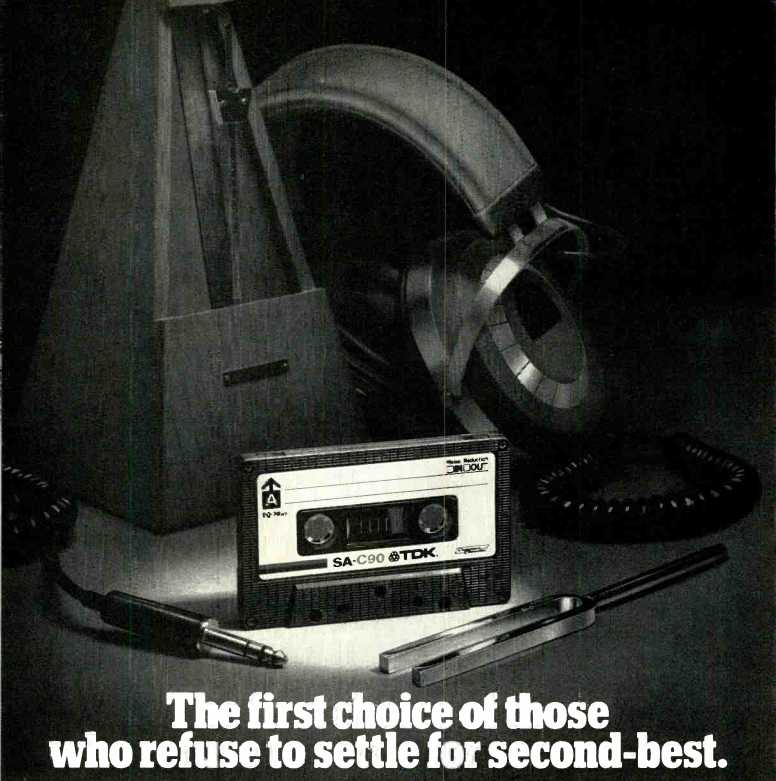
The first choice of those who refuse to settle for second-best.
The true audio perfectionists are those who demand state-of-the-art performance from every part of their system.
For these trend setters, second-best just won't do.

At TDK we consider ourselves perfectionists, too, so it's gratifying to know that TDK SA is the number one selling cassette to these critical listeners.
Perfectionists demand the best possible sound quality. SA is the high bias reference standard; most quality manufacturers set up their decks in the factory to sound best with SA.
Perfectionists appreciate technological superiority. SA's advanced cobalt-adsorbed gamma-ferric oxide particle formulation made it the world's first non-chrome high bias cassette. And many parts of its super precision mechanism, such as its double hub clamp and bubble surface liner sheet have yet to be equaled.
Perfectionists insist on reliability, and they know that TDK was first with a full lifetime warranty*-more than 10 years ago.
You may not be an audio perfectionist; you may not be able to afford an ultimate, cost-no-object stereo system. But it's comforting to know you can get better performance from your present system by using the tape you'd buy even if you had a million to spend—TDK SA. TDK Electronics Corp., Garden City, New York 11530.
* In the unlikely event that any TDK cassette ever fails--to perform due to a defect in materials or workmanship, simply return it to your local dealer or to TDK for a free replacement.
TDK The machine for your machine.
----------------
Jensen
Kevin Cronin listened to us.
He writes, sings and produces with REO Speedwagon.
He listened to the group's latest recording on our new System B.
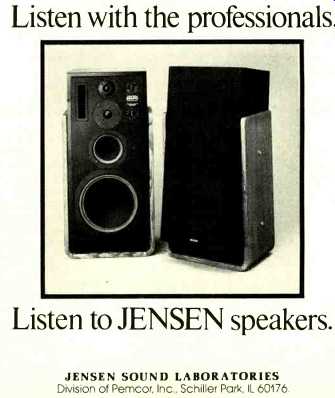
The System B is a vented 4 way, 5 driver loudspeaker system.
Here's what he said.
"I know exactly what's on the record so if there's anything missing, if there's anything these speakers weren't producing, I'd be the first one to fall off my chair. But I hear everything”. That's because we've gone to great lengths to minimize distortion. The System B reproduces the highest and the lowest frequencies of music with amazing accuracy and clarity.
To minimize distortion, we have painstakingly designed each individual mid and high frequency driver so that greater clarity is possible.
What's more, we've carefully selected each crossover frequency to subjugate driver resonance below critical crossover points. That completely eliminates distortion in the crossover regions.
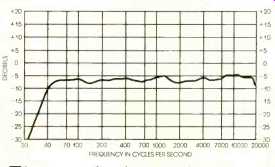
------- graph
The graph shows the acoustic power output of the System B. As you can see, the System B has an incredibly uniform acoustic power output. The result is music that is clearly defined and accurate.
And it doesn't take a high powered amplifier to bring a loud-as-life performance of your favorite artists, either.
That's because System B blends extremely efficient drivers with a vented enclosure. This makes it possible to produce relatively high levels of music with minimal power input.
At the same time, System B has the power handling capability to produce an incredible 115 dB of sound pressure at its 150 watt rating.
We can't go into all the details of this amazing sound system in this ad.
That's why you should go to your audio dealer for a demonstration.
Your ears are the ultimate test.
But here's one more observation by Kevin Cronin, a professional musician and producer.
"I spent six months making this record, so as far as it being on the vinyl it is there and I hear everything through the speakers:” Listen to our speakers in person.
Kevin Cronin did.
Listen with the professionals.
Listen to JENSEN speakers.
JENSEN SOUND LABORATORIES
Division of Pemcor, Inc., Schiller Park, IL 60176.
-------------------
The revolutionary new AIWA AD-6700 put metal-particle tape through its paces.
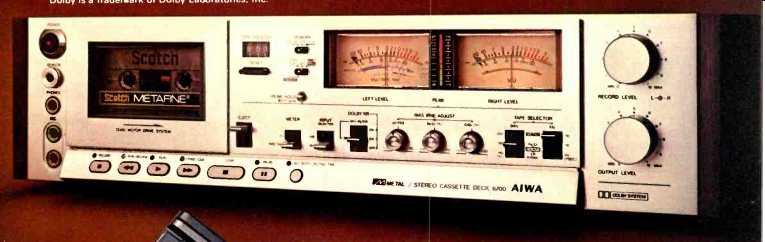
Now there's a cassette deck designed to realize all the potential sound improvement that metal-particle tape can offer: the revolutionary new AIWA AD-6700. With the impressively broader frequency response and increased dynamic range that rival even today's most advanced reel-to-reels.
AIWA designed it that way to make a breathtaking difference in the way you listen. There's a Sendust Guard Head with extended 1.3 micron gap for optimum recording, AIWA's double-gap Ferrite erase head and an improved erase circuit to meet the increased power demands of metal-particle tape.
But the extraordinary performance of the AIWA AD-6700 doesn't stop with just metal-particle tape.
AIWA's own precision Bias Fine Adjustment System lets you select the proper bias for every tape formulation available today with just a twist of the dial. So every tape you play gives a flat response.
The AIWA AD-6700 makes distortion-free recording a cinch, with an amazingly accurate system of sensitive LEDs that instantly respond to peak signal level AIWA's system boasts a highly visible three-color display to help you record a safe level every time. Peak Hold facility is also included.
For are free listening, there's a convenient Auto/ Repeat with Memory Switch that lets you replay the complete side of a tape--or just the portion of it you most want to hear.
And with AIWA's exclusive "3-Minute Warning" Remaining Tape Time Meter you'll never worry again about running out of tape. All you do is check the left meter.
Wow and flutter have been reduced to an out standing 0.04% (WRMS). And there's Dolby" NR with MPX Filter.
As special limited introductory offer, every AIWA AD-6 AD-6700 comes with one free cassette of the Metafine Pure Tape. Now what metal-particle tape can do, the new AIWA 700 makes it do better.
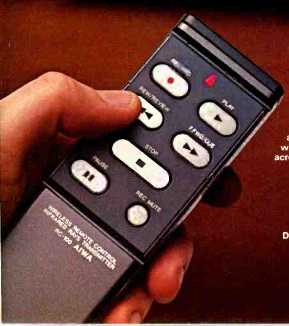
-----------With full-function wireless remote control.
Advanced feather-touch logic controls make the AIWA AD-6700 a pleasure to operate. Plus it's the first cassette deck in the world with full-function wireless remote control that includes the extra freedom of Cue and Review-even from across tie room) So anything the AIWA AD-6700 does, you can do in the palm of your hand.
-------------
Cleaning your records is only half the battle.
What do you suppose happens when the hardest substance found in nature-diamond-is dragged through the soft, intricate vinyl canyons of a phonograph record at a force which produces acceleration that exceeds 1000 G's!
Friction and wear.
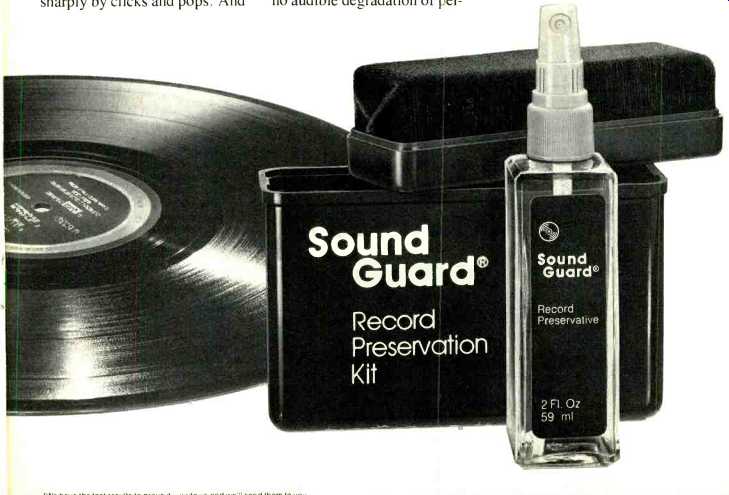
From the very first time you play a record, a process of decay takes place. The delicate high frequency sounds are the first to be impaired. Then the midrange. With every play details are lost and noise becomes more pronounced, eventually rising to a hailstorm often punctuated sharply by clicks and pops. And the better your equipment, the more annoying the disturbance.
Regular cleaning of your records is important and necessary-to remove the dust and oily films that can further mar performance--but it's simply not enough.
The best way to preserve the music on your records is Sound Guard' Record Preservative.
Sound Guard is a revolutionary dry lubricant that virtually eliminates record wear. It's so thin that it will not affect the sound of a new record. It's so effective that a treated record may be played 100 times with no audible degradation of performance or increase in surface noise.' A built-in anti-static property helps keep dust off your records between cleanings.
It's true that it requires a little extra effort and expense to protect your records with Sound Guard. But when you add up the investment you've made in your stereo system and record collection, you really can't afford not to do it.
Sound Guard--Everything else is a lot of noise.
Sound Guard preservative--Sound Guard cleaner
Sound Guard--Total Record Care System.
Sound Guard is Ball Corporation's registered trademark.
Copyright © Ball Corporation, 1979, Muncie, IN 47302
---------------------
= = = =