Holes, Hardware and Hearing -- Can a low-fi mindset miss some beauties?
WE would LIKE to amplify and extend some of the ideas on the psychoacoustics of sound localization presented by Dennis Bayzer (744 1/76, p.34, and 3/78, p. 22). As he states, the major issue in the mechanics of realistic reproduction of auditory space might not be the number of information channels but rather the geometry of the transducers.
Not even an infinite number of record/playback channels (as symbolized in Fig. 1 by a “porous wall ” between the sound source and the listener) would preserve and reproduce the original sound field if the record and playback transducers (i.e., microphones and loudspeakers) do not provide the equivalent of “perfect holes. ” A perfect hole is represented in Fig. 2a. Imagine a piece of acoustic information moving along the solid-line trajectory; in passing through the perfect hole none of its properties including the angular information that specifies its direction of origin is lost or modified.
Thus the solid and dotted-line vectors, representing two different directions of origin, are as distinguishable after passing through the perfect hole as before.
(Note: don't be troubled by the use of vectors to represent waves-a vector passing through a single perfect hole implies that the total geometry of an expanding wavefront is preserved in passing through an infinite number of perfect holes.) But look at Fig. 2b which represents a conventional mike/speaker, or imperfect, hole. This hole acts more like a lens in that the vector is ‘bent’ to emerge perpendicular to the plane of the hole, regardless of its original direction of origin. (In terms of waves, the geometry of expansion on exit will be the same regardless of the point of origin of the original wave.) Thus the dotted and solid vectors are not distinguishable after passing through the imperfect hole.
Notice that this loss of information about the direction of origin is as much a problem of mikes as of loudspeakers. A mike diaphragm can, as Mr. Bayzer points out, encode angular information as a deviation from perpendicular to the diaphragm via induced phase anomalies (another source of angular information is amplitude change as a function of angle of origin, inherent in all directional mikes). However, these anomalies are problematic for the following reasons.
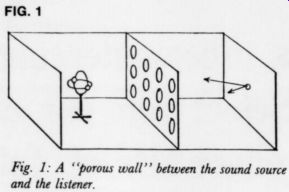
FIG. 1 Fig. 1: A “porous wall ” between the sound source and the listener.
First, they are distortions-they are a failure to preserve the exact wave information. Second, they vary as a function of the geometry of the mike and, as such, might or might not be useful in any given circumstance depending on interactions with all other elements in the reproduction chain. And third, even in the best case the angle of origin is reduced to mere angular deviation such that, for example, 45° right, left, up, or down would all produce identical anomalies and would be in distinguishable. Of course, if a mike/speaker arrangement could operate as a perfect hole, one channel would be sufficient for perfect spatial fidelity.
To summarize: no conventional mike/speaker reproduction system can, even under the best circumstances, preserve and reproduce the original directional information from a sound field because of failures to operate as perfect holes; thus, multiple channels are needed to synthesize the sound field.
However, we do not view this fact so pessimistically as does Mr. Bayzer in his closing paragraph. He speaks of fooling the brain “into believing a recorded sound is unequivocally real, ” whereas we prefer to speak in terms of allowing the listener to experience it as real. In other words, the perception of auditory realism is not merely a function of the sound field information but also includes the listener's point of view. In our research on auditory space perception we have been able to provide some phenomenally “realistic ” spatial...
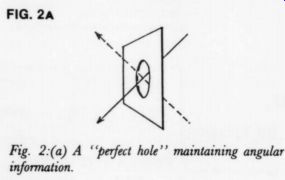
FIG. 2A
...perceptions for our listeners, using relatively mediocre equipment, by the judicious manipulation of both the reproduced sound field and the listener's point of view.
Mr. Bayzer's pessimism is due in part to his implied assumption that the goal of high-fidelity is to place the performance in the listener's room. This goal certainly should lead to pessimism since it is unrealistic. To perceive a symphony orchestra in a living room is not an easy point of view for a listener since one needs to conceptually miniaturize the orchestra or enlarge the room. In other words, the goal should not be to place the performance in the living room, but to allow the listener to “go to ” the performance.
The following excerpt from a paper we delivered at the 1978 Convention of the Rocky Mountain Psychological Association in Denver, Colorado, describes some of our research on auditory space perception.
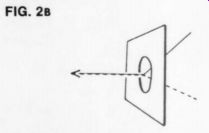
Fig. 2:(b) An “imperfect hole ” losing angular in formation.
Using two sets of binaural mikes, one set was placed inside a soundproof chamber directly behind a window facing into a large room, and the other in the large room directly in front of the window. RR produced a recording beginning with only the inside mikes turned on; he talked and moved about the small chamber making various noises behind the mikes. At one point he whispered directly into the mikes.
He then turned on the outside mikes and turned off the inside mikes, left the chamber, and moved about the large room while talking and making various noises.
Approximately 30 observers have listened to the tape via headphones while seated inside the chamber and reported their observations during interviews. All reported the strong impression of someone being in the chamber with them, moving and talking behind them. When RR whispered into the mikes they reported a very strong sensation that someone was there beside them. Their impression typically included emotional sensations such as the feeling of invasion of personal space. With the outside mikes on and RR in the large room most observers reported themselves as being in the large room, in some sense: some felt they were in the chamber but the walls had opened up or melted; RR envisioned the walls as made of plexiglass; others reported being “transported ” outside the chamber. These perceptions can be summarized in terms of the ability to modify one's point of view to become compatible with the actual location of the mikes; when compatibility of view point occurs, auditory spatial perception can be strikingly realistic.
As our observations of auditory spatial perceptions have accumulated, a common principle has emerged which we call the “auditory view point. ” If, by an adequate reproduction of an acoustical environment (often supplemented by visual, motor, or instructional concomitants), we can induce the observer to accept a compatible auditory viewpoint, then the observer reports a realistic spatial perception of the environment. In short, the observer “puts his head where the mikes were. ”But if the observer is led to an incompatible viewpoint, such as “I am listening to recorded sounds coming out of the headphones, ” then he reports less realistic perceptions.
Lest our general point be misunderstood, let us emphasize we endorse any and all attempts to extend the state of the art in the mechanics of sound reproduction, and feel Mr. Bayzer is correct in focusing on the geometry of the reproducers (we hope we have presented some useful ideas to that end).
Beyond these points, however, we wish to emphasize that perception need not necessarily be thought of as the result of computations on acoustic information by a sensing brain, as Mr. Bayzer claims, but can also be conceived as an irreducible person/environment (or perceiver/perceived) point of view.
The implication of this alternative concept of perception is that the audiophile must not only strive to advance the state of the art in the mechanics of sound reproduction but, equally importantly, learn to acquire different modes of listening to deal with different auditory situations. In particular, the audio listening experience is composed of many “layers, “ or potential points of view, such as the listening room, the loudspeakers, “the cartridge, ”' “the mix-down, ” and “the music, ” to name a few obvious ones. To acquire different modes of listening means to be able to “hear through' these layers in order to focus on any single layer, and to be able to shift at will one's point of view from layer to layer.
Thus, in the research described above, many of our listeners “heard through' our headphones into the room beyond by engaging an appropriate point of view.
Likewise, the adept audiophile can hear through, if he chooses, the mechanical imperfections of the reproduction chain into some aspect of the musical event itself, such as the recording environment, even if that event is imperfectly reproduced. Or, if he so chooses, he can hear through the musical event into some aspect of the reproduction chain itself, such as the loudspeaker colorations. The important point in all this is that the adept audiophile is free to shift among many points of view, focusing on or ignoring reproduction problems as he so desires.
Thus we are correct in searching for the electromechanical El Dorado but wrong in being deaf so long as it eludes us.
By Ron Rees and RON SHAFFER. Drs. Rees and Shaffer teach at Western Washington University, Bellingham, WA 98225
----
Also see:
Test Report: Listening tests of the PAT-5/WJ-1A, by Laurence L. Greenhill, M.D.
MODIFYING YAMAHA'S CD2 CD Player , by Hampton Childress