Editorial--The Post, Parcels and Priorities
AS WE ARE MAIL THIS ISSUE of TAA we are acutely aware that our new subscription rate of $14 per year owes much for its necessity to the U.S. Postal System. Last year's rate hike for second class mail was approximately 17%. Mailing charges for this publication are now better than 400% higher than they were when we began the magazine in 1970. It is difficult to think of much-other than taxes, social security, and such things which have risen at that rate. Evidently the President's 7% inflation guidelines are for everybody except government agencies.
Most of us will know about those sad facts. What you may not know is that the Postal Service is not competing very well with United Parcel Service and is taking drastic action to try to reverse the trend. USPS has lost well over half of its parcel delivery business since 1961. In order to try to recover it they are proposing large "wholesale" parcel handling centers in preparation for offering bulk shippers (over fifty parcels per day) a lower rate than you and I as citizens pay, and than small businesses pay. This will obviously benet larger companies who happen to be close to these centers. Will the cost benefit be passed along to the consumer? And who is paying for those big new centers? Why the consumer, of course. Tax money is being used to erect them in the hope that lower prices will woo the big shippers away from UPS. This is apparently based on the assumption that the shipper has no interest in faster delivery, up to $100 automatic insurance on each parcel, a signed receipt for every one, and the generally better condition of most parcels when they reach their destination.
On the other hand, consider UPS. They have built a ser vice over the last twenty years that has managed to pay union scale, fight off competition and obstruction from the truckers and from the Postal Service to expand their service areas, pay interest on operating capital, build tax paying facilities all across the country, pay taxes on their fuel, their profits, and pay dividends to their stockholders, while at the same time taking half the US parcel business away from the Postal Service.
It must be frustrating to UPS to pay taxes to help a non-taxpaying competitor to build facilities to compete with them more efficiently.
It ought to be evident that the USPS cannot successfully compete with UPS in the parcel business. If a private firm can deliver parcels, and insure them, and get a receipt for them, and they arrive in better condition, maybe it is time for the Postal Service to consider diversifying and getting into something that they can handle.
We think it is time they stopped using tax funds to beat out tax paying competition. If we believe in capitalism and government agencies competing for certain business, then the agency should certainly not have a double tax ad vantage.
At the same time the USPS has taken many steps in court in recent months to make sure private competition does not further menace their monopoly. To head off alternate forms of delivery of magazines USPS has persuaded the courts to declare magazines to be legally "letters" and therefore illegal for anyone other than USPS to deliver. It might be embarrassing to find that private industry could do the job better for the same money-or possibly less, especially in a country whose foundations are an encouragement of private enterprise.
Any impartial survey of a government's effort to run an enterprise necessary to all will usually show that it is more expensive, inefficient, and has poorer performance standards. There are exceptions. But generally the performance level is outstandingly depressing, whether we are talking about the USSR's agriculture, England's medicine, or the U.S. Welfare system.
Our Postal Service has been in trouble for a long time.
The performance has improved somewhat of late, but it is not yet a good postal service and the cost is astronomical.
USPS wages are rising faster than those of any Federal employees and at a rate far above President Carter's wage guidelines. It is impossible not to speculate that if UPS can do as well as they have done with parcels-and no other diversified income, what might well-organized private enterprise do with periodical delivery, advertising distribution, business mail, or even first class private mail.
What has this to do with audio? Only a tiny fraction of the electronics industry will use the Postal Service to handle anything electronic. Most warranties of equipment are voided by sending them through the Postal Service channels. )There are aces where parcels fall two stories when mass dumped from trailer trucks.) If tax supported USPS competition deeply weakens UPS, where will we o for safe delivery? And magazines are, we naturally thin fairly important to the development and growth of the art of reproducing music. Our society and its services are more closely interlinked today than ever.
We do not pretend to know any real answers to the postal service troubles or even to understand them. We do know that a great deal of our life's values are tied to communication and commerce. Manifestly our government's troubled postal enterprise is, we believe, violating some very basic American principles of fair play and philosophy in its present efforts to continue to monopolize mail and parcel delivery. We believe it is time to call a halt. And time for better answers.
Books
by RON MILLER, Book Editor
BOOKS ARE SOMETIMES a problem for a reviewer. Even in a single field like hobby electronics new publications arrive endlessly. This "Book Talk" will give a broad and shallow sweep of un-reviewed books on my shelves.
Howard K. Sams have published a series of books, each titled "ABC's of...." and giving a basic introduction to its subject. I have read the following:
ABC's of Capacitors, by William F. Mullin (20849, $3.95), introduces capacitor theory and construction. Descriptions are superficial, and comparisons of the various types' strengths and weaknesses are insufficient. However, this book is perhaps useful as a basic introduction.
ABC's of Electrical Soldering, by Louis M. Dezettel (20627, $3.25), supplies more in formation about soldering than many novices would believe possible. Some of the details may not be helpful for home project builders, but such an overview of the topic is interesting and informative.
ABC's of Electronic Test Equipment, by Donald A. Smith (20660, $2.95), is a swift overview of VOMs, VTMs, solid state VOMs, battery, tube, diode, and transistor testers, signal tracers, oscilloscopes, power supplies, and signal and TV generators. The broad coverage is likely to be useful for beginners, but is rather superficial and lacking in details of use.
ABC's of FETs, by Rufus Turner (20789, $2.95), represents a good introduction to this class of semiconductor devices. In addition to describing FET operation and characteristics, Turner includes a number of tests one can make. His application circuits give a wide variety of uses but do not supply component values, which means one cannot try such circuits without a higher level of knowledge than the book takes for granted. I suspect these same circuit configurations, with appropriate component values, appear in another of Turner's books.
ABC's of Integrated Circuits, also by Rufus Turner (20823, $2.95), is a similar introduction to linear ICs. One receives a basic feel for these blocks of gain, but little of practical value is supplied. Even those just beginning to read TAA would want more specific information. Turner's ABC's of Voltage Dependent Resistors ( 20371, $3.25) is the final book I have read in this series.
The titles are, I suppose, adequate descriptions of these books. Most of us involved on a practical level in the field really want and need MNO's and PQR's, not ABC's if we are to learn anything useful. I suspect the more basic the subject, the more useful the books will be, for beginners at least. The book on resistors might well have some useful information, as does the one on capacitors however, one can say only so much in 96-128 pages. All I can suggest is that you consider specific volumes in terms of your own needs.
Leonard Feldman in FM From Antenna to Audio ( Sams, 20723, $3.95) gives a thorough and interesting introduction to FM tuner operation. He supplies a good amount of detail, but the 1969 publication date means a number of recent circuit innovations are not discussed. This is a handy, easy-to-read beginner's manual.
MISCELLANEA
Reference books are always needed, and I have come to see the value of a dictionary for just this field. John Markus has recently published the fourth edition of his Electronics Dictionary (McGraw Hill, $24.50). I had no idea it would take 722 pages to define electronic terms. At the moment I don't need to know what a non degenerative gas is, but Markus gives many other useful definitions, often including informative diagrams. If you don't have an electronics dictionary, this is worth your consideration; I shall treasure my copy.
Electronic Conversions, Symbols and Formulas ( Tab, 750, $4.95) by Rufus Turner ( he's turned up a lot in this review, hasn't he?) is another of those indispensable, seldom used, all-but-unreadable books we can't live without. If you forget E = IR it would take a lot of time to look it up (p. 32), but formulae for a shunt m-derived bandpass filter or the functional meaning of all those letter symbols can most easily be stored between the covers of a book. I have not checked for errors, however.
Clement Meadmore provides a change of pace with his All Sound and No Frills ( Pantheon, $3.95). His subtitle, The Best Stereo System for Your Money, is an excellent description. I cannot afford to try his recommendations, but they are consistent with what I know about high quality commercial audio equipment. He gives TAA a very nice plug for those who "have clever hands," which presumably says something positive about his taste. If you don't want to build TAA projects for a friend, here is a book which will give them good advice until, in a couple of years, it inevitably becomes outdated.
Rodney Faber, in Applied Electricity and Electronics for Technology (John Wiley & Sons, $15.95), has written what appears to be a textbook introducing "electricity and electronics and their applications in science and industry." This is a basic but thorough survey for those not majoring in electronics who nevertheless need to understand the field.
Faber covers everything from basic AC and DC theory through such things as digital logic techniques, transducers, and instruments and measurements. Each section has thoroughly worked out problems as examples, and each chapter concludes with a series of problems to be solved and a bibliography for further reading. (The publisher will send answers to a bonafide instructor and might let anyone who can prove non-student status-try to prove such a negative-have a copy, as well.) Faber's book is a very good introduction to and survey of electronic theory. It has almost nothing of practical use to audio amateurs, but the diligent reader can work through plenty of theory.
Sol Papatine's Electronics in Communications ( Wiley, $15.95) is a similarly useful and thorough study of radio frequency and microwave electronics. Most of us aren't into that, but if you are here is a handy volume. Once again we find thoroughly worked out examples and chapter problems which do not give the answers.
Old Colony Books advertises a series of books by G. A. Briggs, who wrote Cabinet Handbook, discussed above. Another one TAA readers might like to know about is Audio Biographies ( Old Colony, $6.00), a fascinating history of high fidelity and stereo music for the home as told in a series of autobiographical reminiscences by the principal figures in that history who were still alive in 1961 when Briggs put the book together.
State of the art is the goal toward which TAA strives, but if, like holiness, that is a constantly receding and unreachable goal, we nevertheless need to remember that such progress as has been made is the work of many individual contributors.
Briggs assembled essays from some 65 pioneers in the audio field or, in a few cases, their female relatives, all giving personal experiences and insights into the development of the audio art and science.
Many names will be un-familiar to TAA readers, but articles about their personal history in audio from such people as Norman Crowhurst, Paul Klipsch, C. G. McProud, H. H. Scott, Cecil Watt and Per cy Wilson shed new light on what we are about. No theory, but a lot of fun and enlightenment.
William F. Boyce's Hi Fi Stereo Hand book ( Sams, 20918, $6.95) is a thorough overview of the field written from a beginner's point of view. He gives greater detail than do smaller books like those available from the Institute of High Fidelity, but not so much as will overwhelm a novice. The photographs and circuit diagrams seem to be drawn from standard audio manufacturers, with little original information. Regular readers of the audio press will not find much new or interesting, but beginners should find this handbook useful.
TTL BASICS
JAMES BOAK, Reviewer
IN THE FIVE YEARS SINCE its publication, Don Lancaster's TTL Cookbook ( Sams, $9.50) has become the bible of TTL experimenters. The reason is simple: Don's methods work. On any level, from the beginner who can't tell a resistor from a soldering iron to the experienced digital engineer who wants a single concise, easy-to-use reference, the TTL Cookbook provides solid, reliable advice and design pointers.
The book is well-organized and readable. Don starts with the basics and then moves into specifics with enough groundwork so an inexperienced reader can follow the ideas. Yet he misses nothing in basic TTL design. Power supply considerations, layout, and noise suppression are covered with a minimum of nonsense. For the more technically inclined Don goes into even more detail, including the actual transistor circuits in some cases and providing the expertise required to solve the occasional thorny circuit problem that the "black box" approach can't reach.
The book's overall layout is sensible and leads logically from the foundations of Chapter 1 ("What Is a Logic Device?") to the small systems of Chapter 8. The author first presents a description of TTL logic, with a functional description of the different families (H, LS, etc.) and how they interconnect. He follows this with a compact yet concise catalog of TTL devices with pinouts and electrical characteristics. Chapter 3 describes solutions to many basic logic problems, including innovative and powerful tricks that use circuits in ways the original chip designers probably never imagined. The succeeding chapters detail the oscillator and timer circuits which are crucial to frequency measurement, decoders, and of course displays. The last chapters give some small systems examples.
Information is here on doing the things audio enthusiasts like to do digitally, although the elements are unembellished; for example, although Don doesn't detail construction of a digital readout add-on for your FM tuner, he does describe the problems inhererent in building a 100MHz counter. Perhaps your tastes run to a fast solid state VU meter, or an LED peak detector? Don's material on comparators and latches will give you a toehold.
However, the book is not, and was not intended to be, a guide to digitizing analog signals. Anyone intending to get serious about a digital signal processor will have to look elsewhere. The book also includes nothing about microprocessors or other computer hardware (which are, with a few exceptions, not TTL anyway). What it does provide is a wealth of information about transistor logic, sufficient to allow almost anyone to build a working logic circuit, first time. The hobbyist who wants to spruce up his design with a digital add-on can hardly do better than consult Don Lancaster's TTL Cookbook.
RECORDIST'S PRIMER
RICHARD KUNC, Reviewer
IT TAKES A SPECIAL KIND OF MIND to make something as inherently complex as late twentieth century recording read as clearly as "The Boy Mechanic" (remember that one?). Craig Anderton seems to have one of those minds, for sure. His book is Home Recording for Musicians (Guitar Player Books, paperbound $9.95, available from Godbout, Dept. TAA, Box 2355, Oakland Airport, CA 94614).
I first encountered Craig several years back, in a recording studio where I was the engineer-in-command and he was ad visor on all things electronic to the rock ' n' roll group holding forth. Even then, while I was talking "Watch this...!", Craig was talking "What if ...?"
A volume that sets out to cover everything from "What is Sound?" to "How to Sell Your Music to a Record Company" in 180 fast, liberally illustrated pages is shooting high, indeed. But Craig gets it done by leaving out a lot of the archaic, high-falootin' (and sometimes questionable) theory and by concentrating in stead on the "which-knob-and-how much" aspects of recording. He has separated the hardware of recording into logical basic elements, such as the rooms ( studio and control), the console and all its features and functions, and microphones and their nuances. Then he gets right into the techniques of recording. Elsewhere he deals lucidly with not only the hardware involved but the software, the psychology, the philosophy, and the magic of producing a superior recording.
The man cares, unmistakably ... and hooray! The last section of the book is perhaps my favorite-being, as I am; an incurable tinkerer/experimenter/builder. This is where Craig spells out in his usual clear terms the nuts and bolts of recording.
Here's where we get into designing and actually putting together some nice useful recording goodies, from a simple but workable mixer to such relatively exotic animals as a noise gate and a reverb system. Craig takes us from basic knowledge about which end of the soldering iron to grab right through a quick course in integrated circuits, and finally into the business of using the mixer and other toys.
Trust me, there is no fair way to include everything offered in Craig's nifty book in one much-too-brief review. Buy the book, devour it, store it in a cool dry place, and keep it always.
RECORDING BASICS
WALT JUNG Reviewer
JOHN EARGLE, AUTHOR OF Sound Recording, ( Van Nostrand Reinhold, $16.95) is well known in the audio field and has contributed many papers to the literature. A member and past president of the Audio Engineering Society, he holds degrees in both music and electrical engineering. His background and varied experience thus bring valuable knowledge to a book on audio recording.
In his preface Eargle tells us he intends the book to contribute to a greater understanding of the tools and techniques of recording. His 10 chapters are: 1) The Physical Aspects of Sound; 2) Psycho acoustics; 3) Stereophonic Sound; 4) Quadraphonic Sound; 5) Microphones; 6) Monitor Loudspeakers and the Monitoring Environment; 7) Audio Control Systems; 8) Magnetic Recording; 9) Signal Processing Devices; and 10) Disc Recording and Reproduction.
Overall the book is well written and easy to follow, with excellent graphics.
The emphasis throughout is on transmit ting the technical message with the minimum mathematics necessary. I think the many block diagrams, charts, and graphs accomplish this objective quite well.
The book covers the sound recording field adequately and should serve as a good text for beginners. It can still serve as a basic reference for the more advanced reader, but may need supplementing in specific areas.
In TAA 1/78, p. 57, I reviewed John Woram's The Recording Studio Handbook ( Sagamore, $35.00). Comparing Woram's book with Eargle's, I find both extremely useful and well done. Woram's is fatter and costlier; Eargle's somewhat slimmer and less expensive. Neither is overwhelmingly my favorite, and your individual taste may well determine which is more suitable for you. If you can, buy them both; you will not regret it.
About this isssue
ELECTROSTATIC ELEGANCE LEADS Off the issue on page 2 with Barry Waldron's speaker/amplifier combination, melding the work of David Hermeyer and Roger Sanders with an assist from kits by Speakerlab.
James Boak recently took an evening off from his work with a team who are up dating a CAT scanning machine at one of Boston's hospitals to spend an overnight in Peterborough. The team, from Ohio Nuclear, are pushing the machine a bit faster so simulated scans of a patient's heart may be made. The scanner produces a full color "slice" photo through any cross section of the human body using computer techniques. The extra speed aids special techniques to "stop" he heart for diagnostic "photos." After hours, Jim evolves his audio system, and in this issue offers the first of three articles on power amps. The regulator circuit is as near to a universal device as we are likely to publish this year. It works well for the Nelson Pass 40W class A and equally well for Reggie Williamson's 40/40. Indeed the eagle eyes will detect that the Nilliamson, with Boak power is capable of 60W per channel at slightly less distortion than with Reggie's clever “mpacitance” multiplier supply.
Next time Jim will be back with a pair of power amps especially designed for headphones: dynamic and electrostatic. In issue 3/80 we will be unveiling his IC driven power amps in a variety of power levels, for which his supply will also do service, of course.
Peter Sutheim isn't with us this time simply because trying to fill a column on what is new and interesting hadn't any harvest in audio land this quarter. He will be in Las Vegas before next issue, however, and we have our fingers crossed.
David White has a most impressive audio system which uses a pair of transmission lines for the sub-bass and Hermeyer electrostatics as well as some new tweeters I haven't seen or heard as yet. His electrostatics are driven by the original Hermeyer amplifier which is about the size of a footlocker-and in a darkened room resembles something out of Star Wars that you hope is taking a short nap.
Dave was puzzled by the breakup he was hearing in his system and became curious about what sort of levels were going through his set-up. With 2,000 polarizing volts on your output line to the midrange, however, it isn't easy to make traditional measurements. The system is crossed over electronically, of course, so Dave decided to work up an indicator for the crossover outputs. He's put crossovers, 30Hz filters and LED indicators into a neat assembly with power supplies. It has doubtless done nicely over Yuletide as an adjunct Christmas tree.
Note that David adapted Walt Jung's 30Hz filter circuitry ( TAA, 4/75, p. 14) to use as a crossover as well as a general high-pass filter for his system. The Jung 30Hz filter has not, from the feedback I hear, seen nearly as much usage as it deserves as a versatile crossover with the convenience of gain. Author White's applications notes for his device are worth very careful study. I'm sure TAA readers will find many more uses for it.
Very early in our publishing history Reg Williamson answered a letter in which a reader wanted to know what he could use as an inverse RIAA network for checking his preamp TAA, 3/71, p. 22(. That was nine years ago. Since that time lots of people have bought a simple handful of fairly precise components from Old Colony to fulfill that function. Put a mirror image RIAA network shaped signal i nto your phono section and if it is properly equalized you should get equal gain at all frequencies.
When Stan Lipshitz delivered his landmark paper at the Audio Engineering Society's New York meeting in 1978 pointing out that the great majority of preamps sold i n the Western hemisphere were inaccurately equalized for RIAA I asked Stan and Walt Jung if they would have a look at the Williamson, test it out, and make suggestions for something that might be better. It turns out that the Williamson is very good indeed and that by adding two additional components to the design it is about as accurate as anything available. (Do not ask what else is available.
Stan is asking the professional suppliers what is in their disc cutting set-ups for this purpose and nobody wants to share much of anything-so far.( The resulting article (page 22( is a joint effort of Stan and Walt who did theory jointly, and Walt did the measurements and constructed the beautiful prototype on page 24.
Old Colony is undertaking to supply a new inverse RIAA kit which is outrageously expensive for several reasons, but especially that 1% polypropylenes must be custom made and metal film 1% devices in the high megohm range are also quite expensive. But if you worry about correctness of equalization in your reproducer chain, the new kit will be very accurate indeed and you can play music through it for a double-check of the preamp's competence.
On page 27 we complete our version of a day-long conversation with Peter Baxandall discussing such things as quadraphonics, headphones, distortion, and listening tests.
Speaking of listening tests-and isn't everyone-we offer more data gathered in another quarter of academe this time from the team of Smith, Peterson and Jackson who are music lovers, audiophiles and diligent researchers as well, beginning on page 34.
Readers Goodman, Shults and Granfeldt offer some helpful suggestions in Audio Aids about phono arm geometry, those horrendous noises at turn-on or turn-off of the system and some suggestions about zener diode size.
Dr. Laurence Greenhill does a listening test for us with a group of listeners further refining methods he first described in these pages in 1/79. Two preamps are the compared devices: the Levinson ML-1 and the Jung/White revision of the PAT-5.
We have a wealth of reviews in this issue: books surveyed by Ron Miller, Jim Boak, Dick Kunc and Walt Jung. In the recordings area we have a variety of reports from editors Williamson, Boak and Gloeckler.
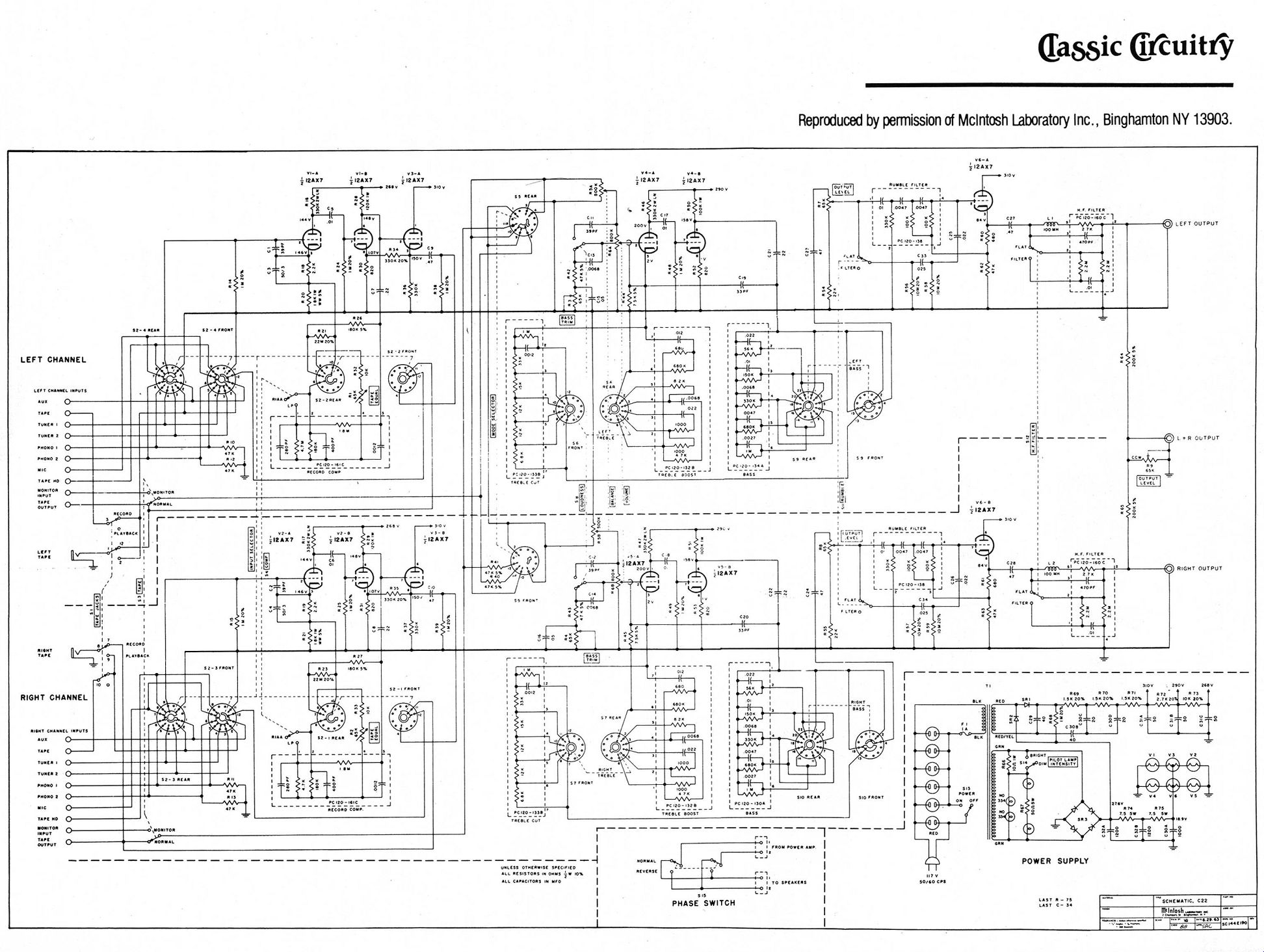
Our classic circuit this time is the McIntosh C22 preamp ( page 54), with our thanks to McIntosh for permission to reproduce it.
Please note the corrections and update column this time beginning on 56, followed by your letters. I have been asked lately how many of the letters we receive we are able to publish. It varies with issue, of course, but it is scarcely ever possible to publish more than four out of ten. All the letters are an important aid to all of us however-one case where more feedback is definitely better, including positive and negative.
Audio Amateur readers may be glad to know that our new publication Speaker Builder ( scheduled for appearance in February,) has had a really excellent response so far. New authors have appeared anxious to have something to say in Speaker Builder's pages, subscriptions are coming in at a fine clip, and advertisers are signing up in good numbers.
We regret to announce a change in one of TAA's oldest customer services. As of January 1, 1980 ElectroValue America will be no more. ElectroValue customers are ask ed to send their orders directly to England after that date.
All orders already in process will be delivered in the usual way. Orders received after Jan. 1, 1980 will be sent directly to England and ElectroValue Ltd. will post them directly to the customer. Changing conditions of supply in the U.S.A., the decline of the dollar and the steady rise of European currencies against the dollar are the reasons for the change.
ElectroValue America was a needed aid to audiophiles for the nine years the service was maintained. ElectroValue Ltd., is a unique enterprise with one of the finest catalogs we know of for audiophiles who want high quality parts. Their address is 28 St. Jude's Road, Englefield Green, Egham, Surrey TW20 OHB, England.
-THE EDITOR
Showcase
THIS WALL OF SOUND began to take shape in my mind shortly before the publication of Roger Sanders article (4/75). I began constructing it just afterward, melding the Sanders’ and the original Hermeyer concepts. The result is a wide dispersion ESL system working in con junction with two folded corner horns assembled from Speakerlab kits.
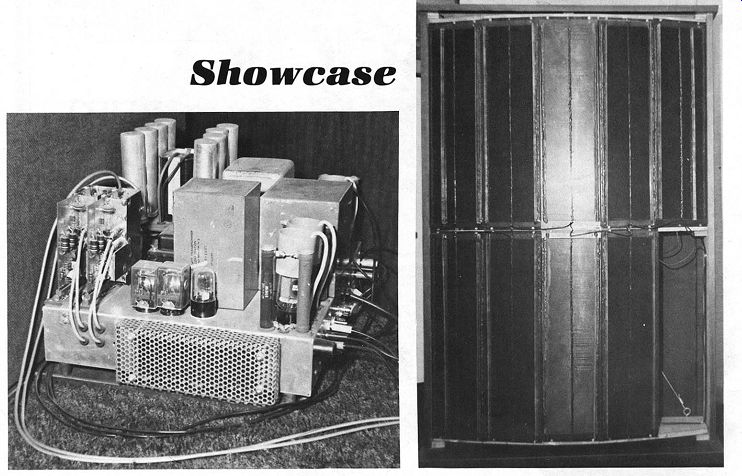
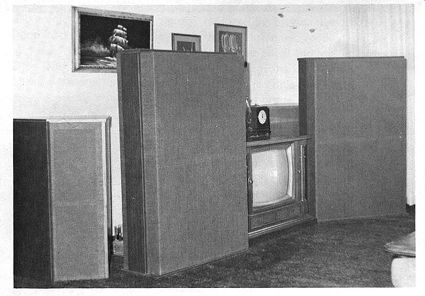
Perched on the “back porch’ of the left panel is the MK II direct drive amp which energizes the electrostatic speakers. Power for the “K horns is handled most ably by a Pass A140 amplifier.
Presently, the crossover is an OCSL unit modified to accept 318 ICs. For private listening a third Class A amplifier directly powers two pairs of electrostatic headphones. The various components blend to form a cohesive and balanced audio system. with excellent accuracy, imagery and, inner detailing.
BARRY A. WALDRON, Stockton, CA 95207
Classic Circuitry--The McIntosh C-22 preamplifier
ADs:
HIGH PERFORMANCE MOVING COIL CARTRIDGE
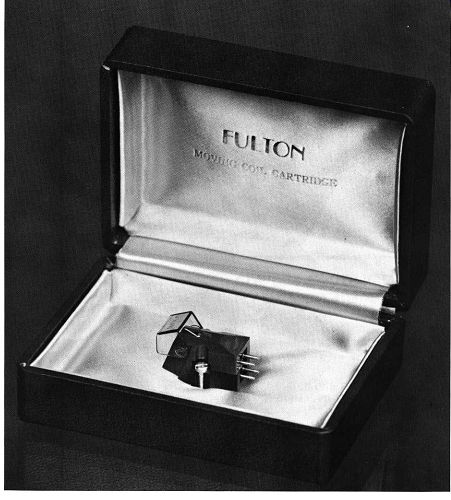
The FULTON cartridge was designed for the discriminating music lover who wants to recreate the live musical experience in his own home. As such, it has outstanding specifications. But specifications tell you very little about how a cartridge sounds. The perfection of the FULTON cartridge can only be realized by hearing it. Its unequalled trackability, tight coupling and light weight make it an instrument of pristine musical beauty. Hear the FULTON cartridge. The "First Choice in Listening."
AD:
Audio Amateur is a magazine that continues a great American tradition--a tradition that loves tinkering and experimentation and embraces rather than eschews technology. Readers of this magazine, I suspect, don't simply discuss the latest heavily advertised "quantum leap" forward. TAA subscribers are impressed more by an interesting project they can build from scratch. They love to extract, by modification, the greatest possible perfection from classic and recently introduced audio products.
Like the New Yorker, the Audio Amateur publishes articles that are measured and thoughtful, articles that are beyond superlatives by the bushel basket found in most of the mass circulated audio magazines. The reasoned tone results in part from the considerable contributions made by English writers, including the late B.J. Webb. Edward T. Dell, Jr., the editor, almost always includes a thoughtful editorial that, alone, is worth the cost of admission. Unlike some of the little audiophile magazines, TAA is generally beyond clannish allegiance to a few manufacturers. Articles on projects to construct and modify appeal to the fondness of its readers for a wide range of projects.
Audio Amateur has served up a smorgasbord of projects over its ten year existence. How to properly adapt a Grace arm to an AR turntable, build a record cabinet, modify a Formula-4 tonearm to improve low frequency reproduction, or build a 10 dollar three-element Yagi antenna have all been offered as appetizers, projects that require some familiarity with tools and a few nights of your time. The main course offerings demand various degrees of more sophisticated electronic skill. If you've only assembled a one tube radio (twenty years ago), many of the electronic projects are going to more than you can chew. Numerous past articles have shown how to improve classic Dynaco products. Recently, Nelson Pass of the Threshold Corp. discussed how to build a 40 watt per channel class A amplifier. Electronic articles typically assume an ability to find the parts necessary to build the projects. Chances are you'll spend some time searching through parts catalogs and local surplus houses before you can begin to wade into the actual construction.
Sophisticated articles that examine specific audio problems but do not involve building projects also abound.
Walt Jung, contributing editor, has discussed slewing induced distortion in amplifiers in a series of articles. How we actually perceive sound and how many speakers may be necessary to recreate the closest possible approximation of the live event has also been discussed.
If speaker building is your forte, past articles have dealt with horn loaded and transmission line designs. Instructions on how to build electrostatic transducers from scratch, and box fabrication for sub-woofers with an ac companying active crossover have also been features. It's a measure of TAA contributor ingenuity that a complex driver like the Heil air-motion transformer has been built by an amateur - complete instructions on how to build a home version of the large Heil appeared in the magazine in 1977.
An excellent analysis of recently introduced audio kits is a regular feature. Kit reviews are technically very thorough and are often more objective than you find elsewhere. A regular feature, "Audio Aids," offers all kinds of informative hints from readers. A letter section from readers comments on past articles and present concerns and lends a thoughtful and inquiring tone to the magazine. Advertisements, themselves, are often helpful to the reader since many of the ads list parts that are vital for project construction. Most of the better kit manufacturers also advertise in Audio Amateur.
If you are already an audio craftsman, or would like to become one, Audio Amateur is an excellent touchstone.
For less than the price of a good meal and a movie ticket, you can receive four issues a year.
-George Hortin, Staff Writer
INPUT, published by BSS, Inc.
9613 Oates Avenue, Sacramento CA 95827
Also see:
Are Those Ears Really Golden? (Or only Iron Pyrites?) -- Extensive explorations of whether listeners detect differences in equipment, by Thomas H. Smith, Michael R. Peterson and Peter O. Jackson