LIVING WITH CD--A DIGITAL CHAIN REACTION
ANGELS FEAR TO TREAD on the ground I am about to trample. However, if you believe in improving the audio illusion (and why else would you be reading this magazine) would you accept that I have plodded my way through this particular sequence with oscilloscope meter and ears fully alert. In particular, I have kept to the old maxims of altering one parameter at a time and backing subjective with objective evidence.
Already discussed at length in TAA's pages, the problems of self-delusion and conclusion-jumping do not need to be restated; when I suspected their intrusion I adjourn testing until I am less tired, better fed or simply more pessimistic.
Introduction and Allegro My first session with compact disk (CD) was in the comfort of my own home, using my own amplifier and loudspeakers. The CD was Sony's flagship product CDP 101, designed to take advantage of all the technical wizardry of the new system. The immediate effect of wide dynamic range and lack of IM (intermodulation) distortion was very impressive on a quiet background. The Kondrashin recording of Dvorak’s New World Symphony, in particular, took one's breath away with vivid tympani transients you could feel-without the overblown effect on other instruments so common in “demonstration ” recordings.
At the end of the session, when we had browsed through about 40 recordings, there were perhaps five I would have judged outstanding. Not the best economic basis for me to start replacing a huge library of black disks (all speeds), open reel tapes and cassettes.
The technical novelty and attraction was strong, but the budget was weak.
My chance to acquire a demonstration model Marantz CD63B came over two years later. Those who know the machine will remember that it is a top-loader with very basic programming facilities and relatively slow track access. However, all the reviewers (who I believe implicitly) agreed it had good quality audio performance, which is really what I was after.
I sold two microphones and in stalled the thing without going broke, joined a CD library to overcome the software cost, and sat back. I had no doubt that the main strengths of the system remained throughout pro longed listening. Where I made comparisons with LP or cassette versions a veil was lifted, often to disclose recording problems such as poor microphones or a strained analog mixer, in addition to the limiting effect of cassettes and the inner radius of the LPs.
It also disclosed that my Pandora's Box (TAA 1/78, p. 4) was contributing too much hum and noise, previously masked by tape hiss, surface noise and even radio background.
My measurements (see below) proved a difficult and enlightening experience. In addition I had a faint sense of uneasiness with strings, some brass and an outrageously overloaded DGG (Deutsche Grammophon Gesellschaft) recording of Il Trovatore-just a minute though.
The notes said this was a digital event from the studio, right through to the CD. Was I actually hearing “'digital glare, ” or “CD edge ” or even ‘boilermaker's ear?' Time for the workbench and the oscilloscope.
Stately Measure: Levels
I obtained a test disk from Hi-Fi News & Record Review that has a number of carefully recorded classical music and voice excerpts with over 50 tracks of computer generated tones, ranging from innocuous glides at -20dB to vicious spot frequencies at full output. One of the latter at 1.1kHz, 0dB, was my first choice. As the cable interconnect ad-men say in their blurbs, 'I forced the pure frequency down my totally inadequate half-meter of screened cable into the electronics.' All was well up to the tone control stage, but then I ran into negative clipping. As the level was at least 3dB above those previously designed for, I reduced the input sensitivity to cope with the 2V output from the player.
Only a few players have variable out puts, so the first lesson is to see how well your auxiliary inputs can cope with 2V RMS (root mean square).
I suspect a high proportion of you will run into some form of overload trouble. Even marginal overload can cause 'blurring of detail', 'loss of 'transparency' and through excessive crosstalk affect “stereo width.” Now, where have we heard all those phrases before? The only one I do not believe is 'loss of image depth,’ and that would take another page to dispose of and lose me lots of friends.
No less an authority than Peter Baxandall interviewed on this subject in TAA 4/79, 1/80, put it most engagingly in a recent letter, answering criticism, that one amplifier was thus being overloaded in the re viewer's listening tests, producing, as overloaded amplifiers always tend to do, degradation of sound quality that was described in entertaining figurative terms. The answer to the problem in most cases can simply be an input attenuator, say 6dB, to match the preamp input impedance. Plug in types are being supplied by some component manufacturers already.
The next step was to try other frequencies and see whether tone controls and filters could cope with their extremes. Straight away 6kHz/0dB caused some aberrations in the trace (the audible effect is a background 'buzz' in the tone) and it took a long time for the light to dawn. Plugged into the back of my system is a ten octave equalizer used to correct minor room deviations, and there it was-a fault in the balanced power supply restricting the peak output of the equalizer on the higher bands.
Again it was at a level rarely reached on other sources.
With that cured, a return to listening tests showed the results had a significant effect on strings. Not self delusion this time, as I could bring the pains on again at will by applying the circuit fault. Sadly Il Trovatore still sounded rough at times, so there was still bad news somewhere.
Measuring an amplifier's watt out put is simple enough on pure tones; even then you must allow for the constant power effect on an unregulated power supply. On program material an oscilloscope is mandatory.
(For the deprived, it looks as though I am making a case for a simple oscilloscope in a construction article in TAA. And so I am.) Transient peaks, lasting only microseconds, can break the overload barrier even when the average levels are well below the “red, ” but here everybody believes VU meters, don't they? I also have a peak watts indicator with a sample and-hold display, which proved in valuable in this case.
At the offending choral passage the 30W red lamp stayed on for at least two seconds. Even the Williamson 40/40 amplifier was straining a bit with that on both channels, which I confirmed by metering the positive supply. I did not think I was playing my music all that loud. What was confounding me was the wide dynamic range of the CD. With average levels the same as my normal cassettes, the peaks were at least 4-5dB higher.
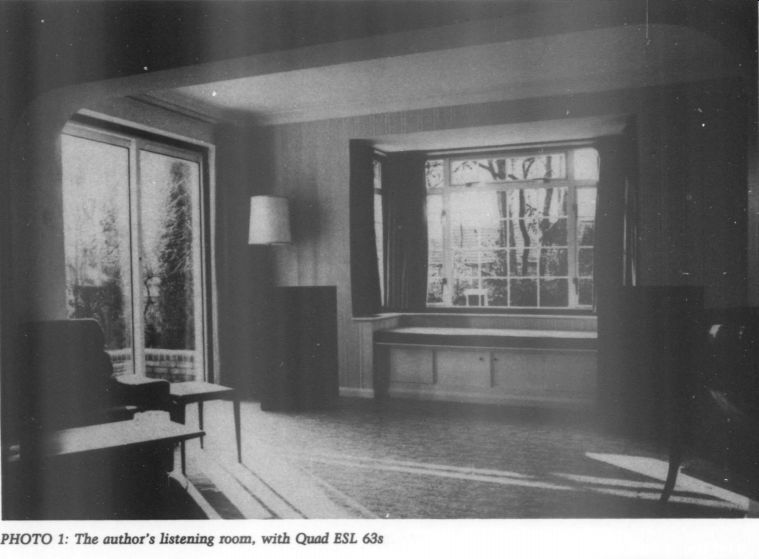
Photo 1
--------------
Now I know you have read all that before in well-informed articles, but when you actually hear the effect without any warning the tendency is to blame the record, the player, the digits or even (madness upon mad ness) the loudspeaker cable. The Earl of Birkenhead once wrote: Nature has no cure for this sort of madness though I have known a legacy from a rich relative work wonders.
It was perhaps coincidental that this was written in 1927, just as H.A. Hartley was coining the phrase “high fidelity. ”
A Stately Measure: Background
I have said that a CD's silent background ( -90dB or so) showed up hitherto innocuous noise in my equipment. When digital recording first started in the studios, engineers feverishly overhauled their mikes and mixers attempting to diminish the sound of electrons crashing about.
What was an acceptable -80dB had to be dropped considerably to meet the demands of digital recorders. At a stroke the copying and editing processes had to be re-thought, and as their own noise sensitivities developed the recording engineers fought technical battles a decibel at a time.
Now the ball is in our court, and the silver disk shouts silence at us be tween every track.
The remedy is not easy. Commercially produced audio equipment is improved by careful working on power supplies and shielding, but changing active devices to more up to-date quieter types often poses re design problems. A safe bet is to start work on the hum first with (you guessed it) the oscilloscope. You will quickly become an expert at recognizing power supply hum, induction hum, ground-loop hum and cases where the signal hum is more dominant than your own equipment.
Zeners, at times, have no effect and some regulators create their own noise. If your amplifier is home built you have a head start, especially if you made notes on faults you encountered during construction. When you have made sufficient improvement for the hum to be subdued in to the “grass' “ of noise on the oscilloscope trace, then perhaps the change to better ICs and resistors can be pursued. At every point check with your ears to see if they believe what you have done. There is a point where you may wish to call it quits and take comfort by listen to someone else's expensive amplifier and hear a worse state of affairs.
One often overlooked point in home designed gear is the position of the level control in the circuit. If you find it is habitually set at a high level, there may be an advantage to raising the gain of previous stages (below overload point of course). Way back in the bad old tube days RCA had a preamp with a ganged volume control, which worked at an early and late stage simultaneously just to solve this problem. [The Lampton Zukauckas preamp (TAA 1/79: pp. 5-16) has a similar configuration for precisely the same reason. -Ed.]
Crescendo & Finale
With everything at optimum, there was still the output power problem.
I was almost resigned to earphones when I remembered Jim Boak's regulated power supply (TAA 1/80 and 2/81) and the useful improvement to the original Williamson 20/20 and 40/40. A little late for me to respond, I suppose, but Jim's design is one that ages well.
I used the regulator in addition to Reggie Williamson's capacitance multiplier supply (suitably reinforced for extra current), because I have found the ‘soft turn-on' facility too elegant to omit. Some judicious bench testing on dummy loads (very hot stuff) showed that even on a miserly basis of one regulator for two channels a conservative 50W was available, so I can at last play Il Trovatore at a reasonable level for me, if not for the neighbors.
It all seems like a lot of trouble to play a few disks, but for me the interest has been following some of CD's and digital's criticisms through to the point where I can either find a logical reason or agree to disagree.
The opportunity to compare some items with master digital tapes, brought along by a friendly recording engineer, showed how remarkable are the silver disks in taking us one step nearer to the studio sound.
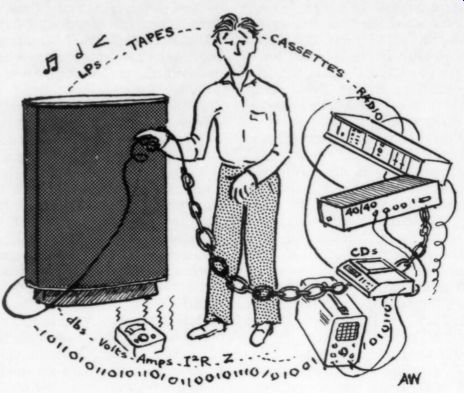
ABOUT THE AUTHOR: Alan Watling resides in a wonderfully quiet side street in Colchester, England where he has pursued well-reproduced music in his evolving living room and in his workshop out in the back garden for many years. His wit is the quiet, wise variety, as evidenced by his cartoon above. The art represents an experiment he once did, passing his signal through all manner of what the British are fond of calling ironmongery to see whether he could detect any deterioration. I have had no recent reports on whether the experiment has been repeated since the changes in the system brought about by the appearance of the CD.
Alan remains a very devoted agnostic on the alleged merits of esoteric forms of wire.
-Ed.
----
Also see:
OP-AMP MEETS CD-- OIL & WATER OR MUSICAL SYNERGISM? (1986, No. 3)
Depts (1986, No. 3)
THE SOUND OF AMPLIFIERS, By Martin Colloms