A RATHER SPECIAL SOCIETY
IT WAS WINSTON CHURCHILL who wittily remarked, that Britain and America were two nations divided by a common language. So, is there an etymologist out there? No? Well I'll give it a try: Gramophone (gram-o-fon) [Greek: gramma, a letter; phone, sound.] An instrument for recording and reproducing sound, invented by Emile Berliner in 1887.
Thus spoke my New English Dictionary and I am in trouble from the start.
Thomas Alva Edison does not get a mention; not even under “phono graph, ” which according to the NED, does exactly the same. Disgraceful, and I hasten to absolve myself from responsibility for such blatant chauvinism by the editor of my 50 year old dictionary.
What I am trying to do, is ease myself into an introduction about a peculiarly British institution-The Gramophone Society. This arose from a suggestion from our respected editor, no stranger to our shores and funny little ways. He felt it may also trigger the idea that such organizations may take root in the USA. I agree, a pleasure shared is a pleasure enhanced.
Some History
Not until the turn of the century did sound recording's potential begin to be realized, although the means had been developing for almost three decades. A few music recordings were made on cylinders, but doubtless Berliner's ergonomically more attractive disk found wider acceptance.
In 1898, the Gramophone and Typewriter Company was formed: the predecessor of the giant UK corporation, EMI (Electrical and Musical Industries) and parent of such familiar recording names as HMV (His Master's Voice) and Angel. Within a few years they established a repertory of recordings by great singers of the day, largely through the enterprise and energy of one Fred Gaisberg. They included Caruso, Chaliapin, Melba and Patti. The human voice predominated, since the primitive technology did not permit recording large scale instrumental music with even the remotest semblance of reality. For this, the science and art of sound recording had to await the mid twenty's electrical techniques.
Right from the outset, enthusiasts began forming Gramophone Societies. Documentation of the movement's early history is somewhat patchy, but some believe the first was around 1904, when some insurance company employees met in a pub on London's Fleet Street and formed a “Phonograph Club.” Whether they met to satisfy their musical interests or were simply interested in the mechanics, we shall never know. No documents of their activities survive.
More solid evidence exists for two groups formed in 1911: the North west London Phonographic Gramophone Society, in Cricklewood, and the Gramophone-Phonograph Society of North London-a nice even handed touch in the titles, don't you agree? We do know the interest here was primarily technical recording; for example, the merits of the Edison cylinder against the Berliner disk.
Electrical recording began to shift the emphasis away from the means, towards the end. In other words, what was on the medium and not how it got there. This is still the principal philosophy of successful Gramophone Societies today. Many societies began and disappeared.
Some formed between 1919 and 1927 still survive, notably the City of Lon don, Acton, Dulwich and Forest Hill.
By the late 1920s, similar societies were springing up throughout the country and some members suggested creating a federation.
The NFGS The National Federation of Gramophone Societies came into being in 1936 and this year celebrates its jubilee with about 300 member societies. It serves a very useful function within the movement, since public (as opposed to domestic) reproduction of commercial recordings requires licensing in the UK.
Two principal bodies exist to protect performing artists' and com posers' interests when their work is recorded in any way: the Performing Rights Society and the Mechanical Copyright Association. Both have the authority to issue licenses, and it is the right of those they represent to enjoy the protection of appropriate legislation.
The federation acts as a negotiating body for its affiliated members, and pays a blanket licence fee to cover their activities. The affiliate's portion is included in the affiliation fee. All very sensible. Members also get the NFGS's Bulletin, a regular magazine about the movement and matters of common interest.
The NFGS acts in the affiliate's corporate interest in other areas, and enjoys a good relationship with the recording and hi-fi industry. For ex ample, they sponsor the Annual Musical Convention weekend held just north of London where affiliate members can enjoy a variety of musical events. Obviously, recordings are the dominant interest, although live recitals and lectures are part of the regular fare. The means is not ignored and new developments are often demonstrated for the first time.
During my years as their Vice Chairman and Technical Officer I organized many “weekends” and recall with pleasure the first time we heard quadraphony done with great expertise by the BBC, along with a demonstration of their prototype digital tape recorder. Many large corporations, public and commercial, contribute to the Federation's Convention. We also enjoy the practical support of the record and hi-fi industry. I can look back with pleasure on our many distinguished guests, such as the NFGS's late President Sir Adrian Boult, Andre Previn, Yehudi Menuhin, Dame Janet Baker and many, many others.
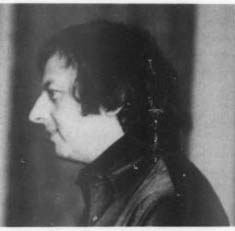
Conductor Andre Previn, one of the many distinguished guests to visit a NFGS Conference.
Activities
I can only give a broad outline as to what a Gramophone Society does since the movement has so many variations. I can say with certainty that they do not have a great interest in hi-fi as such. The mechanics of sound reproduction do play an important role, but in a well-run society it is an art concealing an art.
The equipment to reproduce high quality recordings is sine qua non.
Consequently, an embryo society's first task is getting together a good sound system. As a generalization one could say a gramophone society is for music lovers who are dedicated music listeners. This is a very important distinction. Let me explain.
A society's members can either have a broad musical horizon, or involve those who wish to further their musical knowledge and experience.
The obvious educational aspect is easily misunderstood. I do not mean a facility for furthering an understanding of musical mechanics, these already exist in many educational bodies.
The principal source of music is either radio through the BBC's outstanding “Radio 3” or commercial recordings in most UK towns and cities. Most live musical events will only come through amateur bodies (with inevitably, variable standards) and visiting national orchestras.
Those responsible for programming live events look first at the box office, so the tendency is toward putting on a “safe ” program. It follows, then, that if you are a music lover curious about lesser-known music, by little known composers or from other countries say, outside Europe, then the Gramophone Society is where you can satisfy your appetite.
I did say that one cannot generalize too much on how societies conduct their affairs. So with respect to programming philosophy I can only quote my own, in Norwich in the east of England as an example. It has been in existence for well over 35 years, and began as a small body of enthusiasts who met to provide recorded concerts for members of the Armed Services in the latter part of the last war.
I was not a founding member, but certainly one with the longest un broken membership going back well over 30 years. My service on the Norwich committee has also been almost without interruption, with a period as Chairman between 1963 and 1973.
Because of my professional back ground, it was my responsibility to oversee technical standards.
Our members have always heard the latest technical developments and I still recall with some pleasure the first time we demonstrated stereo in 1955. This, would you believe, was from the early twin track disks by Emory Cook.
Our Society's equipment, which is our main capital asset, is second-to none. We have the highest caliber disk playing facilities, all Quad (British) and including that company's superb electrostatic loud speakers. We also have access to other media, such as tape, and most recently we acquired a CD player so these recordings now appear more and more frequently iin our programs.
The interest in the media is never allowed to obscure the main objective of listening to a wide variety of music. If anything, there is a greater objectivity about new ideas than one might find elsewhere. For example, quadraphony stimulated little interest. We use the best possible source mediums where the musical needs merit them, but the technical quality of the actual program source is a contributing factor-never the dominant one.
The Society meets regularly each week, with the exception of August.
This gives the hard working commit tee and its officers a well-earned break, and in any case the summer months invariably see slackened support.
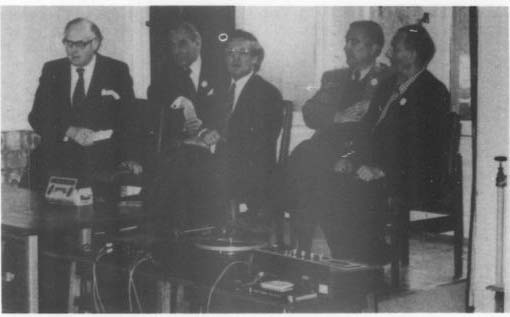
A Technical Quiz at a NFGS Conference. Our Author is in the center.
Forming a Society
Now, a word or two about how a good society is likely to get started, and ultimately managed. The first step is to bring together a few like minded enthusiasts. This can be initiated by a few words in the local press, possibly contributed by a sym pathetic local music critic. Find a venue for an exploratory meeting, which can be in a prospective member's home if only a are expected.
Provide some refreshment at the end of business, because one of the first principles to remember is that it is going to be a 'Society,' and that means social activity and not necessarily just listening to music. Quickly choose a chairman who is an experienced public meeting conductor to make for an orderly progression towards setting up the society. Then agree upon a small agenda for the chairman to work to, and arrange for someone to take the minutes. The first items in the minutes are the venue, those attending (with any apologies from those who could not make it) and the meeting's first action, appointing a temporary chair man. Right, you have begun.
Now, although this sounds obvious, the next item on your agenda is whether or not you actually want a Gramophone Society. When you discuss it, many obstacles and diverse ideas will emerge on what your society should or should not do, and it will become patently obvious whether it will ever take off. There must be a clear demonstration of support. The group may decided there is no suit able meeting place for quietly listening to music; in the UK this is often the biggest stumbling block. These are practical problems, and it would be foolish to proceed unless everyone is confident they can be sorted out.
If these hurdles are negotiated, then the next step is a working party to put it all together prior to a formal inaugural meeting. The party should be as small as possible, no more than three, and consist of a chairman, a secretary and someone with a financial understanding to act as treasurer.
If you find a meeting place, it can also be used for the general inaugural meeting. Again, this can be publicized through the local press.
going well, and sufficient support is indicated, then it is time to elect the full committee. I would t, in itially, the three officers and no more than three others. And so, it goes on.
I will not attempt to lecture readers experienced in conducting formal procedures well established in a general democracy, but I have been invited to many inaugural meetings, and given goodwill, setting up a gramophone society presents few problems. This new formal body also needs to draft a constitution. In the UK the NFGS provides sample constitutions on request, with adequate postage.
Titling I deliberately skirted the dilemma of a new society's title. If it is any com fort, the same problem is vexing many committees in the UK. The term 'gramophone' has a distinctly archaic ring, and for prospective members it does lead to misunderstandings about the society's aims, objectives and musical tastes.
At least two societies in the UK have dropped the word “gramo phone” entirely. They simply take the name of their town or city and add the suffix “music, ” and no more.
I attempted a small campaign to get this universally adopted. At least with uniform titles a society's special nature would soon become known within the community. But alas, it is an old movement and reactionary forces prevail for the time being, clinging to the ancient misleading title with nostalgic tenacity.
Now a word of caution I hope will not be misunderstood. It is my experience, which I must qualify by saying there are obvious exceptions, that professional musicians and those academically involved in music, are not ideal society administrators. I think the reason is that these professionals are more concerned with the notes than the music in toto. Talk to a professional pianist about Schubert, and he or she is more likely to be pre occupied with that difficult arpeggio in the B flat sonata. Outside that narrow horizon, it is unlikely such specialists will be much interested in the broader musical palette; nor for that matter, are they likely to have the right practical knowledge and experience in planning and administration.
Equipment and Planning
Assuming everything is firing on all cylinders, you should have both a venue and a committee ready to plan your first season of meetings. But wait, what about equipment? Well, initially, you might talk a local hi-fi shop into lending some gear, or one of your new members may be willing to provide some temporarily.
Eventually the new organization's structure needs to be run on sound business-like lines, with buying its own equipment a priority.
Make financial provisions for equipment as soon as possible. Your new members will be contributing to their new society by subscription, which will need to take into account a capital expenditure on equipment.
One device we have successfully adopted is to raise interest free loans from among the members, to be paid back within, say, two years. A barbecue here and there is also an effective source of capital.
Now we have a venue, some members and the first season of music to plan. At the inagural meeting, some will voice ideas which should be taken into account. As I said before, all societies have their own ways of doing things and the task of preparing a program can be either delegated to a program secretary or a sub committee. Norwich's entire committee shares this responsibility.
The 13-week season's central core consists of concert-type programs, perhaps an overture, then a concerto and possibly a symphony. Include a short break for refreshments-most important for social activity. Each program is usually introduced with spoken program notes by a commit tee member or a regular member who volunteers; not too long and certainly, not too erudite.
For those diffident about tackling such a task, let me say that preparing a program introduction is the fastest and most pleasurable way of augmenting one's musical knowledge. Specialized programs on some topic interspersed can be; perhaps a series on a particular composer or musical period. One of Norwich's most successful ventures was a sixteen-week series on the history of Western music, which took a year to prepare. This included paid guest speakers.
During my regime as chairman, I introduced a feature that is running to this day. We invited a living composer to come and talk about his or her music and we call it 'Composer Workshop.' Many famous com posers have been to Norwich since it started over 20 years ago, but these ambitious projects only come about when a society is healthy, confident and well established.
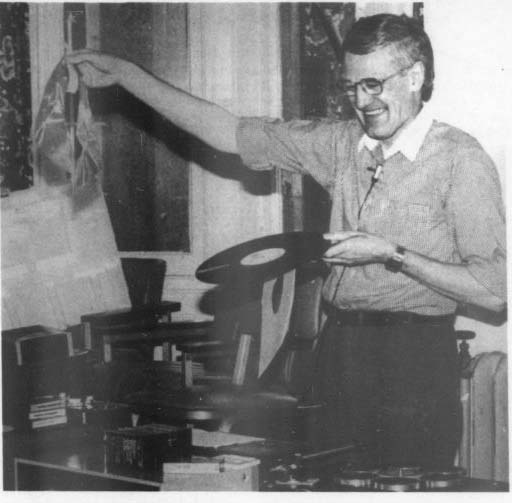
-----41 Reg Williamson demonstrating how to clean a disk on a
Sunday morning.
So, do you think a Gramophone Society would take off in your city? Naturally, if you want further advice write to me via TAA. Do be specific, please. If you wish I may be able to send a sample copy of a Norwich pro gram schedule. It may help. Do also include a self-addressed envelope with an international reply coupon.
Good luck!
ABOUT THE AUTHOR---Reg Williamson recently retired after an ex ceptional and possibly inordinate number of years in the engineering section of the British Post Office at Norwich in East Anglia, Eng land. He has since moved house, bought his first computer and set up a consulting service with his usual vigor and style. Soon he celebrates his fortieth year writing about audio. He advises that after tucking in his long, grey beard, he will favor us with a retrospective.
-Ed.
----
Also see:
LIVING WITH CD--A DIGITAL CHAIN REACTION, By Alan Watling