DECCA RECORDS MONTREAL'S PETRUSHKA
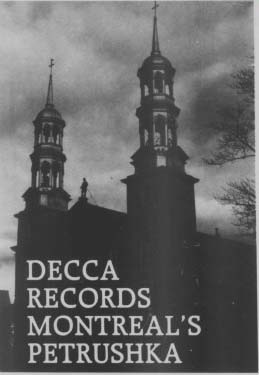
PHOTO 1: St. Eustache Church, the recording site for the Montreal Symphony,
is in a small suburb about 30 miles north and east of the city.
WALT JUNG STARTED the whole thing. During his investigations into compact disk player quality and evaluation of the audio circuitry, he became acutely aware of how much variation he was hearing in the soft ware (the disk) itself. He also noted how often the disks he preferred were from the Decca-London label. Walt began to suspect there were good reasons for this and finally called John Dunkerley, one of Decca's recording engineers, to ask some questions about what sort of equipment their recording teams were using.
Although Dunkerley's replies were modest, Walt became more and more convinced as the conversations progressed that the reasons for the high definition of London compact disks, especially those re-mastered from older analog recordings (what London calls its ADRM system), resulted from care fully crafted hardware in the recording chain.
In the course of time, Jung asked Dunkerley whether it might be possible to arrange an interview with him about recording techniques and philosophy, and also attending a recording session. Dunkerley was immediately agreeable and extended an invitation to come to a session in Montreal, Canada, where L'Orchestre Symphonique de Montreal, directed by Charles Dutoit, were to be recording, among other things, Igor Stravinsky's popular Petrushka.
The dates, October 22 and 23, turned out to be difficult for Walt, so the Editor volunteered to trek up the highways for the five-hour drive from Peterborough to Montreal. Montreal is a beautiful city, even under the overcast of a late October day. It straddles the St. Lawrence River which has leveled to plains above and below it from the old Green and White Mountain ranges on the south, and the Laurentian chain of mountains that rise to the north of it. Coming in from the east you always get a panoramic view of this remarkable city set against the backdrop of the mountain from which it made its name.
To St. Eustache From the sharp, feisty, glitzy down town, you take the main artery (20) eastward early in the morning and join the 60-80 mph traffic (or 100 to 135 kmh in Canadian). Take Route 13 northward past Montreal's two airports and continue for about 25 miles until the signs announce the turn-off for St. Eustache, a small Montreal bedroom suburb.
The community is sited on the banks of Thousand Islands River, just beyond Jesus Island. Its main thoroughfare runs parallel to the river, and the church is a couple of miles from the throughway.
Its gray stone front is topped by two enormous silver-painted tin spires so characteristic of Quebec's ecclesiastical architecture. (Photo 1) Each spire has a bell (calling the faithful in stereo, no doubt) but the main part of the structure appears to be timber. It seems quite large for so modest a suburb. One block away in each direction, a sign sits in the middle of the street (Photo 2) with the polite message 'SVP SILENCE, Enregistrement en cours,' which means, loosely, 'Please don't blow your horn, recording in progress.' I cannot recall hearing a single “honk” all day.
Large trucks are drawn up in the church's front plaza and young guards block all the doors save the one into the parish house. Inside, another functionary asks for your credentials and you are passed through after a word or two.
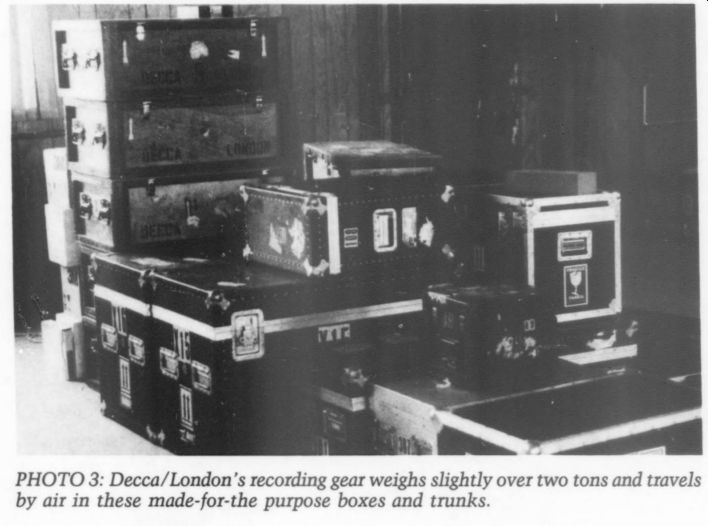
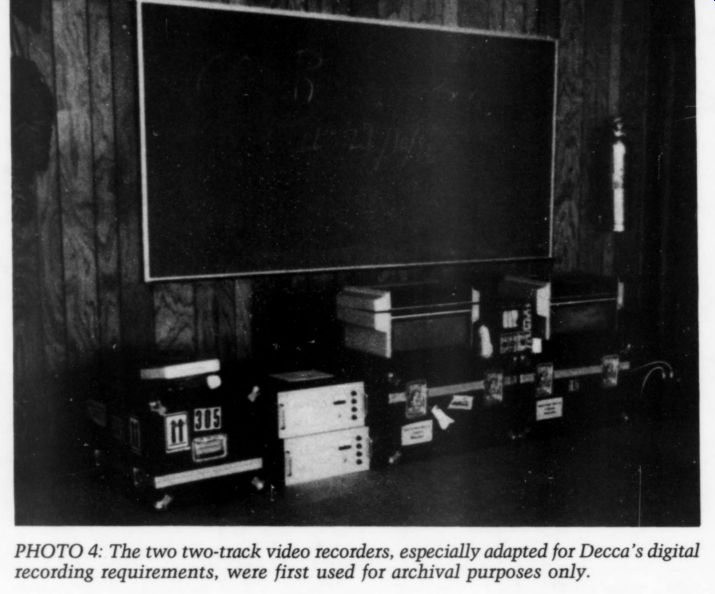
The large all-purpose room is heavily utilitarian with its brown lino floor, and shallow proscenium arch over a stage covered by dusty curtains. The kitchen hatches line the wall at the other end. An impressive pile of trunks ... ... and shipping crates is stacked at one side of the sacristy door (Photo 3), while on the other side are more trunks but also two 3/4 inch video tape machines which I've set up and obviously running (Photo 4). Several boxes of tape are stacked nearby.
Inside the sacristy-turned-control room, the front walls are covered with drapes, and sound absorptive panels line three other walls. A video monitor sits on the work area where chalices and the bread and wine are normally prepared for Mass, just below a nice art print of the Virgin. Two B&W monitors flank the video screen which carries a clear view of Charles Dutoit, leading the orchestra through its paces in the church nave.
Tough Critique
After the first take, Dutoit comes in followed by assorted musicians. He is damp from the exertion, looking older than his photos, clad in a short sleeved, blue-striped shirt, black corduroys, and well-used running shoes. The modular mixing console's controls are covered with large wood panels made for the purpose and everyone settles down to listen intently. The musicians, mostly those with solo parts or section leaders, line the walls, raptly attentive to the music. Dutoit makes copious penciled notes on a score. He and Ray Minshull discuss possible re-takes and some times disagree, resolving eventually and amicably one way or the other.
Inside the church, nearly all the pews have been taken up and piled in the side aisles, two sheets of plywood cover the entire floor. The Steinway and two celestas flank the conductor's podium.
Just behind the podium, the sanctuary is completely covered with heavy black drapes, and above the conductor, two slightly angled mikes are mounted in a “tree. ” A fill mike is in the center.
Several mikes are spotted around the floor for tympani, trumpets, wood winds, and other sections.
Before the red light next to the podium goes on for the second run through of Stravinski's Petrushka, I find my way up to the balcony. The next ten minutes confirm as fact some thing I have taken on faith since I first heard the words 'high fidelity sound.’ Our technology will never capture what can be heard in the live performance. for reproduction in our living rooms. The experience of sitting above 120 musicians playing at their very best is very different from the concert hall experience. The area is smaller, care fully chosen and adapted for sound intensity. The experience is something words will not do justice to.
The session proceeds in segments with many stops and starts. Interactions between the squawk box's disembodied voice of Ray Minshull announcing the take numbers and sometimes calling a halt to tell the conductor some soloist or group's tempo is inexact.
Breaks are called and the mostly young musicians stream to the back of the nave where black coffee with lots of chicory in it flows freely, although fruit juices are the more popular choice.
The lunch-break is 90 minutes and the group disperses to several surprisingly good local restaurants, returning promptly. Maestro Dutoit lunches alone somewhere in the building from his brown paper sack. The afternoon session proceeds much as did the morning. Takes and re-takes with infinite patience all around. Occasionally, there is a sharp disagreement. The maestro is unhappy with the lead trombone's loudness on one passage. The young man, neither awed nor particularly contrite, asks Dutoit exactly where the passage is and what is wrong with his rendition. The issue resolves. The re-takes go on.
Reluctantly, I leave L'Eglise de Ste.
Eustache just before sundown. After noon commuter traffic is moving soundlessly past the edifice at a steady pace in both directions. Montreallers are aware their orchestra is rising in the world's esteem. They take a fierce pride in that, which is why you will not hear the horns of their autos as an obbligato to your CD of Orchestre Symphonique de Montreal playing Petrushka.
-The Editor, Muses and Music
Since the music moves you, the muse is almost surely able to do so as well-the writer's muse, that is. Put pen to paper or better yet, typewriter ribbon to pa per with a clear, orderly account of your adventure in audio construction, or any related field of endeavor leading to good listening. Send it along with a stamped return envelope. We pay modestly for articles, so write us about it and we'll answer promptly with suggestions and tell you whether or not we are interested. Some of our best articles come from people who have never before written for periodicals. And if your muse is as silent as a tomb, don't let that stop you. Write anyway and let's see what develops. We have a nice sheet of suggestions for authors which we will send to nearly anybody who asks for it.
---------------------
INTERVIEW
This interview with Decca's John Dunkerley (JD) took place in the sacristy of The Church of St Eustache, Montreal, 22 October 1986. The questions were, for the most part, formulated by Walt Jung (AA).
AA: How much of this equipment would you guess that you built?
JD: Well, the digital recording system, as such, is completely home designed and home built.
AA: How much does it owe to the BBC!
JD: Not a vast amount. We learnt some thing from them; they learnt some thing from us.
AA: They were the pioneers though, certainly.
JD: We were using this system in 1978, when we first started. And of course it was never designed to be digital recording equipment, it was going to be for archival use to keep the master tapes in an unaltered state. And suddenly dig ital recording took off in 1979 and we thought, well, we might as well continue using it.
AA: Can you talk about what it is, technically?
JD: Sampling rate is 48kHz, the A-to-D (analog-to-digital) is 16-bits, that will soon move along to 18, actually, and the D-to-A is 18-bit capability.
We basically like to have a little head room, professional headroom. With compact disk being, in theory at least, 16-bits. And you need a little more leeway.
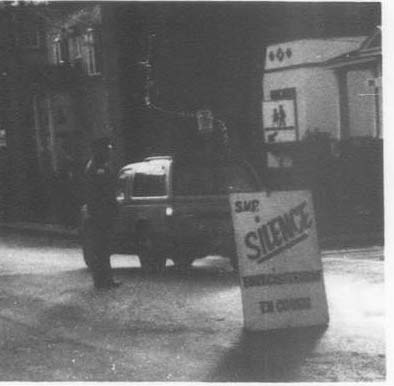
PHOTO 2: Street signs a
block west and east of the church ask motorists to maintain quiet.
AA: Any possibility you may go to 20-bits!?
JD: Well, the mixing equipment uses, I think, 24- or 26-bits inside, so there is plenty of leeway there. The only problem being analog-to-digital conversion.
AA: We mentioned microphones earlier, but I notice out in the hall, you have a central pair which seem to be the main ones, and then fill-mikes here, there and yonder, as it were.
JD: Yes.
AA: I thought I saw four channels running on the screen of the tape control computer. Did I!
JD: You saw only two, it goes straight down to two tracks, I mean. The last time we recorded here and did “The Planets' [Gustav Holst], I did the “ Neptune ” in four tracks, but in fact I ended up using the two-track mix I'd done here.
AA: So you really don't do multi-track recording at all?
JD: We do for opera, obviously for safety and for backup, because those are Very, very expensive sessions, as you probably know. It makes no sense at all, but at least with digital capability you're not losing anything. Because we now mix totally in digital domain with our in-house digital mixers.
AA: So you are going straight from A to-D directly.
JD: Basically, it starts as analog here (in the mike mix) and then the rest is digital until it comes out analog on the D-to-A in the CD player.
AA: That's moving a step closer to what a lot of people think is the purest way to do it. In a way it's like direct to-disk. This says a lot about your confidence in the digital process.
JD: I suppose it might have been easier for us to convert to digital in the first place because we were so used to doing two-channel recording. I mean we've always done that as a house sys tem. Whereas a lot of people have gone through the multi-track form in the late '60s and early '70s, so they then found it quite difficult to convert back.
AA: There have been a lot of embarrassed faces over CDs going out in multi-tracked form.
JD: We're not saying that we're perfect, but at least it was made easier for us.
AA: Do you find that one of the reasons why you can go back and bring your analog recordings on line faster is the two track format?
JD: I think so because we have been used to doing it in two channels.
AA: How did you happen to find this particular place for recording?
JD: Well it's due to what we would call our 'Mr. Fix-it’ here who is called Michel Pierre Boucher. He looks after the orchestral tours and is basically the orchestra's consultant for all that. And when we first looked around, our chief engineer, Jimmy Lock looked 'round the most. I came on later during tours 'round the churches. And I think we spent three or four separate trips to Montreal. We looked at about 40 or 45 different places. It developed that the only viable alternative at the time was Place des Arts, which is by no means an ideal place to record. We thought, well, maybe we'll have to do it there.
-----------
But then Michel Pierre's butcher, as a joke said, 'Oh, you must try this church in St. Eustache, ” because he thought, nobody's going to go that far out of Montreal center [About 30 miles.-Ed.]. But Michel Pierre took him at his word, and came and saw it.
By this time, Michel basically knew more of what we were looking for. So he rang Jimmy, who was in Chicago with me at the time, and said “Come and have a look at this church. ” So Jimmy came through, looked at it, and said “yes.” And then, that's how it happened.
AA: What were the criteria you used? Is there anything you can talk about in terms of size or dimensions generally?
JD: I think from what you've seen of this church you can deduce the general requirements. Obviously it is wide enough to take the full stretch string section and basses without being against the side walls. And also it obviously has depth, but also you have to remember the cubic capacity. It could be wide and long but if it's not high as well, there's no point.
AA: Does the curved ceiling have any thing to do with the choice?
JD: Yes, fortunately. Although barrel vaulting can cause a problem if it is a smooth vault because you get bounce from one side to the other, and a very confused image. But with the decoration you see in this church, there are lots of curved, broken surfaces, and lots of roses which fortunately scatter those rather troublesome reflections you can get.
AA: CDs caught on very big the world over and the many advances are quite obvious, yet many audiophiles have been openly critical of the medium and the players, and so on. To what extent do you think the criticisms may be justified?
JD: Rather indirectly, I was involved with some CD player upgrade projects.
I did quite a lot of listening tests, off the cuff, with some designers. At first we were beginning to wonder whether, in fact, the CD system was wrong after all, because I knew what we'd got on our master tapes. What we were getting on the early generation CD players didn't seem to agree. When they brought along the later revisions, they were closer. Then when they brought the latest prototype for us to listen to we asked, ‘What have you done to this?' Basically, they'd got much, much further.
AA: So is what you're saying that the criticism of CD is really in terms of the reproduction equipment, which was, at first, inferior!
JD: It seemed to be that the analog circuitry was deficient. Because the basic system is extremely fine technically, and an exceptionally polished device.
AA: The rumor is the designers of the players were up against short deadlines, and reached for something off the shelf in the analog section.
JD: Of course most people quietly have forgotten that CD came through quickly. It's now an established and burgeoning standard. Considering how little time they had, it's not surprising if they were deficient.
AA: That has become a concern of Audio Amateur because Walt Jung, one of our editors and an expert in op amp technology, took a look at the devices in the output sections of the players and knew right away they were very poor. He suggests I ask you how close to the quality of your master digital tapes can the audiophile come in reproduction at home!
JD: I think now what one gets at home is extremely close. I suppose one must do a lot of CD and master tape comparisons before one learns what to listen for. It's a learning curve. I think I know better than most people whether the differences are small or great, and I would say now they are very small. Ob viously there are still differences, but they are very, minor differences.
AA: Philips have now come out with the 16-bit, four-times oversampling, but even then the audio section does not seem to have had much benefit of change.
JD: But then again, in their defense, I must say that they're up against com petition in that area, and unless they go into the rarefied audiophile scene, then they are limited by what they can ...
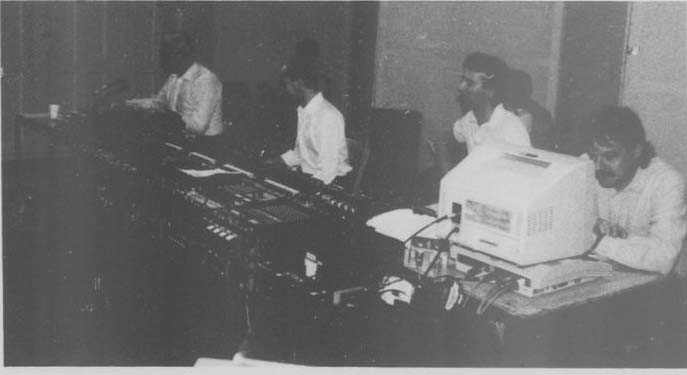
At the mixing/control desk (PHOTO 5, above) sit Ray Minshull who reads
a score aloud, John Dunkerley, chief engineer who handles the mike controls,
Simon Edon, assistant engineer, and Martin Atkinson who monitors the
main signal levels and timecode on a much modified Apple II feeding a
green monitor.
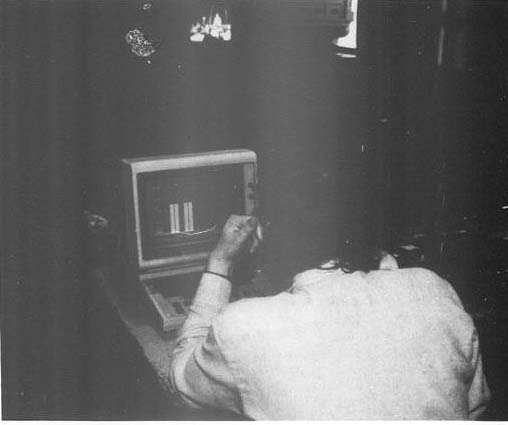
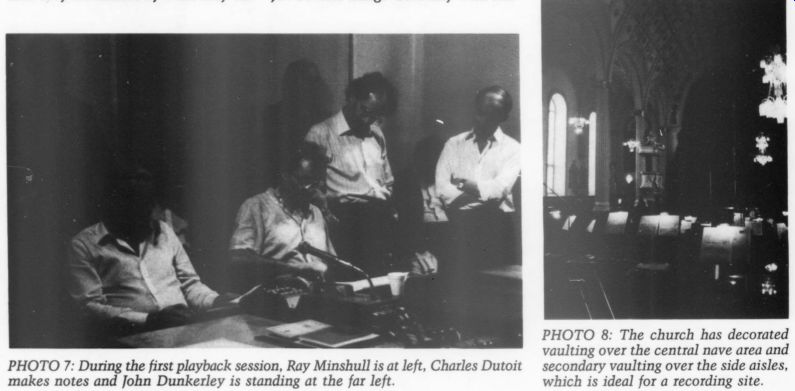
PHOTO 6: Looking over Atkinson's shoulder as he monitors the Apple's
screen, the Digital to Analog converters and recording amplifiers are
visible at the left, one of the B& W monitors is just behind the
computer, and the video monitor view of the podium is visible behind
that.
Photo 7.
PHOTO 8: The church has decorated vaulting over the central nave area and secondary vaulting over the side aisles, which is ideal for a recording site.
... spend on the audio section. Having listened to Philips' new machine, I must say its output is very, very close to our master tapes.
AA: What do you reply to people who say, “Well I think the CD is wonderful, but I prefer those made from analog tape masters! ”
JD: Several things. Basically with analog tape you get this nice comforting carpet of tape hiss which hides an awful lot of evils. At the top end you'll get tape saturation which softens the VHF end. And you'll get some nice inter modulation which will also give a sort of comforting glow to the middle section with a falling low frequency response. So you are opening up yet an other window onto the scene with the CD. So some things you don't think should have been there are there, but also I don't think everyone's got used to recording in digital properly yet.
They have a little more distancing, perhaps.
AA: In a lot of what is being written in Studio Sound, I notice bitter complaints from engineers about material they previously recorded being used in a medium for which it was not recorded.
What would you say the essential differences are!
JD: I think a lot of that argument seems to be on the multi-track pop side, where they've done mixes for black disk, and they've EQ'd things and done different things to get it onto that medium. We believe in doing the best possible mix which we hope will be all right for vinyl, but as far as dynamic range is concerned, an audio cassette requires a different approach.
AA: In reprocessing an ADRM (London Decca's Analog-to-Digital Remastering system) would you wish to comment on whether that could be characterized as “analog sound! ”
JD: I think, as far as we are personally concerned, we've had less of a transition from analog-to-digital and certainly in the remastering. We're finding that an awful lot of things were missed in the much earlier days when they didn't have such sophisticated monitoring.
They had noisier control rooms. We certainly find a lot of the edits are what we'd say “bump,” usually somewhere at the bottom end, because there's been traffic, or then the traffic has gone off at the edit point, also underground trains. So that requires a lot of attention. But a lot of the basic sounds don't require any dressing up at all because they were basically very good to start with.
AA: In terms of how Decca approaches a classical recording session, how much do the general techniques vary from orchestra-to-orchestra, or from hall-to hall?
JD: Well, of course, they must vary.
The basic techniques in what we would call microphone set ups, usually a combination of two main mikes and then two outriggers, or possibly a three-mike tree as we would call it, and the outriggers. It doesn't change too much. The way you actually use the additional microphones does alter quite a lot.
AA: Based on the hall?
JD: Yes. We try to work on the premise that, first of all, we will attend to the hall itself. For instance in Chicago's Orchestra Hall, there's a very large stage extension built out, so that you actually work far more into the hall. Of course, it is a “dry ” hall. And then there are large reflecting surfaces put over several of the balconies. And then after doing all that, then you work on the rest of the setup.
AA: Does it stay pretty much the same from session to session?!
JD: It can, but as a rule, I wouldn't say that it is precisely the same.
AA: I was curious as to whether you had some basic minimum mike set up with only the fill mikes changed for the program material.
JD: Yes, the basic minimums would be the mains, the woodwinds, the horns and the tympani. The rest will change.
For instance, in here, I use a very small amount of a brass mike. They are a long way away because of where the pillars are sited in the church. The de lay becomes a little too great, and also they sound too distant. So I just use a fraction of that.
AA: You've had an opportunity to re cord with some of the world's finest conductors. Would you care to say who some of those are!
JD: Sir Georg Solti, Herbert von Karajan, Sir Adrian Boult, Neville Marriner, Vladimir Ashkenazi, Riccardo Chailly, all sorts of people like that.
AA: You don't go back as far as Emest Ansermet!
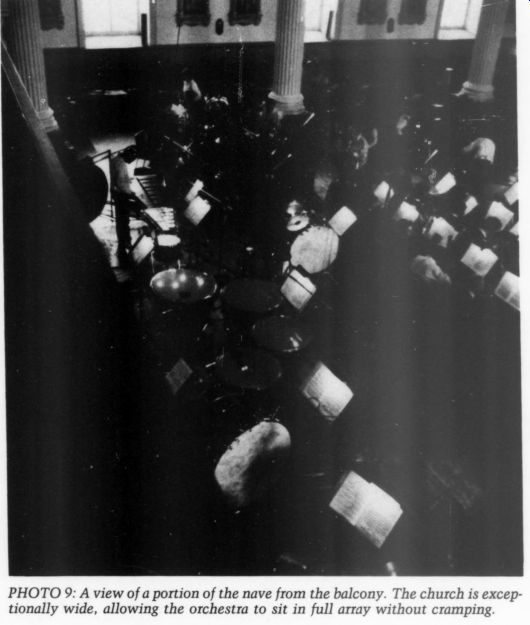
--Photo 9.
JD: No, he was just before my time.
Which is a sadness. I would like to have recorded with him. Also, I would have loved to work with Pierre Monteux. I am still trying to persuade the company to put out the Monteux recording of El gar's Enigma Variations which I think is a fabulous version.
AA: Maestro Dutoit's strong interest in the quality of the captured sound of the orchestra is well known. To what ex tent is his guidance of the recording process during the session unique?
JD: Well, Charlie is particularly conscious of orchestral color. And one of his very strong points is getting a blend between the sections.
AA: I notice he has a great deal of in put during the playback sessions.
JD: Yes. This orchestra seems to be so keen. Not just because they want their section to be heard, but they want the whole thing to work properly.
AA: | noticed a seated timpanist during one of the passages listening intently, although having no part to play for that stretch, and when the tough pas sage went by, his thumb went up energetically. This seems to show a lot of esprit de corps I think. Do you find some composers more difficult to re cord than others?
JD: Depending on the combination of the orchestra and the hall, some com posers will be more difficult to repro duce properly. I mean Mendelssohn can sometimes write quite thickly for a bass-heavy hall, or for a heavy string section, that can be difficult. It does depend on the conductor and where you are doing the recording.
AA: What other problems do you have!
JD: Well, one of the weaknesses we are still having is the loudspeaker and how it interfaces with the room. You'll notice we've had to do quite a lot in here.
AA: This is the sacristry, I take it?
JD: Yes. When it's empty, it's absolutely like a bathroom! We have to do quite a lot to it acoustically to make it usable. But we also have a lot of help from B&W [Bowers and Wilkins] who are interested in making better loud speakers.
AA: Do these have their new “honey comb matrix ” type cabinet?
JD: No, these are the 801s. We hope they will work on a new version which will incorporate the “matrix” type walls.
AA: What technical advancements do you hope London can make! Or what can the industry do to give us a better product!
JD: Well, obviously I would like to see the front end a digital mixer.
AA: Is that in the works?
JD: Possibly in the next five years.
We've got line-mix obviously, so once you've got it into digital you can then do quite a lot with it.
AA: Do you think front-end digital mixing will improve your capability?
JD: Well, it will give us more flexibility and I'm sure it will help in the end to make the product just that little bit better.
AA: It sounds as though you are happy with the way things are going technically.
JD: Well certainly, we're lucky in our company that we have our own digital R&D (research and development) department.
AA: Are you unique in that respect?
JD: I don't know, but I don't think many other companies have their own R&D. Most of them buy in whatever equipment is in the marketplace.
AA: Do you find Polygram supportive in your R&D efforts?
JD: Yes, we're now delivering digital mixers to the rest of the Polygram group. Therefore, they find at least they never have to wait for others to turn out what they need.
AA: So you are doing mixers for other labels?
JD: Well, just for the members of the Polygram group. In that respect we are lucky in that, if we say to the front office, ‘Well, we would like this equipment, what can you do about it?' They will certainly think very seriously about it, because they have given us a very flexible digital equalization section, which means that if you have some traffic rumble on a tape that you'd like to get rid of, you don't have to go back to analog domain to get rid of it. You know that with CD, if we can hear it, so can the rest of the public.
AA: I am delighted to hear that London has its own R&sD and that Polygram are being supportive. One of the com plaints we often make is that audio company managements so seldom give real &D support to their engineering teams.
JD: Well, we've had our fights with the accountants. You wouldn't be a proper company if you didn't. We are lucky to have it, and long may it continue.
Decca
----------
By The Editors
----
Also see:
PREEMINENT PHONO PREAMP, By John H. Roberts
A MOVING COIL PREAMP PART II, By Erno Borbely