When it comes to assessing amplifiers, artists and engineers employ different needs, criteria, and standards. This author examines these opposing viewpoints in the great debate between objective and subjective evaluation.
The audio world is divided between those who live by the objective measurements of audio performance and those who judge audio performance by careful listening. The objective group has formulated a variety of arguments and electronic tests based upon the assumption of the linearity of hearing or upon the ability to detect a difference between the device under test and a standard. The subjective group, un fortunately, is left with an inadequate, nonstandardized language to express its listening impressions.
Battle Lines
As the history of audio shows, this has been a losing battle for the artistic nature of audio, since the "objective" engineers follow their paradigm that amplifiers are supposed to replicate their inputs without embellishments. Unfortunately, it is some of those embellishments that artists prize, and they choose equipment with that in mind.
However, much of the audio world has proceeded to embrace an increasingly sterile, cold, thin, lifeless, and some times harsh character, while the subjective artists prefer what is warm, fat, full bodied, and alive.
Some years ago, I decided to translate the wonders of tubes into solid state, and in doing so I ran into the conflict be tween the engineering paradigm and subjective desire. Ultimately, to successfully translate the character of the vacuum tube, I needed to open my engineering About the Author Eric K. Pritchard is an artistic engineer with degrees in mathematics and electrical engineering. He is a prolific inventor, with 32 US and many foreign patents. Nine teen of these, plus others still pending, are in the general area of translating and exaggerating the nonlinear vacuum-tube character to solid state. Mr. Pritchard is the founder of Pritchard Amps, a West Virginia company in transition from research of artistic amplifiers and mind to different concepts, to reexamine my engineering background and mindset.
My degrees are in mathematics and electrical engineering. Although engineering involves a lot of mathematics, it has very little of the formality of mathematics, which is based upon the full and complete statement of assumptions, theorems, and corollaries. Engineering, however, proves a point by making assumptions along the way and later often forgetting about them. Where mathematics builds on the firm foundation of precise logic, engineering often cannot af ford such precision. Mathematics usually has the luxury of time, while engineering often must make sense of complex devices on the way to meeting a production deadline.
Carlos Santana introduced me to the subjective side of audio while I was visiting the Paul Reed Smith Guitar factory in 1987. He explained that my first at tempt at a solid-state guitar amp was like "white wine" and "glass," not like "red wine" or "flesh." Later, Al Di Meola further confused me by declaring that my third attempt was "dead" in spite of functioning.
I took these rejections seriously, since I was determined to make the greatest guitar amp ever with solid-state components. However, they did not provide much of a clue, because they were not couched in engineering language. But I did know that something was wrong. I eventually reexamined my engineering schooling and my two decades of engineering practice.
The Engineering Paradigm The engineering paradigm is that an amplifier should replicate its input without any embellishments, a dictum that was established threescore years ago RELATIVE INTENSITY (dB) and more. This paradigm is the basis for total harmonic distortion (THD), inter modulation (IM), frequency-response tests, and so on, and is quoted in most audio-equipment specifications. But is it correct? The paradigm is not completely correct. The example of true fidelity in the Radiotron Designer's Handbook! came from Voigt.
The situation of a listener in a room with a window on a concert hall was claimed to be the nearest approach to true fidelity. However, the attenuation of the "window," combined with the nonlinearity of hearing as measured by Fletcher-Munson, produces a different apparent frequency response (Fig. 1).
That is hardly true fidelity. In fact, the loudness control was invented to compensate, at least partially, for this hearing characteristic. Further, since the apparent loudness is nonlinearly related to the sound pressure, the variations in concert levels will be perceived differently.
The Paradigm vs. Jason Audio notables Stanley Lipshitz and John Vanderkooy* proposed "accuracy" as the hallmark of audio, even though much of audio recording processes are not chosen because they are accurate, but be cause they sound better, or are other wise preferred. The measure of accuracy was the detectability of any difference between the device under test and an established standard, with, of course, every effort to make such a comparison reason able. Obviously, this is a restatement of the engineering paradigm.
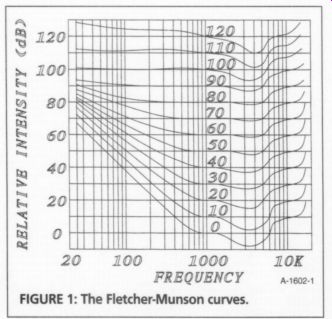
FIGURE 1: The Fletcher-Munson curves.
Raymond Jason noted that the judgment of highly complex audio signals of loudspeakers in listening rooms "does not lend itself to definition." He recommended that "preference" be the basis of judgment.
The paradigm appeals to the intellect, while the subjective preference appeals to the emotions. However, emotions often have the greatest impact upon decisions,® while the intellectual advertising appeal is inefficient. The "accuracy" of bland food is not as appealing as food with spices and sauces, as long as the spiciness is not overdone.
The Paradigm vs. Terman
The highly respected Dr. F. E. Terman wrote, "The ear has a nonlinear response to sound waves of large amplitude. The result is that with powerful sound waves the ear produces harmonics, as well as sum and difference tones that are not present in the original sound and yet are actually present in the hearing organs and are perceived by the brain."" Dr. Terman also explains the phenomenon noted by vacuum-tube proponents that tube amplifiers seem to have an extra octave of bass. This is probably produced by "subjective tones." "The apparent pitch of a sound is not changed by removing the fundamental frequency, since the harmonics combine in the ear to produce a difference frequency tone [i.e., the missing fundamental]." So the fundamental with harmonics may be understood by the brain as still lower frequencies.
The paradigm is also not completely logical because it insists on a linear sys tem for human hearing, which is not linear. While accuracy is laudable, the point of measurement is not correct, only simple. The measurement should take place after the hearing process, not before. With certain reservations, listening is believing.
The Paradigm vs. Hamm
There are people whose hearing tells them that amplifiers with certain embellishments in reasonable quantities are better than amplifiers without such embellishments. In addition to artists, there are some audiophiles and recording engineers who appreciate appropriate embellishments. Russell Hamm?, a recording engineer, was frustrated with the then new transistor-based recording equipment, microphone amplifiers in particular, and he investigated. He determined that peak microphone levels would distort the microphone preamplifiers.
The tests previously mentioned pro vided no reason why the old vacuum tube microphone preamplifiers sounded better than the new and "better" solid state preamplifiers. Mr. Hamm, who later became president of the Audio Engineering Society, ultimately devised his own test: plotting the percentages of each harmonic as a function of over drive. The resulting plots distinguish the various technologies tested: triodes, pentodes, transistors (two types), and operational amplifiers. The triode vacuum tube microphone preamplifier-embellished with its unique harmonics-was judged the best.
Perhaps a word about assumptions is needed here because this story involves two groups speaking the same language but with different assumptions. The de signers believe that their circuits will be treated with a certain reverence and not be overdriven. Hence they can apply feedback of all sorts with only one thought in mind: stability.
However, the recording engineer often would let the preamplifiers clip so that the noise floor would be lower. The feedback and biasing of transistor amplifiers reacted harshly to going beyond the assumed range and into clipping. They were not designed for that.
The Paradigm vs. Accepted Distortions
The paradigm is not completely logical in view of general audio practices.
Recording has many steps that alter the character of the signal. The recording engineer and producer choose various types of equipment to make the end product sound better. Microphones are chosen for their sound, and different microphones are typically used for different instruments. (Tony Bongiovi, of the Power Station in New York, preferred the U47, a famous, revered, old Neumann studio microphone, saying, "It has to do with the harmonics and the way they combine with soft music.
On loud passages, it overloads some .."?) The microphone signal is then amplified by a preamplifier that is also selected for its character, just as Russell Hamm did. Then it is compressed, equalized, mixed, and recorded, all of which are also chosen for how they sound. The compressor introduces scale distortion. The equalizer introduces frequency distortion. Even the recording systems are used for certain effects.
Later, the playback systems include volume controls (scale distortion) and tone controls (frequency distortion).
The intentional distortions of both recording and playback belie "true fidelity" and make the inclusion of some "musical" harmonic distortions reasonable-a matter of taste. In fact, they can make the audio sound loud even when it is not so loud.
The Paradigm vs. "Everybody Hears Differently"
A common response to objections to the engineering paradigm is that every one hears differently, a view that re quires careful scrutiny. The excuse for a single-concept paradigm is that people apparently listen and make judgments differently. There are two possible solutions to this dilemma: either people need a choice of solutions to fit their individual tastes, or their language for describing what they hear varies considerably. One definite conclusion can be drawn, however--the paradigm does at tract complaints.
One explanation for so many descriptions of listening experiences is that there is no standardization of the descriptions of aural sensations. How do you evaluate "distorts too fast," "three-dimensional," "dead," "alive," or "sounds like" glass, flesh, white wine, red wine? No one with a predisposition for the paradigm would give such descriptions a second thought because people hear differently, or they are just nostalgic, or they reflect some other human frailty.
The Paradigm vs. Weighted THD
The standard, non-weighted THD test does not accurately predict listening displeasure. An amplifier with a high THD can sound better than one with a low THD. This phenomenon was tracked down to the influence of high-order harmonics. Since their influence upon listening displeasure is greater, they should be given more weight.
Consequently, weighted THD was developed. One weighting function has coefficients equal to the harmonic number, and another is equal to the square of that number. The latter actually produces numbers that correlate better with listener appreciation tests. !! None of these tests place any positive value on any harmonic at any level. Thus, even weighted THD does not accurately predict artist appreciation. There is a value to some harmonics at some levels, as proven by the many artist preferences.
Electronic Enigmas and Linguistic Mysteries
The engineering community has declared that transistor circuitry has been beyond tubes for many years, at least ac cording to their paradigm. However, many artists do not agree. They have ...
-------------------
Fletcher-Munson Curves Show Nonlinear Hearing
The Fletcher-Munson curves are a graphical depiction of human hearing capability as measured by researchers Fletcher and Munson and published in 1933. It shows the frequency response of the ear at various levels. Each curve represents a constant apparent loudness. The value associated with each curve is its value in phons.
At 1kHz, the phon scale and the decibel scale coincide. At different frequencies they differ, often considerably. They distinctly show the phenomenon that bass sounds good only when turned up, because at low levels, a given decibel level produces a much lower phon level. To a much smaller degree, treble displays the same phenomenon.
The nonlinearity is viewed by looking at the spacing of the phon curves along the vertical constant-frequency lines. Once the bass is finally heard it apparently becomes larger quickly. Then above 80dB, it becomes louder at a slower rate. This change between quickly and slowly is a nonlinearity. These changes between quickly and slowly are different at different bass frequencies. Similarly, but differently, the distances be tween the adjacent phon lines change also.
If hearing were linear, the phon curves would be equally spaced at each frequency.
Thus, all the lines would radiate from a point somewhere (even at infinity). Of course, if hearing were flat, the phon curves would be flat and level. Certainly, since these curves are neither straight lines, nor equally spaced, nor flat, they raise the question of the engineering demand for absolutely flat frequency response and near zero distortion.
Figure 1 was redrawn from the Radiotron Designer's Handbook, Fourth Edition, 1953, p. 826. Although there have been other measurements of the Fletcher-Munson curves, they do share the general shape by not being evenly spaced at every frequency, as linearity demands, and not being flat as a flat frequency response requires.
-EKP
-------------
... long held that tubes still are the measure of artistic performance. Unfortunately, artists and engineers are two peoples separated by linguistic misunderstandings, and the tube phenomenon has remained an engineering aberration until the development of my technology.
With no guidance from any source and no understandable artist critiques, my progress depended upon realizing the limitations of human hearing. The ear and mind are quite adept at diagnosing situations for which it has been trained. However, since artistic amplifier development is new ground, the listening and playing tests did little more than indicate failure. Getting a critique that provided a clue was unusually lucky.
Conclusion
If the formality of mathematics were practiced in audio, the engineering paradigm would have been discarded for a more accurate concept long ago, be cause these counter-examples show the paradigm to be only partially true. How ever, the informality of engineering will accept partial truths, which seem to get the job done. Unfortunately, these partial truths themselves often become paradigms that are then regarded as being above reproach.
Perhaps the passion engineers have for their paradigm is a frantic orthodoxy that was explained by Reinhold Niebuhr as "never rooted in faith but in doubt. It is when we are not sure, that we are doubly sure."
REFERENCES
1. Langford-Smith, Radiotron Designer's Handbook, Fourth Edition, 1953, p. 603.
2. P.G.AH. Voigt, "A Conversational idea from England," Audio Engineering, 34.10, October 1950.
3. Langford-Smith, op. cit., pp. 826-827.
4. SP. Lipshitz and J. Vanderkooy, "The Great Debate: Subjective Evaluation," JAES, vol. 29, pp. 482-491.
5. M. Raymond Jason, "Design Considerations for Loudspeaker Preference Experiments," JAES, Vol. 40, No. 12, pp. 979-995.
6. Barry Feig, Marketing Straight to the Heart, American Management Association, New York, 1997.
7. F.E. Terman, Radio Engineering, McGraw-Hill, 1947, p. 863.
8. Russell Hamm, "Tubes Versus Transistors-Is There an Audible Difference?," JAES, May 1973.
9. "Neumann-the History of Tube Condenser Microphones," Recording Engineer, February 1980.
10. G. Randy Slone, High-Power Audio Amplifier Construction Manual, McGraw-Hill, 1999, p. 17.
11. Langford-Smith, op. cit., 1953, pp. 610-611.
Also see: