TOP OF THE PILE
Denon's Digital Technology
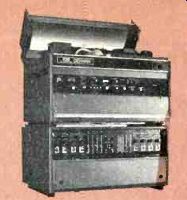
Japan's Denon Company was the first, back in 1972, to produce commercial digital recordings. For the most part, their efforts went unnoticed in this country, due to their lack of cross-licensing ties with any major American record company. In recent years, at least in the U.S., digital recording technology has become almost exclusively associated with blockbuster showpieces, the technique being exploited purely for its sonic values. (On too many occasions, it has been the excuse for charging more for a poorly produced recording.) Denon has over the years continued to use their digital resources for the bulk of their product--most if it definitely not of the blockbuster variety. They have refined their technology during this time, but curiously they have stayed with a 14-bit system while much of the profession al industry has gone to 16. This difference means only that the Denon system basically has a dynamic range of 84 dB, while the 16-bit machines have 96 dB.
For some years, the Discwasher Company has been importing Denon discs into the States, and during the last year I have been provided with enough review albums from them to allow for an overall assessment of the system.
Meanwhile, the digital versus analog controversy rages on. Digital recordings have been publicly blamed for provoking stress and causing headaches. Lord only knows what accusations may have been made in private. From the point of view of production variables, digital recordings are subject to exactly the same excesses that have plagued the main stream of classical recording in recent years: Too many microphones, too much gain manipulation, and other aspects of what we may call "over production." In many cases the released discs themselves are cut at excessive levels, resulting in some edginess to the sound.
If anything, the digital medium bares these faults all the more! It is small wonder that some critics have, without a knowledge of cause and effect in recording processes, zeroed in on "digital" as the culprit when they hear a digital recording they don't like.
One thing is certain: No one can condemn a digital recording system unless he has actually had the machine in his own hands and had the experience of making blind comparisons of its input versus output on a wide variety of pro gram material. One positively cannot make such a judgment on the basis of isolated digital discs because the wide range of production variables and the mechanics of disc transfer and playback will easily swamp the characteristics of the digital recording process itself.
The reason for this rather long-winded preamble is to suggest to the reader that if you find even one superb recording made with a digital process, then that record becomes the vindication of that particular recording process. In a larger sense, it becomes the vindication of the charges which have been leveled against digital technology in general.
Many critics made this positive judgment of the merits of digital recording long ago. For those who haven't yet done this, I suggest that you get your hands on the following two-record set:
Schubert: Symphony No. 9 in C Major (Heinz Rogner conducting the Berlin Radio Symphony Orchestra). Denon OB-7351-51-ND, digital, stereo, $15.00.
This two-record set is a collaboration between Denon's Nippon Columbia label (no relation to CBS) and the East German VEB Deutsche Scallplatten Company. The sound is gorgeous in every respect. The ensemble is precisely imagined in both left-right and fore-aft dimensions. Above all, there is a naturalness to the spectral balance, and the strings have a lovely sheen which bespeaks the proper choice of micro phones and their placement. The recording venue is a semi-draped church in East Berlin, and the producers have found that happiest of combinations, the correct reverberation time and the correct balance between direct and reverberant sound. The result is warmth coupled with analytical detail. All too often, one attribute has to be sacrificed for the other.
The sprawling work is spread over four sides, with an average of about 14 minutes each. This ensures that the ending diameters are suitably large to avoid inner-groove problems. As we have come to expect of just about all Japanese discs, the pressings are faultless.
The double-fold jacket is in French, English and German, as well as Japanese. Photos of the recording session re veal an overall spaced-apart pair of microphones along with an ensemble of six accent microphones, highlighting the first chair strings and providing a secondary stereo pick-up of the woodwinds and brass. Altogether, this is a hand some production, one which will set the record straight on digital for many audiophiles.
Here follow some capsule reviews of other Denon digitals.
Mozart: Symphonies Nos. 36 and 38, Otmar Suitner conducting the NHK Symphony Orchestra, OX-7156-ND.
The Japanese state radio orchestra is given much the same luminous treatment noted in the Schubert, this time in a more intimate acoustical setting.
Vivaldi: The Seasons, Rudolph Baumgartner conducting the Lucerne Festival Strings, OX-7174-ND. Spirited performances along with finely etched sonics.
Janos Starker: Virtuoso Music for Violincello, OX-7171-ND. One of the world's great cellists sumptuously re corded. The Chopin G-minor sonata is the chief work here.
-John M. Eargle
The Delos Series of DMS Digitals In early 1979, Delos Records, a Los Angeles-based classical label, em barked on an ambitious program. Amelia Haygood, the label's founder, noted that digital recording technology had for the most part been relegated to showcase orchestral recordings with heavy emphasis on sound for its own sake. She reasoned that there would be an audience for high-technology recordings of music-making of a more modest sort, such as chamber groups and solo performers.
Haygood also felt that such music could benefit just as positively from advanced recording processes as the heavier orchestral textures that were the mainstay of so many other labels involved in digital recording.
At the present time there are 10 items in the series, with four more due for re lease in the fall of 1981. Following are capsule reviews of several of the DMS records:
Vivaldi: The Seasons. Gerard Schwarz conducting the Los Angeles Chamber Orchestra, Elmer Olviera. violin. DMS 3007, $17.95.
Gerard Schwarz has worked wonders with the Chamber Orchestra, continuing in the traditions of its founder. Neville Marriner. The playing is precise and has all of the rhythmic drive which this music characteristically needs. At the same time the playing is fluid and yielding when it needs to be. The recording was made in Bridges Hall at Claremont College east of Los Angeles. This recital hall is one of the finest recording venues for modest musical resources anywhere; its wood and plaster interior provides plenty of reverberation, but the reverberation time is short enough that articulation does not suffer.
The lavish production includes a double-fold album complete with thematic analysis of the score, along with facsimiles of Vivaldi's sonnets which accompanied the original scores for the four concertos comprising the music. Only one minor flaw needs to be mentioned.
There is some groove echo to be heard in quiet passages or in passages where the solo violin is playing. Some of this is endemic in disc transfer processes themselves, and the nature of the music, as well as the exceedingly quiet surfaces, makes it more apparent than might normally be the case. It is, however, a minor problem which most listeners will not be aware of.
Water Music of the Impressionists. Carol Rosenberger, piano. DMS 3006, $17.95.
Ms. Rosenberger plays a Bosendorfer Imperial Grand in this program of music by Ravel, Debussy, Liszt and Griffes.
The recording venue again is Bridges Hall. At the time was made, the instrument was fairly new, and its relatively soft hammers did not provide the attack, or ictus, which is characteristic of an instrument thoroughly broken in. In addition, microphone placement was a bit on the distant side, and the net result is a mellowness and fullness which is perfectly appropriate to the music at hand. The gorgeous sonorities of the Bosendorfer are at times seemingly transformed into a new instrument, almost a cross between a harp and a piano. Rosenberger's playing is stunning, and her performance of Ravel's--Ondine" is the equal of any.
The Bosendorfer Imperial Grand has 97 keys, nine more than usual, for added low-frequency resonance. The extended bottom octave is very tempting to a pianist. There are a number of doublings in the bottom octave which would be musically compatible with the impressionistic repertoire, but Rosenberger uses this facet of the instrument only in one passage, the tolling of giant bells in Debussy's "Engulfed Cathedral." The low C-string with its nominal fundamental of about 16 Hz yields a sound rarely heard either on disc or in the concert hall. The JVC pressings are as quiet as one could wish for.
The Sound of Trumpets. Gerard Schwarz playing music of Altenburg. Biber. Vivaldi, Torelli and Telemann. DMS 3002, $17.95.
This album was among the first in the DMS series and was recorded in the Ma sonic Temple Auditorium in New York City. Orchestral accompaniments are by the Y Chamber Orchestra of New York, conducted by Schwarz. In three of the works Schwarz is aided by members of the New York Trumpet Ensemble, and the high' point of this ensemble playing is undoubtedly the "Sonata for Eight Trumpets" by Biber. The orchestral playing again evinces the conductor's flair for rhythmic drive coupled with a yielding or bending of rhythmic flow as dictated by the music.
Although tote disc was transferred at normal levels, beware the problems of inner-groove mistracking. If you hear any breakup whatever on loud passages, I suggest checking out your phono cartridge. With a really first-rate cartridge, the sound will be absolutely flawless.
Ravel and Bartok. String Quartets. The Sequoia String Quartet. DMS 3004, $17.95.
The Sequoians, in residence at the California Institute of Arts, give us a broadly paced and leisurely performance of the Ravel work. The recording venue was the auditorium at Immaculate Heart College in Los Angeles. The lushness of the recorded sound, along with the broad stereo spread, works wonders for the Ravel. The Bartok "Third Quartet," on the other hand, is not as well served.
This music ideally calls for a thinner overall texture and precise highlighting of instruments. Again, we are treated to flawless surfaces.
-John Eargle
Die Mannheimer Schule (The Mannheim School). Music of the Early Classical Era. Camerata Bern. Archive 2723 068, 3 discs, stereo, $29.96.
Sound: A- Recording: A Surfaces: A
D-G's Archive Series began way back in the early mono LP days. with sets of buff-colored single records complete with a frightening amount of German scholarship, though the music was excellent. Archive has mellowed since then and even the packaging is now human, as are the annotations in numerous languages and. of course, the music. They do really original things and on a large scale, where so many "early music" labels go in for inexpensive small ensembles.
Every student of music history has heard of the famed " Mannheim School," the dynamic court musical establishment of the fabulous Elector Theodor which, from around 1740 through 1778, turned instrumental music inside out with its innovations. Every body who was anybody in music, including young Mozart, went to Mannheim to see and to hear the phenomenon.
So now you can catch up on your Mannheim listening. Here is the source for much that we know in Haydn and Mozart and even Beethoven. The first truly modern musical idiom, and it is fascinating to hear, so to speak, in the flesh. Some of the works in this album are taken from manuscript, never heard since their first playings. None of the very few well-known Mannheim works are included and lust as well. The others speak the better for themselves.
True, much of it "all sounds alike," like 50 million Chinamen to Western eyes. It was a tight, controlled environment, extremely competitive, advancing rapidly, but everyone was attentive to everyone else, like today's admen borrowing each other's ideas. It was the newness and originality of the whole group of performer--composers that mattered, not the individual differences between artists. Such a fluent, easy, light-hearted kind of expression, such expertise, such virtuosity! Nice recording, with a familiar, slight seeming edginess to the strings that I have noticed before--nothing to bother about. And superb playing. It's marvelous dinner music.
E.T.C.
(Audio magazine, 1981)
Also see:
= = = =