By Aren van Waarde
For this author's simple tube amp, you need efficient, full-range speakers, which he discusses in Part 2 of this series.
In part 1 of this article (aX 2/05), I described a single-ended single tube amplifier which is very simple but nevertheless produces excellent sound. An Italian manufacturer produces a similar amp called "Lo Scherzo" because of both its simplicity and its musicality. ("Scherzo" means "joke," but is also a musical term.) As I mentioned in part 1, flea-power SE amps require efficient full-range speakers to sound their best. The absence of a crossover makes such speakers easy to drive, and the single drive unit behaves almost as a point source, which may result in excellent imaging.
For my study system, I adapted a project from the French magazine L'Audiophile. The Parisian designers used a single 4-ohm driver of Japanese origin, the Fostex FE103 Sigma (Photo 1), in a column-shaped vented enclosure [1].
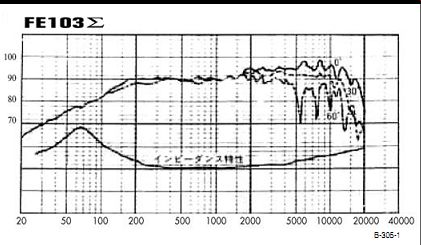
FIGURE 1: IMPEDANCE CURVE AND OPEN-BAFFLE RESPONSE CURVE OF THE FE103 SIGMA
(ON-AXIS, 30 AND 60° OFF-AXIS). MANUFACTURER SPECIFICATIONS.
LA PETITE
My interest in this French speaker was roused for several reasons. The different incarnations of the 4 ohm Fostex unit (FE103, FE103 Sigma, FE103E) have been extremely popular among Japanese audiophiles since the early 1960s. Published speaker projects involving this driver are innumerable. In the pages of L'Audiophile, Gérard Chrétien raved about the sonic qualities of the little Fostex unit 2. When my compatriot Peter van Willenswaard (of Audionote fame) heard the FE103 Sigmas at a show in Paris, he was equally enthusiastic [3].
The German audio amateur Klaus Schiffer has built a pair of Audiophile speakers and uses vintage Leak amplifiers to drive them.
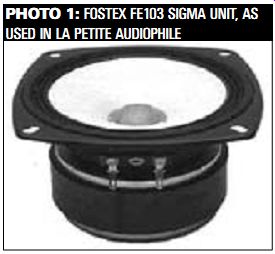
PHOTO 1: FOSTEX FE103 SIGMA UNIT, AS USED IN LA PETITE AUDIOPHILEC
---------------------
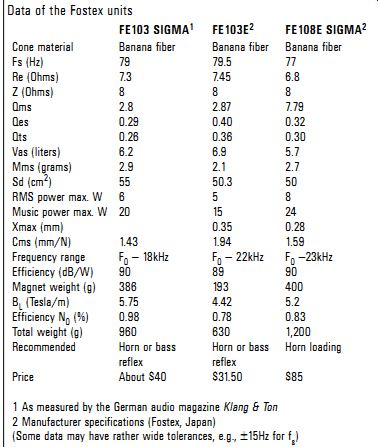
TABLE1--Data of the Fostex units
FE103 SIGMA1 FE103E2 FE108E SIGMA2
Cone material Banana fiber Banana fiber Banana fiber
Fs (Hz) 79 79.5 77
Re (Ohms) 7.3 7.45 6.8 Z (Ohms) 8 8 8 Qms 2.8 2.87 7.79 Qes 0.29 0.40 0.32 Qts 0.26 0.36 0.30 Vas (liters) 6.2 6.9 5.7 Mms (grams) 2.9 2.1 2.7 Sd (cm2) 55 50.3 50 RMS power max. W 6 5 8 Music power max. W 20 15 24 Xmax (mm) 0.35 0.28 Cms (mm/N) 1.43 1.94 1.59 Frequency range F0 - 18kHz F0 - 22kHz F0 -23kHz Efficiency (dB/W) 90 89 90 Magnet weight (g) 386 193 400 BL
(Tesla/m) 5.75 4.42 5.2 Efficiency N0 (%) 0.98 0.78 0.83 Total weight (g) 960 630 1,200 Recommended Horn or bass Horn or bass
Horn loading reflex
Reflex
Price About $40 $31.50 $85
1 As measured by the German audio magazine Klang & Ton 2 Manufacturer specifications ( Fostex, Japan) (Some data may have rather wide tolerances, e.g., ±15Hz for f
---------------------------
On his website, Klaus praises the little speaker as much as Gérard and Peter [4]. Finally, Bert Doppenberg, the driving force behind BD Design--a small company producing horn speakers--published a unique DIY project that employs two of the small Fostex drivers per channel 5. This tapered quarter-wave pipe design has been favor ably received by many audiophiles, both in Europe and in Canada6.
It occurred to me that a driver produced in large quantities for four decades (!) and with many admirers in three continents must be really something. Manufacturer specifications of the FE103 Sigma are shown in Fig. 1 and Table 1.
VARIOUS CABINET SHAPES
Two differently shaped vented enclosures were published for the Fostex FE103 Sigma in L'Audiophile. The internal volume was 26.5 ltr in both cases, with a vent of 140mm long and 70mm diameter, resulting in a cabinet resonance at 47Hz.
The initial cabinet design was very solid (the lower part of the front panel was 50mm thick!), but the shape of the enclosure was not appealing (546 × 352 × 227mm, height × width × depth2). When my wife saw the picture in the magazine, she called it the ugliest speaker she had ever seen! (I disagreed, for some of my own creations also do not deserve a prize for their good looks.) Apparently, many readers in France were of the same opinion as my dear spouse. For after three years, L'Audiophile published another design with identical cabinet volume and vent, but much more appealing proportions (Fig. 2). This design was called "La Petite Audiophile en colonne" (The Small Audiophile in column shape). I decided
to build that version, not only to ensure domestic peace, but also because I concur with my wife's view.
VARIOUS MODS
The Parisian de signers used medium-density fiber board (MDF) with a thickness of 25mm (1 “) to construct their enclosures.
This material proved difficult for me to obtain. DIY stores in Holland only have MDF of 19mm (0.75 “) in stock. They can sell the 1" variety, but you need to special order it in fairly large quantities, and it takes several weeks to arrive. In Germany, Klaus Schiffer encountered the same problem.
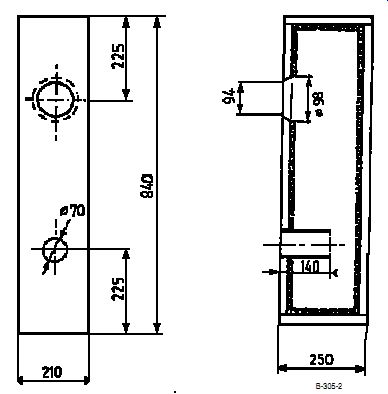
FIGURE 2: ENCLOSURE DIMENSIONS ("LA PETITE AUDIOPHILE EN COLONNE").
Therefore, Klaus decided to make his own pair of speakers from 0.75” MDF and to glue a sandwich of aluminum-rubber-aluminum to the inside of each cabinet wall. To keep the internal volume at 26.5 ltr and to maintain the rigidity of the structure, I decreased the outside dimensions of the enclosure a little (4mm along every axis) and glued bituminized lead sheets to the inside of each cabinet. This damping material (thickness 4mm) is sold by DIY speaker stores and is also used for panel damping in cars. The use of these self-adhesive sheets results in a very heavy enclosure which is completely "dead" in acoustic terms (i.e., free of undesired panel resonances).
The people at L'Audiophile used a 10mm layer of wool, glued to the inside of each cabinet wall, as stuffing material.
Klaus employed the kind of wool that mechanics use for cleaning up oil. I used a dual layer of the loosely woven material (insulating cloth) that home decorators put on floors under the carpet.
For speaker wire, I used two 4m sections of old cable (Van den Hul M.C. CS 122). This is heavy cable from a Dutch manufacturer, a twinlead type with two multiwire strands of 0.16 “ diameter (silver-coated copper). The Van den Hul wire may be overkill, but I thought a good cable wouldn't hurt. The wire, which I used when I was a graduate student, must be at least 15 years old. THE SOUND Can a 4” driver with a power handling of less than 10W and a price of $40 ( US) produce decent sound? Let other people answer this question. In the February 1984 issue of L'Audiophile, Gérard Chrétien wrote: "It is almost embarrassing to talk about listening to this little speaker.
The results which are obtained are so extraordinary in comparison to the small cost and the diminutive size of the driver that it is difficult to be credible in writing. You must listen for yourself.
"The overall homogeneity is excellent.
The bass is there--although of course it can never have the energy of a 15” Woofer--and it lends a very good balance to the sound. However, it is not the quality of the bass which this little speaker can produce which surprises most, but rather its extraordinary capacity for resolution, and this throughout the whole audio spectrum. Whatever is the musical message, one perceives a multitude of information, of small de tails. The absence of filtering and the direct coupling of driver and amplifier may certainly be related to this surprising definition.
"Dynamics of the sound are very good, extremes of audio level are perfectly respected without excessive compression during heavy modulations.
"Sure, the treble is a little bit truncated; one cannot have everything! But it is of excellent quality, sweet and refined at the same time." Besides this French verdict, I quote a German authority. Klaus Schiffer wrote in 1998: "I have listened to this speaker for five years now. Previously, I used the KEF Calinda (also DIY). A few weeks after I changed to the Petite, I considered switching back because I was missing some bass. As soon as I heard the Calinda, I understood the strength of the Petite.
"It is the fantastic localization of each instrument or voice. The midrange and highs are superb; even the bass has a wide range. For such a small speaker, it is really good. OK, you will not feel any punch in your stomach, but believe me: you will be impressed." I can add very little to these comments. When the Petite is driven by my own SE tube amp (see Part 1 in aX 2/05), a bass deficit is evident in some recordings, but this is due to my use of output transformers from old radios. When I use the (expensive) SE tube amp from my living room, or a good solid-state amplifier (Van Medevoort PA 222), the bass is more in harmony with the rest of the audio spectrum. The statements of Gérard and Klaus about dynamics, resolution, and imaging are completely to-the-point. Photo 2 shows the homemade speaker pair.
ADDITIONAL FILTER
Some users of the Petite Audiophile considered the sound too bright, with too much emphasis on the treble end of the audio spectrum. This may be the case especially when the listening room is "hard" in acoustic terms (large surfaces of glass in several walls, stone floor, concrete ceiling, little furniture). In my study, I did not encounter this problem, because two walls are covered with bookshelves and there are many chairs and writing desks in the room.
If you are less lucky, you may consider wiring a parallel connection of a 0.68mH inductor and a 4.7 ohm 10W resistor in series with the speaker. Use the best quality of components you can get. The filter does not affect the low frequency part of the audio spectrum (the region below 300Hz), but it will attenuate the treble region above 3kHz by about 4dB. You may, of course, also use your amplifier's tone controls, if present, to reach the same goal.
Klaus Schiffer used the treble filter for a while, but he finally removed it be cause the RL network seemed to result in loss of resolution.
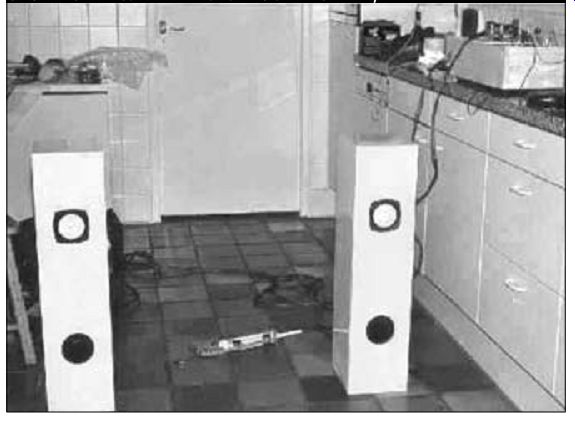
PHOTO 2: FINISHED SPEAKERS DURING AN INITIAL LISTENING TEST IN OUR KITCHEN,
WITH PROTOTYPE OF THE SE TUBE AMP ON THE DRAINING BOARD (QUITE APPROPRIATELY
BUILT INTO A CHEST WHICH HAD CONTAINED TWO BOTTLES OF FRENCH WINE!).
PLACEMENT
How should you place these speakers so that they sound their best? I have tried several possible locations: in corners, close to the walls, and free-standing within the room. Moreover, I tried various vertical positions: floor-standing, on low stands (lifted about 20” from the floor), and on high stands (lifted 32” from the floor). Finally, I tried different angles with respect to the long axis of the room: axis-parallel, or toed in toward the listener.
Within my study, these speakers seem to behave in the same way as mini-monitors in general. The spatial resolution is optimal when the center of the 4” unit is at the same height as the listener's ears, and the speakers are toed in toward him (or her). Placement close to corners or walls results in a loss of front-to-back information; therefore it's better to avoid such positions. How ever, it is not necessary to place them very far from the side walls of the room; a distance of 20” seems to be sufficient.
Thus, I finally settled on the 20” stands, a position halfway along the long axis of the study, about 20” from each side wall, and toed in toward the listener.
To my surprise there is not a narrow "sweet spot." Although cone speakers are said to beam the sound much more than dome tweeters, I can walk to many positions throughout the room and still perceive a good soundstage.
Even if I stand between, or at the back of the speakers, the position of soloists or instruments remains well-defined.
For such cheap speakers, this is no mean feat.
Like most mass-produced units, the speakers do not immediately sound their best. There is a break-in period of a few weeks, during which the compliance of the cone surround increases and the resonance frequency declines. When I had just finished the speakers, I enjoyed the excellent resolution, but I thought they were too bright sounding. However, the tonal balance improved during the first month of listening. With most recordings, they now sound completely OK, as Gérard Chrétien and Klaus Schiffer predicted.
BAD AND GOOD NEWS
Unfortunately, the Fostex FE103 Sigma unit has recently been discontinued.
Several European (and Japanese?) distributors still have some stock, but when these are sold, the legendary unit will become history.
There is no exact replacement for the FE103 Sigma, but Fostex now produces a unit called FE103E and a more expensive 4” speaker called FE108E Sigma (Table 1). According to Wolfgang Vollstädt from Spectrum Audio ( Bremen, Germany), you can use the FE103E in an enclosure designed for the FE103 Sigma--this will result in a little more bass, a little less treble, and a slightly lower efficiency.
However, I advise you to follow an other course. In the US, Fostex loud speakers are distributed by Madisound 7, whose website 8, includes plans for gorgeous horn speakers using a single FE103E or a FE108E Sigma per channel. The neat thing about these folded, back-loaded horns is that you can make them fairly easily: there are no oblique woodcuts and all panels are mounted at angles of 90°. The outside dimensions and proportions of the en closures are similar to those of the Petite Audiophile: 840 × 180 × 405mm for the FE103E and 900 × 200 × 445mm for the FE108E Sigma (height × width × depth).
Cutoff frequency of the horns is set at approximately 50Hz, resulting in a quite extended low-frequency response (for such small drivers). The narrow baffle results in excellent imaging and the horn loading in high efficiency and good dynamics.
If I had to start all over again, I would build the recommended enclosure for the FE108E Sigma. Its published frequency response and that of the "Petite" are quite similar, although the response curve of the novel unit is more even (without any appreciable peaks or dips throughout the whole audio range).
My experience with Fostex loud speakers indicates an excellent relation ship between quality and price. If you give them a try, I don't think you will be disappointed.
Part 3 (the final part of this series) will describe a "cheapskate class A amp" with only three bipolar transistors per channel. . . for the tube-haters among you.
----------
REFERENCES
1. "La Petite Audiophile en colonne" (rubrique On en parle) L'Audiophile, no. 41, p. 80-81, 3e trimestre, 1987.
2. Gérard Chrétien, "Le Fostex FE-103 Sigma," L'Audiophile, no. 31, February 1984. See also: "Le Fostex FE-103" (rubrique On en parle), L'Audiophile, no. 29, p. 95-96, September 1983.
3. Peter van Willenswaard, Audio & Techniek, October 1984.
4. Klaus Schiffer's website:
http://members.aol.com/ IKSchiffer.
5. You can download plans from bd-design.info
6. See the DIY section at the Single Driver web site (James Melhuish), melhuish.org
7. Madisound Speaker Components, Inc., 8608 University Green, PO Box 44283, Madison, WI 53744-4283. madisound.com.
-----------------
============
Also see: