B&W DM602 S2 SPEAKERS:
A look at an affordable two-way from the company that gave us the unique
Nautilus speaker.
-----------------------
Reviewed by Joseph D'Appolito
I ran a series of impedance, frequency response, and distortion tests on the B&W 602 S2 loudspeaker. Figure 1 is a plot of system impedance magnitude. At low frequencies the plot displays the double-peaked curve of a vented system.
The impedance minimum of 5.55 ohm at 42Hz indicates the vented-box tuning frequency. There is a second local impedance minimum of 5.1 ohm at 162Hz. Impedance phase lies between +47° and -55° over the full audio range. Fortunately, these rather large phase angles occur at relatively high impedance values. With minima in the range of 5 ohm, B&W's 8 ohm rating for this system seems a bit high.
FREQUENCY RESPONSE
Figure 2 shows the 602's full-range frequency response, which I obtained as a combination of the far field quasi-anechoic response and properly summed near-field woofer and port responses. I placed the microphone along the tweeter centerline at a distance of 1.25m to produce the far-field response. I then spliced together the near and far-field responses at 200Hz to produce the full-range response1.
The response shown in Fig. 2 has been normalized to 1m to obtain system sensitivity. Sensitivity averages 87.9dB in the two octaves between 500Hz and 2kHz. This is about 2dB less than the figure quoted in B&W's specs.
Relative to this level, the low frequency -3dB point is 48Hz. Response shelves up above 7kHz by 3dB. There is also a broad response peak of about 2dB centered on 100Hz and a sharp response dip of 3-5dB centered on 6kHz. Finally, an ultrasonic peak of 9dB at 24.8kHz (not shown) is due to the tweeter's "oil can" resonance.
The 602 has two pairs of binding posts for bi-wiring. This allowed me to measure the response of the individual drivers. The result is plotted in Fig. 3. The crossover frequency is seen to be 3500Hz.
Notice that the tweeter response is quite smooth. The woofer that is out of phase with the tweeter at this point causes the sharp system response dip at 6kHz. B&W claims that the crossover is fourth-order, but it is clear that woofer response is not falling off anywhere near that fast in the first octave above crossover.
I suspect that the woofer response peaks in this frequency region.
CUMULATIVE SPECTRAL DECAY
The 602's cumulative spectral decay (CSD) response (Fig. 4) shows the frequency content of the system response following a sharp impulsive input at time zero. On the CSD plot, frequency increases from left to right and time moves forward from the rear.
Each slice represents a 0.05ms increment of time. The total vertical scale covers a dynamic 32dB range.
Ideally the response should decay to zero instantaneously. Inertia and stored energy that take a finite amount of time to die away, however, characterize real loudspeakers. A prominent ridge parallel to the time axis would indicate the presence of a strong system resonance.
The first time slice in Fig. 4 (0.00ms) represents the system frequency response. Tweeter decay time is good, but there is a strong woofer resonance mode at 7kHz that rises out of the background beginning at about 0.44ms. This ridge indicates the presence of a woofer response peak, which in turn, prevents the woofer from rolling off rapidly just above the crossover frequency and leads to the response dip.
WOOFER/TWEETER TIMING
The sharp first positive peak in the 602's step response (Fig. 5) indicates the tweeter arrival at the test mike.
The second (more slowly rising) peak indicates the woofer arrival.
This plot tells us that tweeter and woofer are wired in phase, but it also shows that the 602 is not time coherent. The excess group-delay plot (not shown) reveals that the woofer arrives at the listening position 200µs later than the tweeter.
POLAR RESPONSE
Figure 6 is a waterfall plot of horizontal polar response in 10° increments from 60° right (-60°) to 60° left (+60°) when facing the speaker.
All off-axis plots are referenced to the on-axis response, which appears as a straight line at 0.00°. Thus, the plotted curves show the change in response as you move off-axis. For ...
-------------------------
ABOUT THE AUTHOR
Joseph D'Appolito, regular contributor to SB and author of many papers on loudspeaker system design, holds four degrees in electrical and systems engineering, including a Ph.D. Previously, he developed acoustic propagation models and advanced sonar signal processing techniques at an analytical services company. He now runs his own consulting firm specializing in audio, acoustics, and loudspeaker system design. A long time audio enthusiast, he now designs loudspeaker systems for several small companies in the US and Europe.
--------------------------------
... good stereo imaging the off-axis curves should be smooth replicas of the on-axis response with the possible exception of some tweeter rolloff at higher frequencies and larger off-axis angles.
With the exception of the off axis peak at 6kHz, horizontal response is quite uniform out to ±30°. The on-axis response dip at 6kHz tends to disappear as you move off-axis. This causes an off axis peak in the polar response curves that are plotted relative to the on-axis response. An alternate view of horizontal polar response (Fig. 7) plots responses on-axis and at 10° and 20° off-axis. Note the smaller response dip at 6kHz and reduced upward shelving above 7kHz at the off-axis angles.
The average response over a 60° horizontal angle (±30°) in the for ward direction is shown in Fig. 8.
The dip at 6kHz is greatly reduced.
Shelving of the average forward response above 7kHz is also reduced somewhat relative to the on-axis response. This may make the audible effect of the shelving less apparent, since the human ear integrates direct and reflected sound when judging the overall spectral balance of a loudspeaker.
On balance, however, the frequency range between 500Hz and 6kHz is depressed relative to the response at the frequency extremes. This might make the 602 sound somewhat recessed.
Figure 9 is a waterfall plot of vertical polar response, with responses shown in 5° increments from 20° below (-20°) the tweeter axis to 20° above it. Response changes very rapidly as you move off-axis. Here again, off-axis response is smoother. Figure 10 shows response on-axis and at 5° and 10° below horizontal; the -5 and -10° are much smoother than the on-axis response.
-------------
A note on testing: The B&W 602 S2 was tested in the laboratories of Audio and Acoustics, Ltd. Measurements were made with the MLSSA and CLIO PC-based acoustic data-acquisition and analysis systems using an ACO 7012 ½” laboratory-grade condenser micro phone with a custom-designed wideband, low-noise preamp. The polar response tests were performed with a computer-controlled OUTLINE turntable on loan from the Old Colony Division of Audio Amateur Corporation.
----------------
HARMONIC DISTORTION
I ran harmonic-distortion tests at an average level of 90dB SPL. Ideally, harmonic-distortion tests should be run in an anechoic environment. In practice, it is important to minimize reflections at the microphone during these tests.
Out-of-phase reflections can produce false readings by reducing the level of the fundamental while boosting the amplitude of a harmonic. In order to reduce the impact of reflections, I placed the microphone at 0.5m from the loudspeaker. Second-harmonic distortion was below 1% over most of the audible frequency range.
Below 100Hz second-harmonic distortion did rise to 1.3%, but this is still a very low figure. Third-harmonic distortion was 0.7% or less.
This is an excellent result.
INTERMODULATION DISTORTION
Next I measured intermodulation distortion. In this test two frequencies are input to the speaker. Intermodulation distortion produces output frequencies that are not harmonically related to the input. These frequencies are much more audible and annoying than harmonic distortion.
Let the symbols f1 and f2 represent the two frequencies used in ....
-------------------------
DM 602 S2---Technical Features
Nautilus tweeter tube
Flat ring tweeter suspension
Woven Kevlar brand fiber cone
Bullet dust cap
Description 2-way 4th-order vented-box system
Drive Units 1 × 180mm (7 in) woven Kevlar cone bass/mid 1 × 26mm (1 in)metal dome high-frequency
Frequency range -6dB at 43Hz and 30kHz
Frequency response 52Hz - 20kHz ±3dB on reference axis
Dispersion Within 2dB of response on reference axis
Horizontal: over 40° arc Vertical: over 10° arc
Sensitivity 90dB spl (2.83V, 1m)
Harmonic Distortion 2nd and 3rd harmonics <1% 60Hz - 20kHz (90dB spl, 1m)
Nominal Impedance 8 ohm (minimum 4.3 ohm)
Crossover Frequency 4kHz
Power handling 25W - 120W continuous into 8 ohm on unclipped program
Max recommended 0.1 ohm cable impedance
Dimensions Height: 490mm (19.3 in) Width: 236mm (9.3 in) Depth: 306mm (12 in)
Net Weight 9.8kg (21.6 lb)
Finishes Cabinet: Cherry or Black Ash Vinyl Grille: Black Cloth
B&W Loudspeakers, 54 Concord St., North Reading, MA 01864, (978) 664-2870, FAX (978) 664-4109, e-mail: marketing@bwaudio.com, website: BWSPEAKERS.COM
--------
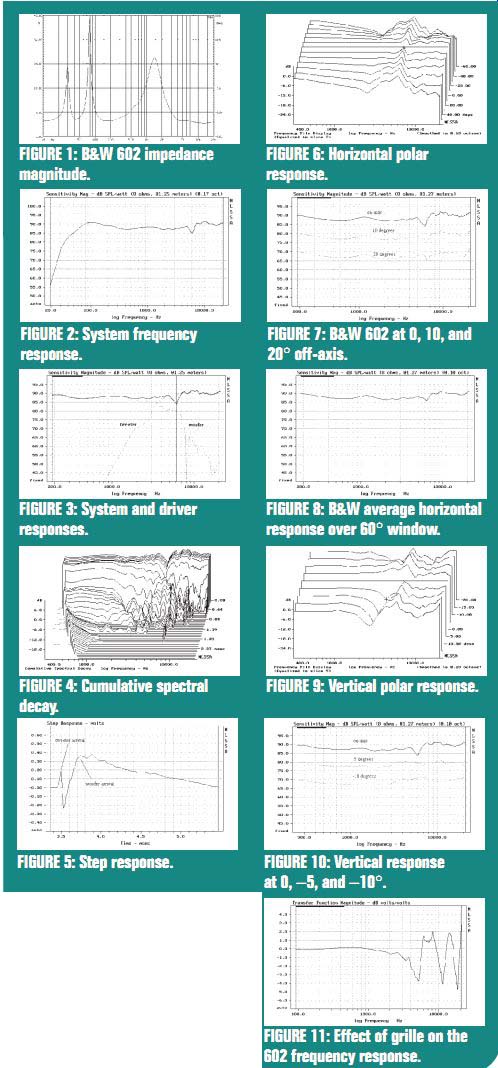
FIGURE 1: B&W 602 impedance magnitude.
FIGURE 2: System frequency response.
FIGURE 3: System and driver responses.
FIGURE 4: Cumulative spectral decay.
FIGURE 5: Step response.
FIGURE 6: Horizontal polar response.
FIGURE 7: B&W 602 at 0, 10, and 20° off-axis.
FIGURE 8: B&W average horizontal response over 60° window.
FIGURE 9: Vertical polar response.
FIGURE 10: Vertical response at 0, -5, and -10°.
FIGURE 11: Effect of grille on the 602 frequency response.
REFERENCES: 1. J. D'Appolito, Testing Loudspeakers, Audio Amateur Corporation, Peterborough, NH, 1998.
================
CRITIQUE---Reviewed by Tom Perazella
I must have a thing with word associations. When someone mentions the word Nautilus, I first think of a submarine or a speaker, not the chambered sea animal from which they both derive their names. The sea animal has certainly been around longer, but alas, it has not had the marketing efforts of the former, possibly explaining the difference in recognition.
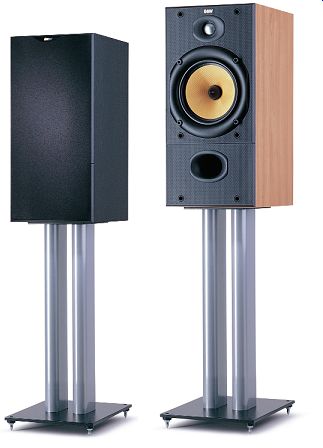
The B&W Nautilus speaker, however, was a real attention-getter when introduced. The radical multiple tapered chamber design not only looked striking, but it also had significant sonic benefits. B&W has taken the knowledge gained in producing the Nautilus and transferred it to a more affordable line of speakers. The DM602 S2 is one of a family of speakers derived from the Nautilus that boasts a friendly combination of small space and low price.
Much more conventional in looks than the Nautilus, the design is a two-way utilizing a 7 ohm woven Kevlar bass/midrange and a 1” metal dome tweeter. The tweeter, similar to that in the Nautilus, is loaded by a closed tapered tube to absorb rear radiation. The enclosure is a vented box 19.3” high × 9.3” wide × 12” deep. Weight is specified as 22 lbs. A knuckle-rap test showed that the construction was fairly solid, with some resonance from the back panel and upper area of the side panels.
Connections are made on the rear through two sets of gold-plated binding posts, one for the woofer and one for the tweeter. Gold-plated jumper strips are pro vided for normal connections with the ability to remove them for bi-wire applications. As is typical of most UK and European products, the accursed positive-to-negative terminal spacing does not match standard ¾” plugs. A pox on the safety fanatics responsible for trying to save the world from self-immolation by making nonstandard speaker post spacing.
The posts themselves have small plastic plugs to prevent insertion of banana plugs. You can remove these plastic inserts by unscrewing the caps of the posts, and then use standard individual banana plugs.
The good news is that the posts have very large holes for wire, making insertion of 12-gauge speaker cables easy.
TEST SETUP
I auditioned the units in my loft that is 21'× 16' with vaulted ceiling. The room has only three walls; it is open to a lower family room along the long dimension. I placed the speakers along the 21' wall facing both the listening position and the opening to the family room.
I positioned them 6' apart with the right speaker 6' from the right wall and the left 9' from the left wall.
Both were 5' from the back wall and angled toward the listening position that was 8' from each. The stands used raised the tweeter 40.5” from the floor and positioned the woofer 34” from the floor. I conducted all of the tests with the grilles removed.
The signal source was a Sony 707ESD CD player feeding a custom pre-amp. I used two power amps.
Since B&W specified a range of 25-120W as a suitable drive level, most of the listening was done with an AudioSource Amp Three that I have measured at 168W per channel at clipping into 8 ohm and 267W per channel into 4ohm. This amp is very clean and is one of the best values on the market.
For higher power tests where I wished to eliminate the amplifier as a potential limiting factor, I used a Crown Macro Reference amplifier. At 760W/channel into 8 ohm and 1160W/channel into 4 ohm, it was more than sufficient to handle any levels likely to be encountered by a speaker of this size. I made connections from the amplifier to the speakers with 12' of 12 gauge stranded zip cord.
SOURCE MATERIALS
To provide consistency for all tests that appear in this publication, the editor has asked all contributors to include one reference CD as part of any audition. That CD, the Hi-Fi News & Record Review Test CD III, number HFN020, contains both musical and test passages.
This is a tough test disk because, in my opinion, it is recorded a little on the bright side. It is clean, but if you have a forward-sounding speaker, this disk will immediately point out the brightness.
For this review, I concentrated on the musical test passages, except for the garage door track. The other CDs were:
Telarc CD-80126 Britten-Young Person's Guide to the Orchestra Columbia CK57424 Tony Bennett-Steppin' Out Columbia C2K68519 Pink Floyd-The Wall Proprius PRCD7778 Jazz at the Pawnshop Chesky JD49 Clark Terry-Live at the Village Gate Mapleshade 06932 Blue Rider Trio-Harp, Steel & Guts CBS MK37793 Vollenweider-Behind the Garden Tristar Music WK35862 Kodo-Ibuki
LISTENING TESTS
The first series of tests was done with the AudioSource Amp Three.
TRACK 1-La Rejouissance-Handel Like most of the initial tracks on the Hi-Fi News CD, the recording was made outside. It is a good test of imaging and definition, with some fireworks thrown in for dynamic flavor. It is by no means a killer cut, but there is enough energy in some of the fireworks to provide a sample of what you can expect in dynamic range from most commercial music CDs.
From the first few minutes of this first piece, the strongest point of the DM602s was readily apparent. The midrange was very good. As the old saying goes, if you are going to get some thing right, make it the midrange.
Also apparent were the very clean and detailed highs. For my taste they were just a little too apparent. Never did I get the feeling that at any sane volume level the problem was distortion. We're not talking about fatiguing here. The sound was just a little more forward than I would prefer. The bass was also quite good compared to many of the small speakers I have auditioned. It didn't come close to shaking anything off the walls, but the fireworks sounded like fireworks, although with a light impact.
There seemed to be a slight rise in the upper bass with most of the instruments, but thankfully, the high level of boom that is often present in small speakers trying to make an impact on a prospective buyer was absent. The sins in the bass range were mostly venial rather than mortal, being those of omission, rather than commission.
The location and separation of the instruments was very good, and the decay of the fireworks was very realistic. The oohs and aahs from the audience as the fire works went off were rather convincing.
TRACK 2--Jerusalem-Parry This cut has a choral work that is especially revealing of the midrange and treble detail. The definition of the voices was excellent, but again, the voices seemed to be just a tad forward. The sibilants were a little too notice able, and the balance seemed just a bit light. Other wise, they provided a very good accounting of the piece.
At this point, I did a stand-up test and noticed quite a bit of change in the tonal balance. You definitely should listen somewhere around the tweeter axis.
TRACK 3--Henry V-Doyle This piece has two tough tests, a high level of cymbals and a solo male voice. The cymbals at the lead-in sounded bright, but the crowd sounds were good. The voice and voice echos were very clean and detailed.
Positioning of the voice was excellent, separated quite nicely from the instruments. On this piece, I did a left to-right head movement to check for tonal changes.
They proved to be minimal.
TRACK 4-Trumpet Concerto in C-Vivaldi The sound on this cut was very clean with good separation of the instruments, but with just a bit too much bite on the brass.
TRACK 7-Welcome, Welcome-Purcell
The vocals on this track had excellent separation and definition of the different vocal characteristics.
The harpsichord was very distinct.
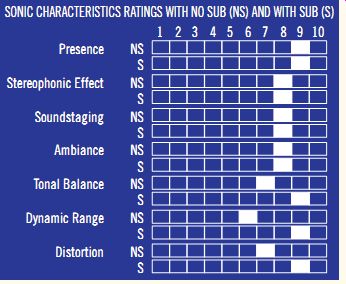
CRITIQUE SONIC CHARACTERISTICS RATINGS WITH NO SUB (NS) AND WITH SUB (S) NS S Presence NS S Stereophonic Effect NS S Soundstaging NS S Ambiance NS S Tonal Balance NS S Dynamic Range NS S Distortion 12345678910
----------
ABOUT THE AUTHOR
Thomas Perazella is the Director of Information Systems for a national retailer of professional photo graphic equipment headquartered in the midwest. His prior experience includes work as a Criminalist in the San Diego and Long Beach California Crime Labs and Director of Marketing for a photographic wholesale distributor. In addition to speaker design, Mr. Perazella has designed commercial high-powered electronic flash equipment, as well as numerous pieces of audio electronics for his own use. Other leisure activities include cooking, golf, scuba diving, and motorcycles.
---------------
TRACK 14-Rio Napa RSS Demo
This track is a good test of image movement, and there certainly was a lot of movement with these speakers. The bass was just a little loose on this track, but the percussion was otherwise very good.
TRACK 17-Return of the Garage Door This was my one concession to non-music, but I could not resist the sound of a garage door closing and someone banging on it. One of my friends once said that I would stop to listen to a garbage can crashing down a concrete stairwell. What can I say ? Dynamic range and, especially, transient dynamics provide a sense of realism that's hard to beat.
On this cut there was a great sense of depth, but the dynamics came up a little compressed. If you are not a garbage-can junkie, you probably won't notice it.
Britten-Young Person's Guide to the Orchestra I listened to quite a few instruments, so I'll just list them and give you short snippets.
Woodwinds-Piccolo a little bright, but flute good.
Brass-Good midrange, especially the lower mid.
Strings-Good lower mids and mids with highs a little forward.
Percussion-OK at lower levels, but some loss of definition at higher levels.
Clarinet-Very good. Delicate with good air.
Oboe-Good reed sounds.
Bassoon-Smooth with good room sounds.
Violins-A little bright.
Violas-Smooth and silky.
Cellos-Good string sound but a little light.
Double basses-Very good string sounds but a little light in the lower registers.
Harp-Excellent definition but a little light on the lower strings.
Horn-Clean with good definition.
Trumpet-Excellent definition.
Trombone and tuba-Trombone very smooth, but tuba a little light.
Bass drums and cymbals-No weight to drums.
Short on definition.
Castanets and gong-Excellent air and shimmer.
Tony Bennett
TRACK 2-Who Cares The piano, a Bosendorfer, had excellent definition of strings and hammer blows. The lower registers were a little light. Voice was very good. Intonation was very clear, and the gravely texture in Tony's voice was presented clearly without being raw. The dynamics were also very good.
Pink Floyd-The Wall TRACK 3-Another Brick in the Wall
There are a lot of things going on in this album, and it takes a speaker with good resolution to really produce the right mood. Voices were very clear. Guitar definition was excellent. The bass lines were just a little weak.
The best part was that the sound was smooth and did not offend, even at relatively high levels. Separation of the different sounds was very good. Dynamics were quite good for a speaker of this size.
Jazz at the Pawnshop TRACK 1-Limehouse Blues I've listened to this piece so many times I feel like I own the club where it was recorded. The room sounds during the intro and at several places during the cut were excellent. This level of micro detail establishes a "you are there" effect.
The brushes on the drums were very clear. The clarinet had good tonal range and was very smooth with just slight bite at times. The vibes were very good with the right combination of attack and reverberation.
Stick sounds on the cymbals were very realistic.
Clark Terry-Live at The Village Gate TRACK 8-Hey Mr. Mumbles Voices and room sounds are the key to this track. The audience sounds were very realistic, including some background noises in the room. Terry's voice was the right level and reminded me of one of his live performances I attended.
Bass was a little fat and not very deep. Sax was very good. The mute had good definition and bite where appropriate. Drums lost a little in the impact department, but again, not bad for a speaker of this size.
Blue Rider Trio TRACK 8-Stagolee If you haven't heard any of the Mapleshade recordings, you should. So far I haven't found any Grammy material, but the sense of having Pierre Sprey produce a transparent window to the artists is fascinating. On this piece, the guitar is just great. The string picking and harmonics are exceptional. Intonation on the voice is very clear, and the roughness in Ben Andrews' voice is distinct.
Let me try to explain the term distinct roughness. I think the real test in resolving power of any speaker is to separate sounds such as a rough human voice until you can almost count the different tones making up the voice. If it can do that, you have character instead of offensive noise. These speakers did that in spades, with only a slight prominence of sibilants. Placement of sounds was also excellent, with the ability to almost see the position of Andrews' head as he plays. The sound was totally removed from the speakers.
Vollenweider TRACK 1-Behind the Gardens During the early part of this piece, a woman laughs from a position that seems well to the right of the right speaker, roughly 45° to the right of center. This is not quite as far as my reference system, but farther than many speakers I have auditioned. When you first hear it, it can be quite surprising, as you don't expect sound to come from that direction in a two-channel system.
There are also some bird songs in this piece, and my dog Cinder, who is a very experienced listener by now, perked up his ears when he heard them.
Kodo-Ibuki TRACK 3-Akabanah
This is a very difficult piece for any speaker to reproduce.
Some high levels of low-frequency drum sounds are superimposed on top of some delicate mid- and high-frequency sounds. Want some intermodulation distortion ? Just crank up this piece. Two-way systems are particularly susceptible as the woofer extends well into the midrange, in this case 4kHz. At high levels, there was al most no appreciable reproduction of the drum fundamentals, and quite a bit of distortion in the midrange.
TRACK 5-The Hunted Impact is the name of the game with this track. Al though not as deep as Akabanah, the drums in this piece have tremendous sock. In addition, there are again midrange details that should not become trampled in the fray. The results were better than with Akabanah, but the drum impact was moderate.
TESTING WITH THE CROWN
When trying to determine the limitations of a speaker, it's best to make sure that the power amp is not the cause of any problems. To do that, I use a Crown Macro Reference amplifier as mentioned earlier. I repeated the previous tracks until I got a clear understanding what the speaker and prior amp limitations were.
There were no big surprises.
TRACK 1-La Rejouissance With the Crown, the overall tonal balance was the same as with the Amp Three. The sound was still a little on the light side, but the fireworks had a little more impact at very high levels.
TRACK 2-Jerusalem The results were the same as before.
TRACK 3-Henry V The results were the same as before.
Britten-Young Person's Guide to the Orchestra On the bass drum track, there was still no deep bass, but the sound was cleaner than before.
Tony Bennett TRACK 2-Who Cares The results were the same as before.
Kodo-Ibuki TRACK 3-Akabanah The very low bass was still absent, but the midrange had not quite as much distortion.
TRACK 5-The Hunted
There was much more impact from the drums than before, but still not as deep as it could be. At very high levels, the speakers surprised me. Even though they were 8' away from the listening position, on major hits of the drums, the puffs of air from the ports actually hit me in the face and the shirt sleeves. Mind you, this was at levels that were for testing only and not representative of normal listening. However, it was very distracting.
The results showed that at sane listening levels with most musical sources, a competent 150W/channel amp should be a good complement to these speakers. Substitute a super amp costing in excess of $4K, and you'll get some improvement, but hardly worth the expenditure.
FINAL SOLUTION
I'll admit it, I'm biased. I think a good subwoofer is one of the best improvements you can make in any sound system. There are lots of reasons, but one of the most important is that a sub will unload the most difficult tasks from your main speakers.
To see how this philosophy would work with the 602s, I used the high-pass function of my Orban parametric equalizers to act as a 12dB/octave high-pass filter to feed them signals only above 80Hz. Then, I passed all frequencies below 80Hz through a 12dB/octave summed mono low-pass filter to one half of my reference sub. Power for the 602s was again provided by the Amp Three. The results were dramatic. Regard less of how many times I do this, I'm always surprised at the improvement this makes. Here are the results.
TRACK 1-La Rejouissance Most of this piece sounded the same, but the fireworks had much more impact, especially toward the end where there is a reasonable amount of low-frequency energy.
Britten-Young Person's Guide to the Orchestra On the cut with the bass drum, there was a total transformation. At high levels, the sound at all frequencies was still clean, with the required room shake from the drum.
Tony Bennett TRACK 2-Who Cares The piano now had the required weight you would expect from a Bosendorfer. The bass was also stronger.
As a matter of fact, the bass is almost too heavy on this recording, and that was apparent in this configuration.
Kodo-Ibuki TRACK 3-Akabanah Wow! Holy cow! The drums sound like drums again.
The lows were very strong and clean. The mids lost the IM distortion that was evident when the seven incher was chugging its little heart out trying to act like a big mean old drum.
TRACK 5-The Hunted Put on your flak vests for this one. Floor-pounding, chest thumping bass was abundant, again coupled with a very clean midrange. The annoying puffs in the face were also gone. As a matter of fact, putting my hand directly in front of the port revealed very little air movement, con firming the effectiveness of the high-pass filter.
CONCLUSIONS
Again, for consistency, reviewers present a subjective rating of components being tested using four categories: presence, stereophonic effect, soundstaging, and ambiance. However, for testing speakers I'm also including three other characteristics that I believe are very critical: tonal balance, dynamic range, and distortion. Ratings range from 0 to 10, with 10 being heavenly and 0 being unlistenable.
These speakers are a great example of good engineering. Given their size and price, they get the basics right without trying to reach for the sky. By doing so, the addition of a sub to extend the frequency and dynamic ranges and also lighten the burden for the bass/mid driver yields a truly enjoyable system. Good speakers allow you to move into the recording venue and feel the music as a participant rather than an outsider. These speakers provide that to a high degree. Lesser approaches sacrifice midband performance to try to extend reach, making improvements more difficult to achieve.
If price is an issue, there are other speakers that have a slightly more extended reach into the bass, but not with the clarity of the DM602s. If you never plan to add a subwoofer, some of those may be better choices.
But, if you are planning to use any speaker in this size and price range without a sub, I think you are missing the mark. There is no other addition you can make that will have as significant an effect as using a sub. Look at the results of changing from a $350 amplifier to a kilobuck amp compared to using the small amp and the sub. The difference is huge.
Save your pennies and buy or build your own sub.
Never before has there been a time when you have had so many choices of great drivers to build a sub. Companies such as ACI, HSU Research, Adire Audio, Madi sound, and Parts Express, to name just a few, have drivers you would have killed for just a few years ago and at prices that will make people think you were holding a gun to someone's head when you bought them. News Flash: Parts Express has just come out with a pair of dual voice-coil drivers with XMAX of around 16mm at ridiculous prices. The 15” driver has a suggested price of $132 in single quantities and $125 for four or more.
This is probably the new champ for volume displacement per dollar. So give the DM602s a listen and then go build a killer sub for a great-sounding system.
==================
D'Appolito Review
.... (cont) ...
the test. Then a second-order non linearity will produce intermods at frequencies of f1 ± f2. A third-order nonlinearity generates intermods at 2f1 ± f2 and f1 ± 2f2.
I first examined woofer inter mods by inputting 900Hz and 1kHz signals at equal levels. These frequencies should appear pre dominantly in the woofer output.
Total SPL with the two signals was adjusted to 86dB at 1m. Because steady tones are used in the IM test, I thought it safer to use a lower power level to prevent possible tweeter damage. Principal woofer IM products occurred at 800, 1100, 2800, and 2900Hz.
However, the overall level was only 0.47%, an excellent result.
I measured tweeter intermods with a 10kHz and 11kHz input pair also adjusted to produce 86dB SPL at 1m, observing IM products at 8, 9, 12, and 13kHz. Total distortion was 0.18%. Again, this is a very low figure.
The last IM test examines cross intermodulation distortion between the woofer and tweeter using frequencies of 900Hz and 10kHz. (A 1kHz signal would pro duce intermods that fall on harmonic-distortion lines, confusing the results.) Ideally, the crossover should prevent high-frequency energy from entering the woofer and low-frequency energy from entering the tweeter. IM products appeared at 6.4, 9.1, and 10.4kHz at a level of 0.07%, the lowest figure I have measured so far in the series of tests.
ADDITIONAL TESTS
I conducted all of the above tests with the grille off. Figure 11 shows the 602's system response with the grille on, but referenced to the response with the grille off; that is, it plots the change in response under the two conditions. Below 3kHz the grille has little effect.
Above 3kHz, however, the grille causes ragged response deviations of +2 to -4.5dB. As usual the grille has only cosmetic value.
Two samples of the 602 system were available for testing. I conducted all of the tests described so far on one sample. Frequency response of the second sample matched the first to within -0.5 and +1dB from 100Hz - 16kHz.
Tweeter response of the second sample rose to 1.8dB above the first at 20kHz, but this should be of little consequence.
---------------
---------------
Also see:
A QUICK BOOKSHELF PAIR: This author finds a way to satisfy his audio needs with a basic 5” driver-in a-box design.