Product Review:
NAD T550 DVD PLAYER: A versatile performer in the DVD field.
by Gary A. Galo
--------------
NAD T550 DVD Player. NAD Electronics International, 633 Granite Court, Pickering Ontario, Canada L1W 3K1, 905-831-0799 (Worldwide), 800-263 4641 (NA), nadelectronics.com. Price: $799.
The T550 (Photo 1) is NAD's first entry into the DVD-player market. NAD calls their T550 a "Music First" DVD player, and their goal was to build a player with the same level of musical performance as their best stereo audio products. The T550 is a completely self contained product, with built-in Dolby 5.1 and DTS surround decoding.
The video performance of the T550 has been designed to compete with the best DVD players on the market. Video processing and D/A conversion are accomplished with a state-of-the-art, fourth-generation chip. Like all current generation DVD players, the T550 has 24-bit/96kHz digital audio circuitry.
You can also use the T550 as a transport, with external audio decoding.
Both RCA coaxial and Toslink optical digital outputs are included. You can feed these outputs to an external two channel D/A converter, Dolby 5.1 de coder, or a DTS decoder. Composite, component (Y/Cb/Cr), and S-Video out puts are also included, allowing optimum interfacing with any monitor or projector (Photo 2). In the 230V version of the T550, the component outputs are replaced with SCART RGB outputs. The 230V version also has built-in MPEG decoding. The T550 has a single-laser-beam pickup, so it won't play CD-R discs (dual wavelength laser pickups are required). The T550 is a full-featured DVD player, supporting Multi-Angle, Multi Sound, and Multi-Subtitle capabilities on suitably provided software. Frame by-frame viewing is possible on all DVD discs, as is chapter and title repeat. The T550 also allows you to repeat sections between two points of your choice.
You can also store markers in the player's memory, allowing you to return to it at a later time. You must leave the DVD in the player, however. Opening the drawer erases the marker memory. A zoom feature is also included, allowing you to "zoom in" by enlarging the picture to either 4× or 16× its normal size.
The T550's menu system includes all of the standard choices offered these days by DVD players, and is quite intuitive in operation. The menus allow selection of the disc audio language, sub title language, menu language, aspect ratio, TV mode, FLT brightness, and audio output. The remote control is easy to operate, though somewhat directional. The T550 is labeled as manufactured in South Korea.
CIRCUIT OVERVIEW
NAD did not provide me with a service manual or a schematic diagram; however, from their product literature and a look inside the player (Photo 3), I was able to make some observations. On the video end, the heart of the T550 is a 10 bit video D/A converter, the Thomson Omega-DVD STi5505AVB-X, one of the best chips available today. NAD's product literature claims that a Burr-Brown PCM1716, a 96kHz/24-bit digital filter/ DAC combination chip, is used for the two-channel stereo/downmix outputs.
My player did not have a PCM1716, however. The review sample has a Burr Brown PCM1600, a six-channel 96kHz/24-bit Delta-Sigma DAC, with on board digital filters. Since the PCM1600 is the only DAC chip on the T550's PC board, I assume that two channels of this chip are also used for stereo/down mix operation.
The PC board in the review sample contains an empty surface-mount foot print labeled "PCM1716," but the chip is not installed. I suspect that the PC board was designed so that it could be used in players with and without internal Dolby 5.1 decoding. A player with out internal Dolby 5.1 decoding would probably employ a PCM1716 for the two channel-only internal D/A conversion.
Most DVD and CD players made in the Far East contain mediocre analog circuitry. 4560 op-amps are common place, and many players still incorporate the 5532. NAD has paid careful attention to the analog circuitry in the T550, selecting the excellent Burr Brown OPA2134 dual op-amp for all audio amplification.
The OPA2134 is essentially a dual version of the OPA134, a high-performance op-amp, and part of Burr Brown's Sound Plus series. The chip has a slew rate of 20V/µs, a bandwidth of 8MHz, and a high open-loop gain of 120dB. A true FET input results in an input bias current of only 5pA, yet the voltage noise is only 8nV/vHz. A total of four OPA2134 chips are used, one for the stereo/mixdown outputs, and three for the six Dolby 5.1 outputs.
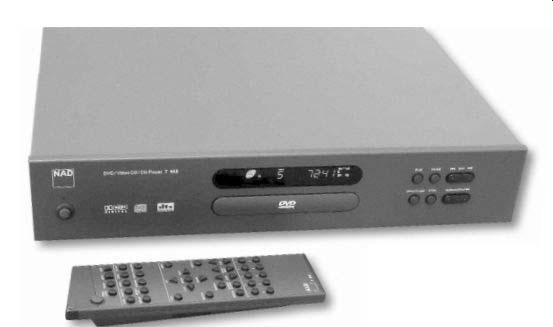
PHOTO 1: Front view of the NAD T550 DVD player and remote control.
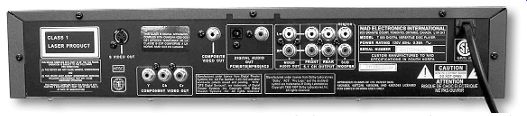
PHOTO
2: Rear panel of the T550. The player has built-in Dolby 5.1 decoding
and the six required outputs. Separate stereo/mixdown outputs are provided
for two-channel operation. Component, composite, and S-Video outputs
are also included.
NAD has also employed metal-film resistors and polypropylene capacitors in critical locations. As Photo 4 shows, these appear to be in the form of surface-mount, chip-type components.
NAD deserves kudos for paying attention to the quality of passive components in the T550. The audio outputs of the T550 appear to be coupled with electrolytic capacitors, however.
POWER SUPPLY
All DVD players, regardless of manufacturer, incorporate switching power sup plies. The T550 is no exception. Audiophiles may cringe at the thought of a "computer" power supply operating high-end audio equipment, but the en tire DVD player industry appears to have embraced switching supplies.
The switching-supply board outputs several voltages to the main PC board. 5V lines labeled A5V and D5V are, in fact, the same supply line fed to two pins on the PC connector. There is also a separate 5V pin labeled V5V. Two 3.3V pins are from the same source, and a pair of +12V pins are also ganged together. There is also a single -5V pin.
The main T550 PC board has three three-terminal IC regulators. A 7808 and 7908 pair is used to regulate the positive and negative supplies for the analog circuitry.
I made some measurements in order to learn more about the power-supply scheme, and stumbled upon a curious design situation. The 7808/7908 IC regulators are fed from the switching supply's ±12V lines through a pair of series inductors which, along with a pair of bypass capacitors, reduce noise from the switching supply. The series inductors seem to have been an afterthought--traces have been cut on the PC board in order to accommodate them (the traces would bypass the inductors, otherwise). The series resistance of these inductors is high enough to drop several volts, to the point where neither regulator has sufficient input voltage to operate properly.
The input to the -8V 7908 regulator is at -7.75V, less than the actual regulator voltage. This means that the 7908 is not regulating at all! The output from the 7908 is -6.96V. The input to the 7808 sees +9V, and it outputs 7.75V. Although the output is within the tolerance of a 7808 regulator, I was suspicious: an input/output difference of only 1.25V is insufficient for a regulator of this type.
To confirm my suspicions, I temporarily soldered jumpers across both series inductors. With ±12V at the regulator inputs, the regulated voltages now measured a full ±8V. As configured by NAD, both analog supply regulators are in a constant state of dropout: the high-performance OPA2134 op-amps are powered by unregulated supplies. With the series inductors jumpered, the output noise from the regulators, viewed on a wideband oscilloscope, is essentially the same as with the inductors in the circuit. When the regulators are functioning properly, their own line rejection has the same effectiveness as the filtering from the series inductors. When in a state of dropout, they have no line rejection.
I am completely baffled by the design rationale for this power supply. There is a second 7808 regulator on the main PC board, but its function is unclear. This 7808 is fed directly from the +12V line and is operating properly with an output of +8V.
PERFORMANCE
It is hard to find a DVD player with a bad picture these days. I found the picture quality on the T550 to be as good as any DVD player I have seen: sharp, de tailed, with brilliant, life-like color. It is easily the equal of Sony's flagship DVP S7700, which retails for $999. You'll be hard-pressed to better the picture quality of the T550. But, I was even more interested in the sound quality of the T550, so I'll cover that in greater detail.
I do not own a surround-sound setup, so I took the T550 to a local audio-video dealer to evaluate its Dolby 5.1 surround performance. The player on hand for comparison was a Sony DVP S560D. Although this player retails for only $399 (half the price of the T550), it is Sony's only single-disc DVD player with built-in Dolby 5.1 decoding.
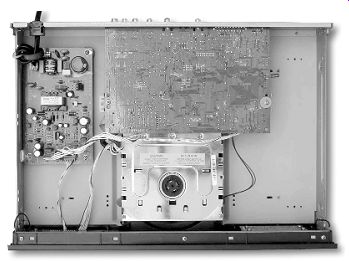
PHOTO 3: Inside the T550. The main PC board is mounted upside down.
The switching power-supply board is on the left.
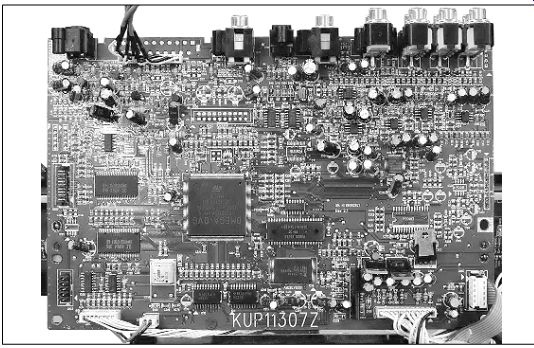
PHOTO 4: The T550's main PC board. You can see the four Burr-Brown OPA2134
dual op amps in the upper right, near the output RCA jacks.
In the film Armageddon (The Criterion Collection #40), the NAD T550's Dolby surround performance was clearly superior to the Sony player. The surround effects were reproduced with a substantially larger soundstage and more precise localization. Detail and treble smoothness were also superior to the Sony.
On Herbert von Karajan's 1983 film of Beethoven's Symphony No. 9 with the Berlin Philharmonic (Sony Classical SVD 46364), there was a greater sense of hall ambience in the Dolby 5.1 surround mode. The string tone was sweeter and more natural, and the orchestra was presented with greater weight and dynamic impact.
CD CRITIQUE
Unlike most DVD players, the T550- price considered-gave a reasonable ac count of itself as a stand-alone two-channel CD player. In particular, the T550 outshone the Marantz PMD340 player (which I review in an upcoming issue of aX). The T550 has a smoother, more musical, more articulate sonic presentation, and more precise soundstaging than the Marantz. The Marantz has a superior power-supply regulation scheme, but its DAC and analog circuitry are well behind those used in the T550. Even though the T550's power-supply topology is inferior to the Marantz, the excellent Burr-Brown DAC and op-amps used in the T550 put the balance in NAD's favor. Overall, the sonic presentation of the T550, used as a CD player, errs toward the warm side, and thus offers musical performance superior to the more analytical Marantz.
I also evaluated the T550 as a CD transport, using my reference Parts Connection DAC 3.0 as the out board D/A converter. Here, the T550 performed extremely well. In comparisons I made with Sony's top-of-the-line DVP-S7700 DVD player (retailing at $999), the NAD T550 consistently outperformed the Sony player. The NAD was simply more musical, with a larger soundstage, greater inner de tail, and a smoother and warmer sonic presentation.
The sonic presentation of the Sony, as a transport, was more analytical.
This despite the fact that the Sony is physically much more robust than the NAD. As a stand-alone CD player, I also found the Sony inferior to the NAD.
I also evaluated the T550 using one of the DAD, audio-only DVD discs from Classic Records, their 96kHz/24-bit PCM transfer of the Rachmaninoff symphonic Dances performed by the Dallas Symphony Orchestra conducted by Donald Johanos. This superb recording was engineered by David Hancock in 1967, and released on LP by Vox/Turn about. Played using my Pioneer DV-525 DVD player, which has a 96kHz/24-bit digital output, and my outboard DAC 3.0, this disc is one of the most impressive recordings I have ever heard- dynamic, airy, with instrumental timbres that are uncanny in their realism, and tremendous bass impact.
The T550's digital output has been downsampled to 48kHz, and the down sampling removes some of the subtleties which make this recording so special. On the T550, used as a transport, this recording is less airy, and slightly "closed down" when compared to the sonic presentation on my Pioneer DV-525 (if I change the output sampling rate on the Pioneer to 48kHz, there is a similar degradation).
I also tried the Classic Records DAD using the T550 as a stand-alone player.
This was an area where I found the performance of the T550 disappointing. Although the T550 has on-board 96kHz/24 bit converters, it was unable to offer a musical sonic presentation on the DAD PCM disc. I found the sound somewhat harsh and aggressive, revealing few of the refinements for which this recording is justly famous.
The T550 performs far better as a stand-alone CD player than it does as a 96kHz/24-bit DAD player. I suspect that this is where the limitations of the analog power-supply regulators really manifest themselves.
CONCLUSION
The NAD T550 is one of the better DVD players on the market today. Its video performance leaves nothing to be desired, and NAD has paid more careful attention to their analog circuitry than most other DVD player manufacturers.
As a result, the T550 outperforms typical Far East DVD players, including some commanding higher prices.
The primary disappointments in the T550 are the mis-configured analog power-supply regulators. Had the regulation circuitry been designed to function properly, NAD could have extracted even more from the excellent Burr Brown chips. Yet, as a stand-alone Dolby 5.1 DVD player, the T550 will still outperform most of the competition.
--------------
Also see:
SAVE THE TUBES: Here are some tips from a tube veteran on how to extend the life of your tubes.
A QUICK BOOKSHELF PAIR: This author finds a way to satisfy his audio needs with a basic 5” driver-in a-box design.