Tube Audio Construction Tips, Part 5: Recycling
--------
After a brief respite, this series continues with advice on how to recycle electronic devices for use in amplifiers.
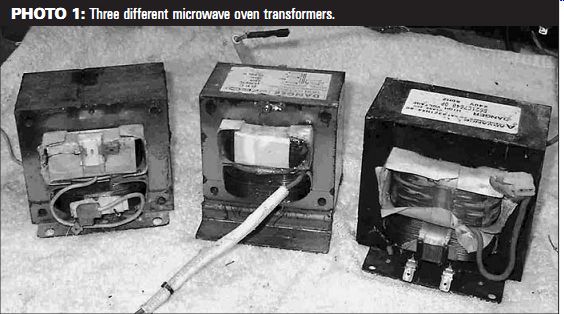
PHOTO 1: Three different microwave oven transformers.
By Graham Dicker
Microwave ovens are one of my favorite items for recovering parts for both power and out put transformer use. With the core of a microwave oven transformer the turns per volt (TPV) is invariably
1. At 1TPV the sums are simple: for a 110V-300V transformer, all you need is 110 turns on the primary and 300 turns on the secondary, which makes things easy. Most microwave ovens also contain other useful parts, such as high voltage (HV) oil-filled capacitors, which I reuse as a high tension filter capacitor. You can also recycle the high-volt age diodes.
RECYCLING WITHOUT REWINDING
Photo 1 shows a few of the different transformers available. One of the common properties is that both the primary and secondary windings are fully exposed (Photo 2). The HV secondary has one wire grounded to the core (Photo 3), which you can lift off and connect to a flexible wire. I usually make a few taps on the winding to determine the voltage I need. The nominal secondary voltage of these trans former s i s 2400V RMS.
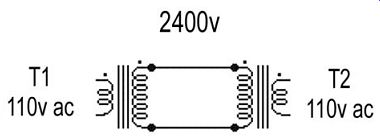
FIGURE 1: Circuit diagram of an isolation transformer using two microwave
oven transformers.
If I need 1200V for an 813 SE amplifier, I just pick out a bit of winding wire at about the halfway point of the winding, scrape the enamel from the wire, and solder on a flexible lead. If you guess wrong, try again. The output current from these transformers is around 250mA. You can push this rating quite a bit if you are using just part of the transformer winding.
REWINDING
You can easily remove windings for re winding. I use a hammer and sharp chisel. In a few minutes you can chop off the old winding without taking the transformer apart. For low-voltage secondaries for filament supplies and so on, I thread car booster cable through the core with the appropriate number of turns.
This was the method I used in Part 3 (June '04), about building your own spot welder. I always use this method with 4-125A tubes, which require 5V at 6.5A each; 4CX250B tubes, which re quire 6V (not 6.3V); and the 813, which needs 10V at 5A. It takes less than 30 minutes to make a complete 600W filament transformer.
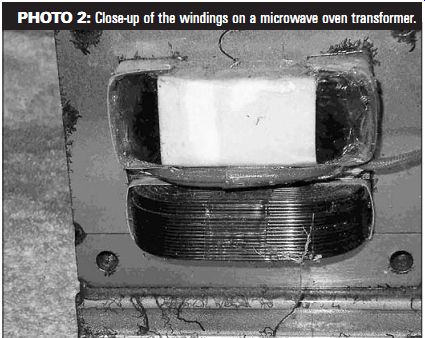
PHOTO 2: Close-up of the windings on a microwave oven transformer.
MAKING A MAINS ISOLATION TRANSFORMER
You can easily make a simple mains isolation transformer by finding a pair of matching transformers and wiring them back to back (Fig. 1). For example, the 110V AC primary of one connects to the mains supply, the secondary of that transformer (2400V) connects to the secondary of the second transformer (2400V), and the second 110V primary becomes the isolated output.
If you need a single transformer, you can disassemble both transformers (by using an angle grinder to remove the welds), and repack the two 110V primaries on the one core. This makes a dandy 1-1 power or isolation transformer. You can use the 110V AC secondary in a voltage-doubler circuit and end up with 380V DC at over an amp.
RECYCLING DIODES, CAPACITORS, AND FANS
Other parts you can use from micro wave ovens are the silicon rectifiers.
There are two types: One is a 7kV PIV diode, the other is usually an avalanche diode used for regulation. You can use the power diodes in sets of four as a power-supply bridge rectifier. The HV oil-filled capacitors can be accumulated to make up the HV power-supply filter.
For better regulation you can use an other microwave oven transformer with an air gap added, as the filter choke, in a choke input filter.
I often use the 240V winding for the choke and disconnect the 2400V winding. Ideally, you should remove the welds that hold the core together and repack the transformer with an air gap; however, due to the massive size of core in use, these make a dandy filter choke without modification.
If you are really on a cost-saving exercise, you can also recycle the fans for use with glass tubes to keep them cool.
These are usually of the squirrel cage variety, with four plastic blades (which are unable to provide sufficient pres sure for use with ceramic tubes, but are quite effective for use with glass).
I have built a complete SE guitar amplifier in an old microwave oven, using most of the parts and removing the turntable and magnetron. I mounted the output tube and associated parts behind the oven door, and retained the internal light globe to show off the work. I even kept the door interlock to remove the extra high tension in case someone decided to have a look, or change tubes.
Some control panels also include a small 12V center tap 5W mains transformer on the PCB assembly, which you can recycle as a bias supply transformer or power the filament s of tubes such as the 12AX7. If the output volt age is higher than you need, you can rectify it and use a three terminal regulator for low noise, or two back-to-back zeners in series with the transformer. For example, if the secondary voltage is 16V RMS, you can use two 3.3V zeners back to back to reduce it to 12V. Another great use is to reverse-connect it and run it from a plug pack to make a low current HT supply for preamps ( “A Tube Preamp for Computer Soundcards, ” xyz, June '03).
RECYCLING COMPUTER POWER SUPPLIES
WARNING: only try this with a mains isolation transformer connected.
You can use working computer power supplies as a complete power supply for a tube amplifier. It is important to always use an isolation transformer if you are going to try this method, for your own safety. You can easily rewind a microwave oven transformer as a mains isolation transformer (110V-110V or 240V-240V) as described.

PHOTO 3: Close-up of the secondary earth contact on a microwave oven transformer.
A computer switch-mode power-sup ply unit uses a voltage doubler for 110V versions and a full-wave bridge for 240V versions to provide around 340V DC for the switch mode transistors or FETs, at around 750mA capacity. You can tap off this voltage as the HT supply for a stereo 50W per channel or mono-block 100W power amplifier. You need add nothing more. The low voltage outputs can provide filament voltages for tubes such as the 4-125A (5V 6.5A per tube) or the +12V output for 12V filament tubes such as preamp tubes or 6V tubes in series.
Broken and used computer power supplies can provide a great source of parts for use in tube amplifiers. I recycle the mains rectifiers and filter capacitors, as well as the IEC power connectors. You can also use the fans to cool glass tubes. You can use the case to build the entire HV section of a conventional power supply, or if you add a nice rack mount front panel you can build an entire tube preamp inside of one. These power supplies also include nice low voltage high-current diodes and filter capacitors that you can reuse to make DC filament supplies for your projects.
Computer monitor power-supply boards often provide around 160V to 185V at 1A, plus other voltages; i.e., 6.3V for filament supplies. You could also use these to power many projects using tubes. The outputs from these power supplies are fully isolated, so you do not need to add an isolation transformer. If you do reuse monitor power sup ply boards, you will need to put them in a shielded box to reduce radiation of noise into audio circuits.
--- xyz
--------
[The discussion above is adapted from an article, Jun 2005, outlined in xyz ]
Also see: