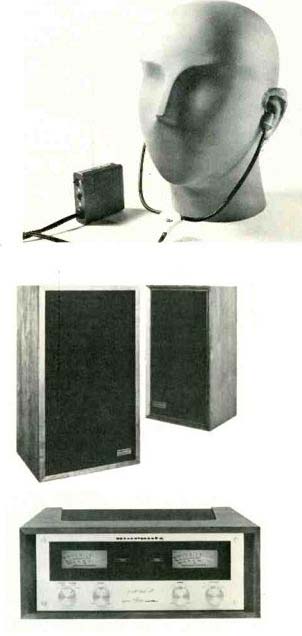
Altec offers two "Mini-Monitors"
Two low-cost systems have been added to Altec's speaker line. Model 891A-the Mini-Monitor I-is a two-way bookshelf system of approximately 2 cu. ft. with a 12-in. woofer and direct-radiator tweeter. It's available at $149 in walnut, $119 in walnut-grained vinyl.
The 887A Capri, or Mini-Monitor II, is slightly smaller. It has an 8-in. woofer and a 3-in. direct-radiator tweeter and costs $89. Altec says both speakers were designed to offer studio performance characteristics to those limited in space and/or budget.
Marantz power amp has meter option: A stereo basic power amp, the latest addition to Marantz's electron ics line, is available with or without power metering. The 400M has two 3 1/2-in. VU meters and a meter-range switch (off, 0 dB, + 10 dB, + 20 dB). Both it and the Model 400 (without meters) have power overload monitoring circuits and peak overload indicators, and are rated for a minimum continuous power of 200 watts per channel (continuous, full band) at 0.1% distortion. The Model 400 costs $599.95; the Model 400M, $699.95.
Unique Superex hybrid headphone: In the new Model EP-5 Electro-Pro headphone, Superex has coupled an electrostatic tweeter with a Mylar-diaphragm dynamic woofer. The intent, the company says, is to combine the clarity of the electrostatic with the deep bass response of the dynamic and make possible the high listening levels associated with rock music. The energizer unit, which is to be driven from amplifier speaker taps, includes crossover and power components plus a speaker/ phones switch. Headset, energizer, and a coiled 15-ft. interconnect cord cost $80.
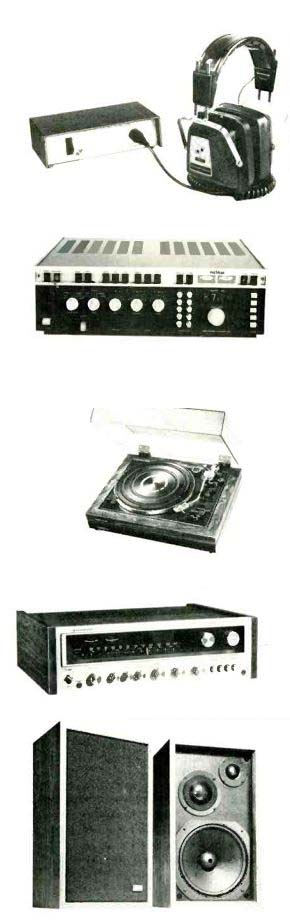
Digital FM tuner/preamp from Revox: Revox's A-720 digital FM tuner/ preamp is part of its new electronic series styled to match the A-700 tape deck. A quartz-stabilized frequency synthesizer, signal-strength and frequency "lock-in" meters, and phase-lock-loop circuitry are incorporated into the tuner section. The digital readout returns to 87 MHz when tuned past 107.95 MHz. The preamp section includes stepped bass, presence, and treble controls; two front-panel headphone outputs; a special binaural headphone circuit; dubbing/ monitoring facilities for two tape decks; screwdriver-adjustable preset levels for the five inputs; two switchable stereo outputs; and remote-control jack. The price is $1,395.
Pioneer's new belt-drive automatic turntable: U.S. Pioneer has a second automated single-play turntable. The PL A45D-a two-motor (one for the platter, one for automatic functions), two-speed (33 1/3 and 45 rpm), belt-drive model-incorporates an S-shaped tone arm and features automatic lead-in, return, and repeat. It can be used for manual play as well, of course. Also included are oil-damped cueing, direct-VTF-readout counterweight, lateral balance adjustment, antiskating control, and a plug-in cartridge shell. The PL-A45D costs $169.95.
First model in new Kenwood receiver line
The top-of-the-line KR-7400 is the first in a new assortment of stereo receivers from Kenwood. It has a tape-through circuit (if you have two decks, tapes may be copied while you listen to another source); two inputs each for phono, aux, and tape; and a four-channel FM detector jack. Amplifier circuitry is direct-coupled, and a dual protection circuit guards both speakers and transistors. Power rating is 63 watts continuous per channel. Phase-lock-loop circuitry and signal-strength and center-tuning meters are included in the tuner section. Cost is $519.95.
Onkyo adds "linear suspension" speaker: Onkyo's new Model 25A loudspeaker system is a three-way design featuring a 14-in. woofer. The woofer cone is molded (a process developed by Onkyo as an alternative to conventional pressure forming), has an extra-length voice coil, and uses a ported cone cap said to promote robust bass and control nonlinearity. The midrange driver is a 2-in. hard (Duraluminum) dome; the tweeter is a similar 1-in. dome. Rear-panel switches allow adjustment of midrange and highs in 2-dB steps. The 25A is rated to handle up to 60 watts; amps of at least 10 watts per channel are recommended. The Model 25A costs $249.95.
++++++++
TOO HOT TO HANDLE
Your report on the Pioneer RT-1020L [open-reel deck, July 1974] didn't seem to rate it as high as your reports on the Teac 3300 and the Tandberg 9000X. I must admit to a bias for Pioneer products; I've never needed a repair on any of my Pioneer units, and though I use my T-8800 [an earlier open-reel deck] almost every day it performs faultlessly. Now I'd like to buy another deck to go with it. In your opinion, is the quality of construction in the new Pioneer close to that of Teac and Tandberg?
-John Monzella, Belleville, N.J.
All three brands have consistently impressed us: Teac for its ruggedness of construction and sanity of design; Tandberg for its often brilliant innovativeness, particularly where the fine points of performance are concerned; and Pioneer for its good value and the excellent flexibility of its features. All of the models you mention could be cited as examples of these strengths; our way of thinking, incorporate design weaknesses significant enough to offset their strengths. That isn't to say they all are equally "good"-it's just that the evaluation of their relative quality is subject to individual interpretation and that we don't think you could go seriously wrong with any of them.
Are speaker equalizers worth it? Should I use one with my AR-2ax's?
-Andrew Hinds, Fort Collins, Colo.
A speaker equalizer is "good" only in inverse proportion to how "bad" you think the speaker is without equalization-and then only if the equalizer is designed to "correct" what you conceive of as bad.
The multiple-band equalizers (like the Altec Acousta-Voicette) will correct almost any imbalance or nonlinearity in response, of course; within reason they can make the speaker's response measurably flat or at least closer to flat than most speakers are in most rooms without equalization. Simpler equalizers (which typically have one control for boosting the deep bass, often another for boosting the extreme treble, and perhaps a third for adjusting relative midrange-or "presence" range-emphasis) may do a similar job at far lower cost.
The AR-2ax, for example, has a response characteristic that gently rolls off above 1 kHz (as measured at CBS Labs) and stays about 6 dB below the 1-kHz level from 5 kHz up. To some ears this will translate to fine performance that needs no equalization; to others it will suggest some over-prominence of the midrange; to still others it will sound a little weak at the high end. An too hot to handle equalizer would be useless for the first group; the second group would want the midrange control; the third group might be satisfied with a treble touchup, perhaps using amplifier controls rather than an equalizer. Similarly, if you want more output from 32-Hz organ pedal tones-a frequency at which loudspeaker bass always is rolling off-you would need an equalizer specifically designed to boost output below about 50 Hz. But the more boost that is applied, the higher the distortion rates will run, so the degree of "improvement" possible involves a complex value judgment on the part of the listener.
If I get a cassette deck with automatic re verse, will it affect the deck's performance or cause any other problems?
-Willard Ryland, Columbia, Tenn.
At least, automatic reverse adds complexity (that is, more elements that potentially could malfunction) to the deck: at the most, it threatens unstable head alignment and compromise elsewhere in the design to prevent seemingly exorbitant selling prices. The same might have been said, at one time, about auto-reverse open-reel equipment, which today has achieved a high degree of reliability and performance very close to that of comparable nonreversing equipment. But the problems of doing likewise in cassette equipment are obvious when you consider that if it costs, say, $100 (at retail) to add a really rugged automatic-reverse system, that would be 20 per cent added to the price of a $500 open-reel deck but 50 percent added to the price of a $200 cassette deck. Faced with numbers like that (obviously we're picking these specifics out of the air), manufacturers are hesitant to commit auto-reverse designs to the production lines for fear that they may find themselves with a model that won't work or won't sell or both. But the demand seems to be growing, and where there's a market there's a way.
I don't understand your efficiency ratings for speakers. According to your review
[May 1971], the Dynaco A-50 "will produce a level of 94 dB (at one meter on axis) when powered by as few as 3.5 watts." How efficient is this, and how much power do I need in the amplifier? The manufacturer recommends 25 watts. I ask because your review of the JBL L-100 [August 1971] says it'll produce the reference level with 2.8 watts. This doesn't seem very different from the 3.5 watts for the Dynaco, yet JBL says all you need for the L-100 is 2 watts minimum to produce good volume in a medium-sized room.
-John A. Pacetti, Manhattan, Kan.
The question can be summarized by an other: How loud is loud? The 94 dB of our test is pretty loud; louder, we suspect, than many component owners drive their systems to in normal use. Yet a live rock band may deliver levels up to as much as 120 dB in the auditorium, and some home listeners try to get as close to "live" levels as they can. Starting at our base of 94 dB, theory dictates that you must double the power to achieve 97 dB (or 3 dB higher), quadruple it to achieve 100 dB (another 3 dB), octuple it for 103 dB, and so on. So for an average level of 100 dB at 1 meter on axis you would need almost 15 watts minimum into the Dynaco, 11 watts or more into the JBL; for 103 dB you would need 28 and 22 watts respectively. In other words, the required power can be altered drastically by what appear to be small changes in the desired acoustic output. (They're not that small; it's just that the dB scale is exponential, while the power scale is not.) Dyna's recommendation of 25 watts seems sane on the basis of allowing for unusually high playback levels and offering some headroom so that peaks aren't clipped. But it's far more than most users ever will actually want or need. Your 2-watt rating for the L-100 presumably is based on JBL's own efficiency-rating sys tem (which involves measuring output at 15 feet for a 1-watt input and taking 75 to 80 dB as "a comfortable listening level").
Working either from their rating (76 dB) or ours, the L-100 normally will draw no more than about 2 watts in average rooms. But that's not the same thing as a minimum power recommendation, which should al low for higher levels when (and if) they are needed.
I recently purchased the Kenwood KR-9340 quad receiver, largely on the basis of your test report in the March issue. The performance figures you published and the specs on a sheet I got with the receiver are two different animals. The discrepancies that I am most concerned with are the capture ratio of 1.5 dB (Kenwood says 3.0 dB) and the FM-section signal-to-noise ratio of 71 dB (Kenwood says 65 dB). I simply do not understand why the measurements are so much better than Kenwood claims.
-Carleton Golden, Astoria, N.Y.
These two discrepancies are quite striking (though others are not) and appear to illustrate one reason why we always are rather circumspect about spec sheets on new products. The data usually must be pre pared from prototypes or from initial production samples if the information is to be printed up and available by the time the product is announced. In regular production, however, the manufacturer may find it impossible to hold some performance parameters as closely as he had predicted on the basis of the handmade prototypes; conversely he may find improved production methods with a "sticky" circuit and be able to do considerably better in the regular output than he did in the initial run. It appears that Kenwood has affected such an improvement in these two respects.
++++++++
NEWS and VIEWS: Explosive tape recorders ... DBX damps down noise
A Dangerous Charge
A major consumer organization says some portable tape recorders with built-in battery chargers-especially some inexpensive models-can be unsafe. Certain types of batteries may cause these models to explode, the group contends.
For the past year the Educational Products Information Exchange Institute (a New York City group funded by the Ford Foundation and associated closely with the Consumers Union) has attempted to force the manufacturers of these allegedly dangerous tape recorders to remove them from the market. It filed charges of hazardous practice against these companies with both the Federal Trade Commission and the Consumer Products Safety Commission. In dispute are certain inexpensive (under $25) models from Craig, Norelco, Sharp, VM, and Wollensak, though presumably many others might also be cited. The CPSC is currently investigating and will report its findings to the FTC.
The EPIE charges specifically that so-called "long-life" alkaline cells, used in portable cassette machines whose battery terminals are live when the unit is line powered, may cause dangerous corrosive leakage or even explode. These cells carry a written warning that they may explode if recharged, but the EPIE questions how many people ever read the fine print. So any battery-powered equipment that has an automatic-re charge feature when connected to AC might be suspect unless it provided some means of switching off the charging voltage.
Cassette machines used around children in schools were the initial subject of the investigation, which was begun with nothing more specific in mind than checking the recorders for possible shock hazards. It was noted that extensive corrosion had occurred in the battery compartment of many AC/battery-powered recorders where the battery terminals were always live.
Further investigation revealed that all alkaline cells are not alike and that, while some may be recharged, this must be done with care. (For example, very limited current should be used in all cases. And if several cells are being recharged at a time they should not be connected in series; one cell could become fully charged before the others and would be subjected to further cur rent in a fully charged state.) The key difference be tween alkaline cells is in the size of their gas-venting hole. Rechargeable cells have a large vent for the gas to escape; the "long-life" types have a small vent, which may cause pressure to build up inside the cell during charging.
The EPIE admits that during its own lab tests, under normal operating conditions, it has never been able to explode a battery. But it does report chronic corrosive leaks. Cooperation among recorder manufacturers has been mixed, the EPIE says. It singles out 3M (Wollensak) as highly responsive; 3M has stopped production and distribution of the model in dispute pending results of its own safety tests.
What is probably of lasting importance here is the ad monition to use the correct type of cells in portable equipment. If the terminals are live during use on line current, and if the battery cannot be recharged safely, remove the cells from the equipment before using it on line voltage. If you want the ease of switching between battery and line power, nickel-cadmium ("nicad") cells, which are specifically made to be recharged, are a wise investment.
---------------
DBX Disc-Noise System Unveiled
It's official. The DBX system for noise reduction in disc recordings, which you read about in this column in April 1974, has been unveiled to the public.
Our report said that we found the dynamic range about 100 dB-startling, that two records encoded for playback through the system were available, and that the DBX-120 decoder would cost about $200. Since then, Klavier Records, producer of one of the original two, is said to have several more recordings in the can.
(The initial disc is available either with or without the DBX encoding; we presume this pattern will continue.) And Stan Kenton has recorded his first DBX disc on the Creative World label.
On the equipment front, DBX has announced that two units (both encode/decode models that can be used for tape recording as well, and therefore quite different from our trial prototype) will be marketed. The Model 122 is a two-channel unit at $259; the Model 124 is a four-channel record-or-play model that, alternatively, can be used for simultaneous record-and-monitor in stereo and costs $379. They have switches that select either the tape or the disc play mode, since expander characteristics are not identical in the two modes.
One element that's wanting at present, of course, is a broad range of attractive program material to play through the system. Says one company representative:
"When will DBX sign the first major label? Not for quite a while. Maybe in a year when we get 10,000 decoders out into the market." In a nutshell, that's it.
Be Your Own Binaural Dummy
You remember binaural recording. Sure you do-it was the means by which (thanks to Emory Cook) two-channel sound first was introduced to the American market.
The terminology hadn't been pinned down yet, but binaural sound eventually came to mean specifically a way of recording one channel for each ear, using mikes placed to simulate the listener's ears in the "hall." A dummy head, matched as closely as possible to the acoustic properties of the human head, might be used as a "mike stand" with the mikes mounted inside the dummy at eardrum position.
Binaural reproduction requires headphones. Each ear, in theory, receives exactly the sound it would if the listener were present at the original "event," and the entire spatial ambience of the original is reproduced.
(This is, of course, very different from stereo, where multichannel sound is captured with the intent of repro Sennheiser has resurrected binaural recording and done so in a way that means a break for the amateur recordist. The MKE-2002 microphone system comprises two tiny condenser elements mounted on a stethoscope-like device that holds them over the ear cavities. The complete system (mikes, power supply, carrying case, and a plastic dummy head) costs $300, substantially less than conventional high-quality binaural setups-if you could buy them.
But by mounting the mikes on the stethoscope (rather than in the dummy head, formerly the standard approach), Sennheiser allows you to be your own dummy-if you can (and want to) sit in one spot through out the recording. Not only does that eliminate the bulkiest item of binaural paraphernalia, but presumably what you hear is precisely what you get, without head phone monitoring.
And later reproduction through headphones should create the aural sensation of being back at the recording. Just remember not to swivel your head around while you're recording.
New Audio Company Formed A new company called Neosonic Corp. of America is offering what it terms "selected audio products" in the U.S. under the Neosonic brand name. (Principals in the Westbury, New York, company are Joseph N. Benjamin, who founded Benjamin Electronic Sound and has been associated with Pilot Radio and Bogen Sound, and Joseph Longin, currently the president of Multi-Products International in Clifton, New Jersey.) Its first product will be the Sonosphere SPR-12, a $30-$35 spherically shaped speaker system manufactured by Audax of France for exclusive distribution this country.
+++++++
Vintage magazine ADs:
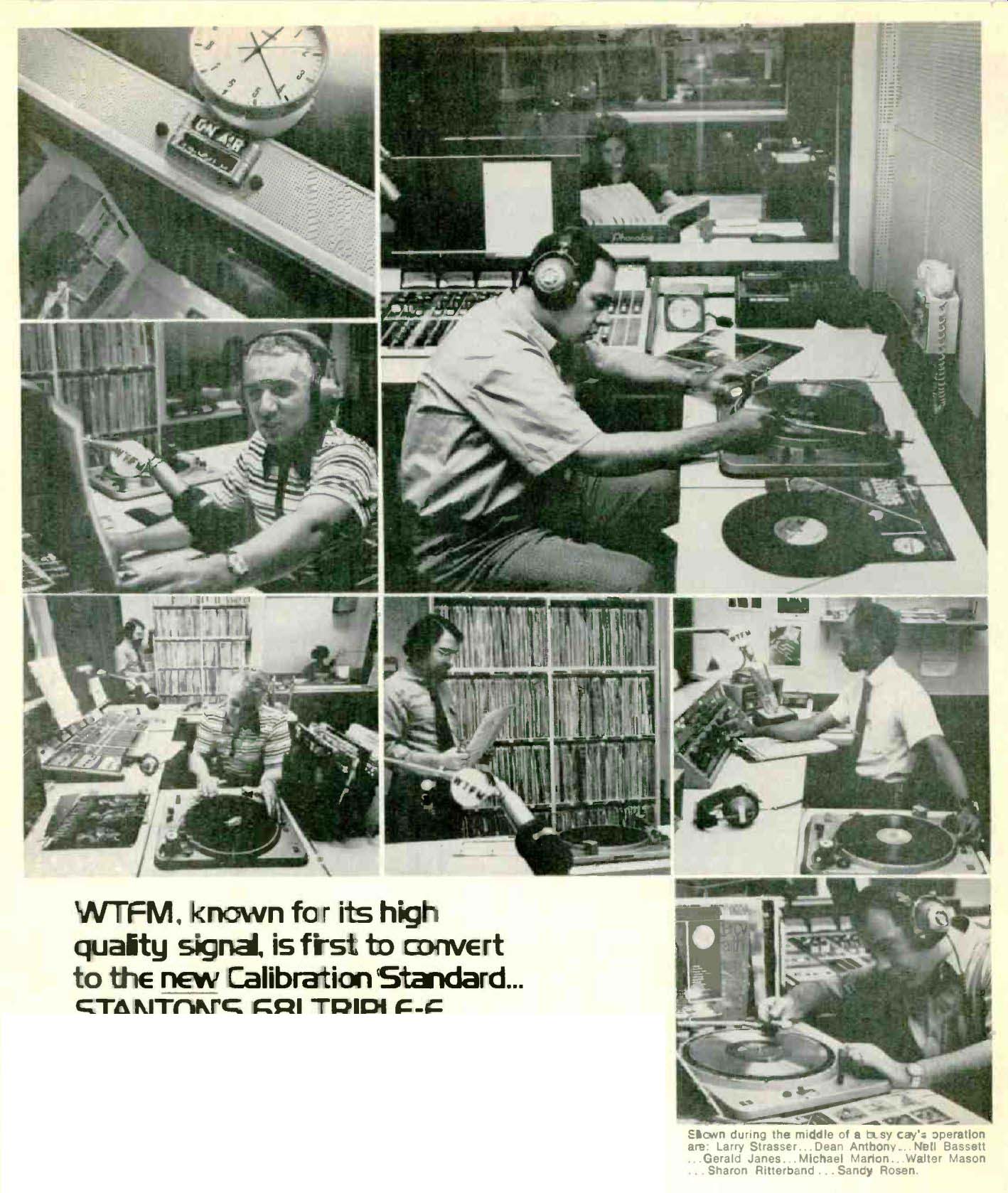
WTFM, known for its high-quality signal, is first to convert ... to the new Calibration Standard...
STANTON'S 681 TRIPLE-E.
Good music stations need the best broadcast cartridges for auditioning critical recordings and making transfers as well as for on-the-air use.
Larre Strasser, Engineer of WTFM, New York, states: " have been impresesd for yearswith the quality and dependability of Stanton's broadcaat cartridges. Naturally, I wanted the improved version for our station just as soon as it became available."
Stanton's 581 Triple-E offers improved tracking at all frequencies. It achieves perfectly fiat frequency response to beyond 20 KHz. It features a stylus assembly that possesses ever' greater durability than had been previously thought possible to achieve.
This came about because Stanton's engineers, who were deeply involved in the development of Stanton's superb discrete 4-channel cartridge, 780/4D0, achieved certain intrica1a refinements and sophisticated new techniques that were equally applicable to stereo cartridge design and construction.
Each 681 Triple-E is guaranteed to meet its specifications within exacting limits, and each one boasts the most meaningful warranty possible an individual calibration test result is packed with each unit.
You can enjoy the professional audio quality of Stanton products whether your purpose involves Broadcasting or Home Entertainment.
Larry Strasser...Dean Anthony ..Nell Bassett
...Gerald Janes...Michael Marion...Walter Mason
...Sharon Ritterband ...Sandy Rosen.
Write today for further information to Stanton Magnetics Inc., Terminal Drive, Rainview, N.Y. 11803, USA.
+++++++
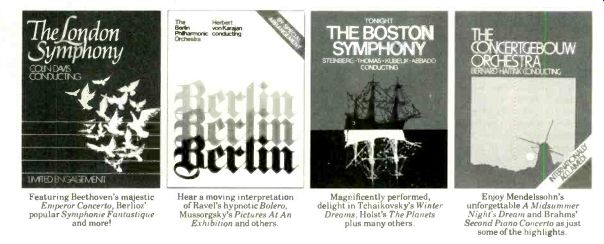
Choose one of these four world-famous orchestras to enjoy in your home for 10 free concert evenings!
Featuring Beethoven's majestic Hear a moving interpretation Magnificently perforn-ed, Enjoy Mendelssohn's Emperor Concerto, Berlioz' popular Symphonic Fantastique of Ravel's hypnotic Bolero, Mussorgsky's Pictures At An delight in Tchaikovsky's Winter Dreams, Hoist's The Planets unforgettable A Midsummer Night's Dream and Brahms' and more! Exhibition and others. plus many others. Second Piano Concerto as just some of the highlights.
Audition superb stereo recordings with no obligation to buy! The International Festival of Great Orchestras brings you the best of critically-acclaimed performances by top-ranking orchestras ...without your ever having to leave your living room! To begin, you choose the world-renowned orchestra you want to audition-
the London Symphony, Berlin Philharmonic, Boston Symphony or Amsterdam's Concertgebouw Orchestra. Then mail the coupon below and we'll send you a superb four-record stereo concert program by the orchestra you choose-along with an exclusive concert guidebook-all in a handsome, hinged storage case. Listen to ... read about ... and enjoy your concert program for 10 days free! Keep all 4 records for less than the price of 1--pay just $6.98! If you decide to keep the set, you pay an incredibly low $6.98* plus a small postage and handling charge). This special introductory price saves you almost $25 off the suggested list price of comparable records in retail stores! Enjoy exclusive concert programs throughout the year! As a member, every two months you'll receive another exclusive concert program by a world-famous orchestra to audition for 10 days free. These handsomely-boxed, silent-surfaced European pressings—
- Choose the concert program you want to audition for 10 days free! including four records for each concert plus an exclusive concert guidebook
--cannot be bought in any store. They're available only through the mail-only from the International Festival of Great Orchestras!
And you keep only the concert programs you want-only when you want them. There is absolutely no obligation to buy every month! Of course, each album is yours to enjoy for 10 full days before you decide whether you want to add it to your permanent record library... and for each one you do decide to keep, you pay only our regular low members' price of $16.95 (plus a small postage and handling charge)... a savings of more than 45 % over comparable retail prices! Send no money now-just indicate on the coupon below the concert you'd most like to hear and mail the coupon today! The International Festival of Great Orchestras 175 Community Drive, Great Neck, N.Y. 11025 Please check one box only:
1. London Symphony
2. Berlin Philharmonic Q77
3. Boston Symphony
4. Concertgebouw Orchestra Yes!
Please send, for my free audition, the handsomely-boxed concert program I have indicated above, including four superb stereo records and my concert guidebook. I may return the complete set after 10 days and owe nothing, or keep it and pay only $6.98 (less than half the regular low members' price) plus a small postage and handling charge. I will then receive, at two-month intervals, additional concert programs by world-renowned orchestras for my free 10-day audition-each a four-record set plus an exclusive concert guidebook. I may return any set or keep it at the regular low price of only $16.95* (plus postage and handling). As a member, there are no minimum number of records l must buy-and I may cancel my membership at any time.
Name Address City please print) State Zip
++++++
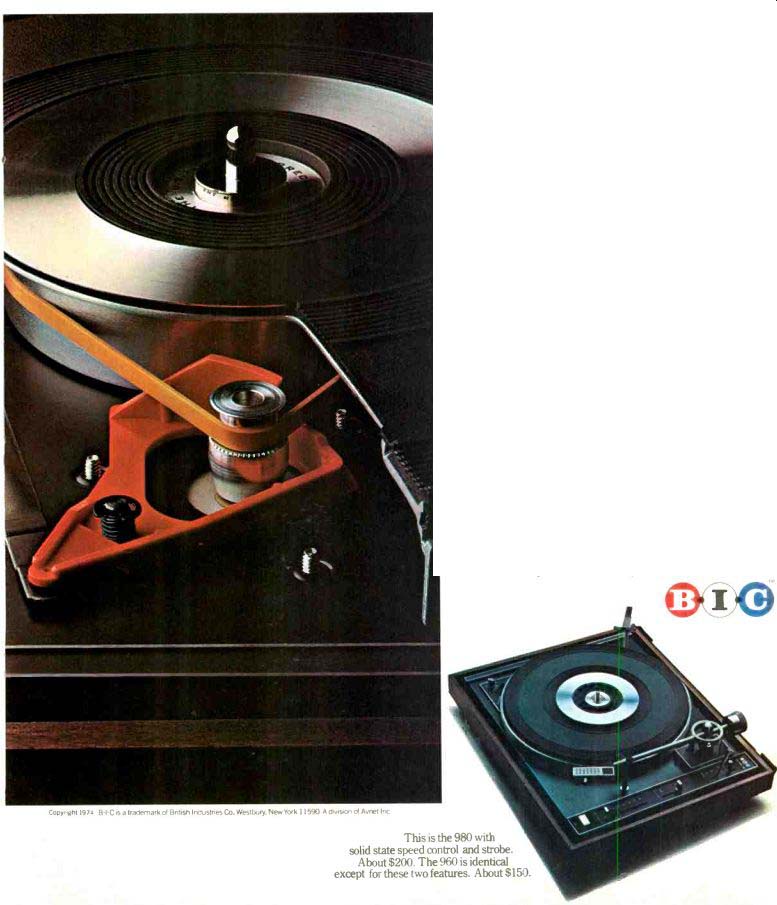
BELT DRIVE ISN'T NEW.
MULTIPLE PLAY ISN'T NEW.
A TURNTABLE THAT COMBINES BOTH IS NEW.
READ ALL ABOUT IT.
New , Back in monophonic times, turntable motors drove platters through a series of wheels called "idlers".
Many automatics and changers still use this system.
In those days, records and playback systems were still relatively unsophisticated, so the distortions an idler drive system created didn't matter much.
Today, however, distortion is a critical problem. With recordings of increased dynamic range, wow, flutter and rumble must be reduced to inconsequential levels.
A belt-drive system is light years ahead of idler drive in that department.
And here the belt is driven by a unique motor found only in B-I-C turntables. It is a 300 RPM, 24-pole motor and it is inherently freer from noise and vibration than the 1800 RPM units with from 2 to 16 poles, which are standard in even the best of the conventional automatics.
The advantage of Programmed Multiple Play The 980 and 960 are not record changers.
They are belt-drive Programmed Turntables which are engineered to play as many as 6 records at a time.
They have a 2-point record support system which is far less complicated and far more reliable than any umbrella spindle we've ever seen.
But an even more important advantage is this.
An automatic record handling system like the one on a BIC turntable can handle a single record, or 6 at a time, perfectly. No false drops. No bouncing and skating a dia mond stylus across the grooves. It eliminates human error, and human error is what damages the sidewalls of your record grooves forever.
The simplicity factor The 980 and 960 have the visibly lower profile of single-play manual instruments. They've been engineered to be simple machines, so they have fewer parts and fewer potential problems.
They abound in innovations. In the tone arm, the cartridge shell, the program panel, the entire system.
We can send you more detailed information if you write to Dept. 11B, British Industries Co., Westbury, L.I. 11590; or better yet, see them at your local audio specialist.
This is the 980 with solid state speed control and strobe.
About $200. The 960 is identical except for these two features. About $150.
++++++++
"The world's most powerful sound system is installed at the Ontario Motor Speedway, California." Guinness Book of World Records, 1974 Edition.
Gentlemen, start your ears.
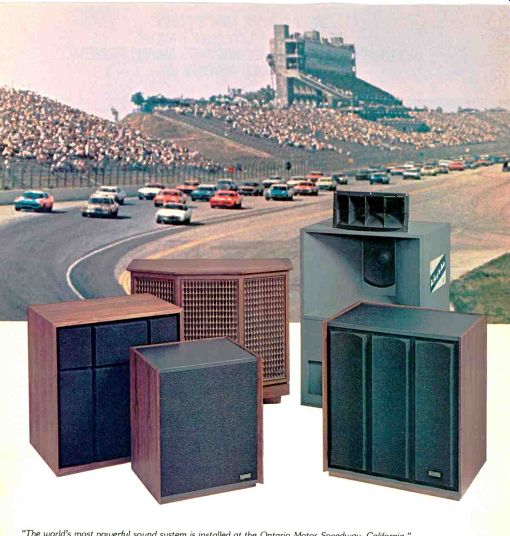
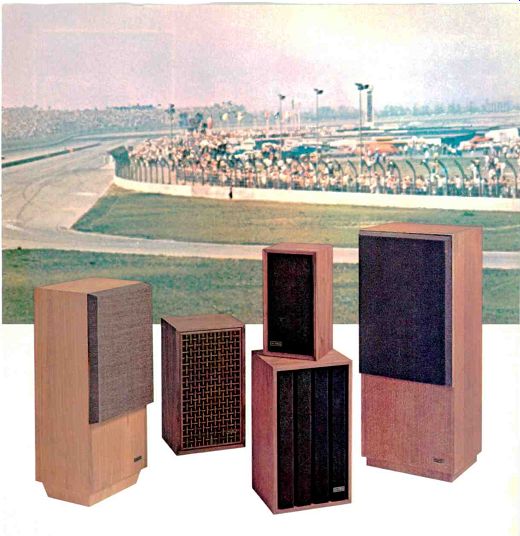
30,800 watts of pure power through 355 precision speaker assemblies.
Enough sound energy to spread the word cleanly, clearly and truthfully to more than 230,000 screaming fans.
Year after year. All above the ear-rending din of 50 roaring race cars.
It took more than ordinary experience to design and produce that spectacular sound system. It took the kind of knowledge and craftsmanship only 37 years of building high quality sound systems can teach.
It took Altec.
The same Altec you'll hear in our super-line of high fidelity loudspeaker systems. The same experience. The same knowledge. The same craftsmanship. The only differences are that we've dressed them up for your use.
Some are small. Some large. Some are powerful. Some are very powerful.
And they're all made to satisfy the ears of just one very important listener.
You.
Before you buy your next speaker system, stop by your local dealer and listen to Altec. Championship performance for more than three decades.
copyright 1974. Altec Corporation 1515 S. Manchester Ave., Anaheim, Calif. 92803
++++++++++++
Sansui
Hardheaded.
The new Sansui SC 737.
++++++++++
Lafayette Criterion speakers
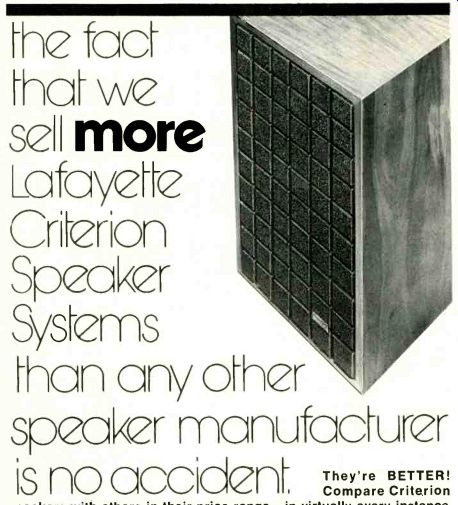
They're BETTER! Compare Criterion speakers with others in their price range-in virtually every instance you'll find: larger magnets, larger diameter voice coils, heavier-gauge wire in crossovers, specially manufactured cone materials and quality control that's the most rigid in the industry. Also speaker to speaker uniformity-an illusive but VERY necessary quality in ANY speaker line. The sound is clean, peak-free, natural-listen to Lafayette Criterion speakers-you can't go wrong! Lafayette Listen to us, you can't go wrong.
111 Jericho Turnpike, Syosset, L.I., N.Y. 11791.
54 years of Leadership and Integrity in Electronics. So although it's easy to be impressed by the sheer size of a company or the weight of its advertising, when you get right down to it performance-per-dollar makes it all hi-fi ho-hum.
Sherwood Electronic Laboratories 4300 North California Avenue Chicago, Illinois 60618.
Sherwood.
The word is getting around.
Hi-Fi Ho-Hum Competing with the giants in a giant industry is no small task.
Which should explain why we at Sherwood feel a sense of accomplishment.
After all, we can't invest as much in advertising as the larger manufacturers. Nor pro duce as many different types of equipment. So we certainly can't come close to matching their total sales volume.
Yet, we've steadily gained leadership status in the field of high fidelity electronics. For one simple reason:
Dollar-for-dollar, Sherwood provides more power and greater performance in its products than anyone else.
You can prove this by com paring our products with others in the same price categories.
The S-7210 is a case in point.
It has minimum RMS 26 X 2 (8 ohms 20-20,000 Hz), with maximum harmonic distortion of only 0.6%. FM Sensitivity (IHF) of 1.9 uv. Alternate channel selectivity of 65 db. Front panel switching of 4-channel decoder (which doubles as second tape monitor). FM muting switch.
And a Tape Dubbing feature.
What's more, the S-7210 is built with the most advanced componentry. Integrated circuits, FET circuitry, solid-state ceramic FM IF filters.
All for under $300.
++++++++++++++
The 800+.
It's six of the best receivers you can buy.
If you'd stop reading this and go listen, we'd both be ahead of the game.
If words could do it you'd be into poetry, not music.
The harman/kardon 800+ gives you both kinds of four channel now. Built-in CD4 now Built-in SQ now. No waiting.
(Anyone who tells you to wait for four channel has a hole in his receiver.) The 800+ will play any four channel record you can buy now. With four separate amplifiers delivering a glorious 22 watts continuous power. Each.
Mono and stereo, of course. Pure stereo. Some four channel systems play stereo like they only half mean it. (They turn off two of their four channels and call it "stereo.") If you're playing stereo on the 800+ you get the whole sound. A simple switch blends the power of four channels into two- more than doubling their quad output. 50 watts continuous power per channel! Then, two kinds of stereo you've never seen before:
Stereo/Stereo. Listen to your tape deck in the living room. Listen to FM in the bedroom. At the same time.
Enhanced Stereo. An incredible bit of electronic magic that makes your entire stereo library think it's quad. (We know an unnerving number of music buffs who say that enhanced stereo is better than quad. You listen. You decide.) Six receivers: mono, stereo, stereo/ stereo, enhanced stereo, CD4 and SQ.
Words, words, too many words. Go hear the 800+. Listen to it do what it does.
One last word: $500. The six receivers are yours for $500. Which figures out to $83.33 a receiver.
That's music.
The harman/kardon 800 +.
Power output 4 x 22 watts continuous per channel. all channels driven into 8 ohms from 20Hz to 20.000 Hz (Stereo mode 2 x 50 watts RMS) Harmonic Distortion Less than 0.5% THD Frequency Response (AMP) 4Hz to 70.000Hz *1 0 dB Hum & Noise. Better than 85 dB (unweighted) FM Sensitivity- 2.0 micro volts (IHF) FM Selectivity- 40 dB FM Capture Ratio. 2.5 dB Ultimate S/N Ratio 70 dB (1000µV)
harman/kardon--High fidelity component systems from $200 to $1300.
55 Ames Court, Plainview. New York 11803 A subsidiary of Harman International.
++++++++++++++
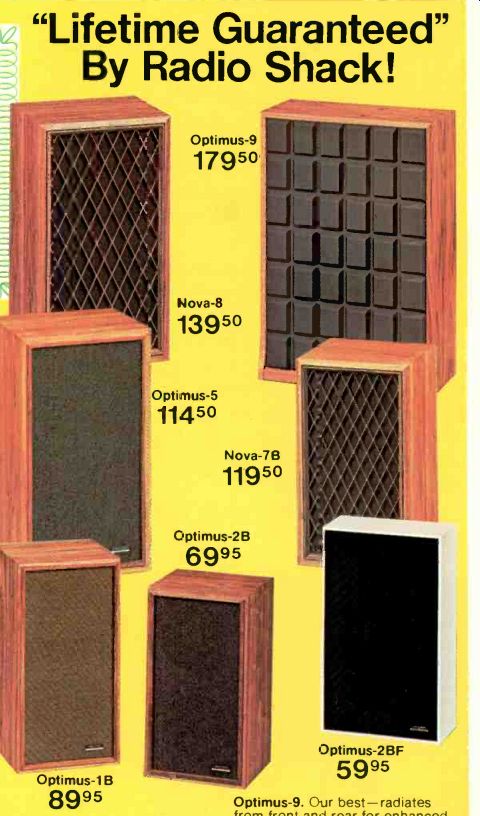

Seven Speakers, One Message:
"Lifetime Guaranteed" By Radio Shack!
Lifetime Guarantee-- Radio Shack guarantees to the original owner without time limitation the proper electro mechanical function of all Optimus and Nova speaker systems in original, unopened enclosures, providing that the system has not been abused (our determination is final) and that the owner provide transportation to and from the repair site.
Your system must function properly or Radio Shack will repair it FREE OF PARTS AND LABOR CHARGES- today, tomorrow, forever! This guarantee is honored at all Radio Shack stores from coast-to-coast. Your receipt is all you need to obtain lifetime free service.
Realistic Optimus and Nova Speakers--America's Best Buy! Radio Shack puts more into its famous Optimus and Nova speakers by leaving a few things out.
Things like middleman profits. Because we design our own speakers, you get better quality control, unique engineering features, elegant walnut wood veneer cabinets.
FREE New 1975 Radio Shack Catalog
OVER 2000 PRODUCTS EXCLUSIVES ON EVERY PAGE BEAUTIFUL FULL COLOR
Stereo Quadraphonic Phonographs TV Antennas
Radios Citizens Band Kits
Recorders Tape Tools Auto Tune-Up Electronic Parts Test Instruments More!
164 pages of the finest in home and hobby electronics Respected brand names like Realistic, Micronta. Archer.
Science Fair- and they're available only at Radio Shack stores and dealers nationwide!
See what's really new in electronics by getting this catalog now.
SEND FOR YOURS TODAY! FILL OUT COUPON BELOW
451 1975 Mail to Radio Shack, P. O. Box 1052, Catalog Ft. Worth. Texas 76101. (Please print.) Name Apt. No.
Street City State ZIP
Nova-8. Firm bass even at 20 Hz.
12" woofer. 3 other speakers handle the midrange and one doubles as a tweeter, too.
20-20,000 Hz. 25x14x 11 1/27 . #40-4020
Optimus-5. Top rated by a leading testing organization. 12"woofer, 3 midrange/tweeter units 20-20,000 Hz. 25x14x 11 1/27
#40-2002
Optimus-1B. Uncolored audio at an affordable price. 10" woofer, 2 midrange/tweeter units.
20-20,000 Hz. 23x12x11"
#40-2005 411) 01 Master Charge or Bank Americard at participating stores Optimus-2BF 5995 Optimus-9. Our best-radiates from front and rear for enhanced midrange. Five speakers including 12"woofer. 20-20,000 Hz. 28x19x9" #40-4023.
Nova-7B. Superb sound. style to match. 10"woofer, two 8" midrange/tweeter units.
20-20,000 Hz 22x12 1/2x117
#40-4025.
Optimus-2B. First low-cost system good enough to win the Optimus name. 8"woofer, tweeter. 30-20,000 Hz. 20x11x 10" #40-2023.
Optimus 2BF. Same as 2B, but you can custom finish its white vinyl enclosure. #40-2024.
Radio Shack---3000 STORES; 50 STATES; 8 COUNTRIES; Retail prices may vary at individual stores
+++++++++++++++
ONE OF THE FINEST YOU CAN FIND.
IF YOU CAN FIND IT.
RECEIVERS
The Concord CR-260 is damn hard to find, because we're just as particular about the stores who sell it as we are about the quality of workmanship that goes into it.
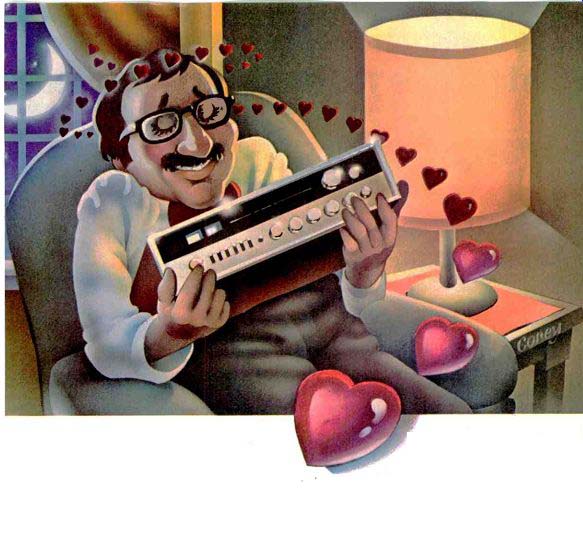

And for under $250; it's damn hard to beat. You simply can't find features like ours in such a beautifully designed receiver for such a reasonable price.
While other receivers may have some of our features, none have all of them! There's simply no competition for the CR-260 at this price.
Here's what makes the CR-260 worth finding: We've taken the care to make tuning more precise, even under the most difficult conditions.
While other receivers have one FM tuning knob, that's not good enough for the CR-260. We went to the trouble of engineering an additional second control for ultra-fine FM tuning.
And when it's receiving a stereo station the dial pointer changes from amber to red.
It even has two FM meters, one for signal strength, and another for center of channel tuning.
Other deluxe touches are the detents on the bass and treble controls that help you reset any combination exactly.
And here are some of the vital statistics: 50 watts rms total power output at 1% total harmonic distortion.
FM capture ratio an incredibly low 1.5 db. And for just pure aesthetics, a beautiful blackout dial.
You'll want the full story on all the CR-260's features before you begin your search; just drop a line to:
Concord Products, Benjamin Electronic Sound Co., 40 Smith Street, Farmingdale, N.Y. 11735.
We hope it's easier for you to find than it was for us to make.
THE CONCORD CR-260.
Damn hard to find. Damn hard to beat.
*Manufacturer's suggested retail; slightly higher in the west.
++++++++++++++++++++
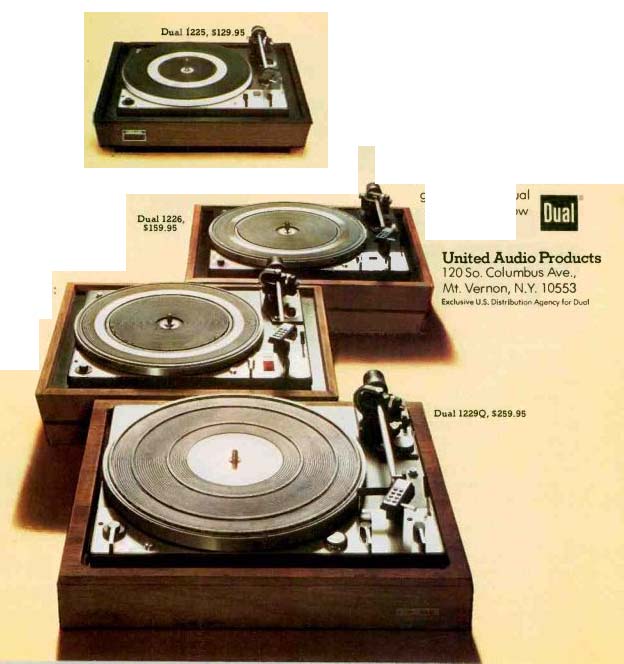
The lowest-priced Dual may well be all the turntable you're ever likely to need.
The least you should require of a turntable is the assurance that its tonearm can track flawlessly with the most sensitive cartridges available, and that its drive system will introduce no audible rumble, wow, or flutter. To accept less means risking damage to your precious record collection and producing sounds from your system which were never recorded.
Happily, the lowest-priced Dual, the 1225, provides this assurance and much more at just $129.95. For it is the perfect example of Dual's basic design concept: to build every Dual turntable with more precision than you are ever likely to need.
In the case of the 1225, this means a vernier-adjust, counter balanced tonearm capable of flawless tracking at as low as one gram.
Stylus pressure is applied exactly as in costlier Duals: around the vertical pivot, Dual 1228, 5189.95 maintaining perfect balance in all planes. Anti-skating force is also applied exactly as in the highest-priced Dual: with separate calibrations for conical, elliptical and CD-4 styli.
Other features the 1225 shares with the more costly Duals include pitch control, viscous-damped cueing and a precision drive system. The 1225's hi-torque motor maintains speed within 0.1%, even when line voltage varies as much as 20%, and its hefty 3-3/4 lb. platter provides effective flywheel action that minimizes the audible effect of any possible speed variations.
All of this explains why even Dual's lowest-priced models have been so well accepted by audio experts. (Many tell us their original Duals which were bought early in their careers are still in service.) Considering all this, why do so many serious music lovers spend as much as $259.95 for the 1229Q? (Readers of the leading music/audio magazines own more Duals-at Dual 1226, 5159.95 every price level-than any other quality turntable.) Although the 1225 has all the precision your records need, the 1229Q has refinements that you may well want. For example, the 1229Q is a full-sized turntable with a 12" dynamically-balanced platter, driven by the powerful Continuous-Pole/ synchronous motor. Its gimbal-mounted 8-3/4" long tonearm can track at as low as 0.25 gram, and has provision for adjusting its vertical tracking angle. It also has an illuminated strobe, and cueing is damped in both directions to prevent bounce.
Dual's other two multi-play turntables, the 1226 at $159.95 and the 1228 at $189.95, offer one or more of these refinements. Which may bring you to this question: having decided that you and your records deserve a Dual, which one should you buy? For the answer, we suggest you visit your franchised United Audio dealer where the new generation of Dual turntables is now on display.
Dual--- United Audio Products ---120 So. Columbus Ave., Mt. Vernon, N.Y. 10553---Exclusive U.S. Distribution Agency for Dual
Dual 1229Q, $259.95
++++++++++++
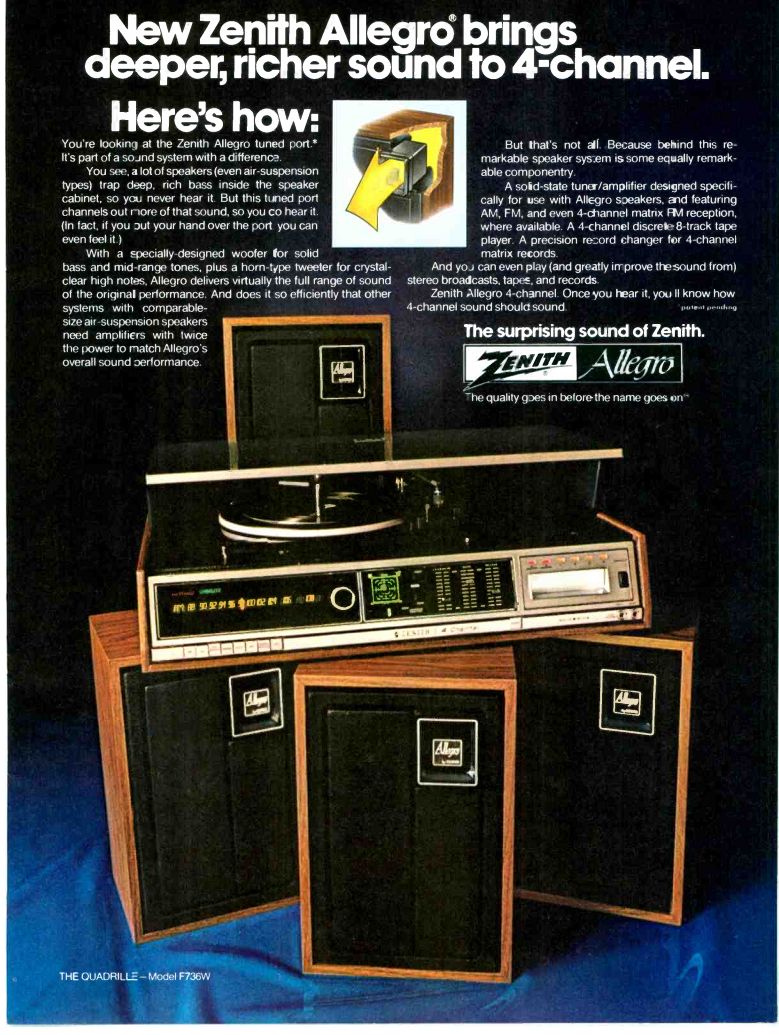
New Zenith Allegro brings deeper, richer sound to 4-channel.
Here's how:
You're looking at the Zenith Allegro tuned port. It's part of a sound system with a difference.
You see, a lot of speakers (even air-suspension types) trap deep, rich bass inside the speaker cabinet, so you never hear it. But this tuned port channels out more of that sound, so you co hear it.
(In fact, if you put your hand over the port you can even feel it.) With a specially-designed woofer for solid bass and mid-range tones, plus a horn-type tweeter for crystal clear high notes, Allegro delivers virtually the full range of sound of the original performance. And does it so efficiently that other systems with comparable-size air-suspension speakers need amplifiers with twice the power to match Allegro's overall sound performance.
THE QUADRILLE- Model F736W 4 But that's not all. Because behind this remarkable speaker system is some equally remark able componentry.
A sold-state tuna/amplifier designed specifically for use with Allegro speakers, and featuring AM, FM and even 4-channel matrix AM reception, where available. A 4-channel discrete 8-track tape player. A precision record changer for 4-channel matrix records.
And you can even play (and greatly in-prove the sound from) stereo broadcasts, tapes, and records.
Zenith Allegro 4-channel. Once you hear it, you II know how 4-channel sound should sound.
The surprising sound of Zenith.
The quality goes in before the name goes on.
+++++++++++++++++
SHARP
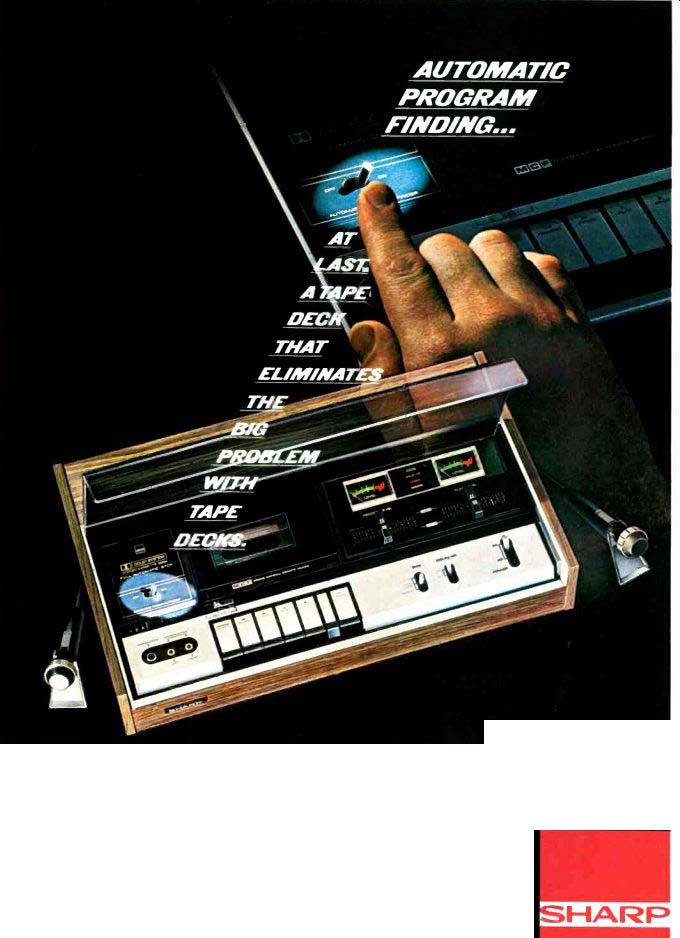
With other cassette decks, finding your tape selection is hit or miss.
You press fast forward...stop...
rewind .. stop .. fast forward over and over in a mad search for each selection. But not with Sharp's RT-480. Just press fast forward or rewind. Our Automatic Program Finder finds the precise beginning of your selection. And does it automatically. No fumbling, bumbling, or mumbling.
We eliminate the hiss as well as the miss. With a built-in Dolby "B' type noise reduction system.
The RT-480 is professional all the way. With Micro Crystal Ferrite heals for Cr0 tapes. A selector switch for normal. low-noise, and CrO2 tapes. Pause control for editing. Automatic shutoff in every PROGRAM mode. Lighted. expanded scale VU meters. Advanced hysteresis synchronous motor for inaudible wow and flutter: 0.15%, weighted.
rms. S/N ratio: 58 dB.
And the frequency response is from 25-17,000Hz with CrO2 tape.
All this, plus great styling. 2 microphones and dust cover. And under S250 For the name of your MARES OTHER CASSETTE DECKS OBSOLETE. THE RT-480.
ONLY FROM nearest Sharp hi-fi dealer. contact "Audio," Sharp Electronics Corp., 10 Keystone PI., Paramus, N.J. 07652.
+++++++++++++
EV
We have this different new speaker system...
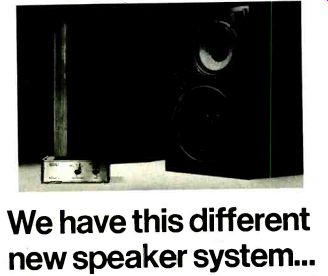
Its woofer isn't really a woofer but it gets down flat to below forty Hertz (3 dB down at 32 Hz) It has a tweeter on the back (plus one on the front) so you hear uniform, well-dispersed acoustic output to beyond 18 000 Hertz It s not an acoustic suspension system but it s 2 to 3 dB more efficient than almost all sealed systems It's too small to be really good but STEREO REVIEW says. "...the Interface:A can deliver a level of undistorted bass far superior to that of any other speaker of its size that we have heard' (March, 1974) So it must be really expensive it costs 3450 per pair. compete! (Suggested retail price) And right now we have 320 dealers standing by to show and demonstrate this different new speaker system.
Just call 800-447-4700 Noll Free) In Illinois only 800-322-4400 for the name and location of :hose nearest you.
Interface:A BY ELECTRO-VOICE
1 144H, 619 Cecil Street. Buchanan, Michigan 49107
++++++++++++++
Empire Speakers named "Best buy of the year"
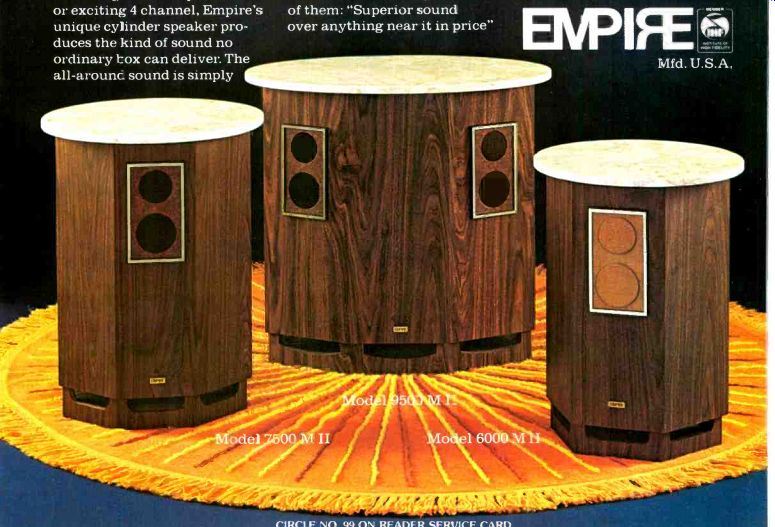
Empire Speakers were named "1974 Best Buy of the Year" by Consumers Digest Stereo Quadraphonic buyers guide. Consumers Digest was enthusiastic about our moderate priced, wide ranging well balanced sound with its rich lush bass and exemplary high frequency dispersion.
With their optional imported marble tops they felt "that Empire Speakers were hand some pieces of furniture that don't look like just speakers.”
Designed for super stereo or exciting 4 channel, Empire's unique cylinder speaker produces the kind of sound no ordinary box can deliver. The all-around sound is simply phenomenal... it radiates in all directions: front rear, left and right. These perfect 3-way systems use a heavy down-facing woofer for bass you can feel as well as hear. A powerful mid-range for crisp. clear alto and voice tones and an ultra sonic tweeter with 180 degree dispersion. The power handling capacity of Empire Speakers is awesome. They can take all the power your receiver can give them without overload, burnout or strain.
Thousands of satisfied Empire owners agree. Here are comments from just a few of them: " Superior sound over anything near it in price"
J.A. Hyattsville, Md.
"This speaker is truly a work of art!"
IF., Vancouver, B.C..
'Full sound even at low levels!'
W.G. Alexandria, Va.
"Can handle large amounts of power," D.M., Huntsville, Ala.
"Fantastic bass!' A.H., Burke, Va. "No ugly grill cloth!' B.M., Newark, N.J. "Incredible fidelity," K.K., Dallas, Texas.
Ask your favorite dealer to let you hear Empire's great speakers and write for our free full color "Guide to Sound Design” EMPIRE SCIENTIFIC CORP, Garden City, N.Y. 11530. Mfd. U.S.A.
+++++++++
NOW Walco PRESENTS
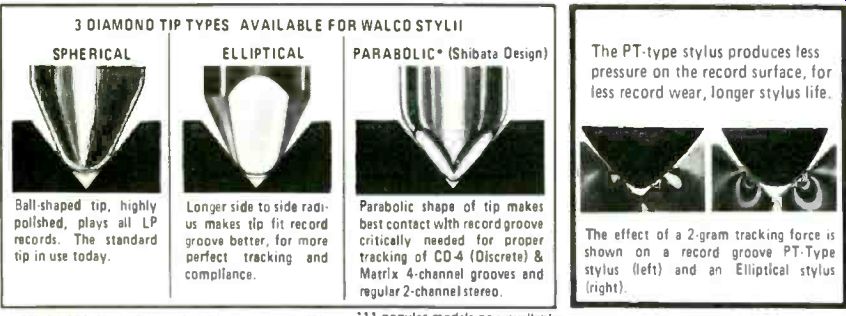
THE NEW PT-TYPE (SHIBATA DESIGN) PARABOLIC TIP STYLUS GREAT FOR REGULAR STEREO RECORDS! A "MUST" FOR 4-CHANNEL DISCS! There's also a Walco Diamond Stylus For Most Phonograph Cartridges in Use Today! Walco has been producing top quality phonograph needles since 1939.
They are Precision Made, Economically Priced, and Fully Guaranteed.
Millions of satisfied users have made Walco a Leading Name in the Audio Industry.
3 DIAMOND TIP TYPES AVAILABLE FOR WALCO STYLI! SPHERICAL ELLIPTICAL PARABOLIC
Ball-shaped rip.
Highly
Longer side to side radius. Parabolic shape of tip makes Polished, plays all LP us makes tip fit record but Contact with record groove records. The standard groove better, for more critically needed for Proper up in use today perfect tracking and tracking of CD4 (Discrete) 8 compliance. Matrix Conon,' grooves and regular 2.chennel stereo.
ALL WALCO NEEDLES GUARANTEED
OK AS PER WARRANTY ENCLOSED WITH EACH NEEDLE
now available.
DLO The PT-type stylus produces less pressure on the record surface, for less record wear, longer stylus life The effect of a 2-gram tracking farce shown on a record groove PT-Type stylus (left) and an Elliptical style right) WALCO ELECTRONICS
Sold Nationally at Fine Audio and Record Stores Write for Free Brochure on ne, PT-Type (Shibata Design) Styli. Rts 3 & 46. Clifton. N.J. 07013
+++++++++
The ADC-XLM.

A significant difference.
The phono cartridge, the smallest and perhaps the most critical element in a home music system, can make a significant difference in your perception of recorded music.
If it does its job well, it can convey a startlingly real sense of the original musical experience. If it doesn't, you end up with a pale, distorted imitation. Or worse, a permanently damaged record.
For only t he cartridge comes into direct contact with the fragile record groove and translates its microscopic undulations into intelligible musical sounds.
For years, the experts, audio professionals, have relied upon ADC cartridges to pro vide faithful record reproduction and protect their valuable collections.
Today. more than ever, the choice of the. experts is- the new ADC-XLM, a cartridge of un matched performance and reliability.
At a modest $50, it can make significant difference in your own music system.
For complete information and reprints of independent test lab evaluations write: Audio Dynamics Corporation, Pickett District Road, New Milford, Conn. 06776.
Audio Dynamics Corporation
++++++++++++
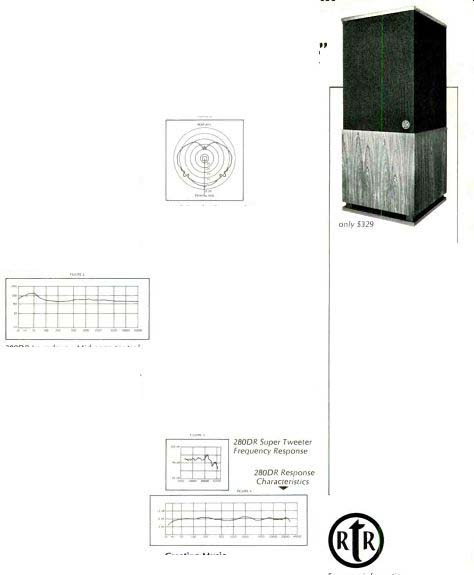
RTR breaks through the wall of speaker distortion with "The Transparent Enclosure" Throughout the history of high fidelity, the acoustic engineer and the audiophile have been plagued by the distorting influence of the never perfect speaker enclosure. The RTR 280DR represents the first major breakthrough in eliminating this adverse effect.
This breakthrough was not easy. It required a complex design incorporating four custom designed woofers
... one front mounted, two side mounted with balancing networks, and one planar slot loaded driven through a reverse phase bridge network. Proof of performance is shown by the complete lack of fundamental resonance exhibited by the broad, smooth curve shown in Figure 1.
FIGURE 2 on 41 411 1020 I./ 50 100 200 500 IOW 2000 5000 10300 20000 280DR
Impedance, Midrange control at "5,"
Tweeter control any setting This unique design earned the following comments from Dr. R. C. Heyser in Audio magazine (Nov. 1973): "The harmonic distortion on the 280DR is extremely low. A flute tone E, (41.2 Hz) at 20 watts input produced 1 percent E2 (second harmonic) and 1 percent A2 (third harmonic). The critical mid bass remained below 0.4 percent at this same level.-The lack of sonic distortion lulled us into testing at high power.
- Investigation of the impedance plot showed that we were in fact delivering close to 200 watts of heating power to the 280
DR at maximum test level. Total Dispersion Many music lovers, relating to the concert hall experience, have maintained that the ideal speaker should radiate uniformly hemispherically.
(This is not to be confused with the "reflecting concept.") The 280DR was engineered for "Total Dispersion." To achieve this "Total Dispersion," six high frequency drivers were joined with the four woofers to produce an incredibly uniform polar energy response which is shown in Figure 2.
FIGURE 2
280DR Polar Energy Plot Total Bandwidth Total bandwidth is dependent on the proper in-system functioning of all transducers. The four woofers are designed and manufactured by RTR.
They are special ten-inch transducers with butyl surrounds and two-inch epoxy impregnated voice coils. Five magnetic high frequency drivers are utilized to properly simulate concert hall ambience. A newly developed super tweeter, operating on the piezoelectric ceramic disc bender principle, extends overall response of the 280DR to 25,000 Hz. Figure 3 shows the uniformity of the frequency response of this super tweeter.
In an average listening room, the midrange and tweeter controls can be adjusted to yield the typical overall frequency response of the 280DR as shown in Figure 4 within ±3dB of the illustrated curve without equalization.
FIGURE 3
280DR Super Tweeter Frequency Response
Response Characteristics FIGURE
Creating Music The 280DR does not create music.
But it does reproduce music with great accuracy. Prove it to yourself by auditioning an RTR 280DR at your RTR franchised dealer and experience RTR "Total Capability." only $329 280DR
Specifications Enclosure:
Genuine hand-rubbed walnut veneers
Size: 16 1/2 " x 39" x 16 1/2 " deep
Shipping Weight: 95 lbs.
Frequency Response: 22 to 25,000 Hz
Speaker Complement: Four 10" woofers, five 2 1/2" mid-range/tweeters, one piezoelectric super tweeter Crossover Frequencies:
2500 Hz and 7500 Hz
Impedance:
8 ohms nominal
Recommended Amp. Power:
25w to 100w RMS per channel Controls:
Midrange and tweeter level, speaker protect circuit breaker with push button reset, dual 5-way input jack.
For more information circle the number below or write RTR INDUSTRIES Dept. HF, 8116 Deering Ave.
Canoga Park, CA 91304
++++++++++++++++
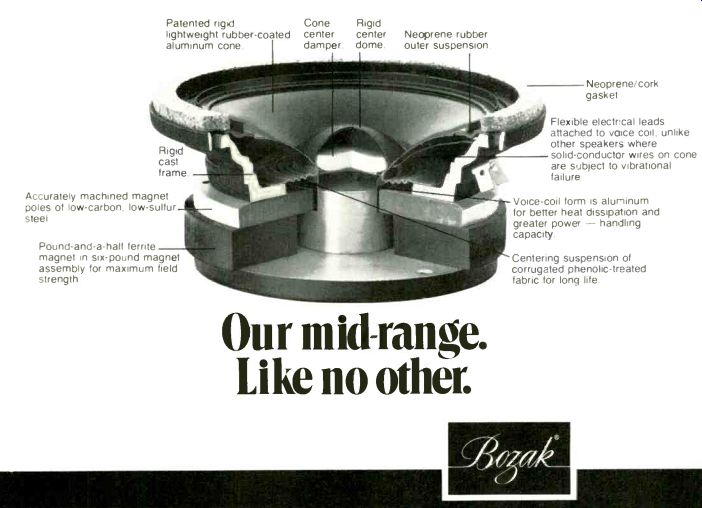
Patented rigid lightweight rubber-coated aluminum cone
Rigid cast frame.
Accurately machined magnet poles of low-carbon. low-sulfur steel
Pound-and-a-half ferrite magnet in six-pound magnet assembly for maximum field strength
Cone center damper
Rigid center Neoprene rubber dome outer suspension
Our mid rank.
Like no other.
Neoprene/ cork gasket Flexible electrical leads attached to voice coil, unlike other speaker; where solid-conductor wires on cone are subject to vibrational failure Voice-coil form is aluminum for better heat dissipation and greater power- handling capacity Centering suspension of corrugated phenolic-treated fabric for long life.
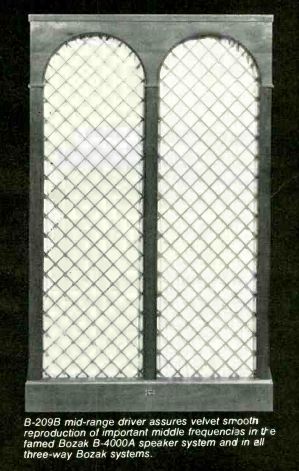
B-209B mid-range driver assures velvet smooth reproduction of important middle frequencies in tie famed Bozak B-4000A speaker system and in 211 three-way Bozak systems.
The mid-range of music--the region of melody--is the area in which most of the "timbre- of sounds occurs, the area which gives music its "definition. ' When you consider the importance of the middle tones, you'll understand why Bozak developed its Mode B-209B mid-range driver. It's a mil-range speaker like none other on the market and it is the reason why, in Bozak three-way systems, every orchestral instrument is clearly distinguishable from every other.
An English horn sounds like an English horn--not like an oboe in low register.
As you can see in the cutaway view above, there are good and scientifically valid reasons for Bozak's unparalleled mid-range performance. The neoprene-coated aluminum cone vibrates as a rigid disc wit-lout internal break-up which spells distortion common to conventional speakers. It is s zed so that the cone diameter does not exceed the wave length is of the mid-range notes.
What it all adds up to is velvet-smooth response and broad spatial coverage without artificial coloration When you consider the Bozak component speakers- bass, mid-range and treble- you'll understand why every Bozak speaker system represents the best possible reproduction- the greatest value- for the investment involved.
Our free booklet, How to Evaluate a Loudspeaker System, tells you what to look- and listen- for in selecting a loudspeaker.
Write Bozak, Department 8, Box 1166, Daren, Connecticut, 06820, for your copy.
Its tough to compare something in a class by itself.
+++++++++++
Listen to your music, not your turntable.
You don't hear distortion, rumble, wow or flutter when you listen to the Philips GA 212. The audio pros already know this. Now it's your turn to hear the best your records have, without listening to the turntable.
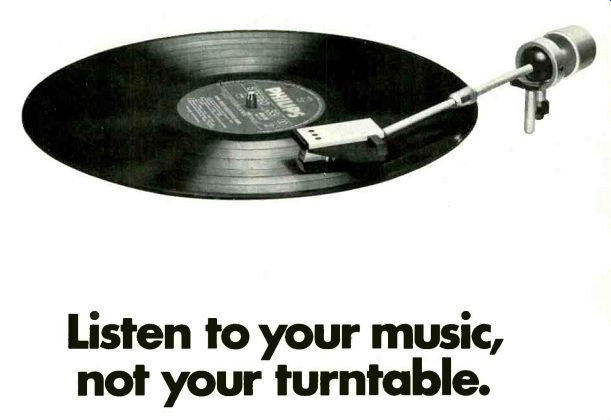
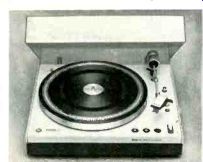
Most turntable problems are mechanical. Motors, controls or massive platters usually introduce sounds of their own. The stiff suspensions required to support heavy platters also contribute to acoustic feedback. These sounds are eliminated in the GA 212.
Solid-state electronics simply work more efficiently-with less noise. You just touch a control switch, no pressure is necessary, it lights up to tell you the GA 212 is working.
There's even a mini-computer net work working with the tacho-generator at the heart of the GA 212. It constantly monitors the speed you select. Any deviation is instantly corrected.
The tone arm is as advanced as the electronic control system. Friction is less than 1/10th of the tracking force. There's nothing to interfere with sound reproduction. Moreover, an hydraulically damped, cueing mechanism protects your cartridge and records as well.
We could print specifications, charts and lists of many more features. But we'd rather you listen for yourself. To paraphrase, one demonstration is worth a thousand words. Visit your better audio dealer. Or write to us for more information and your dealer's name.
PHILIPS-- HIGH FIDELITY COMPONENTS. Distributed by NORTH AMERICAN PHILIPS CORPORATION, East 42 Street, New York, New York 10017
+++++++++++++++++++
No. 27 Subject: Power Selection 4/2-Channel Receivers How to know from apples, oranges and ohms. The more power, the better the amplifier, right?
The truth is, there are a lot of variables to consider before you can really decide.
And Hitachi wants you to know what they are.
Never compare apples (RMS power) to oranges (IHF music power). RMS power means Root Mean Square; continuous rated or average usable power output. It's the most conservative measure and generally considered to be the industry standard. IHF is a standard measurement of power established by the Institute of High Fidelity, also conveniently referred to as music power. Rated this way, power tends to appear less conservative than RMS ratings.
However, either way is acceptable as long as you're com paring like power ratings at the same speaker OHM ratings.
Most mid-priced quality makers give their power ratings at 8c (OHM).
The cleaner the power, the cleaner the sound. Another key consideration in pinning down power is Total Harmonic Distortion (THD). This specification tells you how clean the resultant output signal is.
Any more than 11 2% THD will result in noticeable distortion. Which means, all the power in the world won't give you pure sound unless the THD is within tolerable limits.
And on and on and on. The kind of music you like to hear can also have a bearing on your power requirements.
Classical buffs usually require less power and lower volume than rock freaks. Then too, room size, approximate acoustic conditions, and the number of additional speakers the unit will be required to drive-are all factors that will help you make the right power choice.
The way we look at it, the more you know, the better equipped you'll be to compare the specs on our 4/2-channel (SQ, RM, Discrete) receivers. So do it, already. If you find something you don't understand, your nearby Hitachi dealer can set you straight. And that's getting to be a small wonder in itself.
SMR-7240 FM/AM/FM Stereo Discrete 4-Channel/2-Channel Receiver with BTL Circuits 85 W IHF music power. 15 W WAS x 4, 35 W RMS x 2 (less than 1.0% THD at 8 ohms, PBW 20Hz-25kHz IHF). FM sensitivity 2.2µV. Capture Ratio 1.2 db. Two Tuning Meters. 2-channel and 4-channel Tape Monitors. Mike Mixing Jacks and Volume Control. SQ/RM Matrix Switch. Joystick 4-channel Balance Control. 4-channel Headphone Jack. Wood Cabinet.
SMR-5240 FM/AM/FM Stereo Discrete 4-Channel/2-Channel Receiver with BTL Circuits 70 W IHF music power, 10 W RMS x 4, 25 W RMS x 2 (less than 1.0% THD at 8 ohms, PBV, 20Hz-25kHz IHF). FM sensitivity 2.2µV. Capture Ratio 1.2 db. 2-channel and 4-channel Tape Monitors. Mike Mixing Jacks and Volume Control. SQ/RM Matrix Switch. 4-channel Headphone Jack. Wood Cabinet.
SMR-4040 FM/AM/FM Stereo Discrete 4-Channel Receiver 56 W IHF music power. 9 W per channel RMS (less than 1.0% THD at 8 ohms, PBW 20Hz-30kHz IHF). S/N Ratio 67 db.
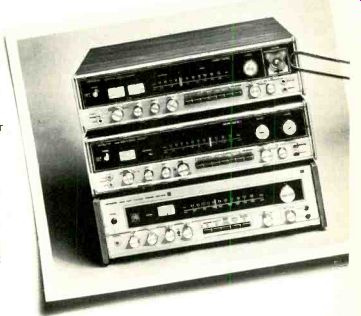
FET Tuning, 4-channel indicator, Regular and SQ Matrix Switch, 2 Microphone Input Jacks, Microphone Mixing. Wood Cabinet. Optional "RQ-1- 4-channel Toggle-Type Remote Balance Control available.
HITACHI working small wonders in sound National Headquarters 401 West Artesia Boulevard, Compton, Calif. 90220
+++++++++++++
Live versus recorded at Covent Garden Rehearsal scene from Mozart's Don Giovanni at Covent Garden, London.
The most severe test for a loudspeaker system is to be compared with live music.
The ultimate success is for the music from the speakers to remain indistinguishable from the real thing.
This is exactly what is happening at The Royal Opera House, Covent Garden, London. Covent Garden has purchased five AR-LST speaker systems as well as a number of AR-7s. The AR speakers are in constant use in such 'roles' as the Commendatore or the voices of the underworld in Don Giovanni. They are also used for the offstage brass band in Aida and the taped sequences in the new production of Benjamin Britten's Owen Wingrave, as well as for many other purposes.
A recent article by Adrian Hope in England's Hi-Fi Sound magazine reported the comments of the Covent Garden technicians who installed the system:
'If you think about it, Covent Garden cannot make do with any audio equipment other than the very best. In a recording studio what you are putting out as a final end product is a recording. What Twenty-four AR-6 speakers are installed at the Danish Royal Opera.
we are putting out here is a live performance and anything electronic is automatically the subject of the classic AB test- the audience can hear live sound and sound from a loudspeaker.
So they have a perpetual yardstick to judge by.' The idea of course is to create the illusion for the critical Covent Garden audience that they are always hearing live music.
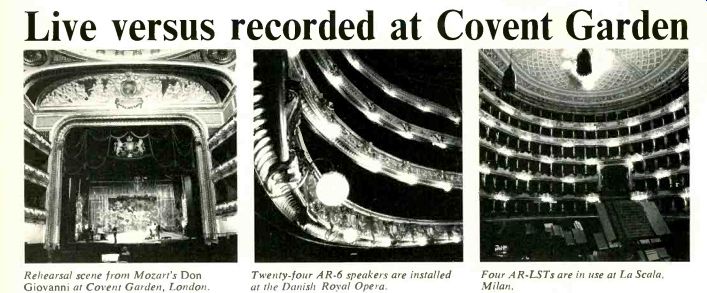
AR itself has produced public live-versus-recorded concerts. Audiences were asked to distinguish between the performance of live musicians on stage and a recording of the same music reproduced over AR loudspeakers- the same AR loud speakers that were designed for home listening. As at Covent Garden, the illusion of live music has been virtually 100-percent effective.
The use of AR speakers in live musical performances doesn't stop with Covent Garden's AR-LSTs and AR-7s. The Danish Royal Opera makes constant use of twenty-four AR-6s and six AR-LSTs.
And La Scala has recently installed four AR-LSTs.
Four AR-LSTs are in use at La Scala, Milan.
Try the grand illusion for yourself.
There's a five-year guarantee that your AR speakers will perform as well as Covent Garden's. Or the Danish Royal Opera's. Or La Scala's.
Acoustic Research US office:
10 American Drive Norwood, Massachusetts 02062
International office:
High Street, Houghton Regis, Bedfordshire, England In Canada:
A C Simmonds & Sons Ltd Toronto
++++++++++++++++
AKAI's new cassette deck stands up for itself
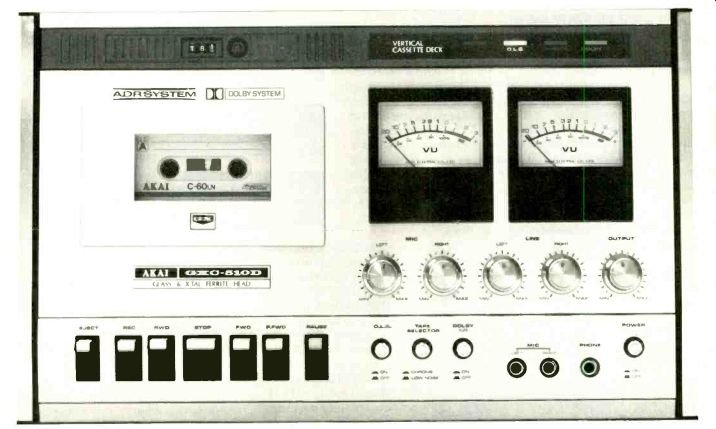
We decided to stand up and cheer! And AKAI's radically new cassette deck format is something to cheer about. The front-loading vertical design-with vertical head block assembly- combines the quality of open-reel and the convenience of cassette. We call the newest member of our cassette line the GXC-510D. You'll call it supreme, with features like Dolby noise reduction circuit plus AKAI's automatic distortion reduction system (ADRS), which eliminates distortion in the critical cassette range of 8 KHz and up; GX heads, one of them a glass and crystal head for recording/ playback; 0.08 percent wow and flutter; microphone and line mixing; full direct functions controls; output level control to match amplifier input; automatic stop and pause control; and many others. Step over to your nearest AKAI dealer and see how the GXC-510D stands up for itself. We think you will stand up and cheer right along with us. AKAI America, Ltd., 2139 East Del Amo Boulevard, Compton, The Innovators Cailfornia 90220. Doty is the trademark of Dolby Laboratories, Inc.
From AKAI.
Dress it up with this 23" x 35" full-color poster. Just send name, address, and 51.00 to "Wall Poster," AKAI America, Ltd.
++++++++++++++++++
Frequency response isn't everything.
If you're a real stereo buff, you know that flat frequency response means flat, uncolored sound.
Like several other manufacturers, we too try to build the flat test, most linear frequency response we can into our speakers.
But we don't stop there.
Because we know that great sound depends on more than just frequency response.
Transient response, for instance.
It's all in your head To understand transient response, it's important to under stand how you hear.
You see, you don't really hear with your ears. You hear with your brain.
For instance, it's the brain that helps you identify what you're listening to. The direction it's coming from. And that re-creates that illusion of "being there." The thing is, every musical note is really a complex tone. A basic tone- the fundamental- plus subtle musical overtones--harmonics that give very instrument a unique personality.
Not only that, musical notes are constantly starting and stop ping. When they do, the number and intensity of the harmonics change.
all those changing harmonics, is called a transient. The brain takes all of them into account in interpreting any sound the ear receives.
This basic tone, together with The proof is in the hearing On making things imperfectly clear It's when a speaker can't react quickly or accurately enough to all those changing musical notes, all those transients, that distortion can occur.
And distortion means muddy-sounding music. With little definition or clarity.
A bad situation made worse when a speaker over-reacts to all those changing tones. The speaker actually adds tones of its own. And that's Now you know there's a lot more to a speaker than just flat frequency response. Like good transient response.
But even the best, most accurate transient response in the world isn't the be-all and end-all of a superb speaker. There's more.
The point is, we're a company that is committed to one thing and one thing only. The design and construction of the clearest, best-sounding stereo speaker systems in their price range.
But you've got to hear for yourself. So go to your hi-fi store bad.
Pattern ( and listen to an Avid.
Most experts feel the best way to measure transient response is with tone bursts. Pure tones of various frequencies are rapidly switched on and off to simulate the transient nature of voice and instrument signals.
In Pattern A, the speaker hasn't reproduced accurately. It's completely overshot the level of the input signal. And the result is a sizzling, hot sound.
Totally colored.
In Pattern B, the speaker has taken too long to react. This "hangover" can cause considerable blurring.
So what you hear is dull and lifeless.
Now look at Pat tern C. The speaker here has reacted both quickly and accurately. And the result is exceptional clarity and definition. The kind that Avid builds into all of its speakers.
Then some other speaker in the same price category.
Then decide. We don't think you're going to have any trouble at all.
AVID CORPORATION
10 Tripps Lane, East Providence, R.I. 02914
Distributed in Canada by: Kairon Electronics. Montreal, Quebec.
++++++++++++++
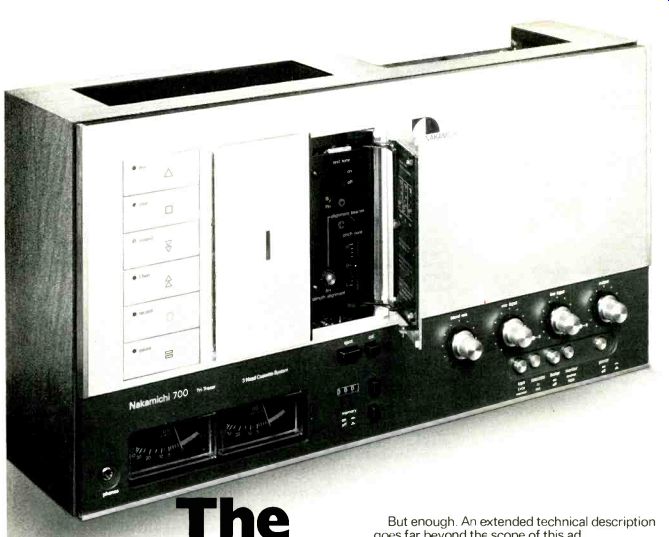
The Nakamichi Revolution An extravagant statement? Not at all.
For the Nakamichi 700 Tri-Tracer cassette system is so completely different from anything that has gone before that it truly represents a quantum jump in cassette technology.
A brilliantly engineered instrument, the Nakamichi 700 is an extraordinary blend of electronic and mechanical sophistication.
To cite a few innovative examples, three separate heads-erase, record, playback-afford off the tape monitoring, but more importantly, extend flat frequency response to beyond 20,000 Hz. A closed-loop dual capstan system employs a servo-controlled d.c. motor to maintain rock-steady, constant speed and a second motor takes over in fast forward and rewind. IC logic and feather-touch solenoids control all tape functions. A built-in record head azimuth-alignment beacon insures perfect recordings every time.
But enough. An extended technical description goes far beyond the scope of this ad.
Far more persuasive, we think, are these comments from a Hirsch-Houck Laboratories Test Report that appeared in the December 1973 issue of Stereo Review.
"As our test data indicate, the Nakamichi 700 is an extraordinary cassette recorder... With Nakamichi CrO2 tape, the performance was...an almost incredible ± 1.5 dB from 46 to 22,500 Hz...The noise level, referred to the 3 per cent distortion level, was very low...- 57 dB without Dolby and- 62.5 dB with Dolby" They go on to say, "We could not measure the 700's combined wow and flutter because it was below the residual level of our test tape:' Summing up, the Report declares, "...we would rank it (the Nakamichi 700) as the best cassette recorder we've tested and one of the best tape recorders of any type we have ever used:' See and hear the Nakamichi 700 and the companion Model 1000 at your dealer now. Then go out and start your own little revolution.
For complete information and the name of your nearest dealer write: Nakamichi Research (U.S.A.),Inc., 220 Westbury Avenue, Carle Place, N.Y. 11514. In California: 1101 Colorado Avenue, Santa Monica 90404.
PERFECTION THROUGH PRECISION. NAKAMICHI
+++++++++++++++
"A bible for record collectors
RECORDS IN REVIEW 4 EDITION
Reviews of new classical and semi-classical records from HIGH FIDELITY Coming Soon in a New Edition RECORDS IN REVIEW 1974 EDITION The Nineteenth annual collection of record reviews from High Fidelity COMPREHENSIVE-Includes all record reviews of classical and semi-classical music that appeared in High Fidelity in 1973. The sturdy, hard-cover book reviews all types of music-vocal, orchestral, chamber and solo-from all periods-medieval to contemporary-and includes information about all formats-discs, open-reel tape, cartridges, and cassettes in both stereo and quadriphonic editions AUTHORITATIVE-High Fidelity's reviewing staff includes today's most knowledgeable and noted critics: Royal S. Brown, Abram Chipman, R. D.
Darrell, Peter G. Davis, Shirley Fleming, Alfred Frankenstein, Kenneth Furie, Clifford F. Gilmore, Harris Goldsmith, David Hamilton, Dale Harris, Philip Hart, Paul Henry Lang, Robert C. Marsh, Robert P. Morgan, Andrew Porter, H. C. Robbins Landon, John Rockwell, and Susan T. Sommer.
They discuss the composition, performance, and sonic quality of each recording and compare it with earlier releases and legendary performances.
CONVENIENT--Reviews are arranged alphabetically by composer. In the case of frequently recorded composers, reviews are further divided into categories such as Chamber Music, Vocal Music, etc.
Moreover, there's a special section on Recitals and Miscellany and a complete Artists' Index of all performers whose recordings were reviewed during the year, as well as composers mentioned only in the text.
With so many records being issue each year, you need a reliable source of information. What better source than reviews from the magazine that has been called "a bible for record collectors!" Reserve your copy now by filling in and returning the coupon below.
Wyeth Press, State Road, Great Barrington, MA 01230
Please send the following copies of Records in Review:
19th Annual (1974) @ $9.95 plus $1.00 for shipping and handling
Please enter my standing order for all future editions of Records in Review
I enclose payment (Check or Money Order only). Add sales tax where applicable. (Sorry-we cannot invoice!) Name Address City State _Zip
++++++++++++++++
it's over! To the serious listener in search of an accurate reproducer of sound, we offer the electrostatic principle.
Listen, and your search will be over.
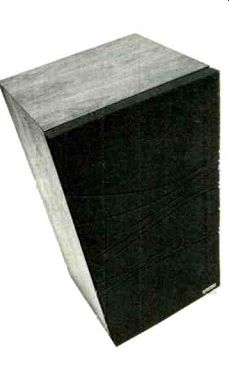
Janszen.
From $120 to $700 JANSZEN ELECTROSTATI C 7516 42nd Avenue North Minneapolis, Minnesota 55427 a division of Electronic Industries, Inc.
+++++++++++++++++
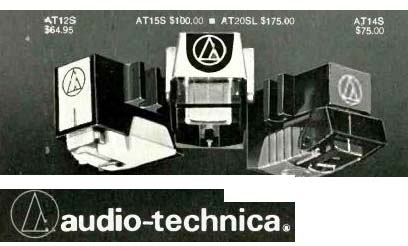
Inside each of our 4-channel cartridges
AT129 364.95 AT15S $100.00
P.T2OSL $175.00 AT14S
$75.00 lurks a Dual Magnet stereo cartridge waiting to please you.
Our sophisticated four-channel cartridges are also stereo cartridges at heat. Very good ones. With ruler flat response outstanding stereo separation (especially above 1 kHz where it counts), and truly impressive high frequency tracking.
All these advantages are as important to good stereo as they are essential to CD-4. And the can be achieved ) audio-technica only by paying very close attention to detail. And using only the best. Like a genuine Shibata stylus. Nothing less.
The results are good for any record ...
whether stereo, matrix, or discrete 4-channel. Bat you should really hear for yourself. Write today for our dealer list. No matter how many channels you want to hear best.
U .S. Pat. Nos: 3,720,796; 3,761,647 Shibata stylus
Pat. No. 3,774,918 AUDIO-TECANICA U.S. INC., Dept 114H, 33 Shiawassee Ave., Fairlawn, Ohio 44313. In Canada Superior Electronics, Inc
++++++++++++++
Superb performance- lavish engineering --a new standard in high fidelity p THE ALL NEW REVOX 700 SERIES Stereo Tape Recorder A700 Digital Stereo Tuner/Pre-amplifier A720 Power Amplifier A722 The Illustration Contains Optional Extras Revox Corporation in USA; 155 Michael Dr., Syosset, NY 11791 & 3637 Cahuenga Blvd. West, Hollywood, Calif. 90068 Revox in England; Lamb House, Church Street, Chiswick, London W4 2PB. Revox Sales and Service in Canada.
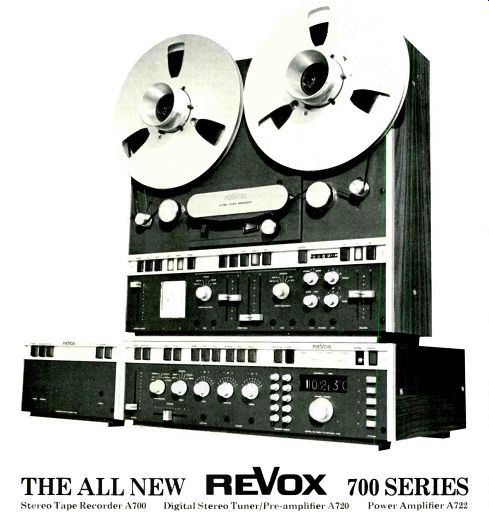
For other countries; Revox International, Regensdorf 8105ZH Althardstrasse 146, Switzerland.
++++++++++++++
The Infinity Monitor has an acoustic accuracy that is unsurpassed. (Except by our own $3000 Servo-Statik 1A.) It gives you all of the overtones and timbres of the original source, in perfect balance and ambience.
The Monitor is unhampered by the electronic limitations of traditional speaker systems. An oboe sounds like an oboe- not like an amplified oboe.
The gut strings of a Martin sound like gut strings-not like steel strings.
And you feel the stab of a great Fender bass line with perfect clarity and articulation-free from the muddy mid-bass thunder that passes for bass in many of today's expensive speakers.
Technically, the achievement is formidable. Our patented Wave Transmission Line tweeter is the first transient-perfect, totally coherent 360° tweeter in the world! Our midrange driver has an incredibly flat response, with brilliant, active transients. Our patented 12" woofer is mounted in our Transmission Line enclosure.
And there's more. Listen to the Monitor and you'll know why it has become a charismatic speaker system.
You see, at Infinity we're music nuts- in addition to being very stub born physicists and engineers. All we insist upon is perfection- and at a reasonable price.
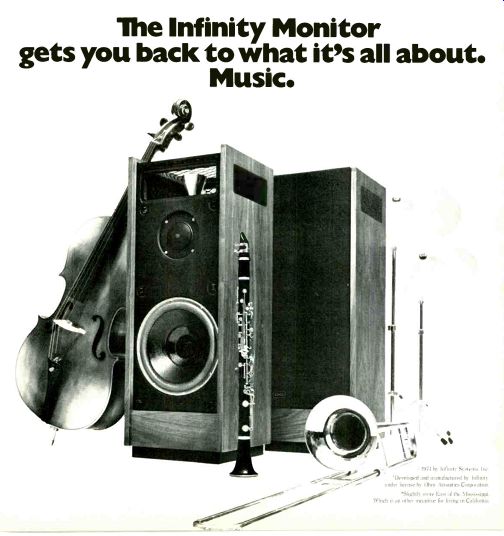
At $429 each, we're pretty well on target.
INFINITY SYSTEMS, INC.
9001 Fullbright Ave.. Chatsworth. Calif. 91311
The Infinity Monitor gets you back to what it's all about.
Music.
++++++++++++++++
----
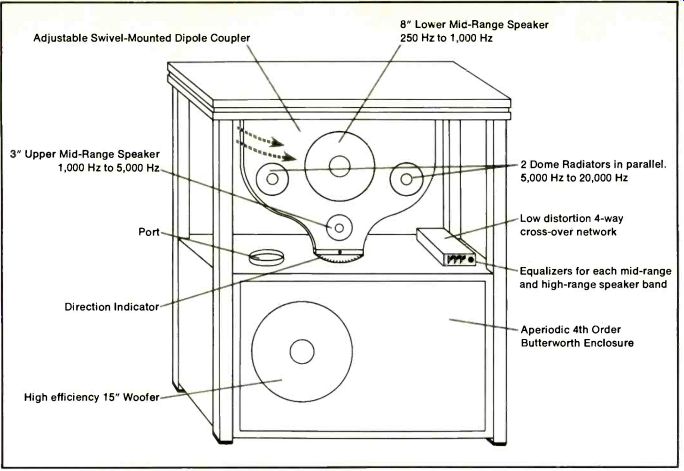
Adjustable Swivel-Mounted Dipole Coupler 8" Lower Mic-Range Speaker 250 Hz to 1,000 Hz 3" Upper Mid-Range Speaker 1,000 Hz to 5,000 Hz Port Direction Indicator High efficiency 15" Woofer
2 Dome Radiators in parallel.
5,000 Hz to 20,000 Hz Low distortion 4-way cross-over network Equalizers for each mid-range and high-range speaker band Aperiodic 4th Order Butterworth Enclosure
---
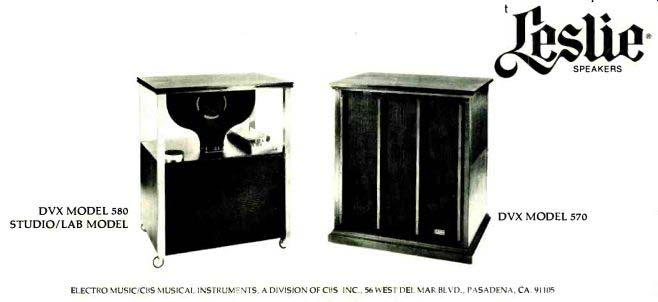
The new Leslie DVX Speaker:
it adjusts to the geometry of your room! CBS Laboratories and Leslie Speakers have now developed an amazing new loudspeaker system that is...quite frankly...amazing! The Leslie DVX speaker is a unique high performance, low distortion four-way system. Its exclusive dipole coupler is swivel mounted... so that you can "aim" the mid-range and high frequency speakers to fit the geometry of your room. This dipole coupler also gives you the optimum balance of direct and reflected energy to pinpoint and anchor the stereo image in the manner intended by the recording director.
DVX MODEL 580 STUDIO/LAB MODEL
The bass frequencies are reproduced by a high energy 15" woofer housed in an aperiodic 4th order Butterworth ported enclosure and descend smoothly to the lowest registers.
Leslie Speakers was the first company to introduce a truly effective "augmentation" system (the Plus 2 speaker) to eliminate the standing waves in your room. Now comes the amazing DVX speaker. D for dipolar. VX for variable axis. A whole new alphabet for sound! Hear it at your nearest Leslie Plus 2/DVX dealer.
SPEAKERS DVX MODEL 570
ELECTRO MUSIC/CBS MUSICAL INSTRUMENTS, A DIVISION OF CBS INC., 56 WEST DEL MAR BLVD., PASADENA, CA.
++++++++++++++++++
++++++++
(High Fidelity)
Also see: