THE CONSUMER'S GUIDE TO HIGH FIDELITY EQUIPMENT
EQUIPMENT REPORTS: Ferrograph Model 7504HDAW open-reel tape deck; Technics Model T-400 speaker system; Philips GA-209 turntable; Sony Model TC-177SD stereo cassette deck; Infinity Monitor 1A re-monitored
--------------
Ferrograph's Finest Deck Yet: The Super 7
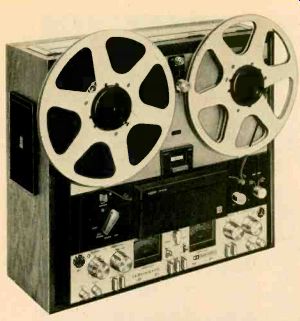
The Equipment: Ferrograph Model 7504HDAW. a three-speed (15, 7 1/2, and 3 3/4 ips), three-motor, quarter-track stereo open-reel tape deck with (optional) Dolby-B circuitry for both recording and playback (simultaneously), in wood case. Dimensions: 19.5 by 17 inches, approx. 8 1/2 inches deep plus allowance for controls, etc.; 7-inch and larger reels overhang main plate, 8.5-inch and larger reels overhang wood case; can be used vertically or horizontally. Price: $1,150; low-speed version (7 1/2, 3 3/4, and 1 7/8 ips) available at same price; decks without Dolby circuits, $1,025. Warranty: one year parts and labor. Manufacturer: The Ferrograph Co.. Ltd.. England: U.S. distributor: Elpa Marketing Industries, Inc., Thorens & Atlantic Ayes., New Hyde Park, N.Y. 11040.
Comment: First, a word about model designations. The entire series is referred to as "Super 7" to distinguish the new models from the Series 7 units that preceded them and to which they bear a great deal of resemblance. It also is called the "Series 75," since all model numbers start with those two digits. The next digit specifies the channels of power amplification, the final one the number of tracks. Thus the Model 7522 is half-track with a built-in stereo amplifier; the 7504 reviewed here is quarter-track stereo with no amp. In the letter suffixes of the reviewed model, the "H" stands for high speed (15 ips top; all models are three-speed). the 'D" is for Dolby. the "A" connotes the American version (60-Hz, 117-volt power supply, adjusted for NAB playback specs and Scotch 206 tape). and the "W" signifies the wood case.
For the American market we would expect the 7504, either with or without Dolby and in either speed version, to be the format of choice. Though the decks-even those with the wood case-have a carrying handle, they are too heavy to be readily portable (except by comparison to some other professional behemoths). Home users will therefore find little need for the monitoring system, preferring to listen via a home component sys tem And the availability of many attractive quarter-track prerecorded tapes has steered American buyers away from the superior S N ratios of half-track equipment.
The (relatively recent) availability of Dolby-processed tapes may likewise argue in favor of the Dolby deck. The speed choice is a tossup. In our quarter-track test sample the Dolby circuitry is defeated automatically at 15 ips though Elpa and the Ferrograph manual say the automatic defeat is intended only for half-track models, to oblige Dolby Labs'-ule that only Dolby A equipment shculd be used with professional formats. This is per haps unimportant, since-for all but mastering-few users will find noise reduction necessary at this speed.
The connections and controls are similar to those on the Ferrograph 7; the 7 itself was quite unconventional, and there are several important changes, so we will de scribe them in detail.-he (rotary) on / off switch and the transport's speed selector are together between the reels. Also between the reels, but next to the head cover, is a four-digit turns counter with its reset button, a "reset" light. and the recording button.
As in the older model. the reset light glows red during any of several stop-and-reprogram situations: a mis match between speed and equalization selectors, for example, or an automatic shutoff. The deck must be returned to stop and the situation corrected before the re set light will go out: only then can it be operated. Unlike the older model, the Super 7 cannot be put accidentally into recording. (We found it unlikely, though not impossible, with the older one.) Ferrograph has added a recording pilot light near the recording button and devised a more positive interlock with a small latch near the head cover. If one presses the recording button while going from "stop" to "pause" or "run," the unit will stay in recording unless one releases the latch. But when one is playing the tape to pick up a recording cue, it no longer is possible to switch to recording simply by pressing the recording button: one must also release the latch.
A second latch nearby, retained from the Ferrograph 7, prevents inadvertently going directly from the fast-wind modes to "run' ; but the latch and the transport lever are so positioned that you can operate both with one hand if you wish, promoting fast operation. The positions of the lever are marked fast, stop (reset), pause, aid run. Wind speed and direction for the "fast" position are controlled by a knob (actually a pair of rheostats that govern the two reel motors reciprocally) to the right of the head cover, giving unique flexibility of control over the speed, tightness, and evenness of the wind.
--------- REPORT POLICY: Equipment reports are based on laboratory measurements and controlled listening tests Unless otherwise noted. test data and measurements are obtained by CBS Laboratories. Stamford, Connecticut. a division of Columbia Broadcasting System. Inc one of the nation's leading research organizations The choice of equipment to be tested rests with the editors of HIGH FIDELITY Manufacturers are not permitted to read reports in advance of publication and no report, or portion thereof may be reproduced for any purpose or in any form without written per mission of the publisher All reports should be construed as applying to the specific samples tested. neither HIGH FIDELITY nor CBS Laboratories assumes responsibility for product performance or quality. ----
Since there is some output from the tape in fast wind (slight withdrawal of the tape from the heads plus a high-frequency filter that switches in automatically on fast wind prevent excessive output and tweeter dam age), you can use your left hand on the transport lever and fast-wind latch and your right hand on the fast-wind knob for an unusually efficient search-and-play technique, which is particularly helpful when editing.
To thread the machine you raise the head cover and pull out the loading latch, which withdraws the pressure pads. (Yes, Virginia, pressure pads-which, we must point out once again for the benefit of readers who associate this feature with "cheap" recorders, do not intrinsically reduce head life by contrast to designs with out them as long as both are correctly adjusted to begin with and are well maintained.) The "tape lifters" are fixed studs that hold the tape slightly away from the heads un less the pressure pads are engaged, as they are in both "pause" and "run." Since the heads are live at all times, "rocking" the tape for physical editing is easy.
To the left of the head cover is a small tension arm that also acts as a contact for an automatic-stop system triggered by metal foil, Farther to the left is another tension arm that-unlike that on the earlier Ferrograph will turn off the transport (after a short delay, so that it is not triggered by brief "bounces") whenever tension is lost, even if the tape has not broken or run out. Nearby is a small screw that adjusts the tension arm action for either vertical or horizontal operation. (Ferrograph pro vides accessory feet that tip the deck backward slightly in vertical operation to make threading easier and controls more readily visible.) The only other control in this area is the tension-adjustment knob: 10 1/2-inch (reel size) only/other sizes.
The electronics panel at the bottom (with the deck standing vertically) has four large knobs. The outer ones are un-ganged two-element controls for mike and line inputs, those for the left ("upper") channel on the left and those for the right ("lower") channel on the right. Just inboard of the left-channel controls is the three-position equalization switch ("high / med / low"), corresponding to the transport's three speeds. Inboard of the right-channel controls is a dual output level control (un-ganged, though the elements for the two channels can easily be moved together). Between them are the two VU meters and a recording mode switch ("up per/stereo.. lower"). Our only criticism of this arrangement-which apparently is dictated by separate input circuit boards for the two channels-is that stereo fades of either mike or line inputs require two hands. So, though the Super 7 offers line/mike mixing, some users may prefer an outboard mixer that allows better tracking between channels and one-hand operation.
Across the very bottom of the panel is a series of controls arranged symmetrically, with those for the left channel on the left and vice versa. In the outboard positions are bass-control knobs for each channel; next to them are treble controls. Next come monitor switches, the outer ones for source, the inner ones for tape. Then, under the meters, are pairs of screwdriver controls; the outer ones (marked "A") adjust playback levels (and metering) to match inputs, the inner ones ("B") adjust bias for each channel. At the center are "transfer" switches (upper to lower and lower to upper) that are used in sound-on-sound and tape echo and a similar switch for metering the bias current instead of audio signals. The tone controls are included in the transfer loops so that signal feeds for either sound-on-sound or echo can be equalized for special purposes. In mono recording this setup also makes it possible to record from two mikes and two line inputs with one of each passing through the tone controls and all four mixed together in the final recording on a single track.
Just above the last group of switches are two toggle switches. One puts a multiplex filter into the circuit for Dolby recordings of FM broadcasts. The other controls the Dolby circuitry itself; between "on" and "off" is a third position, marked simply with a straight line. In this position the Dolby recording circuit is off and the play back circuit is on, allowing you to record Dolby-encoded FM broadcasts or dub Dolby-encoded tapes and to monitor the decoded output.
The jack panel at the top of the unit (again, standing vertically) also is arranged symmetrically-or almost so.
All of the jacks but one are, like the microphone inputs on the front panel near the input level controls, the phone type. In the outboard positions are the line in puts. Next come "low level" outputs that feed through the front-panel tone controls and deliver about 350 milli volts for a 0-VU recording level as measured at CBS Labs, enough to drive a monitoring amplifier (though not necessarily to rated output; check its sensitivity rating if you plan to use this setup).
Next in line are the "600-ohm" outputs normally used for line connections with a stereo system. They deliver just short of 2 volts for 0 VU and are unaffected by the tone controls (except, of course, in the "transfer" modes). Then come adjustable low-level outputs. Their output can be reduced from the 350 millivolts of their nonadjustable counterparts by way of the front-panel level control-which affects only these outputs in the deck model. (The level knob is used for the built-in monitoring system in the amped models.) Just inboard of these left-channel jacks is a 7-pin DIN jack-but not the ordinary input/output variety. Two pins carry the 600-ohm hot outputs, and two more, the low-level outputs; the other three are for a 50-volt DC supply, a connection for the "run" solenoid, and common ground. This jack is used with various accessory devices (none supplied): a foot switch, a remote start/ stop and volume control (for which a schematic dia gram is supplied in the owner's manual), or a magnetic phono preamp powered by the 50-volt supply and feeding to the line input (plans offered by Ferrpgraph, ac cording to the manual). For timed operation-either recording or playback-this socket is not needed. You simply plug the power cord into a timer (preferably one with a grounding socket, since Ferrograph gives you a three-prong plug) and set the controls appropriately.
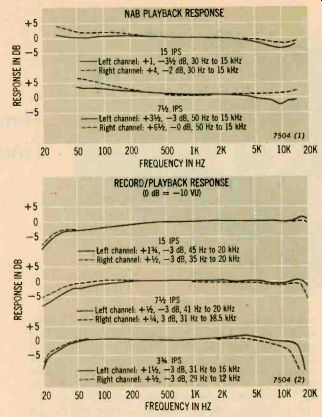
We must apologize for so lengthy a description, but obviously many common presuppositions about tape-deck operation do not apply to the Super 7. Fortunately the story of its performance is more briefly conveyed: It is very good indeed and entirely consistent with the measurements CBS Labs regularly find in competing equipment. Speed accuracy is not quite as precise as some models, though the lab was unable to measure any change in speed with alterations in line voltage and even the worst-case measurement of less than 0.5% fast (at 15 ips) cannot really be faulted. Wow and flutter measurements (all peak measurements) are excellent.
Dolby tracking checks out as particularly good, and the multiplex filter has an extremely sharp cutoff characteristic so that even with the filter in the circuit response is virtually unaffected to about 15 KHz. Scotch 206 tape was used for all measurements.
Obviously this is a deck that merits, and requires, careful consideration by a wide variety of users. Since its design is statonchy individualistic, it car 't be appreciated-let alone related to a potential user's needs-in a brief once-over. In this connection we might suggest that prospective purchasers ask to see the manual. In many respects it is exceptionally fine and inclusive. It has, for example, a marvelous table of counter readings vs. tape thicknesses vs. tape lengths vs. elapsed times that we hope other manufacturers will copy.
But we should caution that the manual is written primarily with the non-Dolby versions in mint and almost exclusively for the domestic British user. But Elpa says it is at work on a supplement to the brochure for Americans. Bravo-it should make an immensely useful product even more so.
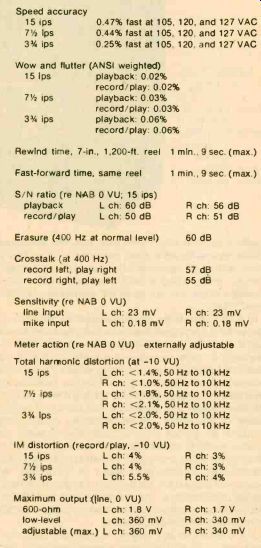
Ferrograph Super 7 Additional Data
Speed accuracy 15 ips 0.47% fast at 105. 120. and 127 VAC 7 1/2 ips 0.44% fast at 105, 120, and 127 VAC 334 'Ps 0.25% fast at 105, 120, and 127 VAC Wow and flutter (ANSI weighted) 15 ips playback: 0.02% record/play: 0.02% 71/2 ips playback: 0.03% record/play: 0.03% 334 ips playback: 0.06% record/play: 0.06% Rewind tine, 7-ir , 1.200-ft reel 1 min 9 sec. (max ) Fast-forward time. same reel 1 min 9 sec (max.) S/N ratio )re NAB 0 VU: 15 ips) playback L ch: 60 dB record; )lay L ch: 50 dB Erasure (400 Hz at normal level) Crosstalk (at 400 Hz) record left, play right record right, play left Sensitivity (re NAB 0 VU) line input L ch: 23 mV mike input L ch: 0.18 mV R ch 56 dB R ch 51 dB 60 dB 57 dB 55 dB R ch: 23 mV R ch: 0.18 mV Meter action (re NAB 0 VU) externally adjustable Total harmonic distortion (at-10 VU) 15 ips L ch: <1.4%, 50 Hz to 10 kHz R ch: <1.0%, 50 Hz to 10 kHz 71/2 ips L ch: <1.8%, 50 Hz to 10 kHz R ch: <2.1%, 50 Hz to 10 kHz 31/4 ips L ch: <2.0%, 50 Hz to 10 kHz R ch: <2.0%, 50 Hz to 10 kHz IM distortion (record/play,-10 VU) 15 ips L ch: 4% 71/2 ips L ch: 4% 334 ips L ch: 5.5% Maximum output (line. 0 VU) 600-ohm L ch: 1.8 V low-level L ch: 360 mV adjustable (max.) L ch: 360 mV R ch: 3% R ch: 3% R ch: 4% R ch: 1 7 V R ch. 340 mV R ch 340 mV
++++++++++++++++
Smooth Sounding "Non-compact" from Technics
The Equipment: Technics Model T-400, full-range speaker system in oiled walnut enclosure with removable wood base. Dimensions: 15 by 27 inches, 13% inches deep; can be used vertically, with or without base, or horizontally.
Price: $279.95. Warranty: five years parts and labor.
Manufacturer: Matsushita Electric Corp., Japan; U.S. distributor: Matsushita Electric Corp. of America, Consumer Electronics Division, 200 Park Ave., New York, N.Y. 10017.
-----------
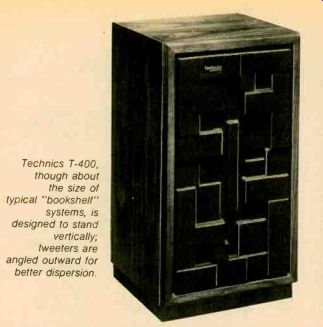
Comment: Technics has recently added to its line four speaker systems in the "T" series. The T-400, tested for this report, is somewhat larger than conventional book shelf models and is, in fact, designed as a floor-standing system-the tweeters' orientation argues against horizontal use, though conceivably it could be fitted on a shelf that is large and sturdy enough to support its 53 pounds.
A completely sealed system, the T-400 uses a 12-inch woofer, a 5-inch midrange cone, a 3 1/2-inch tweeter cone, and two super-tweeters each 2 inches in diameter.
All five drivers are mounted on a front baffle with the pair of supertweeters angled outward for wide-angle sound dispersion. Crossover frequencies-handled by an internal network-are 700 Hz, 3 kHz, and 7.5 kHz. Nominal impedance is 8 ohms. The system is recommended for use with amplifiers capable o' supplying at least 10 watts per channel and is rated for a power-handling capability of 90 watts (maximum sine-wave input at 400-hz) for five minutes.
Connections are made at the rear via polarity-coded knurled-nut binding posts that accept stripped leads or Technics T-400, though about the size of typical "bookshelf" systems, is designed to stand vertically; tweeters are angled outward for better dispersion spade lugs. The rear panel also has two switches for midrange and tweeter level; each switch has two positions, with "up" representing "normal" response and "down" introducing a 3-dB attenuation. The blue re movable grille has an abstract geometric or "sculptured" look.
In CBS Labs' tests, the measured impedance curve showed 7.5 ohms past the usual bass rise and averaged about 8 ohms across the audio range. The T-400 needed 2.2 watts to produce the standard test output level of 94 dB (at 1 meter on axis), which indicates moderately high efficiency and confirms the manufacturer's minimum recommendation for driving it with 10 watts of amplifier power. The speaker could handle steady-state power of 100 watts, before distorting significantly, to produce an output level of 109 dB--10 watts better power-handling capability than specified; it accepted an average pulse power of 240 watts (480 watts peak) to produce an undistorted output of 115.8 dB, which would indicate very good dynamic range combined with robust construction. These figures also document that the T-400 can be driven by the vast majority of amplifiers or receivers on today's market.
Pulse tests showed very good transient behavior with a minimum of bass hangover or high-frequency ringing.
Frequency response, with the rear controls at their indicated normal positions, was clocked within 4 dB from 56 to 16,000 Hz, referenced to an output level of 83.5 dB. The high-frequency switch made a difference of about 1 dB starting at 4 kHz; this increased to 3 dB above 7 kHz. The midrange switch made a 1-dB difference starting at about 800 Hz, increasing to 3 dB be tween 1.5 kHz and 2 kHz, then averaging 2 dB up to about 5 kHz.
On test tones, the audible bass response was clean and smooth down to 40 Hz. Some slight doubling was evident below 40Hz, but it did not increase as frequency was lowered to 30 Hz. Below 30 Hz doubling increased, but some fundamental bass was still evident. The manufacturer's claim of useful low-end response to 38 Hz thus is not only confirmed, but seems, in light of the unit's actual performance, an unusually honest rating.
They could have said 35 Hz without fear of serious debate.
Midrange and highs sound very smooth and evenly balanced. Dispersion is excellent all the way up the spectrum, with a 12-kHz tone clearly audible in a very wide angle about the system. A 13-kHz tone's spread narrows somewhat, but the tone still can be heard well off axis. A 15-kHz tone is audible mainly on axis, and at about 15.5 kHz the response begins its dip toward inaudibility.
White-noise response varies with the settings of the rear switches. With both switches in the "down" position, the white noise response is very smooth and very widely dispersed. With the midrange switch "up" and the high-range switch "down," a slight midrange signal component is audible. With the midrange switch "down" and the high-range switch "up," there is an even slighter treble component in the response pattern; that is, there is less audible difference than previously.
With both switches "up," there is a pronounced upper-frequency signal component and increased directivity.
The fact that the midrange switch makes a more audible difference than does the high-range switch was verified in listening to program material, and the use of either or both of these switches will be, in our view, a matter of personal taste related to the nature of the pro gram material and the acoustical quality of the listening room. After some experimenting, we opted to set the rear controls "down" for classical music but turned them "up" for rock and other pop.
Over-all, the sound produced by the T-400 is well balanced with respect to highs, lows and midrange: neutral and uncolored, and with very good internal separation on complex instrumental textures. It is easily discernible as one of the better "non-compact" speaker systems around and merits serious consideration whether your musical tastes run to Mozart or to Mott the Hoople.
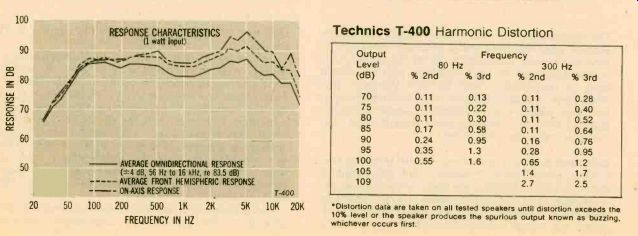
--------- RESPONSE CHARACTERISTICS a watt input) AVERAGE OMNIDIRECTIONAL RESPONSE ( 4 dB, 56 Hz to 16 kHz. re 835 dB) AVERAGE FRONT HEMISPHERIC RESPONSE ON-AXIS RESPONSE Technics T-400 Harmonic Distortion---Distortion data are taken on all tested speakers until distortion exceeds the 10% level or the speaker produces the spurious output known as buzzing, whichever occurs first.
++++++++++++++
Philips Turntable Packs Performance and Features
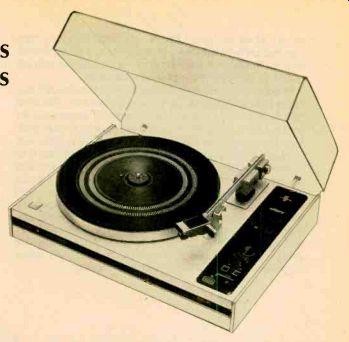
The Equipment: Philips GA -209, two -speed (33 and 45 rpm) single-play turntable-and-arm ensemble with automatic options; supplied with integral base and hinged dust cover. Dimensions: 17 1/8 by 12 7/8 by 6 9;16 inches. Price: $349.50. Warranty: one year parts and labor. Manufacturer: Philips of Holland; U.S. distributor: Norelco, 100 E. 42nd St., New York, N.Y. 10017.
Comment: A number of useful features, some of them really unique, combined with excellent performance and attractive styling make the new Philips GA-209 a very desirable turntable for use in a high-quality play back system. It is, to begin with, a DC-motor/ belt-driven model in which motor speed is electronically controlled. The system makes for accurate speed as well as low noise.
The turntable motor is not loaded with other functions; there actually are two more motors for tone-arm movement and cueing. Platter and tone am share a subchassis that is suspended below the mail chassis, a design feature that further isolates any motor vibrations and helps reduce the ensemble's susceptibility to external jarrings. The drive system enables the use of a relatively lightweight platter (the conventional need for a heavy platter to achieve good "flywheel effect" is obviated), and the motor's high torque makes for very brief startup time.
The platter is a two-piece affair, covered by a ridged rubberized mat on which are imprinted two strobe rings (one for 33, the other for 45 rpm) to help in fine-speed adjustments should they be needed. Actually, in CBS Labs tests, the unit-once adjusted for speed accuracy at 120 volts AC line power supply-showed no measurable error at varying line voltages for either of its operating speeds. The fine-speed adjustment itself is di vided between two control knobs, one each for the two speeds. They provide a very generous margin for variation, should the owner opt to use them. The 33-rpm control varies speed over a range from-3.5 to + 4.4%; the 45-rpm control, from -4.8 to + 5.9%.
The platter weighs 2 lbs., 11 oz. Rumble is among the lowest ever measured: -62 dB (AR LL standard). Flutter (ANSI / IEEE weighting method) is insignificant at 0.03% average and 0.07% peak. Arm resonance was very well damped, showing a mere 3.5-dB rise at 6 Hz. Arm friction, vertically and laterally, is negligible.
The built-in stylus force gauge is utterly unique on the GA-209. It consists of a small weighing scale (a moving pointer under an imprinted transparent window) that is attached to a pressure-sensitive lever in the tone-arm rest. This device not only makes it easy to adjust the VTF, but it also serves as a constant check on VTF since you can read the amount readily each time the arm re turns to rest. The gauge was checked against a laboratory gauge and found to be on the nose for settings of 1, 2, and 3 grams. For a setting of 1.5 it measured 1.6 grams; for 2.5 it measured 2.6 grams-both insignificant discrepancies. The antiskating adjustment .:Philips calls it side-thrust compensation) has separate scales for elliptical and conical stylus tips; the values measured seem well suited for each type.
The GA-209 may be used to play a record manually or automatically, and herein lie some more surprises. The main power off /on switch is at the left. while at the right is an elaborate group of operating controls and indicators. At the head of :his group are four panels that light up to show "automatic" or "manual" and "33" or "45." In front of them is a well, covered by a sliding plastic door, in which you will find the 33- and 45-rpm speed se lectors, a stop bar, the individual fine-speed trimmers, and the antiskating dial. In front of the well are two more controls-touch-sensitive "buttons" that, on gentle contact, light up, raise or lower the tone arm, and mute t-e sound or let it come through. One touchplate, marked with the symbol of a stylus contacting a disc, is t le "play" button; the other's symbol shows the stylus above the disc, and it acts as the "pause" control.
On the platter itself are three small pressure-sensitive pins, and one, two, or all three will be depressed de pending on what size record you put on. These pins activate a sensing device that automatically selects the correct speed (33 for 10-inch and 12-inch discs; 45 for 7-inch discs) and that sets the arm down at the lead-in edge of the record To play a record automatically, you release the arm lock at the foot of its rest and make sure the sliding door over the control well is shut. The word "automatic" will be lighted, and-depending on what size record you put on the platter-the turntable will start at the appropriate speed and the arm will come off its rest and descend gently into the lead-in groove of the disc.
During automatic use, you may interrupt play by opening the control cover and pressing the stop bar.
The arm will return to rest. Or you can leave the control cover shut and simply touch the pause touchplate. The arm will rise and the sound will be muted, but the platter will continue to rotate. Pressing the play touchplate will, of course, lower the arm (to the exact spot it left on the record) and restore the sound. You can repeat a record in the automatic mode simply by opening the cover and closing it again. At the end of play, the arm lifts off the record and returns to its rest. The turntable will stop.
To play a record manually, turn on the power as be fore but this time open the control door. The word "manual" will light up. Unlock tone arm rest, place a disc on the platter, and select the correct speed. (The 33 and 45 buttons, in manual mode, override the three pins on the turntable; this 4eature enables you to play any size record at either speed as you choose.) You may now cue manually or with the aid of the raise-and-lower but tons for the arm lift. At the end of the record, the arm will return to rest and the motor will switch off.
In addition to its novel control system the GA-209 has some familiar features, all of them worthwhile. The tone arm is fitted with a rear counterweight, adjustable for arm balance and VTF. The pickup fits onto a small plat form that slides into the head to make positive electrical contact. Supplied with the GA-209 is an assortment of hardware to help fit any pickup to the shell, and a plastic gauge to adjust the position of the pickup for correct stylus overhang. The platter has a built-in "pop up" adapter for large-hole 45-rpm singles. The stylish base has a hinged dust cover made of sturdy plastic; the hinges are friction-regulated so that the cover will stay up in any position, and if it starts to slip you can turn the screws on the hinges to adjust the friction. The cover may be fully down while a record is playing.
The only feature of this machine one could possibly take exception to is the location of the strobe rings.
Being right on the platter, they are hidden when there's a record on. However, once speed is adjusted, the addition of a disc will not change it. And since the turntable runs at constant speed despite line-voltage changes, there is no need to readjust fine-speed during use. Of course the strobe is not used for deliberate changes to alter musical pitch.
The GA-209 is, on all counts, a deluxe product. If it boasted only its more striking novelties, we would be apt to pat it gently on its tone arm and call it a harmless adult toy. However, the unit is quite obviously a technical triumph as well as a cosmetic coup. Purely from the standpoint of its function as a high-quality record player, it has a lot going for it, including its very quiet operation and its facility for accommodating the most refined of pickups.
++++++++++++++++
Sony's Ultimate Cassette Deck
The Equipment: Sony Model TC-177SD, a stereo cassette deck with Dolby noise reduction (including Dolby-FM switching); bias and equalization switching for ferric, ferrichrome, and chromium dioxide tapes; and separate recording and playback heads; in wood case. Dimensions: 17 by 12 11/16 inches (wood base), 6 inches high plus clearance for cassette-well cover. Price: $699.95. Warranty: two years parts and labor, shipping paid one way.
Manufacturer: Sony Corp., Japan; U.S. distributor: Superscope, Inc., 8150 Vineland Ave., Sun Valley, Calif. 91352.
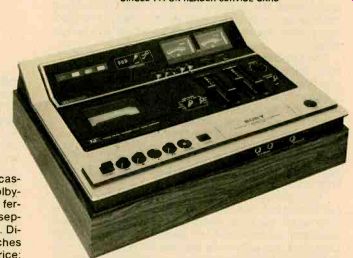
Comment: This is Sony's fanciest cassette deck to date, and it's an impressive bruiser. Though it resembles Sony's more conventional decks, it's larger and more feature-laden than any Sony we've yet examined; in a sense it sums up everything the company has done in the medium.
The rear portion of the top panel is angled upward to make the VU meters and the pilot-light array more easily visible from a sitting position. The pilots are for limiter (green), Dolby (yellow), recording (red), and pause (orange). Next to them is a three-digit turns counter and a "memory rewind" on/off switch. A small red light be tween the meters indicates peak overload condition. In front of the meters is a series of buttons: FM-pilot filter (on/off); four Dolby-mode selectors (Dolby off, Dolby on, Dolby FM on, Dolby calibration tone); and limiter (on/ off). Between the calibration-tone button and that for the limiter are two screwdriver controls for adjusting Dolby recording levels to the tape in use. (These controls are factory-adjusted for Sony's Ferrichrome, and little if any readjustment should be needed with most common tape types.) The 177's separate playback head makes Dolby adjustment unusually easy, since playback levels can be monitored on the meters while you record the tone.
It is a true playback head (not a monitor head in tended only for double-checking recording properties) and fits into the space normally used for a record /play head. The recording head fits into the smaller cassette opening "upstream" (to the left, as one would visualize it, looking "through" the front of the unit toward a cassette in playing position) of the playback head. Since this opening has no pressure pad, Sony controls tape tension-and therefore tape-to-head contact-by applying its bi-peripheral drive system, the second capstan sharing with the erase head the larger opening still farther upstream.
The cassette well is otherwise of conventional construction, with a pop-up, windowed dust cover and a yellow tape-viewing light below the window area of the cassette itself. (We found it a pleasure to return to this high-visibility design after working with a few front-loading-or even un-illuminated top-loading-models.) The transport controls in front of the well are solenoid-assisted; the TC-177 can be used safely with an AC-switching timer for wake-up playback or for recording (say, from FM) when you're away from home. The unit shuts off all transport modes automatically at the end of a cassette, so that no damage can occur in unattended operation even without the timer.
To the right of the cassette well are two three-position switches for bias and equalization. That for bias (which affects recording only, of course) has positions marked "low" (for most ferric tapes), "medium" (for ferri-chromes and high-performance ferrics like Sony UHF and Maxell UD), and "high" (for chromium dioxide).
---------------
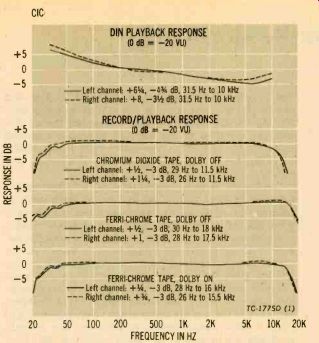
- Left channel: +6 1/4,-49i dB. 31.5 Hz to 10 khz
--- Right channel: +8,-3 1/4 dB, 31.5 Hz to 10 kHz
RECORD/PLAYBACK RESPONSE (0 dB =-20 VU) CHROMIUM DIOXIDE TAPE, DOLBY OFF
- Left channel: +1/4,-3 dB, 29 Hz to 11.5 kHz
--- Right channel: +11/4,-3 dB, 26 Hz to 11.5 kHz
-5 FERRI-CHROME TAPE, DOLBY OFF
- Left channel: +1/4,-3 dB. 30 Hz to 18 kHz
--- Right channel: +1,-3 dB, 28 Hz to 17.5 kHz
FERRI-CHROME TAPE. DOLBY ON
- Left channel: +1/4,-3 dB, 28 Hz to 16 kHz
--- Right channel: +3/4,-3 dB. 26 Hz to 15.5 kHz
TC177SD (1) 20 50 100 200 500 1K 2K 5K 10K
20K FREQUENCY IN HZ
-----------------
The equalization switch alters both recording and playback response; it has positions marked "normal" (for all ferric tapes), "Fe-Cr" (for ferri-chromes), and "CrO2" (for chromium dioxide). Sony Ferri-chrome cassettes, with which most of our tests were made, thus have a special playback-as well as recording-setting.
To the right of these switches are recording-level slider pairs-one for the mike inputs, one for permit input mixing. Nearby are a rotary output-level control (which alters line levels only) and a source/tape monitor switch. With this switch in the "source" position incoming levels can be read on the meters whether or not the deck is in the recording mode, obviating the pause-mode pre-monitoring that is needed to set levels on so many decks. And of course the switch permits B comparison of the taped sound with that of the in coming signal.
A button at the extreme right front corner of the top plate switches AC power. In the front surface just below the edge of the top plate are a pair of phone jacks for mike inputs and a stereo headphone jack. Its output level is controlled by a two-position switch next to it. The back panel has pin-jack pairs for line input and output.
There are no further user-accessible Dolby controls.
In adjusting tracking from Dolby broadcasts you must use the station's test tone to set the line-input controls for a "cal" (0-VU) reading in both channels.
The Dolby-FM setting does not have compensation for the new 25-microsecond broadcast time 'constant; it does, however, override the off position of the FM-pilot filter. That is, the filter is manually controlled by its own switch during regular Dolby operation but is inserted automatically when you press the Dolby-FM button.
Sony obviously has taken care that the TC-177 will make optimum use of its Ferri-chrome tape and has, in a sense, designed the unit around the tape. Record / play response with Ferri-chrome is spectacularly linear: al most ruler-flat from about 50 to 15,000 Hz, even with Dolby (which tends to exaggerate any nonlinearities of course). CBS Labs was not able to get as good response, in fact, with chromium dioxide. (We suspect that this may be due in part to the greater high-frequency boost that "drives" the head harder at these frequencies with chrome than with Ferri-chrome.) We were not able to detect a significant difference with regular program material, however. The sparkling, open high end that the narrow-gap playback head makes possible is most easily discernible with Ferri-chrome and superb source material; with regular ferric tape inherent tape hiss is (predictably) more easily heard, though the highs do seem more open than with conventional record/play leads.
The deck can stand comparison with other top models both electrically and mechanically. Speed is quite accurate at 0.2% fast and was unaffected by line-volt age changes in CBS Labs' tests. Wow and flutter are low; so are noise arid distortion. The operating "feel" of the controls is excellent, attesting to careful workmanship-as does the excellent finish of the parts.
Though the price no longer is as shocking as it once would have been, a $700 cassette deck still isn't for everybody. The TC-177SD seems specifically designed `or the home user who wants all the features that pro mote optimum performance but wants neither the most elaborate (and possibly confusing) controls of the professional or quasi-professional gear nor the mechanically complex (and possibly problematic) "convenience" features like automatic reverse and automatic bias / eq. switching. If that is the intent, we think Sony has succeeded. Even a novice can make first-rate tapes on the 177 (the limiter can help materially in live recording). Its designers have made a logical and consistent choice of features-both for inclusion and for exclusion.
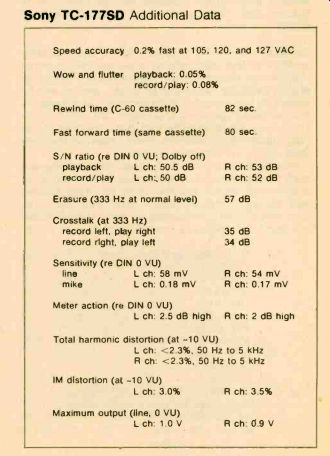
Sony TC-177SD -- Additional Data
Speed accuracy 0.2% fast at 105, 120, and 127 VAC Wow and flutter playback: 0.05% record/play: 0.08% Rewind time (C-60 cassette) 82 sec.
Fast forward time (same cassette) 80 sec.
S/N ratio (re DIN 0 VU, Dolby off) playback L ch: 50.5 dB R ch: 53 dB record/play L ch: 50 dB R ch. 52 dB Erasure (333 Hz at normal level) 57 dB Crosstalk (at 333 Hz) record left, play right record right, .)lay left Sensitivity (re CIN 0 VU) line L ch: 58 mV mike L ch: 0.18 uV Meter action (re DIN 0 VU) L ch: 2.5 dB high 35 dB 34 dB R ch: 54 mV R ch: 0.17 mV R ch: 2 dB high Total harmonic distortion (at-10 VU) L ch: <2.3%, 50 Hz to 5 kHz R ch: <2.3%. 50 Hz to 5 kHz IM distortion (a*-10 VU) L ch: 3.0% Maximum output (line, 0 VU) L ch: 1.0 V R ch: 3.5% R ch: 0.9 V
++++++++++++++++++
Infinity's Monitor Re-Monitored
The Equipment: Infinity Monitor 1A, a floor-standing loudspeaker system in wood enclosure. Dimensions: 14 by 38 inches, 13 inches deep: stands vertically only. Price: $429. Warranty: five years parts and labor (transferable): shipping not included. Manufacturer: Infinity Systems, Inc., 7930 Deering Ave., Canoga Park, Calif. 91304.
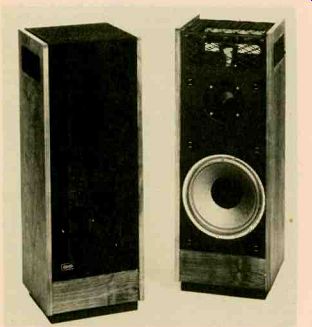
Comment: When Infinity's Monitor-a floor-standing speaker system with (briefly) a unique "wave trans mission line" tweeter resembling the Walsh driver in operating principle, a midrange driver, and a woofer loaded by a conventional transmission-line system first appeared, we were impressed. Our report (June 1973) commented favorably on it. But one aspect of that report raised more questions than it answered: the computer-generated response curves.
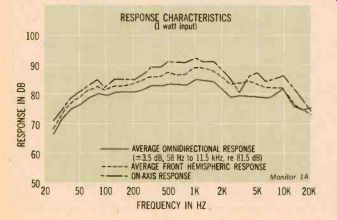
We take the "omnidirectional response" curves--actually an integration of many measurements, each using a pink-noise source and testing by one-third octaves with several different speaker-mike orientations--as most indicative of how the speaker under test will sound in a room. The Monitor's omnidirectional curve exhibited a large (more than 10-dB) peak at 10 kHz and above. (When the computer showed up with the odd-looking curves, CBS Labs had rechecked them.) Our listening samples of the Monitor, however, sounded more like the on-axis curve-without the 10-dB peak than like the omnidirectional curve. What could this mean? The tweeter is totally unlike any we had attempted to measure before, and in the report we attributed the peak to "the application of a standard test procedure to a nonstandard tweeter design." One engineer closely associated with the design of the Monitor claimed, how ever, that the published measurements were "impossible" though they had been double-checked by the lab. We consulted a reputable and disinterested independent audio engineer for his analysis. In his opinion the curves were not impossible; they might be unrepresentative of the way the speaker sounded, but since 8 of the 14 microphone positions used for the omnidirectional curve and 3 of the 5 used for the front hemispheric curve are in the horizontal plane, he reasoned, cumulative emphasis of any nonlinearity peculiar to that horizontal plane was possible.
On this note of stalemate the matter rested for some time. But as we considered it, one point seemed to take on increased significance. During the course of testing, Infinity had made reference to a bead of damping "putty" at the base of the tweeter. We mentioned it to the test engineer at the lab, and he seemed unable to identify it. Was it perhaps missing from the lab test sample (though not from our listening samples)? Infinity insisted it was in the speaker when they shipped it; the lab didn't remember it; Infinity could not trace the test sample, which had meanwhile been returned to the company. We finally decided to test another sample of the unit. Here are the results.
The average omnidirectional response can be characterized as within ±5.5 dB from 38 Hz to 17 kHz or, within the narrower margin of 3.5 dB, from 58 Hz to 11.5 kHz. The curve shows a slight peak at 10 kHz but nothing at all comparable to the peak in the original curves. In both smoothness and range the new curves relate closely to what can be heard in listening to the Monitors, which are excellent in both respects.
There are minor differences elsewhere in the test results on the new sample. Impedance is slightly higher below 1 kHz, for example, and slightly lower in the treble range. The first sample came in at 8.5 ohms nominal and remained very close to this value from the rating point on up to the limit of testing at 20 kHz; the new one measures 9 ohms at the rating point, approximately 12 ohms in the region around 500 Hz, and approximately 6 ohms from about 2 kHz upward. The differences are not significant in our opinion, however.
Obviously our earlier explanation of the microphone positions' not being suited to the Monitor's tweeter de sign-while in itself technically plausible--was not germane. Using the same microphone technique, the lab's measurements of the new sample show no significant peak at 10 kHz or at any other frequency. It is--and was--a fine speaker system; and now the measured response curves more closely demonstrate its listening quality.
+++++++++++++++++++
++++++++++++++++
-------------
(High Fidelity)
Also see: