The New Releases
by R. D. Darrel
The Hyphenated Stokowski: Hail (Once Again) and Farewell (but Not for Good)
London Phase-4 and Odyssey releases prompt a fresh look at the controversial musical adaptations.
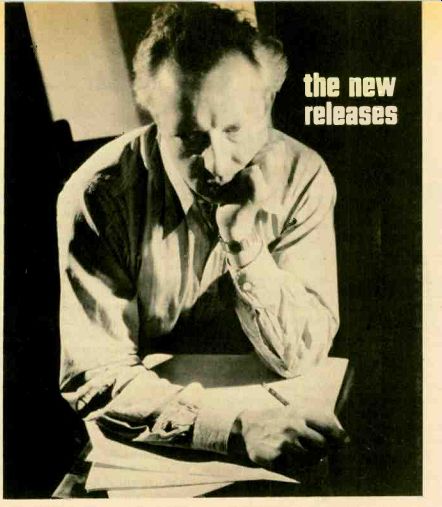
ONCE UPON A time much more circumscribed, far less sophisticated, than our own, few musical bylines were a stronger guarantee of record-sales success than that of Bach-Stokowski. And perhaps none exerted, for a decade or so, a more powerfully significant influence on inexperienced listeners of all ages. Whole generations of music lovers who grew up in the Depression and World War II eras will never be able to forget how electrifyingly they were first introduced to Bach--often indeed to symphonic music itself--by the Stokowskian transcription and recorded-performance series.
---- Ironically enough, the "hyphenated Stokowski" at one time coarted, not very seriously, anonymity. Although his S. 582 Passacaglia transcription was acknowledged in the conductor's own program-book notes on its first concert performance hy the Philadelphia Orchestra in February 1922. later transcription performances. from that of the S. 565 Toccata and Fugue in February 1926. omitted the transcriber’s name in both program listing and notes. So did th! 19:8 first S. 565 recording and the others released in the next few years--although in both concert and record cases "everybody" knew very well who the seemingly overmodest transcriber actually was. III haven't skipped an earlier example in my hasty search of the historical data, the outworn game was finally abandoned with the Bach-Stokowski accreditation of the Rheingold symphonic synthesis (then labeled merely "excerpts-) in Victor al bum M 179 of June 1931 ----
That series began with a then-unprecedented Big Bang (the explosion of a time bomb with a two-century-delay fuse) in January 1928 with the only later world-famous S. 565 Toccata and Fugue in D minor on Victor 6751. A steadily growing flood of further 78-rpm shellac discs and albums followed: the S. 853 E flat minor Prelude coupled with the S. 639 chorale-prelude "kb ruf zu Dir" on Victor 6786 in April 1928; the S. 582 Passacaglia and S. 680 chorale-prelude "Wir glauben all- (together with the Second Brandenburg Concerto, with the high trumpet parts transposed an octave down) in Victor album M 59 in December 1929; etc. Later, in the '40s. after the conductor had parted company with both the Philadelphia Orchestra and Victor, some of the most popular works were rather ineffectively re-recorded with the All American Youth Orchestra for Columbia. But soon the period of changeover from 78s to LPs and 45s found Stokowski returning to what was now RCA Victor to con duct an all-star pickup ensemble grandly known as "His" Orchestra in a new series of almost exclusively re-recordings.
But also by this time, even before the monophonic era drew to a close, mass-public taste was changing and a connoisseur demand for "authentic" Bach recordings was insatiably growing. That the Bach-Stokowski byline no longer spelled sure success became undeniable when the first batch of re-recordings of the old favorites in stereo (with another of "His" orchestras for Capitol) was not followed by others. A decade or so later, a projected new series back with the Philadelphians for Columbia, never actually materialized. And it is only now, a decade and a half or so still later, when the conductor's indefatigable peregrinations have taken him as far as Prague for guest appearances and recordings with the Czech Phil harmonic, that a few of the Bach-Stokowski favorites reappear. (And not for the last time: RCA has recorded yet another LP's worth.) Only those of us who lived through the '20s and '30s can appreciate how well-nigh impossible it is to make to day's young listeners understand how incredibly the musical world has metamorphosed in the meantime.
In the first place, not only Bach, but most "old" masters were scantily represented at best in concert, even more rarely on ,records. Even worse-at least by today's standards-when they were heard at all they were generally in arrangements or transcriptions (piano instead of harpsichord or clavichord, for example). And when prescribed instruments were used, they were almost al ways anachronistic types (big iron-frame harpsichords, nineteenth-century "symphonic" organs, etc.).
Then, worst of all, the interpretations themselves were with rare exceptions characterized by "expressiveness" far more suitable for music of the Romantic period than of baroque and earlier times. Even such justly famed Bach specialists as Landowska, Schweitzer, and Casals were far from guiltless in this respect-yet it was impossible then to complain harshly about them or anyone who helped to refute the old canard that Bach's works were cerebrally devoid of feeling, even mainly Augenmusik better suited for pedantic analysis than for actual performance.
Hence the Stokowski transcriptions could be, and were, a thrillingly dramatic revelation to innumerable listeners for whom Bach first came vitally alive in them.
And for a considerable time the potent combination of Stokowskian scoring and Stokowskian recorded performances played an incalculably influential role in the histories of both music "appreciation" and audio technology.
Even today, when "transcription" has become some thing of a dirty word and we better realize the artistic "wrongness" of Stokowski's sonic inflations and mannered shaping of phrases and tempos, it's not easy to condemn without qualification the Bach-Stokowski canon.
A few of the worst examples are indeed unforgivable horrors-like that victim of musical elephantiasis, the Chaconne from the S. 1004 Unaccompanied Violin Sonata. (I've never forgotten Paul Henry Langr's observation that the poor Chaconne itself emerges from a performance of this transcription like an atom that has passed through an atom-smashing machine.) Then there are smaller lyrical pieces of which the Stokowskian versions (in performance perhaps more than in scoring) are only too accurately described by annotator Charles O'Connell's tropically luxuriant prose:
Phrases impalpably delicate, pathetic beyond words and colored beyond description, float in the air like prayers, and of them is created an atmosphere of reverent longing, of pathos, and of tenderness almost too beautiful to bear.
Amen. But we shouldn't forget to balance such schmaltz with the genuine poignance and eloquence of such true masterpieces as the S. 639 chorale-prelude "Ich ruf zu Dir" scoring (which I'm saddened not to find in the present collection). And, while there are undeniably anachronistic details in the big organ-work transcriptions (although more of them, to my mind, in Stokowski's performances than in the scores themselves), even purists must find it hard to resist the sheer dramatic power and impact of the symphonized S. 565 Toccata and Fugue and S. 582 Passacaglia and Fugue-especially the implacable horn-choir motif at the climactic ending of the latter. I sincerely believe that all of Bach's organ works are best heard on an authentic-period, or baroque-styled, instrument, yet as much as I enjoy them so played there still are moments in the larger-scaled works in particular when I can't help yearning for something more in the way of sheerly sonic weight and breadth.
Other Stokowski transcriptions are a very mixed bag indeed-some of them even internally, like the present S.
680 chorale-prelude "Wir glauben all' an einen Gott," whose "Giant Fugue" nickname has tempted Stokowski to tack a grossly inflated ending onto a score he began with such piquant restraint. None of the Bach works themselves was properly identified originally, even granted that S., or BWV, specifications were not avail able until 1950, and some still are confusingly titled: "'Chorale from the Easter Cantata," for example.
There are several "Easter Cantatas," and the excerpt chosen is not the final four-part chorale of the Cantata No. 4, Christ lag in Todesbanden, but the third verse set for choir tenors singing in unison the chorale theme against vigorous orchestral figures. (Like all the other current se lections, this one has been recorded before, first with the Philadelphians in Victor album VM 401 of December 1937.) The transcription of clavier pieces (like the stately S. 853 Prelude from Book I of the Well-Tempered Clavier, first recorded in 1928) and of "spiritual" songs (like the S. 487 "Mein Jesu," first recorded back in 1937 in the VM 401 album set) are particularly susceptible to romanticization at best, outright sentimentalization at worst. Yet of course the scoring-enhanced emotional fervency is just what makes them so irresistibly appealing to so many listeners.
And however sternly Stokowski's taste may be questioned, his technical skill as an orchestrator/transcriber is best measured against scorings of some of the same works by such noted composers as Schoenberg and Respighi, such noted conductors as Sir Henry Wood ("Klenovsky") and Ormandy, among innumerable others. Surely Stokowski is seldom matched and never, I dare say, surpassed.
Against all this historical background, it is so appropriate that the long-triumphal recording career of Stokowski's Bach transcriptions should be commemorated and crowned by the fabulous nonagenarian's playing and recording of some of them for (not necessarily) the last time. And it's so stimulating to hear the searching new illuminations that present-day engineering techniques can throw on these inimitably Stokowskian scores that I shrink from objective evaluations--rightly fearing they'll turn out be animad versions--of the present interpretations and performances, as distinct from the recordings themselves.
It's only with sadness that I'm forced to note that with time and age the conductor's readings have grown self indulgently slower, more portentous (even pretentious), And even the performances by the enthusiastically responsive Czech players (who make up a fine orchestra, even if they are no Philadelphians) lack the supreme tautness of tempo, balance, and attack control Stokowski would have demanded even relatively few years ago.
Sonically, however, the Old Magician is as spellbinding as ever, while Phase-4 engineer Arthur Lilley, even on location, works miracles in capturing the full range of Stokowskian thunders, glitters, and super-sensuous lushness. If these are indeed live performances, as they are claimed to be, the recording crew must have carefully gagged and straitjacketed everyone in the Prague House of Artists audiences! Remembering how well Victor's mono recordings of the late '20s still stand up and how truly incomparable the Philadelphia Orchestra was in that epoch (as we were reminded just recently by the RCA reissue of the Stokowski/Philadelphian Dvorak New World Symphony of 1927), I now pray harder than ever that RCA may reissue some of the first Bach-Stokowski recorded performances-above all that of my favorite "Ich ruf zu Dir" chorale-prelude.
Patently, so successful a hyphenated Stokowski couldn't long confine his transcribing activities to Bach alone. He went on to score short pieces by other, mostly Italian, "old" composers and many later ones, among them Chopin, Scriabin, Shostakovich. But most of these were ephemeral encore pieces. and it was only with a new kind of opera arrangement/transcription, which he or someone ingeniously named "symphonic syntheses," that he was able at least to approach the success (and the controversies) of the Bach series.
His Wagnerian series began with a Tristan and Isolde synthesis (which included the prelude, love music, and Love-Death) in late 1932 and went on to Parsifal Act III in 1935 and all four Ring operas from 1933 to 1938. All these were with the Philadelphia Orchestra, of course, augmented in the Walkure and Siegfried albums with one or two vocal soloists. Later on the Tristan synthesis, easily the most popular of them all, was twice re-re corded by RCA Victor (1938 78s, 1952 LP with "His" Orchestra) and, in somewhat different form minus the prelude, with the Ail-American Youth Orchestra on Columbia 78s in 1941.
This latter form of the Tristan synthesis, re-titled "Love Music from Acts II and III," was chosen when, in early 1960, Stokowski returned both to Columbia and to the Philadelphia Orchestra after an absence of almost two decades. (In addition to the Falla coupling for this Tristan, he was also rumored to have recorded around this time the Bach Brandenburg No. 5 and a batch of Bach transcriptions, and a complete Columbia recording of Schoenberg's mighty Gurre-Lieder was planned for later that year-none of which, as far as I know, ever actually appeared.) In the works that did materialize, it's almost superfluous to note that the rejoining of conductor and orchestra first made world famous by each other became an occasion for inspired music-making. Here is all the conductor's tautness of control, as well as all the fervency, of the earlier years; here too is all the inimitable Stokowskian/Philadelphian "sound" of old-superbly captured by audio engineering that even fourteen years later remains persuasively gripping. Compared with my carefully preserved open-reel taping (long OP) of this program, the present Odyssey reissue strikes me as. if anything, a shade more crisply processed. yet with no dilution of the hypnotic, now-brooding, now-passionate evocation of the fated lovers' Liebesnacht and Liebestod.
For more than good measure, Stokowski's distillation of Tristan and Isolde is combined with his and Falla's no less potently evocative (however different it is in mood) tone picture of Spanish gypsy love and life in El Amor brujo-a blazing version notable too for Shirley Verrett's recording debut as the mezzo-soprano soloist. Issued at a budget price, this Odyssey reissue is not merely a bar gain. it also is one of the Best Buys in the whole recorded discography today! Of the London Phase-4 reissues, only one is out standing for quintessentially Stokowskian illuminations as well as for spectacularly brilliant Phase-4 sonic technology. This is the Mussorgsky program that combines the 1966 New Philharmonia version of Stokowski's own (not Ravel's) orchestration of Pictures at an Exhibition (which he first recorded with the Philadelphians in RCA Victor M 706 of 1940) with the 1968 London Symphony version of Night on Bald Mountain (which he first re corded with the Philadelphians as an RCA Victor single, 17900, in 1941 and again with "His" Orchestra in the RCA Victor mono LP, LM 1816, of 1956), and the 1970 Orchestre de la Suisse Romande symphonic synthesis of Boris Godunov (which he first recorded with the Philadelphians in RCA Victor M 391 of 1937 and again with the All-American Youth Orchestra in Columbia M 516 of 1942). All three works boast magnetic attractions, not least their extraordinarily virile, even barbaric, Slavic fe rocity, which, while it well may be as much Stokowskian as Mussorgskian, is nonetheless dramatically (some times melodramatically) exciting.
The Bald Mountain fantasia bears an unhyphenated byline here, but it should have a double or triple one. As every discophile knows, the work as it's usually heard owes as much to Rimsky-Korsakov as it does to Mussorgsky himself; as played here, its score also owes a very considerable debt to the conductor's further coloristic touchings-up-a debt acknowledged with an "arr. Stokowski" in the original 78-rpm recording.
The daring, if not arrogant, challenge to the acclaimed Ravel orchestration of Pictures will never displace that favorite in the standard symphonic repertory, if only on account of an almost unrelieved grimness exacerbated by the omission of the lively "Tuilleries" and "Limoges" scenes (along with one of the "Promenades"), which Stokowski considers spurious additions to the original piano series. Yet in its very somberness and savage power this highly individual version exerts a malevolent Medusa-like fascination.
In earlier days, the 'Boris synthesis fired almost as many controversies as the Bach transcriptions, arousing fervent huzzas for its having gone directly to the original Mussorgsky version rather than to the extensively rewritten one by Rimsky-Korsakov that still remains (I'm ashamed to say) the better-known one. Stokowski has been no less fervently condemned for a seeming obsession with chime and gong sound effects and for the synthesis' patchwork construction. Yet it was Mussorgsky himself for whom tintinnabulation was an idee fixe; and whether or not one knows the protean opera itself, the present free-form mosaic makes its own dramatic sense and logic. Running through passages drawn in whole or part from the Introduction, Pilgrims' Chorus, Coronation Scene (complete), Varlaam's song, Revolutionary Scene (last part), Simpleton's Song, and the Death of Boris-with all the vocal materials given to instruments-
this is, whatever else, incomparably plangent, sensibility-searing music. It also boasts sensationally electrifying Phase-4 sonics, but that's scarcely surprising since even back in 1937, evaluated by the standards of the mid-mono era, I uninhibitedly claimed that "even the [RCA Victor] recording itself, which in another work would be acclaimed as the last word in technical miracles, serves here only to give more golden voice to the tongues of men and angels with which Mussorgsky speaks for the soul of a whole nation." All four of the remaining London "fantasias" may be safely skipped except by Phase-4 aficionados who some how missed the differently combined original releases and by suckers for "Greatest Hits" or musical chicken-in-parts merchandising lures. But two special notes might be justified. One is to affix a "Beware" sign to the Debussy program (SPC 21109), which represents, as most Debussians must already know, some of Stokowski's most inexplicably willful interpretive eccentricities. (Even the conductor's staunchest admirers occasionally have to admit that, like the little girl with the curl right in the middle of her forehead, when he is bad, he is indeed horrid.) The other note is to call special attention in the other wise unremarkable "Ballet" grab bag to the one piece in all five "fantasias" that isn't a reissue: the expansive "Nimrod" episode from Elgar's Enigma Variations, a work that Stokowski has never recorded before but that in all likelihood may appear soon in a complete Czech Philharmonic/Phase-4 version of which the present excerpt is an advance sampler. If so, we are reminded that by adding-in his nineties-a new major work to his re corded repertory Stokowski not only proves anew that he is a true musical polymath (man of widely varied talents), but also reveals himself as an even rarer, in the world of music and elsewhere, opsimath (man capable of late-in-life learning).
Let's honor him while he's still with us and still so vi tally productive. We'll never see or hear his like again!
BACK-STOKOWSKI: Orchestral Transcriptions. Czech Phil harmonic Orchestra, Leopold Stokowski, cond. [Raymond Few, prod.] LONDON PHASE-4 SPC 21096, $6.98. Tape: ife L 475096, $7.95; M 81096, $6.95; OIF M 51096, $6.95.
Cantata No. 4: No. 4, Jesus Christus, Gottes Sohn. Geistliches Lied, No. 51: Mein Jesu, was fUr Seelenweh. S. 487. Toccata and Fugue for Organ, in D minor. S 565 Passacaglia and Fugue for Organ, in C minor, S. 582. Chorale-prelude, Wir glauben all' an amen Gott, S. 680 (Giant Fugue). Well-Tempered Clavier. Book I: Prelude No 8. in E flat minor, S. 853.
WAGNER: Tristan and Isolde: Love Music from Acts II and Ill (symphonic synthesis, arr. Stokowski). FALLA: El Amor brujo. Shirley Verrett, mezzo-soprano (in the Falla); Philadelphia Orchestra, Leopold Stokowski, cond. [Howard Scott, prod.] ODYSSEY Y 32368, $3.49 [from COLUMBIA MS 6147, 1960].
EMUSSORGSKY FANTASIA. London Symphony Orchestra, Orchestre de la Suisse Romande, and New Philhar monia Orchestra, Leopold Stokowski, cond. [Tony d'Amato, prod.] LONDON PHASE-4 SPC 21110, $6.98. Tape: L475110, $7.95; 40. M81110, $6.95; w M 51110, $6.95.
Night on Bald Mountain [LSO; from SPC 21026, 1968]; Boris Godunov: sym phonic synthesis (arr. Stokowski) (OSR; from SPC 21032, 19701; Pictures at an Exhibition (orch. Stokowski) [NPO; from SPC 21006, 1966].
R B R DEBUSSY FANTASIA. London Symphony Orchestra and New Philharmonia Orchestra, Leopold Stokowski, cond. [Tony d'Amato, prod.] LONDON PHASE-4 SPC 21109, $6.98. L 475109, $7.95; _ M 81109, $6.95; ii M 51109, $6.95.
La Mer [LSO; from SPC 21059, 1971]; La Cathedrale engloutie (orch. Stokowski)[NPO; from SPC 21006. 1966]: Prelude a apres-midi d'un fauna [LSO: from SPC 21090/1, 1973].
TCHAIKOVSKY FANTASIA. Various orchestras, Leopold Stokowski, cond. [Tony d'Amato, prod.] LONDON PHASE-4 SPC 21108, $6.98 [from various originals]. Tape: fa L 475108, $7.95; M 81108, $6.95;011 M 51108, $6.95.
Romeo and Juliet; Marche slave, Op. 31; 1812 Overture, Op. 49; Swan Lake: Waltz, Act I; Sleeping Beauty: Waltz, Act I.
RUSSIAN FANTASIA. Various orchestras, Leopold Stokowski, cond. [Tony d'Amato, prod.] LONDON PHASE-4 SPC 21111, $6.98 [from various originals]. Tape: f1 L 475111, $7.95; ray M 81111, $6.95; M 51111, $6.95.
Prince Igor: Polovtsian Dances (with chorus). Glazunov: Concerto for Violin and Orchestra, in A minor, Op. 82 (with Silvia Marcovici, violin).
Rimsky-Korsakov: Scheherazade, Op. 35: first movement.
STRAVINSKY: The Firebird: Dense infernale. TC:NAIKOVSKY: Swan Lake: Dance of the Little Swans and Finale. Act IV pi
BALLET FANTASIA. Various orchestras, Leopold Stokowski, cond. [Tony d'Amato, prod.] LONDON PHASE-4 SPC 21112, $6.98 [except for the new Elgar, from various originals]. Tape: Ili L 475112, $7.95:4P.,M 81112, $6.95; ft M 51112, $6.95.
La Damnation de Faust: Dense des sylphes.
Elgar: Enigma Variations, Op. 36: Nimrod. RAVEL: Daphnis et Chloe: Suite No. 2 (with chorus). STRAVINSKY:
The Firebird: Berceuse and Finale. TCHAIKOVSKY: Swan Lake: Danse espa gnole, Act III; Pas de trois, Act I: Variation iii.
++++++++++++++
An Essential American-Music Document--from England
by Royal S. Brown
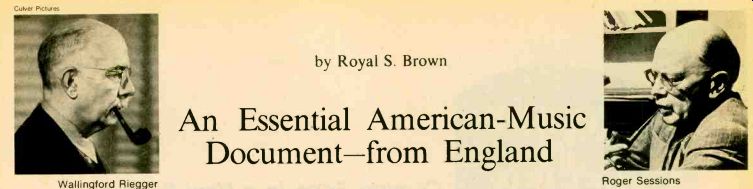
Wallingford Riegger, Roger Sessions,
Argo offers first-rate performances of works by Riegger and Sessions.
IT IS IRONIC that Argo's superlatively conceived disc of some of the richest and most fertile directions taken by American music was produced in England. But listening to this absolutely essential document, it is perhaps not difficult to understand why Wallingford Riegger and Roger Sessions have received but a modicum of the attention they deserve.
Besides the apparent severity (the two make nonsystematic use of atonality, for example) and often incredible density of their styles (it takes several hearings to be- gin to get beneath the surface of these works, even though a single hearing proves immensely rewarding), both composers-especially in the works recorded here have an international flavor to their music, which is basically devoid of the Americana that might make it easier to pinpoint idiomatically. both at home and abroad.
Yet what vitality and inventiveness pervade every measure of the Riegger and Sessidns pieces! One thing the composers have in common is the strong forward movement of their music. In Riegger, this movement tends to grow from a rhythmic idiom that was ideally suited to the many modern-dance projects (Martha Graham et al.) he devoted himself to in the Thirties and For ties. Indeed. Dichotomy, an amazingly forward-looking work composed in 1931, has a dramatic angularity to it that seems almost to demand moving, abstract visualization. Also typical of Riegger in this work is the start-stop momentum acquired by the various instrumental fragments, while from the multi-layered. polyphonic complexity of some of the sections grows an extraordinary sense of spaciousness. (Interestingly, there are several points in the score that seem to foreshadow Messiaen, of all people.) Sessions, on the other hand, creates his movement for ward from a lyrical flow that is as strong and yet as subtle as anything you're apt to hear in non-tonally oriented music. The short Eighth Symphony (1967-68). for in stance. contains long, sustained thematic lines whose convolutions are felt as constantly present. even though the line may shift in instrumentation and travel through various colored planes of diverse textures before arriving at a resting point. Throughout, themes acquire emotional depth from their spatial and harmonic relation ship to material surrounding them, and the ultimate unity of the symphony lies not simply in the repetition and development of melodic and rhythmic motives, but also in the particularly rich and original use of the instruments. including the maracas first mysteriously heard behind the opening theme. There are even points in the symphony where the composer creates large masses of sound that seem to be expanding in directions taken by the likes of Ligeti.
In spite of its title and recent date, the Rhapsody for Orchestra (1970) is a much more violent piece, divided into more recognizable movements and written in a style more identifiable with earlier Sessions than the Eighth Symphony. While the latter has the quality of an exceptionally beautiful meditation, the Rhapsody seems to have more dramatic implications that culminate, in the third section, in a grim, explosive episode that has some what the quality of a frenzied march. This type of intensity of feeling is counterbalanced, in both Sessions and Riegger. by the rigor and control of their compositional techniques, resulting in a kind of expressionism that is perhaps the essence of the composers' styles. although in two differing modes.
I'm not sure what Thea Musgrave's Night Music is doing on this disc. It is an effective enough work, living up to its title but featuring two concertante horns whose players wander about the orchestra creating a spatial dimension that is pretty well captured in this recording.
But its static quality and the ultra-divisi verticality of some of its sections set it strongly against the Sessions and Riegger pieces. even though Riegger in particular uses some of the same techniques. and it suffers in com parison. It would seem much more logical to me to have filled out this release with, say, Riegger's still unrecorded Passacaglia and Fugue for Orchestra.
Nonetheless, program director David Drew deserves enormous credit for the releases and reissues that make up the Calouste Gulbenkian Foundation series on Argo.
As was the case for the Messiaen/Tippett/recording (ZRG 703). I do not see how the reproduction of the or chestral sound in the two Sessions works could be improved upon. while the Riegger and Musgrave likewise benefit from exceptional. if less spectacular. clarity in the sonics.
The Sessions Eighth, which has been a Prausnitz specialty of late, receives the best performance. The playing in the other works is not always as precise as it might be, but this detracts little from the over-all quality. And this version of the Riegger Dichotomy is certainly to be preferred to Mester's on Louisville, particularly because of the accompanying material. The impressive program booklet, besides containing articles by Prausnitz on the Riegger and by Andrew Imbrie on the Sessions Eighth, has analyses by Musgrave and Sessions of their own works.
Sessions: Symphony No. 8; Rhapsody for Orchestra.Reiger: Dichotomy for Chamber Orchestra, Op. 12. Musgrave: Night Music. Barry Tuckwell and Alan Chidell, horns (in the Musgrave); London Sinfonietta (in the Musgrave and Riegger) and New Philharmonia Orchestra (in the Sessions), Frederik Prausnitz, cond. [James Walker, prod.] ARGO ZRG 702, $6.98.
++++++++++++
classical
reviewed by: ROYAL S. BROWN ABRAM CHIPMAN R. D. DARRELL PETER G. DAVIS SHIRLEY FLEMING ALFRED FRANKENSTEIN KENNETH FURIE CLIFFORD F. GILMORE HARRIS GOLDSMITH DAVID HAMILTON DALE S. HARRIS PHILIP HART PAUL HENRY LANG ROBERT C. MARSH ROBERT P. MORGAN ANDREW PORTER H. C. ROBBINS LANDON JOHN ROCKWELL PATRICK J. SMITH SUSAN THIEMANN SOMMER
BACH: English Suites (6), S. 806-11. Huguette Dreyfus, harpsichord (two eighteenth-century French harpsichords by Hemsch and Dubois). [Gerd Ploebsch, prod.] ARCHIV 2533 164, 2533 165, and 2533 166, $7.98 each. English Suites: No. 1. in A: No. 2. in A minor: No. 3. in G minor: No. 4. in F: No. 5. in E minor; No. 6. in D minor.
Comparisons: Galling Vox SVBX 5438 Walcha Mace 9033.9036 Bach was indeed a fortunate man, living as he did at the very end of an era: To him was granted the honor of saying the last word, of summarizing and drawing together many of the various threads that had been developed by his predecessors. Because he was also a genius. he was able. not only to say the last word, but to say it best. What is left to add to the art of fuguing after hearing Bach's Art of Fugue? Similarly with the keyboard suite of dance pieces: Bach brought the form to its highest peak of development with his three great collections, the partitas. French Suites, and English Suites.
Because these are such perfect works, so filled with compositional audacities and strokes of genius. it's really quite painful to hear someone like Huguette Dreyfus brainlessly dashing through the English Suites. giving not the slightest hint that she has even noticed any of the wonders contained therein.
It's simply not enough to switch on the inner metronome and methodically thump out every one of the notes printed in the score.
To give credit where due: Her fingers do work remarkably Well, she has set fairly brisk tempos for most movements, and she pushes all the right keys with great assurance. She has also done enough research to know that trills begin on the upper note and that sarabandes are slower than courantes. Otherwise she plays like a zombie, without the slightest tempo inflection from first measure to last and without the slightest bit of originality in dealing with ornaments or with passages of an improvisatory nature. Bach has given the player some unusually explicit hints in this set of pieces:
Two of the sarabandes are written out a second time with all the aprements (trills, arpeggios. scale passages. roulades, etc.) care fully notated in full. Surely he intended these as samples and expected the performer to sup ply similar elaborations in similar sarabandes.
Dreyfus plays from these alternate versions for the repeats of these two sarabandes. but in all the others the repeats are almost identical to the first time through.
This litany of missed musical opportunities could go on and on, but what of the competition? Pretty grim. I'm afraid. Walcha's () record set is just as unimaginative. and he doesn't even make Dreyfus' attempt to enliven the proceedings with brisk tempos. These performances were available back in mono days on a pair of mono Electrola discs, which Mace is now offering as genuine stereo. Even if it is stereo ( switching my amplifier from stereo to mono mode produces no noticeable difference in sound). it is still archaic, unattractive sound.
That leaves Galling's set on Vox (part of his complete edition of the harpsichord music).
His playing has many admirable qualities combined with more than a touch of Teutonic pedanticism : He clearly understands the structure of these pieces and does a fairly good job of communicating it to the listener. For that reason alone he commands respect and admiration.
As for ornamentation and improvisatory elaboration, he does no more than Dreyfus, and his tempos are generally slower than hers.
Dreyfus plays almost all repeats. while Galling is content with one run-through for most pieces. Since neither of them has anything more to say on the second go-round. Galling's abridgments are to be preferred. and they leave room in his three-record set for nine more pieces. including the Italian Concerto and Chromatic Fantasy.
If you must have a recommendation. I'll reluctantly suggest Galling. Behind the pedanticism there's an understanding brain at work, while Dreyfus seems to be thinking of nothing but finger exercises. And, need I add, the Vox set is far less expensive. C.F.G.
BACH-STOKOWSKI: Orchestral Transcriptions. For a feature review, see page 91.
Bax: Tintagel; Northern Ballad No. 1; The Garden of Fand; Mediterranean. London Philharmonic Orchestra, Adrian Boult, cond.
MUSICAL HERITAGE MHS 1769, $3.50 (Musical Heritage Society, 1991 Broadway, New York, N.Y. 10023).
This program samples well the agreeable out put of one of England's minor masters, as well as that country's most prolific independent record label. Lyrita, which has done yeoman service on behalf of such as Bax. Moeran, Hoist, Parry, Bliss, Elgar, all loyally re-pressed here by MHS.
The Garden of Fand is a broad-brushed seascape that shimmers agreeably in its softer and slower pages. Tintagel is a semi-effective anglicization of the Tristan ambience. Northern Ballad No. 1 is an exuberant essay in Scottish lore, while Mediterranean reminds one of a sort of mini-Espana.
All are presented by Sir Adrian with reverent care and detail, though Barbirolli and Beecham (whose versions were never very long available on these shores) have given us more volatile and sensuous phonographic statements of Fand In typical Lyrita fashion. these Boult recordings are clear and full-bodied. with effective stereo treatment. A.C.
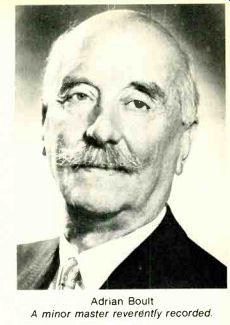
--Adrian Boult, A minor master reverently recorded.
BEETHOVEN: Concerto for Piano and Orchestra, No. 5, in E flat, Op. 73 (Emperor). Walter Gieseking, piano;
Vienna Philharmonic Orchestra, Bruno Walter, cond. TURNABOUT THS 65011, $3.98 (rechanneled) [re corded mid-'30s].
Both of Gieseking's later Emperors are currently available at budget price: the 1953 performance with Karajan on Odyssey 32 16 0029 and the 1955 with Galliera on Seraphim S 60069 (real stereo). According to Schwann-2, the present account, resurrected from a long-famous Columbia 78-rpm album, has already been transferred to LP on Rococo 2019, but this release in Turnabout's newly inaugurated Historical Series makes it readily available for the first time in a quarter century.
The transfer is an honest one, slightly rough in tone but eminently listenable. (A distracting invisible scratch on Side 2 persisting through the whole slow movement is, I hope, restricted to my copy.) The documentation, though, leaves much to be desired: nothing about either of the admittedly well-remembered artists, and even the recording date given (1938) is highly suspect since Walter fled Vienna after the Anschluss: 1933 or 1934 would seem more probable. (His live January 1938 Mahler Ninth-also recirculated in the Turnabout series-was the last thing he did with the Vienna Philharmonic until after the war.) I am quite fond of the mercurial Gieseking/ Galliera Emperor but heartily detest the Gieseking/Karajan, which is leaden in sonics and phrasing. Rehearing the Walter version convinces me again that Gieseking's first recording of the piece was also his best. In a certain intangible way it has more stature, more technical brilliance, more breadth of contour.
To be sure, Gieseking's way with this music was far less weighty and massive than Schnabel's. more oriented toward scintillant brilliance and digital symmetry. One might fairly describe his elegant pianism here as Mozartean. But where the later recordings occasion ally sound a bit skimmy technically, lacking in power at the climaxes, no such reservation can be made about this wonderfully deft, assured reading. Walter's warm, forthright, muscular reading ideally complements the pianist's militancy (and, by the way, surpasses his later recording. with Rudolf Serkin).
In sum, a recorded performance one can heartily welcome back to circulation. H.G.
Bernstein: Dybbuk (complete ballet).David Johnson, baritone; John Ostendorf, bass; New York City Ballet Orchestra, Leonard Bernstein, cond. [John McClure, prod.] COLUMBIA M 33082, $6.98. Tape: 41. MA 33082, $7.98; Ire MT 33082, $7.98. Quadriphonic: MO 33082 (SO-encoded disc), $7.98; MAO 33082 (0-8 cartridge), $7.98.
At first glance Dybbuk would seem to be a further exploration by Leonard Bernstein of his religious heritage-on the same lines, say. as his Jeremiah and Kaddish Symphonies. A dyb buk is the vagrant spirit of a dead person that in Central-European Jewish folklore can possess the body of a living one. The ballet: as choreographed by Jerome Robbins and presented last May by the New York City Bal let. appears to have been inspired by the Yid dish-language play on this subject by Shloyme Rappaport. better known as S. Ansky, 1863-1920.
In the play a young man uses cabalistic conjurations in an attempt to gain the hand of his beloved when, against her wishes, she is about to be wed to another. During the attempt he dies. and at her wedding his spirit takes pos session of her. When she is exorcised by the elders of the religious community, she dies and is reunited with him in spirit forever.
Although a lengthy and detailed synopsis of this work was printed in the New York City Ballet program. the plot. disconcertingly enough. was preceded by a caveat: "The ballet is not a retelling of Ansky's play. but uses it only as a point of departure for a series of related dances concerning rituals and hallucinations which are present in the dark magico-religious ambience of the play and in the obsessions of its characters." It is doubtless for reasons of this sort that the title of the ballet was originally not as Dvb buk. but as Dybbuk Variations. The latter. I suggest. is the truer indication of the work's essential nature. Robbins' ballet is hopelessly confused in intension-an abstract work with vague and fitful references to narrative dements that may. if one has read one's program ahead of time. be linked in some hazy fashion to Ansky's play. Even so. it is nearly impossible to tell what is supposed to be going on.
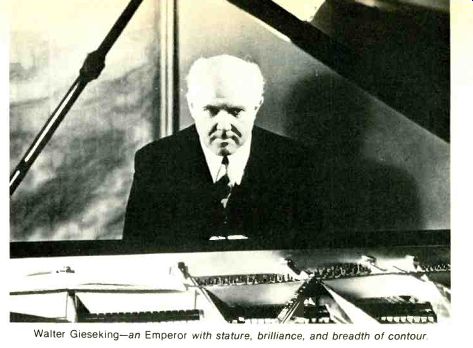
Walter Gieseking--an Emperor with stature, brilliance, and breadth of contour.
Nor, beyond a few details of costuming. is it easy to see anything specifically Jewish in the spectacle. What we get in effect is an obscurely stated assertion of love's power to transcend death. It's as if the plot of Wuthering Heights were being retold by an incoherent and forgetful narrator.
Bernstein's music is on a par with Robbins' choreography. Apart from a few passages for baritone and bass in which. Hebrew prayers are invoked, there is nothing specifically Jewish about his contribution either. One is told that the composer has made use of Hasidic melodies, but the ear fails to distinguish them.
More important by far. the ear fails to catch the slightest indication that this music is implicated in the "magico-religious." Bernstein has announced his dependence upon the cabalistic-that is. the mystical-manipulation of numbers for every bar in this score, and this led him to devise a nine-note scale. But, de spite his recourse to serial techniques. the results sound very familiar, Bernstein, tonal or atonal, remains Bernstein.
In Dybbuk one hears precisely the kind of concoction one has heard so often before in his oeuvre. Here, because he has failed to pique our curiosity, to touch us or capture our imagination, we find ourselves noticing the poverty of his resources as never before: the same old over-reliance on syncopated rhythms. the same kind of trite thematic material. the same old-fashioned orchestral tricks and colorations (the time has come, I would suggest. for Bernstein to renounce the xylophone). the same reminiscences of Aaron Copland and Gustav Holst. As far as I'm concerned. it's all so instantly accessible, so slick, so unequal to the mystical occasion suggested by the ballet's ostensible theme, that you never want to hear it again.
Columbia has coped brilliantly with the sound, and the composer secures admirable playing from the New York City Ballet Orchestra. D.S.H.
Chopin: Sonata for Piano, No. 3-See Liszt: Sonata for Piano
CRUMB: Madrigals. Elizabeth Suder burg, soprano; David Shrader, percussion; Felix Skowronek, flute; Pamela Vokolek, harp; W. Ring Warner, double bass. TURNABOUT TV-S 34523, $3.98.
Settings of fragments of texts by Federigo Garcia Lorca occupied George Crumb throughout most of the 1960s. and the Madrigals constitute one of the major works of the Lorca group. There are four books of these in all, each containing three madrigals: the first two were written in 1965, the last two in 1969.
The twelve madrigals, which are scored for soprano and a small instrumental ensemble that varies somewhat from piece to piece. are surprisingly effective when performed as a whole. Each song is a strongly characterized, rather impressionistic evocation of the mood and quality of its text, and each is sufficiently individualized to provide the needed contrast for the thirty-five-minute duration of the en tire set. The highly expressive and beautifully shaped vocal lines, characterized by contrasts of chantlike incantation and lyrical arabesques. are effectively set off against extremely colorful instrumental accompaniments that seem to supply a sort of ritualistic commentary on the texts. As usual in Crumb's music. there are many moments of striking beauty brought about by his imaginative-and frequently unprecedented-handling of both voice and instruments. Each madrigal is rather like a complex jewel with its own unique coloration.
The last two books of these madrigals were specifically written for soprano Elizabeth Suderburg, who sings the whole set with a fine grasp of the rather special qualities of this music. She is ably 'accompanied by the four instrumentalists, all of whom are members of the Contemporary Group at the University of Washington in Seattle. R.P.M.
DAVIES: Vesalii Icones. Jennifer Ward Clarke, cello; The Fires of London, Peter Maxwell Davies, cond. NONESUCH 71295, $3.98.
Peter Maxwell Davies' Vesalii Icones, written in 1969. is a set of fourteen dances, each based on one of the famous anatomical drawings from De humani corporis jabrica, the principal work of the sixteenth-century anatomist Andreas Vesalius. (The drawings. which show the human body in the various stages-or muscular layers-of its anatomical structure, have more recently been attributed to Jan von Calcar.) Davies associates each of the drawings he uses with one of the fourteen Stations of the Cross so that the work as a whole can be seen as a three-tiered "set of super-positions: 1) the Vesalius illustrations. 2) the Stations of the Cross and 3) [the Dancer's] own body." Each dance begins with the Dancer assuming the body position of the relevant drawing; then he moves to express the corresponding station.
The composer states, however, that "the dance is not an attempt literally to act out the Vesalius drawing or the 'station': It is an ab stract of both, in which the Dancer explores the technical possibilities suggested by the Vesalius illustrations-in the light of the ritual and emotional experience suggested by the 'station'--in terms of his own body." Clearly the visual and choreographic--dramatic aspects of the work are fundamental to its underlying conception. and the present recording of the music alone undoubtedly gives only a pale reflection of Davies' over-all intentions. Nevertheless the music is of considerable interest in itself.
Scored for solo cello and a small instrumental group of five additional players. it mirrors the multilayered conception of the whole in its use of three distinct musical levels: plainsong, "popular" music, and Davies' "own" music.
There is a considerable amount of quotation, both actual and "simulated." Particularly prominent is the use of Victorian hymns, which the composer considers "almost the ultimate blasphemy." as well as popular music from the same period. (During one section "The Mocking of Christ"--such music is played by the Dancer himself, on an out-of-tune piano placed on the stage.) Davies by the strength of his musical personality and extent of his technical control has somehow managed to prevent the resulting collage of disparate frequently opposed materials from turning into an undifferentiated jumble. There are so many cross-references among the various musical strata which are presumably to be experienced in symbolic analogy to the various muscular strata of the drawings--that these appear to be fused into a single, higher-leveled unit. In deed. rarely is one of the "borrowed" elements heard in isolation, without some penetration from other, contrasting elements. It is rather like an aural kaleidoscope. but one whose transformations are ordered according to a larger. panoramic view. There is a decidedly grotesque somewhat surrealistic quality about much of the piece; yet the over-all effect is one of considerable richness and expressivity.
The performance by cellist Jennifer Ward Clarke (to whom, along with dancer William Louther, the work was dedicated) and members of The Fires of London. perhaps Eng land's finest new-music group. is excellent.
Davies who conducts his own piece. has a clear picture of what he is after and he main tains the larger motion of the work very well.
The latter could be a problem. as Vesalli 'cones is sharply divided into its fourteen sections. each signaled by a "ritualistic" jingling of bells. Yet this reading manages to convey effectively a quality of unified progression and cohesiveness. R.P. M.
DEBUSSY FANTASIA. For a feature review, see page 91
DEBUSSY: Quartet for Strings, in G minor, Op. 10.
RAVEL: Quartet for Strings, in F. Danish Quartet. TELEFUNKEN SAT 22$41, $6.98.
The second-movement scherzo of Ravel's Quartet in F has always struck me as containing one of the best possible examples of musical inevitability. The opening two-theme episode culminates in a pianissimo descending tremolo figure that leads into a non-literal repetition of the same episode. As the music climaxes a second time, however, the tremolo figure becomes a mysterious descending chromatic run that seems to have been ineluctably prepared by every single note that has preceded it in the quartet.
No doubt one of the essential characteristics of a great composer is just such an ability to make the listener feel that what takes place musically at any given point in a work is the only possible solution. But I can think of few pieces in which the music flows ahead as effortlessly as it does in these two quartets. the only works in this genre written by these com posers. ( Ravel's was finished in 1903. some ten years after Debussy's.) It is as if the intervention of the composer in translating this movement into musical notes had hardly been necessary. In particular. the contours of the melodic and thematic fragments seem inextricably bound to the rich chordal structures and their unique progressions; perfectly conceived to highlight the interplay of the four strings.
But, for all the parallels between these two eternally coupled quartets, basic differences lie at the base of their over-all conception. For one thing, ...
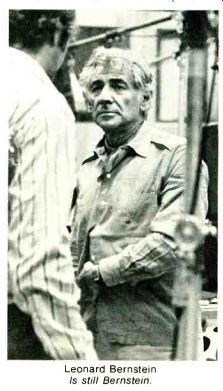
Leonard Bernstein --Is still Bernstein
... I have always felt that the Debussy quartet is essentially a three-movement work: the somewhat bravura fourth movement seems almost like a crowd-pleasing after thought. The Ravel quartet. on the other hand. fits much more comfortably into its four-movement form. And while Debussy seems essentially concerned with the inter relationships of string timbres and harmonic possibility (I know of few quartets that can approach the Debussy in sheer sonic sumptuousness). Ravel rather more conventionally concentrates on the harmony-theme relation ships. with the sonorous potential of the strings used more for "effect." These differences are reflected in the un equal success of the Danish Quartet's two interpretations. Its dynamic. full-toned approach to the Debussy could not be better suited to the work. Even the quiet. tense melancholy of the third movement has not escaped the group, which seems to grasp the full emotional breadth intended by Debussy.
But the more mellow lyricism of the Ravel work is rarely communicated here. One reason may be first violinist Arne Svendsen, whose weak tone and really poor bowing do little justice to the heavy lyrical demands of the first-violin part. Even so, there are some good moments in this performance--the scherzo in particular gets some fine. robust pizzicato playing.
In spite of the excellence of the Debussy performance, neither the recorded sound (good enough but hardly spectacular) nor the undertaking as a whole is attractive enough to bump at least four other ensembles-the Via Nova (Musical Heritage M HS 1211). La Salle (DG 2530 235). Juilliard ( Columbia M 30650), and Stuyvesant (Nonesuch H. 71007, a real sleeper)--out of the competition. R.S.B.
FALLA: El Amor brujo. For a feature review, see page 91.
Fux: Concentus musico instrumentalis (1701): Serenada a 8; Rondeau a 7; Sonata a quattro. Vienna Concentus Musicus, Nikolaus Harnoncourt, cond. TELEFUNKEN SAWT 9619. $6.98.
Johann Joseph Fux (1660-1741) was a famous, respected. and highly influential Viennese musician in his day, but he is remembered today chiefly as the author of the world's most famous textbook on composition: the Gradus ad Parnassum. which appeared in 1725 in Latin. The first German translation of the work was done by Bach's pupil, Mizler , "under the very eyes of Bach. as it were," according to Spitta.
The book was thoroughly studied and assimilated by Haydn. Mozart, and Beethoven, who in turn used it as a basis for their own teaching. W.: can also follow the chain of his instruction in counterpoint and fugue to Schubert. Bruckner. and Brahms; and its use has continued in the hands of teachers of recent generations, among them Richard Strauss and Hindemith. Even today, modern English translations by Alfred Mann (in The Study of Counterpoint and The Study of Fugue, both published by Norton) are utilized by many teachers.
Contemporary attitudes are skeptical that one who could produce such a significant work on musical theory could also produce significant music. Not necessarily so! This Viennese master, who served as court com poser and Kapellmeister under three successive Hapsburg emperors, as well as director of music at St. Stephen's Cathedral, was also a skilled, thoroughly modern composer whose music combines French, Italian, and folk elements in a superb and entertaining manner.
The major piece on this record is a serenade for eight diverse instruments from his Concentus musico instrumentalis (1701), a collection of sonatas and suites with highly varying instrumentations. (The designation here is for three clarino trumpets, two oboes, two violins, bassoon, and continuo.) In the course of its sixteen short, mostly dance, movements these instruments are used in a wide variety of interesting and unusual combinations. The three-movement Sonata a qualm offers an even more unusual grouping of instrumental colors (violin, baroque cornetto, baroque trombone, and bassoon, with organ). The Rondeau a 7 is of interest chiefly for its unusual solo group: solos and duets for violino piccolo and bas soon are played, concerto-grosso style, against the ripieno of strings and continuo.
The music is all lively and entertaining, but the outstanding attraction of this marvelous record lies in the interesting and varied and lusciously beautiful instrumental sonorities, which Harnoncourt and his group of old-instrument specialists produce spectacularly well. Indeed, I can't imagine a better combination of performers and repertoire. C.F.G.
HANDEL: Water Music; Royal Fire works Music; Concerto for Two Wind Choirs and Strings, in B flat. La Grande Ecurie et la Chambre du Roy, Jean-Claude Malgoire, cond. COLUMBIA MG 32813, $7.98 (two discs, manual sequence).
Comparisons--Wafer Music. Menuhin/Bath Festival Orch. Leppard/ English Chamber Orch.
Comparisons--Fireworks Music: Menuhin/Festival Orch. Leppard/English Chamber Orch. Ang. S 36173 Phi. 6500 047 Ang. S 36604 Phi. 6500 369
Among the innumerable things not new under the sun are our presumedly novel "sonic spectaculars." They were in vogue back in the early eighteenth century, when they were per formed live, of course, before out-of-doors crowds rather than from records in individual listeners' homes, but they provided their audiences with even more thrilling experiences, since sheerly aural appeals were enhanced by scenic ones.
Today we can only imagine how Handel's Water Music actually sounded on the Thames in 1715 or 1717 (or both), or how his Royal Fireworks Music actually sounded at Vauxhall Gardens in 1749. As we do know these works in present-day concert or recorded performance, many of us esteem them as some of the most. if not the most, invigorating and completely satisfying music of any period or by any composer. Yet how much we must be missing has been suggested in various earlier attempts to evoke period stylistic idioms, the fiercer, rougher tonal qualities of period instruments, and the special sonorities of greatly enlarged wind-instrument choirs (to say nothing of adding. in the Fireworks Music, appropriate obbligato sound effects).
The present Malgoire versions dispense with musically extraneous effects and don't make use of many extra wind players. but they do feature authentic period instruments and the free improvisation of elaborate melodic ornamentations-both more successfully. on the whole, than in any recordings I've encountered so far. There are inevitably some sour notes from the ensemble of "natural" (i.e., non-keyed) horns, and the French baroque-era oboes are startlingly more penetrating and tartly astringent than their tamer descendants.
(The old bassoons, however, are less pungent than one would expect.) Yet there is nothing here that approaches the ear-twisting horrors of the deservedly un lamented Schulze/Vox period-instrument Fireworks Music of 1961. And while Leppard, among others, has been perhaps reasonably successful in resurrecting (or re-creating) presumed stylistic traditions, Malgoire's players strike me as doing so with much greater idiomatic ease-indeed true improvisatory panache and infectious personal relish.
How truly "authentic" all this is. either tonally or interpretively, I can't claim enough specialized knowledge to judge. But it sounds mightily persuasive, and even though I doubt that eighteenth-century players were accustomed to taking lively movements at such pell mell speeds as Malgoire often sets, the over-all effect-intensified by very strong. close, and sharp-edged recording-is likely to be both stimulatingly distinctive and electrifyingly invigorating to all but tender-eared and conservative-minded listeners. (I must concede that the latter may properly complain of the decidedly thin-toned if not uncharacteristically French violin and trumpet qualities, and that the extraverted conductor gets carried away at times.) My top prize for all-round musical satisfaction remains firmly given to the more orthodox but still superbly vital Menuhin versions of all three works in the present set. (Menuhin's B flat Concerto is included in his Fire works disc.) But the newer Malgoire versions invaluably illuminate different facets of these many-sided Handelian-and baroque-era masterpieces. And despite their occasional eccentricities, they proffer some unique sonic thrills that are also severe tests of the true catholicity of one's personal aural sensibilities.
Certainly they are better suited than any previous versions for actual out-of-doors hearing a further potent excuse for taking advantage of this bargain-priced set's novel attractions.
I'd like to know more about La Grande Ecurie et la Chambre du Roy than the bare facts of its being founded in 1966 by Malgoire to "perform late-Renaissance and baroque music in its original form." Apparently it has been recording for some time in France. but the only previous American representation I've spotted is a program of "Music in the Court of Henri VI" for Turnabout last July that I haven't yet heard or even seen reviewed.
The name itself provokes curiosity: until I'm enlightened I can only assume that, if ecurie is used in its normal sense of "stable," the name must be intended to suggest a royal ensemble that includes mounted as well as chamber players, one suitable for hunt or other out-of doors music-making as well as for indoor musical entertainments. R.D.D.
HUMPERDINCK: Hansel and Gretel. Peter Mother Hansel Gretel The Witch Sandman Dew Fairy Dietrich Fischer-Dieskau (b) Charlotte Berthold (ms) Anna Motto (s) Helen Donath(s) Chnsta Ludwig (ms) Arleen Auger (s) Lucia Popp (s) Tolz Boys' Choir; Bavarian Radio Orchestra, Kurt Eichhorn, cond. [Fritz Ganss and Theodor Holzinger, prod.] RCA RED SEAL ARL 2-0637, $11.98 (two discs, automatic sequence) [from EURODISC 85 340, 1972].
Kiddie Art has produced a very few works of real sensitivity and a mountain of twaddle, but nothing else quite like Humperdinck's Hansel, a simple fairy tale inflated to the proportions and musical language of a sub-Wagner epic.
Between the Scylla of preciosity and the Charybdis of ponderousness. performances are well-nigh doomed to cloying, lumpish embarrassment.
And yet there is that middle ground. Give the score the proper respect, and you discover a work of prodigious--even prodigal-genius.
It was in fact this recording's original Eurodisc issue that persuaded me of what had previously been unthinkable: that Hansel is a great opera. I doubt that it could be made to work in the theater, given the gap between matter and manner (and what opera house would give it the musical care it needs?), but this recording seems to me a must for any operatic collection.
A less-than-first-rate Hansel is hardly better than nothing.
If Humperdinck learned his harmonic language and use of motifs from Wagner. his own fertile imagination took it from there. The melodies are lavish and first-rate. The orches- tration is unceasingly active and inventive.
Humperdinck seems paranoid about repeating himself. endlessly twisting strophic repetitions and concocting new accompaniments for melodic repetitions. The Father's entrance song. for example. can seem endless: by executing the score scrupulously. Fischer Dieskau and Eichhorn produce a bravura vignette.
What makes Hansel so difficult is the simple. though solid. nature of its musical materials: The melodic motifs and rhythms with which Humperdinck builds his rich, ever-shitting textures can, if under-articulated. lapse into triviality. But if properly executed. the music has enormous depth and point--and thanks to that very simplicity of its components, the textures remain transparent how ever complex the scoring gets.
I'm sorry to see that Capitol's fine English-language recording (from the Saddler's Wells production) is no longer listed. but the Eichhorn version pretty well eclipses all the competition--I like it even more than Peter G. Davis did in his glowing review two years ago.
Instead of projecting "personality." Moll and Donath simply sing their parts. It's remarkable how the dance duet becomes spritely instead of simpleminded when it's sung rather than hiccoughed, or how the quiet, simple beauty of the prayer can match the eloquence of its initial statement at the beginning of the overture.
Fischer-Dieskau and Ludwig (in her very best voice) have a grand. rug-chewing time with their parts but never (well, hardly ever) at the expense of the musical line. Berthold's hooty, tonally un-ingratiating Mother is the weak link here. The Capitol set boasted no less than Rita Hunter in the part-with Raimund Herincx's sturdy Father. That tmade a pretty strong pair of parents.
Eichhorn and his excellent orchestra lay out the orchestral textures in all their glory, with a really vital rhythmic underpinning. RCA has preserved Eurodisc's superlative engineering: rich, transparent, beautifully balanced--I don't even mind the hokey echo around Ludwig's "Hokus pokus." When you can track a Dynaflex disc. the sound can be spectacular (and one of my review discs was actually un warped!). K.F.
Janacek: Missa Glagolitica (Slavonic Mass). Teresa Kubiak, soprano; Anne Collins, mezzo; Robert Tear, tenor; Wolfgang Schone, bass; John Birch, organ; Brighton Festival Chorus; Royal Philharmonic Orchestra, Rudolf Kempe, cond. [James Mallinson, prod.] LONDON OS 26338, $6.98.
Comparison
Kubelik /Bavarian Radio Sym. DG 138 954 It is frequently said. and not so flippantly, that the Marconi Requiem is Verdi's best opera.
By the same token, the Moravian genius Leos Janacek may never have written a more in tensely human or theatrically memorable vo cal work than this 1926 setting of the liturgy in Old Slavonic (for which the Glagolitic alphabet was devised).
Replete with brass fanfares. solo parts-particularly the soprano's and tenor's-that are rhapsodically tender and stretch the upper register. timpani writing that will shake loose every bit of crockery in your living room, and two substantial organ interludes that remind one of some zany horror movie (you know, the scene with the wild-eyed creature in the church belfry), this Slavonic Mass stands in splendid isolation in an inimitably eccentric corner of the repertory. As for the operatic quality. the closing pages of Janacek’s Credo setting reach a climax of overpowering splendor that is uncannily reminiscent of the scene of the fifth door (the vast and majestic do main) from Bartok's Bluebeards Castle of fifteen years earlier.
The new issue at hand is by my count the fourth in stereo; the best of the predecessors, the Kubelik /DG. is also the only survivor in Schwann.
The new disc's greatest virtue is the round ness. breadth. and sheer massive power of the sound captured in Kingsway Hall by the Decca/London team. The bass response alone should bring this record into the audio show rooms. Furthermore. the RPO reveals itself in this. one of its all-too-few recordings under its departing maestro. as still in excellent health and quite able to handle the technical and coloristic requirements of the piece. The Brighton Festival Chorus deserves credit for its pitch. ensemble. and grasp of expressive shadings. The chorus is somewhat backwardly miked. however, for the moments when the orchestra is giving it real competition.
The solo quartet here appears stubbornly to conceive of the music as oratorio. Their delivery stresses metrical evenness. subdued vibrato, and loud projection to the balcony. Soprano Kubiak is steady in her fearsomely tough part. though the tone produced is hardly a meltingly lovely one. Tear neither pleads with nor confides to the Almighty. but harangues Him-a mannerism that was also the bane of his Argo recording of Janacek’s Diary of One Who Disappeared.
In his approach to pacing. rhythm. and the building of climaxes. Kempe stresses a monolithic bigness at all times. Admirers of the pioneering Bakala mono edition (made in Janacek’s Moravia and briefly available on Urania. thenceforth as a Supraphon import) will find the massive power of that impressive performance duplicated here in modern sound.
The big problem with Kempe is that he is too much the German Romanticist to let him self go where the sheer wildness and jagged ness of the music is concerned. and so we turn to Kubelik. whose reading is never stolid, as the new one sometimes seems. but is possessed of a white-hot animal vigor. It isn't just his na tive feel for the Slavic speech rhythms that in forms the instrumental as well as vocal writing (though surely that goes a long way!). but also the greater incisiveness of his heat. the faster tempos. and the willingness to allow his forces to throw caution to the wind.
DG's solo lineup is generally excellent, and the closer pickup permits the singers a more intimate vein of lyricism than their counter parts in the London issue. For a sampler, listen to Evelyn Lear negotiate the opening of the Gloria and Sanctus, or Hafliger the Credo.
The decade-old Munich recording. though less opulent than London's. benefits from the conductor's lateral division of first and second violins and the drier ambience surrounding the brass. Janacek was called a "primitive." and it is that peasant-like gruffness, warmth, and headstrongness that the Kubelik production captures to perfection. Kempe's skilled presentation may ultimately do itself in by its very sophistication. A.C.
KABALEVSKY: Concerto for Piano and Orchestra, No. 3-See Rubinstein: Concerto for Piano and Orchestra, No. 3.
KALLIWODA: Symphony No. 1, in F minor, Op. 1. TOMASEK: Concerto for Piano and Orchestra, No. 1, in C, Op. 18. Petr Toperczer, piano (in the Tomaek); Prague Symphony Orchestra, Jindrich Rohan, cond. CANDIDE CE 31073, $4.98.
Burney called Bohemia "the conservatory of Europe." and indeed this part of the old Hapsburg empire furnished excellent musicians to all other countries. What we (in correctly) call the Viennese School had a sizable Czech component. and the two composers recorded here were part of it. At the same time it must be admitted that, Czech protestations notwithstanding. these composers are indistinguishable from their Austro German colleagues-they are wholly in the mainstream of Central European music and without any national characteristics.
Kalliwoda (1801-66) occupied an eminent position in this mainstream until the middle of the nineteenth century: even the New York Philharmonic played one of his works at its opening concert. His Symphony No. 1 (1826) was for a generation a favorite repertory item everywhere, but afterwards it lost its popularity and faded altogether. Yet it is a good piece and could stand occasional revivals.
Kalliwoda was an inventive melodist, solid in counterpoint, and a brilliant orchestrator.
but he did not develop. The twenty-five-year-old who composed this symphony gave the impression of being a major talent and was so greeted, but while he composed other viable works (I know only Symphony No. 3, which is very attractive), he never appreciably deepened and extended his talent.
This first symphony has the genuine sym phonic spirit, there is passion in it, and except for an overextended slow movement the pro portions are fine. There is little impact in this music of Kalliwoda's titanic contemporary.
much more of Mozart and Cherubini. and perhaps a trace of Weber. The "minuet" is a real swift symphonic scherzo, but the conductor reduces its effect by taking the title at its face value-it is too slowly played. Otherwise the performance is very good.
Vaclav Jan Tomasek (1774-1850) was an extremely prolific composer, a good teacher, and a remarkably many-sided man. He was a friend of Goethe and set a number of his poems. While he wrote many large works, his fame rests on his neat piano pieces. which inaugurated Romantic instrumental lyricism and considerably influenced Schubert.
The piano concerto on this record starts with elaborate symphonic bustle, but the promises in the grandiose exposition are not fulfilled. The writing is very competent.
Tomasek having complete command of style and idiom, but the fluent Mozart-Hummel garlands never go beyond conventionality. Interesting how one can pinpoint with accuracy all these same cliches and turns in Beethoven's concertos. yet see what happens to them when manipulated by a genius!
Conductor and orchestra are first-class in both works. and the able soloist Petr Toperczer makes the concerto sound better than it is.
P.H. L.
Liszt: Sonata for Piano, in B minor. CHOPIN: Sonata for Piano, No. 3, in B minor, Op. 58. Agustin Anievas, piano. [Suvi Raj Grubb, prod.] ANGEL S 36784, $6.98.
Liszt: Sonata for Piano, in B minor; Funerailles; Gnomenreigen; Liebestraum; Waltz from Gounod's "Faust." Simon Barere, piano. TURN ABOUT THS 65001, $3.98 (re-channeled) [from various REMINGTON originals, recorded c. 1949-50]. Liszt: Sonata for Piano, in B minor.
CHOPIN: Sonata for Piano, No. 3, in B minor, Op. 58. Alfred Cortot, piano. DACAPO C 047 01504M, $5.98 (mono) [from HMV/VICTOR 78-rpm originals, recorded 1929 (Liszt) and 1933 (Chopin)].
I list these records in alphabetical order (which happens to be the inverse order of my preference), but all three artists plainly know their pianistic ABCs.
The youngish American pianist Anievas re corded the Liszt B minor once before (for the defunct St/And label), and his new version. a bit more flexible and improvisatory than its predecessor, largely duplicates the muscular, vigorous account of yore. Anievas, one suspects. has huge hands; he deals with the octave passages as if they were child's play. He turns in large-scaled. direct. structural. unaffected conceptions of both pieces. which could nevertheless go even further in terms of nuance, voicing, and sheer expressiveness. One has to admire such unostentatious craftsmanship, but the Liszt playing of the two resurrected titans proves all too plainly what is lacking in Anievas' praiseworthy if rarely inspirational pianism. The Angel disc, though. is beautifully solid in tone.
Despite the obvious chinks in Cortot's pianistic armor (his oglave playing is simply horrendous half of the time and superbly assured elsewhere; he was a great virtuoso who was simply too busy and intelligent to practice!).
he rises Galahad-like to the gargantuan de mands of the Liszt. He does many strange things to the music: He stretches and groups certain phrases in a seemingly arbitrary manner (which invariably proves entirely logical, even inevitable, the second or third time around); he inserts alien low "harmonics" of uncertain pitch (e.g., just before the fugue third movement); he pedals in such a manner as to suggest a witches' cauldron.
But what breadth and dignity in his conception, what a wealth of color and nuance! Cortot's sonority is a compendium of velvet and bronze.
Indeed, I like everything about his performance. even the wrong notes! Cortot once commented, upon hearing the record of a lesser pianist. "That fellow hasn't enough technique to hit wrong notes!" This Liszt B minor eloquently proves the point. There is a charged freedom and constant motion in the playing that is assurance itself-one accepts the imperfections as if they were part of a rough-hewn Jacob Epstein statue.
Surprisingly. Cortot's account of the Chopin B minor is less convincing. His performance has its fitful moments, and much of his extravagant rubato I find lurching and discontinuous. Still, there is superb authority in much of the playing--an authority that could come only from a great master.
As usual in its DaCapo series. Electrola's lab work is of the highest order, and the sound on both sides is strong and vital. Fortunately filtering is moderate, and I for one much prefer a hit of original surface noise to muffled conics. (DaCapo is imported by Peters International.) Vox has done similarly salutary work with the much more recent Barere masters. As with all of the Turnabout Historical Series. the engineers have wisely "rechanneled" the original mono tapes only to the extent of running the same signal in duplicate. The result in this instance is a startlingly lifelike evocation of Barere's long-silenced piano-bright, solid, and clear, lacking only the merest overtones now and then. Many less good piano recordings are being made today! If one must find fault it could be noted that there is an audible break in continuity just before the fugue in the Liszt sonata, at the spot where the original Remington LP turned over.
Barere was a sort of pianistic Billy the Kid, an instrumentalist quick on the draw digitally if not always mentally. In some music--Chopin's F minor Fantasy and Schumann's toccata, to cite two examples--his renditions could sound rushed and scatterbrained, too fast for any sort of shaping or logic. In the works on this record, however, the Russian-American pianist was completely in his element. The Liszt sonata gets a magnificently self-indulgent statement. Barere dwells upon many details, stretching phrases. altering a few harmonies, but always achieving a convincing approximation of the authentic Liszt. His is not the intellectualized playing of a Cortot, but nevertheless is decidedly music-making in the grand manner.
The shorter pieces are similarly stunning. The Faust waltz is played with bold, full bodied fortes and gorgeous filigree detail. For all the brilliance and glitter of Barere's finger-work, he always achieves a limpid, singing sonority. The Funerailles performance is broader than most in its pacing but noble in design, the Gnomenreigen breathtakingly light and fast (a real Rachmaninoff tempo. this!).
One can, in the present circumstances, even endure the treacly Liebestraum. H.G.
Liszt: Via crucis; Inna Maria Vergine. Eva Marton, Eva Andor, and Adrienne Csengery, sopranos; Erzsebet Komlossy and Zsuzsa Nemeth, altos; Attila FUlitip, tenor; Sandor Solyom Nagy, baritone; Ferenc Beganyi, bass (all in Via crucis); Hedi Lubik, harp (in limo); Gabor Lehotka, organ; Budapest Choir, Miklos Szabo, cond. [Janos Matyas, prod.] HUNGAROTON LPX 11575, $6.98.
The two works recorded here are a puzzle within a puzzle. Catholic "sacred music" in the second half of the nineteenth century was either flamboy ant-dramatic ( Berlioz. Verdi. Liszt Bruckner being the esception) or steeped in sweet-scented incense (the ('aecilians. Gounod) or hogged down in Romantic historism, an anachronistic Gregorianism and Palestrinianism (Witt and his numerous followers). This is the outer puzzle: the inner puzzle is Liszt himself.
His was undoubtedly a most original and prophetic musical mind that overwhelmed musicians for two generations--Wagner, Strauss, the Russians. and all the way to the Impressionists. Such of his works as the B mi nor Sonata or the E flat Concerto solved with remarkable originality, albeit with a little bombast, the formal-structural problems that haunted all composers trying to escape Beethoven's oppressing shadow. But again, what a puzzle when we look at the makeup of this highly original talent: German. Hungarian. Italian. French. Gregorian. and the Lord only knows what other elements mingle in this bold and astonishingly modern music, giving it a restless quality that nearly always intrigues but seldom satisfies.
And then the aging lion and romantic lover decides to compose nothing but church music: the incomparable virtuoso of keyboard and orchestra turns to the organ and the schola cantorum.
Liszt moved to Rome in 1861, where he stayed until 1869. To be sure, the first aim was to secure annulment of Princess Carolyn Wittgenstein's marriage so that he could marry her, but since the Pope would not hear of it, Liszt abandoned the plan and took the lower degrees of holy orders. The new abbe promptly sat down to compose religious mu sic. Princess Wittgenstein. also newly devout.
still stood by. arranging the text of Via crucis ( Liszt's paramours were usually cultivated women of letters who wrote his books). Her concoction turned out to be a heterogeneous selection, with Latin. French. German--even Aramaic-texts and superscriptions woven together. as well as alternating Catholic and Protestant elements from Latin hymns to Lutheran chorales: an early example of confused ecumenism.
The composition was finished in 1879. but Via crucis was not performed until fifty years later, because the unusual score scared away church musicians. Liszt was indeed far ahead of his time, not only with his chromaticism.
augmented harmonies, and instances of polytonality, but with suggestions that more nearly lit the age of Scriabin and beyond than his own. He wanted the score published with illustrations of the Passion taken from Durer.
The idea has been taken up with a vengeance in our day by producers in Europe who use projections while the music is being sung and played.
Basically, Via crucis is not a vocal work, but instrumental program music with vocal inlays, most of them very brief choral ejaculations.
The organ pieces that carry out the scheme are highly original and reach well into the twentieth century, indeed almost to Tourne mire: no wonder that church musicians around the end of the century were intimidated by these harmonies.
Just the same, it is rather tenuous to maintain that these organ pieces can represent such concrete events of the Stations of the Cross as Jesus meeting Mary or the scene where Jesus' garments are torn from Him. Yes, the chorus thunders "Jesus cadit" ("Jesus has fallen") or "Crucifige!" ("crucify Him!"), but the end result is what usually befalls program music: It needs external, verbal guidance: otherwise it falls far short of its aim.
Though Liszt operates with very sophisticated devices such as recurring motifs (the 14th Station is a skillful weaving together of several of them) and with timely repetitions.
the abstract musical unity and logic are sorely tried by the stylistic hodgepodge. Gregorian and Palestrinian echoes are companioned with avant-garde harmonic subtleties: occasionally the old blatant rhetoric shows through: then again the venerable Passion chorale "O Haupt voll Blut" suddenly makes its appearance in the original language and harmonization, which is the more disconcerting because of the little postlude Liszt attaches to it in his very own language.
So in the end the impression one gains is something decousu: the composition is not convincing. A suspicious Romantic sanctimoniousness hovers over it, or perhaps we should more charitably say a mistaken concept on the part of an essentially robust hedonist of what is religious music.
The performance is excellent, the numerous soloists (who have not much to do). chorus, orchestra, organist, and conductor, as well as the "mono-stereo" sound, all being very good.
Though the tricky harmonic underpinning of the modal melodies at times almost trips these fine singers, they hold their own admirably.
The Italian Hymn to the Virgin is quite an other piece-and it is a good one, only being a little abrupt in its ending. It was composed ten years before Via crucis, when Liszt was still trying to curry favor with the Pope, whom he extolled as a great spiritual and secular ruler.
Unfortunately, by the time the composition was to be performed the Papal States had ceased to exist and the encomiums became moot. So this piece too was put aside, not to be revived until 1936.
The hedonist is not at all inhibited here: he sets the text faithfully, writing well-sounding music with good melodies and euphonious choral setting. Well, there is a little fake Gregorianism and Palestrinianism here and there, balanced by the distinctly secular ac cents of the harp.
Both chorus and conductor are fully equal to the task of good, straightforward music-making. P.H.L.
Mendelssohn Die erste Walpurgisnacht, Op. 60; Infelice, Op. 94. Annelies Burmeister, mezzo-soprano; Eberhard Buchner, tenor; Siegfried Lorenz, baritone; Siegfried Vogel, bass (all in Op. 60); Edda Moser, soprano (in Op. 94); Leipzig Radio Chorus; Leipzig Gewandhaus Orchestra, Kurt Masur, cond. [Bernd Runge, prod.1 ANGEL S 37016, $6.98.
Here at long last is a fine recording of a work that Berlioz hailed as "a masterpiece of Romanticism." From the Everest version by other performers from Leipzig, it was impossible to realize what so excited Berlioz in The First Walpurgis Night, but now we know.
Goethe's impact on the music and literature of the nineteenth century is too well known to require elaboration here. But of all the com posers inspired by the poet. Mendelssohn in many ways captured him most authentically.
Liszt, Berlioz. Wagner, and Gounod, for in stance. used his poetry as a point of departure for their own interpretations. Schumann. with a rapport comparable to Mendelssohn's, un fortunately produced a flawed and uneven tribute in his Scenes from "Faust." Mendelssohn's affinity with Goethe was much more than merely his childhood meeting with the great man or Zelter's influence on his education. Like Goethe. he always tempered his Romanticism with strong classical control and discipline.
Although this balance pervaded much of Mendelssohn's music implicitly, the most explicit artistic bond between composer and poet is the cantata The First Walpurgis Night.
Here Mendelssohn describes vividly the pagan Druid resistance to Christianity in music that is always expressive but never carried away by the rhetoric of the subject.
Some of its most effective pages are the opening sections describing the waning of winter and flowering of spring-nature music at its best. Later sections. narrating the Druids' mobilization against their Christian foes, wear less well, but the final invocation of the Druid priest and flight of the Christians is extremely effective.
Angel's four excellent soloists, strong chorus, and superb orchestra are magisterially conducted by Kurt Masur in a performance that fully captures this masterful Romantic music.
The concert aria "Infelice" is a considerably lesser work, but it is beautifully sung by Edda Moser with the same supporting forces. P.H.
MOZART: Arias. Elly Ameling, soprano; English Chamber Orchestra, Edo de Waart, cond. PHILIPS 6500 544. $7.98.
Le Nozze di Figaro: Non so pie: Voi the sapete; Giunse altin it momento Deh vieni, non tardar. Don Giovanni: Batti. batti; Vedrai, carino. Cosi fan tutte: Temerari! Come scoglio. Concert arias: Misera, dove son?, K. 369; Ch' io mi scordi di te?. K 505: Chi se. chi sa, qual sia, K. 582; Vado. ma dove?. K. 583.
Felix Mendelssohn---A masterpiece of Romanticism.
Elly Ameling is the perfect miniaturist. As her recordings of Mozart, Schubert, Schumann, Brahms, and Wolf demonstrate, she willingly accepts the narrow confines of the Lied, rejecting every temptation to inflate her material or give it unwonted emphasis. Yet her cool headed. direct approach does not preclude either subtlety or feeling. Like Jane Austen, who, as she put it. worked on two inches of ivory with a fine brush, Ameling discovers great human truths in intimate circumstanotes.
How fortunate, after the long Schwarzkopf years, to have a recitalist of such musical probity among us once again.
Ameling's clear and serviceable soprano is capable of expressing many fine shades of meaning, but it is not by any stretch of the imagination an outstanding instrument, being neither powerful nor affectingly sensuous. Because of its limitations in amplitude and color.
its scope is of necessity fairly limited. It is best suited to introspection. Drama-the presentation of personality in action-lies outside its effective range. Or so one must conclude from the present recital, which is something of a disappointment.
Neither opera nor the Mozartean concert aria would seem to suit Ameling's gifts, both of these forms calling for greater dynamism in projection than she can provide. In addition, most of the concert arias demand a virtuoso technique she simply doesn't possess.
In these great showpieces-poised, for the most part. midway between scena and vocal concertante-Ameling manages matters with charm and sweetness. She can trill, she commands an exemplary legato. her fioritura is clean. Yet she sometimes finds herself troubled by low notes (anything below the staff tends to be sketchy-except, oddly enough. in "Come scoglio"); once or twice she runs out of breath: and the gruppettos of "Ch' io mi scordi di to?" are quite beyond her. More damagingly still, so is the kind of grandeur and authority called for by a piece like the latter, a noble statement of faithfulness in adversity, set to Idamante's lines from Act II, Scene I of Ido meneo. But the problem is wider than this suggests, since even the intimate music on this disc is comparatively unrealized. "Deh vieni, non tar dar" is bland. One cannot ever grasp the dramatic occasion, the psychology, the sensuous rapture, as one immediately can, for example, in Mirella Freni's Susanna in Colin Davis' complete Figaro. Similarly, Ameling fails to convince one of Zerlina's beguiling playfulness--a quality Freni also establishes immediately in her recording of Don Giovanni with Davis. Ameling's art cannot fill out the expressive contours of this kind of music. She doesn't have the right sense of scale.
Edo de Waart is not much help here. He is neat too, but unimaginative. The English Chamber Orchestra, however, is a fine body of players, and much of the solo work is out standing. Dalton Baldwin's playing of the piano obbligato in K. 505 is superb. Texts, translations, insufficient notes. The recording is fine, the pressings immaculate.
D.S.H.
Mown: Fantasy in C minor, K. 475; Rondo in D, K. 485; Sonata for Piano, in A, K. 331.
Bach-Busoni: Chaconne in D minor. Alicia de Larrocha, piano. LONDON CS 6866, $6.98.
This mostly admirable collection was issued to coincide with New York's summer Mostly Mozart Festival. De Larrocha is a superb pianist. She has a bright, almost brittle clarity, her finger work boasts an easy. pearly even ness. and her always-musical outlook com bines rhythmic incisiveness and flowing grace that work well for Mozart. She is not quite a stylist in this music, though: She is sometimes a shade cavalier about the proper treatment of trills. appoggiaturas. and the like, and as often as not she uses discredited texts in place of the easily obtainable authentic ones.
I found her festival performances of the C major (K. 330) and D major (K. 311) Sonatas (and of Schubert's posthumous B flat) a bit superficial and bland, and I have a similar "half' complaint about her recorded performances here of the D major Rondo and A major Sonata. The rondo drags a bit, for all the clarity and attack. The sonata comes off better (especially in the vigorously graceful Rondo ally turca) but nevertheless seems a trifle square and plain.
In the dramatic K. 475 Fantasy (here given without the related sonata in the same key. K. 457), Mme. de Larrocha energizes her playing more and turns in a potent. yet still civilized reading. This suits the music ideally. for it gives both the molten desperation and the cool-headed composure to make that quality even more poignant.
The Busoni arrangement of the Bach chaconne doesn't turn up on records too often but this month brought two versions to my turn table (not to mention Seraphim's reissued Heifetz recording of the violin original).
Whereas Jorge Bolet's RCA concert performance presented a conventionally grand. massive account exploiting every iota of bourgeois sonic grandeur, Mme. de Larrocha prefers to keep the music volatile and mercurial. Some of her brisk tempos and subtle colorations, also the biting detachment of her finger-work, made me think of Walter Gieseking's old mono Columbia LP of the Bach Sixth Partita.
It's an unusual outlook for a piece ordinarily treated solemnly. and I rather like it.
Good, biting. almost brittle piano reproduction, but never without requisite coloristic values. H.G.
MUSGRAVE: Night Music. For a feature re view, see page 97.
MUSSORGSKY FANTASIA. For a feature re view, see page 91.
MUSSORGSKY: Pictures at an Exhibition (orch. Ravel); Khovanshchina: Prelude (orch. Rimsky-Korsakov). New Philharmonia Orchestra, Charles Mackerras, cond.
[ Seymour Solomon, prod.] VANGUARD VSD 71188, $6.98. Quadriphonic: VSQ 30032 (SQ-encoded disc), $6.98.
Pictures and the 1919 version of Stravinsky's Firebird Suite are the current top two among the big Slavic wow numbers, hence their present availability in some two dozen orchestral versions. In stereo the Mackerras set really is not especially competitive; although the performance of Pictures is one of real merit, it lacks the immediacy, the big, walloping sense of presence that several of its rivals can pro duce.
Quad changes the situation. Distribute the orchestra around the room, get the whole joint rockin', and make clear the wonderfully imaginative character of Ravel's scoring, and you hear things that not even the best of the stereo versions can duplicate. This therefore be comes a real encounter with the music, pro viding a high sense of involvement made all the more vivid by the unusually wide dynamic range that is possible. Anyone who has quad equipment should make use of the possibilities this version offers. The most exciting moments are very exciting indeed. R.C.M.
NIELSEN: Symphony No. 4 (Inextinguishable). Los Angeles Philharmonic Orchestra, Zubin Mehta, cond. LONDON CS 6848, $6.98.
Comparisons:
Bernstein/N.Y. Phil. Col. M 30293
Markevitch /Royal Danish Orch. Turn. TV-S 34050 Martinon /Chicago Sym. RCA LSC 2958 In substance if not in manner, the Nielsen Fourth is the closest thing I know of to a twentieth-century Eroica Symphony. Deservedly it has been the most recorded of Nielsen's six symphonies, although an absolutely perfect disc version continues to elude us.
The pioneering HMV performance by Launy Grondahl and the Danish State Radio Orchestra, authoritative in both conception and execution, no longer wears its quarter-century easily. Though the Danish and British LP transfers were better than the wan and dull American Victor (long vanished), the music cries out for stereo, if only for the finale's battle scene between two antiphonal sets of timpani.
The stereo premiere was a respectable interpretation by Barbirolli with poetic playing from the Halle winds, but the Pye recording (briefly available here on Vanguard Every man) suffered atrocious balance (e.g.. try detecting the violins' Italianate response to the low brass fanfares at No. 25 in the first movement). Shortly thereafter, on the heels of a pal lid Rudolf/Cincinnati edition on Decca, came Markevitch's propulsive Turnabout reading, marred by shallow and gritty sonics.
Though fully equal to the vehement force and riotous color of the music. Martinon's su per-virtuosic RCA performance has its tragic flaw-a side break that interrupts the momentum of the transition from the adagio to the finale. If only the Helios Overture had been placed as a curtain-raiser rather than a Side 2 filler, this could have been avoided. Perhaps a transfer of the Chicago rendition to the Victrola line could afford RCA opportunity for rectification.
The engineers are also responsible for the most controversial touch in the Bernstein: a jolting tape splice at No. 61 in the finale, cut ting off the resonance at the end of the timpani duel to make more audible the attack on the string fugato that follows. Otherwise. this is a well-balanced, detailed recording of a broadly paced reading. which thereby gains impact in such a pompous outburst as the Sousa quote four measures past No. 8 in the first move ment. but overburdens the second-movement Poco allegretto with more point and deliber ation than the simple. folksy intermezzo can really take.
The Mehta performance has much going for it. The Indian conductor sets lively tempos, yet without unduly pressing his ensemble. The Poco adagio third movement has the contrasting repose to the preceding Poco allegretto. In that slow movement's "un poco agitato" section. he pays closer heed than anyone else to the time values of dotted eighths and sixteenths in the triplet figures. making the music sound for all the world like it has turned suddenly into a French overture! The finale goes lickety-split. if without the rhythmic panache of Martinon. yet Mehta-like Bernstein before him-observes tellingly the "piu mosso" four bars after No. 58, a moment of high tension where that extra tightening of the screws goes a long way indeed.
My principal objection to this latest issue may or may not be the fault of the artists.
There is little here that goes below a mezzo-forte, and in part I blame the technical team, for optimal clarity does not always portend ideal musical balance.
George Rochberg (in 1960) A strong
quartet worth repeated hearings.
This recording is full of details that rise glaringly out of the ensemble larger than life a low woodwind harmonization here, a cello sdo there. Since the Los Angeles Philharmonic is not the most suave orchestra tonally.
the scrutiny is not always flattering. though the brilliance and impact of UCLA's Royce Hall.
where the orchestra records, is as always a help-and those timpani do sound! The buyer who values economy over sonic fidelity will opt for Markevitch. Audio buffs will want the new Mehta. which along with the Martinon will appeal to those who like their Nielsen impulsive and frenetic. Bernstein is the best foil for any of the above, and the af fluent will benefit from having more than one Nielsen Fourth. The work is lucky to retain its "inextinguishable" popularity, which may someday lead to a definitive edition. interpretively and acoustically. A.C.
RAVEL: Quartet for Strings. in F-See Debussy. Quartet for Strings.
PIEGGER: Dichotomy for Chamber Orchestra. For a feature review, see page 97 B ROCHBERG: Quartet for Strings, No. 2. SUDERBURG: Chamber Music II. Phyllis Bryn-Julson, soprano; Con cord String Quartet (in the Rochberg); Philadelphia String Quartet (in the Su derburg). TURNABOUT TV-S 34524, $3.98.
Those who know George Rochberg only through his recent, largely tonal Third String Quartet will be in for a surprise when they hear the Second. Completed in 1961 when Rochberg was still writing twelve-tone music, the work is a rigorous, tightly organized serial composition written in an uncompromising dissonant, melodically disjunctive, and rhythmically fragmented style. Its complexities are considerable. particularly in the rhythmic do main, where different tempos are frequently employed simultaneously. Yet the work makes an immediate and arresting impression. The basic rhythmic and melodic gestures are all so strongly characterized that they are able to carry the listener over the conceptual hurdles.
The quartet is organized into two extended movements, the second of which includes a setting for soprano of Rilke's Ninth Duino Elegy. The abrupt contrasts between explosive rhythmic motions and more sustained pas sages in the first movement are mirrored in the second by the contrast between the lyrical voice line and the dislocated, fragmented character of the accompanying strings. ("Ac companying" is perhaps not quite the right word, as the strings seem to run a sort of parallel. yet essentially independent, path through out the latter movement.) Moreover, in both movements there is a tendency for the contrasts to be reconciled as the end is approached, a procedure that does much to pro vide a sense of formal unity, not only within each movement, but for the work as a whole.
It is a very strong piece, and one that will wear well with repeated hearings.
Given the difficulties involved, the performance by the Concord String Quartet and soprano Phyllis Bryn-Julson is quite extraordinary. The quartet plays the piece with the kind of assurance and expressive conviction one associates mainly with performances of the "great works" but rarely with difficult new music. And Miss Bryn-Julson sings her part with disarming ease; her pitch sense is some thing quite remarkable, and she manages the complex rhythmic relationships with complete authority.
Interesting, the Philadelphia String Quartet, which plays the other work on this disc, gave the first performance of the Rochberg quartet some years ago and recorded it for CRI with soprano Janice Harsanyi (still listed in Schwann II but now clearly superseded by this new version). It turns in a fine performance here of Robert Suderburg's Chamber Music II. although both the performance and the work seem to me to lack the impact of the other side.
Suderburg's quartet. written in the late 1960s, is quite up to date in its materials, making use of all kinds of special sound effects on the instruments, yet the piece is basically quite conventional and simple in organization. De spite its considerable length (almost thirty minutes), it is so over-articulated as to seem rather short-winded. Ultimately it breaks up into an extended series of isolated gestures that, at least to my ears, fail to add up to a unified statement. Chamber Music II is extremely eclectic, and although there are some very nice moments it strives too hard-and too exclusively-for its effects. R. P. M.
RUBINSTEIN: Concerto for Piano and Orchestra. No. 3, in G, Op. 45. Kabalevsky: Concerto for Piano and Orchestra, No. 3, in D, Op. 50. Robert Preston, piano; Westphalian Symphony Orchestra, Paul Freeman, cond. ORION ORS 74149, $6.98.
At a time when up-and-coming European soloists and conductors can attain first record ings on major labels with the best orchestras of their homelands, two young Americans have to go abroad to collaborate with a second-rate German orchestra for release by a small but enterprising West Coast label. Nevertheless they have produced first-rate recordings of two large-scale virtuoso concertos.
Robert Preston comes from the New York area, and I first heard him play when he was a student at Juilliard. Always a strong player, somewhat inclined to substitute power for in sight. he has matured considerably, so far as one can tell from hearing him here in music that is essentially virtuosic. I should like to hear him in works of greater artistic stature.
Paul Freeman is a truly American conductor, having served his apprenticeship in a vari ety of minor-league posts before becoming conductor in residence of the Detroit Sym phony and artistic director of the Columbia Records' Black Composers Series. His experience stood him in good stead at these recording sessions, for he obviously is in command of the admittedly weak orchestral resources at hand. The Westphalian Symphony lacks any strong solo players. though the strings and ensemble in general play with discipline if not much distinction. Freeman certainly gets from the orchestra solid and well-ordered support for Preston's solo pyrotechnics.
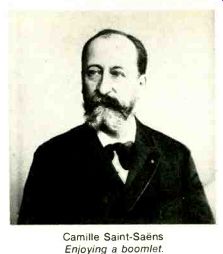
Camille Saint-Saens--- Enjoying a boomlet.
The young pianist makes the best of Rubinstein's early showpiece, which requires only that the orchestra stay out of the way of the soloist's virtuoso display. Kabalevsky makes more demands on the orchestra and is somewhat less exacting of the soloist; though the music has a certain cleverness, I seldom find it engaging.
The recording, apparently made in a close studio, has no special ambience and at times sounds rather coarse. P.H.
Saint-Saens: Danse macabre; Le Rouet d'Omphale; La Jeunesse d'Hercule; Phaeton. Orchestre de Paris, Pierre Dervaux, cond. [Rene Challan, prod.] ANGEL S 37009, $6.98.
There seems to be a Saint-Saens boomlet in progress. at least as far as Angel Records is concerned, judging from its releases of the past year. The five piano concertos have been issued in one package on its Seraphim label, and the First and Second Symphonies by An gel. The present record is the first that brings together all four of Saint-Saens's orchestral tone poems. (In addition, Jean Martinon will introduce to the U.S. the recently resurrected "Fourth" Symphony, written when Saint Saens was in his teens-it should by Brucknerian rights be termed "le Zero"-with the San Francisco Symphony this winter, and doubt less a recording is in the works.) Of the four tone poems, Danse macabre, of course, is the warhorse for which the com poser is remembered, and it remains an effective. if not exactly memorable, piece. But his other three are well worth investigating. They are good examples of the genre that Liszt popularized but that had a large part of its history in French music at the end of the nineteenth century. thanks to Saint-Satin's lead.
The salient feature of the tone poem lies in its ability to be "read" two ways, either as "pure" music or as a story or visualization in sound. An extension of this last is the portrayal not only of story, but of character and mood, which was a Liszt specialty (the Gretchen movement of the Faust Symphony being one of the supreme character portraits in "pure" music). I suspect that the visual aspect of the tone poem appealed especially to the French.
who have always been more literally and visually than purely musically inclined, and that it is closely allied to the ballets and operatic intermezzos that are so much a feature of their music. In any case, this combination of "pure" music structure and story and characterization obviously appealed to Saint-Saens's musical makeup, and the results justify his interest.
His four tone poems were all written be tween 1871 and 1877, an especially productive period in his life. Three are based on mythological stories. The earliest written, Omphale's Spinning Wheel, is perhaps best known of the three, because of the beguiling performances Sir Thomas Beecham used to give, and in the hands of an orchestral colorist its very real grace and charm overcome the inevitable comparisons to other "spinning musics," the tinkly nature of its main theme, and the echoes of Mendelssohn and Berlioz in their magic moods.
Phaeton is my favorite: superbly propulsive and energetic (it influenced Franck's Le Chas seur maudit in its onrushing inevitability), yet with a tenderness in the second theme appro priate to the story, and a lovely "uniting" coda. In many ways Phaeton is the best ex ample of the bifurcated balance mentioned above that is the hallmark of the tone poem.
Danse macabre is too well-known for comment. The last written, La Jeunesse d'Hercule, is the longest and in some ways the least successful, in that its very length carries it beyond the tone-poem scale and into being an orchestral work in and of itself. Saint-Satins did not have Richard Strauss's grasp of larger tone-poem structure (it can be argued that Strauss did not have it, either!), and La Jeunesse, de spite some effective pages and a noble close, seems bloated in comparison to the other three. It is not helped by the commonplace nature of the theme of Hercules' Virtue--but then, in music as in life, good is far harder to create than bad. (The "story" here, by the way, concerns Hercules' Tannhauserlike choice between Virtue and Vice. Besides owing more than a little to Wagner, it is interesting because it can probably be considered one of the few times Saint-Satins ever put aspects of his own life into his music.) The present performance is mandatory if you want all four works. On the whole, it is a solid, very good job, in rather resonant (as op posed to close-in) acoustics. Dervaux misses the dynamic gradations and some of the color istic ones in the works, and he generally chooses expansive tempos (Saint-Saens, from what we know of his conducting of his own works, liked fast tempos). But there is plenty of power and drive in Dervaux's playing. If Danse macabre has been recorded more brilliantly, however, he is only slightly inferior over-all to Martinon's performance of Omphale on London Treasury (STS 15093). al though he does get the important tranquillo feeling in the final section-representative of Omphale's quiet triumph over Hercules--better than the febrile Martinon. In the other two works. Dervaux has no competition in the cur rent Schwann. P.J.S.
SCHUBERT: Vocal Quartets. Elly Ameling, soprano; Janet Baker, mezzo; Peter Schreier, tenor; Dietrich Fischer-Dieskau, baritone; Gerald Moore, piano. [Cord Garben, prod.] DEUTSCHE GRAMMOPHON 2530 409, $7.98. Der Tanz: Des Tages Weihe: Hymns an den Unendlichen: An die Sonne: Begrabnislied: Gott im Ungewitter: Gott der Weltschopter; Lebenslust: Gebet.
DIETRICH FISCHER-DIESKAU: Petrarch Son nets. Dietrich Fischer-Dieskau, baritone; Gerald Moore, piano (in Schubert); Jorg Demus, piano (in others). [Cord Garben, prod.] DEUTSCHE GRAMMOPHON 2530 332. $7.98.
J. F. Reicsumot Canzon. dolce loco; Erano i capei d'oro; 0 poggi, o valli, o fiume. o selve. o campi; PIO volts gie dal bel sembiante umano; Di tempo in tempo mi si fa men dura; Or che'I cuel e la terra.
SCHUBERT: Apollo. !abet noch dein hold Verlangen: Allein. nachdenklich, wie gelahmt; Nunmehr. da Himmel. Erde schweigt und Winde. LIUT: Benedetto sia 'I giorno, e'l mese e'l anno; Pace non trovo e non ho da far guerra; I vidi in terra an gelic! costumi. ITFITZHES: Voll jener Susse.
SCHUURT: Songs. Christa Ludwig, mezzo soprano; Irwin Gago, piano. [Cord Garben, prod.] DEUTSCHE GRAMMOPHON 2530 404, $7.98.
Gretchen am Spinnrade; Der Tod und des Madchen; La chen und Weinen; Die junge Nonne: Der KOnig im Thule: Mignon (D. 877.4); FrUhlingsglaube. Am Bach im Fruh ling; Die Rose; Auf der Donau: Des Madchens Klage (D. 191b); Im Abendrot; Romanze (from Rosamund()); An die Nachtigall (D. 497); Ave. Maria.
In 1839, an English critic voiced suspicion at the flood of newly published Schubert songs, at a time when "one would think his ashes were resting at peace in Vienna." The modern, phonographic equivalent of that flood contin ues, and there are still Schubert songs that haven't been recorded. Even after the monster packages of Fischer-Dieskau, and last sea son's addenda of duets and trios. Deutsche Grammophon forges ahead with yet more premieres. duplications, and repackagings.
Most of the novelties in this lot are on the "Vocal Quartets" record, a bag as mixed as its three-voiced predecessor (DG 2530 361).
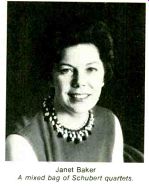
Janet Baker A mixed bag of Schubert quartets.
Alongside two bits of rather conventional jol lity is a variety of more hymnic material, of which the 1824 setting of De la Motte Fouque's "Gebet" and the 1822 "Des Tages Weihe" are particularly eloquent. The last of these is nicely done on the new disc, but the four star soloists do not always yield a con sistently fine blend (nor is Fischer-Dieskau the true bass required by some of these pieces; at the bottom of the staff he almost vanishes, and a very deep phrase in "Gebet" has been moved up an octave). "Gebet" is particularly choppy, in fact, and it's a good thing these singers will be remembered by posterity for something other than their work in this piece.
The less-celebrated soloists who join the Elizabethan Singers for their recording of "Gebet" (Argo ZRG 527. also duplicating "Gott im Ungewitter") give more pleasure. es pecially since Viola Tunnard makes Schu bert's ostinato accompaniment figures move more vibrantly than does Gerald Moore. If you're just beginning to investigate Schubert's partsongs, by all means go to the Argo record first; it includes several real masterpieces ("Nachthelle." with its quicksilver harmonic changes.. and the gorgeous "Standchen" with alto solo), and most of this music works better with a chorus anyway.
One of Schubert's predecessors about whom we read much in the history books is Johann Friedrich Reichardt (1752-1814), and Fischer-Dieskau's contribution to the Pet rarch anniversary year includes six settings by Reichardt-not all of them sonnets, actually (the original publication was entitled Sonetti e Can:oni di Petrarca and appeared in Berlin around 1800). These are most Italianate in style. with graceful ornamentation and charm ing details, although little breadth or expan siveness to match the poet's scope. The excep tion is a setting of "Orche'l del e la terra" that reaches into a kind of nature- and mood painting that we have come to associate with Schubert. Melismatic writing drives Dieskau to some choppy expedients, but he achieves some nice effects as well.
The third of Schubert's Petrarch settings (in German translations by A. W. Schlegel and Cries) uses the same "Or che'l ciel" sonnet, al though DG does not trouble to tell us this.
None of these records, incidentally. includes a single word of annotation copy, although texts and translations are faithfully provided.
Schubert's songs are very freely formed, ab juring the older composer's homogeneous tex tures in favor of a mix of recitative. arioso, and cantilena that works rather well. These per formances. effectively declaimed, are reissued from Vol. 1 of the big Schubert set.
On the verso of this disc, we find a real treas ure, Dieskau's 1962 recording of Liszt's three Petrarch sonnets. Although better known in the solo-piano versions. these are among the greatest of Romantic love songs, as the poems are among the greatest of all time. Liszt matches all their nuances, with smooth transi tions from recitative to broad flowing lines, embedded effectively in richly inventive ac companiments (discreetly simpler than the writing in the solo versions). Dieskau's Liszt record was one of his best, and it's good to have even this much of it back again.
After this, the single Pfitzner song is a let down-not a bad piece. but its introspection, and Dieskau's occasionally explosive singing, are poorly placed after the gorgeous Liszt.
Finally, we have Christa Ludwig. offering not a supplement to Dieskau's efforts, but an other version of the standard female Schubert recital, liberally sweetened with chestnuts we all know and love. Five of these songs were also on her earlier Schubert disc (Angel S 36462). Seven of them are not to be found in the Dieskau series (usually for obvious rea sons), and one of these ("Die Rose") seems to be a first recording.
This is, I am sorry to say, a very monotonous recital. Miss Ludwig has chosen predomi nantly sad/mournful/elegiac songs. She has transposed most of them down-not in itself a reprehensible practice. but in extenso some what dampening. Her basic timbre is dark to begin with; on this occasion, at least, the tone is also slightly soggy, and hardly varied in color throughout; a note of wounded feminin ity, of barely suppressed anguish, is appro priate enough in some or these songs. but at forty-five minutes' length this unrelieved tonal dolor dangerously courts antipathy on the part of the listener.
The piano tone as recorded is muffled, never bright-a good match for this voice, in one sense, but contributory to the prevalent gloom. Mr. Gage is a dab hand at vitalizing Schubert's repetitious accompaniment pat terns, but he isn't given much opportunity here to show his full range, either musically or sonorously. A very disappointing disc. for Miss Ludwig has elsewhere shown herself to be a singer of more imagination than can be discerned here. D.H.
SCHUBERT: Works for Piano and Strings. Heidrun Ganz, violin; Hetmar Stiehler, cello; Benedikt Kehlen, piano (.n the trios). Carroll Glenn, violin; Francis Tursi, viola; Alan Harris, cello; Oscar Zimmermann, double bass; Eugene List, piano (in the remaining works). Vox SVBX 600, $9.95 (three discs, manual se quence). Trios for Violin. Cello. and Piano: No. 1. in B flat. D. 898. ho. 2, in E flat, D. 929. Notturno for Violin. Cello. and Pi ano. in E flat, D. 897. Sonata for Violin, Cello, and Piano, in B flat, D. 28. Quintet for Piano and Strings, in A. D. 667 (Trout). Adagio and Rondo concertante for Piano and Strings, in F, D. 487.
Comparison--Trios Nos. 1, 2: Stern, Rose. Istomin Col. MS 6716 and 7419
Comparisons--Trout Quintet: R. Serkin, Laredo. et al. Col. MS 7067 P. Serkin, Schneider. et al. Van. VSD 71145 k's a pity that while Vox was boxing the com plete Schubert chamber music for piano and strings they could not have done it with the same performers throughout-one could then at least accept or reject the set as a whole. For the lines are pretty clearly drawn here: Eugene List and his colleagues at the Eastman School of Music proffer very good performances of the Trout Quintet and the strange D. 487 Piano Quartet. with generally acceptable recorded sound and good instrumental balances; on the other hand, the two famous piano trios and other assorted oddities played by the Kehlen/ Ganz/Stiehler ensemble can't hold a candle to the tough competition, are pinched in sound and atrociously balanced in a number of in stances. So you must take the good with the had, and my advice would be to buy these works separately.
But to be specific. It takes only a quick dip into the Istomin /Stern/Rose versions of the B flat and E flat Trios to realize all over again how articulate, intelligent, exciting they are; by comparison, the Vox group is stiffish. dull-toned, flatter in nuance-all of which would steer one away even if the pinched recorded sound did not.
The Vox Box does include two curiosities.
The excessively sweet Nouurno, an awkwardly scored essay, may according to some specula tions be simply an exercise in piano-trio writ ing undertaken by the composer before he embarked on the magnificent B flat Trio. The sonata for violin, cello, and piano was com posed when Schubert was fifteen and contains a good bit of formula writing; the piano is so anderrecorded at moments here that it vitiates whatever effectiveness the piece might have had.
The Trout Quintet performance contains a moral: Never underrate a performing group because it may be less prominent than some others. The List/Eastman ensemble plays with propulsion, rhythmic vitality, and a sense for the over-all flow of the music. Theirs is a less individualized approach than either Rudolf Serkin's group on Columbia or Peter Serkin's on Vanguard-the latter in particular verging on self-consciousness at times, almost pre ciousness in the scherzo. In general the List ensemble chooses faster tempos than do either of the others, and the result is a clean, clear, articulate, and uncomplicated Trout that can hold its own in any company. The only prob lem that struck me was the balance in the sec ond variation of the fourth movement, in which the violin is underemphasized.
The piano quartet, also known as the Adagio and Rondo concertante, is the nearest Schubert ever came to writing a piano con certo, and the keyboard has its way through out, the strings merely assisting. List lets his part sing and flow, displays discretion in the more delicate passages, and creates an appro priate bright pianism that doesn't have much in the way of depth but produces some very pleasant surfaces indeed. S.F.
SCHUMANN: Concerto for Piano and Or chestra, in A minor, Op. 54. GRIEG: Con certo for Piano and Orchestra, in A minor, Op. 16. Radu Lupu, piano; London Sym phony Orchestra, Andre Previn, cond. [Christopher Raeburn (in the Schumann) and Michael Woolcock (in the Grieg), prod.] LONDON CS 6840, $6.98.
For Lupu this is surprisingly straight playing. One might, on the basis of his prior work on record and in the concert hall. have expected that these two popular works-the ham 'n' eggs of the Romantic concerto literature would have encouraged all sorts of theatri calities from a player obviously prone to them, but instead we are given a pair of readings that are lyrical and coloristic, to be sure, but with no alarming mannerisms of phrasing or tempo.
These interpretations do not have the feel ing of symmetry and containment of the old Lipatti coupling (Odyssey 31 16 0141), and the plushy ambience of the recorded acoustic fur ther softens the over-all line (without, how ever, losing detail; balance is good). For all that, tempos are on the brisk side, phrasing is cogent, and those who want these works to sing should be very happy with these state ments. Previn proves an alert, sympathetic col laborator.
Definitely one of the more recommendable offerings of this perennial coupling. H.G.
SCHUMANN: Piano Works, Vol. 2. Karl Engel, piano. TELEFUNKEN SKA 25085, $27.92 (four discs, manual sequence). Fantasiestilcke. Opp. 12 and 111; Kinderszenen, Op. 15; Kreisleriana, Op. 16: Fantasy in C, Op. 17; Arabeske in C, Op. 18; BlumenstUck in D flat. Op. 19; Faschingsschwank aus Wien, Op. 26; Romances (3), Op. 28; Marches (4). Op. 76; StUcke in Fughettenform (7). Op. 126; Gesange der Frilhe, Op. 133.
SCHUMANN: Humoreske, Op. 20; Waldsze nen, Op. 82. Wilhelm Kempff, piano. [Cord Garben, prod.] DEUTSCHE GRAMMOPHON 2530 410, $7.98.
Consistency is the word that best describes Karl Engel's unfolding Schumann piano cycle. Vol. 2 comes in the same dignified ...
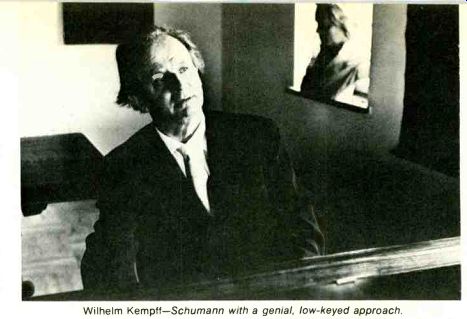
Wilhelm Kempff-Schumann with
a genial, low-keyed approach.
...brown album, continues the essay about the music begun in the first four-disc set (SKA 25082. reviewed in May), and like its predecessor is beautifully recorded and pressed.
And the playing style is all of a piece. This is not to say that Engel enjoys equal success with every piece or that there are no fanciful moments or other surprises in his performances.
Vol. 1 ranged from a bleak, unimaginative Carnaval to fine, classically poised accounts of the Davicisbundler and Intermezzi. But all the renditions, good and bad, are characterized by a basic integrity, a tough-skinned structuralism, and a respect for the printed page that occasionally verges on the over-earnest in such impulsively emotional repertory-almost a welcome variant in music so frequently manhandled! The works in Vol. 2 are without exception well suited to Engel's basic outlook. The great Fantasy doesn't erase memories of Curzon, Arrau, and Kempff, but it is well knit, rhyth mically convincing, clear in its contrapuntal strands, and (in such well-known trouble spots as the coda to the alla marcia second movement) impressively clean technically. A little more ardor, lots more color (though Engel's restricted sonority is never unpleasant to the ear or even without a certain chiaroscuro), and this would have been a truly great account of a problematic work.
Engel is as cognizant as Arrau of those often misunderstood forte-pianos in section two of the Arabeske and, like that master, turns in a strong, succinct interpretation minus the usual coy banalities. The Op. 12 set of Fantasy Pieces is well shaped, though at times slightly hard-toned and prosaic; Engel seems more songful and relaxed in the Op. 111 set. The final section of Kreisleriana with its "mis placed" bass line gets a tidy. sprightly account, although some of the earlier sections in the same work are a shade too literal for maximum effectiveness.
The Carnival Jest from Vienna (which Engel previously recorded on a long-deleted Epic mono disc) is admirably forthright. and so are the Op. 76 marches, although I question the pianist's tempos in Nos. 3 and 4. The third march, marked "very moderate" and subtitled "Lager-Szene" ("At the Campsite"), should, in my opinion, supply the needed repose of a slow movement; Engel, in his desire to set a single tempo for this elusive piece. seems al most brutally flippant in the outer section and, conversely, too sober and angular in the central, darting trio. March No. 4 is excessively heavy and lumbering as he gives it. Still, the playing has point, clarity, and rhythmic vitality.
I like the unusual classicism of Engel's Kinderszenen: The judiciously gauged poco ritenutos and a tempos in "At the Fireside" are indicative of the finely conceived readings as a whole. If both the Blumenstack and the Op. 28 Romances could have more warmth and poetry, the very late Songs of Morning brooding essays with late-Brahms chromaticisms and harmonies-are given with more sanity and strength than I would have imagined possible. Engel similarly presents the quasi-etude Pieces in Fugue Form in as strong a light as possible. This is all purposeful playing without ostentation or fuss, sympathetic if not terribly imaginative, and digitally well above average.
Kempff presents gracious accounts of two Schumann cycles previously unrecorded by him. Of the two, Waldszenen profits more from his genial, low-keyed approach. His playing of these vignettes is midway between the magical fleetness of Richter's long-vanished mono recording and the ample, burgher values of Arrau's recently issued Philips disc (6500 423).
The tender, simple, homely qualities of Kempff's latter-day pianism are less convincingly applied to the changing "humors" of Op. 20. He tends to flatten out contrasts excessively by setting cautious tempos in the scurrying interludes and almost perfunctory ones in the leisurely passages. While every note of his performance is artistic and sensitively conceived, it seems to me that he is outclassed in this score by both Arrau (Philips 839 709) and Richter (Monitor MC 2022, mono). DG's sound is beautifully atmospheric.
H.G.
Scriabin: Piano Works, Vols. 2-3. Michael Ponti, piano. Vox SVBX 5462 and 5463, $10.95 each three-disc set (manual sequence). vol. 2: Preludes (83); Egoroff Variations; Allegro appassionato, Op. 4; Allegro de concert, Op. 18; Polonaise, Op. 21; Fantasy, Op. 28. Vol. 3: Etudes (23, plus alternate version of Op. 8, No. 12); Mazurkas (23); Two Impromptus a la Mazur, Op. 7; Waltzes (4); Quasi-Waltz in F, Op. 47.
Comparisons: Estrin (Op. 8 etudes) Conn. Soc. CS 2009 Laredo (Opp. 11,74 preludes) Desto DC 7145 Laredo (Op. 42 etudes) Conn. Soc. CS 2032 Kuerti (Op. 65 preludes. Op. 74 etudes) Mon. MCS 2134 Horowitz (various preludes) RCA LM 2005
When (and if) I grow old and I sit by the fire musing over the various banes of my exist ence. I'm sure that the "Complete Works (or Symphonies. Sonatas. etc.) of ..." mania that has been growing within the record industry will be one of the first that comes to mind.
Time was when one of the perverse joys of record collecting lay in slowly building up, say, the complete Scriabin etudes by discovering isolated excerpts on recital discs and once in a while hitting upon a complete opus number recorded by an artist particularly in tune with that set. Now, as soon as a certain composer hits a vogue of sorts, the record collector can be sure that, especially in the case of solo or small-ensemble compositions. some devoted artists will be willing to tackle the quasi-entire oeuvre for some record company.
I can't help feeling that the efforts necessary. both by the artists and the record producers, to commit to disc all in one gulp consider able volumes of similar music produce results that are inevitably below the best everyone concerned is capable of. Even in the case of the superlative series of Scriabin piano sonatas done by Ruth Laredo for Connoisseur Society. the last two discs rarely seemed to show the enthusiasm and involvement evident in almost every note of the first. In the case of Michael Ponti's ongoing struggle to get through the complete Scriabin piano works (and the composer wrote principally for that instrument), such things as a slightly out-of-tune F (on the third disc of Vol. 2) and some unpleasant clinkers (such as in the ever-popu lar Twelfth Etude from Op. 8. where every body will recognize them) have been allowed to go through.
The adverse effects of such undertakings extend as well to the listener, who begins to get jaded after hearing. say. the thirty-seventh piece entitled "Prelude" from the composer's early period. It is not simply a matter of being sated. In some cases, there are good reasons why certain previously unrecorded works are rarely performed. I was beginning to feel, for instance, that the sheer volume of Scriabin preludes, with their eternal Chopinisms, was beginning to get to me when suddenly. as of Op. 48. I began to perk up again as the full, striking originality and the frequently chilling bleakness of his later style began to come into full evidence.
Not that I dislike Scriabin's early work. But the Chopin-Liszt orientation of his earlier pi ano endeavors proves much more substantial in works such as the Op. 8 etudes or the first three sonatas than in the more wispy preludes.
in spite of the excellence of some (such as the five preludes of Op. 15. some of which are al ready taken over by a wistful vagueness that eventually translated itself into every element of the composer's style).
All these drawbacks would matter little, however, if you could just sit back and revel in the performer's artistry. And while I will immediately say that I like Ponti much better in these performances of less-developed works than in his renditions of the sonatas (Vox SVBX 5461), I can nonetheless think of at least two non-superstar artists-Ruth Laredo and Anton Kuerti-whom I would rather have seen undertake this project. Thus. while Ponti performs the Op. 42 etudes, which are among my favorite short pieces by Scriabin, with excellent tone and a great deal of subtlety. he does not match the depth of the Laredo version; and similar remarks can be made vis-a vis Kuerti's brilliant interpretations of the startling Op. 65 etudes.
In other instances, Ponti fares even less well. He has a general tendency. I feel, to play on the surface of the keys so that the fast passage-work of a piece. such as the third of the Op. 31 preludes, simply does not have the clarity it needs, in spite of his generally brilliant technique. On the other hand, in the more "heroic" pieces. including the hammy Op. 28 Fantasy (which neither Zhukov. Szidon. nor Ponti has convinced me is worth engraving in vinyl), Ponti can become impetuous to the point of sounding labored, paradoxical as that may seem. I will say. however, that he is capable of striking just the right balance on some of the slower, more plaintive works-a number of the preludes, for example.
Of the two sets, Vol. 3 is definitely more enticing. Not only are the rarely heard mazurkas it contains among the best of Scriabin's Chopiniana, but Ponti imparts perfect spirit and pulse to them. If he suffers in comparison with Estrin. Laredo. and Kuerti in the etudes.
his interpretations are nonetheless quite convincing, particularly in Opp. 42 and 65. And the alternate version of the famous D sharp minor Etude (Op. 8, No. 12) is sure to jolt those imbued with the "definitive" version into thinking the pianist has forgotten the music and is trying to improvise his way back home it couldn't happen to a nicer warhorse.
Vol. 2, on the other hand, is dominated by the preludes, a number of which have better performances on other recordings. including Laredo's Op. 11 and Kuerti's extraordinary Op. 74 (and an ancient RCA disc contains a good sampling from Opp. II. 13. 16, 27, 48, 51, 59 and 67 by Vladimir Horowitz). The other works in this volume are generally written in a "heroic" idiom that was basically ill suited to Scriabin's gifts.
As for the recorded sound. it tends to be very good to spectacular in the bass and mid range, occasionally shrill and tinny (as if Ponti's Bechstein had thumbtacks in the ham mers) in the upper. The quality of the pressings vary considerably from disc to disc, some of the more subdued numbers suffering from very low recording levels.
The twenty-page program booklet prepared by Donald Garvelmann (identical for Vols. 2, 3. and the up-and-coming 4. but different from that of the sonata volume, also done by Garvelmann) is one of the most useful Scriabin documents around. Besides the cogency of his observations (although some of his short descriptions of the music are worth little), the notes contain a complete catalogue of the published piano works (complete with Vox Box location), a selected bibliography (which pointedly excludes the Faubion Bowers opus), a list of musical scores, and a thematic index of all the piano works save the sonatas, which are indexed in Vol. I. Inasmuch as one of the chief values of the recordings themselves is as a scholarly tool, the Garvelmann booklet is exceedingly apropos.
One final comment. Garvelmann mentions in his notes the name of Ivan Vishnegradsky (or Wyschnegradsky). who avoided the pit falls of Scriabin copycatism by developing a quarter-tone idiom in which many of his com positions are written. There is a certain value to "filling in." as Vox is doing. the still unrecorded works of a major composer. but I would personally be willing to trade in both of these volumes for a single disc containing...
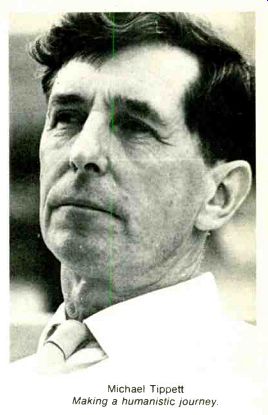
Michael Tippett Making a humanistic
journey.
... works by Vishnegradsky and/or, to give an other example. Nicolai Roslavetz, a Russian pioneer in atonality whose output has been almost entirely buried (although a Notturno recently surfaced in New York). R.S.B.
Sessions: Symphony No. 8; Rhapsody for Orchestra. For a feature review, see page 97.
SUDERBURG: Chamber Music II-See Rochberg Quartet for Strings, No 2.
TCHAIKOVSKY--FANTASIA. For a feature review, see page 91
TIPPETT: The Vision of Saint Augustine; Fantasia on a Theme by Handel. John Shirley-Quirk, baritone (in Vision): Margaret Kitchin, piano (in the Fantasia): London Sym phony Chorus and Orchestra. Sir Michael Tippett, cond. RCA RED SEAL SER 5620, $6.98.
Visions, particularly those of the religious variety. are not very welcome these days. Even the Catholic church tends to talk around St. Augustine's visionary experiences. and one feels that current theology finds them a bit too melodramatic to be taken altogether seriously.
Today the Confessions are read primarily as secular works, admired chiefly for their rich humanity and the self-revelations of an extraordinarily complex and fascinating individual.
Certainly one comes away from Michael Tippett's cantata The Vision of Saint Augustine with the knowledge of having made an in tensely humanistic journey. Tippett is not a practicing believer. and it's not difficult to see why Augustine's highly colored word associations would appeal so strongly to a thinker who. like Augustine himself. is also something of a mystic with a keen sense of the flesh.
It would be wrong. then. to approach The Vision of Saint Augustine as a religious work:
it is instead an expression of how the artist seeks, glimpses, and tries to retain his own vision of eternity through the creation and the actual physical practice of the art itself. I have the feeling that such an attitude would hardly be enthusiastically endorsed in most aesthetic circles nowadays, any more than the religious community seeks to encourage its visionaries, but Tippett believes and has gone about the task of communicating his convictions with his customary individuality, vigor, and inventive power.
The cantata is in three parts with a Latin text, devised by Tippett. that ingeniously operates on several simultaneous levels. The baritone soloist sings Augustine's own account of his joint vision with his mother. Monica. and there is additional choral commentary drawn from the saint's confessions, relevant Biblical quotations. the hymn "Deus, creator omnium" (by Bishop Ambrose. Augustine's early spiritual adviser), and outbursts of glossalalia, me lismatic vowel sounds ("alleluia" being the most familiar) that in ancient music expressed an ecstasy that went beyond words.
Part one prepares us for the vision as Augustine and Monica rest in Ostia. the port of Rome, before traveling on to Africa: part two is the vision itself ("And higher still we soared thinking inwardly and speaking and marvel ling at your works: and so we came to our own souls and went beyond them ... And while we were talking of eternal life and panting for it we touched it for a moment with a supreme effort of our heart"): part three is Augustine's reflections on the vision, an incredibly pro longed rhetorical "if' ending with the thought that, if this vision could be extended indefinitely, he would truly experience the eternal life of the saints.
Tippitt wrote The Vision of Saint Augustine between 1963 and 1965. Stylistically it seems to represent something of a synthesis of the florid. proliferating richness of The Midsummer Marriage (1954) and the harmonic pungency and linear angularity of King Priam (1962). In any case, it is an extremely dense and complicated score that requires several hearings before all the various philosophical and musical levels become firmly fixed in the mind and ear.
Once digested. however, there is no resisting the singular impact of the piece. which consistently burns with an intensity that rarely subsides. Even in moments of relative repose, the ecstatic visionary quality of the piece erupts without warning, taking the chorus sopranos over a full two and one-half octaves or exciting the baritone to turn isolated vowel sounds into extravagant cadenzas with Monteverdian trillo ornamentations. For the final section. Tippett matches Augustine's seemingly endless conditional "if' clause with a breathlessly sustained musical paragraph that resolves itself into a spell-inducing cadence on St. Paul's words. "I count not myself to have apprehended." whispered by the chorus, first in Greek and then in English.
The recorded performance is an exception ally fine one considering the awesome executant challenges. Tippett. unlike Britten, is not a naturally gifted conductor, and quite frankly one can imagine a reading of greater rhythmic definition and sweep. Even at that. John Shirley-Quirk. the chorus, and the orchestra sing and play their hearts out with the kind of skill and dedication that comes only from a total belief in the labor at hand. The recording on this imported British RCA disc is subtly spec tacular, managing to blend all the diverse elements into a superbly balanced entity in which virtually every element of the musical discourse is immediately audible.
The early Handel Fantasia (1939-41). five variations and a fugue on the prelude to an air with variations from Handel's Suites de pieces pour le clavecin (1733). is an attractive work in Tippett's most robust, luxuriant tonal style. Its juxtaposition with the Augustine cantata is instructive in view of the composer's eventual development, but surely it would have made more sense to place the Fantasia on Side I rather than at the end of Side 2. where it rudely breaks in on the meditative hush of the cantata's final measures. P.G.D.
Tomasek: Concerto for Piano and Orchestra, No. 1-See Kalliwoda. Symphony No. 1.
WAGNER: Orchestral Excerpts, Album 2. London Philharmonic Orchestra, Adrian Boult, cond. [Christopher Bishop, prod.] ANGEL S 36998, $6.98.
Die Walkure: Ride of the Valkyries. Siegfried: Forest Murmurs. Gotterdammerung: Dawn and Rhine Journey: Funeral Music. Tannhauser: Prelude to Act III (original version). Tristan und Isolde: Prelude to Act III.
Sir Adrian Boult's second Wagner disc includes one special enticement: Wagner's original version of the prelude to Act III of Tannhauser, which recounts, in much greater detail than the familiar final recension, the hero's pilgrimage to Rome. If there has been a previous commercial it has escaped my attention. Wagner decided early on that in the opera house, with the Rome Narrative yet to come, the longer version would be redundant--but for concert use it is eminently satisfactory: well shaped and full of effective gestures.
Sir Adrian gives us yet another novelty in his treatment of the Tristan third-act prelude: Instead of the solo version of the English horn tune, he reaches later into the act (to Tristan's "Muss ich dich so verstehn, du alte ernste Weise") for an accompanied presentation (mostly soft tremolando strings), and then rounds it off in the usual way. The resulting slight gain in textural cohesion is useful, for the long unaccompanied passage, so atmospheric in the stage version, tends to tear the piece apart as a concert number.
However, not even Sir Adrian's just, meticulous readings can reconcile me to those static patchworks, the Ride of the Valkvries and the Forest Murmurs. Nor does the peregrinating transitional music of the Rhine Journey' make much sense on its own (Boult omits the portion of the duet music usually retained in concert versions of the piece. and ends in B minor, as in the opera). Even the Funeral Mu sic, which owns a certain unity of key and rhythmic motive, does not gain by abstraction from its context.
Still, if you get a kick out of these Ring ex tracts, you could do worse-but also, perhaps, better. On Angel S 35947, Klemperer adds to Boult's Ring selections the Entrance of the Gods but omits the Funeral Music (the disc also includes the Parsifal Prelude and the shorter version of Tannhauser Act III).
Klemperer's Ride is briefer (just the first time through the big tune and then cutting to the battle-cry music-no splicing back for a reprise), and so is his Rhine Journey (which starts after the duet). Both excerpts gain in coherence, and the performances are stately, coloristically more varied than Boult's, and more lucidly recorded.
Szell's Ring disc (Columbia MS 7291) offers the Entrance of the Gods, Ride, Magic Fire, Forest Murmurs, and the usual Gotterdammerung extracts (plus the final pages of the op era)-lithe, almost edgy performances of dazzling executive brilliance. Szell slightly improves the Forest Murmurs by skipping the irrelevant opening of the concert version and further vulgarizes the Ride by cueing additional vocal parts into the brass.
As I have suggested, the main inducement for acquiring this record should be that Tannhauser excerpt. Sir Adrian never does anything unmusical, never impedes the progress of the musical line, and secures lively, intelligent phrasing and accenting from the less-than-first-rate band. Angel's sound is on the overripe side, confusingly resonant in the tut tis-some details here and there are not as clear as in Toscanini's old mono versions, and the sound of the orchestra in full cry is not as cohesive as it might be.
Sir Adrian is an admirable conductor of the German Romantic repertory, but our pleasure would be greatly enhanced were he put to work on proper concert fare, rather than on bits and showpieces. For a start, Angel might issue his excellent set of Brahms symphonies, of which only the Second has so far been re leased domestically. D.H.
WAGNER: Tristan und Isolde: symphonic synthesis. For a feature review, see page 91
+++++++++++++++++++++
recitals and miscellany
BALLET FANTASIA. For a feature review, see page 91
RUSSIAN FANTASIA. For a feature review, see page 91.
ART OF AKSEL SCHIOTZ, ALBUM 3: Oratorio Arias; Mozart Opera Arias.
Aksel SCHIOTZ, tenor; Royal Danish Orchestra, Egisto Tango, cond. (in the Mozart); orchestras, Mogens Woldike, cond. (in the remaining works). SERAPHIM 60277, $3.98 (mono) [recorded 1940-46].
Buxtehude: Aperite mihi iustitiae portas. HANDEL: Messiah: Comfort ye ... Ey' ry valley. Bach: St. Matthew Passion: O Schmerz! Ich will bei memem Jesu wachen. HAYDN: Die Schtipfung: Mit Wurd und Hoheit angetan. MOZART: Die Entfdhrung aus dem Serail: Hier soil ich dich denn sehen; Im Mohrenland getangen war. Don Giovanni: Della sua pace; II mio tesoro. Cosi fan tutte: Lin' aura amorosa. Die Zautierflote: Bildnisarie.
This record is exactly the same as Danish Odeon MOAK 2, except in one important re spect: The quality of sound on the Mozart side has deteriorated badly. Though this particular group of 78s dates from 1942-43, there is a lot more life in them than is suggested by their latest incarnation, in which they sound muddy and distant. Intending purchasers would therefore do better to seek out the Odeon disc in import shops.
Aksel Schiotz had a blighted career as a singer. He did not make his operatic debut until 1939, when he was thirty-three. The out break of World War 2 in September of that year kept him confined to Denmark until 1945. After the liberation of Europe, he immediately made a name for himself outside his native country. both through live appearances and recordings. In the following year, how ever, he was operated on for tumor acusticus, and though he eventually reappeared as a baritone he 'never really enjoyed the same sort of success again. Today he teaches singing.
The 78s collected on this recital caused something of a sensation when, after the war, they were finally issued in the U.S. and Britain. Their musicality and the wide range of styles and anguages they covered seemed startling at the time. Everyone marveled at Schiotz's English in "Ev'ry valley." So they did too at his unfailing tastefulness, his restraint and unmannered style.
The perpetuation of these records on LP would indicate that Schiotz still has a large fol lowing. Nevertheless, listening to them after a lapse of time has proved a sobering experience. The musicianship, especially in the Buxtehude and Bach selections, is as apparent as ever, but so is a certain dispassion. One feels this even in "Ev'ry valley," despite the good breath control and the cleanness of the runs.
During the aria from Die Schopfung one thinks longingly of Julius Patzak's individuality and the way he relishes the text. The Mozart side is, in the end, monotonous, though Pedrillo's serenade is not without its charm, even now.
The passage of nearly thirty years causes one to listen afresh. How clearly today one hears the limitations of Schilfitz's voice: its dry, somewhat throaty sound, its lack of tonal variety, the absence of muscle. How clearly too one is aware of his tendency to rhythmic flabbiness, the scanted syllables. At this juncture, moreover, one tends to notice the fact that his German and Italian are not quite good enough. the ,former being softened by the suppression of consonants, the latter spoiled by incorrect vowels.
Synopses but no texts. D.S.H.
ElGERARD SCHWARZ: Cornet Favorites. Gerard Schwarz, cornet; William Bolcom, piano. [Marc J. Aubort and Joanna Nickrenz, prod.] NONESUCH H 71298, $3.98.
Hammer L Cutter From the Shores of the Mighty Pacific (rondo caprice); Sounds from the Hudson (valse bril lents); The Debutante (caprice brillante); The Bride of the Waves (polka brillante). FRANK SIMON: Willow Echoes. Jean-Baptiste ARBAN: Fantasia and Variations on The Carnival of Venice." Wean. Mouses: At the Beach (con cert waltz). CARL Hohne: Slavische Fantasie.
To such intoxicatingly fragrant evocations of musical Americana as those in its Stephen Foster songs and Scott Joplin rags, None such's nostalgia series now adds loving tribute to those fabulous coloratura heroes of summer bandstands, soloists on the cornet--the trumpet's stubbier, blander-toned, but fabulously agile poor-man cousin. A whole realm of the band-music repertory is devoted to show pieces for cornet virtuosos, much of it written by such outstanding stars themselves as the Americans Clarke and Simon (both soloists with Sousa's band); the pioneering French man, Arban. who published the still-standard Cornet-Method in 1864; and the more shadowy German. or Austrian. Hohne, who com posed the Slavic Fantasie for a celebrated late-nineteenth-century Austrian cornetist, Fritz Werner.
This music is as naive, old-fashioned, ingra tiating, and floridly showy as the selections' ti tles and subtitles suggest-perhaps none of it more so than Virgil Thomson's tender rather than satirical reminiscence of his own child hood relish of this genre. This piece originally was composed (1929) for violin and piano and some twenty years later was revamped and elaborated for trumpet and piano.
Already outstanding among young American trumpeters, Gerard Schwarz was born (1947) long after the era when star cornetists were as famous as top pro quarterbacks are to day, but he has an obvious affinity for old fashioned pyrotechnical bravura, and he has shifted from trumpet to cornet with disdainful ease in the face of all the super-speed, double-
and triple-tongued demands on him. Both he and his pianistic partner Bolcom (another who brings properly idiomatic panache to this band-standing music) are captured in admirably clean, bright, un-gimmicked recording.
For full measure, the jacket notes. by Bolcom himself, are lively as well as informative reading. But as always, it's the music that's the prime attraction-not a strictly serious or substantial one, perhaps. but a unique kind of camp-in-good-taste that is also of authentic documentary value. R.D.D.
A SURVEY OF THE WORLD'S GREATEST ORGAN MUSIC: GERMANY: VOI. 1, North Ger many. Vol. 2, South Germany; Vol. 3, Central Germany. Helmuth Rifling (Vol. 1) and Franz Lehrndorfer (Vols. 2 and 3), organ (various historic and new organs). Vox SVBX 5316, 5317, and 5318, $10.95 each three-disc set.
Vox's monumental "Survey of the World's Greatest Organ Music" aims to present a comprehensive picture of the development of organ music from its very beginnings down to the present day. So far, the series has been remarkably successful in presenting this vast amount of material in a realistic and reason ably complete perspective, with few serious omissions and with an excellent balance and emphasis throughout. The series is subdivided by country: When complete there will be six three-disc boxes each, devoted to France, Germany. and Italy. (For a review of all six volumes of French organ music, see the Au gust issue; the Italian records will be discussed in a future issue.) The very first few fragmentary manuscripts of keyboard music of any kind come from England and Italy and date back to the early 14th century. Throughout the 15th century, though, Germany reigned supreme, and many manuscripts survive. Of particular importance are Conrad Paumann's Fundumentum organisundt of 1452 (primarily an instruction manual) and the Buxheim Organ Book of 1470. a huge collection of more than 250 pieces. which represents the last great example of medieval organ music (a few of these pieces are included in Vol. 2). Particularly at this early date. German production is divided into three distinct geographical areas-southern, central, and northwestern-and the Vox series is similarly subdivided.
In the 16th century, keyboard music expanded rapidly, and five countries participated actively: Germany, Italy. Spain. Eng land, and France. Germany (and France), however, played a minor role in the development at this time, only to rise again to supremacy early in the 17th century. and it has maintained that dominant position ever since. Only during the reign of Louis XIV and again toward the end of the 19th century did French keyboard music seriously challenge Germany's position.
Before proceeding to a more detailed description of the separate volumes, I must point out that two of the greatest of German key board composers are absent from this series altogether: Bach and Buxtehude have been banished, not for unworthiness, but because Vox has already recorded the complete organ works of both men. In spite of the distortion in perspective that their absence necessarily produces, there would be an even greater danger of distortion if these two giants had been per mitted to cast their shadows over the works of their colleagues. Bach and Buxtehude must be dealt with separately.
Within the geographical subdivisions, the various works in the German series are loosely arranged chronologically. Vol. 1. "North Germany," begins with Sweelinck and other late-16th-century composer's, covers the 17th century. and overlaps slightly into the 18th. Vol. 2. "South Germany," is centered largely around Munich and includes the very earliest German keyboard pieces. from the mid-15th century.
The remainder of the composers are spread fairly evenly through the 16th. 17th. and 18th centuries. Vol. 3. " Central Germany," concentrates on a narrower time span-mid-17th Through the 18th century-and centers around the Bach family. Nearly every composer in this volume was associated with Bach in some manner.
Vol. 4 will be devoted to the Vienna school, including a number of Bohemian and Czech composers. After a few 17th-century works (by Froberger and Muffat), it will concentrate on the 18th- and 19th-century giants (Mozart, Beethoven, Mendelssohn, Schumann, Brahms, and several others). Vols. 5 and 6 will round out the 19th century (works by Bruckner. Reubke, Rheinberger, Reger. and others), and focus a good deal of attention on 20th-century composers (Schoenberg, Hindemith, Pepping, Schroeder, and Distler are the best known among them).
Quite a few of the French volumes included performances that had been previously avail able on single Turnabout discs. But all of the German and Italian records seem to contain only new releases. and, needless to say. the majority of the repertoire (in the early vol umes at least) has never been recorded by any one before now.
Vol. 1. " North Germany." presents 23 works by 18 composers, centered mainly around Hamburg and Lubeck. It begins, how ever. with a full record side devoted to three works (two fantasias and the poignantly beautiful variations on "My Young Life Has Come to an End") by the Dutchman Sweelinck (1562-1621). This Italian-trained. Amsterdam-based organist/composer/teacher is the real father of the North German school: at least six other composers in this volume studied with him directly. and his influence continued to be felt in North Germany for generations.
One of Sweelinck's most important pupils was Samuel Scheidt (1587-1654). a friend of Schutz. He also earns a full record side, de voted to three works (a set of chorale variations and two free works, from his Tabula tura nova of 1624).
This North German school continued to develop throughout the 17th century the brilliant style that culminated in the works of Buxtehude. Bohm. and Lubeck and their predecessors. Tunder, Bruhns, and Reinken. Inexplicably. three of the most important North Germans (Reinken, Bohm. and Lubeck) turn up in Vol. 3. grouped with the Central German composers.
The North German school of organ building. also descended directly from Dutch in fluence. continued to emphasize strong. independent divisions. especially a complete and independent pedal. It reached its culmination in the instruments of Arp Schnitger around the turn of the 18th century.
All the works in this first volume are played by the well-known organist and conductor.
Helmuth Rilling. whose technical facility and historical understanding are certainly more than adequate to the task. His approach to this early music. though. is that of the scholarly.
pure. and pedantic old German professor. His tempos are slow and careful, and hardly a trill or ornament or rhythmic alteration or tempo inflection is allowed to mar the purity of these "Urtext" performances. There's not much excitement. but he does offer clear aural pictures of the Urtext scores.
Rilling plays on four very fine organs: the famous Schnitger in Stade and three new instruments built by Karl Schuke of Berlin. including the magnificent big instrument in Berlin's Kaiser Wihelm Gedachtniskirche. All are beautifully recorded, as well.
Vol. 2. " South Germany." includes the earliest keyboard music in Vox's entire series: a pair of short works from the important Buxheim Organ Book, compiled in Munich in about 1470. There are also short works by four other composers. born in the 15th century, who began the tradition of bringing Italian in fluence to southern Germany: Isaac. Hofhaimer. Buchner. and Sicher. Unfortunately.
one of the greatest and most fascinating com posers of this time. Arnolt Schlick, is not rep resented. Among his liturgical organ works is a setting of the antiphon A scendo ad Parrem. a ten-voiced composition with six independent parts for the manuals and four for the pedals! This volume includes a total of 37 works by 25 composers: taken together, they show the steady development of keyboard composition in the Catholic south through the 16th, 17th, and 18th centuries and even into the early 19th. Fewer of the names here will be familiar to the non-specialist than those in Vol. I.
The most famous among them, and the one allotted the most disc space. Johann Pachelbel (1653-1706). would rest more comfortably with his fellow Protestant Central German composers than in this volume. Side 6 is de voted to four of his free works and three cho rale settings, all of which exerted a strong in fluence on Bach.
Vol. 3. " Central Germany." is for a variety of reasons the most interesting and enjoyable of the three volumes now available. It is de voted almost entirely to nine members of the Bach family (omitting Johann Sebastian) and to various composers associated with the family.
The earliest musical members of the Bach clan are Heinrich (1615-1692), a brother of Sebastian's grandfather, and two of his sons, J. Michael and J. Christoph. Also included are J. Bernhard, J. Ernst, and Lorenz. as well as three of Sebastian's sons. Friedemann. Ema nuel. and Johann Christian. Though it should be news to no one, these records emphasize once again what a remarkable dynasty it was:
Virtually every one of the ten carefully chosen works by these nine composers are among the best in the series.
Among the remaining thirteen composers in the volume are Reinken and Bohm. who exerted a strong influence on the young Sebas tian: Kuhnau. his predecessor in Leipzig: his friends Walther and Telemann; and four of his pupils. Vogler. Krebs, Homilius. and Kirnberger.
The organist in all volumes of the German series except the first is Franz Lehrndorfer, a professor at the Musikhochschule in Munich and organist at the Cathedral there. He is a well known and frequently recorded artist in Germany, though few of his records are avail able here. His performances are considerably more lively and entertaining than Rifling's, though he is still definitely a member of that peculiarly German old school of scholarly purists. He ornaments a little and is partial to fussy. sometimes eccentric phrasings, and fre quent registration and manual changes.
In the early, unfamiliar pieces. his playing is often particularly academic and dull, but in the majority of the later, more familiar music Lehrndorfer sounds much more at ease and plays with a great deal of flexibility and rhyth mic fluidity. He's not the most gifted tech nician I've heard, but wrong notes and smudged passagework are held to an accept able minimum.
The six organs used in Vols. 2 and 3 (four old, two new) are all fine instruments, well re corded.
Each volume comes with an eight-page booklet outlining in detail the development of keyboard music in Germany. It is much better organized and more readable than the booklet accompanying the French records, but there are a few rather serious errors-especially in the section dealing with 15th century music probably attributable more to sloppy editing than to sloppy research. In addition, each vol ume contains a single sheet listing its complete contents. The outsides of the boxes list only a few of the composers included and none of the pieces.
In sum. Vox is providing a wonderfully in formative as well as entertaining series of records, and my few criticisms of details should dissuade no one interested in the development of keyboard music from obtaining the entire series. The records and accompanying printed matter provide an overview and insight that cannot easily be acquired in any other manner. C.F.G.
+++++++++++++++
4-channel discs tapes
BY ROBERT LONG
Bouncing Bach. Surely Johann Sebastian is the most indestructible of com posers. He has been crooned, Mooged, tootled, and droned-one would think to death; but every time he bounces back (pun intended), ready for another en counter with the arrangers.
The latest in quad is John Lewis of the Modern Jazz Quartet with his "Blues on Bach" record (reviewed from the stereo version in the August issue-see "Jazz").
Lewis, together with vibist Milt Jackson, has devised a sort of suite that I find entirely engrossing-partly because of its lively use of quad. Lewis plays five Bach pieces (including the Ein'feste Burg chorale and the inevitable "Jesu, joy of man's desiring") on the harpsichord with the other three MJQ members. In be tween he switches to the piano, and the four play original blues (two by Lewis, two by Jackson) that, in their key signatures, spell out Bach's name: They're in B flat, A minor, C minor, and H (German usage for B natural). Hardly an original device.
The music is highly original, however.
The Bach portions glitter with cymbal effects that complement the harpsichord sound. One of the blues pieces has some marvelously expressive bass porta mentos by Percy Heath. The whole is far more musically intelligent than most of the Bach-derived specialties around, and I'm less disturbed by the Bach/blues dichotomy than John S. Wilson was in the earlier review.
Vibes and keyboard parts dominate the front of the quad perspective; the rhythm is toward the back (though the bass sometimes counts for far more than mere continuo). The sound uses the spatial separation to advantage, but it is very well integrated, with absolutely no sense of its having been pieced together by overdub-which, I assume, it wasn't.
The recording is on an Atlantic Quadradisc (QD 1652, $6.98). My review copy was rather warped and a bit noisy-particularly between cuts, where it doesn't matter so much. The sound otherwise is crystalline and the shortcomings less than obtrusive.
A Gamelan Glint. The first Nonesuch Quadradisc release list consisted of recordings that seemed to be remixed from earlier stereo releases. If the more recent batch is likewise remixed, I can't find any evidence of it. Not only do they sound like "real" quadriphonics, but they (or rather their producers) seem to feel free to use all four channels or not, as the material demands-a luxury that's hard to command when you're struggling to create quadriphonic effects from (stereo) scratch.
A most striking example is in the New Jersey Percussion Ensemble's disc (Nonesuch HQ 1291, $3.98) of works by Varese, Colgrass, Cowell, Saperstein, and Oak. I'd heard-and been much taken by-the stereo version of this recording (HF, "Recitals and Miscellany," August 1974), but the Quadradisc is far more effective. Varese's tumultuous Ionisation virtually requires four channels, in fact. So much is going on within it that the stereo version no longer seems even adequate.
The far lovelier Fantasy-Variations by Michael Colgrass, on the other hand.
hardly needs quadriphonics, though it profits materially from the medium. Its gamelan-like sonorites would glint as attractively in mono, but the miking of related instruments presumably played by a single percussionist (the chromatic drums, for example) spreads them out into an area-rather than at a fixed point-within the room, and these areas then interact to fill the room with a scintillating web of sound. The effect is quite fascinating without detracting in any way from the marvelous sonic textures themselves.
The texture of Cowell's Ostinato pianissimo also is marvelous; but this is the one piece in the group that is built on "conventional" musical ideas, and Nonesuch has chosen to treat it in relatively conventional fashion-substantially centered in the front of the room.
To have spread it out would have been to dilute its impact.
The original recording is exception ally wide range-both in frequency response and dynamics-but this unfortunately works against its success in quad.
Noise is all too audible in the "holes" be tween the percussion transients, and some of the highest sounds seem rather less stable in placement than the. lower ones. And my review copy, like several I've had from the WEA group, is visibly eccentric. Fortunately much of this is music in which wow due to eccentricity is hard to hear. All told, the sound as sound is better on the stereo disc; but the Quadradisc is extremely successful and I suspect I'll continue to prefer it, noise or no noise.
It Tolls for Me! One of the joys of doing a column like this is that you're given all sorts of records that you never would stumble across otherwise. A case in point is the Victor Young film score for For Whom the Bell Tolls conducted by Ray Heindorf and done up in SQ by Stanyan Records (SRQ 4013, $5.00; available by mail from Stanyan Record Co., P.O. Box 2783, Hollywood, Calif. 90028).
I'm not a movie-music (nor even movie) buff; nor am I particularly an admirer of Victor Young. But here was the record, so I tried it. It is a studio job in real SQ, not a rechanneling from the soundtrack recording. And-in the sonic equivalent of glorious Technicolor-it gives you ten musical selections from the score.
It's not what I'd call particularly memorable music, but it does get to me in a peculiar way. Here is all this music written to go behind Gary Cooper, In grid Bergman, et al. and meant to be en countered (along with them) in a public theater. And now, with no competition from visual images, dialogue, high priced movie stars, popcorn-munching neighbors, or dank air-conditioning, it suddenly is unfolding for my benefit alone. That remote, often muffled, and usually obscured orchestra suddenly has come down off the Rivoli screen and assembled around me. Somehow I find the experience pleasurably jarring.
Fops Up to Date? One of Arthur Fiedler's "Greatest Hits" albums-"The '70s, Vol. 2" (RCA ARCI 0052, $7.98)--has come in --in Quadradisc form and, for the benefit of readers who admire the Boston Pops, I should mention that the sound is excellent, the quad engulfing, and the Pops its ultra-professional self.
The Bostonians always seem deadly sober sides to me in such collections of popular tunes, and the arrangements so overblown that otherwise unassuming tunes like "Leave Me Alone" sound downright tacky. But there; Fiedler and friends obviously have a fond following that will enjoy this disc.
P.D.Q. Again. Vanguard has issued an other SQ record of the Fictitious Bach ("The Intimate P.D.Q. Bach"; Vanguard VSD 79335, $6.98). The sound remains excellent (as most of "The Wurst of ..." was), though, again, the audience-vs.-performers placement is not what one would expect in a normal theater situation. The audience seems to be every where, and you sit not among them, but among the performers.
The quad does let you hear a great deal of contrapuntal textures (in this case signifying that the performers are punting upstream against the current trends of musical thought and sanity)-for ex ample, in the The Art of the Ground Round, a series of canons to ground basses-and therefore lets you savor the fun a little more piquantly than stereo could.
++++++++
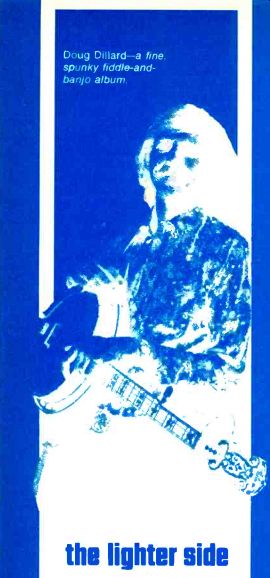
the lighter side
Doug Dillard-a fine, spunky fiddle-and-banjo album.
--reviewed by: MORGAN AMES ROYAL S. BROWN R.D. DARRELL HENRY EDWARDS KENNETH FURIE MIKE JAHN JOHN ROCKWELL JOHN S. WILSON
Explanation of symbols: exceptional recording; Recorded tape; Open Reel; 8 –Track; Cartridge; Cassette;
DOUGLAS FLINT DILLARD: You Don't Need a Reason to Sing. Douglas Flint Dillard, vocals and banjo; vocal and instrumental accompaniment. Fiddle 'n' Banjo; You Don't Need a Reason; Sittin' in Limbo; Ninety Miles; seven more. [Rodney Dillard, prod.] 20TH CENTURY T 426, $6.98.
Doug Dillard has for more than ten years been a significant figure in country and folk music.
and has even made tentative stabs into what used to be called folk rock with the short-lived but fairly popular Dillard & Clark. He is a fine banjoist and has, for this album, assembled a stunning array of country pickers. including Vassal Clements. Buddy Emmons. John Hart ford. and Billy Ray Lathum.
The material is likewise well-chosen. Best are the up-tempo tunes, and the best of these is the sterling rendition of "Sittin' in Limbo." "Ninety Miles" is a competent ballad.
Dillard's voice is a mite light and at times uncertain, but it is by no means deficient enough to mar the over-all luster. "You Don't Need a Reason to Sing" is a fine, spunky fiddle-and-banjo album. MJ.
VIENNESE OPERETTA FAVORITES: Music of J. Strauss, Millbcker, Suppe, Kalman, and others. Renate Holm, soprano; Werner Krenn, tenor; Vienna Volksoper Orchestra, Anton Paulik, cond. Wer unsgetraut; Treu sein; Soil ich reden; ten more. LONDON OS 26219, $6.98.
If. like most American devotees of easy-listening. honest -to -god tuneful music. you know some of the superbly mellifluous hits of the Viennese operetta stage only in Broadway translations and disarrangements, you're in for a delightful surprise when you encounter the Real McCoy and Icarn to discriminate be tween flat tonal soda pop and effervescent musical champagne. You may recognize only two of the composers names represented here (Strauss and Suppe). but their melodies are no more insidiously catchy than those of the less famous internationally but scarcely less esteemed locally. Millocker, Kalman, Dostal, Kiinneke, Kattnigg, and the Italian Czernik.
Indeed, this program's high points are the soprano air "Spiel' mir das Lied' from Dostal's Die ungarische Hock:eit and Czernik's bravura showpiece "Chi sa? Nel mio giurdino d'umore." But that may not be entirely to the two com posers credit. Renate Holm boasts one of the best, most brilliant. and most surely controlled soprano voices you're likely to hear anywhere today, on or off records. Her partner in several duets and tenor soloist on his own is the better known (so far) Werner Krenn. who also possesses a fine voice but who is often interpretively too lachrymose and schmaltzy-especially in some of the airs that Viennese operetta connoisseurs remember best as sung so incomparably by Richard Tauber. But. be sides Ms. Holm, there's a wealth of sheer melodism here, deftly accompanied in authentic Viennese style by the expert Anton Paulik. Incidentally, the present disc sides are num bered 1 and 4: the all-Lehar Sides 2 and 3 were issued last year as OS 26220. -R.D.D.
MARTIN MULL: In the Soop. Martin Mull, vocals and guitar; Ed Wise, vocals and key boards; Les Daniels, vocals; Charles La Chappelle, bass; Al Kaufman, drums. Auto Mechanic; Consuela Was a Mexican; Tuna Fish Salad; Margie the Midget; seven more. [Sam Charters, prod.] VANGUARD VSD 79338, $6.98.
Since Martin Mull became both famous and infamous with his comedy song routines and his records of the same on the Capricorn label, it seemed inevitable that Vanguard would is sue this early LP. recorded in 1967 but never released.
Inevitable but unfortunate. The material is for the most part weak and unfunny. a seeming attempt to do a Mothers of Invention chatty -nonsense number, most popular in 1967. The music is also light, of a namby pamby sort that might be termed cocktail-lounge rock.
Mull's best is the "live" recording "Martin Mull and His Fabulous Furniture in Your Living Room." on Capricorn. This Vanguard release is to be avoided. M.J.
JACKIE DESHANNON: Your Baby Is a Lady. Jackie DeShannon, vocals; strings, rhythm, synthesizer, horns, and vocal accompaniment. Small Town Talk; Jimmie, Just Sing Me One More Song; I Won't Let You Go; seven more. [Antisia Music, prod.] ATLANTIC SD 7303, $6.98. Tape: PETP 7303, $7.97; CS 7303, $7.97.
This long-awaited Jackie DeShannon LP is a pleasant divertissement. DeShannon displays a svelte, slick, insinuating vocal style as well as a powerful, full-bodied approach and a gritty, guttural growl. She rides on top of a series of chugging bass lines and makes pulsating soul music. She also throws in a Neil Sedaka song done in a wispy manner that doesn't quite work and a Stephen Schwartz song whose lyric is given an intelligent reading. On "I Don't Know What's the Matter with My Baby" she delivers a jolly Aretha impersonation.
Somewhere along the way, however, I sense that DeShannon has been arbitrarily forced into an assumed commercial mold. These arrangements-all done by Antisia Music-are reasonably professional soul charts. but they do lack intrinsic interest. The search for a commercial format is usually self-defeating: one must produce something that has a life of its own -and then one gets a commercial result.
H.E.
Bill AMESBURY: Jus' a Taste of the Kid. Bill Amesbury, vocals, songs, arrangements, guitar, bass, and mandolin. Justin; On the Matter of Direction; Lakehead; nine more. [Bill Amesbury and Bill Gilliland, prod.] CASABLANCA NB 9005, $6.98.
This guy is a dynamo, and, if the record business were not hugging itself so tightly these days to save what's established. there would be room for him to slip into the big time. He has had considerable L.A. air play (mostly AM easy -listening stations) with a fabulous track called "Virginia (Touch Me Like You Do)."
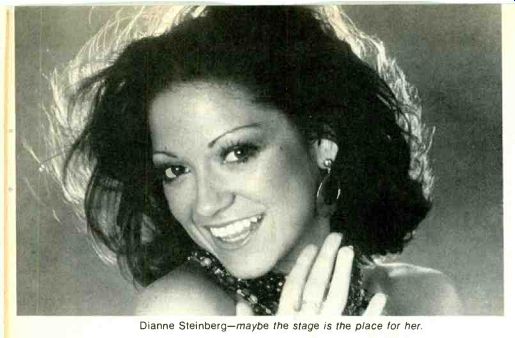
Dianne Steinberg--maybe the stage is the place for her.
People in records always say to the young hopefuls, "You gotta come up with a sound, kid." Bill Amesbury even did that. " Virginia" is live and hot and noisy, freshly mixing acoustic guitar. handclaps. and mandolin plus an excellent song and singing-the whole thing is in the pocket. Even all that has not yet pushed him over the edge into the real action.
Amesbury is twenty-four and Canadian.
"I've worked with a lot of people," he says in his bio, "but I'm my first big endeavor." He has a hand in everything. "Sailin' " has an interesting string concept and excellent backup singing by himself, pure and straight-toned.
This is the sort of album that could sell later, as did Carole King's first albums once "Tapestry" hit big. Amesbury definitely has got the goods, and I'd bet a lot that he is hell-bent on being a star. Anyone who isn't better stay out of today's record business. The company, Casablanca, subsidiary of Warners, must know all this about Amesbury. What goes around comes around. For Bill Amesbury it's only a matter of time. M.A.
Sro Barnum The Madcap Laughs. Syd Barrett, guitars and vocals; Jerry Shirley, drums; David Gilmour, bass; Richard Wright, keyboards. Here I Go; Late Night; twenty three more. [David Gilmour, Roger Waters, and Malcolm Jones, prod.] HARVEST SABB 11314, $7.98 (two discs). Tape: 8XW 11314, $8.98.
Syd Barrett is a former member of Pink Floyd, the British band for whom he played guitar and was lead voice. It was his voice and flair for the weird that made PF's initial LP, "The Piper at the Gates of Dawn," released on Tower in 1967, so fascinating.
Since then, Pink Floyd has turned in the direction of Moog rock, and Barrett, it would seem, wishes to recall the old days. That is what he has done with this two-disc set, which is fascinating without being compelling. An acoustic guitar drones atonally. Barrett mum bles words that either make little sense or fail to draw attention to themselves. Melodies, when they exist, are barely distinguishable from one another. The whole thing has the aura of a long chant, an exercise beneficial mainly to the chanter.
Some of it is better than the rest. "Here I Go" is a pleasant little ditty reminiscent of post-Beatles British rock.
Barrett gives the impression that he put a great deal of thought into this album, but I am afraid he is talking to himself. It is adventurous in that he resisted the wholly British temptation to grab an electric guitar and blast away at the ceiling. It is adventurous in that he plays with atonality and isn't afraid to sing off key when it suits the purpose of the song. But it is, unfortunately, more masturbation than revelation. M.J.
DIANNE STEINBERG. Dianne Steinberg, vocals; vocal and orchestral accompaniment; Tony Bell, Richard Rome, Perry Botkin Jr., and Ann Swain Clark, arr. Enough for You; One More Time; Sunny One; seven more. [LeBaron Taylor, Phil Hurtt, and Tony Bell, prod.] ATLANTIC SD 7309, $6.98. Tape: TP 7309, $7.97; MI CS 7309, $7.97.
It's hard to find much wrong with this debut album (I think it is a debut), except that it's all but impossible to break an album like this. It is almost all ballads, which eliminates the dancers, who break the newcomers. (Everyone else has opinions, but it's the kids who buy records.) Dianne Steinberg is an interesting young lady, photographed (no credit) on front and back to look like a high fashion model--a dubious graphics notion, if you ask me. She sings quite well in sad colors that sometimes bend toward Laura Nyro or one or another r&b ballad mode. The songs, some by the singer, are pensive and pensively produced, featuring large and well-written orchestrations and varying tempos. The outlook is theatrical and valid, so long as you give it your entire concentration. This is precisely what record buyers refuse to do for new artists. People will concentrate for familiar artists who have earned it-Stevie Wonder and occasionally a Bette Midler.
I find the background vocals pretty choir--lofty and overdone, and the first track is called "Dianne Who?", which is a pushy production idea for an unknown.
Overall, Dianne Steinberg is an unhappy lady where love is concerned. That is the message, and no answer is offered. Then out of no where is the addition of "Gee Whiz," a mind less hit of the '50's that sounded fine in its own pointless context. In this album it's like the third arm in a sweater.
If Ms. Steinberg is a good stage performer, and I suspect she is, then she will be all right.
She can then build her career slowly without starving or getting rusty waiting to record. She has a soft sweet quality that gives her great possibilities in the proper setting. Good luck.
M.A.
JIM WEATHERLY: Songs of. Jim Weatherly, vocals; rhythm, strings, and vocal accompaniment. I'll Still Love You; Where Do I Put Her Memory; Coming Apart; seven more.
[Jimmy Bowen, prod.] BUDDAH BDS 5608, $6.98.
More than two hundred versions of the songs of Jim Weatherly have been done by the nation's top recording artists. This creator of country-flavored tunes is obviously a man whose song-writing talents are respected.
Yes, Weatherly has had his hits. And some of them have been monster-sized. Gladys Knight and the Pips, for example. adding a heavy dose of soul-funk to the down-home Weatherly songbook. materialized three of them: "Midnight Train to Georgia." "Neither One of Us (Wants to Be the First to Say Good bye)," and "Best Thing That Ever Happened to Me." After these super-successes. it was inevitable that Weatherly would cut his own al bum. Simply titled "The Songs of Jim Weatherly." it is a disciplined. classily and sparingly arranged LP. designed to present him as both an attractive country singer and a songwriter of distinctive abilities. The result is engaging but not enthralling. These country-style love songs are reassuring and sentimental, and they are skillfully crafted. They cry out, however.
for a dramatic vocal approach. It's obvious now why they are given to soul singers. Lack of restraint is the one thing they do need. Every cut on this disk has the potential to be a hit.
Weatherly. however, may be too spare an art ist to be his own hit-maker H.E.
VINTAGE BOB AND RAY.
Performed by Bob Elliott and Ray Goulding. Wally Ballou Visits a Glass Fruit Factory; Mister Science: How Gas Refrigeration Works; Aunt Penny's Sunlit Kitchen; One Fella's Family: Bringing Out the New Garbage; sixteen more. [Robert F. Commagere, prod.] GENESIS GS 1047, $5.98 (mono).
DAVID STEINBERG: Booga! Booga! Performed by David Steinberg. Take My Wife, Please; Thirty-Three Revisited; Remember Pat Boone; Prejudice; six more. [Michael Brandman, prod.] COLUMBIA KC 32563, $5.98. Tape: OF, CA 32563, $6.98.
"All laughter is merely a compensatory reflex to take the place of sneezing. . .. We sneeze because we are thwarted, discouraged, or devil-may-care. Failing a sneeze, we laugh, faure de mieux. Analyze any funny story or comic situation at which we 'laugh; and it will be seen that this theory is correct. Incidentally, by the time you have the 'humor' analyzed, it will be found that the necessity for laughing has been relieved." Thus the great Robert Benchley in "Why We Laugh-or Do We?," the most concentrated of his many one-sided tilts with the humorologists. ("Why We Laugh" is included in the posthumously collected Benchley Round up. This is perhaps the place to note that the paltry amount of Benchley now in print is a major scandal.) With Benchley enmeshed in the consciousness, it is utter folly to analyze humor, and yet the temptation proves irresistible. Probably I should merely say that both these records are wonderfully funny and leave it at that.
Genesis' Bob and Ray album is a generous (more than an hour) sampling of their radio material from the Fifties and Sixties, two sides of soft-spoken, wild brilliance. Genesis president at Robert Commagere, appalled that the only Bob and Ray record in print is the album of their recent two-man Broadway show, The Two and Only (Columbia S 30412), decided to do something about it. From the enormous amount of taped radio material, this disc and a forthcoming sequel, "More Vintage Bob and Ray." were put together, with the stars' blessing (this is not a pirate record). There is also talk of making a new record.
Perhaps the time is right for a Bob and Ray boom. They're now firmly ensconced in their highly successful four-hours-daily "Radio New York" show for New York's WOR. Last year. as a matter of fact, was a big one for them, what with the new show. Wally Ballou's unsuccessful but heroic race for the mayoralty, and a New Yorker profile.
Why all the fuss? Well, either you're a Bob and Ray devotee, in which case no explanation is needed, or you're not, in which case we have nothing to talk about.
In the early radio years of their long partnership, they developed an uncanny sense of pomposity-shattering whimsy, both as writers and as performers. While they're fully at home with the most practiced comic technique, exaggeration, they are above all the master practitioners of its opposite, understatement. One of my favorite moments on the Genesis disc is the tearless reunion of a brother and sister who haven't seen each other for seventy years (or sixty-seven, depending on whose version you believe); all Frank can think of to say to Tabetha (pronounced Ta-BETH-a) is, "You've changed." Or there is "the very sad and unsuccessful story" of Waycroft U. Ferguss, "a com pleat failure." Even when the material is red-hot, the de livery remains so un-hysterical that they can get away with all sorts of wickedness. The Two and Only contains a devastating interview with "the corrupt mayor of Skunk Haven, New Jersey" (Ray), in which the admiring interviewer elicits from his subject the secret of his success.
Anyone who wonders about the Nixon army of bright, energetic yes-men will hear part of the answer here.
Most of the routines on the Genesis disc are broadcast parodies. Aunt Jenny, who was sponsored by Crisco, is metamorphosed into Aunt Penny. who does all her cooking and baking with chicken fat ("it's so digestible; it just sits in your stomach like a commemorative half-dollar piece"). "Mister Science" ex plains the miracle of gas refrigeration to his young friend Sandy, and you won't believe you're hearing right.
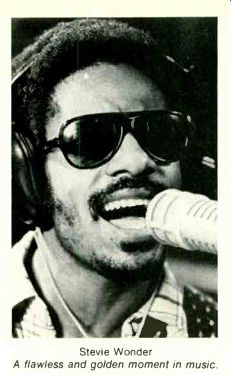
Stevie Wonder A flawless and golden
moment in music.
Although Bob and Ray can work brilliantly on television and stage. they have always been radio-oriented, where their range of voices and characters is unimpeded by mere visual reality. Consequently their material is ideally suited to disc. Given their inexhaustible inventiveness, there can't be enough for me.
What David Steinberg has in common with Bob and Ray is a sharp ear for details of be havior and speech patterns, which are high lighted, twisted, scaled up or down. Steinberg's routines are laced with one-liners, but that isn't what makes them distinctive--it's rather the sustained control of mood and ver bal texture. His material relies heavily on elevating dark shadows from the American sub conscious into comic archetypes. "I feel that the Doublemint Twins by comparison make Tricia Nixon seem mysterious." "At nineteen, Alexander the Great had conquered Gaul [?] and Mesopotamia, was known clear around the world, and didn't even have to do the Mike Douglas show." Steinberg deals easily and unselfconsciously with sex, television, politics, pop culture, being Jewish (but not with the familiar New York sensibility; he's from western Canada), growing up. One routine begins with a straight parody of the endless TV nostalgia-record commercials and proceeds to such embellishments as: "Hi, I'm Feodor Mikhailovich Dostoevsky, remember me?
The Idiot? ..." or, for 1983, "Hi, I'm Richard Nixon, remember me? Remember Agnew? Remember meat? Remember paper?" The record, made at the Cellar Door in Washington, concludes with a version of Steinberg's classic demented-psychiatrist routine, whence the album title. What surprises me is how well this physical and verbal tour de force works without being seen.
Is it possible after all to analyze humor? Pere Benchley himself provided five checkpoints for a joke ("besides wanting to make us sneeze"), including: "The joke must be in a language we can understand." "It must be about something. You can't just say, 'Here's a good joke' and let it go at that. (You can, but don't wait for the laugh.)" "It must begin with the letter W." (This latter, a footnote tells us, is hotly disputed.) So there. K.F.
STEVIE WONDER: Fulfillingness' First Finale. Stevie Wonder, vocals, songs, arrangements, drums, keyboards, harmonica, and synthesizers; vocal accompaniment. Smile Please; It Ain't No Use; Please Don't Go; seven more. [Stevie Wonder, prod.] TAMLA T6 332S1, $6.98. Tape: li.ET 332T, $7.98; T 332C, $7.98.
Stevie Wonder is royalty. Musically he can't do anything wrong at this point. We need only wait to see where he wants to go next. Word has it that he wakes in the morning, reaches for his cassette recorder, and just goes.
Wonder's new album represents an incalculable amount and intensity of work energy. It is the statement of a man totally in touch with his own musical powers and intentions. So total is its concentration that it is also effortless, leading other contributors along easily people such as Minnie Riperton, the Jackson 5 (for whom Wonder just produced an album).
Sneaky Pete, James Jamerson, Michael Sembello, and Reggie McBride.
This is his most romantic album. It is like suddenly finding oneself in an affair with someone who has always been a wonderful platonic friend. Wonder and Elton John are the two hottest personalities in records today.
But while John appeals to our restless energies and high volume hungers, sweet Stevie Wonder appeals to our hearts and spirits.
Nothing on this album is left to chance. It is not that every note of music was worked out beforehand, but that each setting is purely structured and harmonically/rhythmically surefooted. Wonder plays drums for himself, doing things that no "drummer" would do but that always feel perfect.
"Smile Please" has an irresistible vocal chorus (Jim Gilstrap, Denise Williams). "You Haven't Done Nothin' " is the first single re lease from the set and is a timely statement about Nixon, whom you may remember in connection with Watergate. The song makes purely perfect use of the Jackson 5 as back ground singers. "Please Don't Go" has such an energy level that it nearly soars off the turntable.
It is with sweetest pleasure that I say to you that, as far as I'm concerned, this is a flawless and golden moment in music, and its existence makes it possible for me to put up with a lot more jive than I could otherwise. Thank you, Stevie Wonder. M.A.
MARVIN GAYE: Live! Marvin Gaye, vocals; Ed Green, James Jamerson, David T. Walker, Ray Parker, Joe Sample, John Arnold, and Joe Clayton, rhythm; strings, horns, and vocal accompaniment; Gene Page and Lesley Drayton, cond. Trouble Man; Distant Lover; How Sweet It Is; ten more [E. G. Abner, exec. prod.] TAMLA T6 333S1, $6.98. Tape: El T 333T, $7.98; 10119 T 333C, $7.98.
Marvin Gaye is one of the great veterans of American musical wars. He has been around long enough to have been Negro and colored and you name it, and now he is black.
Through it all, the main thing he got was better-and he started out stronger than most of the competition. I recently saw on television a ten-year-old clip of Gaye doing the same thing he does today and being generally ignored for it. Ahead of his time, as the saying goes.
Marvin Gaye is not a shouter, though he surely has the power. He chose a subtler, slower method of expression on the open market. Never has his choice paid off more triumphantly than in this live album, which has already jumped to No. 20 with a bullet in the charts. (He has three albums in the Top 200 simultaneously.) The audience goes wild between and during tracks on this set, but, instead of being irritating to hear at home, it is energizing. We all participate as Gaye and his audience pass joy back and forth. He is at the top of his form:
I've never heard him anywhere else.
The most touching aspect of things is that they nearly didn't happen. Gaye has not per formed much for several years. though he remained active on records. The reason is too simple to stand: He's shy. The man who looks like he could whip the Green Bay Packers in line can't handle the idea that he might fail with an audience. He'd rather retreat than take the chance. But all artists are subject to the whims of their own sense of drive, how ever fragile. Evidently it was time for Gaye to face the arena, panic or not. With that in mind, the adoring audience reaction is doubly human and things couldn't have been warmer.
Gaye includes one blockbuster after an other: " Trouble Man," "Inner City Blues," "How Sweet It Is," "Let's Get It On," and "What's Going On." The musical setting of many of the songs is the same both chordally and rhythmically. But the groove is so infectious and the harmonics so pure that I'd hate to hear anything else.
Musical supervisor Gene Page is a superb conductor/director, and he keeps Gaye fully supported throughout. as does the brilliantly appropriate rhythm section. This may be the most satisfying live album I've ever heard. M.A.
+++++++++++++++
theater and film
THE GOLDEN VOYAGE OF SINBAD. Original film soundtrack recording. Composed by Midis Rozsa. Rome Symphony Orchestra, Miklos Rozsa, cond. UNITED ARTISTS UA-LA 308G, $6.98.
There is much to be happy about here. Miklos Rozsa has not written a completely new film score since The Power ( 1968). The Private Life of Sherlock Holmes (1970) being based largely on the composer's splendid violin concerto.
And no new Rozsa film music has appeared on disc since The VI Ps (1963). even though re leases were apparently scheduled and then dropped for the Sherlock Holmes film. which did contain some new music, and, pardon the expression. The Green Berets (1968).
Listening to this record is like renewing the acquaintance of an old friend. You discover that he is wearing the same styles he has worn for twenty. thirty. even forty years: but this particular friend has kept his clothing in such impeccable shape. has such an interesting wardrobe. and wears it all with such flair that you could not imagine him in any other garb.
It is simply amazing how much Rozsa contin ues to sound like Rozsa.
Few composers. for instance, could write a title theme with quite the exotic romance and sweep that hits you immediately in the prelude, which sounds ever so much like a theme from Rozsa's Sodom and Gomorrah score. The theme itself is good enough: but what really gives it movement and life are the various instrumental over-lappings and filigrees that pervade every Rozsa score. Similarly. he proves masterful in creating diverse moods of suspense. excitement, and grotesquerie. the latter being particularly characteristic of the "Centaur and Gryphon" cut, with its bass tubas.
Granted, much of the film music Rozsa has written over almost the last forty years can be felt, in one form or another, throughout the twenty cuts on this disc, which runs almost fifty-five minutes. I was particularly struck by the Spellbound overtones in the "Dream" and "Koura's Pursuit" sequences (Rozsa even uses an electronic instrument, not identified in the liner notes. which may be an ondes martenot or perhaps a Moog synthesizer: but the effect is very much that of the theremin he has used to good effect in several scores. including Spellbound). Yet for all the parallels, the score rarely actually duplicates previous material, and the listener can basically sit back and delight in the new contours taken on by a familiar style.
+++++++++++++++
Only one or two things distract from this delight. I have heard many amateur groups that play with more accuracy and gusto than the Rome Symphony Orchestra, which on occasion, especially in the prelude, sounds suspiciously like a five-piece band. And no effort seems to have been made to counteract at least partially the orchestra's shortcomings by beefing up the sound. which instead is appallingly tubby at times, again particularly in the prelude. But after the initial shock of the latter, things seem to get better, for one reason or an other (although the stereo channels have been reversed from one side to the other), and for the most part the entire project is one that film music buffs should be most grateful for. R.S.B.
THE Looms OF FLATBUSH. Original film soundtrack recording. Music composed, arranged, and conducted by Joe Brooks. You and Me (Montage); Rock & Roll Music; Oh What a Night for Love; seven more. [Joe Brooks, prod.] ABC ABCD 828, $6.98.
The music on the soundtrack from this latest film lionizing the 1950s-which to me is like lionizing a bad case of athlete's foot-is new music written to sound like old music. There is a lack of feeling inherent in such a process.
Thus this sounds a bit like Lawrence Welk demonstrating rock and roll.
In short, a waste of time. With all the au thentic rock and roll tunes ready for revival, I see no good artistic reason for writing new ones. M.J.
SAVE THE CHILDREN. Film soundtrack. Cannonball Adderley, Jerry Butler, Sammy Davis Jr., Roberta Flack, Marvin Gaye, Jackson Five, Quincy Jones, Gladys Knight and the Pips, Main Ingredient, Curtis Mayfield, Temptations, Bill Withers, and other performers;
Iris Gordy and Mark Davis, coordinating and editing supervision. [E. G. Abner, exec. prod.] MOTOWN M 800R2, $6.98 (two discs). Tape: EM 800T,.$7.98; M 800C, $7.98.
This highly emotional album was inspired by the Rev. Jesse Jackson. leader of Operation Push headquartered in Chicago. He was deeply involved with the work of Dr. Martin Luther King and later with that of the Rev.
Ralph Abernathy. Later Jackson organized Operation Push and emerged as a natural leader of the movement toward black pride and effectiveness. It is impossible to be un moved when hearing him say. "I Am Some body. I may be poor, but I am somebody. I am God's child...
Jackson's power as a human being was. I believe. the mobilizing factor in organizing this project called "Save the Children." It was performed in Chicago in 1973 at the Black Ex position sponsored by Operation Push. The best black talent in the country came to keep the faith, and the emotionalism ran high. all of it focused on a universal urge. As Dick Gregory put it: "All my life America has always taught me to raise the children and save America. and now we talkin' about raising America and saving the children." Even if you ignore all that, you still have a highly entertaining album, and Motown is to be praised for that. Among the most stirring moments are Marvin Gaye singing "Save the Children." Cannonball Adderley's "Country Preacher" (dedicated to Jackson). Bill Withers' "Lean on Me." and the Rev. James Cleaveland's work with the Push Expo Choir.
As a listening experience, the best is at the first. but even then there is enough to hold throughout.
I don't know who gets what royalties from what aspects of this multi-branched project.
but we can hope a lot of it goes to Jesse Jackson and his people in Chicago. If anyone can help to save the babies, it is these people. M.A.
+++++++++++++++
the tape deck
BY R.D. DARRELL
The Advent of Advent-with a catalogue of deluxe musicassettes, that is. The enterprising Cambridge corporation (not to be confused with a smaller, newer record company in Cleveland) long has been esteemed for its audio-equipment products, of which I can speak from first hand knowledge since I was one of the early purchasers of the 101 Dolby-B unit, 200 cassette recorder/player, and more recently the extraordinary 202 cassette player. My consistent satisfaction with these units quite possibly biases my reception of the long-anticipated Advent musicassettes.
Yet no pre-favoring is needed to appreciate the technological advantages of the new CR/70 Process' unique features-chromium-dioxide-base tape and a duplication speed ratio of only four to one-or the benefits of the invariable use of Dolby-B noise reduction, screwed (rather than welded) cassette shells, 100% quality-control sampling, and brief notes with the cassettes themselves and more detailed annotations on request via a supplied postcard. Another attraction speaks persuasively for itself: a sliding price scale that not only lists normal-length and some double-length pro grams at the industry's $6.95 standard, but also proffers some "budget" (but not necessarily short) programs at $5.95 and even $4.95.
High as expectations have been for such a Rolls-Royce cassette series, the actuality lives up to them, and not the least of the processing excellences are in Dolby-B playback-quieter surfaces than any commercial musicassettes have achieved hitherto. Individual releases' musical appeals and recorded-performance qualities naturally vary considerably, but since many programs stem from the widely acclaimed Nonesuch and Connoisseur Society catalogues (augmented by several Advent Corporation "originals") the over-all artistic as well as technical level is impressively high. I hope to report later on many of the twenty-eight items in the first Process CR/70 list, but for the moment just two provide some index to the panoramic at tractions of the series as a whole.
Entertainers--Now and Then. The sure first best-seller is Nonesuch/Advent E 1013, $6.95, which couples polymath Joshua Rifkin's spectacularly successful (on disc) "Scott Joplin Rags, Vol. 1," with the more extraverted pianist William Bolcom's "Heliotrope Bouquet" anthology comprising rags by Lamb, Turpin, Roberts, and himself, as well as by Joplin. If you've already heard any of these, you don't need me to tell you that the Joplin/Rifkin combination is not only rhythmically but lyrically irresistible, that Bolcom stresses more overtly the kinship between ragtime and jazz,
and that both are appropriately re corded: Rifkin with gleaming sonic purity, Bolcom with startlingly realistic power.
Over four centuries separate today's (and yesterday's) ragtime piano players from the vagabond singers/instrumentalists of around 1500. But the Cam bridge Consort's "Songs of a Traveling Apprentice," in German taverns and churches and on the roads to Flanders and Venice, have. a freshness and relish that belie the chronological age of this music by Isaac, Josquin des Prez, Hofhaimer, Agricola, Senfi, and others whose names figure less prominently in, or have been entirely lost from, the history books. Joel Cohen and his six versatile colleagues sing and play, solo and in ensemble, with infectious zest, and they have been well-nigh ideally recorded (Advent Corp. C 1023, 41 minutes, $4.95).
Tapes from Golden Crest. Leaping vertiginously back across the time gulf between Josquin and Joplin, I can now re port on Golden Crest's Schuller/New England Conservatory sequel to their hit "Red Back Book" (1973) for Angel, to which I alluded with keen anticipation in September. The imaginative little Golden Crest company, which knows a good thing when it has it, lost no time in crashing the tape world with "More Scott Joplin Rags" (CRS 5-31031/8 31031, cassette/eight-track cartridge, $7.98 each).
As in producer George Sponhaltz's Angel program, also noted in September, Schuller plays several of the rags featured in the film The Sting, plus seven not included by Sponhaltz: Elite Syncopations, Solace, and the Original, Magnetic, Peacherine, Pine Apple, and Scott Joplin's New Rags. Listeners who first succumbed to the insidious appeal of ragtime at its best via "Red Back Book" (or via Rifkin's piano collections) will need no special recommendation to this latest program, nor will they be deterred by a trace of coarseness in the otherwise effective recording or by some very slight non-Dolby surface noise that in any case is generally covered up by the lively mu sic itself.
And Golden Crest (hitherto best known for its specialized-instrument, band, and school-music discography) goes on to honor the greatest white rag time master, Joe Lamb. As persuasively interpreted by Milton Kaye (best known as a "classical" pianist), such pieces as the toe- and ear-tickling Ragtime Nightingale and Topliner Rag, and the nostalgically haunting Bobolink and Alaskan Rag, prove to be true musical gems (CRS 5-4127/8-4127, cassette/cartridge, $7.98 each).
Dvorakian Delectations. You don't need to share my personal susceptibility to Czech music to be bewitched by the mellifluous charms of Dvorak's Op. 22 Serenade in E, long a disc favorite but hitherto available on tape only in Alfred Scholz's budget Ampex editions. And they can't come close to competing with Colin Davis' enchanting performance (1969) with the London Symphony strings, appetizingly coupled with the inexplicably less-familiar but gloriously invigorating Symphonic Variations, Op. 78, plus-on tape only-an incongruous "filler" waltz for string quintet (Philips 18423 CAA, Dolby-B cassette, $6.95).
Incidentally, I've learned since my comments last month that Philips' down playing of its recently begun Dolbyization policy was only a temporary measure. By the time this appears in print, a new Philips musicassette catalogue should be available that frankly boasts as it justly should-of its Dolby-B items.
Eventually these may include many bigger and more spectacular works than the present unpretentious Dvorak program, but I doubt that any ever can provide more immediately heart-warming musical pleasure.
Better Late ... After a considerable hiatus in Ampex's normally extensive and regular provision of open-reel tapes for review, I'm relieved to welcome a belated batch from which I hastily grab two releases that my ears have been impatiently hanging out for. One is the Ashkenazy Rachmaninoff program I mentioned back in August, which proves to be everything I had anticipated. It has superbly magisterial yet distinctively personal playing and tremendously impressive sonic weight and presence in what are the most idiomatically pianistic (klaviermassig) works since Chopin: the intricate Op. 39 Etudes tableaux and the mighty Op. 42 Corelli Variations (Lon don/Ampex L 480276, Dolby-B, 7 1/2-ips reel, $7.95; also M 10276/M 67276, cassette/cartridge, $6.95 each).
The other is the reel edition of the Bach-transcriptions program included in my "Hyphenated Stokowski" feature re view this month (London/Ampex L 421096, Dolby-B, 7 1/2-ips reel, $7.95; also M 521096/M 821096, cassette/cartridge, $6.95 each). It's no less ambivalently fascinating than the disc edition, yet it not only confirms the disc's interpretive tilt toward Stokowski and away from Bach, but tilts the frequency-spectrum balance even further toward the lows and away from the highs. Indeed the reel sonics are even more-almost incredibly-big and weighty, but they are quite unlike any thing one ever hears in the concert hall.
++++++++++++++++
-------------
(High Fidelity)
Also see:
Speaking of Records. Edward Greenfield: METAMORPHOSIS. In Britain, Andre Previn is a national institution.